

Mastermind Groups for Founders: A Practical Guide

Building in MENA? You don't have to do it alone.
Join 300+ founders in the Founder Connects Residency. Monthly squad calls, warm intros, $3M+ in perks, and much more. All for less than your monthly coffee budget.

You're in Dubai or Abu Dhabi, it's late, and three decisions are waiting for an answer. Should you hire the expensive operator or keep searching? Is the runway strong enough for another month of experimentation? Can a shaky distribution channel be repaired, or is it time to replace it? Your team wants clarity, your investors want momentum, and the people around you either lack context or have a vested interest in the outcome.
That's the founder problem mastermind groups can solve. Not loneliness. Not the need to collect more contacts. A well-run group acts as a compact peer advisory board, giving you a recurring place to pressure-test important decisions with founders who understand the conditions in which you're operating.
The Founder Problem Mastermind Groups Actually Solve
Founders rarely suffer from a total absence of advice. They suffer from too much disconnected advice. An investor sees the financing angle, a recruiter sees the hiring angle, a friend sees the emotional strain, and a consultant sees the problem they were hired to solve. Few people see the whole decision with enough context to challenge it properly.
That's where a mastermind earns its place. The right group gives you a small set of peers who can ask sharper questions because they've also sold, hired, raised, negotiated, failed, and rebuilt. You're not presenting a polished update. You're bringing the decision before it becomes an expensive mistake.
Practical rule: Use the group for decisions with consequences, not for updates that could have been sent by email.
Reduce decision load, not founder isolation
A founder peer group should reduce the amount of mental processing you carry alone. It should help you separate facts from assumptions, identify the missing conversation, and choose the next action.
A useful hot seat follows a simple sequence:
- State the decision. “Should we replace this channel?” is clearer than “Growth feels difficult.”
- Give the operating context. Explain the customers, constraints, cash position, team capability, and timing.
- Name the trade-off. Every serious decision has a cost. Make it visible.
- Invite challenge. Ask for questions before recommendations.
- Commit publicly. Leave with one owner, one action, and a review point.
This structure compresses feedback loops. It also exposes blind spots that are difficult to see while you're inside the company. A recurring meeting matters because peers can revisit the decision later and ask what happened, rather than offering one-off opinions and disappearing.
Make the room useful
A mastermind group becomes another calendar obligation when the agenda is vague, attendance is optional, and members offer advice without understanding the problem. It becomes valuable when the group protects confidentiality, limits discussion to real issues, and expects follow-through.
The strongest circles combine similar-stage founders with enough difference in experience, sector, and network to produce new options. That balance reflects research on MENA entrepreneurs, which found that entrepreneurial networks change as ventures mature and that founders use different relationships at different stages. A group should therefore match the immediate operating reality while still exposing members to distinct knowledge and resources, as discussed in this analysis of mastermind groups and founder trust.
What a Mastermind Group Really Is
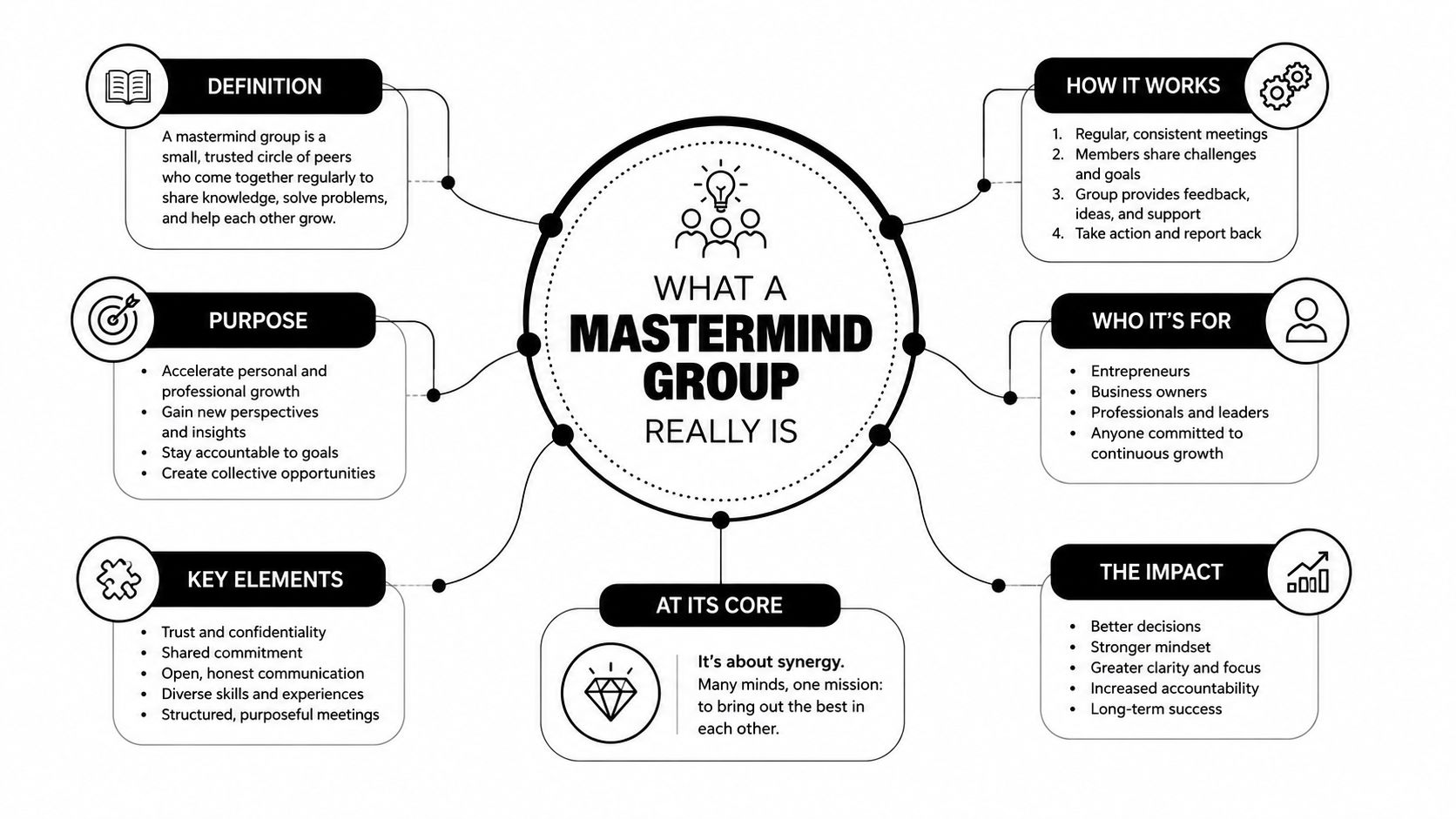
A mastermind group is a small, curated, recurring circle of peers who agree to mutual candour, structured discussion, confidentiality, and accountability around real business decisions. It's closer to a personal board of advisors than to a networking club.
The essential features are straightforward:
- Curated membership: Members are selected for stage, intent, relevance, and the ability to contribute.
- Recurring cadence: The same people meet often enough to understand each other's businesses.
- Rotating hot seats: Each founder brings a defined challenge instead of waiting for general discussion.
- Mutual contribution: Everyone gives insight, introductions, challenge, or practical help.
- Explicit commitments: Members report back on what they said they'd do.
The format is not coaching or community chat
One-to-one coaching is usually hierarchical and paid. You receive one person's perspective, often from someone working from a defined method. That can be useful when you need expertise, skill development, or a neutral facilitator.
A generic online community offers reach and access, but usually lacks context and consequence. Messages move quickly, conversations fragment, and members can consume advice without ever reporting what they did with it. A mastermind group trades breadth for signal density.
Accelerators, investor networks, and founder communities still have a role. A mastermind complements them by giving you a consistent room where people know the details behind your numbers, decisions, and constraints.
Design beats branding
The word “mastermind” has become popular, but the label proves nothing. A group with an impressive name can still produce shallow conversations. A modest private circle can become a serious decision forum if the members are carefully chosen and the meetings are disciplined.
Use practical exercises before the group starts, especially if members need to establish equal participation and listening norms. United We Transform's run these Air Time exercises offers a useful resource for creating balanced discussion rather than allowing the most senior or vocal founder to dominate.
In Dubai, Riyadh, and Cairo, founders can use this format to pressure-test a pivot, co-diligence a senior hire, prepare for investor conversations, or compare market-entry decisions. The value doesn't come from calling the meeting a mastermind. It comes from putting the right people in the same room repeatedly, with enough structure to turn conversation into action.
Why UAE and MENA Founders Benefit Most
A UAE founder can lose weeks on a hiring decision, investor conversation, or market-entry choice before anyone with relevant context challenges the assumption. The startup ecosystem is competitive, relationship-driven, and tightly connected. Dubai ranks second in MENA, with a reported ecosystem value of $30 billion and $1.14 billion in Series A funding across H2 2023 to 2025, according to Startup Genome's MENA ecosystem analysis. Abu Dhabi ranks fourth in MENA, with an ecosystem value of $73 billion and an AI-native ecosystem value of $5.4 billion, reported as 351% above the H2 2021 to 2023 baseline in the same source.
That density creates access and raises the cost of poor judgement. Founders compete for talent, capital, enterprise attention, and strategic partners in a market where the relevant people often overlap. A trusted introduction can start a serious conversation faster than untargeted outreach. A peer who understands local business practices can also identify a weak hiring plan, unrealistic fundraising narrative, or poorly timed expansion decision before it becomes expensive to reverse.
Regional funding activity adds pressure. The UAE led MENA startup funding in 2024, with $1.1 billion raised across 207 startups. UAE-based startups raised $1.2 billion across 83 deals in H1 2026, representing about 70% of regional capital invested during that period. The figures, reported in Startup Genome's MENA ecosystem analysis, point to a demanding environment. Access matters, but founders gain an advantage only when access produces sharper decisions.
The founder's hidden cost
A curated group does not remove risk. It exposes risk earlier through repeated, structured review. That matters when a founder operates across several markets, legal environments, customer segments, and relationship networks.
| Ecosystem condition in UAE/MENA | What it costs the solo founder | How a mastermind group offsets it |
|---|---|---|
| Capital and key relationships cluster in major hubs | Cold outreach consumes time and produces weak context | Members share relevant introductions with background and credibility |
| Competition is concentrated in visible startup centres | Founders can mistake market noise for traction | Peers challenge vanity signals and ask for operating evidence |
| Entrepreneurial networks serve different functions | One contact rarely solves a complex problem | The group separates advice, professional, market, workplace, and international relationships |
| Many SMEs historically lacked formal digital reach | Public discovery cannot replace trusted referrals | Recurring peer exchange creates a dependable feedback and referral channel |
Historical regional research found that only 18% of UAE SMEs had an online presence, while 75% did not plan to have a website and 15% had a social networking page, according to Arabian Business' report on the survey. Wider MENA research also described limited digital presence and a small role for online retail in the cited comparison. The implication is practical: trusted human networks have carried significant weight, particularly for businesses without strong digital distribution.
A mastermind group should function as a compact peer advisory board, not a social calendar. Members should bring a live decision, provide the relevant facts, receive direct challenge, and report back on the result.
Founder-ecosystem reporting from the UAE associates structured peer sessions, regular check-ins, and moderated introductions with 261 active founders, 98 collaborations, AED 189 million raised, and AED 3.89 million saved in costs, as described by Founder Connects' peer-group report. The recommendation is straightforward: judge the circle by useful action, follow-through, and relevant introductions, not attendance or the number of contacts collected.
Mastermind Groups vs Other Peer Formats
Founders often choose the wrong format because they're solving the wrong problem. If you need capital, an accelerator may be appropriate. If you need a desk and informal proximity, a co-working space may work. If you need broad exposure in one evening, attend a networking event. None of those automatically gives you a trusted room for recurring decision review.
A mastermind group is strongest when the problem is judgement. You need people who remember what you said last month, know what changed, and will challenge the story you're telling yourself today.
| Format | Structure | Accountability | Signal density | Time commitment | Best for |
|---|---|---|---|---|---|
| Mastermind group | Small, recurring, agenda-led peer circle | High, through commitments and follow-up | High, because members build context | Regular and deliberate | Decision support, prioritisation, and execution |
| Accelerator | Cohort-based programme with defined milestones | Programme-led | Variable, depending on cohort fit | Intensive and time-bound | Fundraising preparation, validation, and structured growth |
| Co-working community | Shared physical or virtual environment | Low to moderate | Variable, often relationship-led | Flexible | Proximity, informal exchange, and workspace |
| One-to-many networking event | Event-based, broad participation | Low | Low to moderate | Short, concentrated | Discovery, visibility, and initial introductions |
DIFC and Hub71 can be useful when a founder needs ecosystem access, programme support, or investor exposure. WeWork and AstroLabs can help create proximity to other operators and service providers. Step Conference and Founders Majlis can create valuable first conversations. But a single meeting rarely gives a peer enough context to challenge a decision properly.
The formats also work together. Meet a potential partner at Step Conference, then bring the opportunity to your mastermind for scrutiny. Use an accelerator to sharpen the fundraising narrative, then ask peers to test whether the operating plan matches the pitch. Take a closer look at mentorship versus coaching for founders when you're deciding whether you need advice, skill development, or a peer room.
Decision rule: Choose the format that matches the bottleneck. Pick a mastermind for repeated judgement and follow-through, an accelerator for a defined programme, co-working for proximity, and events for breadth.
How to Join or Run a High-Signal Group
A founder in Dubai may leave a networking event with ten new contacts and still have no clear answer on hiring, pricing, or fundraising. A high-signal mastermind gives that decision a smaller room, relevant context, and a deadline for action. Treat it as a compact peer advisory board, not another networking channel.
You have two practical options. Join a curated group when you want an established structure and faster access to suitable peers. Build your own when you already know founders with complementary experience and can enforce the standards yourself.
Vet an existing group before you commit
Ask the organiser for operating details, not promises. A serious group should explain:
- Who belongs: Look for founders at a similar operating stage, with enough variation to bring useful perspective.
- How members are selected: Open sign-ups often create mismatched expectations and conflicts of interest.
- How many people attend: A working range is 5 to 8 founders, allowing depth without losing perspective.
- What confidentiality means: Ask how sensitive information stays in the room and what happens after a breach.
- How meetings run: Look for hot seats, advance preparation, time limits, and written actions.
- Who enforces commitments: Someone must address repeated lateness, silence, and missed actions.
- What happens when the fit fails: Strong groups review membership instead of preserving every seat indefinitely.
Founder Connects uses curated peer groups, moderated sessions, relevant introductions, practical tools, and accountability. Use that structure as a benchmark whether you join an organised community or create a private circle. For the digital layer, review this guide to running effective virtual mastermind groups. Mava's guide to build an online community 2026 is also useful for planning member experience and engagement mechanics.
Build your own operating system
Choose a defined theme, such as UAE B2B growth, pre-seed fundraising, or cross-border expansion. Recruit 5 to 8 non-competing founders who can contribute relevant experience and respect confidentiality.
Write the operating rules before the first meeting:
- Meet at the same time on a recurring schedule.
- Rotate the facilitator.
- Give each session a defined hot seat rotation.
- Limit each hot seat to one issue.
- Ask questions before advice.
- Require context before any recommendation.
- Record commitments and review them at the next meeting.
- Review membership periodically and remove anyone who repeatedly weakens the standard.
Use a simple agenda: brief check-in, hot seats, commitments, and a final review of introductions or follow-up. Written updates belong in the pre-read. Meeting time belongs to decisions, especially when founders are balancing customers, investors, and teams across Dubai, Abu Dhabi, and wider MENA.
No-advice-without-context: If a member cannot explain the decision, constraints, and desired outcome, the room should ask questions rather than guess.
Reject groups with vague membership standards, no confidentiality agreement, irregular attendance, an organiser who dominates discussion, or promises of access without a clear process for useful introductions. If the group cannot show how discussion becomes action, do not join it.
Best Practices and Common Pitfalls
Most founder groups don't fail because the members lack ambition. They fail because the structure disappears. A WhatsApp group starts with energy, meetings move around calendars, and the discussion becomes a comfortable exchange of broad opinions.
The patterns that drain signal
Drift starts when every member gives a status update. Fix it by requiring each founder to submit one decision or obstacle before the meeting and reserving live time for the issue that needs judgement.
Groupthink appears when members protect relationships instead of challenging assumptions. Rotate the person who argues the opposing case, and ask at least one member to identify what could make the proposed plan fail.
Ghosting becomes normal when absence has no consequence. Set an attendance expectation, record missed commitments, and speak directly with anyone who repeatedly disappears. Founders running ventures between Dubai and Abu Dhabi need clear time boundaries, not informal permission to deprioritise the group.
Dominance lets one experienced founder turn every hot seat into a lecture. Use timed contributions, ask quieter members first, and let the facilitator interrupt respectfully when one voice takes over.
Shallow advice sounds like “hire better people” or “focus on sales”. Require context before recommendations. The member asking for help should explain the customer, stage, constraint, decision deadline, and what they've already tried.
Make discomfort productive
A durable mastermind group should feel safe enough for honesty and demanding enough to produce movement. Members don't need constant encouragement. They need clear questions, direct challenge, and the expectation that they'll return with evidence of what happened.
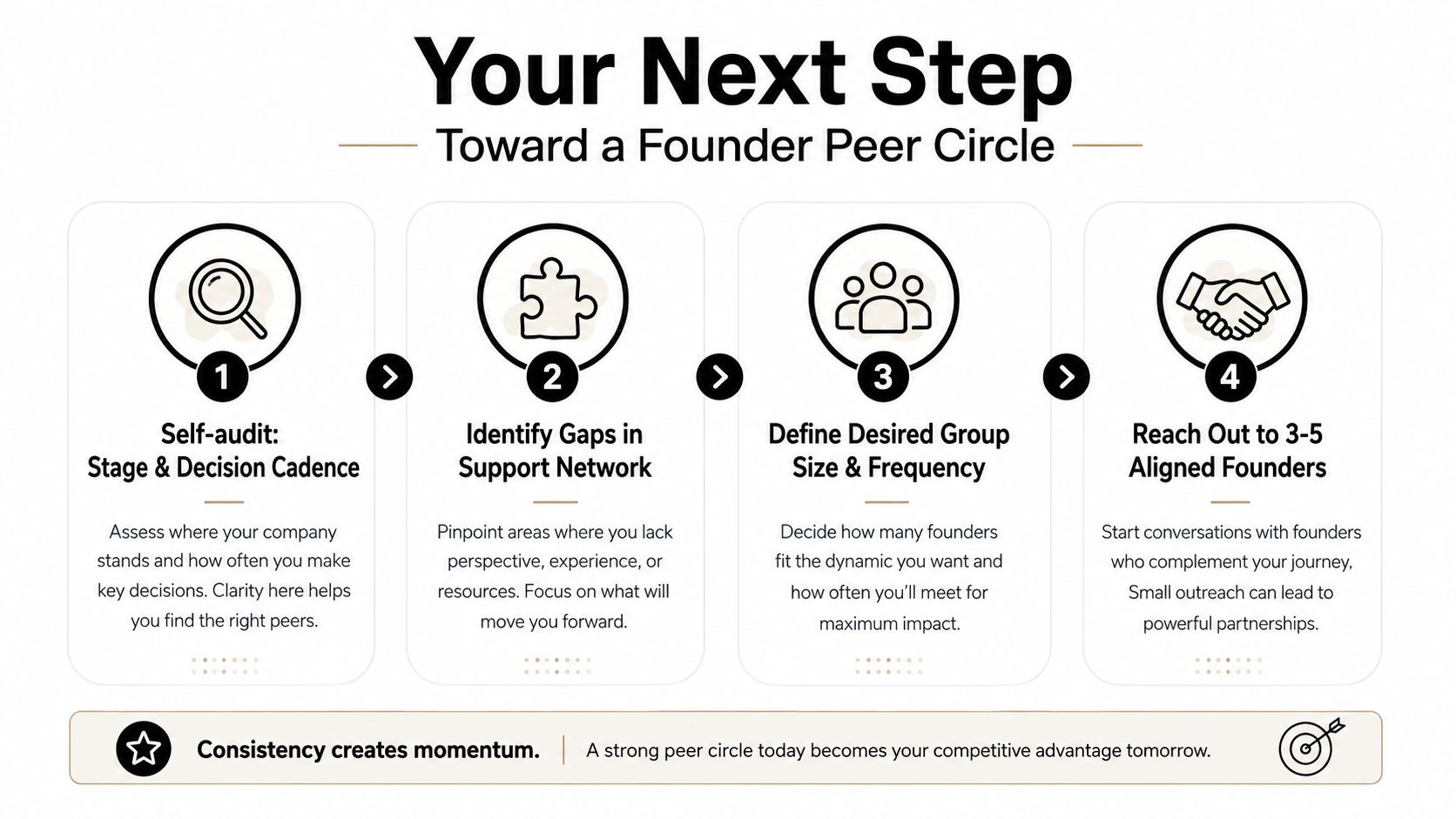
Keep these principles fixed:
- Confidentiality is explicit: Sensitive customer, team, and fundraising information stays inside the group.
- The agenda is enforced: Discussion serves decisions, not general conversation.
- The hot seat rotates: Every member contributes and receives challenge.
- Commitments are visible: The group reviews actions at the next meeting.
- Questions precede advice: Context comes before conclusions.
- Membership is earned continuously: Repeated low contribution is a fit problem, not a personality quirk.
Research on MENA entrepreneurial networks identifies private advice, workplace, professional, market, and international networks as distinct relationship types. Use that insight to ask what kind of relationship a founder needs before offering an introduction. A local customer connection, a hiring referral, and an international market bridge solve different problems.
Your Next Step Toward a Founder Peer Circle
Don't start by searching for the most impressive event on the calendar. Start with a self-audit.
Write down:
- Your stage: Are you validating an idea, finding repeatable distribution, fundraising, hiring, or scaling?
- Your decision cadence: Which decisions keep returning without a clear owner or answer?
- Your support gaps: Do you lack market insight, hiring judgement, investor preparation, international access, or accountability?
- Your preferred route: Do you want an existing facilitated group, or can you recruit and manage your own?
- Your contribution: What experience, access, or operating knowledge will you bring to peers?
A founder in Dubai may need a circle that understands enterprise sales and procurement. A founder in Abu Dhabi may want peers who can challenge fundraising timing or help handle an AI-heavy operating environment. Someone expanding from Riyadh into the UAE may need local trust plus international relationships. A founder in Cairo may value a group that offers regional market context instead of advice limited to one city.
The MENA network evidence supports designing for both local and cross-border access. In a Viaka MENA community study, nearly 94% of respondents considered connecting with resources outside their region critical or very important to success, as reported in Viaka's community research. That makes the right group more than a local sounding board. It should help you identify which relationship you need and who can credibly open the door.
Choose one path this week
Join an existing group if you want moderated sessions, curated membership, and accountability without building the operating system yourself. Ask for the member profile, meeting format, confidentiality rules, and examples of how introductions or commitments are handled.
Build a private circle if you already know aligned, non-competing founders. Invite three to five people to an initial conversation, agree on the decision-support purpose, and schedule the first recurring meeting before enthusiasm fades.
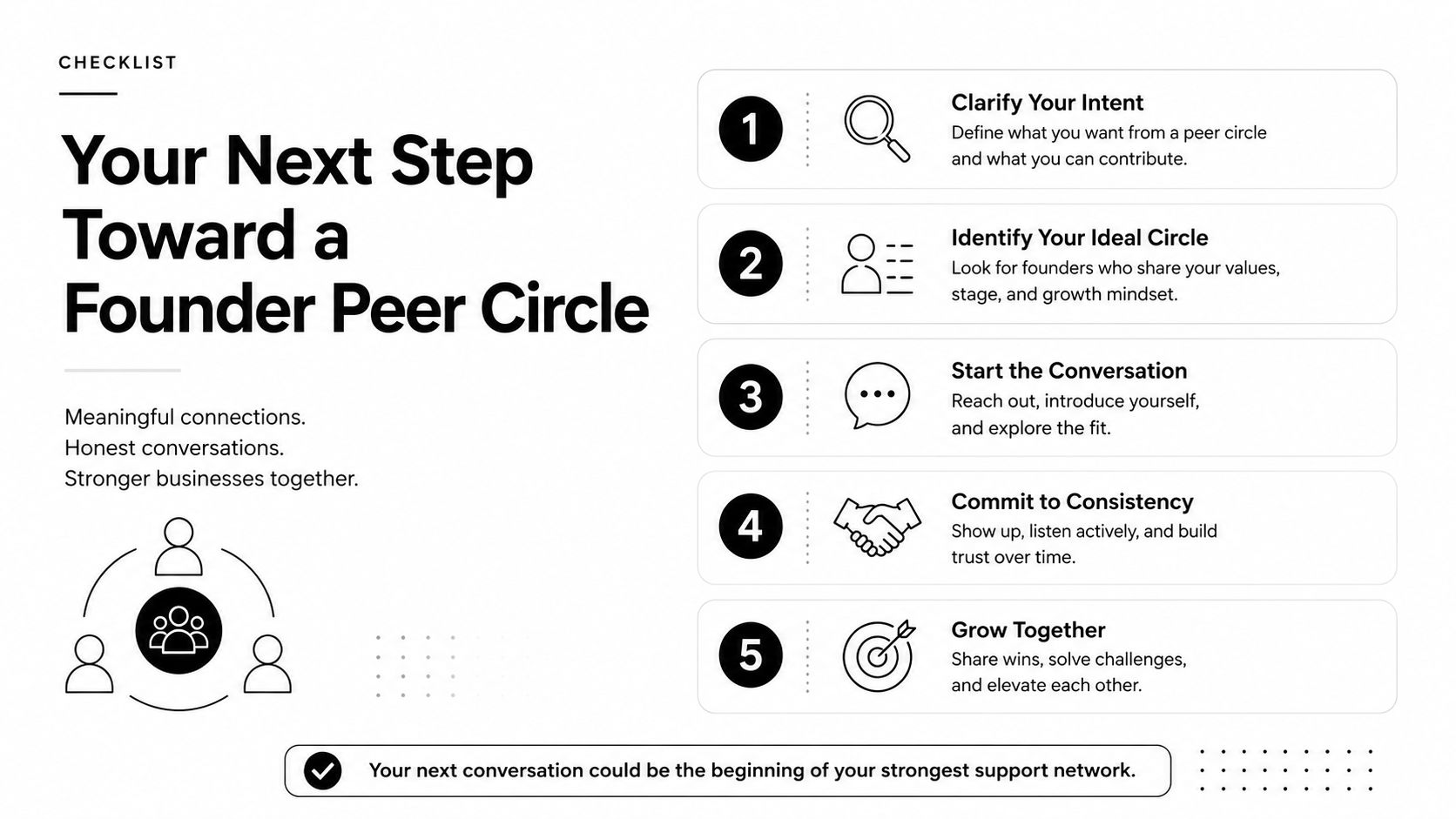
Large events can create access, but small intentionally composed circles create context. Take one concrete step this week. Send the invitation, apply to a curated group, or bring your hardest current decision to three founders who will challenge it properly.
Founder Connects offers curated founder peer groups, moderated sessions, accountability, practical tools, and relevant introductions across the UAE and wider MENA ecosystem. If you want a compact decision-support circle rather than another generic networking room, visit Founder Connects and explore the next step.

Building in MENA? You don't have to do it alone.
Join 300+ founders in the Founder Connects Residency. Monthly squad calls, warm intros, $3M+ in perks, and much more. All for less than your monthly coffee budget.
Popular posts





Founder Connects is a premium MENA tech founder community. Meetups in Dubai and across MENA, Residency Squads of 8–10, and 400+ vetted WhatsApp founders (apply and screened).