

Queens International School Dubai: Ultimate Parent Guide

Building in MENA? You don't have to do it alone.
Join 300+ founders in the Founder Connects Residency. Monthly squad calls, warm intros, $3M+ in perks, and much more. All for less than your monthly coffee budget.

School search gets messy fast when you're running a company at the same time. You've got limited time, conflicting opinions, polished admissions language, and a decision that affects your child every day, not just your calendar.
That's why I'd treat Queens International School Dubai the same way I'd assess any meaningful operating decision. Start with the signals of substance, ignore the brochure language, and pressure-test the school against your family's real constraints: commute, curriculum pathway, fee tolerance, and the school's ability to deliver consistently rather than occasionally.
The Founder's Dilemma A Fast and Smart School Search
A founder usually knows how to make hard calls under uncertainty. You compare options, look for durable signals, and decide before perfect information arrives. School selection in Dubai works the same way, except the stakes feel more personal and the noise level is higher.
Most parents lose time in three places. They over-index on campus aesthetics, they confuse a friendly tour with strong execution, and they treat all British schools as interchangeable. They aren't.
With a school like Queens International School Dubai, the useful question isn't “is it good or bad?” That's too vague to help. The better question is: for this fee band, location, and curriculum model, is it the right operational fit for your child and your household?
A founder-style screen that saves time
When I advise busy parents, I use a simple screen before any visit:
- Location practicality: Can your family realistically sustain the daily run without turning mornings into chaos?
- Curriculum continuity: Does the school offer a pathway that matches your longer-term academic plan?
- Inspection pattern: Is the school improving, flat, or inconsistent?
- Value logic: Are you paying for actual educational fit, or just paying less and hoping for the best?
That framework filters out a lot of wasted effort.
Practical rule: Don't shortlist a school because it feels convenient on one tour. Shortlist it because the trade-offs make sense for the next few years.
Founders are already used to building trusted circles to make faster decisions. The same instinct helps here, whether that's speaking to current parents or using a curated peer network like this guide to building a strong startup network in Dubai to find people who've already experienced the same school-market questions.
Signal matters more than marketing
For Queens International School Dubai, the core signals are clear enough to justify a closer look. It's established, it sits in a known part of old Dubai, and it operates in the affordable British-school segment where trade-offs are unavoidable.
That means the decision isn't abstract. You're assessing whether a long-running school with a budget-conscious positioning can still give your child enough academic continuity, classroom stability, and day-to-day structure to make the fee worthwhile.
Queens International School Dubai At a Glance
A school can look fine on paper and still create friction every weekday. For a parent running a company, the first screen is simpler than that. Is the school established, is the curriculum stable, and does the location fit the life you already have?

The top-line facts that qualify the school
Queens International School Dubai is a British curriculum school in Hor Al Anz, and it was founded in 1998, according to WhichSchoolAdvisor's school review. Those facts matter because they answer two early screening questions fast. You are looking at an older Dubai operator with a familiar curriculum model, not a newly launched campus still setting expectations year by year.
That changes how to assess it.
An established school usually gives you more evidence to work with. You can ask sharper questions about how children progress from the early years into later stages, whether routines feel settled, and whether the school's current delivery matches its long operating history. With QIS, the key signal at this stage is continuity. It has been in the market long enough for parents to judge it on execution, not prospectus language.
The Hor Al Anz location also matters more than many glossy school profiles admit. For families living or working around Deira, Al Qusais, Mamzar, or nearby older Dubai districts, that can make the school operationally practical. For families based deep in newer suburban areas, the lower fee point can be offset by commute fatigue, transport complexity, and less flexible mornings.
What a founder-parent should read from this
QIS fits a specific use case. It is more relevant for families who want a British curriculum path without stepping into premium-fee territory, and who already have their daily routine anchored on this side of Dubai.
That does not make it the right choice by default. It means the trade-off is easier to define.
Use these filters before you spend time on a tour:
| Decision filter | Why it matters at QIS |
|---|---|
| Commute fit | Hor Al Anz works best when home, work, or caregiver logistics already line up with old Dubai |
| Curriculum continuity | A British curriculum route can reduce the chance of another academic reset in a few years |
| Budget discipline | Judge the school against the affordable British segment, not against premium campuses with very different cost structures |
| Operating history | A school founded in 1998 gives you a long record to test through parent feedback, inspection history, and classroom observations |
A long-running school still needs current proof. Longevity helps only if daily execution is steady.
That is the practical reason QIS stays on the shortlist for some families. It offers a known curriculum, a known part of the city, and a fee position that puts value-for-money at the center of the decision.
Decoding the Data KHDA Ratings and Performance Trends
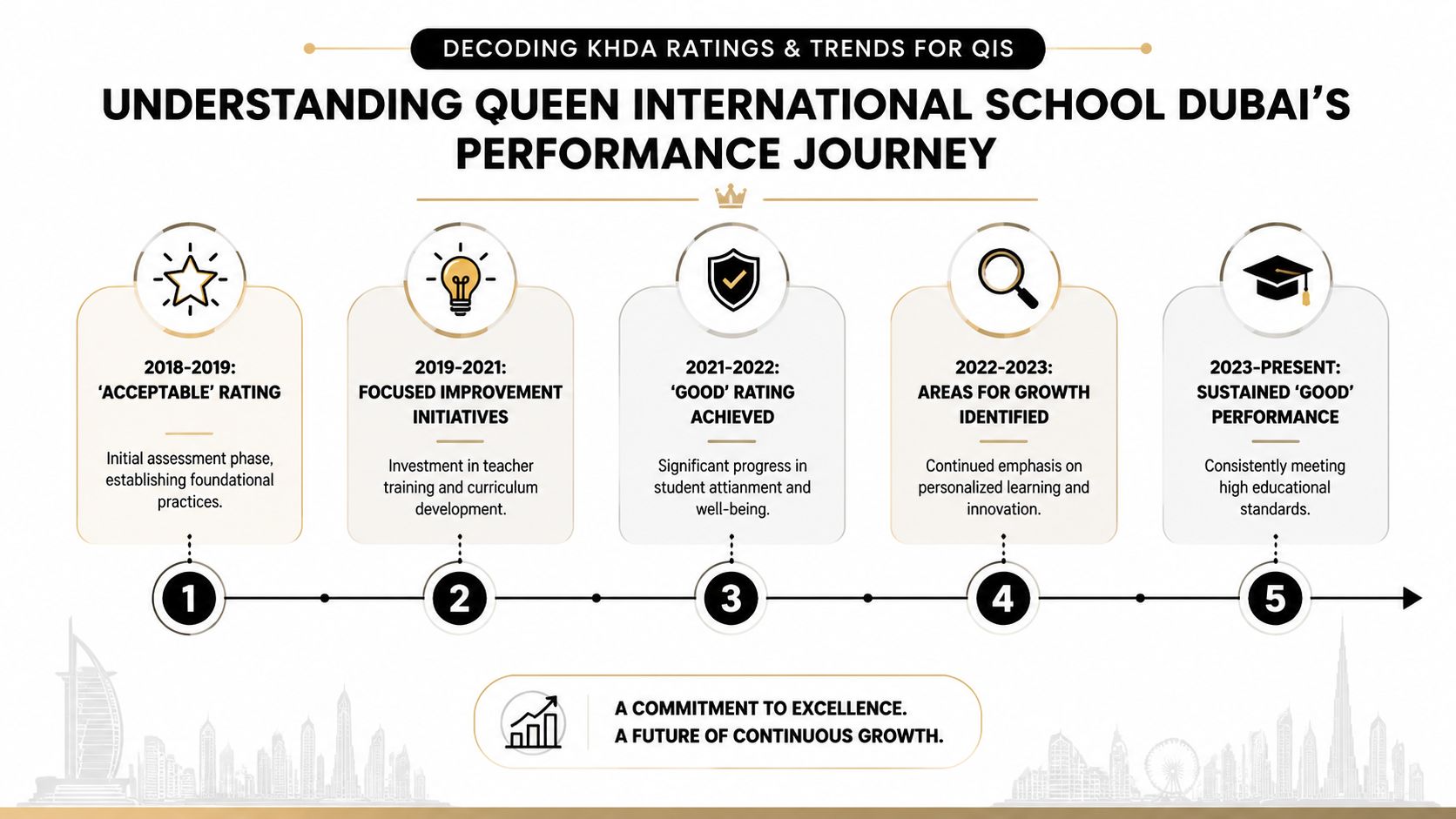
Most parents in Dubai stop at the one-word KHDA label. That's a mistake. A single rating only tells you where a school sits now. The more useful insight comes from the pattern over time.
What the inspection history actually signals
Independent UAE school review data reports that Queens International School Dubai had a KHDA rating of Acceptable in 2023–2024, with a brief period of Good ratings in 2016–17 and 2017–18 before reverting. The same dataset reports 689 students, 50 teachers, 5 teaching assistants, and 56 Emirati students, as listed on EdCare's school profile.
For me, that history says one thing first: there was improvement, but it wasn't sustained.
That doesn't automatically make the school a poor option. In the lower-cost British segment, some families will accept an Acceptable rating if the school is orderly, affordable, convenient, and suitable for their child's temperament. But it does tell you not to rely on legacy reputation or one strong period in the past.
How to read this like an operator
If a business briefly improves and then slips back, I ask three questions. The same logic applies to schools.
- Was the earlier improvement structural or temporary? A short-lived uplift can come from focused leadership, temporary staffing strength, or inspection-year urgency.
- Has the school built repeatable systems? Parents should look for evidence that classroom quality is consistent, not dependent on a handful of standout teachers.
- Is leadership honest about current priorities? Schools that explain their weak points clearly tend to be easier to assess than schools that hide behind generic language.
What to listen for on a tour: If admissions staff can explain where the school is strong and where it is still improving, that's more useful than polished claims about being “well-rounded”.
The staffing and scale context
A school with 689 students and 50 teachers is large enough to feel like a functioning institution rather than a tiny niche operator. It also suggests you should ask about consistency between year groups, because scale creates variation if systems are weak.
The reported 5 teaching assistants also matters. In practice, parents of younger children or children who need more support should ask direct questions about in-class help, literacy support, behaviour management, and how the school handles students who need extra attention.
What founders should conclude
I wouldn't interpret the current rating in isolation. I'd interpret it as a prompt for sharper questions.
If Queens International School Dubai is on your shortlist, ask the school to show how it is improving today, not how it improved years ago. Ask what has changed in teaching quality, leadership routines, and student support. If the answers stay vague, that's a warning. If the answers are concrete and observable in classrooms, the school may still represent a sensible fit for the right family.
Analyzing the Investment Tuition Fees and Value for Money
School fees aren't just a line item. They're a long-term operating commitment for the family. That's why I'd look at Queens International School Dubai through a value-for-money lens, not just a sticker-price lens.
Where the school sits in the market
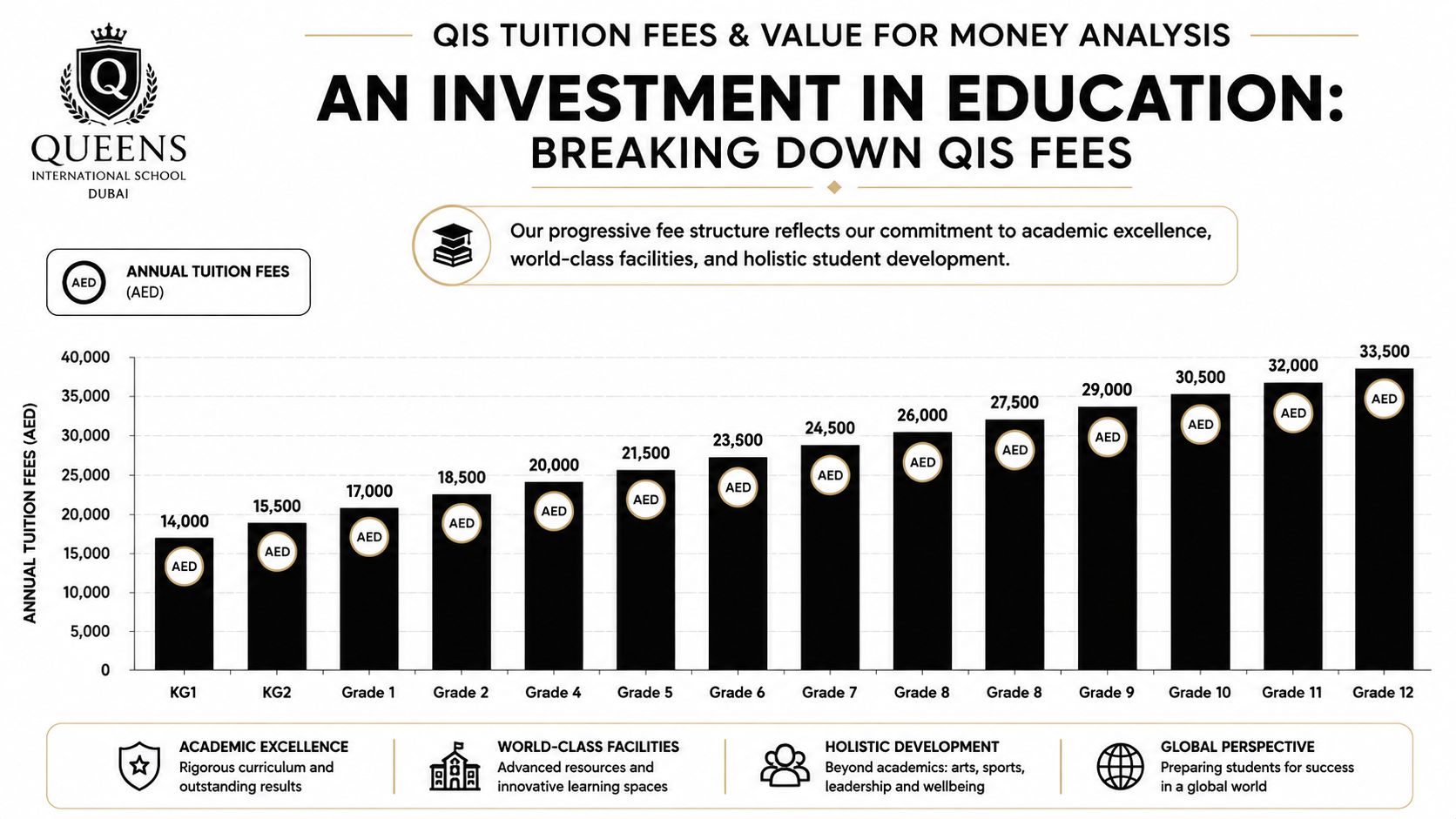
Public listings place annual fees in the AED 14,381 to AED 26,969 range, while KHDA records list FS 1 tuition at AED 17,175, according to Yalla Schools' school page. That places the school in Dubai's regulated low-cost British school segment.
Parents often ask the wrong question, specifically inquiring, “Is it cheap?” The more pertinent question, however, is, “What trade-offs come with this fee band?”
In this part of the market, schools often compete on affordability and accessibility. That can be a strength. It can also mean you need to inspect the details more carefully, especially classroom culture, support resources, and how well the school maintains standards across year groups.
Think in total cost of ownership
Fee value isn't just tuition. It's the full burden on your family.
Use this lens when you evaluate the school:
- Academic supplementation: If you expect to pay for extra tutoring because the classroom pace or support isn't enough, the low headline fee may be less attractive.
- Time cost: A school that saves money but creates constant parent follow-up, homework supervision stress, or commute friction can become expensive in practical terms.
- Stability cost: If you suspect you'll move your child after a short period, the “affordable” choice may delay a more suitable decision.
For families exploring alternatives in a similar market conversation, this breakdown of Kent College Dubai fees is a useful way to think about price positioning versus actual delivery.
What good value actually looks like
A school in this segment can still be good value if several things are true at once:
| Value test | What you want to see |
|---|---|
| Daily experience | Calm classrooms, clear routines, responsive staff |
| Academic pathway | No confusion about progression through the British curriculum |
| Parent communication | Timely, specific, and not purely promotional |
| Support level | Adequate help for children who need structure or extra attention |
Low fees are only a win if the school still gives your child a stable learning environment. If the family has to patch the gaps externally, the maths changes.
My practical read on QIS
Queens International School Dubai can appeal to budget-aware families who want a British curriculum without entering a higher-fee bracket. That's the clear commercial logic.
But this is not a school to choose blindly on affordability alone. You need to verify whether the value comes from efficient delivery or from compromises your child will feel in class. That distinction is where the key decision sits.
The Campus and Features Facilities and Extracurriculars
Campus quality matters, but not in the way many brochures suggest. For most families, the useful question isn't whether a school looks premium. It's whether the facilities are fit for purpose and support the actual learning experience.
Queens International School Dubai's local presence is tied to a project in Hor Al Anz East with Emirates Engineering Consultants listed as consultant, according to the BeCa Arabia project page. For parents, that isn't a selling point by itself. What it does indicate is that the school sits within the normal Dubai pattern of regulated site development and operational compliance.
What to inspect instead of admiring the campus
When you visit, don't spend most of your time on the reception area. Spend it on the parts your child will use.
Look closely at:
- Classrooms: Are they organised, calm, and visibly used for real teaching rather than staged for tours?
- Library and reading spaces: Do they feel active and age-appropriate?
- Science and specialist rooms: Are they functional and maintained well enough to support the curriculum?
- Sports areas: Ask how frequently students use them, not just whether they exist.
A modest campus can work perfectly well if the school uses it effectively. A polished campus can still disappoint if the routines inside it are weak.
Extracurriculars are a lifestyle question
For founder families, extracurricular provision often comes down to logistics. If the school's after-school options are thin or poorly organised, parents end up outsourcing sports, arts, or enrichment elsewhere. That creates another set of pickups, schedules, and costs.
Ask practical questions, not broad ones:
- Which activities run consistently across the term?
- Which age groups get access?
- Are clubs included, limited, or rotating?
- What happens if your child isn't naturally sporty or highly extroverted?
Don't ask whether the school offers extracurriculars. Ask whether your child would realistically participate in them every week.
A useful campus checklist for the tour
Take notes on these before you leave the site:
- Noise level in corridors and classrooms
- Condition of learning spaces
- Student supervision during transitions
- Whether displays reflect current student work
- Whether staff seem rushed, present, or disengaged
Those observations usually tell you more than any facilities list.
Market Analysis How QIS Compares to Other Dubai Schools
A school doesn't exist in isolation. It competes for your family's time, money, and trust against other schools that may solve the same problem differently.
For Queens International School Dubai, the strongest comparison isn't against premium British schools. It's against other affordable British-curriculum options where parents are balancing fees, inspection record, and practical convenience.
The comparison method that matters
When I compare schools in this band, I look at four things only:
- Location fit
- Current KHDA standing
- Fee position
- What the school seems to optimise for
That last point matters. Some schools optimise for affordability, some for academic reputation, some for convenience, and some for parent experience. Confusion starts when parents assume one school can maximise all four.
QIS vs competitor schools
| School | Location | KHDA Rating (2024) | Annual Fee Range (AED) | Key Feature |
|---|---|---|---|---|
| Queens International School Dubai | Hor Al Anz, Deira side | Acceptable | Affordable to lower mid-market British segment | Long-established British curriculum option with a value-focused positioning |
| Competitor A | Nearby older Dubai catchment | Varies by school | Similar budget band | Often chosen for commute practicality over campus polish |
| Competitor B | Alternative affordable British location | Varies by school | Similar or slightly higher | May appeal to parents prioritising inspection momentum |
| Competitor C | Wider Dubai British-school market | Varies by school | Broadly comparable segment | Sometimes offers stronger facilities but with different trade-offs on access or fit |
That table is intentionally conservative because school-specific competitor data changes fast, and parents should verify each shortlist directly rather than rely on stale roundup content.
Where QIS may have an edge
Queens International School Dubai is likely to appeal most when your priorities look like this:
- You want an established school, not a start-up campus
- You prefer older Dubai geography
- You need a British curriculum at a more accessible fee level
- You're willing to do deeper due diligence on classroom quality
If, on the other hand, your top requirement is a stronger inspection trajectory or a more aspirational campus proposition, you may decide the school sits too close to the “acceptable but not compelling” line.
Parents comparing options in the broader British-school space may also find this review of Kent School Dubai useful as a contrast in how to think about school positioning, parent expectations, and fit.
The right market conclusion
The market case for QIS isn't that it beats every competitor. It's that it may fit a specific type of family well: one that values affordability, continuity, and location, but is disciplined enough to verify quality firsthand instead of assuming all long-running schools perform equally.
Your Decision Framework How to Visit and Apply
A school visit in Dubai usually gives you 30 to 45 minutes, a polished route through the campus, and a lot of broad promises. The job is to leave with decision-useful signals, not a good feeling. With Queens International School Dubai, the practical question is simple: does the school justify its fee level for your child's needs, commute, and likely multi-year path through the British curriculum?
QIS has history in the market, which matters because it gives parents something newer schools cannot offer. You can test whether today's leadership, teaching quality, and parent experience feel stable, or whether the school is coasting on familiarity. For a mid-market school, that distinction matters more than polished marketing.
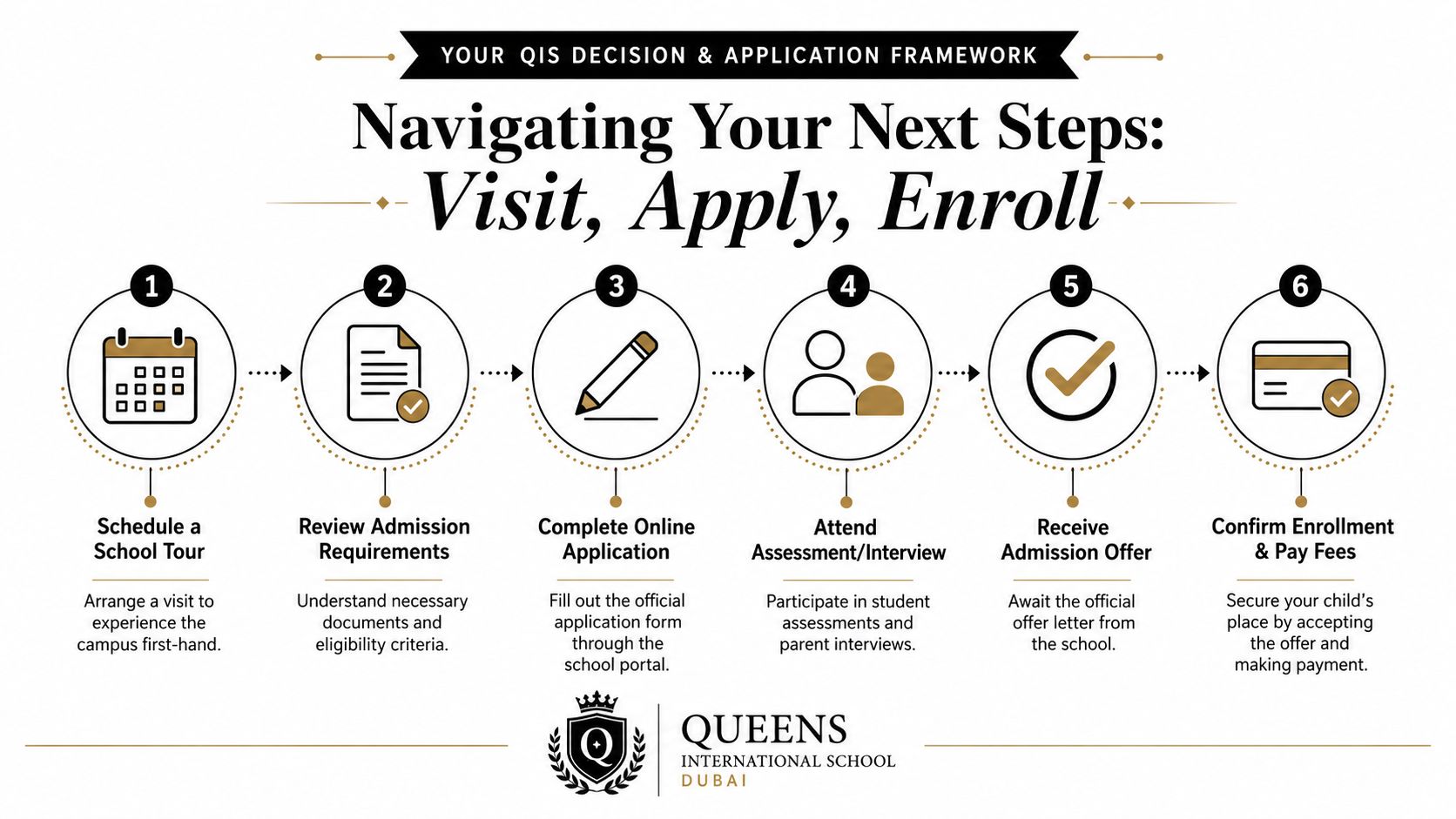
The visit questions worth asking
Go in with a short checklist and write the answers down during or right after the tour. Memory gets unreliable once you have seen three schools in a week.
- Classroom consistency: Ask how leadership checks that teaching quality is consistent across year groups and subjects, not concentrated in a few strong teachers.
- Improvement actions: Ask what the school has changed in the last year in teaching, student support, behaviour systems, or parent communication.
- Your child's fit: Give a direct profile of your child. Academic level, confidence, learning style, any support needs. Then ask how the school would handle that profile in practice.
- Curriculum continuity: Ask how the school manages transitions between key stages so students do not lose momentum as content gets harder.
- Parent response times: Ask who owns parent concerns, how escalation works, and what happens if an issue is not solved at class-teacher level.
One practical test helps a lot. Ask for examples, not statements. “We monitor progress closely” means very little. “Heads of department review books fortnightly and we intervene after two weak assessments” is a real answer.
A simple decision scorecard
I'd score the visit using red, amber, and green. It keeps the process disciplined and stops one friendly tour guide from distorting the decision.
| Area | Your score |
|---|---|
| Commute and daily practicality | Red / Amber / Green |
| Classroom atmosphere | Red / Amber / Green |
| Leadership clarity | Red / Amber / Green |
| Value for money | Red / Amber / Green |
| Fit for your child | Red / Amber / Green |
Two reds usually mean stop.
A sheet full of amber scores is not a rejection. It means you are looking at a school that may work, but only relative to the alternatives in your shortlist. In that case, compare QIS directly against one or two schools in the same fee band and ask where you are getting a better trade-off on teaching quality, convenience, and long-term continuity.
What to do next
Book the tour. Ask to see live teaching areas if the school allows it. Try to speak to one current parent who is not part of the admissions process.
Then make the call quickly while the details are still clear.
School choice in Dubai is rarely about finding a perfect option. It is about choosing a set of trade-offs you understand early, before they become daily friction for your family.
If you're a founder in the UAE making high-stakes decisions at work and at home, Founder Connects is built for exactly that mindset. It's a private community for founders who want sharper peer conversations, better decision-making support, and practical connections that lead to real progress.

Building in MENA? You don't have to do it alone.
Join 300+ founders in the Founder Connects Residency. Monthly squad calls, warm intros, $3M+ in perks, and much more. All for less than your monthly coffee budget.
Popular posts





Founder Connects is a premium MENA tech founder community. Meetups in Dubai and across MENA, Residency Squads of 8–10, and 400+ vetted WhatsApp founders (apply and screened).