

Solo Founder Dubai: A Practical Playbook for Building Alone

Building in MENA? You don't have to do it alone.
Join 300+ founders in the Founder Connects Residency. Monthly squad calls, warm intros, $3M+ in perks, and much more. All for less than your monthly coffee budget.

You've got the idea, the visa, and a calendar full of rooms where people are "networking" but nobody is helping you decide what to build next. That's the solo founder problem in Dubai, not paperwork. The city will happily give you options, but it won't give you clarity, discipline, or a customer on day one.
If you're building alone, you need an operating system, not inspiration. That means making hard decisions early about what to validate, what to postpone, and who you want around you before the loneliness and admin start eating your week.
Why Going Solo in Dubai Feels Harder Than It Should
Dubai can make a solo founder feel behind before they've even started. You're expected to validate the idea, understand licensing, answer customer questions, and stay emotionally steady while everyone around you seems to be moving faster. That pressure is real, especially in a market where SMEs account for more than 94% of companies in the UAE and employ more than 86% of the private-sector workforce according to the UAE Ministry of Economy's business ecosystem overview, and Dubai-specific figures show 99.2% of establishments are micro, small, or medium-sized enterprises, employing 51% of the emirate's workforce and contributing about 46% of Dubai's GDP UAE business ecosystem.
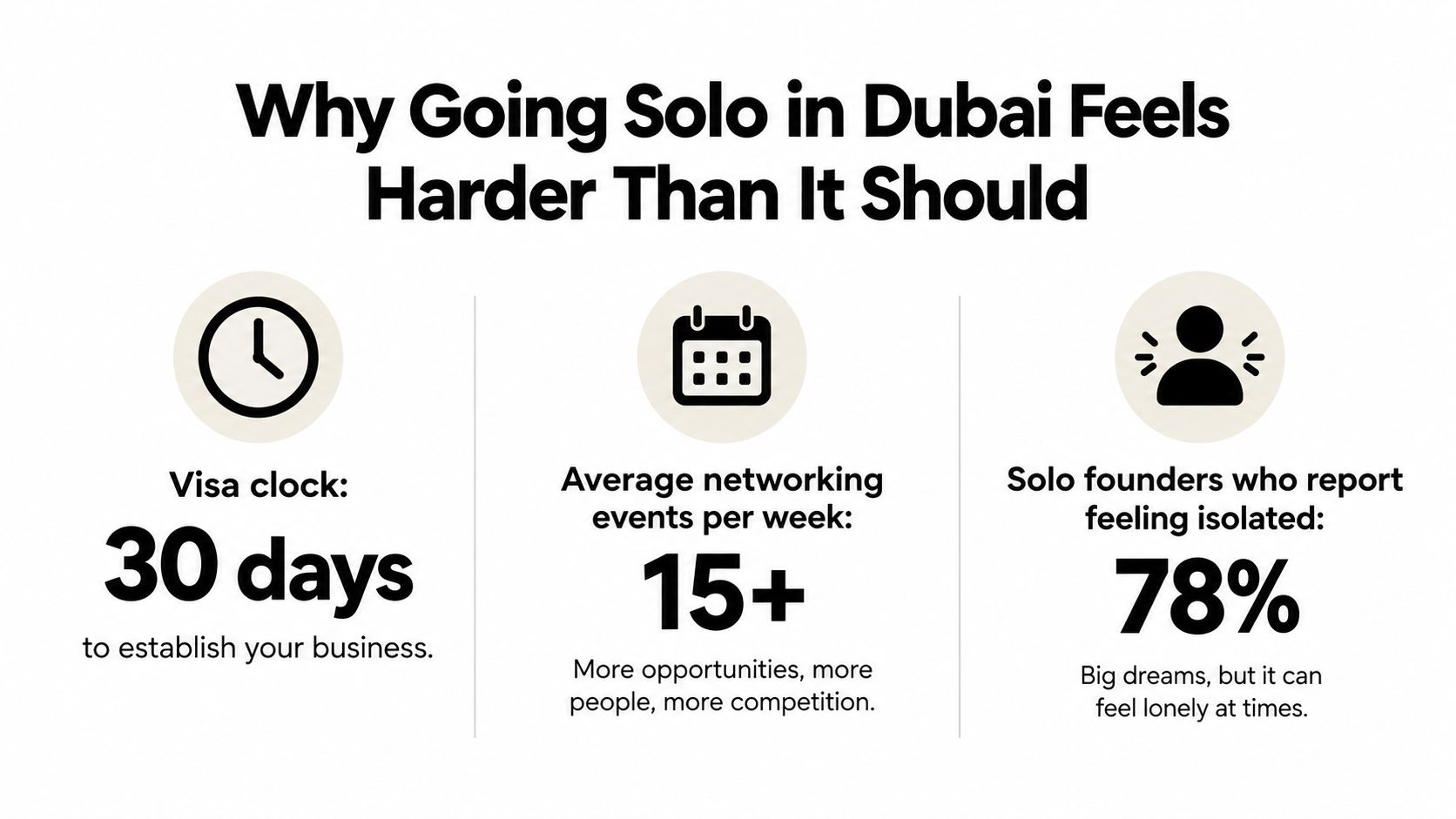
The mistake made is treating “getting set up” as the main milestone. It isn't. The work that matters is sequencing your energy so you don't burn cash and confidence at the same time.
Practical rule: if a decision creates fixed overhead before you've proved demand, it's probably too early.
Dubai's own public-sector support data backs that up. In 2024, Dubai SME facilitated the launch of 3,461 new Emirati businesses, up 524 from 2023, while advisory services reached 3,075 entrepreneurs that year, more than double the 2023 figure Dubai SME milestones. That tells you something simple, solo founders here are not a fringe case. They're part of a large, officially supported pipeline.
What to decide first
- What you're validating now. Pick the one problem you can test with conversations and a paid pilot.
- What you're postponing. Delay hiring, office spend, and anything that locks you into a bad structure.
- What support you need early. Don't confuse solo with unsupported. You need peers, not noise.
The Dubai Business Survey also points to cost pressure around licensing, rent, and workforce costs as a live issue, not an abstract one Dubai Business Survey Q1 2025. That's why solo building here has to be designed, not improvised.
Validate Before You Incorporate
The fastest way to waste money in Dubai is to incorporate first and validate later. I've seen founders do this because paperwork feels productive. It isn't. If you haven't tested demand, you've just paid for the right to learn the expensive way.
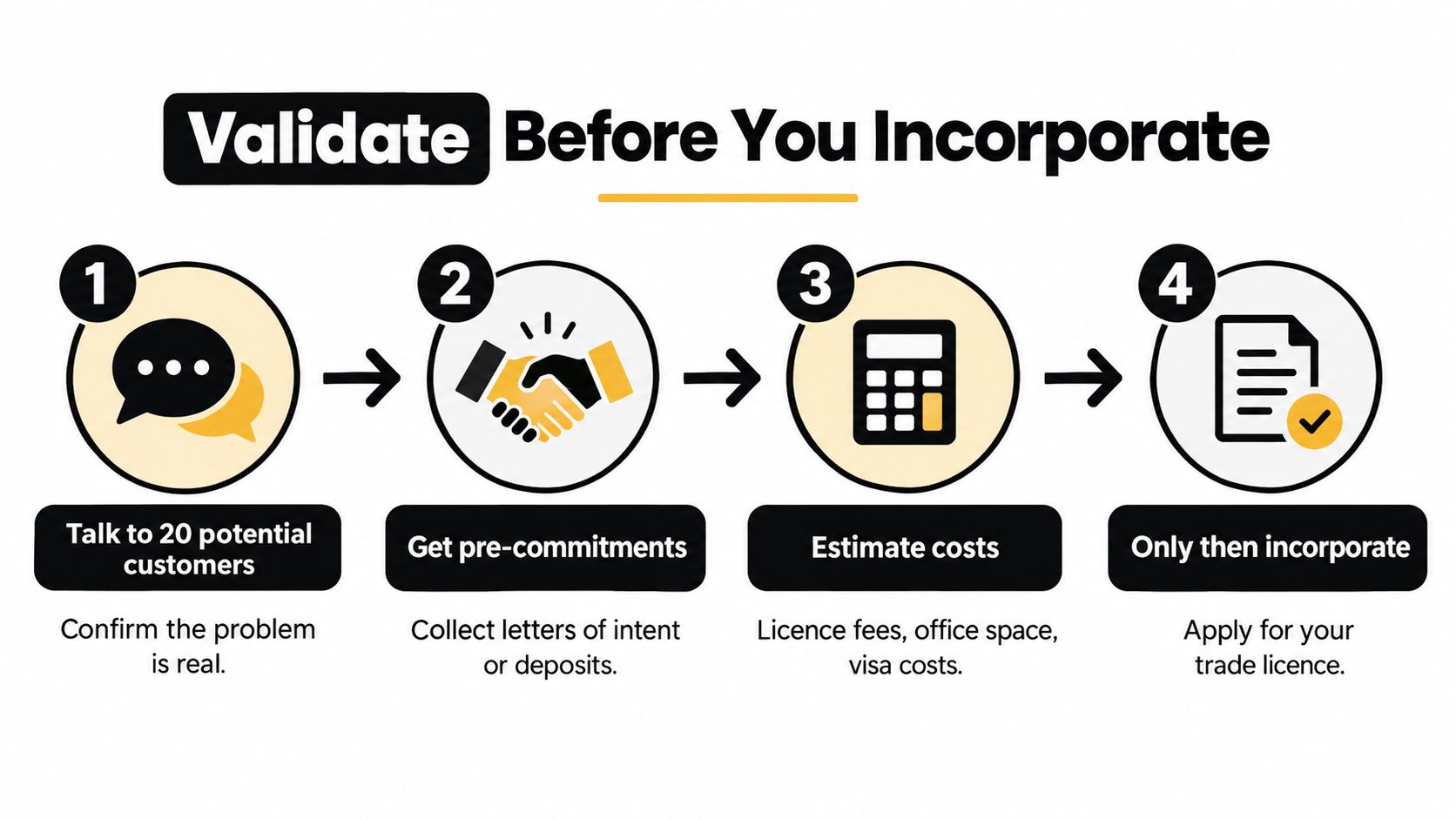
Start with customer conversations and a paid pilot. If people won't talk to you, they won't buy from you. If they'll talk but won't commit, you don't have a business yet, you have interest.
Then document the evidence. Look for repeated demand, pricing logic, and signs that the customer will come back. For anyone still tempted to jump straight into registration, Bazzly's product-market fit validation guide is a useful reminder that market proof comes before structure.
The sequence that saves cash
- Talk to real customers first. Use structured interviews, not vague chats.
- Run a paid pilot. Even a small paid commitment tells you more than ten compliments.
- Choose the smallest compliant licence route. Only after you know what you're selling.
- Layer in visas, banking and accounting last. They're necessary, but they're not validation.
Dubai Chamber research says incorporation costs and bureaucracy around licensing, visas and real estate are material growth inhibitors, and that access to funding is one of the top three startup challenges in the UAE Startup Panorama PDF. The same source also notes that bank loans generally require an established track record of about three years, which is why bootstrapped revenue evidence matters so much in the first cycle.
Use this runway split: keep licensing, visa, housing, healthcare, accounting and customer acquisition separate from product spend. If you lump everything together, you'll misread your burn.
If you want a practical benchmark, model the costs you can't escape and assume the rest is optional until demand proves otherwise. A solo founder doesn't need a perfect structure. You need a structure that doesn't punish you for learning.
For a deeper framework on proving demand in the UAE, use this product-market fit guide for UAE startups before you sign anything irreversible.
Design Your Operating System as a Team of One
Once the licence question is out of the way, the main bottleneck is your calendar. A solo founder has to decide what stays founder-owned, what gets automated, what gets outsourced and what gets hired later. Skip that work and every bottleneck lands on one person's shoulders, which is how promising businesses turn into exhausting ones.
Use the four-task model
Keep these with you:
- Customer discovery. No one else should own your learning.
- Pricing. Hand this off too early and you lose control of margin.
- Cash decisions. You need a clear view of what is coming in and what is going out.
- Positioning. The founder should stay close to the market story.
Automate what repeats. That means reporting, follow-ups, reminders and any compliance task that exists only because people forget. Outsource specialist work like design or development once the scope is clear and the acceptance criteria are written down. Hire only when the bottleneck is obvious and keeps coming back.
The data explains why. A UAE entrepreneurship study based on 150 participants found that fear of failure, risk aversion, lack of resources and limited networking are major barriers, and that entrepreneurs also report shortages of appropriately skilled people and difficulty building competitive advantage MDPI study. The same study reports Dubai tech-sector employee attrition at 8.75%, above the UAE national average of 6.5%. Early hiring deserves caution.
Track the right weekly numbers
You do not need a giant dashboard. You need a short one that tells the truth.
- Qualified leads.
- Conversion rate.
- Cash runway.
- Delivery capacity.
- Customer retention.
Rule of thumb: if a metric does not change a decision, do not track it weekly.
Review capacity every month. Ask where you are overloaded, what keeps slipping, and what would break if you got sick for a week. That last question matters more than most founders admit. If one illness can stop sales, compliance and delivery at the same time, your business still depends on you too much.
Find Customers Without a Sales Team
Most solo founders in Dubai don't need more exposure. They need a better way to turn attention into conversations and conversations into revenue. The city is full of activity, but activity is not traction. You can attend a dozen things and still learn nothing about buying behaviour.
Recent UAE data shows how common the execution bottleneck is. Among Emirati entrepreneurs, 30% report difficulty generating engaging social-media ideas, 30% lack time to publish consistently, 30% struggle to convert followers into customers, and 35% cannot reach the right audience GoDaddy data via TahawulTech. That's not a content problem alone. It's a distribution problem.
Choose channels by trust and speed
| Channel | Sales cycle | Trust needed | Weekly founder hours | Keep-or-kill signal |
|---|---|---|---|---|
| Founder-led outbound | Short to medium | Moderate | 3 to 5 | Replies turn into calls, calls turn into paid trials |
| Partnerships | Medium | High | 2 to 4 | Partners send real leads, not polite intros |
| Marketplaces | Short | Low to moderate | 2 to 3 | Listings generate repeat enquiries |
| Community selling | Medium | High | 3 to 5 | People ask for demos without being pushed |
| Content | Long | High | 3 to 6 | Content drives direct conversations, not likes |
| Paid acquisition | Variable | Moderate | 2 to 4 | Cost per lead stays sensible and leads convert |
Pick two channels for the first 90 days, not six. My default is one direct channel, one trust-building channel. That could be outbound and partnerships, or content and community, depending on your category.
A disciplined weekly cadence beats more networking. One useful rhythm is five customer conversations, one distribution experiment, one conversion experiment and one retention check. The point is to learn, not to stay busy.
Dubai's dense calendar can create motion without learning. If an activity doesn't produce a customer conversation, a feedback loop or a strategic asset, cut it.
If you want a benchmark for how to think about acquisition versus traction, check your experiments against your actual conversion, not against the room's enthusiasm. A founder who keeps getting compliments but no calls has not found a channel yet.
Build the Right Kind of Peer Support in Dubai
Most solo founders don't need a huge network. They need the right peers, at the right stage, for the right job. Generic networking is weak medicine. It gives you business cards, not accountability.
Start with the gap you have. If you are missing a complementary operator, a cofounder match process makes sense. If you need weekly visibility and pitch reps, use Meetups. If you want depth, pressure-testing and cadence, small Residency Squads of 8 to 10 vetted, stage-matched founders are the better tool. Founder Connects also runs a vetted WhatsApp community of 500+ founders who apply and are screened, with about 23.3% acceptance, which is useful for fast feedback between sessions. The platform also notes 1,000+ founders attended Meetups in the last few months, 300+ Residents, and a Residency priced at $582 for 6 months.

The important part is what each tool is for. Cofounder search is for missing capability. Meetups are for visibility and repetition. Squads are for accountability and honest feedback. The WhatsApp group is for quick reactions, not deep strategy.
If you're evaluating peer groups, the link between fit and behaviour matters more than branding. This note on vetting values before networking is a useful reminder that a room only helps if the people in it operate the way you want to operate.
What the residency actually gives you
The practical value of a squad is not status. It's regular exposure to founders at a similar stage, pressure on your assumptions, and a place to say the thing you're avoiding saying out loud. That kind of peer friction is useful because it shortens bad decisions.
Booking for Meetups goes through the Founder Connects site or the public Luma page, and that matters because the signal should stay clean. Use the founder peer group guide if you want a sharper view of when peer support should be lightweight and when it should be structured.
Protect Your Energy While You Build
Isolation is an operational risk. A solo founder in Dubai can slide into a six-day workweek, mistake social media visibility for progress, and keep saying yes because the city always offers another room, another panel, another dinner.
Burnout starts as a string of unfinished weeks. If you are working alone, build a rhythm that protects judgement as much as output.
Build a week that can survive pressure
Use four anchors:
- One rest block. Keep it clear.
- One relationship block. A dinner, a call, or co-working with someone steady.
- One review block. Check numbers, decisions, and bottlenecks.
- One visibility block. A Meetup, a post, or a customer call.
Cut anything that does not lead to a customer conversation, a peer feedback loop, or a strategic asset. Dubai makes it easy to fill a calendar and still miss the market. A packed week feels productive until you realise you have no real feedback from customers.
Signal over noise: if an activity only makes you feel connected, but does not improve your business, it is optional.
The burnout piece belongs inside the business plan. This guide to founder burnout prevention strategies across MENA gives you a practical way to treat stress as an operating issue before it turns into lost momentum.
What the residency gives you
A residency gives you regular exposure to founders at a similar stage, pressure on your assumptions, and a place to say the thing you keep avoiding. That kind of peer friction shortens bad decisions.
Booking for Meetups goes through the Founder Connects site or the public Luma page, and that matters because the signal should stay clean. Use the founder peer group guide if you want a sharper view of when peer support should stay lightweight and when it should be structured.
You do not need a productivity machine. You need enough structure for the business to keep moving when your mood dips, your energy drops, or the city gets loud.
Your First 90 Days as a Solo Founder in Dubai
The first month is for evidence. Talk to 10 customers, run 1 paid pilot, write a one-page licence hypothesis, and name one peer accountability partner from your Meetup or residency circle. If you can't get to ten real conversations, that's already a signal.
The second month is for system. Put the four-task model on paper, set your weekly dashboard, and write down your first outsourcing boundary. That means deciding what you will no longer do yourself, and who gets access to what.
The third month is for focus. Double down on your two best acquisition channels, choose the least-cost compliant licence route that matches the evidence, and decide whether you need a cofounder process or whether a strong peer structure is enough for now.
If you need a community built around that kind of discipline, Founder Connects gives solo founders in the UAE and MENA a place to compare notes, pressure-test decisions, and stay accountable without turning every conversation into networking theatre. Start with one Meetup, one peer group, and one clear business decision you've been putting off.

Building in MENA? You don't have to do it alone.
Join 300+ founders in the Founder Connects Residency. Monthly squad calls, warm intros, $3M+ in perks, and much more. All for less than your monthly coffee budget.
Popular posts





Founder Connects is a premium MENA tech founder community. Meetups in Dubai and across MENA, Residency Squads of 8–10, and 400+ vetted WhatsApp founders (apply and screened).