

Startup Advisory Board UAE: A Founder's Guide

Building in MENA? You don't have to do it alone.
Join 300+ founders in the Founder Connects Residency. Monthly squad calls, warm intros, $3M+ in perks, and much more. All for less than your monthly coffee budget.

You're running product, chasing customer payments and preparing for a raise, while an investor asks questions your deck doesn't answer. Someone suggests an advisory board. Your first reaction is reasonable: will this help you make better decisions, or create another meeting you don't have time for?
A startup advisory board in the UAE should earn its place through work you can inspect. Build it around the evidence, expertise and judgement you're missing, not the names you'd like on your website.
When a UAE Founder Actually Needs an Advisory Board
Consider a solo founder selling software to enterprise customers in Dubai. The product works, prospects are interested, but procurement conversations keep stalling. Meanwhile, the founder needs to decide whether to hire a salesperson, pursue a regulated customer segment or start fundraising.
That's an illustrative situation, not a success story. It shows the distinction that matters: several consequential decisions need specialist judgement, and the founder can't resolve them through harder work alone.
An advisory board becomes useful when those decisions recur and connect. A commercial operator might explain why pilots aren't converting, a finance advisor might challenge the hiring plan, and a regulatory specialist might identify conditions that change which customers the company can serve.
Decide whether you need a board or a specialist
Don't create a board to solve a bounded task. If you need management accounts cleaned up, commission that work. If you need a contract reviewed, engage counsel. A standing advisory relationship makes sense when the questions continue after the immediate deliverable.
Use this test:
- Decision exposure: You're making choices that could materially affect cash, customer access or ownership.
- Missing judgement: Your team lacks relevant experience, rather than lacking time.
- Capacity to act: You can implement recommendations and return with evidence of what happened.
- Continuity: The advisor's expertise will remain useful beyond an initial conversation.
My recommendation is a small, compensated group of operators with explicit responsibilities. Payment might be cash, vesting equity or a carefully documented combination. Don't assume an unpaid mentor will provide the availability of a retained specialist.
For a useful starting point on the founder-advisor relationship, consult the founder advisory resources from a bookkeeping firm published by MyOfficeOps. Use that reading to sharpen your own requirements, not to justify appointing someone before you have a clear problem.
Know when to wait
Wait if your main challenge is consistency, isolation or uncertainty about everyday priorities. Peer accountability may be more appropriate than specialist oversight. Also wait if you haven't gathered enough customer or financial evidence for an advisor to examine.
Practical rule: Recruit for a decision you need to make, not for a title you want someone to hold.
Write down the decisions you're not ready to make alone in the coming quarter. For each, identify the consequences of getting it wrong and the expertise missing from your team. If the list remains vague, start with focused conversations rather than a board.
Defining Purpose, Roles and the Risks You Want Closed
Write the mandate before approaching candidates. Otherwise, the people available to you will determine the board's purpose, rather than the company's needs determining who joins.
Start with your highest-risk decisions over the coming year. Product-market validation, regulatory access and fundraising are useful starting categories, but describe the actual decision underneath each. “Help with growth” isn't a mandate. “Challenge whether our enterprise pilot evidence supports expanding the sales team” is.
The process should look like this:
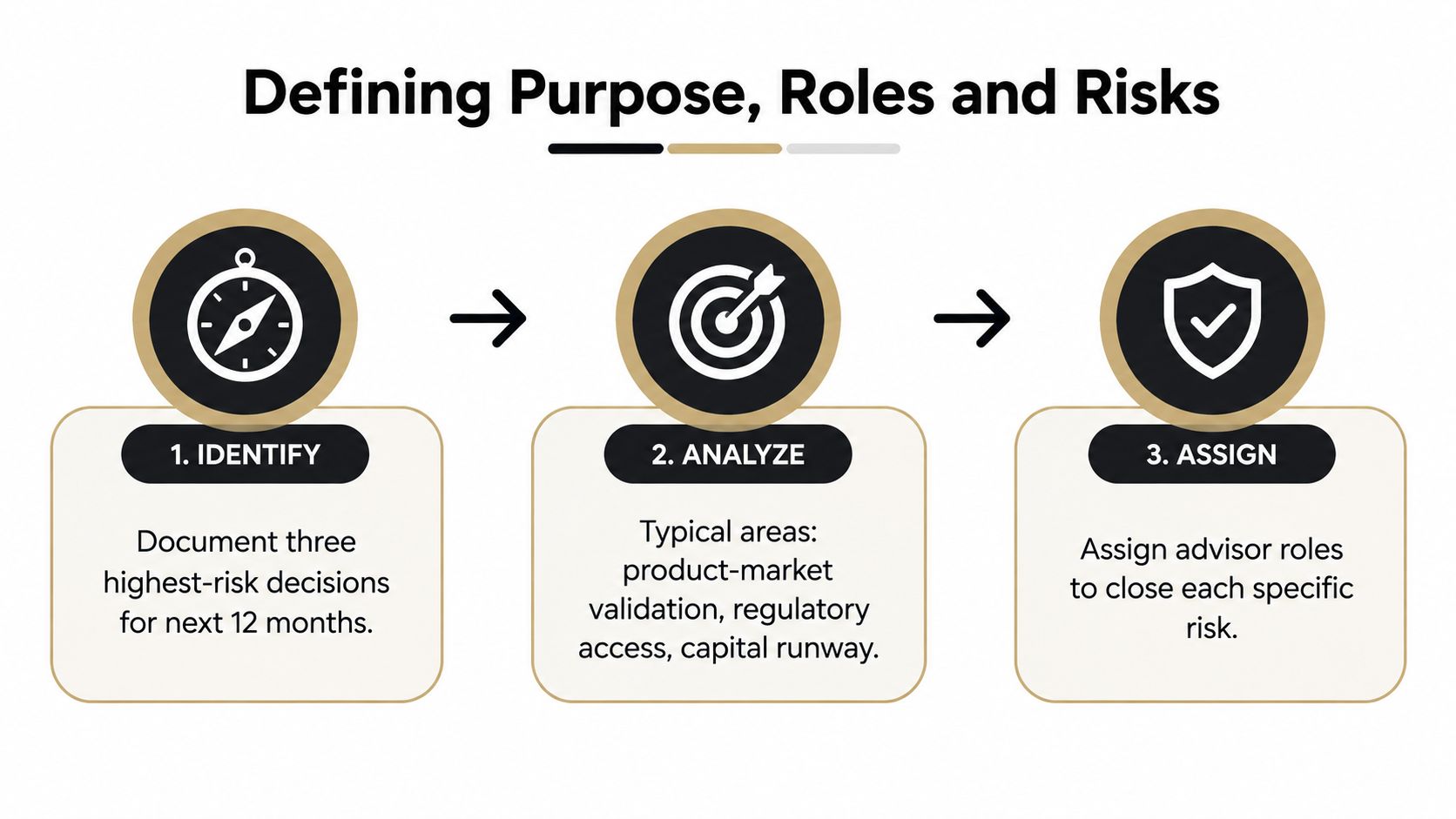
Turn uncertainty into an assignment
For each risk, record the decision, evidence missing, advisor capability and expected output. That forces you to distinguish someone who can discuss a topic from someone who can help you resolve it.
| Decision area | Evidence you need | Useful advisor output |
|---|---|---|
| Product-market validation | Reasons customers activate, stay or leave | Review of customer interviews and retention assumptions |
| Regulatory access | Confirmation of relevant permissions and constraints | Questions for qualified counsel and a documented risk assessment |
| Fundraising | Defensible financial assumptions and milestone logic | Investor-readiness review and challenged financing scenarios |
Require demonstrated UAE or target-MENA operating experience where local execution matters. An impressive international career doesn't automatically equip someone to interpret your customer procurement process or expansion constraints.
The strategic decision making guide for executives from Acheloa Wellness, Inc. is a supplementary resource for framing decisions. Keep your own mandate closer to the ground: what must be decided, what evidence is missing and who will do the work?
Separate advice from authority
An advisory board, a statutory board and an informal mentor relationship shouldn't be treated as interchangeable. Document the advisory group as non-binding unless qualified counsel approves a different arrangement. Keep formal company decisions with the people authorised to make them.
A staged design should include a written mandate, quarterly objectives, confidentiality rules, conflict disclosures, meeting expectations and measurable outputs. The Dubai SME governance material identifies insufficient technical knowledge as a constraint on establishing and operating formal boards or advisory structures. Don't solve that problem by copying a corporate board template you don't understand.
If the distinction between ongoing advice and informal mentoring is still unclear, the startup mentor guide offers a separate starting point.
Your mandate should end with an owner for every output. Advisors can challenge assumptions, review materials or make agreed introductions; the founder remains responsible for execution. Draft that document before discussing compensation, because you can't price a role you haven't defined.
Why the UAE Market Changes What an Advisory Board Must Do
An advisor who offers only investor access leaves the difficult work untouched. Your company still needs credible numbers, coherent milestones and a financing plan that survives scrutiny.
The UAE's funding history makes that distinction concrete. UAE startups raised $371 million in the first nine months of 2023, investor participation fell 41% year on year, and more than 82% of rounds were below $5 million, according to The National's reporting on UAE startup financing.
Across the full year, UAE venture funding declined 46% from 2022, while the country remained MENA's most active ecosystem by deal count, as recorded in MAGNiTT's full-year UAE venture investment report. These are historical figures, not a description of today's funding conditions.
The practical distinction between activity and available capital is illustrated below.
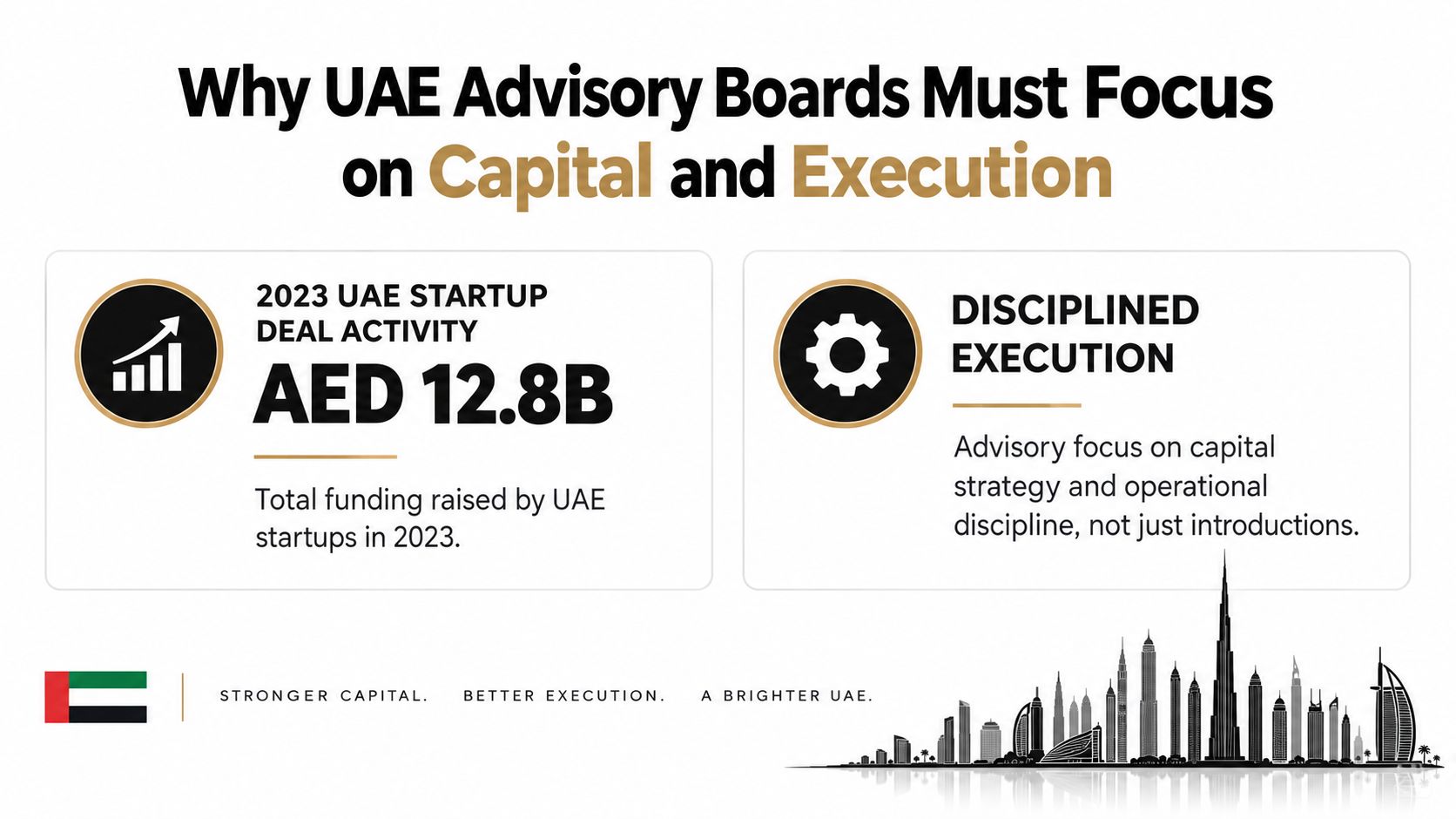
Treat fundraising readiness as evidence work
My reading is straightforward: a busy ecosystem doesn't mean your company can raise on the terms it wants. Founders should select advisors who can test the financing case, not just distribute the deck.
For an enterprise startup, that could mean distinguishing signed revenue from enthusiastic pilot feedback. For a consumer product, it could mean examining retention rather than presenting registrations as traction. Those are illustrative assignments, not claims about particular companies.
Ask your capital advisor to examine:
- Milestone logic: What will the proposed round let the company prove, and why should that evidence support the next financing decision?
- Valuation assumptions: Which operating achievements justify the proposed price?
- Downside planning: What changes if fundraising takes longer or produces less capital than intended?
- Investor fit: Why would a particular investor care about this business, beyond its location or sector label?
A useful introduction comes with a reason the investor should engage and a founder who's ready to answer difficult questions.
Include financing documentation, not just the pitch
Bank financing requires a different evidence package from venture fundraising. The UAE SME financing market overview identifies documentation, collateral and trading-history barriers. An advisor's useful contribution may therefore be financial records and financing preparation rather than investor access.
Require a review of management accounts, customer contracts, cash assumptions and the supporting records behind headline metrics. For asset-light businesses, ask a finance specialist to assess realistic financing options rather than promising that traction alone will satisfy a lender.
During candidate conversations, ask them to walk through your next financing decision. A credible answer identifies missing evidence, sequencing and trade-offs. A list of people they know isn't a plan.
Peers, Advisors and Where to Find Both in the UAE
Peers help you examine your thinking. Advisors supply specialist judgement you don't already have. You may need both, but don't confuse a valuable founder conversation with accountable professional advice.
Use the Squads FAQ for the peer format rather than treating it as an advisory appointment. The founder peer group guide for Dubai can help you decide whether shared accountability addresses your immediate need.
For specialist advisors, begin with the problem and work backwards to people who have handled it. Keep the discussion grounded in your actual company, not a generic networking pitch.

Search where relevant experience is visible
UAE accelerator mentor pools are a practical place to look. The Ignyte mentor directory provides a starting point for identifying candidates whose expertise you can investigate.
Also consider sector communities, former operators in Dubai and Abu Dhabi, and people recommended by customers, existing investors or professional advisers. For expansion beyond the UAE, prioritise direct experience in the destination market. MENA familiarity shouldn't be treated as a substitute for country-specific execution.
Verify candidates through work, not biography:
- Operating relevance: Ask what comparable decision they personally handled and what responsibility they held.
- Local understanding: Test their familiarity with your buyer, jurisdiction and commercial constraints.
- Availability: Establish whether they can review documents and follow through between conversations.
- Independence: Ask about competing companies, investment interests and relationships that could affect their advice.
A recommendation from someone you trust is a route into a conversation, not evidence that the candidate fits your company.
Send a brief that makes the conversation useful
Use this advisor brief template:
Company and stage: What you're building, for whom, and what evidence you have.
Decision: The specific choice you need help making.
Context: Customer, financial, regulatory or market facts the advisor must understand.
Desired output: What you want to leave the conversation able to do.
Working arrangement: Expected availability and a proposed trial discussion.
Don't attach your entire data room to an introductory message. Share enough context to test relevance, then handle sensitive access through the appropriate agreement.
During the trial, notice whether the candidate asks diagnostic questions before recommending action. Someone who immediately prescribes fundraising, hiring or expansion without examining your constraints may be selling a familiar answer.
End by agreeing a bounded piece of work. Ask for a review, decision memo or specific follow-up, then assess its usefulness. Your first conversation is a test of working fit, not an appointment ceremony.
Compensation, Equity and the Written Agreement
Pay for a defined contribution, not access to someone's reputation. Cash, equity and a combination can all be negotiated, but none removes the need to specify what the advisor will do.
There isn't a defensible universal UAE advisor rate in the evidence available for this guide. Don't treat an overseas percentage range as a local standard. Price the scope, availability and expertise, then have the arrangement reviewed for your company.
Cash Versus Equity Compensation for UAE Advisors
| Dimension | Cash Fee Model | Equity Grant Model |
|---|---|---|
| Immediate cost | Creates a payment obligation | Preserves cash but creates an ownership commitment |
| Suitable assignment | Defined recurring services or specialist work | An ongoing advisory contribution where long-term alignment matters |
| Documentation | Scope, fees, invoices and service expectations | Grant terms, vesting, approvals and departure treatment |
| Main founder concern | Paying for activity without useful delivery | Committing ownership before contribution is established |
| Negotiation focus | Outputs, availability and termination | Contribution, vesting conditions and unvested equity |
| Legal review | Contracting entity, authority and relevant licensing | Corporate structure and the proposed grant mechanism |
The UAE Ministry of Economy and Tourism model advisory agreement describes a long-term arrangement governed by UAE law in which the advisor receives an annual fee paid monthly in arrears and makes specified personnel available to the customer, as set out in the Ministry's advisory agreement materials.
That model is different from an informal founder mentor arrangement. It establishes recurring services and payment obligations; it isn't evidence of a standard startup advisor fee. If a candidate proposes cash compensation, request a written scope and compare it with commissioning the work project by project.
Protect the company before sharing sensitive information
An advisor is not automatically a director, shareholder or employee. The advisory shares explainer provides context for documenting advisory equity, including role, compensation, vesting and termination.
Your agreement checklist should cover:
- Scope and deliverables: What the advisor does, expected availability and how work is accepted.
- Authority limits: Whether they may represent the company, communicate with investors or make commitments.
- Information access: Confidentiality, permitted use, secure handling and access removal.
- Intellectual property: Ownership of work created and treatment of pre-existing materials.
- Conflicts: Disclosure obligations and exclusions from sensitive discussions.
- Departure terms: Termination, outstanding payments and unvested equity.
- Legal framework: Governing law and consistency with the company's structure.
For mainland or free-zone companies, ask UAE-qualified counsel to assess the proposed arrangement against the actual entity and its documents. Don't assume an agreement suitable for another founder's company will fit yours.
Make this explicit before engagement: the advisor can recommend, but can't bind the company unless separately authorised. Have counsel review the agreement before sensitive information is shared or the advisor represents you externally.
Meeting Cadence, Dashboards and Measuring Real Impact
The meeting should produce decisions and assigned work. If everyone leaves feeling encouraged but nobody knows what changes tomorrow, you've run a conversation, not an execution system.
Set a recurring working session, supported by a monthly dashboard and a pre-read circulated early enough for proper review. Increase or reduce contact according to the active decisions, rather than preserving a schedule nobody needs.
Use the following structure as a working reference.
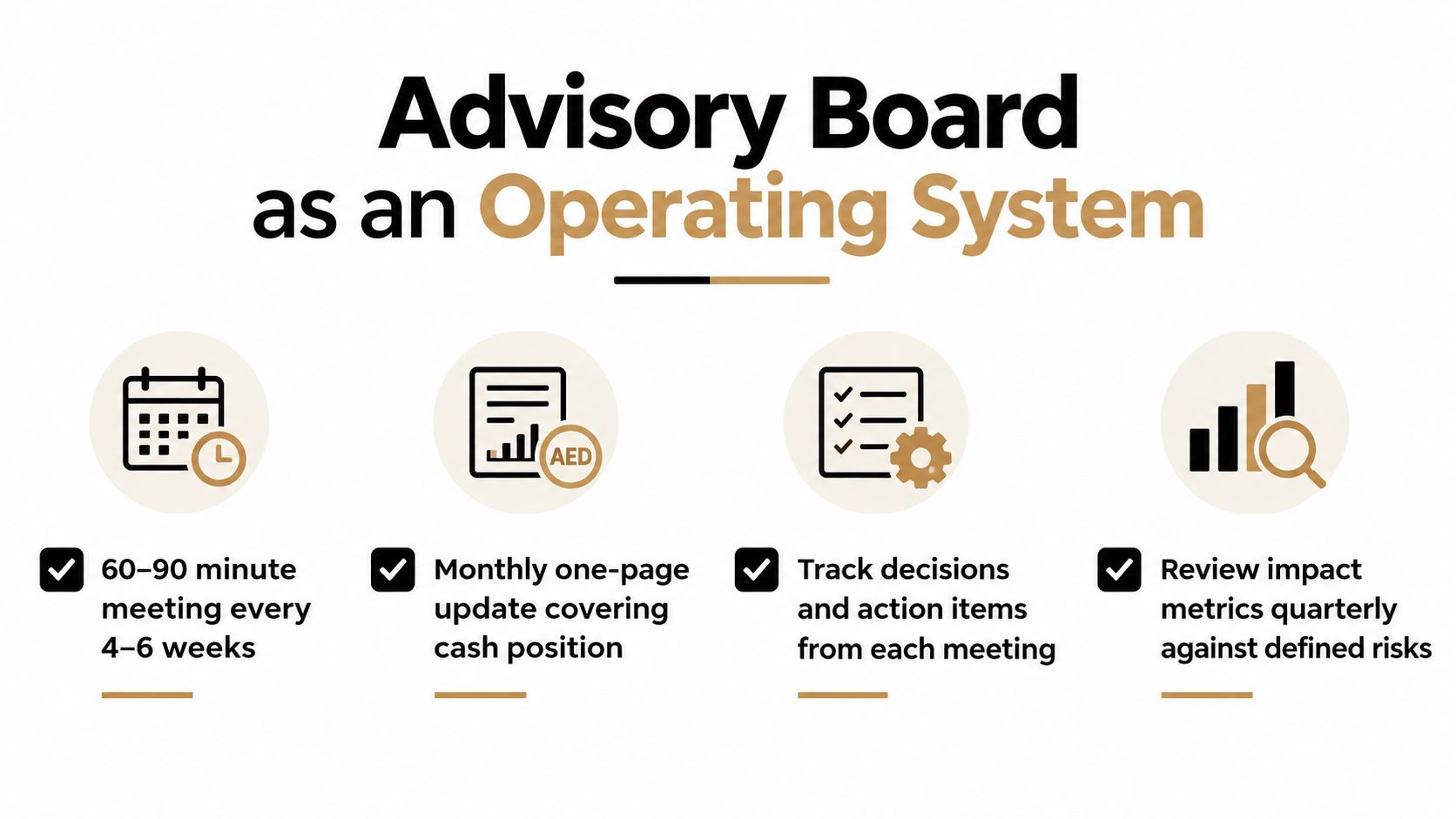
Send decision-ready information
Your dashboard should include cash runway, activation or retention, sales pipeline, regulatory risks and fundraising milestones. Alongside each material change, explain what happened and identify the decision required.
Use the striveX Ltd board pack guidance as a supplementary reference when organising financial material. The investor update guide for angel investors is also useful for keeping external reporting clear, although an advisory pre-read should focus more directly on decisions.
Track these outputs:
- Decision record: Recommendation, founder decision, rationale and unresolved assumptions.
- Action ownership: Named person responsible for delivery and follow-up.
- Impact evidence: Qualified investor meetings, diligence-cycle time, pilot-to-paid conversion, gross margin or runway, where relevant.
- Baseline comparison: Your own performance before the advisory engagement, rather than unsupported mentorship benchmarks.
The UAE AI and digital SME financing research identifies early-stage and scale-up financing gaps. That supports keeping financing readiness in view, but it doesn't establish that mentorship guarantees survival. Measure the work against your company's results, and don't attribute every improvement to the advisor.
The video below is an additional viewing resource for a founder working on advisory structure.
Make AI, IP and expansion risks visible
The Mohammed Bin Rashid School of Government study on UAE AI SMEs identifies concerns around compliance costs, unclear AI-specific regulation, specialist talent and overseas IP registration.
Translate those concerns into review questions. Which customer data can an advisor access? Who owns contributed code or product materials? Does a new emirate or market require a fresh legal assessment? Which conflicts require someone to leave the discussion?
Review standard: Keep an advisor because their work improves decisions, not because removing their name feels awkward.
At the review date, assess completed outputs, judgement and follow-through. Renew, narrow or end the role using the agreed departure terms.
Common Mistakes and Your First 30 Days
The common failures are avoidable. Founders recruit a recognisable name, leave the role undefined, promise equity too early and never establish whether the advice helped.
Use the fixes as a launch checklist:
- Prestige-first recruitment: Replace biography-led selection with evidence of relevant operating work.
- No mandate: Write the decision, required contribution and owner before approaching candidates.
- Blurred authority: Keep advisory recommendations separate from formal company approvals.
- Premature equity: Agree the scope and obtain local legal review before making commitments.
- No outcome review: Record a baseline and set a date to assess delivered work.
Start with documents, not appointments
During your first month, draft the mandate and advisor brief, identify candidates by risk, hold trial conversations and prepare the agreement with UAE-qualified counsel. Don't announce a board while those foundations are missing.
Block a focused session this week to write the mandate and shortlist. Then ask each candidate to work through the same concrete decision so you can compare their questions, reasoning and proposed next steps.
A useful advisory board is an execution system. Run it with clear assignments, controlled access and honest reviews. That discipline also prepares you for more formal governance later, without pretending your startup needs corporate theatre today.
Founder Connects offers founder Meetups, peer learning and practical support across the UAE and wider MENA ecosystem. If you need honest peer feedback while defining your advisory needs, visit Founder Connects and bring the decision you're currently struggling to make.

Building in MENA? You don't have to do it alone.
Join 300+ founders in the Founder Connects Residency. Monthly squad calls, warm intros, $3M+ in perks, and much more. All for less than your monthly coffee budget.
Popular posts





Founder Connects is a premium MENA tech founder community. Meetups in Dubai and across MENA, Residency Squads of 8–10, and 400+ vetted WhatsApp founders (apply and screened).