

Startup Mentor Guide for UAE and MENA Founders in 2026

Building in MENA? You don't have to do it alone.
Join 300+ founders in the Founder Connects Residency. Monthly squad calls, warm intros, $3M+ in perks, and much more. All for less than your monthly coffee budget.

You can be six months into a Dubai company and still feel like you're making it up as you go. The product is moving, a customer has signed an LOI, the bank wants another document, your first hire keeps slipping, and the regulator has gone quiet. That's usually the moment founders realise they don't need more motivation, they need a startup mentor who understands how business gets built in the UAE.
The trap is thinking the wall is product-market fit. Often it isn't. It's licensing, hiring, market entry, founder fatigue, and the cost of making one bad operational call with no one around who's seen it before. If you want a practical local guide on the startup path in Dubai, read the guide by Smart Classic Business alongside this. And if you're already dealing with overload, the internal note on founder burnout prevention strategies in MENA is worth keeping open in another tab.
The Moment Every UAE Founder Hits a Wall
A founder I'll never forget was sitting in a DIFC coffee shop with a laptop, two tabs open, and the kind of fixed stare that means the day has already gone sideways. The pitch deck looked decent. The first customer was interested. The problem was everything around the pitch deck, the licence, the bank account, the hire, the timeline, the quiet panic that comes when you realise no one is going to make the next call for you.
That's the UAE founder wall. It's rarely a problem with ambition. It's a problem with context.
The product wasn't the issue
Most early founders think they need another idea session. They usually don't. They need someone who can say, “don't chase that hire yet,” or “this customer is useful, but not on the terms you think,” or “stop trying to force mainland and free zone logic into the same decision.” In the UAE, that kind of judgment matters because the operating environment has real structure. Free-zone companies sit outside UAE mainland jurisdiction, but they still have to comply with the laws that govern their activity, including sector rules such as food, education, or medical regulations, according to the official UAE platform. The same platform says business-licence setup can often be completed online through the relevant free zone authority, and in most cases a licence is issued within 14 working days after review and approval, which makes speed to launch a concrete operational variable, not a vibe. UAE free-zone business guidance and free-zone setup steps
A founder without regional context burns time on avoidable mistakes. A mentor shortens that loop.
Practical rule: if your next problem is about regulation, hiring, or market entry, don't ask for encouragement, ask for someone who has already solved that exact class of problem.
A good mentor does not replace execution. They stop you from wasting a quarter on the wrong version of it. That's why the startup mentor conversation in the UAE is never just “who do I know?”, it's “who can help me choose the next trade-off without guessing?” The right answer changes based on stage, which is exactly where most generic advice falls apart.
What a Startup Mentor Does
A startup mentor is an experienced operator who gives context-specific judgment. That is the job. Clear calls, sharper trade-offs, fewer bad detours.
A mentor is a senior operator who has seen similar problems before. An advisor sits closer to a part-time board member. A coach helps you think clearly through process and behaviour, even if they have not lived your market.
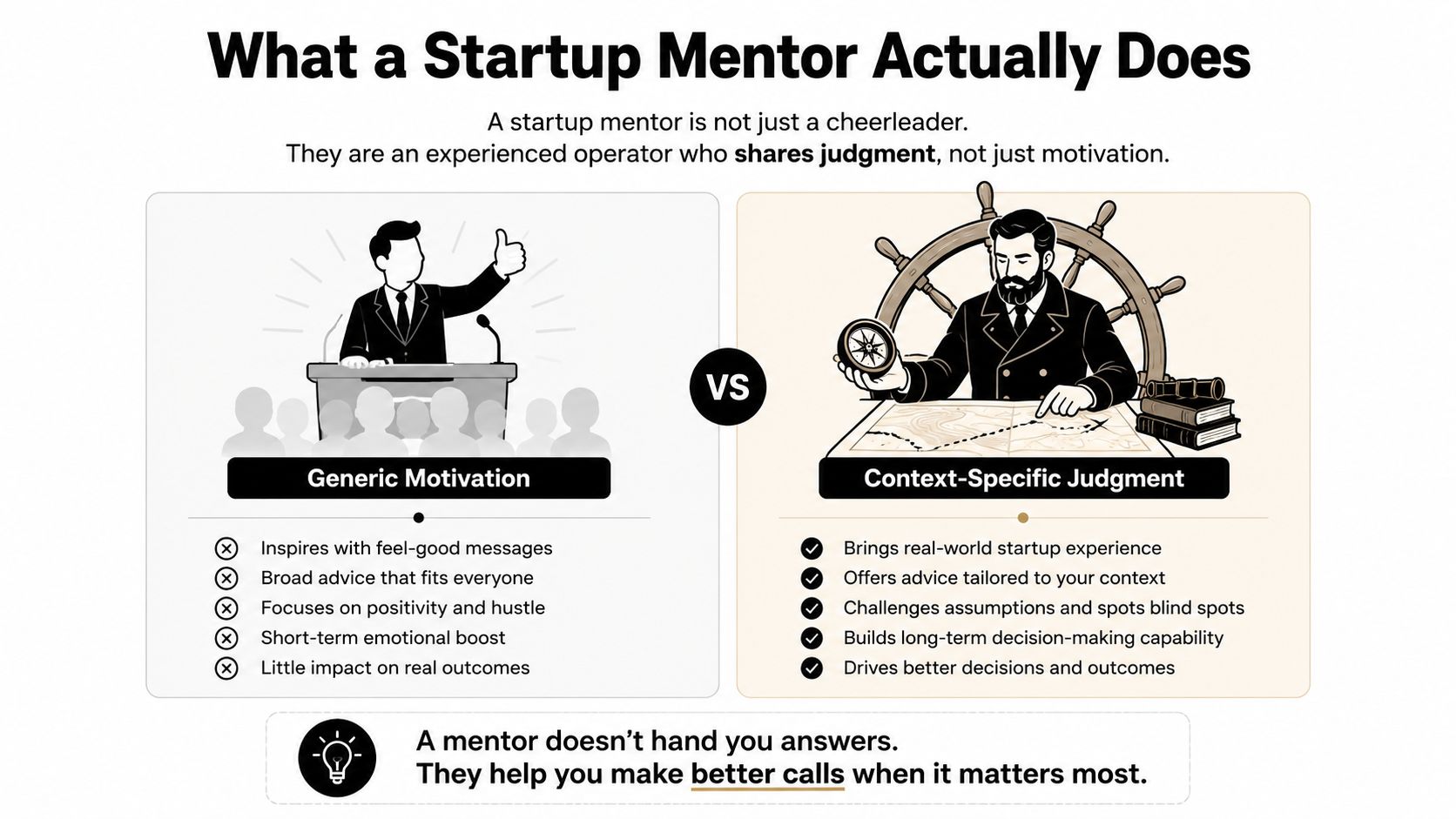
The clean comparison founders need
A mentor relationship is usually informal, low-friction, and built on trust. No equity is normally expected, there is usually no heavy contract, and accountability comes from the relationship rather than legal paperwork. An advisor is more formal, more scoped, and more connected to strategy or governance. A coach is there to sharpen process and behaviour, which is useful, but different.
A mentor should recognise patterns inside your actual business, not just sound impressive in the room.
That distinction matters because founders often confuse charisma with usefulness. I have sat across from people who could talk for ten minutes about the future of startups and say nothing useful about the founder in front of them. I have also sat across from quieter operators who asked three sharp questions and then saved a founder six weeks of avoidable work.
The best mentors are not universal experts. They have relevant scars. If you are building in fintech, logistics, healthtech, or D2C, you want someone who has dealt with the same regulatory friction, customer acquisition pain, or hiring constraint. At the idea stage, you want judgment on validation and first revenue. At growth, you want someone who can help with expansion, localisation, and team design.
The distinction between roles matters here. this breakdown on mentorship versus coaching is useful if you keep mixing the terms.
The Abu Dhabi policy picture reinforces the same point. The OECD review of Abu Dhabi MSME and startup policy highlights mentoring, coaching, and networking as core services, including the Abu Dhabi SME Hub's Access to Experts initiative, and the ecosystem map report identifies a hierarchy of support entities for incubation, acceleration, funding, mentorship, and more. That is a signal that the region treats mentor support as part of the operating system, not a luxury add-on. OECD assessment of Abu Dhabi startup policy
Why Mentorship Matters More in the UAE and MENA
The UAE doesn't reward slow guessing. The region is fast-moving, commercially ambitious, and structurally uneven. That combination makes a startup mentor more valuable here than in ecosystems where founders can rely on a bigger domestic market and more forgiving execution cycles.
The regional case is practical, not romantic
Dubai SME's numbers make the point clearly. Since its launch in 2002, it has provided guidance and training services to 48,923 entrepreneurs and mentoring services to 51,504 Emirati entrepreneurs, while supporting the establishment of 18,429 local enterprises. In the first half of 2024 alone, 1,373 Emirati entrepreneurs benefited from mentoring services, up 190.3% from 473 in H1 2023, and 2,714 entrepreneurs received guidance and training services, up 164.3% year over year. Sheraa's reporting on Dubai SME and Arabian Business coverage of Dubai SME
That tells you mentorship in the UAE is not just a soft concept. It's part of the formal startup infrastructure.
The other side of the story is harder. A DGGF early-stage ecosystem report says the MENA ecosystem is still nascent and there is not a sufficient supply of experienced entrepreneurs to mentor new founders, which creates a real bottleneck for market-entry support and founder decision quality. The same report quotes UAE ecosystem operators saying the most effective way to support founders expanding into MENA is to connect them with a founder who has already done it. That's the difference between abstract advice and regional execution. DGGF MENA pipeline report
Mentorship here is an operating input
Rule of thumb: if a bad GTM decision can cost you months, mentorship isn't optional, it's infrastructure.
The UAE has structural complexity built in. The Ministry of Economy says the UAE ranked first globally in the Global Entrepreneurship Monitor 2024/2025 report for the fourth consecutive year, and also topped GEM's National Entrepreneurship Context Index. That's strong ecosystem validation, but it doesn't remove the need for stage-specific guidance. It just means the system is strong enough to expose the weak spots faster. UAE Ministry of Economy on GEM 2024/2025
Here's the useful way to think about it.
| Outcome Metric | With Active Mentorship | Without Mentorship |
|---|---|---|
| Decision quality | Faster, more grounded judgment | More trial and error |
| Regulatory navigation | More likely to be contextual and staged | More likely to be improvised |
| Founder confidence | Built on pattern recognition | Built on hope |
| Market expansion | More likely to be sequenced | More likely to be rushed |
| Execution rhythm | More disciplined | More reactive |
PwC Middle East says small business survival rates double when guided by experienced mentors, and it also places mentorship ecosystems among the priority strategies for strengthening youth entrepreneurship in MENA. At the same time, the UAE market is outward-facing, with 55% of UAE entrepreneurs serving customers outside the UAE, which means mentoring has to cover cross-border growth and not just domestic setup. Founder Connects lesson summary on UAE incubator success stories
If you're a founder here, the takeaway is blunt. Mentorship is no longer about encouragement. It's about compressing the learning curve in a region where one wrong assumption about licensing, localisation, or expansion can cost you a year.
The Stage-Specific Mentor Most Advice Gets Wrong
Most founders in the UAE chase names, not fit. They want the loudest LinkedIn operator, the speaker from GITEX, or the person everyone else talks about. That's a weak filter. What you need is the person who can solve the problem in front of you at your exact stage.
Match by stage, not by prestige
An idea-stage founder in Dubai does not need a glossy ex-CEO who has forgotten what first revenue feels like. They need someone who understands validation, a lean team, and the friction of getting from intent to first proof. A growth-stage founder entering Saudi or Egypt needs a different mentor, someone who understands cross-border licensing, product localisation, and pacing. A scale-stage founder raising or preparing for a serious institutional round needs someone fluent in board dynamics, term sheets, and investor psychology.
The OECD-backed Abu Dhabi assessment also notes that mentoring schemes remain limited, mentors have limited availability, and there is a particular gap in mentoring after the initial startup phase for more established founders. That's the gap most founders miss. Early validation gets all the attention, but scale-up judgment is where companies usually need help most. ADSME Hub surveys and assessments
The best mentor for you might look boring on a conference panel. That's fine. You're not hiring a performer.
The wrong mentor creates expensive noise
A mentor who built in a different regulatory environment can still be useful, but only if they understand the local constraints you're facing. A founder building in a free zone can't take advice from someone who speaks only in mainland assumptions. A founder selling across borders can't rely on someone whose only experience is one domestic market.
The easiest way to avoid this mistake is to reverse the question. Don't ask, “Who's the most impressive person I can reach?” Ask, “What exact gap is blocking my next milestone?” Then find the person who closes that gap.
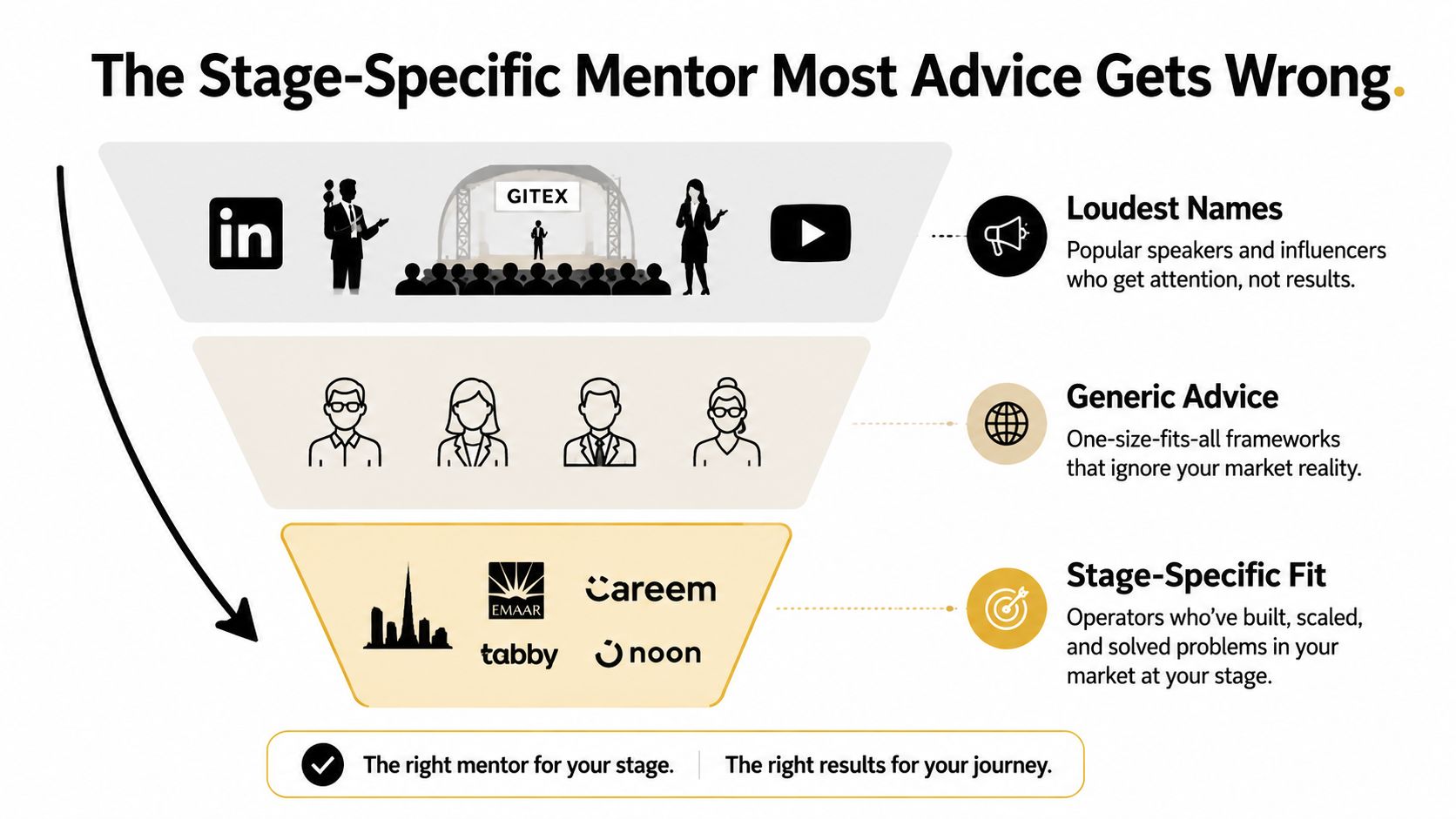
If you want a sharper operational test, a founder community that structures these conversations can help. Founder Connects is one such community, and it works best when you use it for stage-appropriate introductions rather than casual browsing. I'll come back to that later.
How to Spot a Strong Startup Mentor in the Region
Don't wait until after the first coffee to figure out whether the mentor is useful. Filter early. The strongest founders I know treat mentor selection the same way they treat senior hires, with a clear set of checks.
Use a tight pre-meeting filter
Start with regional credibility. Has this person built or operated inside the UAE or MENA, or are they recycling advice from another market? That one question cuts a lot of noise.
Then check relevant stage. If you're early, they should understand early. If you're growing, they should understand growth. If you're scaling, they should know what real complexity looks like. Sector depth matters too, because fintech, logistics, healthtech, and D2C all break in different places.
Strong mentors ask more questions than they answer.
That's the easiest signal to miss. Good mentors diagnose before they prescribe. They should be able to take one of your current problems and talk through the trade-offs with you, not jump straight to generic best practices.
Red flags are usually obvious
Walk away if a mentor does any of this:
- Pushes paid masterminds immediately: That usually means the relationship is shifting towards their funnel, not your problem.
- Refuses accountability check-ins: If they won't commit to a rhythm, they're probably not serious about helping.
- Takes meetings but never follows up: That's a sign of low signal and low engagement.
- Centres the conversation on their portfolio or pitch: You're there to solve your company's problem, not to sit through a sales deck.
Trust and confidentiality matter just as much as experience. Ask how they handle sensitive financials, hiring disputes, or co-founder conflict. If they're vague, defensive, or overly performative, keep moving.
For founders in the UAE, the right mentor also needs to understand the business environment in practical terms. That means knowing how to think about mainland versus free zone structure, sector-specific compliance, and the pace at which licensing and launch can happen. It doesn't mean they need to be a lawyer. It means they shouldn't give you legal-sounding advice they don't understand.
Use one first call to test judgement. Bring a real issue, not a hypothetical. Ask what they'd do, listen for diagnosis, and pay attention to whether they ask for missing context before giving you an answer. The good ones will.
How to Get Real Value from a Mentor Relationship
A mentor relationship only works if you run it like an operating rhythm. If you treat it like a favour, you'll get vague advice. If you treat it like a high-impact reporting line, you'll get sharper thinking and better follow-through.
Bring a decision, not a story
Before each meeting, send a one-page brief. Keep it simple.
- The decision in front of you: State the actual choice, not the background drama.
- The options you've considered: Show that you've already done some thinking.
- The specific ask: Tell the mentor exactly where you want their judgment.
That habit changes the quality of the conversation immediately. It forces you to think clearly before the call, and it stops the session from drifting into motivational talk.
Keep the cadence predictable. Biweekly is usually enough for active mentor work, provided you're making progress between sessions. When you say you'll do something, do it. Mentors notice execution faster than founders think they do.
Handle disagreement like an adult
When you disagree with a mentor, say so directly and use data. Don't perform deference if your market signal points the other way. A good mentor should be comfortable with pushback. If they're not, they're not really mentoring, they're performing authority.
Practical rule: if advice and the market collide, the market wins, but only after you've checked your interpretation carefully.
Also review the relationship every so often. Has your stage changed? Has your problem changed? If the mentor was perfect for idea validation and you're now dealing with hiring, scaling, or investor conversations, you may need a different person. End the relationship cleanly, thank them, and move on. Good mentors won't take that badly. They'll usually help you find the next one.
That rhythm turns a single relationship into a compounding asset. It also keeps founders from hoarding stale advice just because it came from a respected name.
Where Founder Connects Fits Into Your Mentor Stack
A strong founder support stack has three layers. Solo clarity. One-to-one mentorship. A vetted peer community that keeps the work moving between calls. If one of those layers is missing, founders either overthink alone or collect advice they never use.
The stack works best when each layer has a job
Solo clarity is where you define the actual problem. Without that, every mentor conversation becomes a mess. One-to-one mentorship is where you go deep on the exact gap blocking the next stage. That's where you want stage-specific judgment. A curated founder community is where you pressure-test decisions, get live reactions, and stay honest when things get messy.
Founder Connects fits in the third layer, and sometimes the second. It's a private startup community built for founders who want meaningful connections, practical support, and real progress. The structure matters more than the label. Members get curated peer groups, weekly one-to-one founder introductions, and a setting that's designed to reduce isolated guesswork.
If you want the practical version, that means fewer cold outreach attempts and more warm intros to operators who've already dealt with similar issues. It also means a better chance of finding someone who has handled licensing in DIFC, expansion in MENA, or product-market fit in regulated sectors without having to start from zero.
Use community for continuity, not replacement
A community like this doesn't replace a strong mentor. It raises the floor around your decision-making and makes mentor calls more useful because you're not arriving cold. Founder Connects' model includes moderated peer sessions, one-to-one introductions, and ongoing introductions that help founders keep momentum across stages. Used well, that turns one-off advice into a continuous operating rhythm.
If you're early, the highest value is usually clarity and honest feedback. If you have traction, the community becomes a fast way to find people who've already lived through the next set of mistakes. If you're growing, the value is in pattern-matched introductions and accountability.
The point is not to collect contacts. The point is to move.
Your Next Step and Quick Founder FAQs
Write down your top three stage-specific gaps today. Keep them painfully concrete, things like “first regulated customer acquisition,” “first finance hire,” or “cross-border expansion into KSA.” Then schedule one exploratory mentor call, or apply to a vetted community like Founder Connects for a curated introduction that matches your stage instead of your ego.
If you do nothing else, do that this week. The cheapest mistake is waiting for the perfect mentor to fall out of the sky after the next funding round.
Quick founder FAQs
How long should a mentor relationship last?
As long as the stage-specific gap is still relevant. In the UAE and Abu Dhabi policy context, some structured mentoring relationships are designed for continuity rather than one-off advice, so think in stages, not meetings.
Should a mentor take equity?
Usually no for informal mentoring. If the relationship becomes formal, advisory-style, or tied to governance, then terms can change, but don't assume equity is required just because someone is experienced.
How often should you meet?
Often enough to keep momentum, not so often that it becomes a social habit. Biweekly works well for many founders if you're sending a clear brief and acting on the last meeting's decisions.
What if a mentor's advice contradicts what the market is showing in the UAE?
Use the mentor to sharpen your interpretation, not to replace the market. If the market signal is consistent and the mentor is working from stale assumptions, trust the evidence and move on.
How is a mentor different from a board seat?
A mentor gives judgment without formal governance. A board seat comes with fiduciary responsibility, formal oversight, and a very different level of accountability.
The right mentor at the right stage won't make noise every week. They'll improve how you decide, hire, launch, and scale. That's the compounding effect, and it starts with the first conversation, not the perfect one.
If you want a curated place to compare notes with other UAE and MENA founders, get matched into relevant conversations, and find the kind of mentor introduction that fits your stage, visit Founder Connects and start there.

Building in MENA? You don't have to do it alone.
Join 300+ founders in the Founder Connects Residency. Monthly squad calls, warm intros, $3M+ in perks, and much more. All for less than your monthly coffee budget.
Popular posts





Founder Connects is a premium MENA tech founder community. Meetups in Dubai and across MENA, Residency Squads of 8–10, and 400+ vetted WhatsApp founders (apply and screened).