

Startup Legal UAE: Common Founders' Agreement Gaps

Building in MENA? You don't have to do it alone.
Join 300+ founders in the Founder Connects Residency. Monthly squad calls, warm intros, $3M+ in perks, and much more. All for less than your monthly coffee budget.

Most founder disputes do not start with bad intent. They start with missing terms.
If I were checking a UAE founders’ agreement before funding talks, I would look for four things first: clear roles, vesting, exit rules, and UAE-law fit. If any of those are missing, the company can end up with dead equity, IP that is not owned by the business, or a 50/50 deadlock with no way out.
Here’s the short version:
- Roles must be written down, not left to job titles alone
- Vesting should start on day one, often over 4 years with a 1-year cliff
- Cash, IP, and sweat equity should be recorded clearly in AED
- Exit and transfer terms should cover leavers, pre-emption, drag-along, tag-along, and deadlock
- The founders’ agreement must match the MOA and filed documents in the UAE
A few points stand out fast. In a mainland LLC, some major company decisions need a 75% vote. That means a 50/50 split can block action unless the documents include a tie-break path. And under UAE IP law, IP usually stays with the creator unless it has been assigned in writing.
| Gap | What goes wrong | What I would check |
|---|---|---|
| Vague roles | Disputes over authority and spend | Written duties, approval limits, reserved matters |
| No vesting | Early leaver keeps full shares | 4-year vesting, 1-year cliff, repurchase terms |
| Weak exit terms | Sale or founder exit gets stuck | Leaver rules, valuation method, transfer process |
| Foreign template | Terms do not work under UAE law | MOA alignment, local review, enforceability |
Bottom line: if the agreement does not line up with UAE company documents and local law, it may fail when you need it most.
Below, I break down the gaps that tend to cause the most trouble and what to fix before investor due diligence starts.
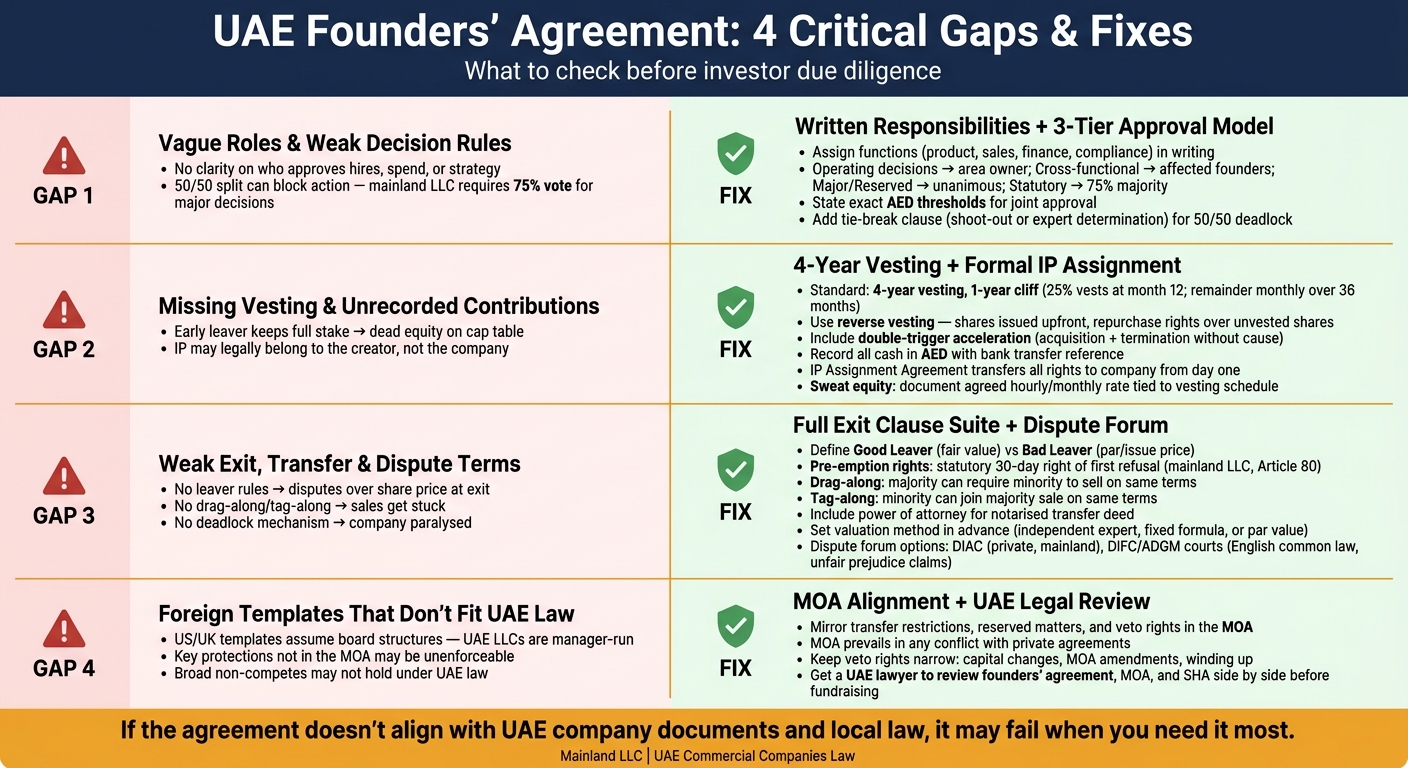
UAE Founders' Agreement: 4 Critical Gaps & Fixes
Gap 1: Vague founder roles and weak decision rules
Titles don't tell you who has the final say. You can call one founder the CEO and another the CTO, but that still doesn't answer the day-to-day questions that trip startups up fast: who approves a new hire, who runs fundraising, who controls spend, or who makes the call on a big shift in strategy? That's where many early-stage UAE startups get stuck.
Assign responsibilities by function, not title alone
The fix is simple: attach a written responsibilities schedule to the founders' agreement. This should link each founder to clear functions such as product, sales, fundraising, hiring, compliance, and finance. It should also spell out the authority that comes with each area.
If one founder is dealing with regulatory filings and investor relations, put that on paper. If another owns product and hiring for the tech team, write that down too. The founder named for that function leads the decision. That cuts overlap, limits friction, and helps the company move without constant back-and-forth.
Clear roles also need clear approval rules. Even if functions are split well, founders still need a rulebook for decisions that affect the whole company.
Set approval thresholds for routine and major decisions
A simple three-tier model can keep things moving while closing governance gaps:
| Decision Category | Examples | Approval |
|---|---|---|
| Operating | Campaign launch, supplier selection | Area owner decides |
| Cross-functional | New hire, major pricing change | Affected founders agree |
| Major / Reserved | Fundraising, equity changes, expansion | All founders (unanimous) |
| Statutory (Mainland) | Amending MOA, changing capital, dissolution | 75% majority vote [3] |
For money decisions, don't leave it fuzzy. State the exact AED amount that needs joint approval. Terms like "large transactions" sound fine until there's a dispute. Then they're close to useless.
A 50/50 split can also become a headache. In a mainland UAE LLC, major structural decisions need a 75% majority vote [3]. So if the founders hold 50/50, the law doesn't give you an easy way out. Add a tie-break method now, before emotions are high and the stakes are bigger. A shoot-out clause or expert determination can do that job.
One more point matters here: check your reserved matters list. If a reserved matter needs to bind the company, include it in the MOA as well as the founders' agreement [1][3].
Once authority is clear, the next issue is equity - and who earns it over time.
Gap 2: Missing vesting terms and unrecorded founder contributions
If a founder leaves after three months but still holds their full day-one stake, you end up with dead equity sitting on the cap table. That’s a problem from the start, and investors tend to spot it fast.
Apply founder vesting and reverse vesting from day one
In UAE startup deals, a four-year vesting period with a one-year cliff is standard [1]. Here’s how that usually works:
- No equity vests during the first 12 months
- 25% vests at month 12
- The rest vests monthly over the next 36 months
For many UAE startup setups, reverse vesting is the usual fix. All shares are issued upfront, but the agreement gives repurchase rights over any unvested shares. So if a founder leaves early, the unearned shares can be repurchased at the lower of par value or issue price [1]. That matters for a simple reason: the founders can still vote their full shareholding from day one, which helps with governance.
It’s also smart to include double-trigger acceleration. In plain terms, unvested equity speeds up only if the company is acquired and the founder is terminated without cause [1]. That stops a founder from being pushed out just before a sale, while still keeping the cap table in good shape for investors.
| Vesting Type | How It Works | What Happens If a Founder Leaves |
|---|---|---|
| No Vesting | Full equity granted on day one | Founder keeps the entire stake, creating unearned equity on the cap table |
| Standard Vesting | Equity is earned progressively over time | Unvested shares are forfeited or repurchased |
| Reverse Vesting | All shares are issued upfront, with repurchase rights over unvested shares | The unearned portion can be repurchased by the remaining founders or a nominated buyer |
Vesting deals with when equity is earned. The next issue is just as important: what each founder actually contributed.
Record cash, IP, and work contributions (sweat equity) in AED with clear timing
Every cash contribution should be recorded in AED with the payment date [1]. At a minimum, that means a bank transfer reference and a dated entry in the founders' agreement. If the money went in, it should be easy to prove.
For intellectual property such as code, algorithms, designs, or trademarks, a formal IP Assignment Agreement is a must. It should transfer all rights to the company from day one [1][2]. Without that, the business may be building on assets it doesn’t fully own.
Sweat equity needs the same level of care. If one founder is putting in time instead of cash, spell out the agreed hourly rate, monthly value, or milestone-based value, and tie it to the vesting schedule. If it’s vague, it turns into an argument later.
| Contribution Type | Valuation Approach | Ownership Impact | Required Documentation |
|---|---|---|---|
| Cash | Nominal value in AED | Direct equity issuance | Bank transfer record / SHA |
| Intellectual Property | Agreed valuation or description of assets | Immediate assignment to company | IP Assignment Agreement / Ministry of Economy registry |
| Sweat Equity | Agreed hourly/monthly rate or milestone value | Earned over vesting period | Founder Service Agreement / Vesting Schedule |
One more point that gets missed all the time: your registered company documents need to match your private agreements. Put vesting and transfer limits into the MOA as well as the founders' agreement, because if there’s a conflict, the MOA prevails [3]. Terms that live only in a private agreement may not bind the company or third parties, and they won’t survive investor due diligence.
Gap 3: Weak exit, transfer, and dispute terms
Most founders’ agreements deal with setup, not what happens when things go sideways. Vesting gets attention early on. After that, the next weak spot is usually the same: what happens if a founder leaves, wants to sell, or ends up in a deadlock with the rest.
Add leaver rules, transfer restrictions, and sale rights
Start with good leaver and bad leaver status. That one choice affects price, and price is often where the fight begins. It decides whether shares are bought back at par value, issue price, or fair value [1][5].
Every founders’ agreement should also include pre-emption rights. In a mainland LLC, shareholders already have a statutory 30-day right of first refusal under Article 80. If one partner wants to sell, they must notify the others, and those others have 30 days to buy on the same terms [3]. That step should be built into any drag-along process from the start. If it is not, the sale can stall when time matters most [3].
Transfer rights sound simple on paper. In practice, they only work when the sale process is spelled out with the same level of detail as the exit rules.
Drag-along and tag-along rights complete the set. Drag-along gives a majority the right to require a minority to sell on the same terms. Tag-along gives a minority the right to join a majority sale if they want to. It also helps to include a power of attorney clause. That way, if a dragged founder refuses to sign the notarised transfer deed, a named person can sign on their behalf [4][5].
Set valuation and dispute procedures in advance
If a founder exits and there is no agreed valuation method, the argument shifts straight to price. That is where deals get stuck. The fix is simple: set the method in advance. The agreement should say whether the exit price will be decided by an independent expert, a fixed formula, or par value in bad leaver cases [3]. For mainland LLCs, if the parties cannot agree, an expert nominated by the licensing authority will usually value the shares [3].
The dispute forum matters too. It shapes leverage, privacy, and whether a court can order one side to buy the other out. Mainland UAE courts operate in Arabic under civil law and do not have a general power to order a forced buyout [5]. DIFC and ADGM courts operate in English under common law and allow “unfair prejudice” claims, which can lead to a court-ordered buyout [3]. For mainland structures, the Dubai International Arbitration Centre (DIAC) is often a practical route because proceedings stay private [3]. Investors tend to see this as a sign of proper governance, not paperwork for its own sake.
Here’s how these clauses usually play out:
| Exit Scenario | Clause Triggered | Practical Outcome |
|---|---|---|
| Founder resigns early | Bad Leaver + Vesting | Unvested shares repurchased at par value or issue price |
| Founder dies or becomes seriously ill | Good Leaver | Shares dealt with under the agreed valuation method |
| Founder wants to sell to an outsider | Pre-emption rights | Co-founders get 30 days to buy at the same price |
| Majority wants to sell the company | Drag-along rights | Minority is obliged to sell on the same terms |
| Minority wants to join a majority sale | Tag-along rights | Minority can participate on the same terms |
| 50/50 deadlock on a major decision | Shoot-out clause | One party names a price; the other buys or sells |
These clauses should also be mirrored in the MOA. If they sit only in a private agreement, enforcement gets harder. The next gap is foreign templates that do not fit UAE law.
sbb-itb-f597d8f
Gap 4: Foreign templates that do not fit UAE law
The last gap is structural: sometimes the document is built for the wrong legal system from day one.
Take a US or UK founders' agreement and drop it into a UAE startup, and the fit can be off. In the UAE, LLCs are run by managers, not a board. On top of that, key removal rights and approval thresholds often need to sit inside the MOA itself. That’s why you should check the MOA before reusing any template wording.
The legal nuts and bolts are different too. Onshore courts are less likely to force performance, so imported remedy clauses need a local review. Broad non-compete clauses can also run into trouble unless they are tightly limited by scope, geography, and duration.
Align the founders' agreement with the MOA and shareholder documents
Onshore, the MOA takes priority. So if a protection matters, it should appear in both the founders' agreement and the registered documents. Transfer restrictions, reserved matters, and veto rights should all be mirrored in the MOA if you want them to bind the company [1][3].
Keep veto rights narrow. They should be tied to fundamental decisions, such as capital changes, amending the MOA, or winding up [4].
Get a local legal review before fundraising or expansion
Investors will spot these gaps fast. Before fundraising or expansion, have a UAE lawyer compare the founders' agreement, MOA, and SHA side by side.
A line-by-line UAE legal review is the last check before investors see the documents.
Conclusion: How to make a founders' agreement investor-ready
Fix these gaps before investor talks. Start with the basics: define roles clearly, put vesting in place from day one, record contributions in AED, and make sure the founders' agreement matches the MOA and all registered documents. The aim is simple: remove ambiguity before it turns into founder conflict.
Clear founder terms lower the risk of disputes and make the company easier to diligence. Investor readiness starts with clean founder terms: control, ownership, and exit terms that line up with the company's registered documents. Once those terms are in order, the last step is a UAE legal review against the company's filed documents. A final UAE legal review before fundraising helps avoid diligence issues that could have been fixed early.
FAQs
Do all founders need separate IP assignments?
Yes. In the UAE, informal understandings can leave software, branding, and proprietary processes owned by individuals instead of the company.
A separate IP assignment from each founder helps make sure the business clearly owns any IP created before and after formation. Without it, due diligence issues can slow down or even block future funding rounds or acquisitions.
What if our MOA conflicts with the founders’ agreement?
If your Memorandum of Association (MOA) conflicts with your founders’ agreement, the MOA will usually take priority.
Why? Because the MOA is the public document filed with the licensing authorities, and it binds the company.
A founders’ agreement is private. So if key rights, protections, or share transfer limits appear only in that private agreement and not in the MOA, they may not be enforceable against the company.
The safest move is simple: keep the founders’ agreement and MOA fully aligned.
When should UAE founders update their agreement?
UAE founders should sign their initial agreement as early as possible - ideally before any code is written, personal funds go in, or client work starts.
After that, treat it as a living document. Update it when the business learns something new or when day-to-day conditions shift. A regular check-in, such as a monthly review, helps keep roles, equity logic, and exit plans clear as the company grows.
Related Blog Posts

Building in MENA? You don't have to do it alone.
Join 300+ founders in the Founder Connects Residency. Monthly squad calls, warm intros, $3M+ in perks, and much more. All for less than your monthly coffee budget.
Popular posts





The premier community for tech founders, investors, and builders. Connect, collaborate, and grow together.