

Tech Founder Meetups in Dubai: What to Expect

Building in MENA? You don't have to do it alone.
Join 300+ founders in the Founder Connects Residency. Monthly squad calls, warm intros, $3M+ in perks, and much more. All for less than your monthly coffee budget.

You arrive at a Dubai tech Meetup with a polished pitch, a pocket full of contact details, and an hour before your next call. The room is busy, but most conversations stay at the level of “we should connect sometime”. By the following week, you can't remember who offered a useful introduction, who needed your product, or which conversation deserved a second meeting.
That outcome isn't unusual. Tech founder meetups in Dubai are valuable when you choose the right room, prepare for a specific outcome, and follow up with discipline. They're far less useful when you treat every gathering as a generic networking opportunity.
The Reality of Dubai Startup Networking
A founder can spend an evening moving between crowded conversations without having one useful discussion. At a large mixer, people often optimise for visibility. They deliver the shortest possible description of their startup, exchange details, and move on before either person understands the other's actual priorities.
The problem isn't a lack of ambition in the room. Dubai has a visibly active startup ecosystem, with founders, investors, operators, and service providers building relationships across technology sectors. The problem is poor matching. A pre-seed founder looking for product feedback doesn't need the same conversation as a scale-up seeking regional distribution or a technical co-founder.
Curated Meetups change the setting. Smaller rooms create enough space to ask why a company was started, what has already been tested, and where the founder is stuck. That makes it easier to distinguish a promising connection from a polite exchange.
Practical rule: Don't measure a Meetup by the number of contacts you collect. Measure it by whether you leave with a clear next conversation.
Consider a solo founder validating a B2B product. At a crowded summit, the founder might meet several investors but struggle to find someone willing to challenge the pricing, customer profile, or sales process. In a focused room, another operator may recognise the same procurement obstacle from their own experience and offer a relevant introduction. That peer feedback can be more useful at this stage than a premature fundraising conversation.
The shift is from contact collection to strategic alignment. Arrive with one problem you want to examine, one type of person you need to meet, and one useful contribution you can make to someone else.
For a more detailed view of how to approach relationship-building in the UAE, use this practical guide to building a business network in Dubai. It's a useful reminder that trust develops through repeated, relevant interactions rather than a single impressive introduction.
Founder Connects describes a community of 863 founders and weekly events on its platform, with residents receiving discounted access to every paid format through its membership information. That model reflects the practical reality of Dubai networking: the value often comes from returning to a community, not appearing once and expecting immediate results.
Understanding the Ecosystem Dynamics
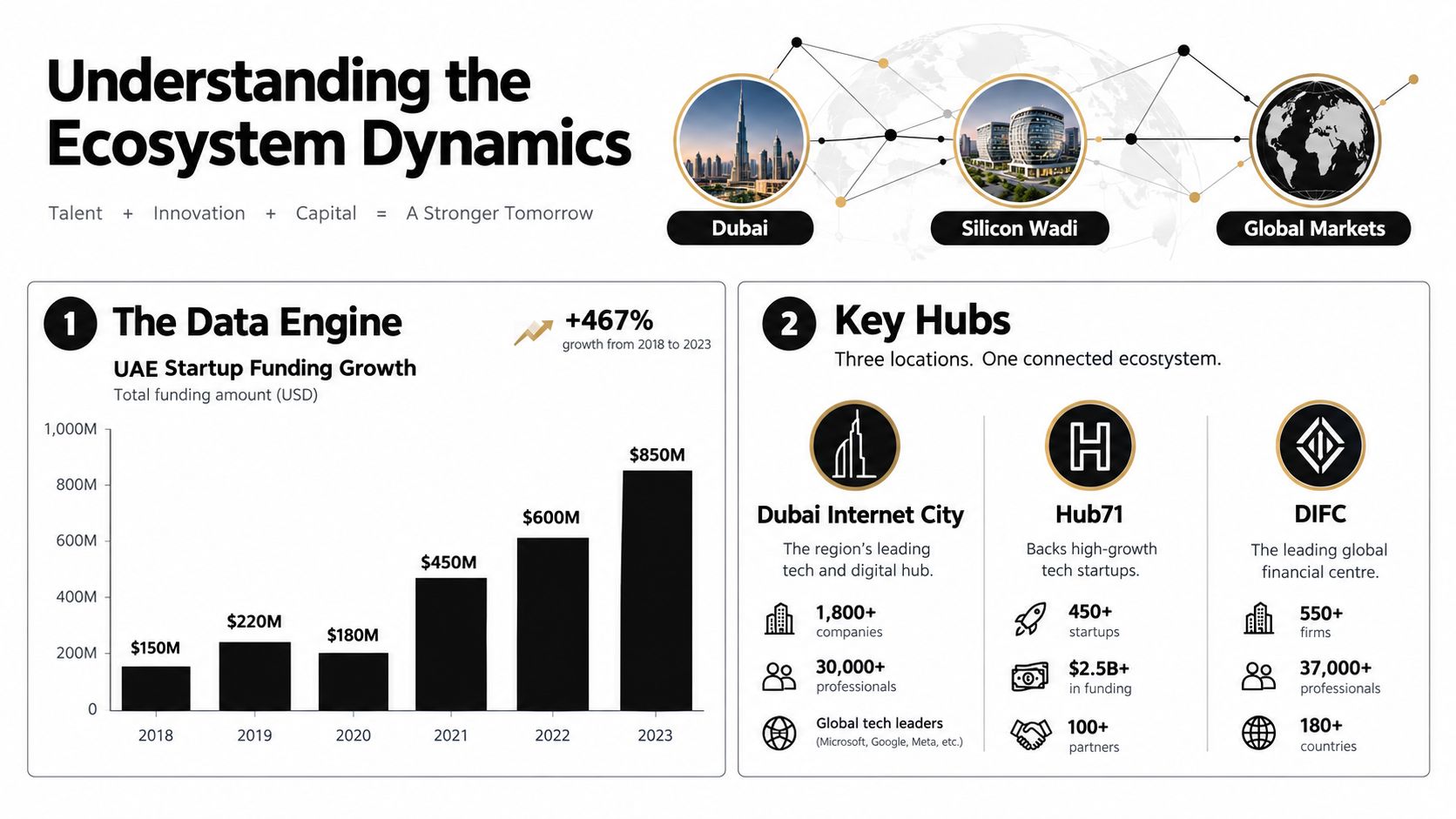
Dubai's Meetup culture makes more sense when you understand the market surrounding it. The city is hosting far more than casual founder gatherings. It sits inside an ecosystem with substantial scale-up activity, funding concentration, and an established network of investors and operators.
Dubai ranked 44th globally in the 2025 Global Startup Ecosystem Index, while the UAE ranked 21st globally and first among Arab countries. The same reporting put Dubai's ecosystem value at USD 21 billion and described continued growth in early-stage funding and activity in its coverage of the 2025 ranking.
Why conversations skew towards execution
Dubai's concentration of mature companies influences what people discuss in the room. A 2023 Dubai Chamber of Digital Economy report identified 306 scale-ups in the emirate, representing over 40% of MENA scale-ups, and said those companies had raised more than US$11.7 billion over the previous decade in the Chamber's report launch coverage.
That environment attracts conversations about capital efficiency, enterprise sales, hiring, licensing, cross-border expansion, and fundraising readiness. Founders still validate ideas in Dubai, but they'll often meet people who expect a clear commercial path rather than an interesting concept alone.
A separate report on Dubai's venture-capital ecosystem described the emirate's 306 scale-ups as accounting for 60% of MENA's cumulative fundraising total, with more than 30% of funding rounds tied to Dubai-headquartered startups, implying that 87% of UAE-based funding rounds involved companies based in the emirate according to its published findings.
Those figures don't mean every Meetup is investor-led. They do explain why a casual introduction can quickly turn into questions about customer acquisition, unit economics, regional readiness, or the next financing milestone.
What to prepare before you attend
Bring evidence of progress that matches your stage. An idea-stage founder might bring interview notes and a sharply defined customer problem. A product-led startup might bring activation observations, a buyer objection, or a live product question. A company preparing to raise should be ready to explain its traction, use of capital, and specific introduction request.
Dubai Startup Hub and Dtec have served a community of over 10,000 founders and investors, while ecosystem coverage highlights practical issues such as regulation, free zones, access to finance, and skilled talent in Dubai Chambers' overview. Use that context to make your questions concrete.
Ask about the trade-offs between mainland and free-zone setup, how a founder approached a first enterprise pilot, or which investor introduction is appropriate for your current stage. Don't ask the room to solve “growth” in general. Bring a decision.
Summits Versus Curated Meetups
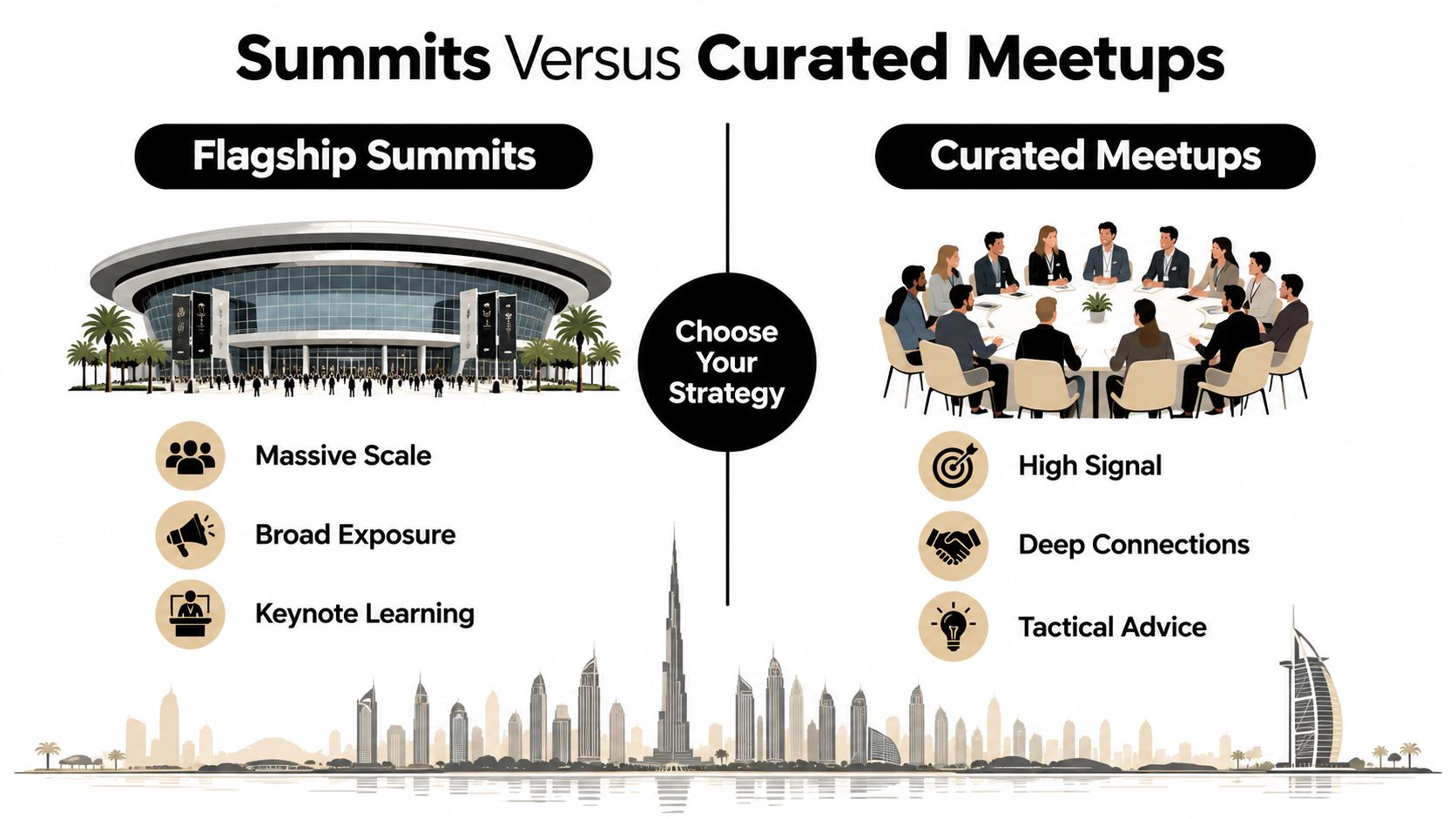
Summits and curated Meetups serve different jobs. A summit can help you understand broad market direction, meet a wide range of ecosystem participants, and place your company in front of people you wouldn't encounter in a smaller setting. A curated Meetup is better suited to focused discussion, honest feedback, and a follow-up conversation with a clear purpose.
Recent UAE coverage described the Doers Summit as bringing together over 3,000 founders, operators, investors, and ecosystem leaders, while Expand North Star 2025 reported more than 1,800 startups pitching to over 1,000 investors in its coverage of Dubai's startup activity. That scale is useful, particularly when you're mapping a market or looking for broad exposure. It also makes personal follow-up harder because attention is fragmented.
Choose based on the job to be done
Use a summit when you need:
- Market breadth: You want to hear several perspectives on a sector, geography, or technology.
- Visibility: You're ready to demonstrate your product to a wider audience.
- Partner discovery: You're mapping corporates, investors, accelerators, or ecosystem operators.
- Pattern recognition: You need to compare how different companies describe similar problems.
Choose a curated Meetup when you need:
- A decision challenged: You want experienced founders to test your assumptions.
- A relevant introduction: You need one customer, operator, investor, or potential collaborator.
- Accountability: You want to return with a concrete commitment and report progress.
- Trust: You need more than a short pitch before discussing a sensitive business problem.
The right comparison isn't “big versus small”. It's reach versus depth. A summit may put you in front of a useful contact. A smaller Meetup may help that contact understand your context well enough to make an appropriate introduction.
A busy room creates opportunity. A well-matched room creates momentum.
If you're planning a wider networking programme, this guide to business networking Meetups can help you distinguish between visibility-led attendance and relationship-led participation.
Operational details matter at large gatherings too. If your team is collecting attendee photographs or sharing content after a summit, a tool designed to streamline attendee photo sharing can reduce the administrative work around content distribution. That won't replace thoughtful follow-up, but it can make the post-summit process more organised.
Use both formats deliberately. Attend the summit to identify a shortlist of relevant people and questions. Use a curated Meetup to explore one of those relationships properly, with enough context to establish whether there's a real fit.
Core Meetup Formats and Scenarios
The format should match the problem you're trying to solve. Founder Connects lists five practical Meetup formats, each with a different interaction pattern. Choosing based on the calendar alone is a common way to waste time.
Pitch Night
Pitch Night suits founders who need visibility, structured feedback, or a fundraising warm-up. Don't treat it as a performance for its own sake. Use the pitch to expose one important question, such as whether your positioning is clear to a non-specialist investor or whether your customer problem sounds urgent enough.
A strong preparation task is to write down the feedback you want before you arrive. If your real concern is pricing, don't leave the room with only comments about your slides.
Coffee Series
Coffee Series works well for early conversations and practical peer exchange. It's a useful fit when you're validating a problem, entering the UAE market, or looking for another founder who has faced a similar operational issue.
The relaxed setting doesn't mean you should arrive without an objective. Prepare one question that can be answered from experience, such as how someone reached a first buyer or evaluated a potential partner.
Tech After Hours
Tech After Hours is suited to technical founders, product leaders, and operators who want a more focused discussion after the working day. Bring a product trade-off, implementation challenge, or technical-commercial question rather than a broad description of your technology.
For example, a founder building an AI workflow tool might ask how other teams handle enterprise proof-of-concept requests without turning every pilot into bespoke consultancy. That question creates a much stronger conversation than “What do you think of AI?”
The Playbook
The Playbook is for applied learning. It's a good choice when you need a repeatable approach to a business problem, such as selling into larger organisations, preparing for fundraising, or improving founder decision-making.
Take notes in the form of actions, not quotations. Leave with one experiment to run, one person to contact, and one assumption to test.
Cofounder Match
Cofounder Match addresses a different need entirely. It's for founders searching for complementary skills, shared commitment, and a workable relationship with a potential co-founder.
Don't evaluate someone only on their title or technical ability. Discuss availability, decision-making, risk tolerance, ownership expectations, and how each of you handles disagreement. A promising first conversation should lead to a structured follow-up, not an immediate commitment.
| Format | Best For | Primary Outcome |
|---|---|---|
| Pitch Night | Founders seeking feedback, visibility, or investor preparation | A sharper pitch and targeted introductions |
| Coffee Series | Early-stage validation and peer problem-solving | Practical feedback and relevant founder connections |
| Tech After Hours | Technical and product-led discussions | Applied advice on product or technology decisions |
| The Playbook | Founders seeking a repeatable operating approach | A concrete experiment or execution plan |
| Cofounder Match | Solo founders exploring a founding partnership | A structured conversation about fit and next steps |
Choose one primary outcome before you RSVP. If you need both fundraising feedback and a co-founder, attend the format that addresses the most urgent constraint first.
Preparation and Room Etiquette
Preparation begins before you enter the room. The most useful founders aren't necessarily the most polished speakers. They're the people who can explain what they're building, what they've learned, and what kind of help would move the company forward.
Founder Connects describes three common UAE Meetup mechanics: morning coffee Meetups run from 9:30 AM to 12:00 PM, after-work sessions begin around 3:30 PM to 4:00 PM and often use structured introductions and an Offer and Ask format, while evening socials start from 7:00 PM and allow looser founder-investor mixing in its UAE Meetup guide.
Match your preparation to the format
Morning coffee sessions favour clarity and energy. Decide which founder profile you want to meet before you arrive, then ask direct questions while the conversation is still fresh.
After-work sessions reward a concise Offer and Ask. Your offer might be a customer insight, a useful operator introduction, or feedback on a product decision. Your ask should be specific enough for another person to recognise someone relevant.
Evening socials are less structured, so don't force every conversation into a pitch. Start with the person's work, listen for a shared problem, and only explain your company when the context makes it useful.
Use a simple room protocol
- Prepare a 30-second introduction: State the customer, problem, current solution, and immediate objective.
- Bring one proof point: Mention a product test, customer conversation, pilot, or operational lesson that shows you're learning.
- Ask before offering: Find out what the other person is working on before presenting your own request.
- Respect boundaries: Investors and operators may be open to a future conversation but not ready to make an introduction on the spot.
- Record context: After each meaningful discussion, note the person's role, the relevant topic, and the agreed next action.
Room etiquette: A good introduction is a two-way exchange, not a timed monologue.
Avoid cornering one prominent investor for the entire evening. Speak with peers, operators, and ecosystem participants too. They often understand the practical route to a customer, regulator, partner, or specialist better than a generic investor conversation does.
Your goal isn't to speak to everyone. It's to identify two or three people with whom a follow-up would be useful, then make that follow-up easy.
Turning Introductions into Progress
The Meetup ends when the room closes. The relationship starts when you give the next conversation a clear reason to happen.
Send a message while the discussion is still specific. Avoid “great to meet you, let's catch up” unless you add the topic, the relevance, and a proposed next step. A peer founder should know why you're contacting them, what you remember, and what you're asking them to do.
For a founder you want to know better:
“Good speaking with you at Coffee Series. Your experience selling into regional enterprises was relevant to the procurement issue we discussed. Could we schedule a short call to compare approaches? I'll send the two questions I'm trying to resolve beforehand.”
For a potential investor:
“Thank you for the conversation at Pitch Night. You asked how we'll expand beyond our first customer segment. I've clarified that plan and attached a short summary. If the approach fits your focus, I'd value your view on the next proof point we should establish.”
For a potential co-founder, slow the process down:
“I enjoyed discussing the product and the way we each approach decisions. Rather than assume there's a fit, would you be open to a working session on the customer problem, responsibilities, and availability?”
If you need help shaping the wording, these follow-up email examples for coaches offer useful patterns for making a message specific without making it overly formal.
Use a 24-hour follow-up system
- Sort contacts immediately: Separate action-worthy introductions from general contacts.
- Write the context: Record the problem discussed and the person's stated priority.
- Send a personalised message: Mention the exact conversation rather than the Meetup name alone.
- Offer a small next step: Suggest a short call, a relevant introduction, or a document exchange.
- Track the commitment: Put the agreed action in your calendar and follow through.
Use this post-networking follow-up checklist when you need a repeatable process.
Residency can also matter if you want continuity rather than isolated attendance. Founder Connects presents Residency as a way to engage with an ongoing founder community, which can support repeated peer conversations and accountability. The practical test is simple: after your first Meetup, can you return with progress to report and a useful question for the same community?
Dubai rewards founders who turn introductions into evidence of execution. Choose the room that matches your current constraint, arrive with a precise Offer and Ask, and follow up while the context is still fresh.
Founder Connects offers curated Meetups, founder introductions, and ongoing peer support for builders across the UAE and wider MENA ecosystem. If you want meaningful conversations rather than generic networking, visit Founder Connects and choose the format or community pathway that matches your next business decision.

Building in MENA? You don't have to do it alone.
Join 300+ founders in the Founder Connects Residency. Monthly squad calls, warm intros, $3M+ in perks, and much more. All for less than your monthly coffee budget.
Popular posts





Founder Connects is a premium MENA tech founder community. Meetups in Dubai and across MENA, Residency Squads of 8–10, and 400+ vetted WhatsApp founders (apply and screened).