

Techstars vs 500 Global Mena Startups: Choosing An

Building in MENA? You don't have to do it alone.
Join 300+ founders in the Founder Connects Residency. Monthly squad calls, warm intros, $3M+ in perks, and much more. All for less than your monthly coffee budget.

You're staring at two accelerator logos, a half-finished deck, and one very real question, which programme helps a MENA founder win in this market? In the UAE, KSA, or Egypt, the wrong choice costs more than equity. It can send you into a cohort that looks impressive on paper but gives you the wrong kind of help for the market you're trying to crack.
| Decision factor | Techstars | 500 Global |
|---|---|---|
| Core strength | Mentor-heavy, relationship-dense support | International reach and cross-border network leverage |
| Best fit | Founders who need deep guidance in a specific ecosystem | Founders building for global or multi-market growth |
| Program shape | Roughly 3 months, city-based and vertical-specific | Roughly 4 months, broader international model |
| Network style | Deep, local, and highly connective | Wide, diverse, and more geographically distributed |
| Practical signal for MENA | Strong when you need local validation and warm introductions | Strong when your market map already crosses borders |
For founders in MENA, this is not a generic branding contest. It's a decision about what kind of advantage you need right now, investor credibility in one hub, or access across several markets. If your next 12 months depend on closing customers in Dubai, Riyadh, or Cairo, the local shape of the network matters. If your model already points to GCC plus wider international expansion, the breadth of the network starts to matter more.
Choosing Your Accelerator Techstars vs 500 Global
The painful part is that both names carry weight, and both can look “right” when you're under pressure. A founder in Dubai can get different advice from a VC, a mentor, and a peer operator, all in the same week. The trick is to stop asking which brand is stronger in the abstract and ask which one matches your actual market motion.
The real question is network fit
Techstars is the older and more globally distributed accelerator model, founded in 2006, with a footprint across 50+ cities and vertical-specific programmes, according to the comparison source in this article's verified data. That city-based design matters in the UAE because it's easier to plug into a specific regional ecosystem than to hope a single-location programme understands your market dynamics. The same source also describes 500 Global as the better fit when the primary market is international rather than US-focused, which is often the right frame for MENA founders who sell across borders.
Practical rule: if your biggest bottleneck is access to people who already know your market, choose the programme that puts you closer to the people you need, not the programme with the louder global brand.
For UAE and MENA founders, that means one thing, don't overvalue prestige if your real challenge is commercial traction. A founder selling into government, enterprise, logistics, fintech, or regional consumer categories usually needs a dense web of intros, trust, and follow-on support. That is where the structure of the programme matters more than the logo on the acceptance email.
Why MENA founders keep getting this wrong
A lot of founders treat accelerators as if they were interchangeable. They're not. One model is built to help you go deep in a specific community, the other is built to help you go wide across markets.
Techstars also has a reputation for intense mentorship. One independent overview says founders can have over 100 mentor meetings during the first month of “mentor madness,” which shows how relationship-heavy the programme is. If you are trying to validate product-market fit in Dubai, Abu Dhabi, or Riyadh, that kind of density can be more useful than broad, generic visibility. It gives you repeated exposure, fast feedback loops, and a better shot at finding operators who understand your sector.
The trade-off is simple. If you need a high-signal, locally connected environment, Techstars is often the sharper tool. If you need cross-border momentum from the start, 500 Global starts to look more aligned.
The Techstars Model A Deep Dive for MENA Founders

Techstars works best when a founder needs repeat exposure to the right people, not just one polished demo day. The standard model has been described as about US$20,000 in startup capital plus a three-month programme and lifetime access to the Techstars network in one comparison source, and as US$120,000 for 6% equity in another comparison source. The number you focus on depends on the programme, but the operating idea stays the same, the accelerator is buying into your company in exchange for structured access, guidance, and network effects.
Why the city-based model matters in Dubai, Abu Dhabi, and Riyadh
Techstars is a franchise-style network, not a single campus. That's useful for MENA founders because your business rarely lives inside one neat market box. A logistics startup might start in Dubai, sell into Saudi Arabia, and recruit in Egypt. A fintech founder might build in the UAE but need credibility with investors and partners across the Gulf.
The city-based structure means the programme can be plugged into an existing ecosystem rather than trying to flatten it into a generic global batch. That matters when relationship capital is concentrated in specific hubs. A founder who needs support from regional angels, sector specialists, or corporate partners will usually get more value from a programme that is built around proximity and local trust.
What Techstars really sells is density. Not density of marketing, density of people who can open doors, pressure-test the product, and keep the conversation going after the cohort ends.
That last point is important. Lifetime access to the Techstars network changes the value proposition from a short-term bootcamp into a long-tail relationship platform. In MENA, where a warm intro often matters more than a cold pitch, that can be the difference between a useful meeting and a dead end.
The mentor-heavy model in practice
Techstars is unusually intense on mentorship. The “mentor madness” phase, with its very high volume of mentor meetings, is not just a colourful programme detail. It's a signal about how the accelerator expects you to work. You're not there to be passive, and you're not there to be handheld. You're there to absorb advice, filter it quickly, and convert it into decisions.
That works for founders who can already communicate clearly and want external validation. It doesn't work as well for teams who need a broad market network more than a thick advisory layer. In Dubai or Riyadh, that distinction matters because many startups don't fail from lack of ambition. They fail because the founder can't get enough qualified feedback from people who understand the region's buying patterns, procurement behaviour, and trust dynamics.
Techstars often gives founders a better shot at that kind of learning. If your problem is “I need the right people in the room,” this model is built for that.
The 500 Global Model A Playbook for International Scale

If Techstars is about depth, 500 Global is about reach. For a MENA founder, that usually means the difference between building inside one ecosystem and building for a market map that already spans several of them. One comparison source says that if the primary market is international, “500 Global or a regional program is where you get real network leverage.” That's the key phrase. Real leverage is not random intros. It's a network that can help you move between geographies.
What international growth looks like for a MENA startup
International growth is not a vanity metric. For many UAE founders, it's a survival strategy. Your first serious customers may be in the Gulf, but your hiring, distribution, or funding path may stretch into Egypt, North Africa, Europe, or the wider diaspora. A network that understands only one market can leave you stranded when you try to expand.
500 Global is generally positioned as the better fit for founders focused on international growth or operating outside traditional tech hubs. Another comparison source describes the standard model as roughly US$150,000 for 6% equity over four months, with weekly workshops and mentor access. That structure is useful when a founder wants a mix of capital, structure, and access to a wider, more diverse set of relationships.
For a startup in the UAE, that can be especially relevant if the company is built to sell beyond one city from day one. A consumer brand that wants GCC distribution, a SaaS company targeting several MENA markets, or a fintech building toward cross-border partnerships may all benefit from a programme that's less geographically narrow.
Where the model fits and where it doesn't
500 Global's broad network is an advantage when you need cross-border motion. It's less useful if you're trying to do deep ecosystem embedding in one city. A founder with a very local commercial cycle, for example enterprise sales into one regulator-heavy market, may prefer the narrower, more relationship-dense support of Techstars.
That's the core trade-off. 500 Global gives breadth. Techstars gives depth. One is not “better” in isolation. They solve different problems.
If your team needs introductions across the Gulf, North Africa, and global investor circles, 500 Global starts to make more sense. If your biggest need is a concentrated room full of mentors who can keep pressure on your product and open regional doors, Techstars is usually the cleaner fit.
Program Comparison Investment Terms Network and Structure
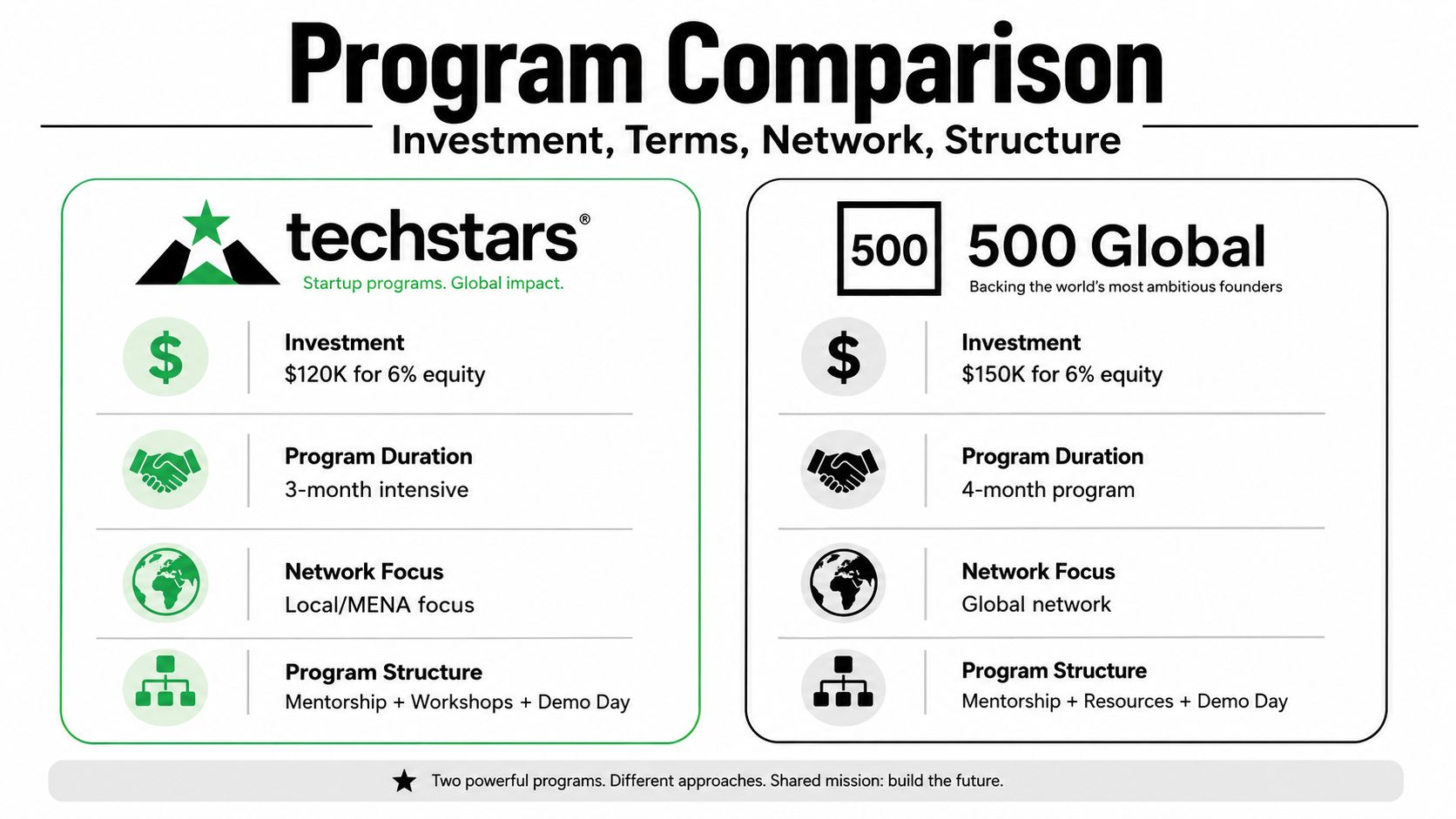
A founder in Dubai, Riyadh, or Cairo usually feels the difference only after the paperwork is signed. The pitch sounds similar at first, but the key trade-offs show up in equity, support style, and who keeps picking up the phone after the cohort ends. In MENA, that matters more than accelerator branding.
If you want the side-by-side view first, this program comparison chart lays out the structure, investment, and network focus in one place.
| Category | Techstars | 500 Global |
|---|---|---|
| Investment terms | Comparison sources describe a standard package around US$20,000 in startup capital plus access, and another source frames it as US$120,000 for 6% equity | Comparison source describes roughly US$150,000 for 6% equity |
| Duration | About three months | About four months |
| Network shape | Mentor-centric, city-based, relationship dense | International-first, broader and more diverse |
| Core use case | Deep ecosystem integration | Cross-border growth and market expansion |
For founders in the UAE, KSA, or Egypt, that table is the practical starting point. Techstars is usually the better fit when the next step depends on concentrated local relationships, repeat access to mentors, and a tighter operating cadence. 500 Global makes more sense when the company already needs reach across markets, or when the founder wants the programme to function as a bridge into multiple regions at once.
Equity is not the whole story
Founders often fixate on the headline equity number and miss the part that decides whether the programme pays off. A smaller ask is not automatically a better deal if the support is too generic for your market. A larger ask can be worth it if the people around the table help with distribution, hiring, partners, or follow-on capital.
The comparison sources in the brief describe Techstars as the more mentor-dense accelerator and 500 Global as the one built for broader international reach. That difference is the essential filter. You are not only buying capital. You are buying the shape of the network, the likelihood of useful follow-up, and whether the introductions are to people who understand your operating reality in MENA.
The structure signals the operating style
Techstars' shorter, more intense format suits founders who can move fast and absorb feedback without losing focus. 500 Global's slightly longer structure gives teams more room to connect market signals across countries and to turn scattered conversations into a wider expansion plan.
For a UAE startup selling into local enterprises, the narrower model can be more productive because the same names, buyers, and advisors keep coming back into the process. For a founder whose customers are already spread across the GCC or beyond, the broader network can compound faster. Genuine network value is not random intros. It is whether the programme gives you access to people who can move a deal, shape a hiring decision, or open a market door when it counts.
Before you apply, read the accelerator equity cost breakdown and price the programme as a whole, not just the equity line.
Which Accelerator Aligns with Your Startup Stage and Sector
For pre-seed founders, the decision usually comes down to whether you need sharp feedback or broad reach. A B2B SaaS team in Dubai that hasn't fully nailed product-market fit usually benefits more from Techstars' mentor density. A founder can test pricing, refine the pitch, and get repeated input from people who understand the local business environment.
Match the programme to the kind of risk you're carrying
If the risk is commercial clarity, Techstars tends to be the cleaner choice. If the risk is geographical ambition, 500 Global is often more aligned. A startup in e-commerce, consumer, or cross-border software that already has early traction may use 500 Global to think bigger, especially if the next step is market entry outside the UAE.
For FinTech, the answer depends on the company's motion. If the product depends on institutional trust, licensing awareness, and ecosystem credibility in one hub, Techstars can help more. If the fintech is designed for multi-market expansion and partner discovery, 500 Global's international reach starts to matter more.
For deep tech or hardware-adjacent startups, mentor quality and sector-specific access are usually the priority. That doesn't automatically make one accelerator right and the other wrong. It means you should ask who in the programme has shipped with founders like yours.
A simple way to self-sort
- Choose Techstars if you need a dense mentor layer, warm introductions in a specific city, and ecosystem validation in the UAE or Saudi market.
- Choose 500 Global if you need international partner access, cross-border investor reach, and a network that can support expansion beyond one market.
- Pause before applying if your team cannot explain where the next customer comes from. No accelerator can fix that for you.
One useful outside resource is the Founders guide to accelerator selection criteria, which is helpful if your co-founders are split on whether you need depth or breadth.
The best founders don't ask, “Which programme is famous?” They ask, “Which programme matches our current bottleneck?” That question saves months.
MENA Alumni Success Stories and Founder Outcomes
The most useful founder outcomes are usually boring in the right way. A Dubai fintech doesn't need a dramatic accelerator story. It needs a better path to enterprise conversations, a few trusted introductions, and a cleaner fundraising narrative. That is often what the right accelerator network helps create.
A representative Techstars-style outcome in MENA looks like this. A founder uses the mentor-heavy environment to refine a regulated product, gets repeated feedback from operators who understand the market, and leaves with warmer intros into regional decision-makers. The gain isn't the demo day stage. It's that people in the ecosystem start treating the startup as pre-vetted.
A representative 500 Global-style outcome looks different. A Riyadh or Dubai-based consumer or SaaS founder uses the broader network to open conversations in several markets, then leans on those relationships to test demand outside the home market. The programme's value comes from its reach, not from overfitting the company to one ecosystem.
What founders should copy, not just admire
- Use the network for customer access first. Fundraising comes later. The accelerator should help you tighten the sales story before it helps you decorate the deck.
- Track what changes after the programme. Did you get better warm intros, better partner meetings, or just better social proof?
- Borrow from operator playbooks. If you want another practical lens on market entry and messaging, the actionable marketing insights resource from ReachLabs.ai is useful because it focuses on execution rather than theory.
Don't measure an accelerator by how many people know its name. Measure it by how many of the right people answer your follow-up.
For MENA founders, the goal is usually not to become an “accelerator company”. It's to leave the programme with enough trust, momentum, and network density to raise well and sell faster. That's what makes the choice between Techstars and 500 Global matter.
A Founder's Framework for Making the Right Choice
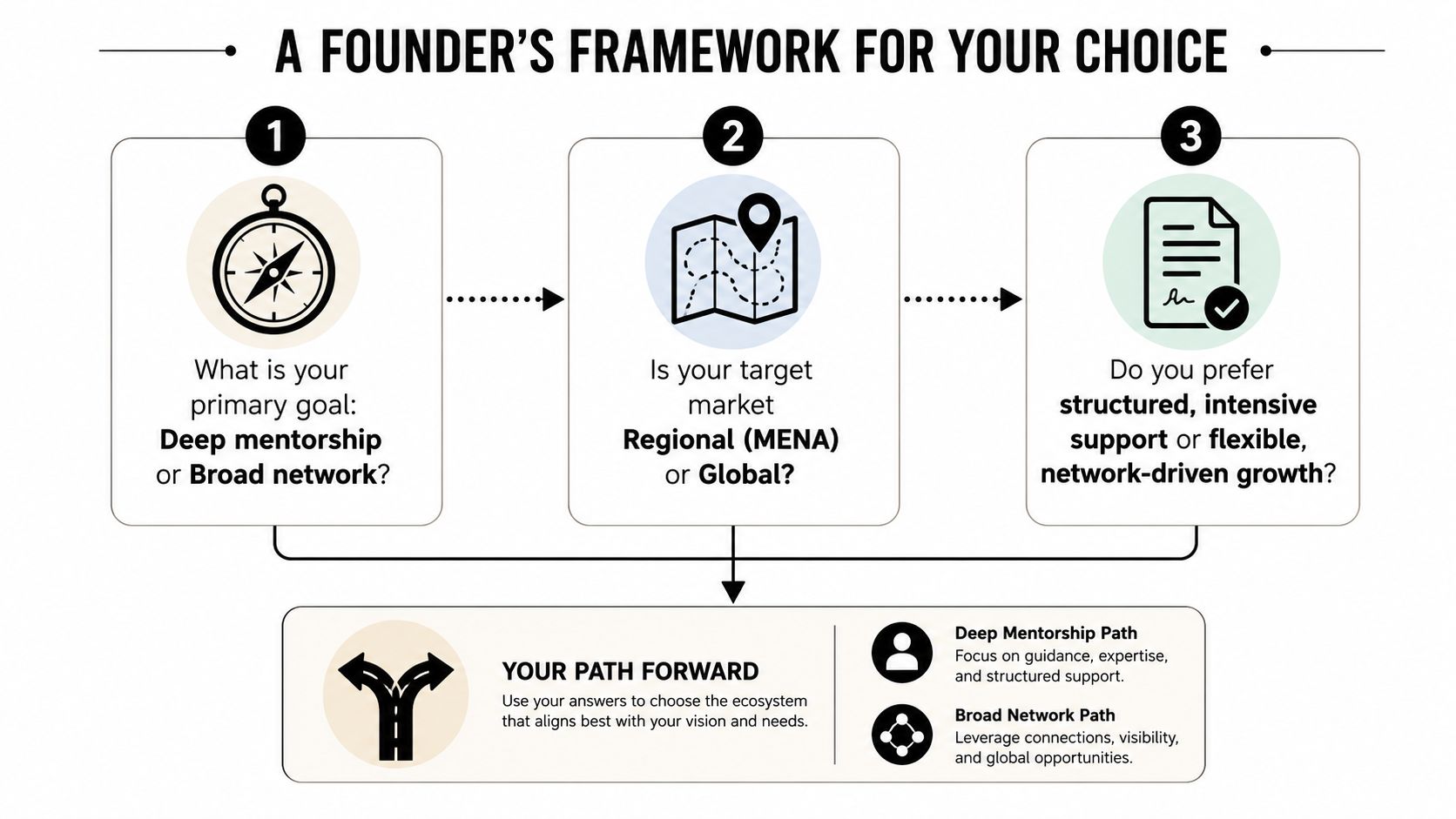
Before you apply, sit down with your co-founder and answer these questions directly.
- What is the next 12-month goal? If it is deep local traction in the UAE, KSA, or Egypt, choose the programme that gives you mentor density and tight operator feedback. If the goal is multi-market expansion, choose the one built for international growth.
- What do you need more of? If the answer is guidance from operators who will stress-test the product, Techstars usually fits better. If the answer is introductions across regions, 500 Global usually fits better.
- Where will your next customers come from? If the answer is one ecosystem, pick the more localised network model. If the answer is several geographies, pick the broader one.
- How much structure does the team need? Some teams work best under intensive, tight feedback. Others need a programme that gives them room to test markets and partnerships without being boxed in too early.
The accelerator selection criteria guide is worth using as a final checklist before you send the application. It helps you compare fit instead of chasing brand names.
The critical question is not which accelerator has the stronger logo. It is which one matches your market motion, your stage, and your fundraising path in the MENA region. A founder in Dubai, Riyadh, or Cairo who gets that decision right usually wastes less time, burns less social capital, and reaches meaningful progress faster.

Building in MENA? You don't have to do it alone.
Join 300+ founders in the Founder Connects Residency. Monthly squad calls, warm intros, $3M+ in perks, and much more. All for less than your monthly coffee budget.
Popular posts





Founder Connects is a premium MENA tech founder community. Meetups in Dubai and across MENA, Residency Squads of 8–10, and 400+ vetted WhatsApp founders (apply and screened).