

UAE Golden Visa for Startup Founders: Your 2026 Guide

Building in MENA? You don't have to do it alone.
Join 300+ founders in the Founder Connects Residency. Monthly squad calls, warm intros, $3M+ in perks, and much more. All for less than your monthly coffee budget.

If you're looking at the UAE as your base, you're probably not chasing a visa for vanity. You want stability, the ability to build without resetting your residency every year, and a setup that doesn't make every bank call, investor meeting, and hiring decision harder than it needs to be.
That's where the UAE Golden Visa becomes practical. For startup founders, it's less about prestige and more about operating room. You can plan longer, move faster, and stop tying personal residency to short-term company admin.
The problem is that most advice on the UAE Golden Visa for startup founders is written as if you already have a UAE entity, local traction, and clean eligibility. Many founders don't. They're still abroad, still pre-incorporation, and trying to solve a sequencing problem. As noted by Auxilium's overview of the entrepreneur route, founders applying from outside the UAE often first receive a six-month, multiple-entry visa to establish the business before the longer residency is issued. That creates the exact chicken-and-egg issue most guides ignore.
If that's where you are, the confusion is normal. You need local momentum to qualify cleanly, but you also need legal access and time on the ground to create that momentum. That gap is real, and it's one reason founders mix up founder residency options, incubator-backed routes, and longer-term status. If you're still deciding which route makes sense before incorporation, this breakdown of founder residency versus accelerator pathways is worth reading before you spend money on setup.
Practical rule: Don't start with the application form. Start by identifying which evidence you can prove today, and which evidence still needs to be created.
The founders who get through this efficiently usually do three things well. They choose the correct path early, they prepare documents in the format reviewers expect, and they budget time for nomination, not just visa processing. That last part is where most “fast” timelines fall apart.
Your Founder Journey and the UAE Golden Visa
For most founders, the UAE Golden Visa becomes relevant at one of three moments. You're scaling and want long-term residency independent of an employer. You've had an exit and want to anchor your next company in the region. Or you're still early, but you know the UAE is where you want to build and raise.
The visa works best when you treat it as an operating decision, not an immigration side task. A founder with clear residency status is easier to diligence, easier to onboard into local systems, and usually more credible in conversations that require long-term commitment. That's especially true when you're opening accounts, signing leases, or proving that you're not passing through.
The gap most founders hit
The hardest version of this process is the one few people talk about. You're outside the UAE, you don't yet have the full local footprint, and you need a route that gets you in legally so you can build what the later application expects. That's where the pre-incorporation gap shows up.
Some founders should not start with the Golden Visa application itself. They should start with incubator conversations, a tighter project deck, and a valuation narrative that can survive review. If you skip that groundwork, you end up paying for submissions that were never ready.
What actually matters
Ignore broad promises about “easy approval” or “startup-friendly systems”. The questions that matter are simpler:
- Can you prove revenue, a prior exit, or project value clearly?
- Do you have the right validating body for your route?
- Are your documents organised for review, not just collected in a folder?
- Can you stay patient during the nomination stage, which is often slower than the formal visa stage?
Founders who answer those properly waste less time and less money.
Are You Eligible The Three Paths for Founders
There are several Golden Visa categories in the UAE more broadly, including entrepreneur, investor, and talent routes. For startup founders specifically, the entrepreneur category is usually the cleanest fit. Within that category, there are three practical paths.
As outlined by AMCA's entrepreneur eligibility guide, a founder qualifies if they meet one of these thresholds: annual revenue of at least AED 1,000,000, a previous startup sold for at least AED 7,000,000, or a promising project idea valued at no less than AED 500,000 and approved by an accredited UAE business incubator.
UAE Golden Visa Paths for Startup Founders
| Criteria | Path 1: Established SME | Path 2: Successful Exit | Path 3: Pioneering Project |
|---|---|---|---|
| Core basis | Existing startup performance | Previous founder exit | Early-stage innovative project |
| Main threshold | AED 1,000,000 annual revenue | AED 7,000,000 sale value | AED 500,000 project value |
| Proof expected | Audited financial statements | Sale proof and approval evidence | Valuation evidence plus incubator backing |
| Best fit for | Operating startup with traction | Repeat founder with documented outcome | Pre-revenue or early founder with strong concept |
| Main risk | Revenue isn't documented correctly | Sale evidence is incomplete | No credible incubator nomination |
A more detailed view of current UAE startup visa requirements in 2026 can help if you're still comparing entrepreneur residency options.
Path 1 works for founders with real operating history
This is the cleanest route on paper if your company is already functioning like a serious SME. But “we're doing well” isn't enough. The file has to show the revenue in a way the reviewer can verify. If your accounts are messy, delayed, or spread awkwardly across entities, this route becomes weaker than founders expect.
This path suits founders who already have audited reporting discipline. If that's not you yet, forcing this route usually leads to friction.
Path 2 is excellent if your paperwork is complete
If you've sold a previous startup, this route can be straightforward. The key word is documented. The sale needs to be evidenced properly and accepted by the relevant authority.
A founder with a real exit but poor documentation can have a weaker file than a pre-seed founder with a sharp incubator-backed project.
This is often the best option for second-time founders entering the UAE with a new venture in mind. It doesn't depend on your current startup producing local revenue immediately.
Path 3 is where most early founders should focus
This is the route people talk about most, and also the one they misunderstand most. It is not “idea only”. It is idea plus valuation plus incubator endorsement. That combination is what makes the file credible.
For pre-seed founders, this path is the practical bridge into the ecosystem. But it only works if your deck, market logic, founder profile, and growth case are strong enough for an accredited incubator to back you formally.
Entrepreneur, investor, or talent
For founders, I'd usually test the routes in this order:
- Entrepreneur first if your company or project is the basis of your move.
- Investor second if your main qualification comes from capital deployment rather than startup building.
- Talent third if your profile is better framed around specialist achievement than venture creation.
Most founders overcomplicate this. Start with the route your documents support today.
The Document Checklist That Actually Works
A weak application usually isn't rejected because the founder is unqualified. It's rejected because the file doesn't tell the story cleanly. Reviewers shouldn't have to hunt through attachments to figure out who you are, what the business is, and why you qualify.
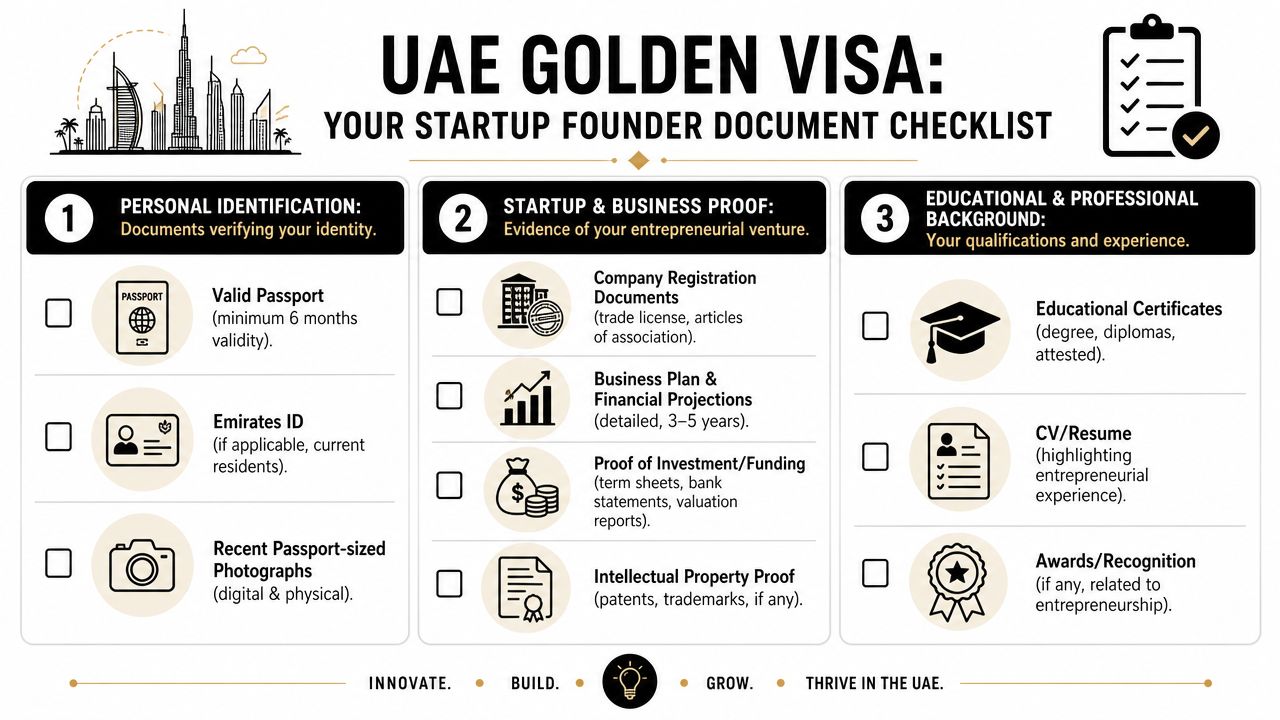
Core documents almost everyone needs
Start with the basics. Keep these in one clean folder, with filenames that make sense.
- Passport copy: Use a valid passport with enough runway left on it.
- Photographs: Keep digital and print-ready versions.
- Emirates ID: Only if you already have one as a current resident.
- CV or founder profile: Focus on operating experience, not buzzwords.
- LinkedIn profile: Make sure it matches your CV and current company narrative.
Documents by eligibility path
If you're applying through the revenue route, your file needs financial discipline.
- Revenue evidence: Audited financial statements for the relevant period.
- Company documents: Trade licence, incorporation papers, and ownership records.
- SME alignment: If your company sits in a regulated or unclear activity category, verify that early.
- Supporting company pack: A short deck that explains what the business does helps reviewers orient fast.
If you're applying through an exit:
- Sale proof: Keep definitive sale documents ready.
- Authority-ready paperwork: Don't submit partial transaction evidence and hope it's enough.
- Founder identity link: Make it easy to see your role in the sold company.
If you're applying through the incubator-backed project path:
- Business plan: Not generic. It needs to show technical quality and market logic.
- Project valuation evidence: This is the part many early founders underestimate.
- Incubator acceptance: An email saying “welcome” isn't the same as formal backing.
- Nomination letter: This is often the document that turns an interesting startup into an admissible file.
For some founders, corporate paperwork takes longer than the visa file itself. If your business documents still need local certification, chamber-related admin, or supporting trade records, sort that out before submission. This guide to the Chamber of Commerce certificate process in Dubai is useful if your file needs that layer of business documentation.
Checklist test: If a reviewer opened only your top ten files, would they understand your eligibility in under five minutes?
One small but costly mistake
Don't dump everything into a single PDF. Use a simple folder structure. Personal documents, company documents, financial proof, and nomination materials should each be separate. Good organisation won't guarantee approval, but bad organisation absolutely slows things down.
The Application Process from Nomination to Visa Stamp
The official flow sounds simple. In practice, it is simple only after the nomination is secured. Before that, the process is mostly about validation. That's why founders who focus only on the ICP step often feel blindsided by delays.
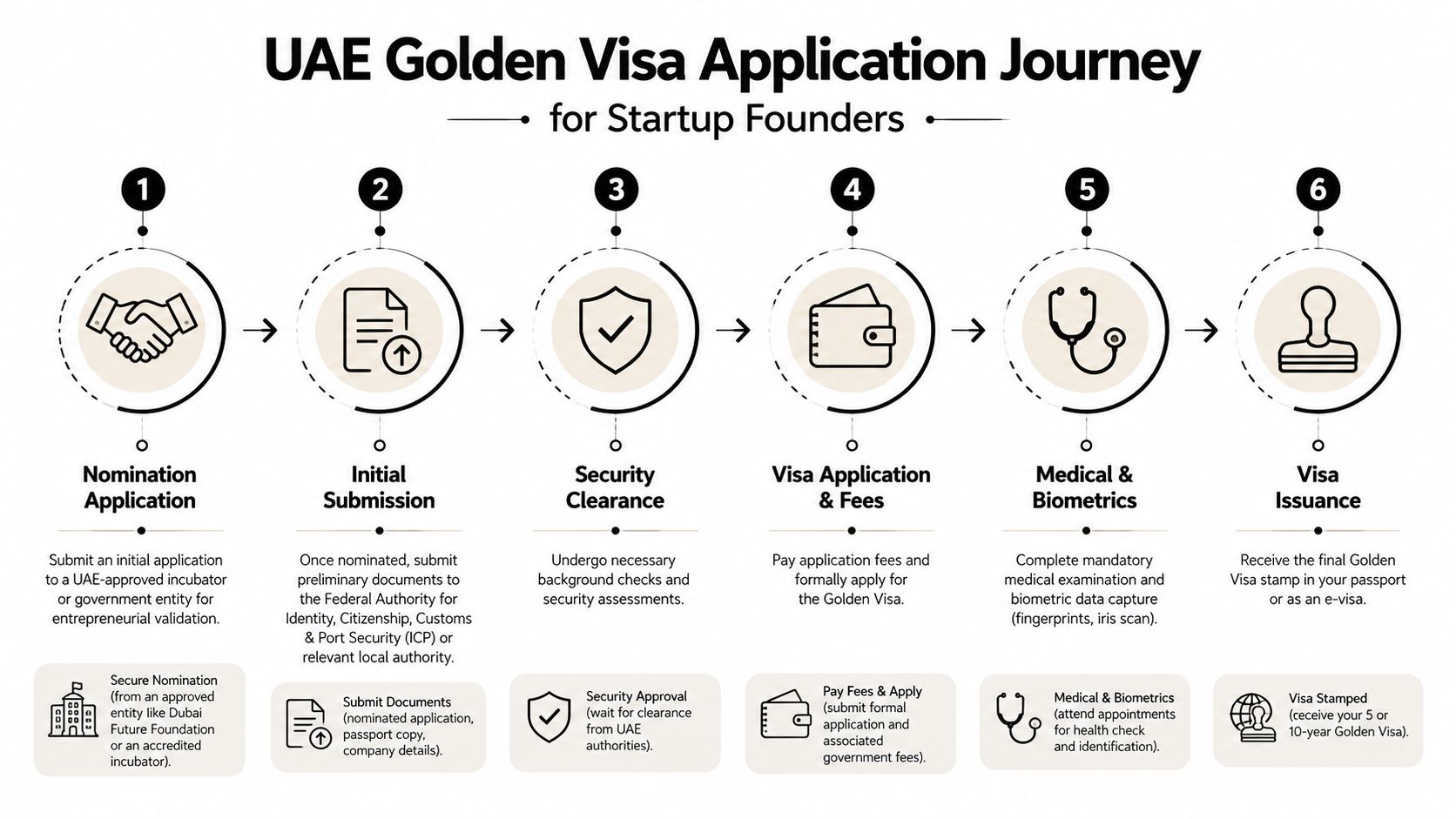
According to SKP Federation's breakdown of the entrepreneur process, the incubator route typically involves securing acceptance and a formal nomination letter from an accredited entity such as Hub71, DTEC, or in5, then submitting that to the Federal Authority for Identity, Citizenship, Customs & Port Security, completing medicals and biometrics, and receiving the visa. The same source also notes a common rejection trigger: founders confuse the AED 500,000 project valuation requirement with the AED 1,000,000 annual revenue requirement for SMEs.
Step 1 starts before the government portal
For early founders, the first real step is getting your startup into shape for incubator review. That means:
- Tight deck.
- Coherent business plan.
- Founder profile that shows why you can execute.
- Clean explanation of what makes the project pioneering.
If your materials are vague, the visa process hasn't really started yet. You're still in the “earn validation” phase.
Step 2 secure the nomination properly
This isn't a casual recommendation letter. The nomination is the technical validation that your project is worth backing within the entrepreneur route.
The strongest nominations usually come when your application package is already investable in tone. Not over-designed. Just clear, specific, and grounded.
Step 3 submit the formal application
Once the nomination is in hand, the process becomes more administrative:
- Upload nomination and personal documents
- Submit company or project materials
- Complete any required identity checks
- Wait for authority review
- Move into medical and biometrics
- Receive visa issuance outcome
This stage is usually less subjective than the nomination stage. Most of the heavy lifting has already happened.
Step 4 complete the UAE-side formalities
Medical fitness and Emirates ID biometrics are not optional process details. They're operational steps that still need scheduling and coordination. If you're applying from abroad, plan your travel and availability carefully.
The formal visa stage often moves faster than the period it took to become nomination-ready.
What founders get wrong about process sequencing
Many applicants try to submit first and explain later. That doesn't work well here. The process rewards prepared founders, not rushed founders.
A better order is:
- Choose the route
- Build the proof
- Secure nomination or evidence
- Submit only when the file is internally coherent
That one sequencing change saves a surprising amount of time.
Beyond Residency Real Benefits for Your Startup
A founder lands in Dubai on a visit status, spends two weeks opening bank conversations, meeting a free zone, and pitching early hires, then starts hearing the same question in different forms: are you staying here long enough to build this properly? That is where the Golden Visa starts to matter commercially, not just legally.
The main benefit is time. A longer residency window lets founders make decisions on a 12 to 24 month operating horizon instead of planning around the next renewal cycle. In practice, that changes how you set up the company, when you hire, and how seriously local counterparties take your commitment.
Here is where founders usually feel the difference first:
- Banking and compliance: A stable residency profile makes onboarding discussions easier, especially when the business is new and the founder is still building local transaction history.
- Investor confidence: Funds and angel investors want execution risk low. If your right to remain in the UAE looks stable, one obvious concern is removed from diligence.
- Supplier and customer trust: Enterprise buyers, payment partners, and service providers are more comfortable signing with a founder who clearly plans to stay.
- Hiring: Senior candidates ask quieter questions about founder stability than many people expect. Long-term residency answers some of them before they are spoken.
The pre-incorporation gap is where this becomes especially useful. Founders applying from outside the UAE often need credibility before the company is fully operational in-country. The visa helps close that gap. You can arrive, complete the formalities, and build from a position that looks more permanent to banks, landlords, partners, and recruits.
That does not mean the visa solves operating problems. It gives you the room to solve them properly.
I have seen founders waste their first six months in the UAE because they treated residency as the finish line. The better approach is to use that stability to tighten the basics fast: entity setup, banking, accounting, sales documentation, and customer operations. If support is still sitting in the founders inbox at that stage, fixing it early pays off. This guide to customer support automation is a practical place to start.
There is also a credibility effect that is hard to quantify but easy to notice in meetings. A Golden Visa does not make a weak business stronger. It does signal continuity. In the UAE, continuity matters. People want to know you can still be here to close the next round, sign the next contract, and handle the next problem yourself.
For startup founders, that is the primary benefit. You stop operating like a temporary guest and start operating like a builder with enough runway to execute.
Common Pitfalls and Real World Timelines
The advertised timeline is only part of the story. Founders often hear that startup-related categories can move in roughly 6 to 12 weeks once submitted, as noted in Founder Connects' startup visa guide. That's useful, but incomplete. It describes the formal process better than the actual founder journey.

The complete timeline includes preparing the business case, getting financials or sale proof in order, applying to an incubator if needed, waiting for nomination, then handling the actual government steps. For some founders, that means the “visa process” starts long before the portal submission.
Where delays actually happen
The biggest delays usually come from one of four places:
- Wrong eligibility path: The founder applies under the route they want, not the route their documents support.
- Weak incubator package: Good startup, poor presentation.
- Incomplete proof: Missing sale evidence, unclear valuation, or financial statements that don't line up.
- Loose personal profile: CV, LinkedIn, and company materials tell different stories.
For the Abu Dhabi route, the Abu Dhabi Residents Office entrepreneur page is especially useful because it makes the document expectations concrete. Applicants may need a trade licence if applicable, company profile or deck, LinkedIn profile, acceptance letter into an incubator or accelerator, and a nomination letter from the incubator. Founders applying based on a previous sale must provide proof that the transaction reached AED 7,000,000.
The timeline I'd tell a founder to expect
If your route depends on nomination, don't anchor on the published processing window alone. Think in phases:
- Qualification phase: Proving you fit the route.
- Preparation phase: Cleaning up docs and business materials.
- Nomination phase: Getting accepted and endorsed.
- Submission phase: Formal filing and review.
- Completion phase: Medicals, biometrics, issuance.
That's the actual clock.
A short explainer can help if you want to see how founders frame this process in practice:
What doesn't work
Don't rely on verbal assurances from intermediaries who haven't reviewed your actual documents. Don't assume a strong product automatically makes a strong visa file. And don't wait until the last minute to align your deck, company profile, and founder background.
If your application story changes depending on which document someone opens first, expect delays.
Your Golden Visa Questions Answered
Can you sponsor family on a Golden Visa
In practice, founders use the Golden Visa because it supports longer-term stability for the household, not just the company. Family sponsorship is one of the reasons the route is attractive. The exact administrative steps depend on your status and filing route, so handle that as a separate process after your own approval is clear.
What does renewal look like
Renewal depends on whether you still meet the relevant criteria for the route you used. Keep your core evidence organised from day one. That means financial records, company documents, and any nomination-related paperwork should stay accessible even after approval. Founders who treat approval as the finish line often create renewal problems later.
What if your startup pivots
A pivot isn't automatically a problem. What matters is whether your legal and documentary position still supports the basis on which your visa was granted. If the company changes direction, keep the paperwork aligned. A mismatch between what the file says and what the company now does is where complications begin.
What if the startup fails
This is the question almost every founder contemplates. The practical answer is that you should not assume all scenarios are treated the same. If the business materially changes, closes, or no longer matches the original qualification basis, get advice before making further immigration moves. Don't wait until a bank, authority, or renewal process surfaces the issue.
Do you need to live in the UAE full-time
Founders want flexibility, especially if they're building across MENA. But residency planning should be based on current immigration rules and your own use case, not founder folklore. If travel frequency matters to you, confirm the rule set that applies to your category before you optimise around it.
What's the best next step if you're unsure
Use a simple decision filter:
- Already operating and revenue-backed? Prepare the SME route.
- Past exit with strong proof? Use the successful founder route.
- Early-stage but high-potential? Focus on incubator acceptance first.
That last route is where many strong founders should begin, especially if they're outside the UAE and still building their first layer of local traction.
Founder Connects helps UAE and MENA founders make progress faster through curated peer groups, practical support, and warm introductions that don't waste your time. If you want a sharper founder circle while you build, apply to Founder Connects.

Building in MENA? You don't have to do it alone.
Join 300+ founders in the Founder Connects Residency. Monthly squad calls, warm intros, $3M+ in perks, and much more. All for less than your monthly coffee budget.
Popular posts





Founder Connects is a premium MENA tech founder community. Meetups in Dubai and across MENA, Residency Squads of 8–10, and 400+ vetted WhatsApp founders (apply and screened).