

UAE Startup Visa Requirements 2026: A Founder's Guide

Building in MENA? You don't have to do it alone.
Join 300+ founders in the Founder Connects Residency. Monthly squad calls, warm intros, $3M+ in perks, and much more. All for less than your monthly coffee budget.

You're probably in one of three situations right now. You've set up a company and need the cleanest residency path. You're planning a UAE move and trying to work out whether the “startup visa” is real or just marketing shorthand. Or you already run a revenue-generating startup and want to know if the newer entrepreneur Golden Visa routes let you qualify without parking AED 2M in the wrong place.
That confusion is normal. The UAE visa system is workable, but only if you treat it like an operations process, not a branding exercise. Founders lose time when they chase the wrong visa category, submit to the wrong authority, or assume a business licence automatically solves residency.
Here's the practical version of the UAE startup visa requirements 2026. Which route fits which founder, what documents are key, where applications stall, and how to move without wasting weeks.
Quick-Reference Visa Comparison for Founders
A founder usually feels the visa problem at the wrong moment. The company is almost ready, the bank account is still pending, and someone says, "just get the startup visa" as if that is a single product with one application form. It is not. The right choice depends on what you already have: revenue, valuation evidence, shareholding documents, or a newly formed company that needs a practical residency route first.
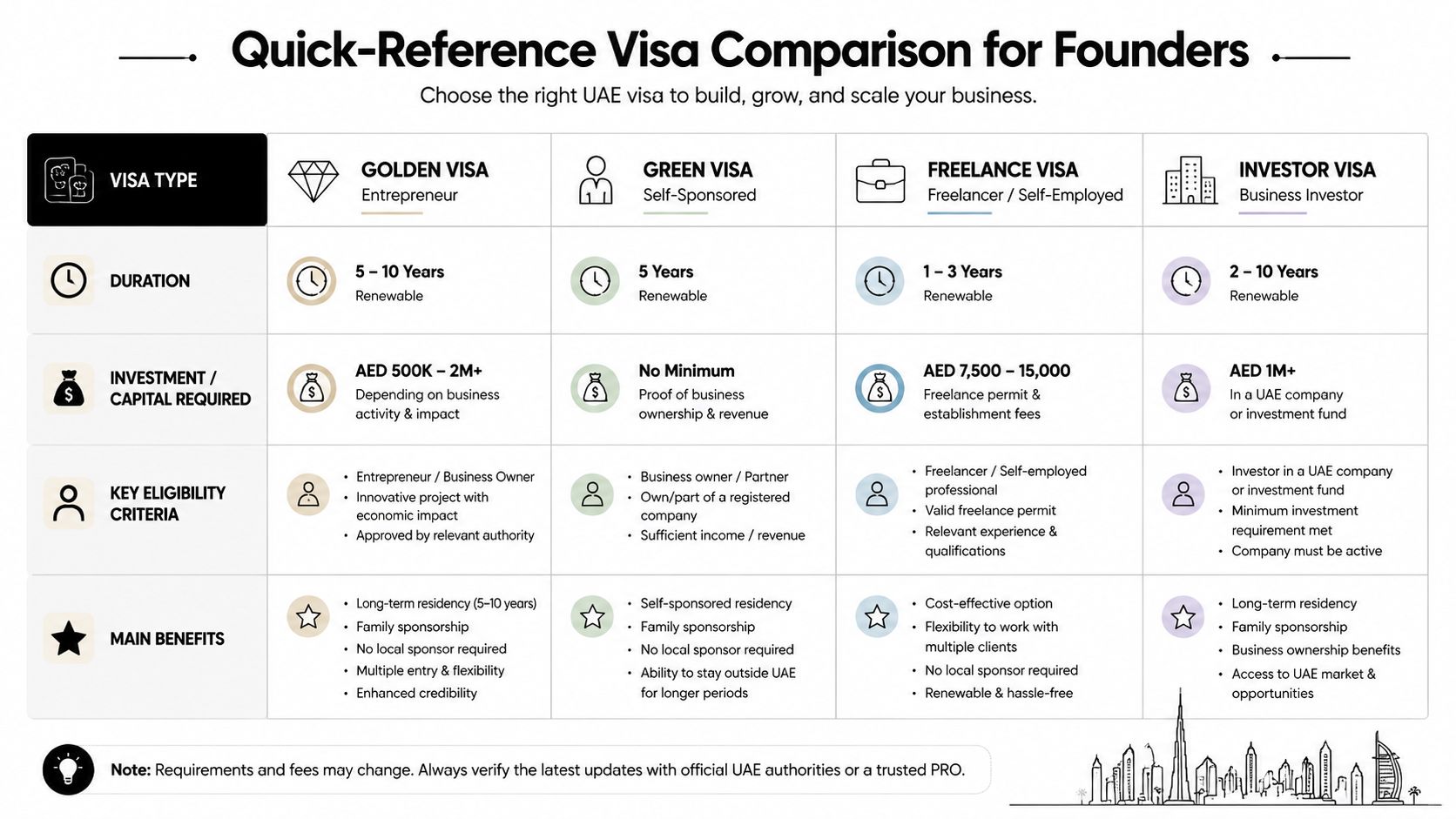
UAE Founder Visa Options at a Glance 2026
| Visa Type | Validity | Minimum Capital/Value | Ideal For | Key Benefit |
|---|---|---|---|---|
| Golden Visa for Entrepreneurs | 10 years or 5 years, depending on the qualifying route | High project valuation or approved entrepreneurial criteria | Founders with a credible growth story, clean documentation, and supportable eligibility | Long-term residency with fewer renewal interruptions |
| Standard Investor Visa | Varies by company setup and jurisdiction | Usually tied to share ownership, licence structure, and establishment documents | Founders who want the fastest operational residency linked to their company | Straightforward path for active owner-operators |
| Startup pathway through company registration | Follows company setup and residence processing | Depends on jurisdiction, business activity, and proof your setup is real and fundable | Early-stage founders entering the UAE market and building locally | Lets you start operating before you qualify for higher-tier options |
The practical split is simple. If the company is new and your main goal is speed, the investor route usually gets you resident status faster. If you already run a revenue-generating startup, the Golden Visa deserves a closer look, especially through the newer SME-oriented routes that can rely on business performance and tax history rather than forcing you into the old assumption that you need AED 2M in personal capital sitting idle.
That distinction saves money.
Many founders overbuild too early. They pay for a setup designed to impress a future visa officer, then learn the current file only supports a standard investor visa because the valuation evidence is weak, the incubator letter is missing, or the company has not yet built the tax record that strengthens an SME-focused Golden Visa case.
Use the visa to match the stage of the business, not the story you want to tell.
If you are still choosing the company side of the setup, this UAE free zones comparison for tech startups will help you narrow the jurisdiction. For a broader licensing, ownership, and setup cost breakdown, this comprehensive guide for business owners is useful before you commit to a structure.
Ask one question first. Do you need residency fast so the company can operate, or are you in a position to apply for longer-term status based on proven business substance?
The Golden Visa for Entrepreneurs Explained
A founder hits profitability, starts paying meaningful corporate tax, and assumes the Golden Visa will be straightforward. Then the file stalls because the company can prove revenue, but not the right kind of valuation, authority approval, or ownership trail. That is the gap many guides miss.

The entrepreneur Golden Visa is attractive for one practical reason. It gives founders longer-term residency without tying status to a standard employment setup. But it is narrower, and more document-sensitive, than many applicants expect.
The two valuation routes founders should know
For entrepreneur applicants, there are two routes that usually matter most:
- 10-year route: The entrepreneur category can support a longer-term Golden Visa where the founder owns a qualifying business project with a valuation of AED 7,000,000.
- 5-year route: A shorter entrepreneur Golden Visa can apply where the project has a valuation of at least AED 500,000 and the file is supported by both a certified auditor's letter and approval from a competent authority or approved business incubator.
The second route catches founders off guard. A valuation figure on its own does not carry the case. The supporting letters need to match the business model, the product story, and the financial record.
The primary bottleneck is dual approval
Founders usually get stuck on evidence, not on form filling.
According to the ICP Golden Residency service guidance, the entrepreneur file typically needs two different types of support. One is financial validation. The other is ecosystem or authority validation. If those two documents describe different businesses, expect delays or rejection.
| Required approval | What it proves | Where founders go wrong |
|---|---|---|
| Auditor letter | The project meets the valuation threshold | Management accounts are weak, revenue support is incomplete, or the valuation logic is too thin |
| Incubator or competent authority approval | The project is technically advanced, novel, or fits a future-focused economic category | The company reads like a normal service SME with software layered on top |
Founder positioning matters. A consultancy that added a dashboard is still likely to be treated as a consultancy. A company with proprietary software, a clear product, retained users, and a technical roadmap is easier to defend.
The SME-focused Golden Visa route deserves more attention
There is another path that matters for revenue-generating startups. The official UAE government Golden Visa page confirms broader Golden Visa eligibility tied to UAE SME investment or to ownership in companies paying at least AED 250,000 in annual taxes.
For founders, that changes the calculation. The question is not always whether you personally parked AED 2M in capital. Sometimes the stronger case comes from proven operating substance inside the company. If the business is already generating revenue and paying tax at that level, you may have a route that many startup articles barely explain.
The practical challenge is proof, especially for solo founders.
Here is a realistic example. A solo founder owns a UAE SaaS company through a clean shareholding structure, files corporate tax properly, and can show the company paid at least AED 250,000 in annual tax. In practice, I would expect that founder to prepare more than just the tax payment receipt. The stronger file would include the trade licence, MOA or shareholder records, tax registration details, corporate tax return support, FTA payment confirmations, audited or accountant-prepared financials, and a short cover note that connects ownership to tax paid by the operating entity. That does not guarantee approval, but it gives the officer a coherent chain from founder to company to tax contribution.
That is the part many people miss. Authorities are not just checking whether tax was paid. They are checking whether the applicant can cleanly show beneficial ownership and a genuine operating business behind that payment history.
Practical rule: If you may qualify through tax paid by the company, build the evidence pack before starting the application. Do not assume the payment receipt alone will carry the case.
For a broader founder view of setting up and operating locally, this guide to being an entrepreneur in the UAE is a useful companion.
The authority chain matters too
This route can involve more than one reviewing body. Depending on the pathway and emirate, founders may need supporting input from:
- Ministry of Economy
- ICP
- A competent local authority
- An approved business incubator
That multi-step review is why timing often slips. One document may satisfy the valuation side but fail to satisfy the authority reviewing the nature of the project.
The file also needs the standard immigration pieces such as a valid passport, housing proof, health insurance, and the later medical and biometrics steps that lead to Emirates ID issuance. Founders often discover this too late. A company can be fully operational and still not be ready for immigration review because the personal and corporate documents were prepared in different standards.
Understanding the Standard Investor Visa
A lot of founders should stop trying to force a Golden Visa too early. The standard investor visa is often the better operating choice when the business is still proving itself.
When the investor visa is the smarter move
This route usually fits founders who own shares in a UAE entity and need straightforward residency tied to that ownership. It doesn't rely on proving that the company is “pioneering” or “futuristic”. It relies on the fact that you are an owner or partner in the business.
That matters for service firms, agencies, consultancies, trading companies, and early SaaS businesses that have a valid commercial structure but don't yet have the valuation profile or innovation evidence needed for the entrepreneur Golden Visa route.
The trade-off is simple:
- Golden Visa: Better if you qualify and want longer-term stability.
- Investor Visa: Better if you need a practical residency base now.
- Employment Visa: Better if the company sponsors you in an operator capacity and you're not relying on founder-specific criteria.
What founders often miss
The investor visa is not glamorous, but it's operationally clean. If your immediate goal is opening accounts, renting, hiring, and signing contracts without waiting on entrepreneur-category approvals, this route can be far less frustrating.
Here's the founder lens:
| Option | Best use case | Main constraint |
|---|---|---|
| Golden Visa | Strong valuation, innovation proof, or qualified SME profile | More evidence-heavy |
| Investor Visa | You own the UAE company and want residency linked to it | Shorter validity and renewals |
| Employment Visa | You're employed by the operating company | Depends on company sponsorship structure |
What slows founder decisions is ego. People hear “Golden Visa” and assume anything else is a temporary compromise. In practice, many businesses are better served by an investor visa while they build real traction, then upgrade later from a stronger position.
If you're comparing setup costs and structures before choosing this route, this breakdown of business setup in Dubai free zone cost 2026 is a useful companion.
Where this route works well
This route tends to work best when:
- You've already formed the company: Your ownership documents are clear and current.
- You need residency fast: You're prioritising execution over prestige.
- Your business is conventional: It's investable or profitable, but not easily framed as a technical or futuristic venture yet.
The mistake is treating the investor visa like a fallback. For a lot of founders, it's the right first move.
Decoding the UAE Startup Visa Pathway
A founder sets up a company in Dubai, then starts looking for a “startup visa” portal that does not exist. Two weeks go into the wrong forms, the wrong PRO advice, and a business plan written for investors instead of licensing officers. That mistake is common, and it is expensive.
The practical reality is simpler. In the UAE, “startup visa” usually means a company formation route plus a residency route, with startup classification or founder eligibility established through the business itself. The visa comes after the company file is in order.
That distinction matters because founders often optimise for the wrong thing. They chase a label instead of building an approvable file.
What this pathway actually is
For early-stage founders, the process usually starts with company setup, licence issuance, and supporting documents that show the business is real, fundable, and operational. The authority reviewing your case wants substance. A serious business plan, clear founder ownership, activity codes that match what the company does, and funding evidence that is easy to verify.
In practice, the business plan needs to read like an operating document. It should explain the problem, revenue model, target market, execution plan, hiring logic, and financial assumptions. A glossy pitch deck is rarely enough.
Some founders also miss a more important angle. If your company becomes revenue-generating in the UAE, the stronger long-term opportunity may not be a loosely described “startup visa” at all. It may be a Golden Visa route tied to SME performance, tax history, and business contribution. That is the part many articles skip, even though it can matter more than whether you launched with large personal capital on day one.
How founders usually move through it
The sequence is straightforward:
- Set up the company with the right legal structure and activity codes.
- Prepare a business plan that matches the licensed activity.
- Organise proof of ownership, identity documents, and any funding evidence the authority may ask for.
- Apply for residency through the relevant company or sponsor process after the entity is active.
- Complete medicals, Emirates ID steps, and final stamping or issuance.
Where founders lose time is in the handoff between step two and step four. The licence says one thing, the business plan says another, and the bank records do not clearly support either. That mismatch creates review friction fast.
Where the real trade-offs sit
This route works best for founders who are building locally from scratch and need a clean way to connect company formation with residency. It is useful, but it is not magic.
What tends to help approval:
- A written plan with operating detail, not branding language
- Founder shareholding records that exactly match the licence
- Business activity selection that supports the startup story
- Clear proof of funds or business capability
- A realistic explanation of how revenue will be generated in the UAE
What creates problems:
- Calling the company “AI” or “tech” without evidence in the product or licence
- Using a generic plan copied from an incubator template
- Filing before ownership documents, signatures, and capital records line up
- Assuming startup language by itself improves approval odds
I have seen founders spend heavily on advisory packages before fixing those basics. That is backwards. The file quality matters more than the sales pitch.
The part many guides miss
The newer founder opportunity is not only in getting initial residency. It is in building toward the less-publicised SME-focused Golden Visa pathways once the business is operating and paying tax. For some founders, that route is more realistic than trying to prove major personal capital upfront.
That changes strategy. If the company is already generating revenue, filing returns properly, and building a credible local footprint, the smartest move may be to treat the first visa as a setup step and prepare early for a stronger later application based on business performance.
The same principle applies in other administrative systems. Good outcomes usually come from choosing the correct process early, not from fixing preventable errors later. Even outside visas, that discipline matters. A detailed expert China travel planning guide is useful for the same reason. It helps you avoid procedural mistakes before they become expensive.
Founders who handle this pathway well do three things. They set up the right entity, keep the documents consistent, and plan one visa step ahead.
Your Essential Document Checklist
A weak document pack burns time before an officer reviews the business case. I have seen founders lose weeks because one document used an old shareholder split, another showed a different trade name, and the passport copy attached was from a previous application draft.
Build the file around the visa route you are filing, then run a consistency check across all documents. Names, ownership percentages, licence details, signatures, and dates need to match.
Golden Visa file
For the entrepreneur Golden Visa route, the core pack usually includes:
- Valid passport: Use the same identity document across the full application.
- Auditor letter: Needed where company valuation is part of the eligibility route.
- Approved incubator or competent authority letter: Used to support the project's technical or future-focused basis where that criterion applies.
- Health insurance: Often requested as part of the entrepreneur file.
- Proof of housing: Ejari, tenancy contract, or ownership deed, depending on your situation.
- Medical exam records: Required during processing for eligible applicants.
Founders using the SME or tax-based Golden Visa path should treat financial records as the centre of the file. That means tax registration, filed returns, payment evidence, audited accounts where available, and clean proof of ownership. This is the route many articles miss. A revenue-generating startup may build toward long-term residency through business performance and tax compliance, without relying on AED 2M in personal capital. That only works if the paperwork shows a clear story from licence to revenue to tax paid.
Startup pathway file
For the startup validation route, keep these in one controlled folder:
| Document | Why it matters |
|---|---|
| Passport copy | Core identity record |
| Business licence | Connects the founder to the operating entity |
| Business plan | Supports startup classification |
| Proof of capital in UAE bank account | Shows funding evidence for the route |
| Attested birth certificate | Part of the required personal documentation |
| Medical exam report | Needed in the visa stage |
| Labour card application documents | Used during the later processing stage |
Use final filenames. Assign one person to control versions. Do not let the latest signed document sit in someone's WhatsApp history while an older draft gets uploaded.
Nationality-specific requirement founders miss
Some applicants need one extra document.
Founders from Iraq, Iran, Afghanistan, or Pakistan must also submit a copy of their home country national identity card alongside the standard passport and photograph, as noted in RAKEZ's guide to the startup and entrepreneur visa process in the UAE.
This looks minor on paper. In practice, it can stall an otherwise clean file.
A second review catches expensive mistakes. Ask someone outside the founding team to compare every identity document, company record, and supporting letter line by line before submission.
If you're coordinating relocation around wider travel planning, this expert China travel planning guide is unrelated to UAE visas but is the kind of practical itinerary resource that helps when founders are juggling multiple market visits and document runs.
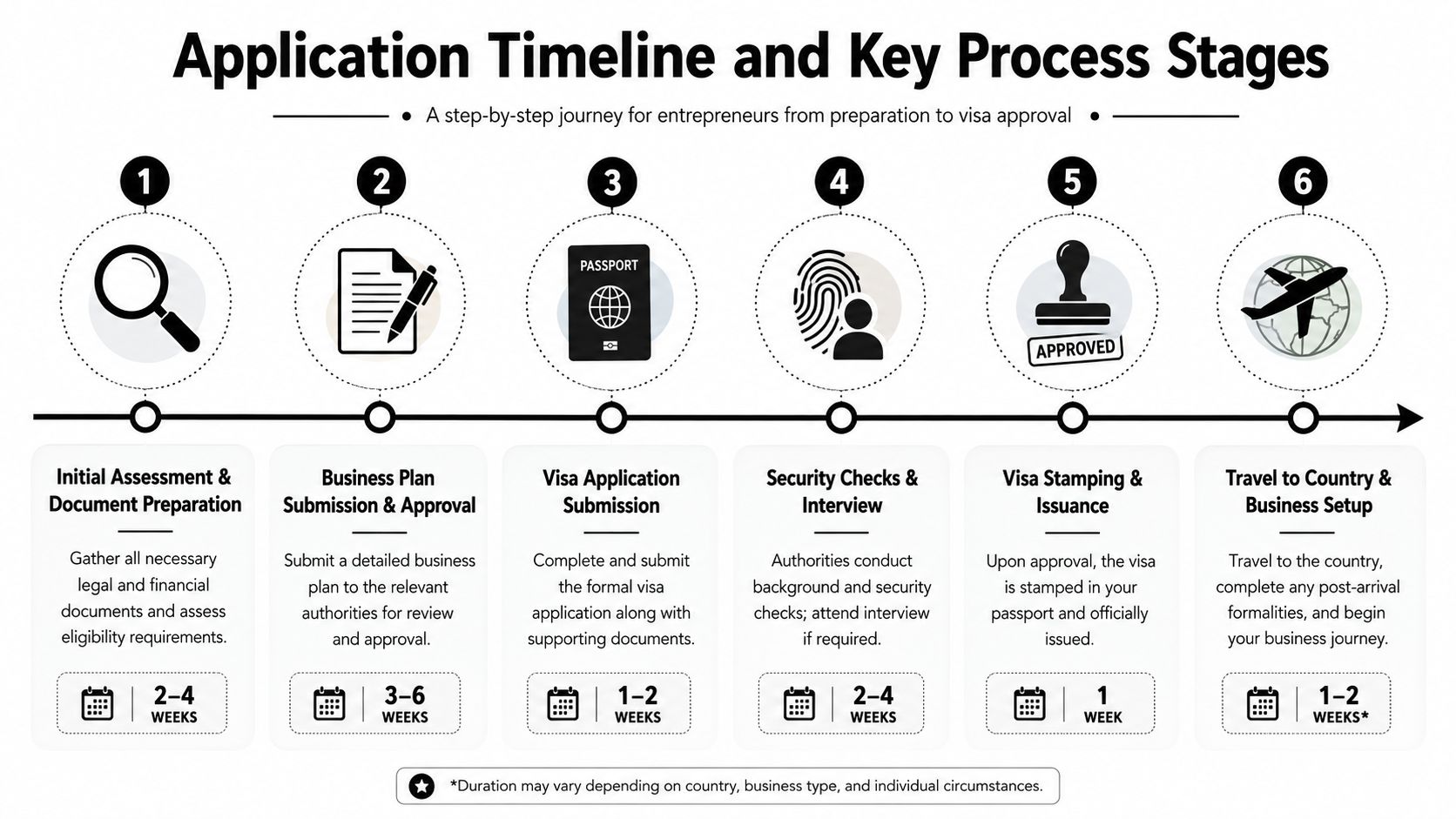
Application Timeline and Key Process Stages
A founder gets verbal confirmation on Monday, books flights on Tuesday, and discovers on Thursday that the application has not even entered the right system. That is how relocation budgets get burned in the UAE. The visa process is usually workable. The expensive part is poor sequencing.
What actually sets the timeline
The clock does not start at submission. It starts when your route, jurisdiction, and evidence line up.
For founders using the startup pathway, the early stage usually runs in two parts. First comes company setup and confirmation that the business fits the relevant startup criteria. Then comes the visa file itself through the labour and immigration channel tied to that setup. Medical and identity checks are part of the process, but they do not rescue a file with mismatched company records or the wrong sponsor details.
For Golden Visa applicants, the timeline is less about one fixed sequence and more about proving the right qualification route from the start. That matters even more under the newer SME-focused founder pathways. If you are applying based on a revenue-generating company and tax evidence, the review turns on whether your licence, financial records, and Federal Tax Authority trail support the category you are claiming. Founders waste weeks chasing attestations for the wrong route when weak qualification evidence is the problem.
The submission channel depends on where the company sits
The authority is not the same across the UAE.
The Federal Authority for Identity, Citizenship, Customs and Ports Security (ICP) handles federal applications, while GDRFA handles Dubai residency processing. This practical breakdown of how the UAE Golden Visa process works explains the split clearly enough for founders deciding where to file.
That distinction is operational, not academic. A Dubai-linked file sent through the wrong lane can sit untouched while the founder assumes “processing” has started.
The process that wastes the least time
Use this order:
- Pick the visa route before you collect documents. Golden Visa, investor visa, employee visa, and startup pathway all need different proof.
- Confirm the right authority based on jurisdiction. Dubai and federal channels are not interchangeable.
- Build the evidence file around the route you chose. For SME-oriented Golden Visa cases, that may mean tax records, audited or management accounts, and proof the business is active and generating revenue, not proof of AED 2 million in personal capital.
- Submit only when names, dates, and licence details match exactly. Small mismatches create large delays.
- Handle medical, biometrics, and follow-up requests immediately. Idle approvals expire faster than founders expect.
- Keep one owner for the process. One person should control submissions, portal logins, and response deadlines.
I have seen founders lose time at step one and think the problem appeared at step five.
A realistic way to plan your calendar
Treat the process in stages, not promises. Setup and eligibility confirmation come first. Submission comes second. Medical, biometrics, and residence stamping or issuance come after that. Any missing item can stop the file between stages, even if the previous step looked approved.
Do not book family relocation, school start dates, or client travel around best-case timing. Book around buffer. The founders who get through this cleanly are usually not the ones with the fastest service provider. They are the ones who chose the right route early, used the correct authority, and submitted a file that did not need explaining.
Common Rejection Reasons and How to Avoid Them
Most rejections aren't dramatic. They come from ordinary sloppiness. Missing paperwork, mismatched records, wrong portal, weak evidence, or assumptions that a corporate services provider “must have handled it”.

The most expensive mistake is incomplete submission
A common reason for application rejection or delay is missing documents. If required documents are missing, the authority grants only 30 days to provide them before the application is automatically cancelled, according to Get Golden Visa's summary of the UAE application rule.
That single deadline changes how founders should operate. Don't submit with a “we'll add that later” mindset unless you know exactly what is still pending and can deliver it fast.
Why founder applications usually slow down
Here's where I see preventable friction most often:
- Wrong jurisdiction routing: Dubai file sent down the wrong path.
- Document mismatch: Passport name, trade licence details, bank proof, and approval letters don't align neatly.
- Weak innovation case: The company is good, but the paperwork doesn't show why it fits entrepreneur criteria.
- Incomplete supporting letters: A founder has the auditor letter but not the incubator approval, or vice versa.
- Late response to follow-up requests: Founders get busy operating the company and miss the admin clock.
A cleaner prevention framework
Use this before submission.
| Risk | What it looks like | Prevention move |
|---|---|---|
| Missing documents | Authority asks for absent items after filing | Run a final checklist review before submission |
| Incorrect authority | Application goes to the wrong channel | Confirm whether ICP or GDRFA handles your case |
| Inconsistent records | Different names, values, or company details across documents | Cross-check every data field manually |
| Incomplete eligibility proof | One approval letter missing or unclear | Secure the full evidence stack before filing |
Good applications are built backwards. Start from the approval evidence, then fill the form.
One more point matters. Founders often assume the “hard” part is eligibility. Often it isn't. The hard part is assembling a file where every document supports the same version of the business.
If the company is a startup, the plan, capital proof, and sector description should all support that. If the route is entrepreneur Golden Visa, the valuation evidence and innovation approval should reinforce each other. If you're using a tax-led SME pathway, your tax documents should be easy for a reviewer to understand without interpretation.
Your Immediate Next Steps
Do three things today.
First, choose one primary route and one backup route. Don't keep all options open forever. Second, create a single document folder with subfolders for identity, company, financial, medical, and approval records. Third, contact the most relevant external party now, either an approved incubator, your auditor, or your setup adviser, depending on the route.
If your startup is also working on visibility while entering the market, a manual directory submission service can help with distribution tasks that usually get deprioritised during setup.
Founder Connects helps UAE and MENA founders make faster, better decisions through curated peer groups, warm introductions, and practical support from people who are building. If you want a stronger circle while navigating company setup, hiring, fundraising, or founder-level trade-offs, explore Founder Connects.

Building in MENA? You don't have to do it alone.
Join 300+ founders in the Founder Connects Residency. Monthly squad calls, warm intros, $3M+ in perks, and much more. All for less than your monthly coffee budget.
Popular posts





Founder Connects is a premium MENA tech founder community. Meetups in Dubai and across MENA, Residency Squads of 8–10, and 400+ vetted WhatsApp founders (apply and screened).