

UAE Startup Cash Flow Guide for Fast-Growth Teams

Building in MENA? You don't have to do it alone.
Join 300+ founders in the Founder Connects Residency. Monthly squad calls, warm intros, $3M+ in perks, and much more. All for less than your monthly coffee budget.

Growth does not pay salaries - cash does. I’d read this article as one clear message: if I don’t track when money lands, when money leaves, and what cash is off-limits, growth can strain my startup long before profit looks weak.
In simple terms, the article says I should focus on five things:
- Track cash by collection date, not invoice date
- Watch overdue invoices every week
- Match supplier payments to customer receipts
- Use billing terms that bring cash in earlier
- Keep a reserve floor and review a 13-week forecast every week
A few numbers make the point fast:
- UAE B2B payment cycles can stretch close to 125 days
- Large buyers may pay in 45–90 days
- VAT on an invoice can be due before I collect the cash
- A team may have fixed monthly costs of AED 250,000.00+, then get hit by licence and visa fees in the same month
So if I want a short version, it’s this:
- Revenue is not bank balance
- VAT is not spending cash
- Late invoicing slows collections
- Poor payment terms drain runway
- A weekly cash review helps me act early
Here’s the article at a glance:
| Area | What I need to do | Why it matters |
|---|---|---|
| Inflows | Track expected receipt dates and confidence levels | Invoiced cash may arrive months later |
| Receivables | Review ageing weekly and chase overdue invoices fast | Delay grows quietly if I wait |
| Outflows | Time supplier payments around known collections | Fixed costs leave on schedule |
| Pricing | Use annual, deposit, or milestone billing where possible | Cash comes in earlier |
| Reserves | Keep a set buffer plus separate tax balances | Stops tax and runway shocks |
| Review rhythm | Run a 13-week cash check every week | I can spot pressure before it turns into a problem |
If I run a UAE startup, this is less about accounting theory and more about staying in control of payroll, tax, rent, cloud spend, and hiring while sales grow. For those still in the early stages, our UAE entrepreneur guide covers the transition from idea to launch.
Startup cashflow management: How CFO's manage very tight cashflows
sbb-itb-f597d8f
Control Cash In: Receivables and Inflow Timing
UAE startups that sell to corporates or government-linked buyers often record revenue long before the cash shows up in the bank. That gap can get ugly, fast. In the UAE, B2B payment terms often sit around 47–57 days, and some SMEs say they wait about 75 extra days after the due date. That can stretch the full collection cycle to nearly 125 days.[9][10] So the fix is simple in theory: track inflows by collection date, not invoice date.
Build an Inflow Calendar That Shows When Cash Actually Lands
An inflow calendar shows every expected cash event from contract signature all the way to bank receipt. For each inflow, track the signed date, invoice date, payment terms, due date, expected collection date, confidence level, currency, and any dependencies like PO approval or milestone sign-off. That last part matters more than many founders think.
Not all inflows behave the same way. B2B contract payments, annual software prepayments, milestone billing, and investor tranches each follow their own timeline. If you lump them together, your cash view can look better than it is.
Use a weekly 13-week view for receivables timing. Then colour-code each inflow:
- Green for confirmed
- Amber for likely
- Red for uncertain
Dates matter, but confidence matters just as much. A signed annual prepayment from a customer who usually pays on time belongs in the high-confidence bucket. A milestone payment waiting for client approval sits lower. Investor tranches tied to final documents sit lower again. Keep those separate from operating cash so they do not quietly cover monthly burn on paper only.
Track funding inflows from UAE accelerators and incubators and investors only when closing conditions, compliance checks, and transfer dates are confirmed.
That calendar tells you what should come in. The ageing report tells you what is already slipping.
Use Ageing Reports to Stop Overdue Invoices from Growing Silently
An ageing report groups unpaid invoices into time buckets: Current (0–30 days), 31–60 days, 61–90 days, and 90+ days. A healthy book keeps most receivables in the first bucket: 70–80% in 0–30 days, 15–20% in 31–60 days, 5–10% in 61–90 days, and only a minimal balance in 90+ days.[2][3]
Each bucket points to a different issue. If the 31–60 day bucket starts growing, the problem is often process-related. Maybe invoices went out late. Maybe reminders were missed. If the 61–90 day bucket gets bigger, that usually points to an escalation issue, often inside the customer’s approval chain. Anything in the 90+ day bucket needs executive attention straight away.[3][7]
Review the ageing report every week, not once a month. Receivables often go off track because follow-up starts too late. A simple sequence works well:
- Send a reminder a few days before the due date
- Send a polite note on day 1 overdue
- Follow up directly with payment details by day 7
- Make a phone call or involve a senior contact by day 14–21
- Escalate formally by day 30 if the invoice is still unpaid[4][8]
Receivables Tactics That Speed Up Collection
One of the fastest wins for many UAE startups is invoicing within 24 hours of delivery. When invoicing is delayed, you create hidden Days Sales Outstanding (DSO). It does not appear in the payment terms, but it still pushes cash receipt further out. Research suggests this step alone can cut average payment time by about 14 days in B2B settings.[4]
Once overdue balances are clear, pick the collection method that gets cash in fastest without damaging the customer relationship more than needed. The table below moves from the lightest touch to the strictest option:
| Strategy | Cash Inflow Speed | Collection Risk | Customer Friction | Best-Fit Use Case |
|---|---|---|---|---|
| Upfront deposit | Fastest | Lowest | Moderate | Custom work or hardware delivery |
| Milestone billing | Fast (staged) | Low–Moderate | Low–Moderate | Longer projects with defined deliverables |
| Early-payment discount | Fast (if adopted) | Low | Low | Buyers who can pay faster; discount smaller than cost of delay |
| Clear net terms + automated reminders | Moderate | Moderate | Lowest | All customer types; baseline for every contract |
| Strict credit control | Slower new sales | Lowest | High | Consistently late payers or tight runway |
A 2/10, net 30 early-payment discount usually cuts DSO by 3–8 days when used at scale.[5] More aggressive early-payment programmes have been linked to DSO reductions of up to 40% and a 30% drop in default rates.[6] Start with the least disruptive option that protects runway, then tighten controls as deal size, project length, or buyer risk goes up.
Once receivables are under control, match outgoing payments to incoming cash.
Control Cash Out: Payables, Pricing, and Working Capital
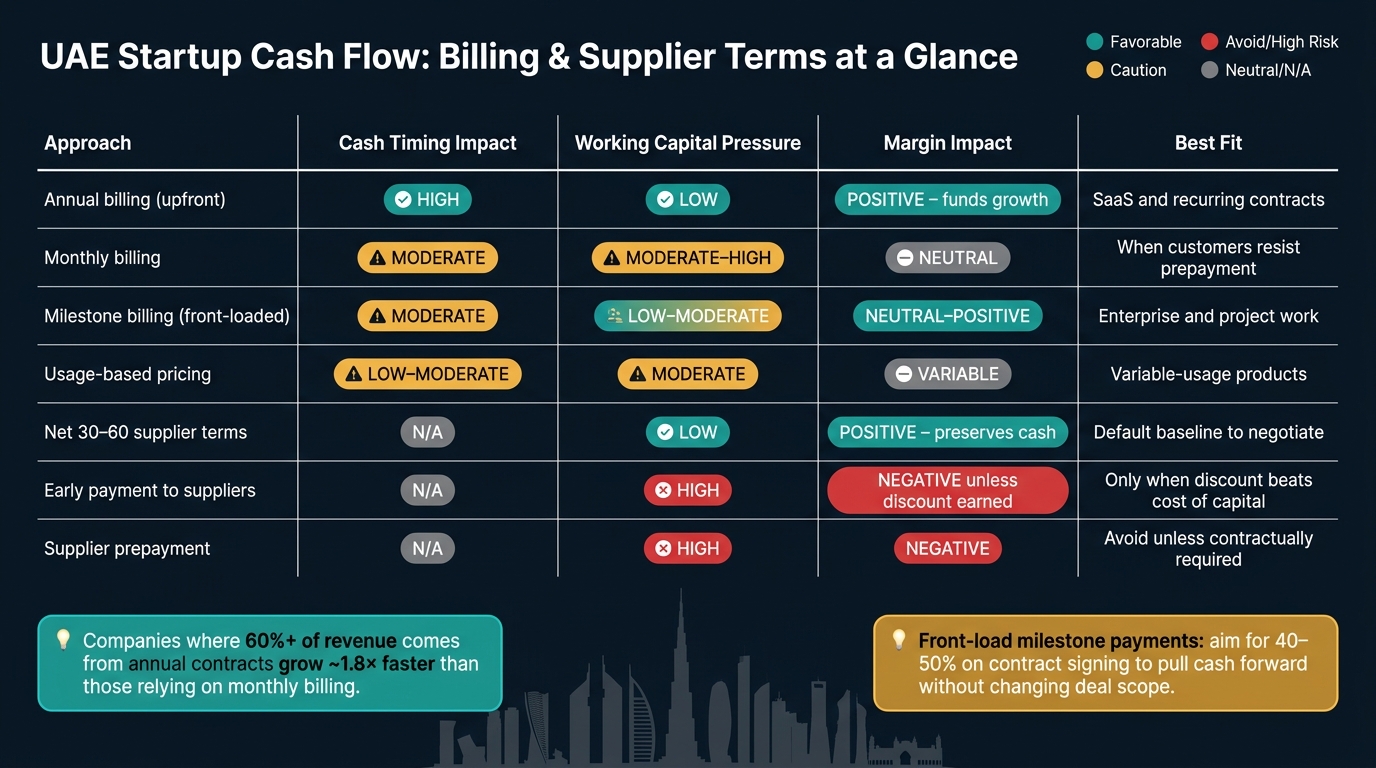
UAE Startup Cash Flow: Billing & Supplier Terms Comparison
Use the same 13-week cash view to plan every big payment. Let the 13-week inflow calendar tell you when cash can leave without putting pressure on the business.
Match Supplier Payments to Customer Collections
A 10-person Dubai team can burn over AED 300,000 a month on salaries alone.[11][12] That money goes out on schedule. Customer payments usually don’t. They arrive late, unevenly, or all at once.
For asset-light UAE tech and fintech startups, DSO and DPO are the numbers that matter most. If enterprise customers pay in 60 days, push for 45–60 day terms with major vendors where you can. Pay on the due date. The only time it makes sense to pay earlier is when the discount is better than your cost of cash.
There’s a simple rhythm to this. Schedule quarterly rent and annual licences after known customer collections. If a big inflow is due, that’s the moment to buy annual licences. And ring-fence VAT in a separate account from day one, so it doesn’t get mixed into day-to-day spending. This separation is a core part of maintaining fintech compliance for regulated entities.
Once supplier dates line up with collections, the next move is to bring cash in sooner through pricing and billing.
Price for Cash, Not Only for Revenue Growth
Pricing shapes cash timing more than many founders expect. A B2B SaaS business charging USD 480 per month with a USD 4,000 customer acquisition cost (CAC) can stay cash-flow negative for several quarters under monthly billing. Change that to an annual plan at USD 5,760 paid upfront, and the same customer produces USD 1,760 in cash on day one. That flips a shortfall into a surplus before even one month of service is delivered.[14]
For UAE AI and enterprise fintech teams, the same logic applies to project work. Front-load milestone payments and aim for 40–50% on contract signing. It’s one of the cleanest ways to pull cash forward without changing the scope of the deal.
Compare Billing and Supplier Terms Before Liquidity Tightens
| Approach | Cash Timing Impact | Working Capital Pressure | Margin Impact | Best Fit |
|---|---|---|---|---|
| Annual billing (upfront) | High | Low | Positive (funds growth) | SaaS and recurring contracts |
| Monthly billing | Moderate | Moderate–High | Neutral | When customers resist prepayment |
| Milestone billing (front-loaded) | Moderate | Low–Moderate | Neutral–Positive | Enterprise and project work |
| Usage-based pricing | Low–Moderate | Moderate | Variable | Variable-usage products |
| Net 30–60 supplier terms | N/A | Low | Positive (preserves cash) | Default baseline to negotiate |
| Early payment to suppliers | N/A | High | Negative (unless discount earned) | Only when the discount beats the cost of capital |
| Supplier prepayment | N/A | High | Negative | Avoid unless contractually required |
Companies where 60% or more of revenue comes from annual contracts grow roughly 1.8× faster than those relying mostly on monthly billing.[13] After billing terms and supplier terms are set, the next step is to turn them into a reserve rule and a weekly cash review.
Set Reserve Rules and Run a Weekly Cash Review
Once billing and supplier timing are in place, turn them into a weekly cash routine with a clear reserve floor and set action triggers. That habit makes your cash buffer a rule, not a guess.
Set a Reserve Policy by Stage and Burn Rate
A reserve policy is a simple rule: the minimum cash buffer your business must keep. If that rule isn’t written down, founders often spend until something breaks.
Reserves cover the gap between customer collections and supplier deadlines. Keep separate balances for VAT and Corporate Tax so that money doesn’t get pulled into day-to-day operating spend by mistake. If runway drops below your floor, freeze discretionary hiring. If it drops again, cut non-essential spend and start a funding plan. Investors want to see a clear burn number, ring-fenced tax cash, and firm runway triggers.
Use that floor to decide what stays live in the 13-week forecast.
Run a 30-Minute Weekly Cash Review with a 13-Week Forecast
Run the review at the start of the UAE working week, ideally on Sunday morning. Block 30 minutes. Keep it short, sharp, and structured.
Work through these five items in order:
- Opening cash balance - the actual figure from your bank.
- Expected inflows in the next 14–30 days - use the ageing report to flag due and overdue invoices.
- Due outflows this week and next - salary payments through WPS, rent, VAT filing dates, and vendor payments.
- Runway calculation - current cash ÷ monthly fixed burn. Update this every week, not quarterly.
- Decisions triggered - based on runway, which spend, hires, and payments stay live?
Connect your bank to your accounting software so the review runs on live data. Digital-first banking can cut admin overhead by up to 30% for SMEs [1]. Use fixed-limit virtual cards for recurring SaaS spend so small costs don’t quietly drift upward.
Use Community Accountability to Keep the Habit Consistent
A reserve rule only works if the weekly review actually happens. Skip it because cash looks fine, and problems often show up when it’s too late to react calmly.
Use Founder Connects for peer accountability through group-matched masterminds and live talks.
Conclusion: A Simple Cash Flow Playbook for Fast-Growth UAE Teams
Cash flow problems rarely show up all at once. They creep in. A client pays late. Supplier terms don’t match your collection cycle. Cash reserves get used like day-to-day operating funds instead of a hard safety buffer. By the time the shortfall is clear, your room to move is small.
The answer is simple, but it takes discipline: tighten inflows, outflows, reserves, and your review rhythm. Cut DSO with fast invoicing, payment links, and automatic reconciliation. Match payables to collections, and line up billing with buyer procurement cycles.
Set reserves as a fixed rule, not a nice-to-have. Then protect that rule with a weekly 13-week cash review.
This matters a lot for UAE AI, fintech, and tech startups. In the UAE startup scene, speed counts. But discipline is still what decides who handles growth and who gets caught by it. Clean books and low DSO also shape how investors assess and price your business.
Cash discipline protects runway today and valuation later. Founder Connects helps founders stick to the weekly cash review habit through peer accountability.
FAQs
How much cash reserve should I keep?
Aim to keep at least six months of liquidity in your cash reserve, plus a 20% buffer for surprise costs or time-sensitive opportunities.
That extra cushion helps if client payments slip, rules change, or investor decisions take longer than expected. It’s a simple way to give yourself more room to breathe when things don’t go to plan.
Also, stress-test your runway on a regular basis and review your finances with a 13-week rolling cash flow model. That gives you a near-term view of what’s coming in, what’s going out, and where pressure might build.
What should go into a 13-week cash forecast?
A 13-week cash forecast is a rolling model that helps you monitor liquidity and runway.
Here’s the simple way to run it:
- Track actual cash figures weekly for the first week
- Track them daily for the next 2 to 4 weeks
- Then track them weekly for the remaining 9 to 11 weeks
The goal is to include all cash inflows and outflows so you can work out your net burn rate and cash runway. That means money in, money out, and no blind spots.
Use the 80/20 rule to focus on the contract values that matter most. In plain terms, don’t get lost in tiny line items if a small number of major contracts drive most of your cash position.
It also helps to keep a contingency fund that covers 3 to 6 months of operating costs. Think of it as breathing room. If payments slip or costs jump, that buffer can give you time to respond without making rushed decisions.
When should I change my billing terms?
Review and adjust your billing terms when your cash flow, revenue predictability, or procurement needs change. It’s best to do this before pricing goes live. That way, you can avoid costly updates to contracts, checkout flows, and reporting scripts.
You should also revisit your terms if you’re dealing with longer regional payment cycles, such as 60–90 days for private contracts or up to 120 days for government entities. The same applies when your current terms no longer match B2B procurement cycles.
Related Blog Posts

Building in MENA? You don't have to do it alone.
Join 300+ founders in the Founder Connects Residency. Monthly squad calls, warm intros, $3M+ in perks, and much more. All for less than your monthly coffee budget.
Popular posts





Founder Connects is a premium MENA tech founder community. Meetups in Dubai and across MENA, Residency Squads of 8–10, and 400+ vetted WhatsApp founders (apply and screened).