

What Is YC? a Founder's Guide for UAE Startups

Building in MENA? You don't have to do it alone.
Join 300+ founders in the Founder Connects Residency. Monthly squad calls, warm intros, $3M+ in perks, and much more. All for less than your monthly coffee budget.

If you're building in Dubai, you've probably heard some version of this advice already. “Apply to YC.” It gets said as if the decision is obvious, universal, and urgent.
It isn't.
For a founder in the UAE or wider MENA region, the primary question isn't just what is YC. The better question is whether YC is the right lever for your company at this stage, in this market, with this team, and with your own constraints around geography, customers, hiring, and fundraising.
Some startups in the region should absolutely pursue it. Others would get further, faster, by going deeper into local customers, local operators, and regional support first. A lot of founders confuse prestige with fit. That mistake costs time.
The YC Question for MENA Founders
Most first-time founders encounter YC through startup Twitter, founder podcasts, investor conversations, or a friend forwarding a Demo Day clip. The brand is strong enough that it can feel like a default milestone. If serious startups apply to YC, then serious founders should too. That's usually the implied message.
But MENA founders don't build in a vacuum. You're dealing with a very specific operating environment. Customer behaviour differs across Gulf markets. Enterprise sales cycles often depend on trust and relationships. Some sectors need local licensing, local partners, or local credibility before global visibility matters. A startup serving the UAE government, regulated finance, healthcare providers, or legacy family businesses has a different path from a founder building developer tools or global SaaS.
That means the YC decision should be strategic, not emotional.
A practical way to think about it is this:
- If your market is global from day one, YC may help compress time.
- If your product depends on local market depth, YC may be helpful later, but not necessarily first.
- If you're still searching for the problem, the application process can become a distraction.
- If you already have real user pull, the programme can sharpen execution and widen your investor surface area.
A founder in MENA usually doesn't suffer from lack of ambition. They suffer from too many good-looking paths and not enough honest filtering.
The smartest founders I know don't ask whether YC is “worth it” in the abstract. They ask whether it solves their next bottleneck. If your bottleneck is network, fundraising, founder discipline, or access to a global peer set, YC may fit. If your bottleneck is distribution inside the GCC, regulatory clarity, or landing your first local design partners, your first move might be closer to home.
If you're trying to build that global founder surface area before deciding, this guide to global networking for UAE startups is a better first step than blindly chasing a logo.
What Y Combinator Actually Is Beyond the Hype
For a founder in Dubai, YC is rarely just a brand question. It is a company design question. Are you building something that benefits from extreme speed, blunt feedback, and fast exposure to US investors, or do you need local customer access, regulatory trust, and regional distribution first?
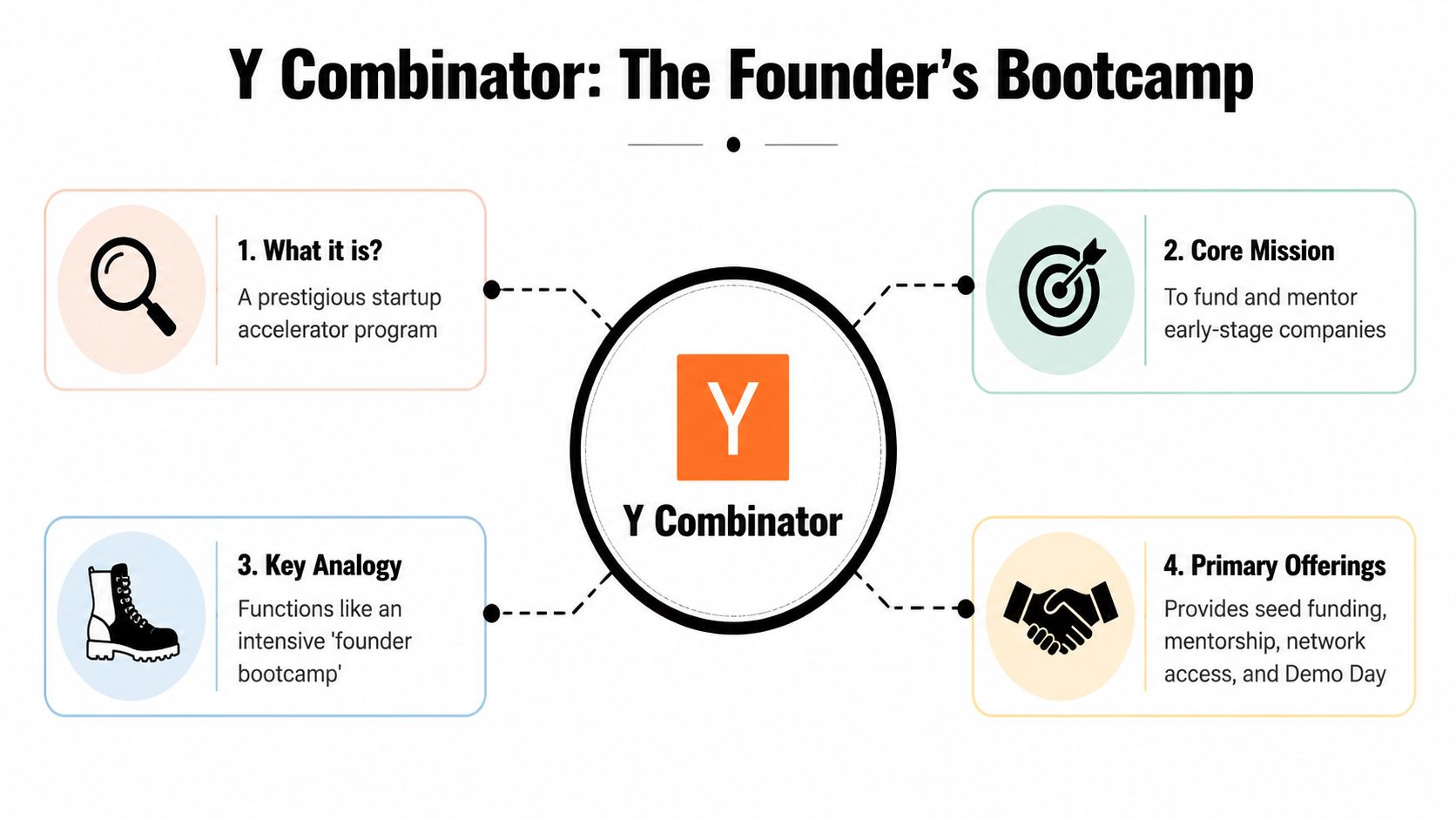
Y Combinator, usually called YC, is a startup accelerator. In plain terms, it invests a small amount at the earliest stage, puts founders through a tight operating cycle, and gives them access to partners, peers, and investors.
That combination matters.
What an accelerator does
An accelerator sits between starting the company and raising a larger seed round.
The role is more hands-on than an angel investor and more structured than a typical fund relationship. Founders get capital, deadlines, repeated scrutiny, and a cohort environment that pushes pace. If you want a broader view of how different programmes are structured, this accelerator comparison chart covering formats, funding models, and founder fit is useful before treating YC as the only serious option.
A simple comparison helps:
| Type | Main job |
|---|---|
| Angel investor | Invests early and may help occasionally |
| VC fund | Invests, tracks progress, helps selectively |
| Accelerator like YC | Invests, sets the cadence, pressures execution, and creates investor attention |
YC's reputation comes from how hard it pushes the basics. Talk to users. Ship faster. Focus on traction. Cut anything that looks smart but does not move the company.
That sounds obvious. Under pressure, very few founders do it consistently.
What founders are buying into
Founders asking “what is YC” usually want the practical answer. What changes if you get in?
The biggest shift is operating tempo. YC compresses decisions that might otherwise take six months into a few intense weeks. That can be great for a startup selling developer tools, AI software, fintech infrastructure, or a product with global demand patterns. It can be less helpful if your next milestone depends on UAE procurement cycles, Saudi enterprise sales, or local regulatory approvals that do not speed up just because your batch does.
The upside is clear:
- Faster feedback loops: bad assumptions get exposed sooner
- Better pattern recognition: partners have seen many versions of early-stage mistakes
- A stronger founder peer group: your default standard for speed and clarity rises
- A concentrated fundraising window: more investors pay attention at once
The trade-off is clear too. YC does not remove the hard parts of company building. It sharpens them. If your real bottleneck is regional trust, first local customers, or market-specific execution in MENA, the logo helps less than founders hope.
Looking at alumni products can make this concrete. mailX by mailwarm (YC S20) is one example of a YC-backed company built for a clear operational problem, with straightforward positioning and fast execution. This represents a core lesson from YC companies. Not prestige. Repetition, clarity, and speed.
YC works best as a pressure system for startups that are ready to move faster than their current environment allows. If your company still needs local proof more than global acceleration, the better first move may be in MENA, not Silicon Valley.
How the YC Program Works A 3 Month Sprint
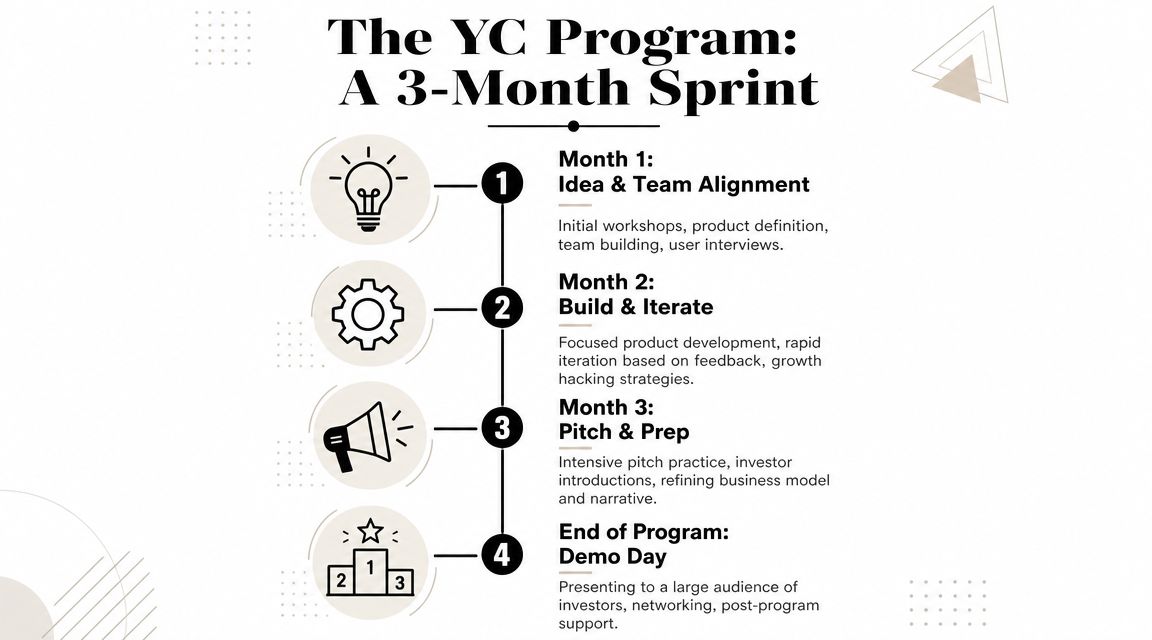
A Dubai founder joins YC thinking, "It's only three months." Two weeks in, the calendar looks very different. Customer calls are tighter, product decisions happen faster, and every vague plan gets exposed.
YC runs as a short, high-pressure batch held multiple times a year, as noted earlier. The timeline is simple. The operating tempo is not.
What the rhythm feels like
The program rewards founders who can handle repeated scrutiny and keep shipping. This is not a classroom model. You are expected to show progress, explain what changed, and defend why it matters.
Early in the batch, the work is often less glamorous than founders expect. Messaging gets stripped down. The target user gets narrower. Loose claims get challenged. If you cannot explain the problem clearly, the next question is usually whether the market is real, the pain is urgent, or the team is avoiding the harder truth.
Then the weekly cadence takes over:
- Talk to users constantly: customer contact becomes a working habit, not a founder slogan.
- Ship changes fast: speed matters because long debates hide weak conviction.
- Measure the response: retention, usage, conversion, and sales conversations need to show movement.
- Cut distractions: side projects, event plans, and polished strategy work get dropped if they do not help the core business.
Make something people want.
That line is tied to YC because it keeps founders honest. Vision matters, but behaviour matters more. Are users coming back, paying, referring others, or changing their workflow because your product solves a painful problem?
A useful companion video is below if you want a quick visual overview of how founders think about the programme in practice.
Month by month reality
Month one and the removal of excuses
The first month usually exposes how much work felt productive without being decisive. Founders come in with feature lists, branding ideas, partnership ambitions, and investor plans. YC keeps bringing the company back to one question. What did you learn from users this week, and what changed because of it?
For a first-time MENA founder, this can be unusually useful. In the UAE, it is easy to spend months in meetings, pilots, and relationship-building that feel promising but do not create sharp product learning. YC pushes toward tighter experiments and shorter feedback loops.
Month two and visible pressure
By the middle of the batch, intentions stop carrying weight. Results start to matter more.
Some companies benefit enormously, while others feel the mismatch. If your product can be tested, shipped, and adopted quickly, the pressure helps. If your next milestone depends on an enterprise procurement cycle in Abu Dhabi, a government approval, or a slow Saudi sales process, the YC cadence may outpace what your market can realistically return. The batch still moves. Your customers may not.
That does not make YC bad. It means timing matters.
For founders comparing options, this accelerator guide with a detailed programme comparison chart helps show how different YC's pace is from softer or more relationship-driven programs.
Month three and fundraising readiness
The last month shifts toward sharper company presentation. Product work continues, but fundraising preparation becomes part of the job. Founders refine the story, tighten the numbers, and learn to explain traction without hiding behind broad claims.
Good companies benefit from this. Weak companies get exposed faster.
That trade matters for MENA founders. If you already have credible early traction and need a concentrated investor window, this part of YC can be powerful. If you are still trying to earn first local trust, secure pilots, or prove that buyers in the region will move, the fundraising push can arrive before the company is ready.
Practical rule: Apply to YC when speed, pressure, and investor attention match your next milestone. If your next milestone is local proof, get that first.
The Real Benefits and Hidden Downsides of YC
YC has real advantages. It also has costs that many founders minimise until they're already in motion.
For a UAE or MENA founder, the biggest mistake is treating YC as pure upside. It isn't. It's a trade. The quality of that trade depends on what your company needs now.

Where YC can be genuinely powerful
One of YC's strongest advantages is network density. According to YC's official about page, each batch is split into sections of 6–10 companies within larger groups, and tools like Bookface help founders request introductions, knowledge, and peer advice across a community of 5,000+ companies. That structure matters because the value isn't only “access to famous people”. It's access to founders dealing with similar problems right now.
Here are the practical upsides that tend to matter most.
- Brand signal: YC can open doors faster than a cold intro from an unknown startup. That matters with investors, early hires, and some customers.
- Peer benchmark: You see what serious execution looks like up close. That often upgrades your internal standards.
- Fast founder learning: Common early mistakes become easier to spot when partners and peers have seen them many times.
- Global orientation: If you're building for the US or international markets, YC gives you immediate exposure to that operating style.
A founder in Dubai building cross-border B2B software may benefit a lot from that environment. The same founder can use the YC network to find design partners, compare pricing patterns, or get warm introductions outside the region more quickly than they could alone.
What founders often underprice
The downsides aren't theoretical. They hit your cap table, your focus, your logistics, and your energy.
Equity and strategic cost
Every accelerator deal has a cost. Founders often focus on prestige and ignore dilution until later financing rounds make the math more real.
The issue isn't whether equity should ever be traded. It often should. The question is whether this specific trade buys something you can't get another way. If local investors, operators, and customers can solve your next bottleneck, then giving up equity for a global signal may be premature. This breakdown of accelerator equity cost and what programmes take is worth reviewing before you decide.
Market misalignment
A startup whose future depends on Saudi enterprise distribution, UAE licensing, Arabic-first user behaviour, or regional payment realities may not get its core advantage from a Silicon Valley environment.
YC can still help such a company, especially later. But the advice, peer context, and investor framing may tilt global and US-centric. That's not wrong. It's just not always your immediate need.
Personal strain
The founder cost is easy to overlook.
Relocation, time zone stress, family constraints, and operating away from your main customer base all create friction. If you're a solo founder, the pressure can compound quickly. If you have a cofounder, the split matters too. Who travels? Who stays close to customers? Who keeps the team stable?
A programme can improve your company and still be the wrong move for your life at that moment.
A practical founder lens
Ask these before you get seduced by the logo:
- Is your core market global or region-specific?
- Do you need investor access more than customer access?
- Will the programme accelerate your current direction, or interrupt it?
- Can your team handle a hard sprint without dropping core execution?
- Would strong local traction make you a better YC candidate later anyway?
If your answers are mixed, that's normal. The right conclusion may be “not yet” rather than “no”.
YC vs MENA Accelerators A Founder's Comparison
For founders in the UAE, Saudi Arabia, Egypt, or the wider region, the choice usually isn't YC versus nothing. It's YC versus local or regional options that solve different problems.
That distinction matters because accelerators are not interchangeable. A programme can be excellent and still be wrong for your startup.
Side by side view
| Criteria | Y Combinator (YC) | Typical MENA Accelerator |
|---|---|---|
| Primary network | Global founder and investor network | Regional founders, investors, corporates, and ecosystem operators |
| Best fit | Startups with global ambition and broad investor appeal | Startups that need market access, regional pilots, or local ecosystem support |
| Programme style | High-pressure execution sprint | Often more relationship-driven and locally contextual |
| Customer relevance | Strong if your users or buyers are international | Strong if your users or buyers are in GCC or wider MENA |
| Regulatory help | Limited local specificity for MENA rules and market nuances | Usually stronger on local setup, partnerships, and market navigation |
| Brand effect | Powerful global signal | Stronger local credibility in specific ecosystems |
| Logistical burden | Can require more geographic flexibility and adaptation | Usually easier if your team is already operating in-region |
| Investor orientation | Optimised for broad startup investor visibility | More useful if you need regional angels, family offices, or local funds first |
| Main risk | Great brand but possible local misfit | Helpful locally but may not expand your global reach enough |
When the regional option is stronger
Many MENA startups need trust before scale.
If you're selling to banks, government entities, healthcare groups, education operators, or large family businesses, a regional accelerator can be more practical than YC in the early phase. You may need introductions that aren't globally famous, but are locally decisive. A senior operator in Abu Dhabi or Riyadh who can facilitate a pilot may be worth more than broad international visibility.
The same applies if your startup depends on local distribution quirks. In MENA, payment behaviour, procurement cycles, bilingual product requirements, and legal structure often shape execution. A regional programme may help you manage those details faster.
When YC is clearly stronger
YC becomes more compelling when your company looks less like a “regional startup” and more like a startup that happens to be based in the region.
That usually includes companies with traits like these:
- Global buyer profile: SaaS, developer tools, AI infrastructure, workflow software, or products that don't depend on one geography.
- Remote-friendly sales motion: You can acquire users and customers without needing deep local institutional trust first.
- Clear founder-market speed: The team already ships quickly and can benefit from compression.
- Fundraising need: You want a larger global investor set, not only local capital.
The non-obvious middle ground
Some founders should do both, just not in the wrong order.
A sensible path can look like this:
- Validate in the UAE or GCC first
- Build customer proof and operational discipline
- Use regional support to solve local friction
- Apply to YC once the global story is sharper
That route often produces a better application anyway. A founder with specific customer pain, sharper product language, and cleaner proof is easier to back than one applying from pure ambition.
The best accelerator is the one that solves your next real bottleneck, not the one that looks best on LinkedIn.
Your Next Step Applying to YC and Building in MENA
If you're still asking what is YC, the short answer is simple. It's a respected accelerator built to compress startup progress. If you're asking whether you should apply, the answer depends on fit.
When YC likely makes sense now
YC is a logical next step if most of the following are true:
- You're building for a global market: Especially software products that aren't tightly tied to one country's regulation or buyer behaviour.
- You already have momentum: Not perfection, but signs that users care and the team can move fast.
- You want a wider investor network: You're likely to benefit from concentrated exposure to global startup capital.
- You can handle programme intensity: Your team can survive a hard sprint without losing the business underneath it.
When local focus is probably smarter first
Hold off and go deeper into MENA first if these sound more like your situation:
- Your startup depends on regional trust: Enterprise, government, regulated sectors, or relationship-heavy sales.
- Your product still needs local insight: Arabic UX, local workflows, distribution partnerships, or market-specific onboarding.
- Your company isn't ready for acceleration: You still need sharper customer understanding more than broader visibility.
- Your team capacity is fragile: YC can amplify momentum, but it can also expose weak operating foundations.
If you do apply, keep it brutally clear
Most weak accelerator applications fail for the same reason. They sound ambitious but not grounded.
A stronger approach is straightforward:
- Show movement: Explain what changed recently in the product, users, or customer learning.
- Write plainly: Avoid inflated language. Founders don't need to sound impressive. They need to sound precise.
- Prove speed: YC likes founders who execute, learn, and adapt quickly.
- Explain the market clearly: If a smart generalist can't understand who buys this and why, the story isn't ready.
If one of your current blockers is technical hiring rather than funding alone, a resource like AI engineer placement services for startups can help you test whether talent access is the true issue before you chase an accelerator to solve everything at once.
Apply to YC when it can multiply existing motion. Don't use it as a substitute for finding it.
Before you decide, ask your team three questions:
- What is our real bottleneck for the next few months?
- Would YC solve that bottleneck directly, or just look impressive externally?
- What could we prove locally first that would make every later option stronger?
For many UAE and MENA founders, the best move isn't choosing between local and global. It's sequencing them properly.
If you want a sharper answer than “it depends”, Founder Connects gives UAE and MENA founders a place to pressure-test decisions like YC with peers who've faced similar trade-offs. It's built for honest conversations, practical accountability, and the kind of high-signal connections that help you decide what to do next.

Building in MENA? You don't have to do it alone.
Join 300+ founders in the Founder Connects Residency. Monthly squad calls, warm intros, $3M+ in perks, and much more. All for less than your monthly coffee budget.
Popular posts





Founder Connects is a premium MENA tech founder community. Meetups in Dubai and across MENA, Residency Squads of 8–10, and 400+ vetted WhatsApp founders (apply and screened).