

Almaty Kazakhstan Current Time: A Founder's Guide 2026
Building in MENA? You don't have to do it alone.
Join 300+ founders in the Founder Connects Residency. Monthly squad calls, warm intros, $3M+ in perks, and much more. All for less than your monthly coffee budget.

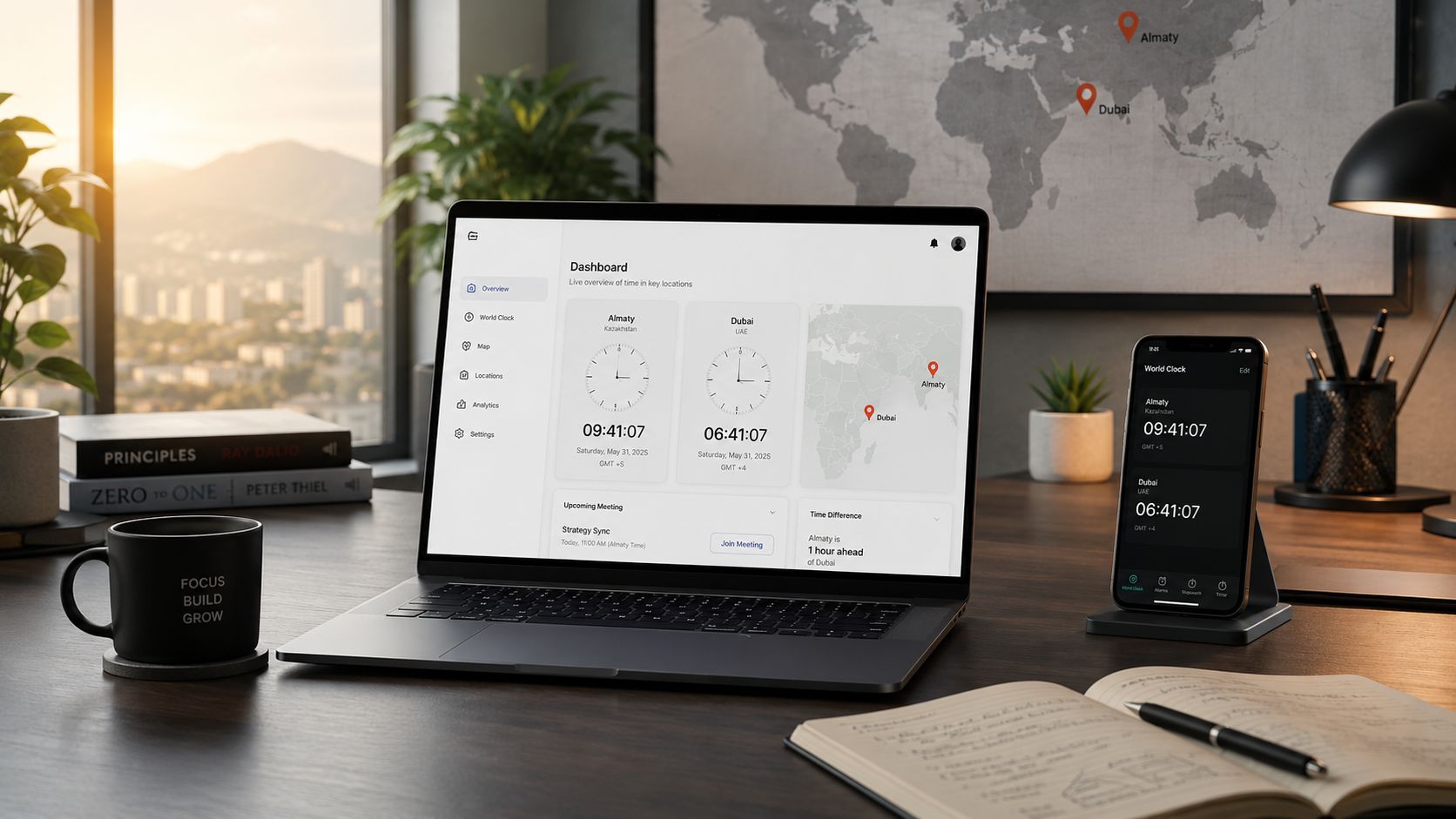
Almaty is currently on UTC+5, it does not observe daylight saving time, and it is typically one hour ahead of the UAE on UTC+4. If you're scheduling from Dubai or elsewhere in the Gulf, the good news is the offset is simple and stable, so you can plan calls without seasonal clock changes catching your team out.
That matters more than most founders think. A missed intro call with a prospective partner, engineer, distributor, or investor contact in a new market doesn't just waste half an hour. It signals that your operation isn't tight yet.
For UAE and MENA founders, Almaty is one of the easier cross-border markets to coordinate with because the timing isn't messy. The value isn't in memorising the offset. It's in turning that clarity into a better operating rhythm, cleaner invites, and fewer avoidable mistakes.
Coordinating with Almaty from the UAE
If you're in Dubai and trying to book a call with a team in Almaty, the first instinct is usually right. The cities are close enough in working-day rhythm that scheduling is manageable. The problem isn't the maths. It's assuming every market handles clocks like the Gulf.
Almaty uses Kazakhstan Time and sits on a fixed business clock for planning purposes. That makes it easier to work into your existing founder calendar than markets where seasonal changes force recurring adjustments. If you're building a regional operating cadence, that's useful.
Practical rule: treat Almaty as a straightforward adjacent market for meetings, but still force calendar discipline on first contact.
Two habits work well.
- Set expectations early: Put both local times in the first email or WhatsApp confirmation.
- Centralise your process: If your team already spans markets, use shared systems instead of letting each founder or EA improvise.
- Train for relationship work: Good coordination isn't only about clocks. It also affects pipelines, investor follow-ups, and partnership momentum. These strategies for global VC team productivity are useful because they translate well to founder-led cross-border work.
- Sharpen networking process: Founders expanding regionally should also tighten how they build and maintain international relationships. This global networking guide for UAE startups is a practical companion to your scheduling workflow.
Almaty Current Time Quick View
A Dubai founder sends a calendar invite for 3:00 PM UAE time, assuming it lands neatly after lunch in Almaty. It does not if nobody has checked the local clock first. For fast-moving sales, hiring, or investor conversations, a one-line time reference saves avoidable back-and-forth.
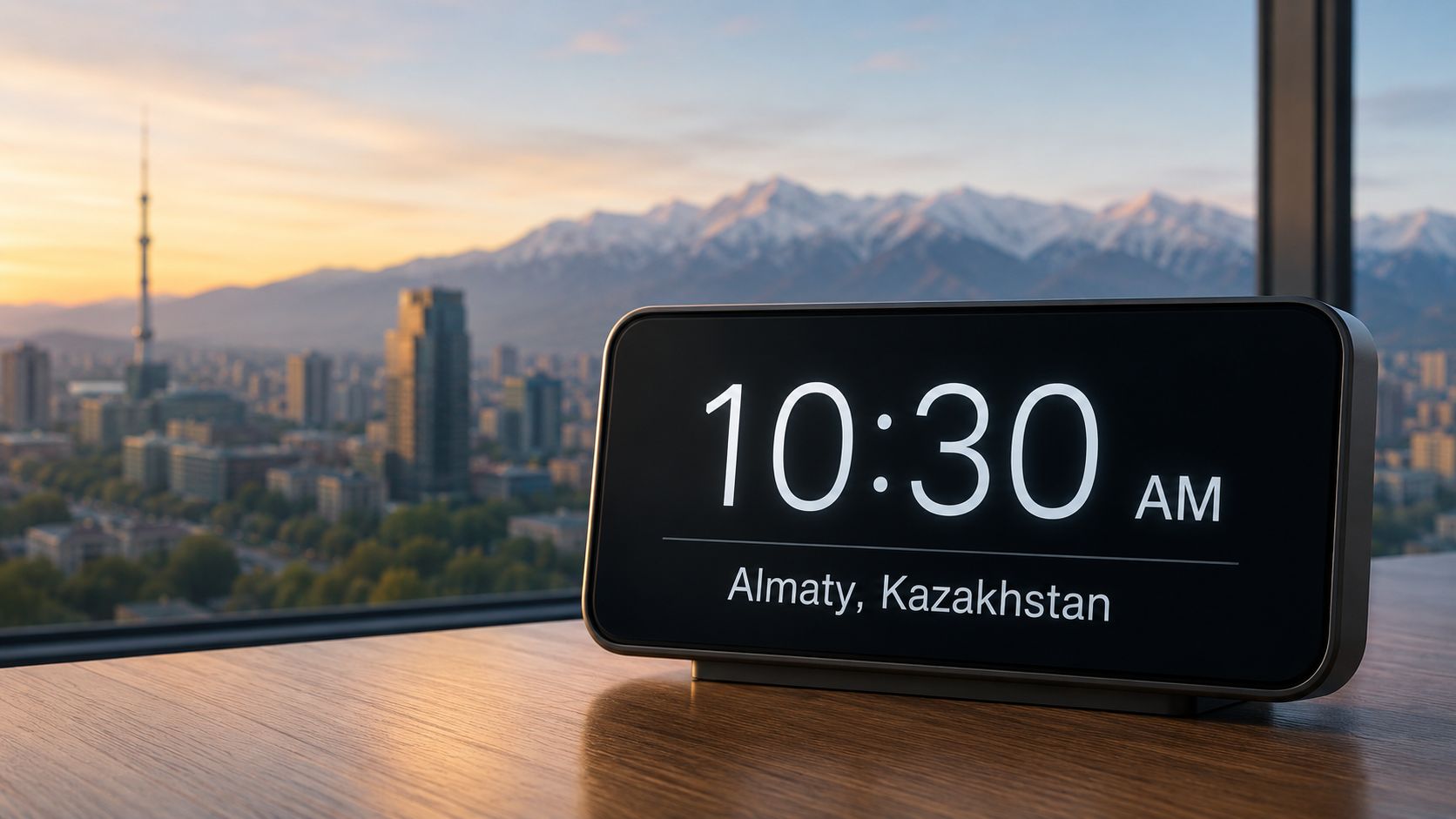
Snapshot format to use internally
Use this format in your CRM, meeting templates, or founder ops docs:
| Location | Time zone label | Current offset |
|---|---|---|
| Almaty | KZT / ALMT | UTC+05:00 |
For UAE and wider MENA teams, the useful part is speed. Nobody should pause to recalculate Almaty time during outreach, rescheduling, or assistant handoffs. Keep the city, label, and offset visible in the tools your team already opens all day.
What to pin in your workflow
Put an Almaty clock or time reference in places where scheduling decisions happen:
- Your ops workspace in Notion, Airtable, or ClickUp
- Calendar booking notes used by founders, EAs, and sales leads
- Shared account plans for Kazakhstan prospects, partners, or investor contacts
This avoids the usual failure point. One person checks the time correctly, another copies the meeting into a different system, and the local-hour context disappears.
For a UAE-based team, the practical standard is simple. Store Almaty as Asia/Almaty with UTC+05:00 in internal documentation, then make sure invites show both sides before they go out.
Almaty Time Zone Explained UTC+5
The useful fact isn't just the local time. It's the predictability.
Almaty is on Kazakhstan Time (KZT) and currently uses UTC+5 with no daylight saving time, so its local clock stays fixed year-round, according to this Almaty time reference. For UAE operators, that means Almaty is typically one hour ahead of UAE time when the UAE is on UTC+4.
Why founders should care
A fixed offset removes one of the most common causes of cross-border scheduling errors. Teams don't need to remember a spring change, an autumn change, or a temporary mismatch period.
That gives you three practical advantages:
- Recurring calls stay clean: Weekly stand-ups and investor updates don't need seasonal adjustment.
- Sales and partnership outreach gets easier: Your SDR, EA, or founder can propose times with confidence.
- Internal documentation holds up: Playbooks, templates, and booking links don't need constant edits.
Almaty works well for UAE-based teams because the relationship between the clocks is stable, not because the conversion is complicated.
What doesn't work is hardcoding assumptions into human behaviour alone. Even with a stable offset, people still make mistakes when invites only show one time zone or when someone manually types the wrong local hour.
Conversion Guide for UAE and MENA Founders
For day-to-day scheduling, founders need a quick reference that can be skimmed in seconds. This is the easiest way to reduce friction when a call includes the Gulf plus a broader MENA participant set.
Almaty Time Conversion for MENA Hubs
| If it is 10:00 AM in... | The time in Almaty (KZT, UTC+5) is... |
|---|---|
| Dubai | 11:00 AM |
| Abu Dhabi | 11:00 AM |
| Riyadh | 12:00 PM |
| Doha | 11:00 AM |
| Cairo | Check current local offset before sending invite |
The Dubai and Abu Dhabi rows are the ones most UAE founders will use most often. The practical shorthand is simple: if your UAE calendar shows 10:00 AM, your Almaty counterpart will typically see 11:00 AM.
A cleaner invite format
Use meeting titles and descriptions that remove ambiguity:
- Product review | 10:00 AM UAE / 11:00 AM Almaty
- Investor intro | 2:00 PM GST / 3:00 PM KZT
- Vendor onboarding | 4:30 PM Dubai / 5:30 PM Almaty
For Cairo and other markets outside the core Gulf rhythm, don't assume. Check the local setting at the time you send the invite. The extra few seconds are worth it when the meeting matters.
Finding the Best Meeting Times
The offset is small enough that most of the working day overlaps naturally. That's a significant operational win.
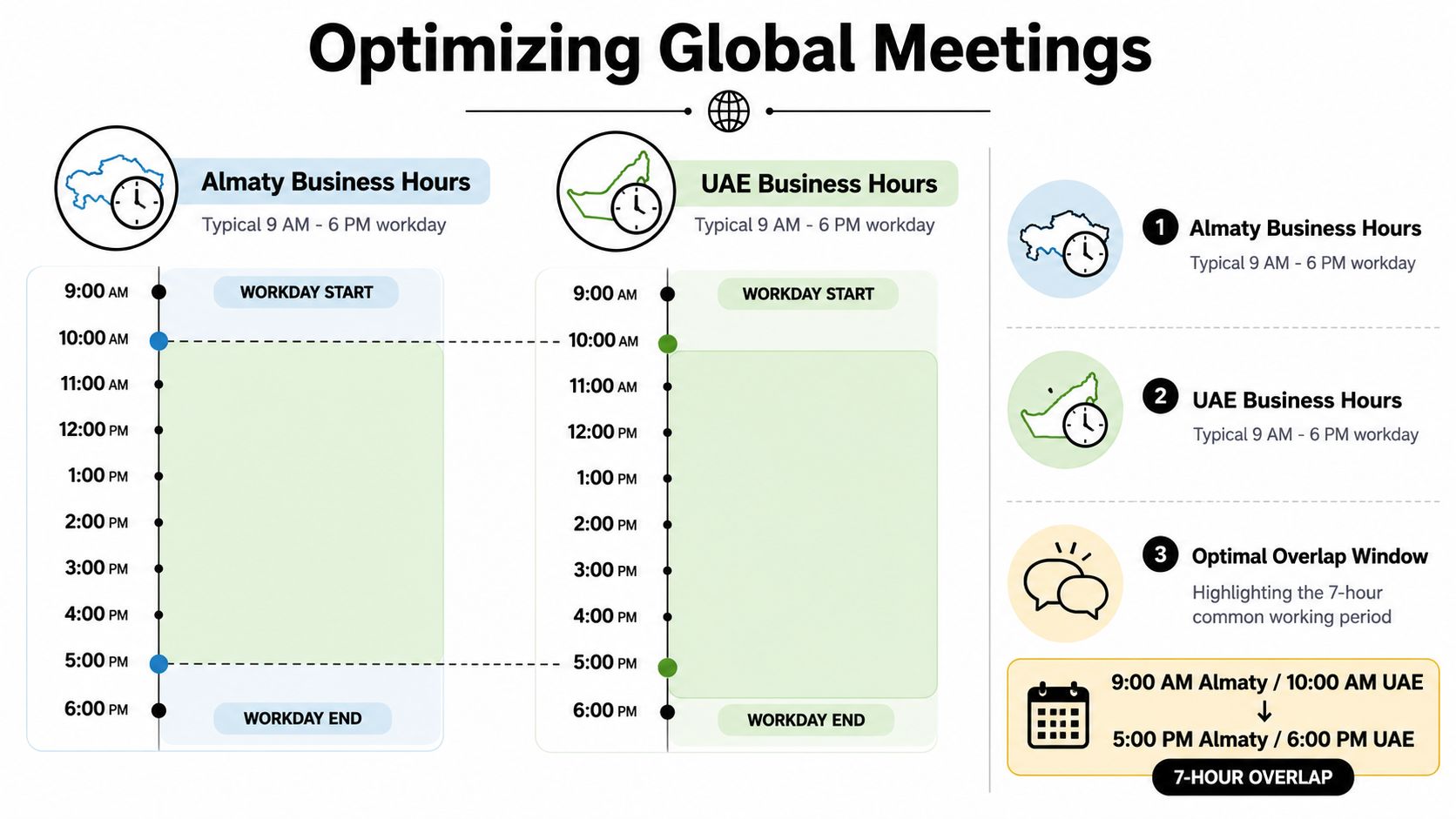
The overlap that actually works
If both teams roughly operate on a 9:00 AM to 6:00 PM day, you have a wide shared window without asking anyone to start unusually early or stay online late.
The cleanest scheduling band for most founder-led conversations is:
- 9:00 AM UAE / 10:00 AM Almaty
- through
- 4:00 PM UAE / 5:00 PM Almaty
That range works well for intro calls, product reviews, hiring interviews, and partner check-ins. It gives enough room for same-day follow-up, which matters if you're moving a deal or technical decision quickly.
Where teams waste time
The bad pattern is endless back-and-forth over availability. The better pattern is to send a booking link or a short set of pre-converted options.
If your team is still evaluating tools, this Formzz guide to scheduling software is a useful starting point for comparing categories and setup styles. For live founder conversations across markets, it's often faster to route serious meetings through a dedicated Founder Connects meeting page or your own equivalent booking flow instead of negotiating availability over email.
Keep high-stakes meetings inside the middle of the overlap window. Early and late slots are where misunderstandings and delays tend to show up.
Programmatic Time Access for Tech Teams
A UAE founder books a demo for 3:00 PM Dubai, the customer success workflow fires reminders off a fixed offset, and the Almaty contact gets the wrong local time in the email. That is a small bug with real cost. Missed calls, support tickets, and a weaker first impression.

Use the right zone identifier
For engineering and RevOps teams, the implementation detail that matters is the IANA time zone name. For Almaty, use Asia/Almaty. As noted earlier, Almaty runs on UTC+5 and does not shift seasonally, so scheduling logic stays predictable for UAE and wider MENA teams.
Use the zone identifier in code, calendar logic, notification jobs, and CRM automations. A plain +05:00 offset can work for a quick display, but it is a poor choice for systems you expect to scale or maintain.
Practical implementation options
These three approaches cover most startup stacks.
Native JavaScript
const nowInAlmaty = new Intl.DateTimeFormat('en-GB', {timeZone: 'Asia/Almaty',dateStyle: 'full',timeStyle: 'short'}).format(new Date());console.log(nowInAlmaty);Use this for admin panels, internal dashboards, and browser-based tools where you need a clean local-time display without extra dependencies.
Day.js with timezone support
import dayjs from 'dayjs';import utc from 'dayjs/plugin/utc';import timezone from 'dayjs/plugin/timezone';dayjs.extend(utc);dayjs.extend(timezone);const almatyTime = dayjs().tz('Asia/Almaty').format('YYYY-MM-DD HH:mm');console.log(almatyTime);Use this when product logic needs repeated conversions, consistent formatting, or timezone-aware timestamps across front-end flows.
Python with zoneinfo
from datetime import datetimefrom zoneinfo import ZoneInfoalmaty_now = datetime.now(ZoneInfo("Asia/Almaty"))print(almaty_now.strftime("%Y-%m-%d %H:%M"))Use this for back-end jobs, reminder queues, reporting scripts, and CRM syncs.
What to build around it
Founders do not need an elaborate time stack on day one. They do need a few rules early, especially if sales, hiring, or onboarding runs between the UAE and Kazakhstan.
- Store timestamps in UTC. Convert only when rendering for the user.
- Use
Asia/Almatyin scheduling logic. Keep the city-specific zone in booking flows and reminder services. - Render local time in customer records. Sales and support teams reply faster when they can see contact time at a glance.
- Test invites and reminder emails. Check the actual output in Dubai and Almaty before rolling changes live.
- Keep one source of truth for time handling. A shared utility or service prevents each team from formatting dates differently.
If your team is still cleaning up calendar ops and founder workflows, this guide to time management tools for founders is a practical next read.
The operating rule is simple. Let standards and libraries handle time zones. Your team should spend time closing deals and shipping product, not fixing preventable calendar errors.
Practical Scheduling Tips for Cross-Border Teams
Professional scheduling isn't admin polish. It's trust-building. When your team handles timing cleanly, partners notice that you operate like a serious company.
Regional planning tools also show why this corridor is easier to manage than many others. Almaty's fixed UTC+05:00 offset creates a stable scheduling baseline for cross-border coordination, making meeting windows predictable year-round, as reflected by 24TimeZones' Almaty time planning reference.
Habits worth standardising
- Put both times in every invite: Write the subject or description in dual format. Example: Growth sync | 3:00 PM UAE / 4:00 PM Almaty.
- Add Almaty to every device clock: Laptops and phones should show it by default for founders, EAs, recruiters, and partnership leads.
- Confirm first-time meetings manually: For a high-value first conversation, add one plain line in the email: Confirming this is 11:00 AM your time in Almaty.
- Use software for availability: Calendly, Google Calendar appointment schedules, and similar tools reduce avoidable human error.
- Keep outreach inside local business hours: A message sent at the wrong local hour can make a small team look disorganised.
What usually fails
The weak approach is casual and fragmented. One founder types a time manually. An assistant forwards it without checking. A prospect accepts the meeting but joins at the wrong hour because the original note only referenced Gulf time.
A stronger system is boring on purpose:
- Team templates use dual-zone naming.
- Shared calendars show key market clocks.
- Booking links handle conversion automatically.
- Anyone scheduling externally follows the same rulebook.
If your founders are still tightening personal operating discipline, this guide to founder time management tools is a useful place to refine the workflow around meetings, follow-ups, and calendar control.
Stable time zones don't fix messy scheduling habits. Process does.
Your Next Action Plan for Flawless Scheduling
The best version of this setup is simple enough that your team doesn't need to think about it twice. Once you've standardised the basics, Almaty becomes an easy market to coordinate with.
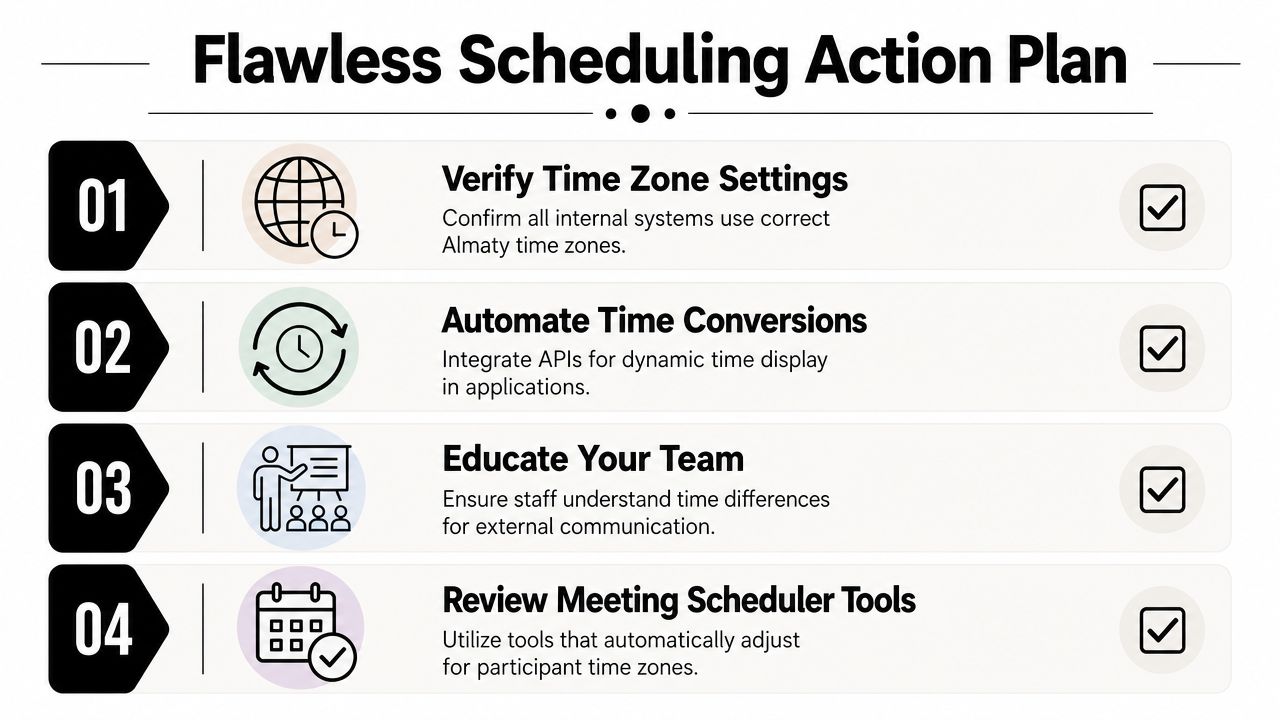
Use this checklist today:
- Update your shared clock view: Add Almaty to Google Calendar, Apple Clock, or your team dashboard.
- Fix invite templates: Make dual-zone formatting mandatory for external meetings.
- Review booking links: Ensure they display local times properly for invitees.
- Check product logic: If your app shows local time, confirm it uses Asia/Almaty.
- Brief your team: Give one clear instruction. Almaty is one hour ahead of the UAE, and invites should reflect that cleanly.
Founders don't need more complexity. They need fewer avoidable errors, faster coordination, and better signals to partners in new markets.
Founder Connects helps UAE and MENA founders build those kinds of sharper operating habits through curated peer relationships, practical support, and meaningful introductions. If you want a stronger founder circle, better accountability, and higher-signal connections, explore Founder Connects.

Building in MENA? You don't have to do it alone.
Join 300+ founders in the Founder Connects Residency. Monthly squad calls, warm intros, $3M+ in perks, and much more. All for less than your monthly coffee budget.
Popular posts





Founder Connects is a premium MENA tech founder community. Meetups in Dubai and across MENA, Residency Squads of 8–10, and 400+ vetted WhatsApp founders (apply and screened).