

Building a Remote Team from Dubai: A Founder's Guide 2026

Building in MENA? You don't have to do it alone.
Join 300+ founders in the Founder Connects Residency. Monthly squad calls, warm intros, $3M+ in perks, and much more. All for less than your monthly coffee budget.

You're probably in one of two situations right now. You've built the first version of the company in Dubai, and the next hires you need aren't all in Dubai. Or you've already made a few remote hires across MENA, Asia, or Europe, and now the cracks are showing in communication, compliance, or culture.
That's the challenge with building a remote team from Dubai. Talent access gets wider fast, but so do the operational risks. A founder can hire a strong engineer in Egypt, a growth lead in Jordan, and a closer in Europe, then realise a month later that contracts are weak, response times are vague, and nobody agrees on when “urgent” means urgent.
Dubai gives founders a serious strategic advantage if they use it properly. The city sits in a time zone that overlaps naturally with Europe and Asia, the UAE already operates in a hybrid-first reality, and founders here can build teams that are faster and more flexible than office-bound competitors. But that only works when hiring, payroll, documentation, culture, and management are designed deliberately.
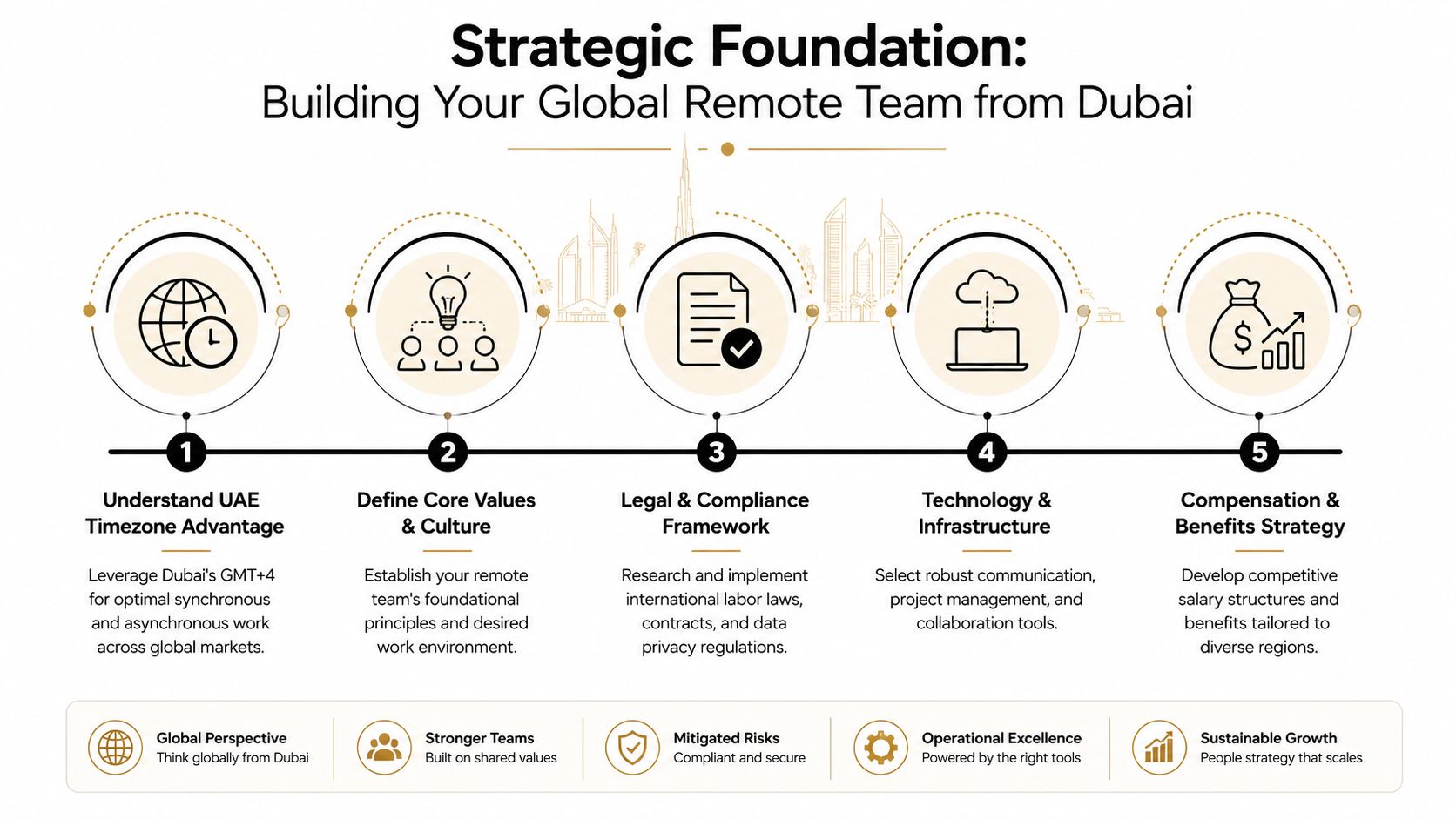
The Strategic Foundation for Your Global Team
Dubai is one of the better headquarters locations for a distributed company because GMT+4 creates overlap with both European mornings and Asian afternoons, which makes UAE-based teams practical for cross-regional collaboration (Labeeb on UAE remote jobs and timezone overlap). In practical terms, founders in Dubai can run core collaboration hours from 10 AM to 4 PM UAE time, which supports real-time work with cities such as London, Berlin, Istanbul, Mumbai, and Kuala Lumpur through the same operating window, according to that same source.
That advantage matters more than most founders think. If your company is building product in one region, selling in another, and supporting customers in a third, timezone friction becomes an execution problem very quickly. Dubai reduces that friction without forcing your team into extreme shifts.
The broader shift also supports this model. During the pandemic peak, over 62% of employees in Dubai worked remotely, compared with 51% in Abu Dhabi and 56% in other emirates, and hybrid work has since become the dominant workplace arrangement in the UAE, with hybrid job postings rising by 25.2% while remote-only postings declined from 4.3% in 2023 to 3.7% in 2024 (UAE and GCC remote work statistics). That matters because founders aren't building against the market anymore. They're building inside a market that already accepts hybrid and distributed work as normal.
Decide your operating model before you hire
Most mistakes happen before the first offer letter goes out. Founders often hire into a remote setup they haven't designed.
Use a simple decision filter:
- Choose fully remote if your work is documentation-heavy, output-based, and doesn't depend on in-person client delivery.
- Choose hybrid from Dubai HQ if leadership, sales, or client trust still benefits from a physical base but execution can happen across borders.
- Avoid accidental hybrid where some people sit in an office, others work remotely, and no one knows which discussions belong where.
Practical rule: If a decision can't be understood without being in the room, your operating model isn't remote-ready yet.
Build your schedule around overlap, not office hours
A Dubai-based remote company works best when the day is split into two modes:
- Synchronous block: Use the overlap window for stand-ups, client calls, hiring interviews, and issue resolution.
- Asynchronous block: Reserve the rest for deep work, documentation, code review, proposals, and follow-ups.
This keeps your company from becoming meeting-heavy while still preserving speed. Teams that try to mimic a full office day across multiple countries usually create the worst of both worlds. Too many meetings, too little clarity, and constant waiting.
Budget for the real cost of distributed hiring
Founders often compare only salary lines. That's too narrow.
Your budget needs to include:
- Compensation structure: Model pay against seniority, language capability, and delivery expectations.
- Equipment and setup: Decide what the company provides and what gets reimbursed.
- Compliance overhead: Contracts, payroll setup, visa or employment model decisions, and legal review.
- Management load: Remote teams require more written process than co-located teams.
The companies that do this well treat remote setup as infrastructure, not as a shortcut. The UAE's remote workforce was projected at 40% of the total workforce in 2023, 46% in 2024, and 52% by 2025, while ICT investment rose from $18.5 billion in 2022 to $21.7 billion in 2023, $25.3 billion in 2024, and a projected $29.7 billion in 2025 to support that shift (Gulf region remote work statistics). That trend tells founders something simple. Remote capability is now an operating requirement, not an experiment.
Sourcing and Hiring Talent Across Borders
Once the structure is clear, hiring gets much easier. The best Dubai-based remote teams don't recruit everywhere. They recruit intentionally.
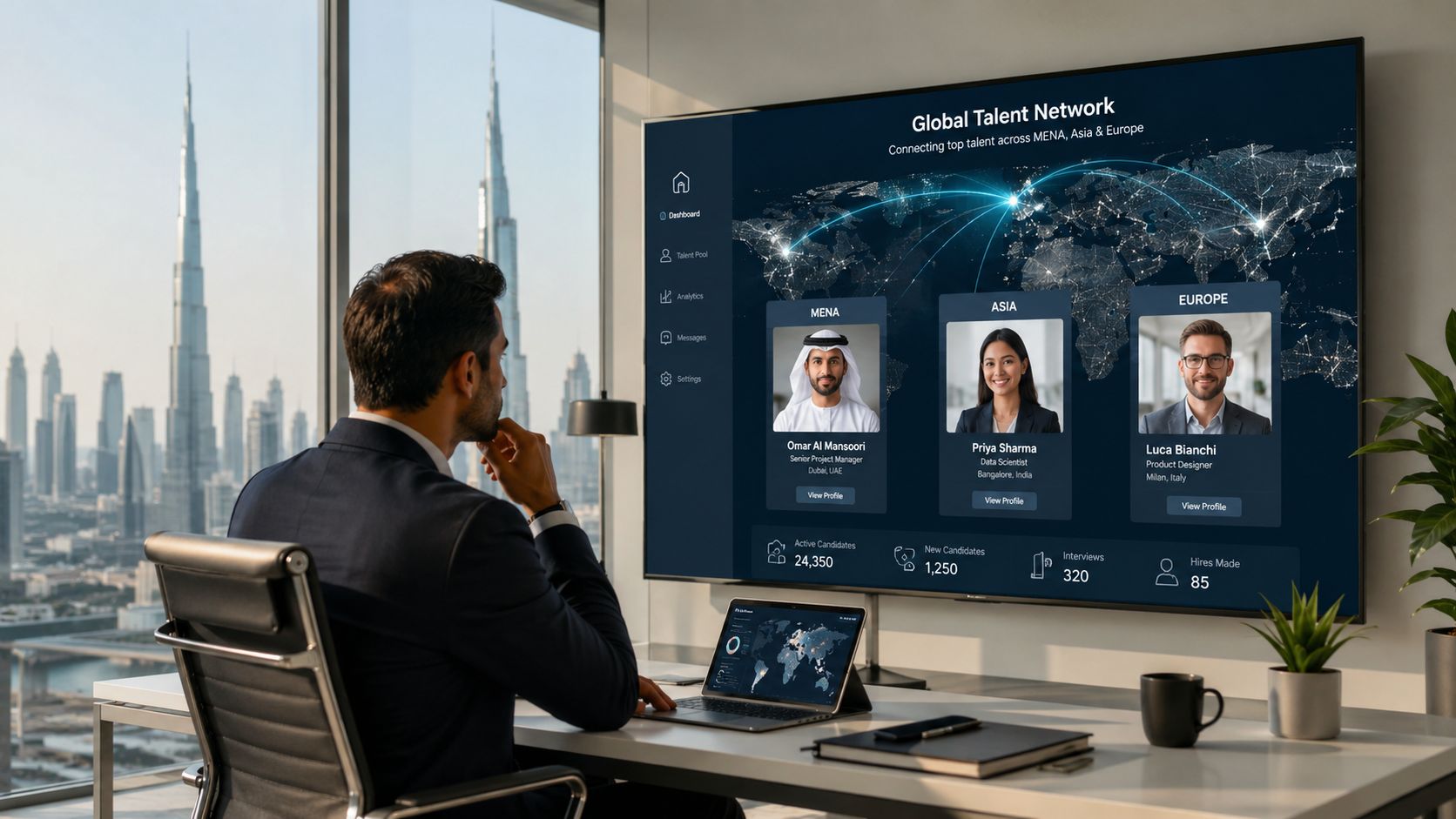
When hiring across MENA, founders should prioritise markets like Egypt, Jordan, and Morocco for cost-effective talent, model compensation on outcomes rather than location, and screen technical roles for async communication habits while revenue roles should be screened for CRM discipline and language fluency (practical guide to hiring in MENA).
Pick markets by role, not by habit
Founders often default to the same talent market for every hire. That's lazy and expensive.
A better approach:
- Product and engineering roles: Look for strong async habits, problem-solving depth, and evidence of shipping work across borders.
- Sales and revenue roles: Focus on pipeline ownership, CRM hygiene, language fluency, and comfort working across different buyer cultures.
- Operations and support roles: Prioritise written clarity, reliability, and comfort with process-heavy environments.
The region matters, but role-fit matters more. A great remote hire usually shows strong written thinking before they ever show impressive credentials.
Where to post and how to tighten your funnel
Use a mix of broad and regional channels. LinkedIn still matters because serious candidates expect to find legitimate employers there. GulfTalent helps when you want visibility in the region. Foundit MENA and EuropeRemotely can widen reach for specific profiles.
But posting isn't the hard part. Screening is.
These questions expose whether someone can thrive remotely:
- “Tell me about a project where your manager wasn't online when you were blocked. What did you do next?”
- “Show me how you usually structure updates when working across time zones.”
- “What do you document automatically, even when nobody asks?”
- “How have you handled disagreement with a team in another country?”
You're not looking for polished theory. You're looking for operating behaviour.
A lot of UAE founders also repeat the same hiring errors early. This breakdown of startup hiring mistakes UAE founders make is worth reviewing before you scale your pipeline, especially if you're hiring quickly and don't yet have a strong interview process.
Test remote readiness before the offer
A CV won't tell you whether someone can work well in a distributed team. A short paid exercise usually will.
For example:
- For engineers: give a scoped task with a written brief and evaluate both the output and the questions they ask.
- For marketers: ask for a campaign teardown plus a proposed weekly reporting structure.
- For sales hires: ask them to review a mock pipeline and explain what they'd do first.
Later in the process, show candidates how a distributed team operates in practice:
What works is consistency. Same scorecard. Same interview sequence. Same expectations. That's what helps you compare talent fairly across MENA, Asia, and Europe without getting distracted by charisma.
Navigating Legal Compliance and Payroll
Many founders building a remote team from Dubai often slow down at this stage. They can identify talent globally, but they're not sure how to hire that talent cleanly.
The first decision is local. To build a compliant remote team from Dubai, founders need to choose a jurisdiction, either mainland UAE under MOHRE or a free zone, use fixed-term contracts that define remote work clearly, and activate payroll through the Wage Protection System, while misclassifying freelancers or overseas employees without the right status can create significant compliance breaches (remote work Dubai compliance guide).
The legal backdrop also matters. UAE remote work is recognised under Federal Decree-Law No. 33 of 2021, and remote, hybrid, and flexible work must be documented in employment contracts or formal addendums. For foreign nationals working remotely from the UAE, tourist visas don't authorise remote work, and the UAE Remote Work Visa requires proof of foreign employment, valid health insurance, a passport with six months' validity, and a minimum monthly income of $3,500 USD. That visa permits remote work for foreign employers only, not local employment without the appropriate permit (UAE labour law and remote work overview).
Compare the three main hiring models
| Model | Best For | Compliance Risk | Typical Cost |
|---|---|---|---|
| Employer of Record | Founders hiring quickly in countries where they don't have an entity | Lower than informal hiring, but still depends on provider quality and contract clarity | Higher ongoing service cost |
| Independent contractor | Project-based work, specialist contributors, short-term needs | Higher if the relationship looks like employment in practice | Lower direct cost, but risk can be expensive later |
| Local entity setup | Repeated hiring in one country, long-term team building | Lower once properly structured, but setup burden is heavier | Higher setup and admin burden |
What works for most early-stage Dubai startups
Most early-stage companies don't need to set up entities in multiple countries immediately. They usually choose between an Employer of Record and carefully structured contractor arrangements.
Use an EOR when:
- The role is core to the business: engineering lead, country operator, head of growth.
- You need employer-style control: full-time expectations, managed hours, local payroll, benefits handling.
- The person is in a country where employment law is harder to manage alone.
Use a contractor model when:
- The work is clearly project-based: design sprint, content production, advisory, implementation work.
- The person already operates independently: with a valid licence where relevant.
- You can define output without treating them like a regular employee.
Use your own local entity abroad only when a market becomes strategically important enough to justify the ongoing burden.
If someone works like your employee, joins your internal rhythms like your employee, and depends on you like your employee, don't try to force a contractor label onto the relationship.
The hidden risk founders ignore
The hardest issue isn't payroll software. It's legal ambiguity around non-UAE remote employees when the company is headquartered in Dubai. Existing guidance often explains remote work generally, but gives weak answers on how a Dubai startup can legally employ foreign staff without a local establishment in that country. That gap is real, especially when founders want employees rather than freelancers and don't yet have foreign entities (analysis of the legal uncertainty for Dubai founders hiring global talent).
That's why contract quality matters so much. Your contract should define remote work terms, working hours, equipment responsibilities, confidentiality, and data handling. It should also line up with the model you've chosen. Sloppy paperwork is usually the first sign of a messy remote operation.
If your hiring team needs better interview discipline around regulatory and classification risk, this guide on how to master compliance talent hiring is useful because it sharpens the questions you ask before a misclassification issue lands on your desk.
There's also a finance angle. Remote expansion affects payroll design, contractor treatment, and how you think about cross-border operating structure, so founders should keep tax planning close to hiring decisions. This overview of UAE corporate tax for startups explained is a practical starting point when you're designing the company around growth rather than patching things later.
Non-negotiables before anyone starts
Use this checklist before sending an offer:
- Confirm jurisdiction first: mainland or free zone changes payroll and EOSB handling.
- Choose the hiring model deliberately: EOR, contractor, or direct employment.
- Write remote clauses into the contract: don't leave work location, equipment, or security implied.
- Check visa and work authorisation status: especially for foreign nationals based in the UAE.
- Align payroll operations early: WPS and related obligations shouldn't wait until after the start date.
The Right Tools and Communication Cadence
Tools don't fix weak management. They do make weak management visible very quickly.
For UAE-based remote teams, the essential stack is Slack for daily updates and async communication, Microsoft Teams or Zoom for weekly video calls, and Asana for task management, with a rule that all messages must be answered within a 4-hour maximum to maintain clarity and accountability (remote employees UAE guide).
That's a sensible starting point because each tool has a clear job. Slack handles fast-moving discussion. Zoom or Teams handles live alignment. Asana becomes the record of work and ownership. Once founders start using five tools for the same purpose, response quality falls and accountability gets fuzzy.
Set channel rules early
A remote team doesn't need more communication. It needs cleaner communication.
Use simple rules like these:
- Slack is for coordination: questions, updates, blockers, quick clarifications.
- Asana is for committed work: owners, deadlines, next steps, and status.
- Zoom or Teams is for decisions that need live discussion: sensitive issues, planning trade-offs, feedback that gets lost in text.
- Documentation holds the final answer: if it matters next week, write it down.
Operating principle: If your team keeps asking the same question twice, the problem isn't memory. The problem is that nobody documented the answer properly.
Make async the default and meetings the exception
A lot of founders say they want async work, but still reward whoever replies fastest in chat. That creates anxiety, not speed.
A healthier rhythm looks like this:
- Team members post daily written updates in Slack.
- Work moves through Asana with clear owners.
- Weekly video calls handle alignment, not status theatre.
- Decisions get written down after meetings.
- Response expectations are explicit, not assumed.
Google Calendar's timezone-aware scheduling and Slack's local time display help reduce friction, but the bigger win comes from behavioural consistency. People need to know where to look, what to update, and how long they can wait before escalating.
If your own calendar is already chaotic, the team will feel it immediately. Founders who struggle to manage attention usually create communication overload for everyone else. This roundup of top tools for founder time management is useful because remote communication quality usually starts with founder discipline.
A lean documentation standard
You don't need a corporate wiki on day one. You do need a minimum standard.
Every team should have:
- Role pages: what each person owns.
- Meeting notes: key decisions and unresolved questions.
- Process documents: how hiring, onboarding, approvals, and reporting work.
- Project briefs: goals, constraints, owners, deadlines.
That's enough to reduce repeated explanations and onboard new hires without relying on informal context.
Building Culture and Managing Performance
Remote culture isn't something a team “has”. It's something leadership keeps building through repeated behaviour.
That matters even more in this region because remote workers in the Middle East report higher isolation due to fragmented communication norms, and 62% of Emirati startups struggle with cross-border team cohesion, which means generic advice like “use Slack more” doesn't solve the underlying issue (remote work Dubai and cross-border cohesion challenges).
The problem gets sharper when your company is Dubai-led but culturally mixed across MENA. A founder may have team members in Cairo, Riyadh, Beirut, and Dubai, all speaking English at work but bringing very different habits around hierarchy, response style, humour, directness, and religious routine. If you ignore those differences, trust drops.

Culture comes from systems
Founders often treat culture as a values slide. Remote teams experience culture through cadence.
A stronger approach includes:
- Structured one-to-ones: not just for task updates, but for friction, morale, and context.
- Written recognition: praise in public channels for useful behaviours, not just wins.
- Clear onboarding rituals: who welcomes the hire, what they read first, and how they meet the team.
- Culturally aware scheduling: respect religious observance, national holidays, and regional working habits.
The details matter. Don't schedule your whole team as if everyone shares Dubai's rhythm exactly. Don't assume people will bond naturally across borders. And don't rely on virtual coffee chats as your main answer to isolation.
A remote team becomes cohesive when people know how to work together under pressure, not when they've attended another forced social call.
Onboarding needs more structure than office teams
Distributed development teams in Dubai perform best when onboarding is deliberate. One source notes an 89% success rate only when teams use five factors together: recurring overlap hours with a minimum of 4 daily, cultural onboarding in week one, pilot projects in weeks three and four, daily video stand-ups, and dedicated onboarding buddies. Omitting any factor drops success below 60%. That same source also recommends tracking Sprint Velocity and Cycle Time, reserving 15% to 20% sprint capacity for technical debt, and using quarterly Developer Experience surveys because teams that ignore these metrics see 25% higher attrition in UAE tech firms (distributed development success factors).
Even if you're not running a pure engineering team, the lesson holds. New hires need overlap, context, small early wins, and one person explicitly responsible for helping them integrate.
Manage performance by outcomes, not availability
Remote teams fail when founders substitute visibility for performance. If someone writes constantly in Slack but doesn't move work forward, that isn't strong performance. It's noise.
Use a simple performance structure:
- Define outcomes clearly: what must be achieved in the next month or quarter.
- Track leading indicators: not just final outcomes, but the behaviours that create them.
- Review written progress regularly: this makes performance discussion less emotional.
- Make growth visible: tell people how they move to the next level.
For managers who want an additional operating reference, these remote team best practices for HR are useful as a practical complement to a founder-led system.
Compensation fairness is part of culture
Compensation isn't only a finance decision. It signals what the company values.
When you hire across MENA, Asia, and Europe, don't improvise pay. Create a compensation philosophy early. Tie it to seniority, language capability where relevant, scope of ownership, and delivery expectations. Don't let the first few hires set accidental precedents that become impossible to unwind later.
Fairness doesn't always mean identical salaries across countries. It means the logic is clear, defensible, and consistent. The moment your team believes pay is arbitrary, trust erodes.
Scaling Your Team and Avoiding Common Pitfalls
The first remote hires usually work because founders stay close to everything. The next stage is harder because complexity grows faster than visibility.
Most problems in building a remote team from Dubai come from drift, not from one dramatic mistake. Contracts get copied without review. Meeting habits expand. Documentation gets stale. New hires inherit different norms from older hires. Then the company starts feeling uneven depending on which manager or timezone someone sits under.
The founder audit
Use this checklist with your co-founder or leadership team:
- Check legal consistency: Are people hired under the right model, or did convenience drive classification?
- Review documentation quality: Can a new joiner understand how the company works without chasing five people?
- Pressure-test communication norms: Does everyone know what belongs in Slack, Asana, and meetings?
- Look for timezone bias: Are some team members always carrying the burden of awkward scheduling?
- Audit manager quality: Are one-to-ones, feedback loops, and role expectations consistent across the team?
- Revisit compensation logic: Can you explain why people are paid the way they are?
- Watch for cultural fragmentation: Do sub-teams feel connected to one company, or only to their direct manager?
Final test: If a key manager disappeared for two weeks, would the team still know how to operate? If the answer is no, the system is too dependent on verbal context.
What works as you scale
The strongest remote companies from Dubai do three things well. They document earlier than feels necessary. They solve compliance before it becomes urgent. And they treat culture as an operating system, not as a side project.
That's the standard worth aiming for. Dubai gives founders a strong base for a global team, but the advantage only holds when the company runs with discipline.
If you're building in the UAE and want a sharper sounding board for decisions like remote hiring, team structure, compensation, or founder operating rhythm, Founder Connects is built for that. It brings founders into curated peer groups, practical conversations, and high-signal introductions so you can make progress with less isolation and better judgment.

Building in MENA? You don't have to do it alone.
Join 300+ founders in the Founder Connects Residency. Monthly squad calls, warm intros, $3M+ in perks, and much more. All for less than your monthly coffee budget.
Popular posts





Founder Connects is a premium MENA tech founder community. Meetups in Dubai and across MENA, Residency Squads of 8–10, and 400+ vetted WhatsApp founders (apply and screened).