

Business Coach: What They Do and How to Choose One

Building in MENA? You don't have to do it alone.
Join 300+ founders in the Founder Connects Residency. Monthly squad calls, warm intros, $3M+ in perks, and much more. All for less than your monthly coffee budget.

You have one decision that has sat open for three weeks, and the calendar will not make it for you. Hire the sales lead, or wait until buyers will pay the price on the page. A business coach will not write the offer, close the deal, or file the licence. The useful ones sit with you until that choice has a test, a date, and a name on it.
In Dubai the pile is thicker. Free zone or mainland, visa timing, and which funding route even applies can all look urgent on the same morning. A coach who sorts which decision comes first saves weeks. A weak one leaves a motivational recap and the same open question.
What a Business Coach Does for a Founder
Think of a driving instructor in the passenger seat. They ask what you see, point at the risk you missed, and make you drive. A business coach works the same way with a founder or leader. They work on the decisions and habits that move the business, and they do not do the work for you.

A typical session runs 60 to 90 minutes, every two to four weeks. It starts with the last commitment, then one current decision, then one action with a deadline before you meet again. Skip the status tour. If the last promise did not happen, that is the session.
Say a founder in Dubai wants a sales lead before anyone has paid the proposed price. The coach turns that into one question, the evidence that would answer it, and a two-week test of ten customer conversations. Hire only if those conversations show people will pay. Otherwise the role stays unfilled.
That sorting matters in the UAE, where founders often weigh structure, licensing, visas, and several funding routes at once. The setting is unusually supportive. In the 2023 to 2024 Global Entrepreneurship Monitor, the UAE Ministry of Economy and Tourism notes the country ranked first worldwide in the National Entrepreneurship Context Index for a third year, with a score of 7.7. A favourable environment still does not pick your next move.
Practical rule: Ask what decision the next session will change. If the answer is a feeling, not a choice, keep looking.
Buying a company is a different job from building one. Before you treat them as the same brief, compare SMB acquisition coaching programs and see whether the method matches the decision you have.
How a Business Coach Differs From a Mentor or Consultant
Four people can sit across the table and sound similar. They are not interchangeable. A coach asks questions and keeps you to commitments. A mentor shares lived experience and offers opinions. A consultant delivers a defined answer or project. A specialist adviser solves one technical problem, such as licensing, tax, or contract terms.
| Role | Main job | Who holds the answers | Typical format | Best when |
|---|---|---|---|---|
| Business coach | Sharpen decisions and hold you to actions | You, with the coach asking questions | Recurring sessions, often every two to four weeks | You have a goal but unclear next steps |
| Mentor | Share experience from a similar path | The mentor, who offers views | Informal or relationship based | You want pattern recognition from someone who has done it |
| Consultant | Deliver a defined answer, plan or project | The consultant, who recommends and often executes | Fixed scope and deliverables | You need a specific analysis or system built |
| Specialist adviser | Solve one technical problem | The adviser, within their field | Project based or hourly | You need licensing, tax or legal clarity |
Read the middle column first. If you want someone else to own the answer, you are not buying coaching. Many coaches also share a view, and many consultants coach while they deliver. The mode that dominates the invoice is the one you are paying for.
A short decision rule
- Finished deliverable: Hire a consultant, with scope, date, and what "done" looks like.
- Thinking partner and accountability: Hire a business coach.
- Someone who has walked your path: Look for a mentor, and treat their story as one data point.
- One technical unknown: Pay a specialist for that question only.
If you are still unsure which label fits, a business consultant near you is a different brief from a coach, and mixing the two usually produces a vague retainer.
Put one question to any provider. Will you tell me what you would do, or will you help me decide what I should do? Advisers who live on outbound also need a way to start those conversations. A practical look at how consultants win clients via Twitter DMs shows the difference between a coach who sells clarity and one who sells a project.
How to Vet a Business Coach Before You Commit
Use this scorecard before you hand over a problem. Start at the top. Founder-stage fit and local context fail more engagements in Dubai than a missing certificate does.
| Criterion | Evidence to ask for | Red flag |
|---|---|---|
| Founder-stage fit | Clients at your stage, with examples | Only large corporate case studies |
| Measurable outcomes | Two or three client results with before and after measures and context | Testimonials with no measures or context |
| Local context | Experience with UAE licensing, free zone or mainland choices and your sector | Generic advice that ignores UAE rules and funding routes |
| Method | A written session structure, homework and review process | Relies on motivation or inspiration alone |
| Specialist or generalist | A clear statement of the problem they solve best | Claims to solve every problem |
| Conflicts and confidentiality | Written confidentiality terms and disclosure of investor, partner or vendor ties | Vague or no answer on conflicts |
| Trial and exit | A trial session and clear notice terms | Long commitment before any proof of value |
What to check first
A coach who has never worked with a Dubai or UAE founder can miss free zone and mainland choices, and the funding routes that follow them. Ask for two clients at your stage, in a sentence each, with the decision they were stuck on.
Then ask for before-and-after results with context, not a wall of praise. "Revenue grew" without a starting point, a time window, and what else changed is not evidence.
Specialist, conflicts, and a trial
A well-known generalist is not automatically the better buy. A specialist who has solved your immediate problem, pricing, a first hire, or a narrow channel, often beats a famous name who "does strategy". Formal accreditation is one signal among several. It is not proof of results.
Ask how fees are structured and what a session includes. Homework, a review of the last commitment, and a short written summary should be on that list. Ask whether they hold investor, partner, or vendor ties, and get confidentiality in writing.
They should also know which public support a Dubai founder can screen before paying for private advice. In 2024, Dubai Media Office reported that Dubai SME gave expert guidance and mentorship to 3,075 entrepreneurs, more than double the 2023 total, while training reached 5,498 entrepreneurs, up from 1,627. Eligibility is not automatic. The UAE Government portal states that the National Programme for Small and Medium Enterprises was established under Federal Law No. 2 of 2014 for Emirati entrepreneurs and SME owners, and that Khalifa Fund supports eligible Emirati founders with market access, resources, mentorship, and enterprise funding. A coach who skips nationality, emirate, stage, and documents will waste your month. Entrepreneur Middle East describes the same pattern at ADGM Academy. Mentorship helps first-time founders when it is tied to a specific priority and a practical next step, not a general pep talk.
Book one trial. Bring one real decision. Judge the week after, not the feeling in the room. If execution did not change, do not buy a quarter.
Where a Business Coach Helps Founders Most
Coaching earns its fee in three situations: a decision keeps stalling, a goal has no weekly next step, or you are alone with a choice you cannot test by yourself. If the problem is a single technical question, a specialist adviser is the better buy.
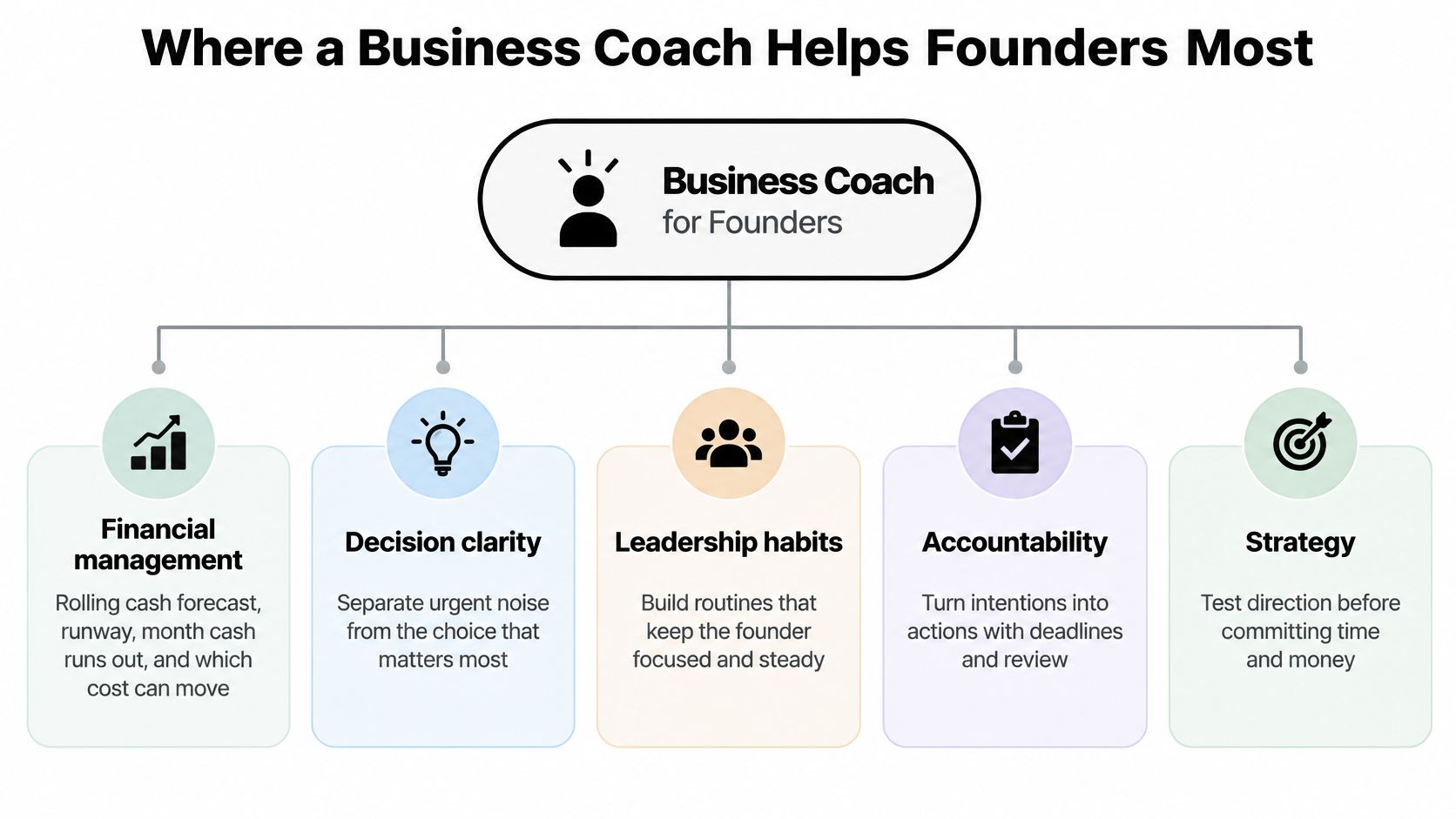
Research on women entrepreneurs in the UAE, published via Springer, found mentors most often credited with financial management, business strategy, marketing, and networking. That order matches what early-stage founders usually bring to a first session: money first, then direction, then distribution. A minority of respondents reported no benefit or a negative effect, a reminder that the wrong adviser can slow you down rather than speed you up.
Six places the work earns its fee
Financial management comes first for most early companies. Build a rolling cash forecast that shows runway, the month cash runs out, and which costs can realistically move. Then ask the harder question: which number in that sheet would change a decision this month. A coach who will not open the sheet is coaching a story.
Strategy and prioritisation means picking one market or one customer segment to test, not three. The other two wait until the first test has a result, and the test gets an end date and a pass/fail bar before it starts.
Customer validation is the habit of talking to buyers before you build the feature. Record what people did, a payment, a second meeting, a no, not only what they said they liked. Five real conversations before a build decision beats fifty opinions collected after it.
Marketing focus is one channel, one conversion metric, and a weekly review. If you are launching a digital product, a digital product launch checklist keeps that test inside a fixed sequence instead of a new idea every Monday.
Hiring and role clarity is the question of cofounder, operator, or sales lead. Write the outcome you need in 90 days before you write the job title, and let a coach pressure-test whether a hire or a process change gets you there faster.
Solo founder isolation is last, and it is real. A fixed check-in and a short list of open decisions keep progress from depending on motivation. A mastermind group of peers working through similar decisions can carry some of that load between paid sessions, as long as the group still closes with an owner and a date.
Rank those six areas tonight. Take the top two into the first session and leave the rest off the agenda. That ranking also works as a vetting scorecard: ask each candidate how they would run a session on your top two, and favour the one who answers in tests, owners, and dates.
How to Run a Coaching Session That Changes Decisions
You can run this flow with a coach or on your own. The point is a choice that changes what you do next week, not a better story about last month.
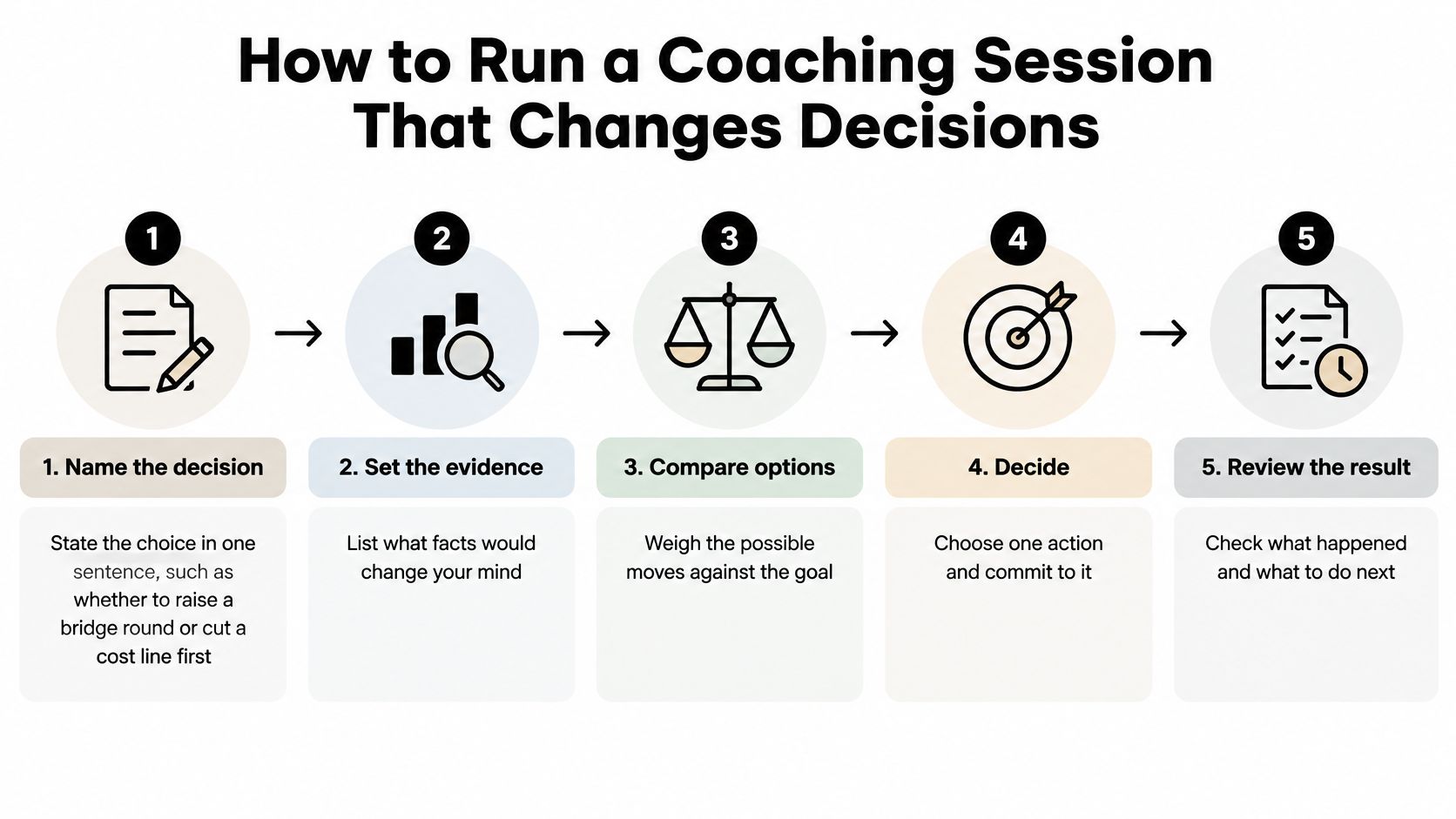
- Name the decision in one sentence. Raise a bridge round, or cut a cost line first. If you cannot say it in one line, you have a topic, not a decision.
- Set the evidence bar before you talk. Write what would make the answer yes, and what would make it no. Founders often collect numbers that cannot change the choice. This step stops that.
- Choose a test that fits one to two weeks. Five pricing conversations, or a fortnight on a single marketing channel. A test with no end date is a hobby.
- Assign one action with an owner and a date. If two people own it, nobody does.
- Open the next session with the result, not the story of how busy the fortnight was.
Keep funding in a separate question
Do not let a loan conversation replace the test. The UAE Government's SME guidance identifies Dubai SME as support across planning, launching, and growing, including guidance and training in the planning stage, and, for eligible applicants, a seed-capital loan of up to AED 1 million. Write two lines before any funding talk. What must be validated before launch? What funding structure fits the next milestone?
A useful session leaves three marks. One decision made, one experiment launched, and one commitment recorded.
The short film below is a plain walk-through of that same rhythm, decision first and review after, if you want to see the sequence before you try it live.
Measuring Whether Coaching Is Working
More sessions are not the same thing as more progress. Count outcomes, not attendance.
- Validated customer conversations completed against the number you set.
- Experiments finished by a fixed deadline, including the ones that failed.
- Conversion or retention on the one channel you agreed to work.
- Runway in weeks, written down, not remembered.
- Decision speed, from open to closed, on the short list you brought in.
Coaching does not work alone. Mentor quality, sector, access to capital, and your own capability all shape the result. Do not credit a coach with every gain, and do not blame them for every miss. PwC Middle East reports that 35% of small businesses without mentors survive beyond five years, compared with about 70% of mentored businesses. Read that as a signal that guidance can matter, not as proof that any programme causes survival.
Treat debt as a scenario
Until a lender gives written terms, debt is a possibility, not committed capital. A Central Bank of the UAE MSME survey found that only 17% of surveyed companies sought bank financing in 2020, and 9% of all surveyed MSMEs secured the finance they needed, about half of those who applied. The survey covered 632 MSMEs and seven banks. Those figures are from that year, not a promise about your file. Ask two or more banks for indicative requirements. Compare collateral, guarantees, repayment timing, and approval conditions with your actual runway.
At 90 days, use three columns with the coach or a peer. What was decided, what was tested, and what changed. If the third column is empty, stop adding sessions and change the brief. The habits that make those reviews honest are the same leadership skills early-stage founders need when nobody else will close the loop.
Write Your Decision Brief Before the First Session
Bring one page to the first session. A backstory can wait until the choice is settled.

Use five headings and stop there.
- Customer problem: Who hurts, and how you know.
- Business model: One line on who pays and for what.
- Decision needed: The choice, in a single sentence.
- Evidence: What would justify a yes, and what would justify a no.
- Date: When the choice must be made.
Fill it before the trial session. Treat the decision line and the evidence bar as the agenda, so the coach sees the question, the deadline, and the standard of proof before offering a view. Then ask one question back. What would change your recommendation? A coach who cannot answer is attached to a script. A coach who can answer names the evidence they would need, which shows you how they think under pressure.
Peer conversation can sit beside coaching and stress-test the same brief. Founder Connects is a startup community in Dubai and the world, with Meetups in Dubai and in cities around the world. Formats include Pitch Night & Mixer, Cofounders Wanted, Coffee Series, Tech After Hours, and The Playbook. The Playbook is a free, bi-annual online Meetup where founders share playbooks on AI agents, lead generation, fundraising, and growth. Cofounders Wanted is an in-person monthly Meetup for finding a CTO, CPO, growth lead, or CEO. Book at Founder Connects Meetups or on Luma.
Complete the brief this week, book one session or one Meetup, and put the first decision on the calendar.
Founder Connects is a startup community in Dubai and the world where founders work through real decisions with peers. Meetups such as Pitch Night & Mixer, Cofounders Wanted, and The Playbook give you a place to test a choice, hear what other builders tried, and leave with a next step. If you want that kind of company around the brief you just wrote, visit Founder Connects.

Building in MENA? You don't have to do it alone.
Join 300+ founders in the Founder Connects Residency. Monthly squad calls, warm intros, $3M+ in perks, and much more. All for less than your monthly coffee budget.
Popular posts





Founder Connects is a premium tech founder community in Dubai and the world. Meetups, Residency Squads of 8–10, and a WhatsApp group of 600+ vetted founders.