
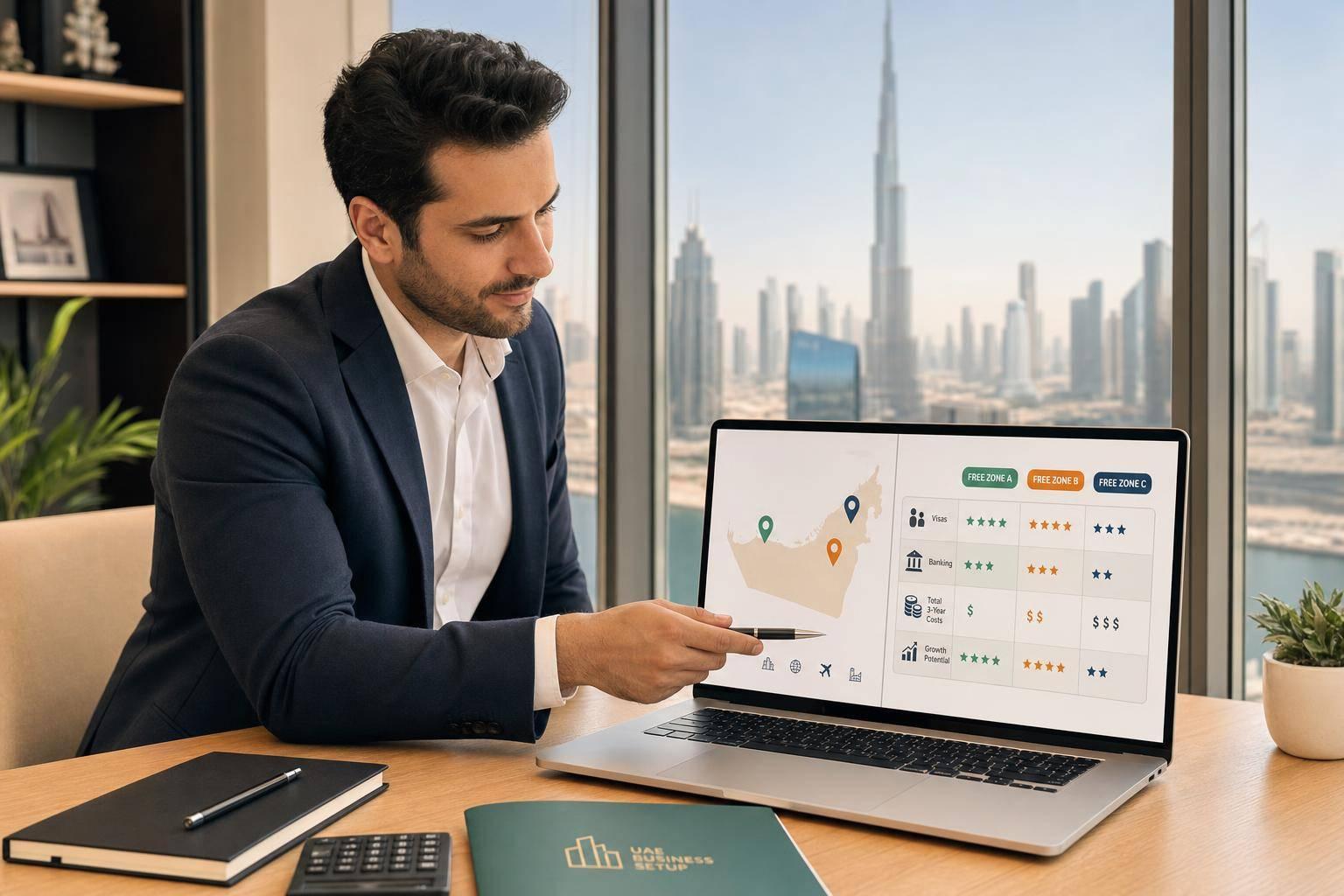
How to Choose the Right UAE Free Zone
Building in MENA? You don't have to do it alone.
Join 300+ founders in the Founder Connects Residency. Monthly squad calls, warm intros, $3M+ in perks, and much more. All for less than your monthly coffee budget.

If I had to sum it up in one line: I’d choose a UAE free zone based on business fit first, then total cost, then room to grow.
A low setup price can look good at the start. But the wrong zone can slow down banking, limit visas, create licence activity issues, and add tax or office costs later. In the UAE, first-year setup costs can start from around AED 5,750 in SHAMS, while a regulated setup in places like DIFC or ADGM can be far higher. That gap matters, but price alone is not the decision.
Before I shortlist any zone, I’d check four things:
- Licence fit: does the activity match how I’ll actually bill clients?
- Sector fit: am I in fintech, tech, trade, logistics, media, or general services?
- Visa room: can the package cover my team for the next 24 months?
- Full cost: not just launch fees, but renewals, office space, insurance, audits, and tax position
Here’s the short version:
- DIFC and ADGM suit firms that need common-law structures and finance-focused rules
- DSO fits many tech, AI, robotics, and IoT companies
- JAFZA and Dubai South work well for goods, trade, warehousing, e-commerce, and aviation-linked firms
- RAKEZ, IFZA, Ajman Free Zone, and SHAMS are often picked for lower entry cost and simpler setups
I’d also keep two checks in mind:
- If I plan to sell into the mainland, I need to confirm the permit route early
- If I want the 0% corporate tax treatment as a Qualifying Free Zone Person, I need to check activity and substance rules from the start; otherwise, 9% applies on taxable profits above AED 375,000
How to Start a Business in a UAE Free Zone | Setup Process, Costs & Tips
sbb-itb-f597d8f
Quick Comparison
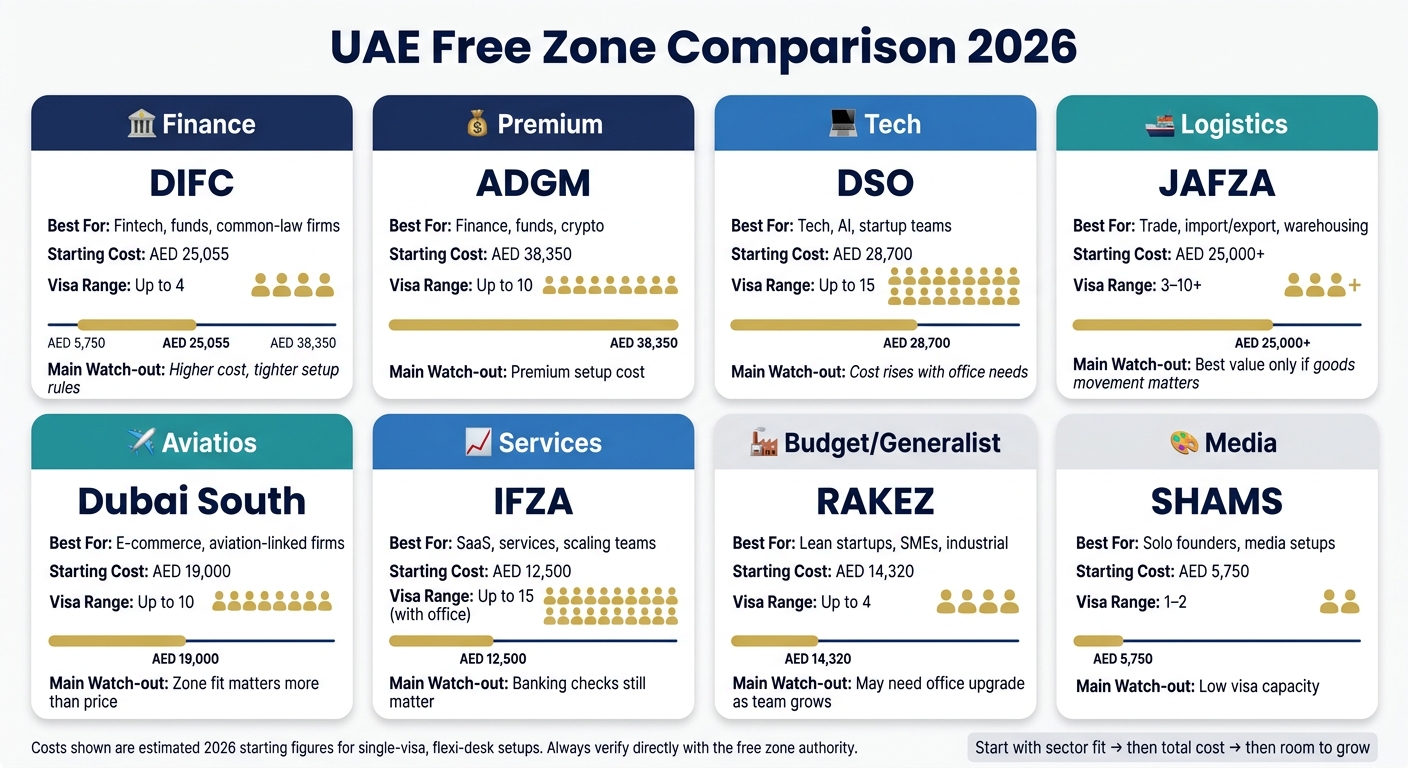
UAE Free Zone Comparison: Cost, Visas & Best Fit (2026)
| Free Zone | Best For | Starting Cost | Visa Range | Main Watchout |
|---|---|---|---|---|
| DIFC | Fintech, funds, firms needing common law | AED 25,055 | Up to 4 | Higher cost, tighter setup rules |
| ADGM | Finance, funds, crypto | AED 38,350 | Up to 10 | Premium setup cost |
| DSO | Tech, AI, startup teams | AED 28,700 | Up to 15 | Cost rises with office needs |
| JAFZA | Trade, import/export, warehousing | AED 25,000+ | 3–10+ | Best value only if goods movement matters |
| Dubai South | E-commerce, aviation-linked firms | AED 19,000 | Up to 10 | Zone fit matters more than price |
| IFZA | SaaS, services, scaling teams | AED 12,500 | Up to 15 with office | Banking checks still matter |
| RAKEZ | Lean startups, SMEs, industrial use | AED 14,320 | Up to 4 | May need office upgrade as team grows |
| SHAMS | Solo founders, media setups | AED 5,750 | 1–2 | Low visa capacity |
If I were making the decision today, 16 July 2026, I’d start with a startup roadmap based on invoice lines, hiring plans, and client bases - not the cheapest package on a zone website. That usually cuts the shortlist fast and avoids problems later.
The main types of UAE free zones explained
UAE free zones usually fall into four broad types, and each one fits a different kind of business. If you sort zones by category first, you can avoid wasting time on options that were never built for your model. Start with sector fit, then look at cost and compliance.
Premium, specialist, logistics, and budget-friendly zones
Premium financial centres like DIFC and ADGM run under English common law and have their own courts and regulators - the DFSA and FSRA, respectively [3][6]. That setup works well for regulated fintech startups, fund managers, and firms where legal structure matters to investors or banking partners. The downside is price. A regulated DIFC licence can cost AED 150,000 or more, while ADGM's tech startup package starts at AED 38,350 [6][2].
Specialist tech and media hubs are built around industry clusters. Dubai Silicon Oasis (DSO) stands out for UAE tech startups and UAE AI startups. It is home to the Dtec incubator, which gives early-stage founders access to mentorship, co-working, and investor introductions [6][2].
Logistics and industrial zones such as JAFZA and Dubai South are geared towards businesses that move or store physical goods. JAFZA has direct port access, which makes it a natural match for import/export, warehousing, and light manufacturing. In early 2026, Bharat Mart officially opened at JAFZA - a hub developed by DP World and the India-UAE Business Council that gives Indian MSMEs ready-to-use warehousing and exhibition space, plus bonded storage, to distribute goods across the GCC and Africa [6]. Dubai South, near Al Maktoum International Airport, launched its "Beyond Hub" portal in September 2025. The portal allows fast digital licensing for eligible e-commerce and aviation businesses [2].
Budget-friendly generalist zones like RAKEZ, IFZA, and Ajman Free Zone are aimed at lean setups. RAKEZ starts from about AED 14,320 for a one-visa package, and Shams has entry-level packages from AED 5,750 [6][2]. These zones make sense for solo founders, consultants, and early-stage startups that want speed and lower overhead. They cost less and are often faster to set up, though banks may place more trust in specialist zones.
Compare the main options below.
| Free Zone | Sector Fit | Starting Cost (AED) | Visa Flexibility | Ecosystem Strength |
|---|---|---|---|---|
| DIFC | Regulated fintech, VC-backed startups / Finance / AI | 25,055 | Up to 4 (Innovation licence) | High - VCs, common law, investor access |
| ADGM | Family offices, funds, crypto / Finance / Crypto | 38,350 | Up to 10 (scalable) | High - sovereign wealth, institutional |
| DSO | UAE tech and AI startups / AI / Robotics / IoT | 28,700 | Up to 15 (with office) | High - Dtec incubator, mentorship |
| JAFZA | Physical products, import/export / Logistics / Trade | 25,000+ | 3–10+ | High - port access, Bharat Mart |
| Dubai South | E-commerce, aviation-adjacent / Logistics / Aviation | 19,000 | Up to 10 | Moderate - airport proximity |
| IFZA | Scaling teams, SaaS, consulting / General / Services | 12,500 | Up to 15 (with office) | Moderate - B2B network |
| RAKEZ | Budget-conscious founders / General / Industrial | 14,320 | Up to 4 (SME package) | Moderate - dual-licence option |
| SHAMS | Solo founders, media, creatives / Media / Creative | 5,750 | 1–2 | Low to moderate - cost-focused |
A simple way to use this table: check whether the visa range covers your first 24 months of hiring. After that, test each shortlisted zone against your business activity, budget, and planned headcount.
Define your startup's needs before shortlisting any zone
Start with the sector table above, then test each zone against your business activity, budget, and visa plan. Before you speak with any free zone authority or setup consultant, get clear on what your business needs on day one and over the next two years. If your licence, office setup, and visa plan don't line up, that gap can cause friction later.
Match your business activity, market focus, and regulatory needs
A simple way to pressure-test your setup is the "Invoice Test". Write ten realistic invoice line items for your first year of trading. Then compare those line items with the exact wording of your proposed licence activity. If they don't match, you may face banking delays and compliance issues later [1][5]. A SaaS startup registered under "General Trading" is a common example of a poor fit.
That gives you a clear order to follow: check licence fit first, then look at cost and day-to-day operations.
Once the activity match is sorted, check whether the zone can support your first 24 months of sales and hiring. Fintech, crypto, and financial services always need secondary regulatory approval from bodies such as the DFSA at DIFC, the FSRA at ADGM, or VARA for Dubai-wide crypto activity [3][7]. If most of your clients are overseas, a flexi-desk package may be enough. If you plan to sell to mainland clients, pay attention to the remote-branch route for most non-DIFC free zones [3].
Calculate your total first-year costs and operating requirements
Model costs for six to 12 months, not just launch day.
Include licence fees, visa costs, insurance, office space, and any refundable deposits. Map your 24-month hiring plan before you choose a package. A flexi-desk often supports 1–3 visas. If you grow past that, you'll usually need to move into a physical office, and that can change your cost base in a big way. Zones like IFZA and DSO can support up to 15 visas with an office upgrade, while DIFC's Innovation Licence caps at 4 [2].
Requirements versus zone fit: a comparison table
Use this as a quick elimination check, not a ranking.
| Requirement | DIFC | ADGM | DSO | DMCC | RAKEZ | Ajman (AFZ) |
|---|---|---|---|---|---|---|
| Budget Band | Premium | Premium | Mid-tier | Mid-to-Premium | Budget-to-Mid | Budget (Lowest) |
| Regulation Level | High (Common Law) | High (Common Law) | Moderate | Moderate | Low-Moderate | Low |
| Office Type | Physical/Co-working | Physical/Co-working | Physical/Incubator | Physical/Serviced | Flexi/Physical | Flexi/Physical |
| Max Visas (Standard) | 4 (Innovation) | 10 | 15 | 1–3 (Flexi) | Up to 4 | 10 |
After this filter, keep only the zones that still match your activity, budget, and hiring plan. Then move on to setup costs, banking, and tax. For a broader look at the ecosystem, see our guide for startups in UAE.
A step-by-step process for choosing the right UAE free zone
Once you’ve cut down your shortlist with the comparison table above, the choice usually comes down to three practical steps. Each one helps reduce a different risk.
Step 1: Shortlist by sector, then confirm the legal and ecosystem match
Start with sector fit first, then look at price. Use the sector table from the earlier section to narrow your options to two or three zones. Then use the Invoice Test to confirm licence fit.
Next, check the legal setup and the business environment around the zone. If you’re in fintech, crypto, or another regulated financial service, DIFC and ADGM are the main options. Both run on an English common-law framework and have independent courts. Their regulators are the DFSA and FSRA respectively [3][8].
If you’re building in tech or AI, DSO’s Dtec incubator and ADGM’s Hub71 can be a good match because they offer mentorship and investor networks [2]. DMCC is often a better fit for commodities and trade-heavy businesses [3].
Step 2: Model setup costs, check banking and tax, then confirm your zone
Work out your first-year cost and your renewal cost before you decide. The table below shows 2026 estimated first-year costs for a single-visa, flexi-desk setup across a range of common options for UAE startups [2]:
| Free Zone | Year 1 Total (AED) | Renewal (AED) | Banking Friction |
|---|---|---|---|
| RAKEZ | 14,320 | 6,000 | Moderate |
| Dubai South | 19,000 | 12,500 | Moderate |
| DIFC (Innovation Licence) | 25,055 | 16,515 | Low |
| DSO (Dtec) | 28,700 | 18,500 | Low-Moderate |
| IFZA | 28,790 | 12,900 | Low-Moderate |
| ADGM (Tech Startup) | 38,350 | 5,505 | Low |
Banking fit gets missed all the time, and that can come back to bite you. Before you file anything, speak to two or three UAE banks and ask how they handle companies from your shortlisted zones [4][2].
You’ll also want to confirm your corporate tax position early. Register for corporate tax within three months of incorporation [8]. If you want access to the 0% rate as a Qualifying Free Zone Person (QFZP), your activities and substance need to meet the set criteria. If not, the standard 9% rate applies on profits above AED 375,000 [3][4].
Once the numbers work and the compliance side checks out, put your shortlist through one more filter: founder feedback.
Step 3: Get feedback from other UAE founders before you commit
After you’ve checked costs and banking, talk to founders who’ve already set up in the zone.
Official zone material doesn’t usually tell you much about actual turnaround times or how much banking friction you may face. Use Founder Connects to compare notes with UAE founders on licensing speed, banking friction, and zone fit.
That kind of feedback can help you trim your shortlist before incorporation. This is a critical phase in the broader process of starting a company in the UAE.
Conclusion: Choose for fit now and flexibility later
The free zone choice should start with fit, then move to cost, then growth. Before you commit, check every line on your invoice again. That decision shapes your licence, banking, and tax setup. If mainland sales are part of the plan, test that early. Executive Council Resolution 11 of 2025 allows free zone companies to obtain mainland permits [1][3].
Once your activity and market access line up, look at the true cost over time. Don’t pick based on launch price alone. What matters is the total cost across 3 to 5 years, including workspace, visas, renewals, insurance, and audits [3][4]. A package that looks lean on day one can get expensive once you start hiring or renewing.
Then do one more sense check: speak to founders in UAE startup communities. The quality of the ecosystem matters, especially for UAE tech startups and fintech founders. So it’s worth talking to people who already know the trade-offs before you sign anything.
Choose for what fits now and what can still work later. Get the activity right, price the full package, and check the decision with founders who’ve been through it.
FAQs
Which free zone is best for my business type?
There’s no one “best” free zone. The right pick comes down to your business model, growth plans, and budget.
If you’re running a lean startup, working as a freelancer, or building a remote-first digital business, IFZA, SHAMS, or RAKEZ may be a good fit. If you want a more premium Dubai base, DMCC or Dubai Internet City could make more sense. And if you’re in fintech, DIFC and ADGM offer the regulatory frameworks that match that space.
How many visas should I plan for at the start?
Plan your visa needs around a realistic three-year hiring forecast, not just what you need right now. In many cases, visa eligibility is linked to your licence package or office size. If your setup can’t grow with you, you may end up paying for costly upgrades later.
For solo consultants, a lean package with zero or one visa may be enough. But if you expect to hire over time, check the free zone’s visa-to-desk ratio first. That simple detail can shape how far your setup can grow without forcing a change too soon.
When do I need a mainland permit or 9% tax?
You do not need a mainland permit to fall under the 9% corporate tax. The tax applies to UAE businesses, including free zone companies.
Free zone companies may still get a 0% rate on qualifying income. But non-qualifying income, such as revenue from mainland UAE clients, is taxed at 9% on profits above AED 375,000. A de minimis threshold may still apply.
Related Blog Posts

Building in MENA? You don't have to do it alone.
Join 300+ founders in the Founder Connects Residency. Monthly squad calls, warm intros, $3M+ in perks, and much more. All for less than your monthly coffee budget.
Popular posts





Founder Connects is a premium MENA tech founder community. Meetups in Dubai and across MENA, Residency Squads of 8–10, and 400+ vetted WhatsApp founders (apply and screened).