

Cleantech Green Tech Funding UAE: A Founder's 2026 Guide

Building in MENA? You don't have to do it alone.
Join 300+ founders in the Founder Connects Residency. Monthly squad calls, warm intros, $3M+ in perks, and much more. All for less than your monthly coffee budget.

You've got a working prototype, a credible climate story and perhaps a promising corporate conversation. Then the UAE funding maze appears. Should you pursue Hub71+ ClimateTech, an ALTÉRRA-aligned investor, a government programme or a corporate pilot that may take months to convert into revenue?
For UAE and MENA cleantech founders, the difficult question isn't whether capital exists. It's which capital is deployable, what milestone it expects, and what your company gives up in return. This guide maps the practical routes through cleantech green tech funding in the UAE, from non-dilutive support and government-backed programmes to corporate pilots, venture capital and project finance.
You'll find the named programmes worth investigating, the evidence funders will expect, the difference between a grant application and a venture pitch, and a sequencing model for reducing dilution while building commercial proof. For broader context on the local support environment, review this UAE incentives guide for green tech startups alongside the funding paths below.
Bookmark the route that matches your current stage. Then build your fundraising plan around the next proof point, not the most impressive headline commitment.
Why UAE Cleantech Funding Looks Different in 2026
A founder I know recently faced a familiar choice. The company had a climate solution ready for a pilot, but the pilot required engineering work, certification and access to a major operator. A venture investor offered a conventional equity route, while a government-backed programme offered cash and in-kind support with a slower process. The founder was tempted to apply everywhere, but each route demanded a different story and a different form of evidence.
That's the central reality of the UAE market. Funding isn't one pool of money. It's a stack of capital sources with different decision-makers, timelines, reporting obligations and expectations around deployment.
Government programmes may care about local impact, technical readiness and national priorities. Corporate partners care about operational risk, procurement, integration and whether your product solves a live problem. Venture investors care about market scale, defensibility, return potential and the path to a later financing round. A founder who sends the same deck to all three usually underperforms with all three.
The practical map
Use this article if you're:
- Preparing a first institutional raise: You need to know whether grant support, an accelerator or a pilot should come first.
- Moving from prototype to deployment: You need capital that can fund testing without forcing premature dilution.
- Building a MENA expansion case: You need to explain why UAE validation can open regional or international markets.
- Comparing public and private capital: You need clarity on what “support” means beyond a press release.
The UAE's climate funding environment has become more substantial, but that doesn't make it frictionless. Capital-intensive ventures still face technical diligence, regulatory questions, long sales cycles and demanding corporate procurement processes.
Practical rule: Choose the funder that can remove your next bottleneck. Don't choose based only on the size of its announced fund.
Before you contact anyone, write down your present stage, the next value-creating milestone and the exact resource needed to reach it. Then match that need to one funding path.
The COP28 Legacy and the Policy Tailwind Behind the Capital
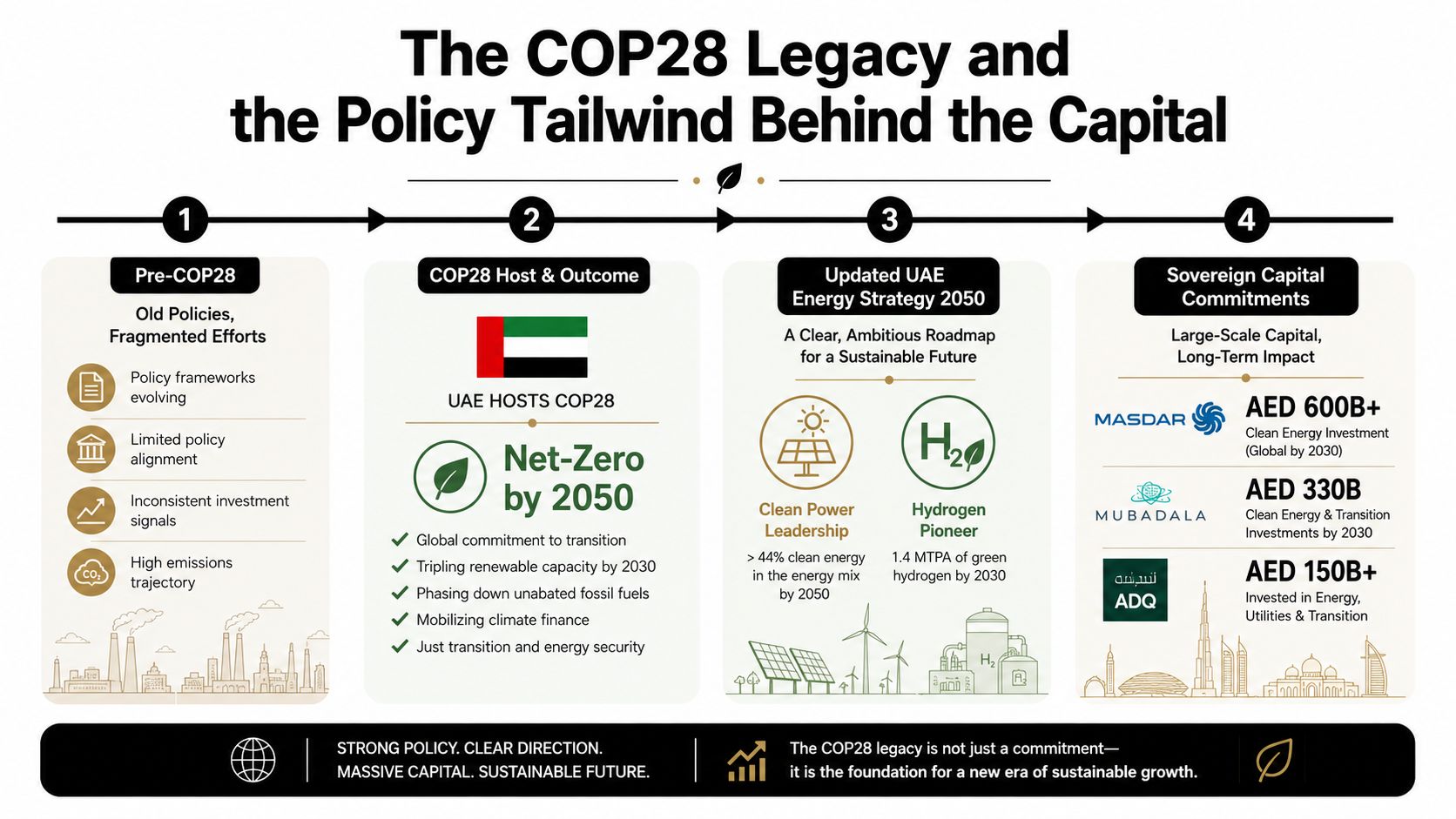
COP28 changed the context in which UAE climate founders raise money. The country's climate-tech investment profile accelerated sharply after the summit. A PwC Middle East report on climate-tech deployment in the UAE found that the UAE increased climate-tech investments globally by 138% between 2023 and 2024, spending US$2.3 billion over that period. The same report described the UAE as the region's largest global investor in climate tech during that period.
That matters because it changes who founders need to address. UAE climate capital is no longer only an early-stage venture story. It combines sovereign investment, development finance, government programmes, corporate deployment and private funds.
Policy language becomes investment language
The UAE's updated energy strategy links national ambition to defined priorities. The Ministry of Energy and Infrastructure says the strategy aims to raise electricity generation from clean sources to 35% by 2031 and integrate the National Hydrogen Strategy 2050 into energy planning, as stated in its official clean-energy transition update.
COP28 also created a major sovereign-capital signal. The UAE's NDC 3.0 says ALTÉRRA launched with US$30 billion of committed capital, with a target to catalyse US$250 billion by 2030, according to coverage of the UAE's energy sovereignty strategy.
Those figures are not automatically available to your startup. ALTÉRRA is a large climate-investment vehicle, not a grant desk for every early-stage founder. The useful interpretation is structural: UAE allocators have a stronger mandate to finance technologies that support clean electricity, hydrogen, industrial decarbonisation, resilience and resource efficiency.
Position your company inside one priority
Your one-line pitch should connect your product to one named UAE priority. For example:
- “We help operators improve the economics of clean electricity and storage.”
- “We provide technology that supports the UAE's hydrogen planning through safer monitoring.”
- “We reduce industrial emissions while creating a deployment pathway for local operators.”
Don't list every national strategy in your deck. Select the priority that creates a real commercial reason to buy.
The Five Funding Paths Every UAE Founder Should Know
Founders often compare funding sources by headline value. That's the wrong comparison. Compare them by dilution, speed, proof required and access to deployment.
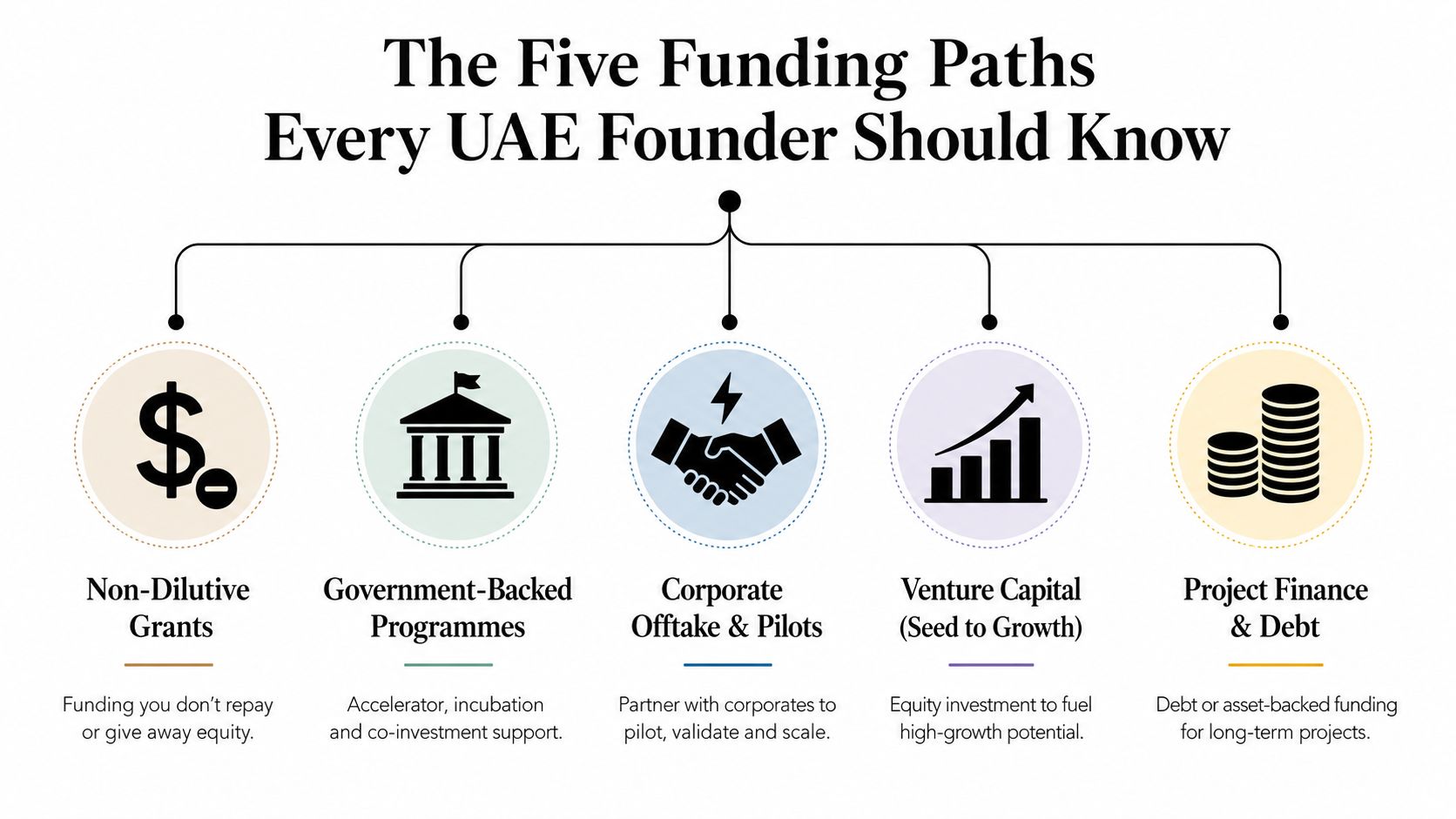
Non-dilutive grants
Grants are useful when your next milestone is technical validation, testing or research. You keep ownership, but you don't get free money in the operational sense. Grant capital usually carries approved-use restrictions, milestone reporting, procurement rules and evidence requirements.
Use grants before a priced equity round when the money can increase valuation by reducing technical uncertainty. Don't use them to cover an unfocused burn rate.
Government-backed programmes
Programmes combine capital with introductions, facilities, mentoring or access to public and corporate partners. Their value often sits in the package rather than the cash alone.
They're suited to founders who need structured support and can work within an application or cohort process. Expect selection criteria tied to national priorities, local presence, technical readiness and the ability to participate fully.
Corporate offtake and pilots
A corporate pilot can be more valuable than a small investment because it produces operating data, a reference customer and a route to procurement. It can also become a trap if the partner demands exclusivity, unpaid customisation or open-ended testing.
Ask for a written pilot scope, success criteria, data ownership terms, commercial conversion path and named decision-maker. A letter of intent without a budget owner is useful evidence, but it isn't revenue.
Venture capital
VC is appropriate when your business can scale beyond individual projects and show a credible path to a large market. Investors will examine technical defensibility, sales cycles, gross margins, capital intensity and future financing needs.
Equity is expensive when raised before validation. Use venture money for repeatable growth, not to discover whether a corporate will let you run a pilot.
Impact investors and private climate funds
Impact investors assess both financial return and measurable environmental outcomes. Private climate funds may be more comfortable with longer development cycles, but they'll still demand commercial discipline.
Project finance and debt belong here as the company moves towards contracted assets or predictable cash flows. Debt can preserve equity, but repayment obligations and covenants make it unsuitable for an unproven technology.
Founder decision: Rank these five paths from one to five for your current stage. Your ranking should reflect the next milestone you can prove, not the path that sounds most prestigious.
Active Funds, Programmes and Accelerators Worth Approaching
The UAE ecosystem contains real programmes, but founders should separate cash available to the startup from capital committed at ecosystem level. Start with the route that matches your immediate bottleneck.
Hub71+ ClimateTech
Abu Dhabi's Hub71+ ClimateTech programme offers AED 250,000 in cash and AED 250,000 in in-kind incentives, with an optional top-up of up to AED 250,000 for additional equity, according to reporting on the programme's startup support. It also includes anchor-partner signals, including AED 2.5 million from ADNOC and AED 500,000 pilot commitments each from Tabreed and TAQA.
Approach the programme team with a deployment-ready use of funds. If your product needs a pilot, explain the operator, site, technical scope and success metric.
ALTÉRRA-aligned vehicles
ALTÉRRA's scale makes it relevant to growth-stage climate companies, infrastructure investors and funds rather than most idea-stage startups. Founders should identify the specific fund manager or vehicle investing in their sector and stage.
Before seeking an introduction, study how sovereign wealth funds evaluate mandates, governance and long-duration assets. Unitism's sovereign wealth fund guide provides useful context for understanding how these institutional investors differ from conventional venture funds.
Dubai Green Fund
The Dubai Clean Energy Strategy includes the Dubai Green Fund, worth AED 100 billion, designed to provide easy loans at reduced interest rates for clean-energy investors, according to the UAE government's Dubai Clean Energy Strategy overview.
This is more relevant to projects and businesses with financeable deployment plans than to a founder raising purely for product discovery. Bring a clear asset model, repayment logic and project pipeline.
Corporate routes
ADNOC, Tabreed and TAQA are important names for founders whose products can operate inside energy, utilities or industrial environments. Contact the partnerships, innovation or procurement team, not a generic investor mailbox. A strong introduction should include a one-page pilot proposal and the operational owner who would use the product.
For a broader overview of UAE accelerator options, use this guide to government accelerators and free programmes.
| Programme | Support Package | Best Fit Stage | Practical Tip |
|---|---|---|---|
| Hub71+ ClimateTech | AED 250,000 cash, AED 250,000 in-kind, optional equity top-up | Early climate-tech ventures with pilot potential | Lead with the deployment milestone |
| ALTÉRRA-aligned vehicles | Institutional climate capital through relevant investment vehicles | Growth-stage companies and project platforms | Find the specific manager, not only the umbrella name |
| Dubai Green Fund | Reduced-interest clean-energy loans | Financeable projects and asset-backed deployment | Prepare a repayment and project pipeline model |
| ADNOC-linked support | AED 2.5 million capital signal | Industrial and energy technologies | Seek an operational sponsor inside the target business |
| Tabreed and TAQA | AED 500,000 pilot commitments each | Utility and infrastructure applications | Define pilot success before discussing scale |
Pick two programmes to investigate this week. Read their eligibility rules, identify the correct contact and rewrite your first outreach around one concrete milestone.
Application Timelines and What UAE Climate Term Sheets Actually Look Like
A climate-tech raise takes longer when the investor must validate hardware, safety, regulatory permissions, deployment economics and customer adoption. The UAE's investment environment reflects that capital intensity. The Ministry of Energy and Infrastructure reported that the country completed more than AED 45 billion in new and renewable energy projects, while clean-energy investment in the UAE was around US$2.80 billion in 2024, as stated in its clean-energy investment announcement.
That project-finance base creates opportunity, but it also raises the diligence bar.
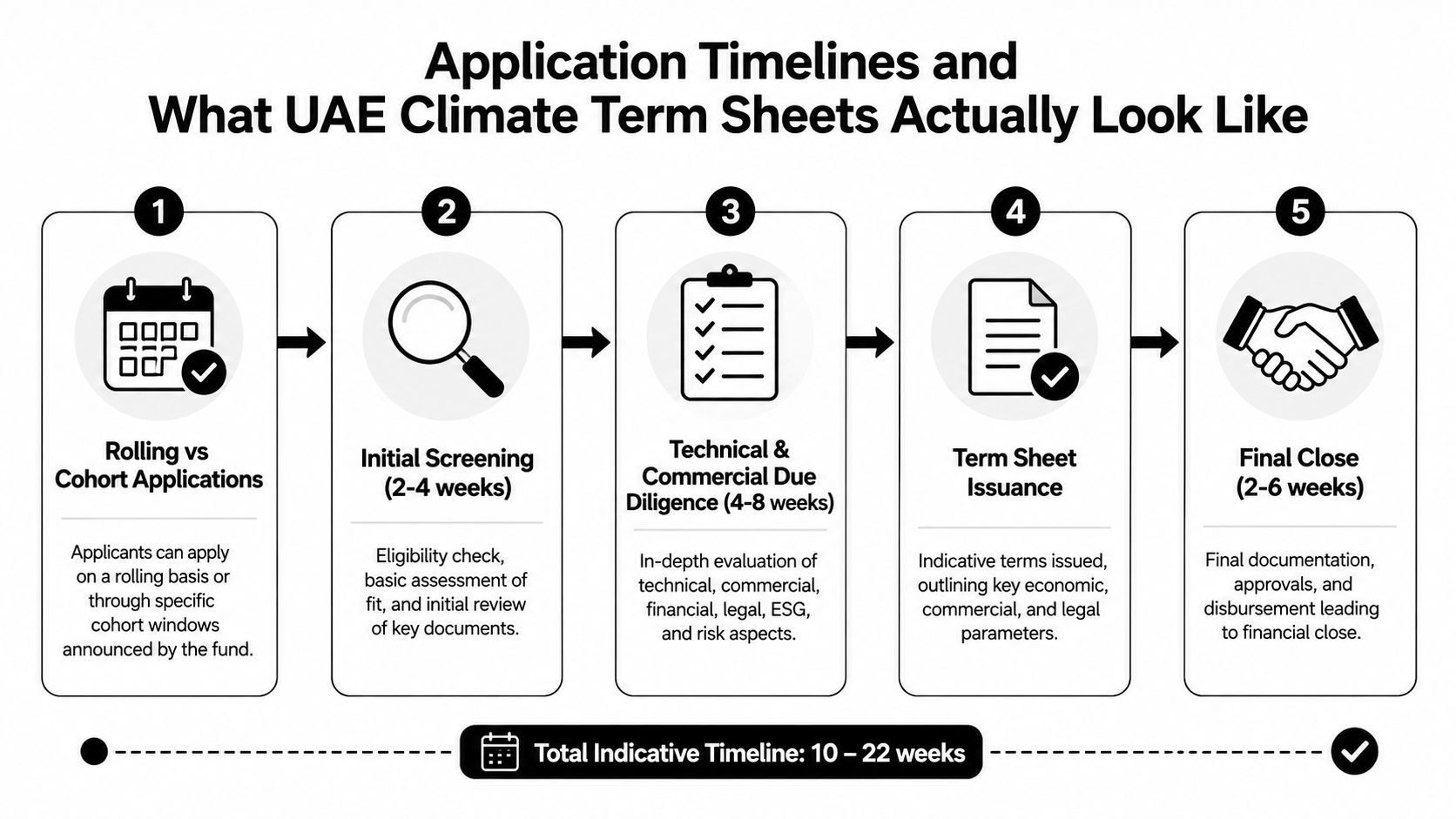
Plan two calendars
Programme applications may be rolling or cohort-based. Venture processes are usually relationship-led and can involve several investment committee stages. Don't build your runway around an optimistic verbal indication.
Create a calendar containing:
- Application dates: Record opening, closing and expected cohort dates for each programme.
- Diligence dependencies: Mark when you'll need test results, customer references, regulatory opinions and financial data.
- Corporate approvals: Assume the pilot partner has its own technical, procurement and legal gates.
- Runway decisions: Set a date for deciding whether to pursue bridge capital or adjust the scope.
Read terms beyond the valuation
Seed and Series A climate rounds commonly use SAFEs, convertible instruments or priced equity, but the structure matters less than the rights attached to it. Examine valuation caps, discounts, pro-rata rights, liquidation preferences, board rights, information rights and investor consent provisions with counsel.
Grant-backed capital can require milestone reports, approved expenditure and impact documentation. Corporate cheques may come with pilot conditions, data access terms, preferred supplier expectations or exclusivity.
The guide to term-sheet clauses that change founder ownership is useful preparation, but don't treat any template as a substitute for UAE legal advice.
Negotiation rule: Ask what happens if the pilot succeeds, fails or runs late. A term sheet or pilot agreement that only describes the success case is incomplete.
Map your decision calendar against two named programme windows before you pitch. If the dates don't support your runway, change the financing sequence now.
Your Founder Fundraising Preparation Checklist
UAE climate funders want more than a polished sustainability narrative. They need confidence that your entity can contract, your technology can operate, your impact can be measured and a customer can buy.
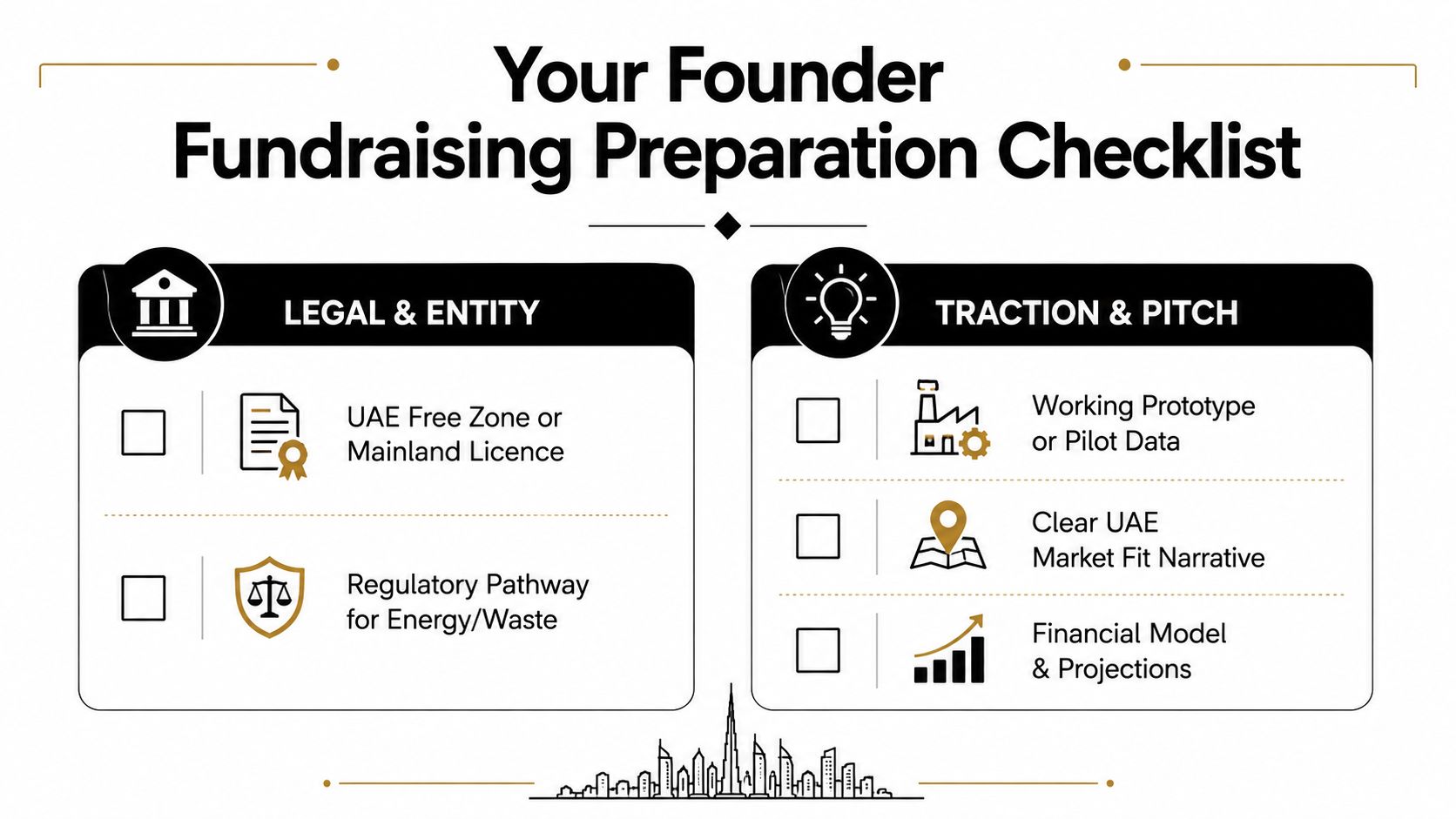
Entity and regulatory readiness
- Licence: Confirm whether your UAE Free Zone or Mainland structure can conduct the activity you're proposing. Ask your corporate services adviser to identify any mismatch between your licence and revenue model.
- Regulatory pathway: Map approvals for energy, waste, water, transport or industrial operations. Ask your engineering and legal leads to name the regulator, approval and expected evidence.
- Contracting authority: Confirm who can sign a pilot, grant agreement, data-processing arrangement and commercial supply contract. Add those signing authorities to your data room.
Technical proof
Your technical file should let a non-founder understand what has been built and what remains unproven.
Include:
- Technology readiness: State the current technology readiness level, test environment and next validation step. Ask your engineering lead to support every claim with a test record.
- Performance evidence: Add operating data, assumptions, failure modes and maintenance requirements. Don't show only the best result.
- Third-party verification: Include independent testing or certification where available. If it isn't available, state the plan, cost and timeline to obtain it.
- Intellectual property: Document ownership, patent status, licences, freedom-to-operate work and employee invention assignments.
Commercial and impact evidence
A UAE funder will want to know how your technology reaches local deployment.
- Pilot evidence: Request a signed scope or detailed letter from the pilot partner naming the site, owner, budget status and success criteria.
- Unit economics: Add installation cost, operating cost, payback assumptions and sensitivity cases. Explain which variables the pilot will validate.
- Impact model: Quantify emissions, energy, water or waste outcomes in defensible local units. Add the baseline and calculation method.
- Policy fit: Include one slide connecting the product to a UAE clean-energy or hydrogen priority, rather than listing every policy document.
Finish with a data room index. A funder should find the pitch deck, financial model, cap table, corporate documents, technical validation, contracts, IP records, impact methodology and regulatory materials without asking you to reconstruct the company under deadline pressure.
Pitching UAE Climate Funders and Surviving Due Diligence
A climate pitch needs three narratives running together. The problem must be urgent for a buyer, the technology must be defensible and the deployment model must show how the product becomes a repeatable business.
For a UAE programme, lead with national relevance, technical readiness and the support you need to reach a defined milestone. For a corporate, lead with operational value, integration requirements and the pilot decision process. For a VC, lead with market scale, repeatability, margin potential and why this company can win beyond one UAE customer.
Build the deck around proof
Your core slides should answer:
- Why now: Identify the UAE policy or infrastructure priority that makes the problem commercially relevant.
- Why this product: Explain the technical advantage without hiding behind climate terminology.
- Why this buyer: Name the operator, asset class or customer workflow where deployment starts.
- What changes: Show emissions avoided, energy saved, water conserved or waste diverted using a transparent methodology.
- How it scales: Explain manufacturing, installation, maintenance, sales and financing requirements.
- What you need: Tie the raise to a technical, commercial or regulatory milestone.
- What happens next: Define the pilot-to-contract or pilot-to-repeatability pathway.
Expect quiet deal-killers
Investors may tolerate an early product. They won't tolerate unclear ownership, unsupported performance claims or a sales model dependent on one enthusiastic contact.
The most damaging diligence questions usually concern:
- Technology defensibility: Can a better-funded competitor reproduce the solution?
- Offtake durability: Is the customer committed beyond a pilot?
- Regulatory exposure: Which approval could delay deployment?
- Founder depth: Who owns engineering, commercial delivery and regulatory execution?
- Capital intensity: How much money does each deployment consume before it generates cash?
- Data integrity: Can your impact claims survive scrutiny from a technical or ESG reviewer?
Rehearse separately for a grant committee, a corporate sponsor and a VC. Their incentives differ, so your evidence must change with the room.
Book a 30-minute rehearsal with a founder who has raised in the UAE climate space before sending the next application. Ask them to interrupt whenever your answer sounds like a panel statement instead of an investable fact.
Turning Research Into Real Conversations
A strong funding map still fails if you approach the wrong person with the wrong proof. Cleantech deals depend on context because the person introducing a pilot, reviewing a programme application or sponsoring an investment usually needs confidence that you understand the operating environment.
Corporate pilots need warm introductions to the business owner, not only the innovation team. Programme managers need a clear fit with their mandate and an application that makes evaluation easy. VCs need to see why the company belongs in their portfolio and how the UAE can support wider regional deployment.
That's where a curated founder network can help. Founder Connects combines moderated peer groups, ongoing one-to-one introductions and spotlight events where founders can practise their pitch and meet relevant ecosystem participants without relying on generic mixer-style networking.
Choose one action from this guide and schedule it within seven days. Bring the result, whether it's a pilot brief, a revised policy-aligned pitch or a programme conversation, into a peer session so someone can challenge your assumptions before the next funder sees them.
Founder Connects gives UAE and MENA founders structured peer support, relevant introductions and practical spaces to sharpen fundraising conversations. Visit Founder Connects to find a founder community that can help turn your cleantech funding plan into accountable next steps.

Building in MENA? You don't have to do it alone.
Join 300+ founders in the Founder Connects Residency. Monthly squad calls, warm intros, $3M+ in perks, and much more. All for less than your monthly coffee budget.
Popular posts





Founder Connects is a premium MENA tech founder community. Meetups in Dubai and across MENA, Residency Squads of 8–10, and 400+ vetted WhatsApp founders (apply and screened).