
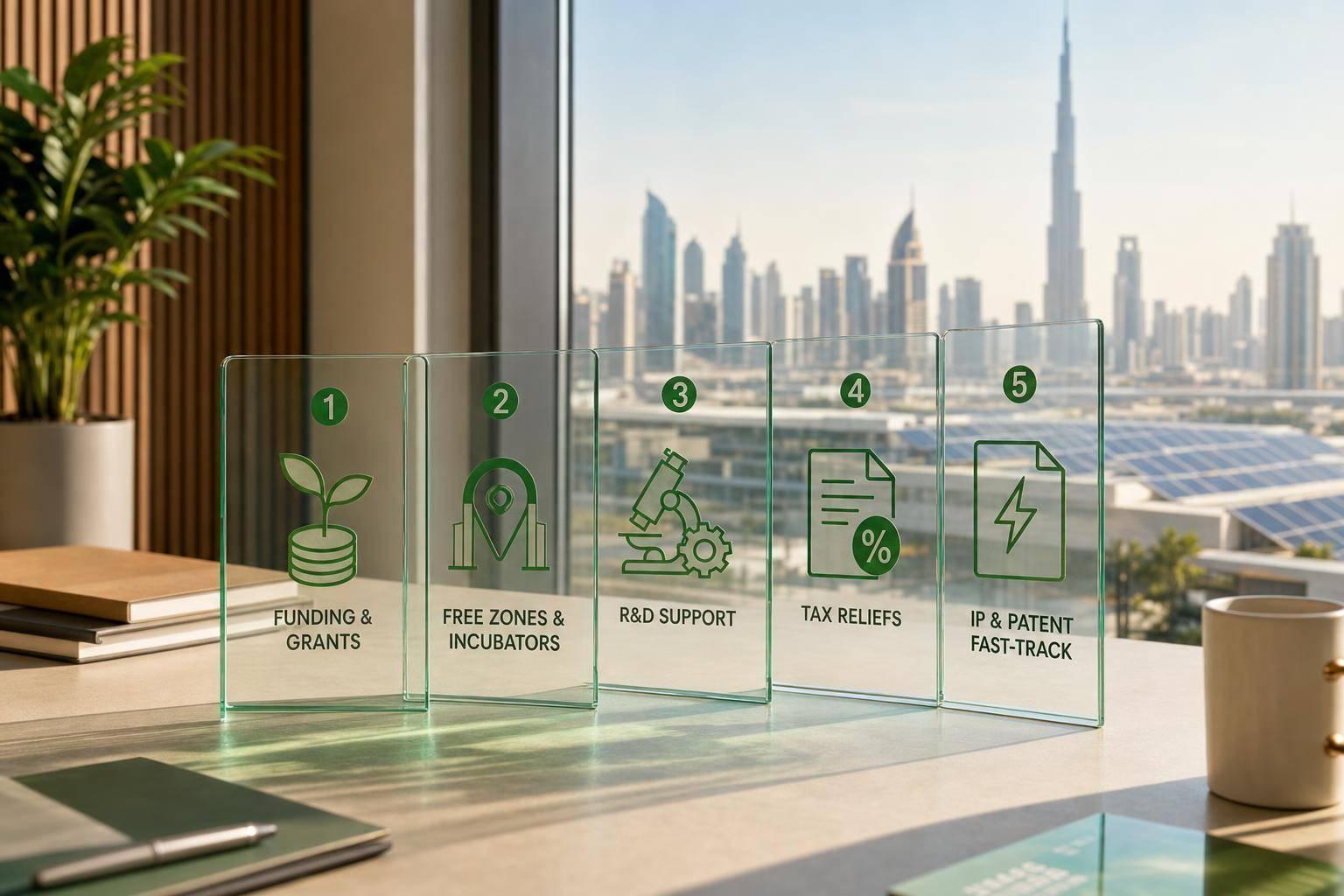
Top 5 UAE Incentives for Green Tech Startups
Building in MENA? You don't have to do it alone.
Join 300+ founders in the Founder Connects Residency. Monthly squad calls, warm intros, $3M+ in perks, and much more. All for less than your monthly coffee budget.

If I were building a green tech startup in the UAE today, I’d start with five routes: MBRIF, Abu Dhabi funding programmes, Masdar City and The Catalyst, tax and R&D relief, and Expo City Dubai’s Green Licence. Together, they cover funding, setup, R&D, IP, and market access.
The short version is simple. The UAE has put US$163 billion into clean energy plans, targets 50% clean energy by 2050, and new emissions reporting rules are pushing more companies to buy climate tools. That gives founders two things at once: support to build and buyers with a reason to act.
Here’s what I’d keep in mind first:
- MBRIF: best if you need non-equity support and bank financing support
- ADIO and Hub71+ ClimateTech: best for grant-style help, rebates, and early-stage backing
- Masdar City and The Catalyst: best if you need a free zone base, lab access, and accelerator support
- Tax and R&D relief: best for startups with high research spend and patent-led income
- Expo City Dubai Green Licence: best if you want a green-focused setup path and faster IP handling
What matters most? I’d match the incentive to my stage. Early-stage teams usually care most about setup, pilots, and cash support. Growth-stage teams often care more about debt access, tax treatment, and tender readiness.
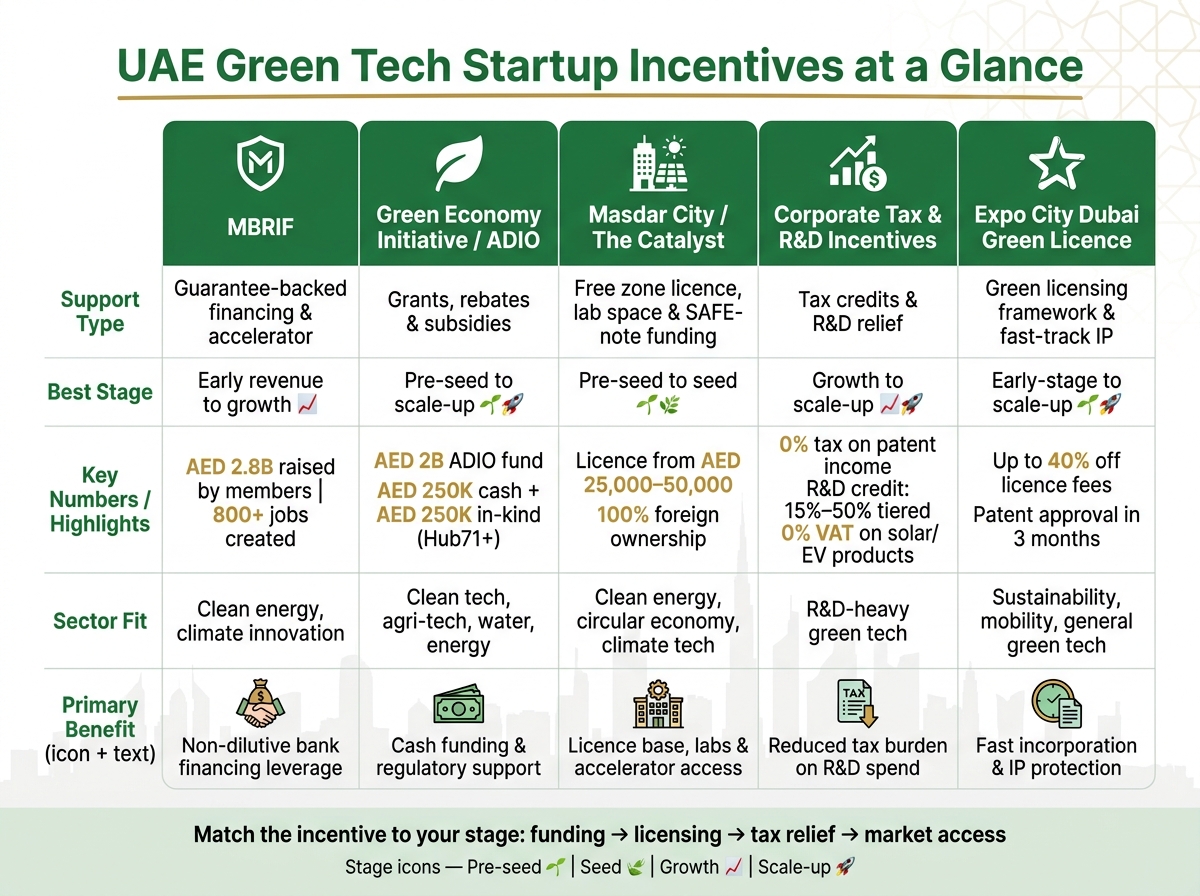
UAE Green Tech Startup Incentives: Quick Comparison Guide
Quick Comparison
| Incentive | Best for | Main support | Best stage |
|---|---|---|---|
| MBRIF | Startups with traction | Guarantee-backed finance and accelerator support | Early revenue to growth |
| ADIO / Hub71+ ClimateTech | Teams needing cash support | Grants, rebates, cash, and in-kind support | Pre-seed to scale-up |
| Masdar City / The Catalyst | Founders setting up and testing | Free zone licence, lab space, SAFE-note funding | Pre-seed to seed |
| Tax / R&D relief | R&D-heavy companies | 0% relief options, tax credits, loss relief | Growth to scale-up |
| Expo City Dubai Green Licence | Green firms needing a setup route | Green licence discount and fast IP path | Early-stage to scale-up |
I’d treat these incentives as tools, not shortcuts. The right one depends on your revenue stage, licence needs, R&D spend, and whether you need funding now or market access first.
sbb-itb-f597d8f
Why Green Tech Founders Are Choosing the UAE
The UAE backs green tech with more than good headlines. It gives founders practical ways to get funded, get licensed, and get into the market.
Government-backed funding
Government programmes help cut the money risk that often slows early-stage companies. The Abu Dhabi Investment Office (ADIO) runs an AED 2 billion fund for its Innovation Programme [10]. Abu Dhabi’s GreenHorizon Fund also brings together US$100 million for climate deep tech, including carbon capture and hydrogen [9].
At the same time, new reporting rules are creating direct demand for climate software and emissions tools. Federal Decree-Law No. 11 of 2024 requires greenhouse gas emissions reporting for all UAE companies, including businesses in free zones [2].
That means founders aren’t just chasing grants. They’re also building for a market that now has a clear reason to buy.
### Free zones built for clean tech and advanced industry
Masdar City and Expo City Dubai are set up with clean-tech and advanced industry firms in mind. They offer sector-led facilities, labs, and licensing routes that fit the work these companies do. Expo City Dubai’s Green Licensing Framework, launched in 2025, gives renewable energy, mobility, and water technology firms a dedicated setup path [2]. Masdar City also offers R&D labs, testing environments, and pilot-line spaces [8].
For founders, the upside is simple: setup can be faster, and scaling can be less of a headache. A basic single-activity free zone licence at Masdar City usually costs between AED 25,000 and AED 50,000 [7]. On top of that, 2025 reforms now make it easier for free zone-based startups to open mainland branches, which matters when bidding for government contracts [2].
Once the company is set up, the next step is often pilots, research support, and IP help.
Access to capital, incubators, and research partners
The UAE startup scene gives green tech founders several ways to move from idea to test project. Hub71+ ClimateTech offers startups AED 250,000 in cash and AED 250,000 in in-kind support, with extra top-up support for high performers [8]. Dubai Future Accelerators runs 12-week cohorts that match startups with government bodies such as DEWA and RTA for paid pilot projects [1][7].
Research support is also within reach. The Sharjah Research, Technology and Innovation Park (SRTIP) connects startups with the American University of Sharjah for hardware and deep-tech prototyping [1]. The Ministry of Economy has also reduced patent approval times from as long as two years to three to six months [4][5].
Put together, these support layers make the five incentives below much easier for founders to use.
1. Mohammed Bin Rashid Innovation Fund (MBRIF)
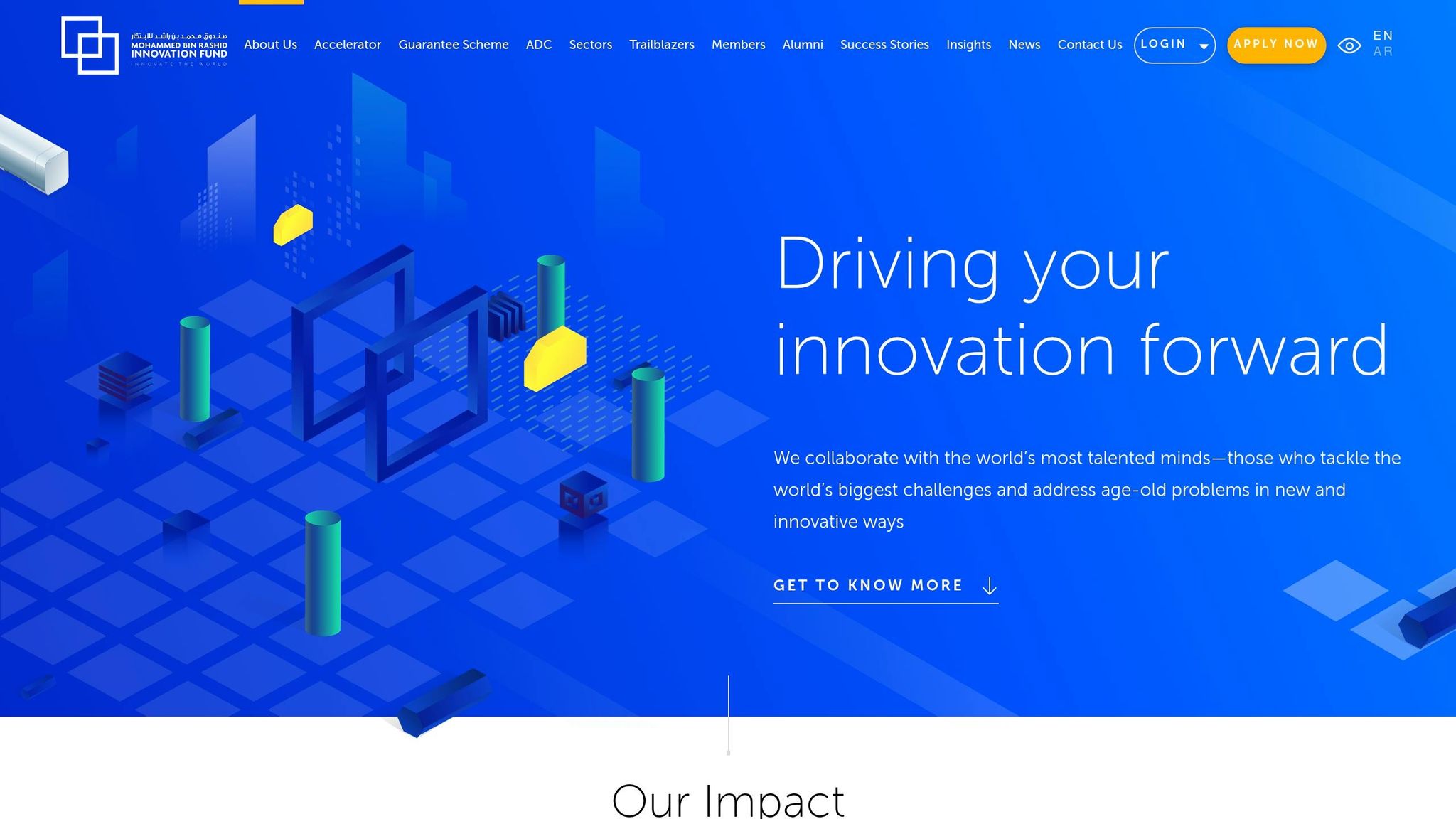
Incentive type: Non-dilutive funding and advisory support
Best fit: Revenue-stage startups for the Guarantee Scheme; market-ready startups for the Accelerator
For founders ready to scale, MBRIF is one of the clearest federal paths to non-dilutive support. It is aimed at climate, water, and clean-energy startups that have moved past the idea stage. The fund focuses on seven priority sectors, including Clean Energy and Water, which makes it directly relevant for green tech founders.
MBRIF runs through two tracks. The first is a government-backed Guarantee Scheme for revenue-generating startups. The second is a 12-month Innovation Accelerator that offers mentorship and access to global experts at no cost and with no equity taken. Put simply, the Guarantee Scheme helps startups with revenue secure bank financing, while the Accelerator helps earlier commercial teams sharpen their business model and get investor-ready.
The numbers give some context here. MBRIF members have raised more than AED 2.8 billion in funding and helped create over 800 jobs [12].
There is one practical point founders should not gloss over. The Accelerator has a strict due diligence process that looks at innovation, commercial viability, and credit risk. Founders should have audited financials and IP documentation ready before they apply [11]. Decisions can take up to 10 business weeks from submission [11].
The big draw is leverage. MBRIF can help founders open the door to bank debt and strengthen how banks and investors view the business. That added credibility can matter a lot when a startup is trying to move from early traction to serious scale.
That makes MBRIF a strong federal layer before founders move into emirate-level policy and finance support.
2. UAE Green Economy Initiative and Abu Dhabi Sustainable Finance Programmes
Incentive type: Grants, rebates, and startup subsidies
Best fit: Pre-Seed to Series A for Hub71+ ClimateTech; Growth/Scale-up for the ADIO Innovation Programme
If MBRIF is the federal route, Abu Dhabi adds the next layer of clean-tech capital.
The UAE Green Economy Initiative turns climate policy into startup funding through Abu Dhabi’s sustainable finance programmes. The Abu Dhabi Investment Office (ADIO) Innovation Programme channels a dedicated AED 2 billion fund into clean tech, agri-tech, and energy startups, with direct grants and rebates instead of equity [10].
For founders at the earlier stage, Hub71+ ClimateTech is the main way in. It supports Pre-Seed to Series A startups with cash and in-kind support as part of Abu Dhabi’s clean-tech stack [6][10].
There’s also a speed advantage here. The same policy stack helps green startups protect new ideas faster. Under the Green IP Roadmap, patent approval for green innovations drops to 3–6 months [5][4].
For growth-stage companies building capital-heavy deep-tech, Abu Dhabi's GreenHorizon Fund sits further up the ladder [9].
And if you want to sell into government projects, an ICV certificate can strengthen your position in tenders [10][1].
Once funding is sorted, the next move is securing a licence and an operating base.
3. Masdar City Free Zone and The Catalyst
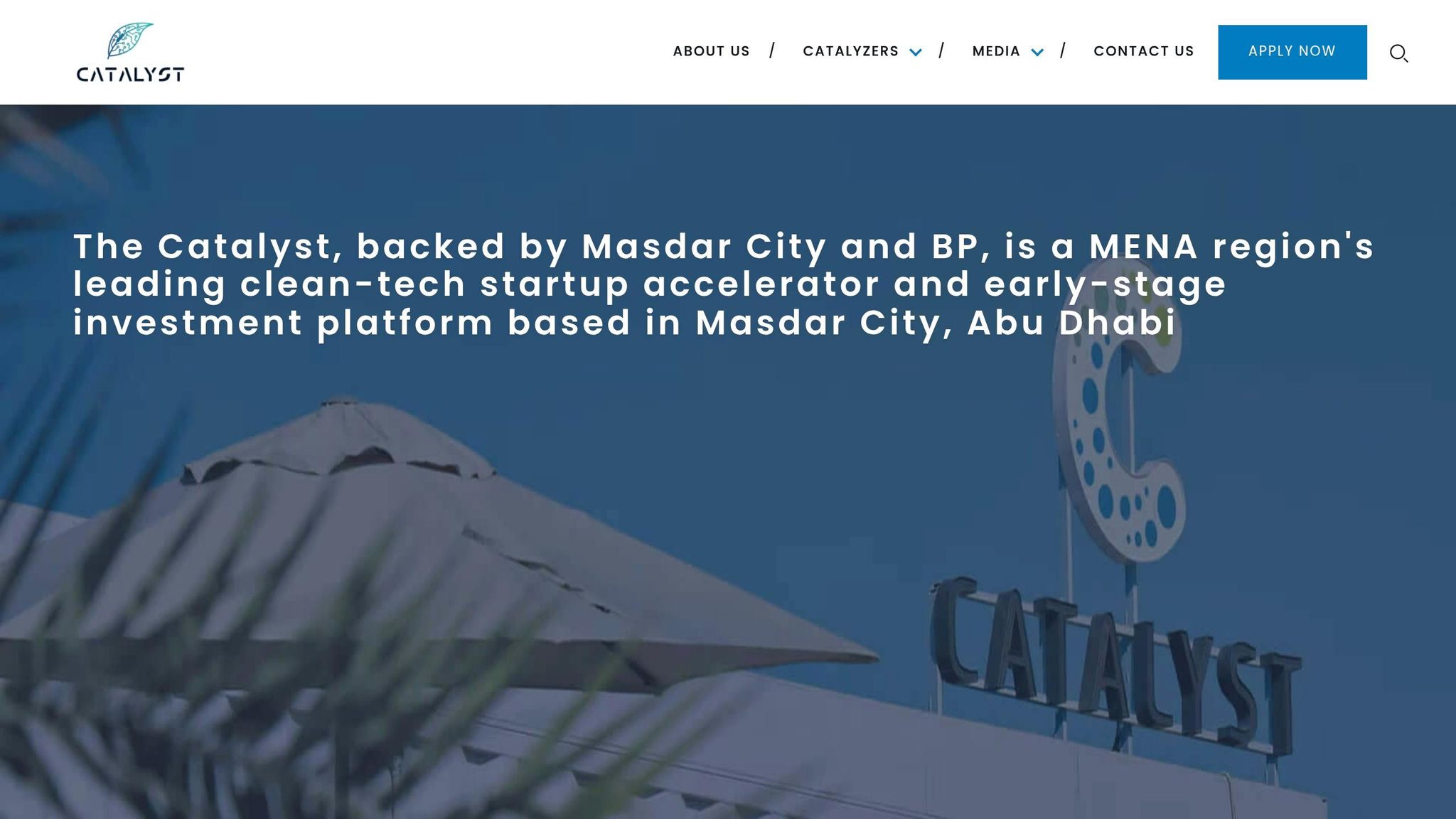
Incentive type: Free zone tax exemptions, SAFE-note funding, lab space, and accelerator support
Best fit: Pre-seed and seed startups, usually 1–3 years from market launch
Masdar City offers a strong base for green tech founders. Startups can get 100% foreign ownership, customs relief, no personal income tax, and qualifying corporate tax relief[13]. A basic single-activity licence usually costs AED 25,000 to AED 50,000[7]. And the Free Zone’s One-Stop Shop handles registration, visas, and Emirates ID processing in one place[13].
That setup makes Masdar useful in two ways. It works as a practical licence base, and it can also act as the entry point to The Catalyst.
The Catalyst is the more selective option. It’s a joint accelerator run by Masdar City and BP. Startups accepted into the programme can access SAFE-note funding, lab space, mentorship, marketing support, and pilot project openings[14][15]. The focus is clear:
- Renewable energy
- Energy storage
- Circular economy
- Green mobility
- Carbon intelligence[15]
Global startups can apply. But to get MENA expansion support, they need to set up a legal entity within Masdar City[14]. Priority goes to founders from the UAE, Egypt, and Oman[15].
For founders weighing up operating costs, the next piece to look at is UAE-wide tax relief.
4. UAE Corporate Tax Relief and R&D Tax Incentives
Incentive type: Corporate tax relief, R&D tax credits, VAT relief, and 0% tax on qualifying patent income
Best fit: Startups with at least AED 500,000 in qualifying R&D spend per tax period
Once licence costs are out of the way, tax relief can become the next big lever for growth. In the UAE, Corporate Tax is 9% on taxable income above AED 375,000. But green tech startups may cut that bill through Small Business Relief, patent income relief, and certain VAT exemptions.
Here are the reliefs that tend to matter most for green tech founders:
- Small Business Relief: Startups with revenue below AED 3 million pay 0% tax, often for the first five years [17]
- Patent income relief: Income from selling or licensing registered green technology patents is taxed at 0% [17]
- VAT exemptions: Products like solar panels, EV chargers, and wind turbines may qualify for a 0% VAT rate [17]
- Tax loss relief: Losses can be carried forward with no time limit and used to offset up to 75% of taxable income in future profit-making years [18]
For startups that are starting to scale, the R&D credit is often the main one to watch. Introduced in early 2026, it can offset Corporate Tax or Top-up Tax for approved R&D projects [16][19].
The 2026 R&D credit works on a tiered basis:
- 15% on the first AED 1 million
- 35% on the next AED 1 million
- 50% on spend above AED 2 million
This is subject to approval [19][20]. On top of that, qualifying staff costs get a 30% overhead uplift, and the credit is capped at AED 2 million per entity or Tax Group for each tax period [19][20].
There are two limits to keep in mind. First, startups using Small Business Relief can't claim the R&D credit at the same time [19][20]. Second, the project must spend at least AED 500,000 in each tax period and meet the approved R&D rules [19][20].
If your startup plans to sell into the mainland grid, it makes sense to model the tax treatment before picking your setup [18]. A small change in structure can affect what relief you can claim and when.
5. Expo City Dubai Green Licence and Specialist Green Incubators
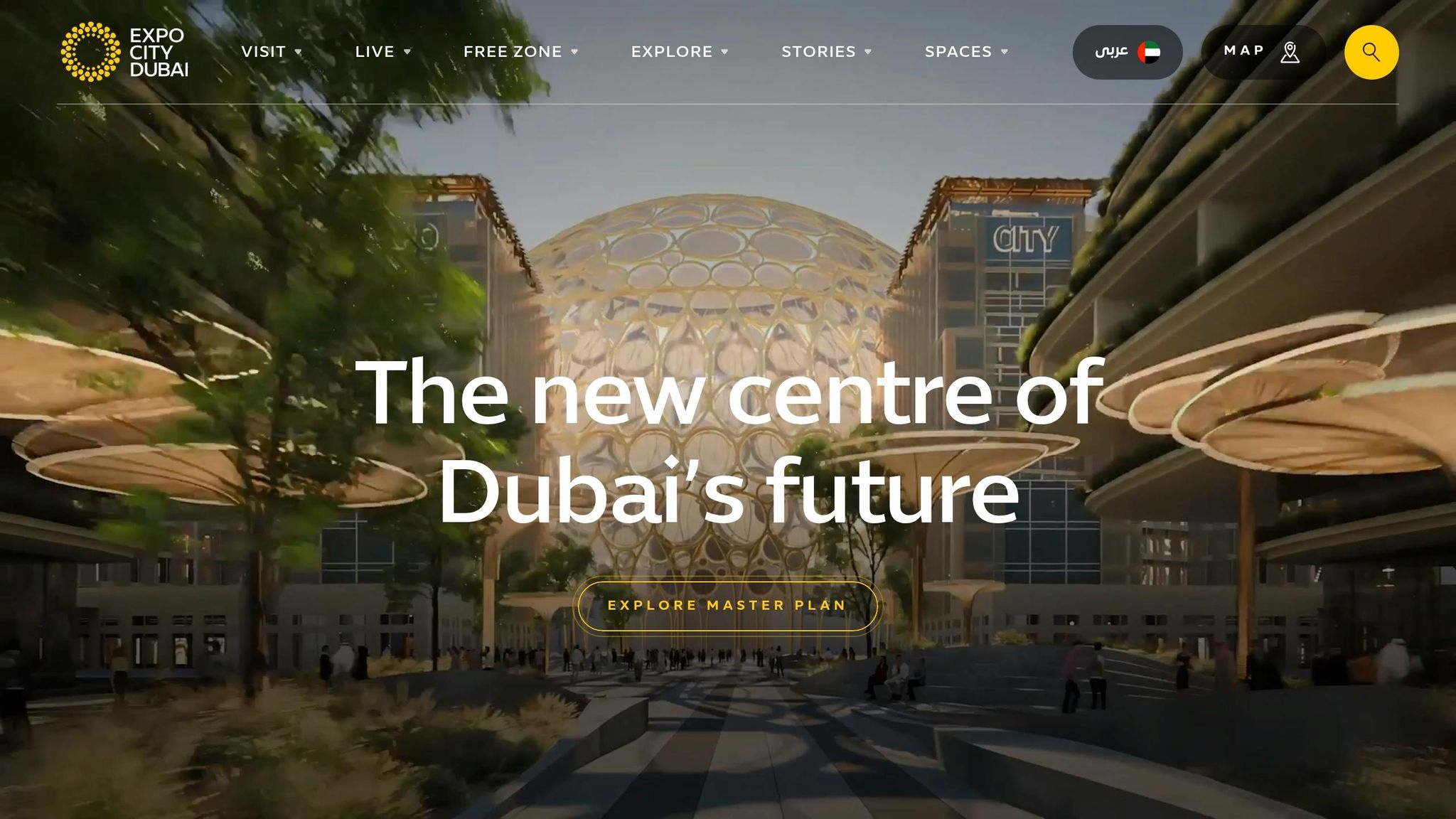
Incentive type: Dedicated green licensing framework, fast-track IP protection, and specialist incubation programmes
Best fit: Early-stage to scale-up green tech startups across renewable energy, waste-to-energy, agri-tech, eco-friendly transport, and circular economy solutions
Launched in October 2025, the Green Licence is the UAE's first dedicated licensing framework for green tech businesses. It is based in the Green Innovation District at Expo City Dubai [21][2].
One of the biggest draws is the on-site Green IP Office. It cuts patent processing time to 3 months for qualifying green IP [4]. If you're building around proprietary hardware, chemical processes, or novel materials, that shorter wait can make a big difference.
Startups with approved green activities can also get up to 40% off initial licence fees [3].
That discount helps, of course. But the bigger upside comes when the licence is paired with startup support built for green sectors.
After licensing, founders can move into sector-specific incubation for funding and mentorship. These specialist incubators can add another layer of support around the licence, especially for teams trying to move from idea to field test without wasting time.
Used together, Expo City's licence and specialist incubators give founders a faster route from incorporation to pilot.
Quick Comparison of the 5 Incentives
Use this snapshot to match each incentive to your stage, sector, and funding need.
If you need to make a quick call, look at these five incentives through three lenses: stage, type of support, and sector fit using our UAE Startup Ecosystem Analyzer.
| Incentive | Support Type | Stage Fit | Sector Relevance | Primary Benefit |
|---|---|---|---|---|
| MBRIF | Guarantee-backed financing | Early to Growth | Clean tech and climate innovation | Access to bank financing without giving up equity |
| Green Economy Initiative / ADIO | Grants / Subsidies | Early to growth | Clean tech, agri-tech, water, energy | Cash funding and regulatory support |
| Masdar City / The Catalyst | Incubator | Idea / Seed | Clean Energy, Circular Economy, Climate Tech | Licence base, lab access, and accelerator support |
| Corporate Tax / R&D Incentives | Fiscal / R&D Support | Growth / Scale-up | R&D-heavy green tech | Tax reduction and R&D support |
| Expo City Dubai Green Licence | Licensing / Accelerator | Idea to Early | Sustainability, Mobility, General Green Tech | Fast-track green licensing and IP processing |
Here’s the simple read: MBRIF fits founders who want financing leverage without giving up equity. Masdar City and Expo City Dubai make more sense for early-stage teams that need a licence set-up, room to test ideas, and faster IP movement. And Corporate Tax / R&D Incentives start to matter more when research spend begins to climb.
That said, policy support is only one side of the story. What changes outcomes is execution. A founder may have access to a grant, tax relief, or a green licence on paper, but using it well often comes down to the people around them, investors, peers, and support networks that can help turn a good option into actual progress.
How Founder Support and Community Fit In
Government incentives can open the door. But founders still need help picking the right route, getting applications ready, and turning approvals into momentum. Even when the options are clear, the next step is often the hard part: choosing well and acting fast.
Founder Connects as a non-government support layer
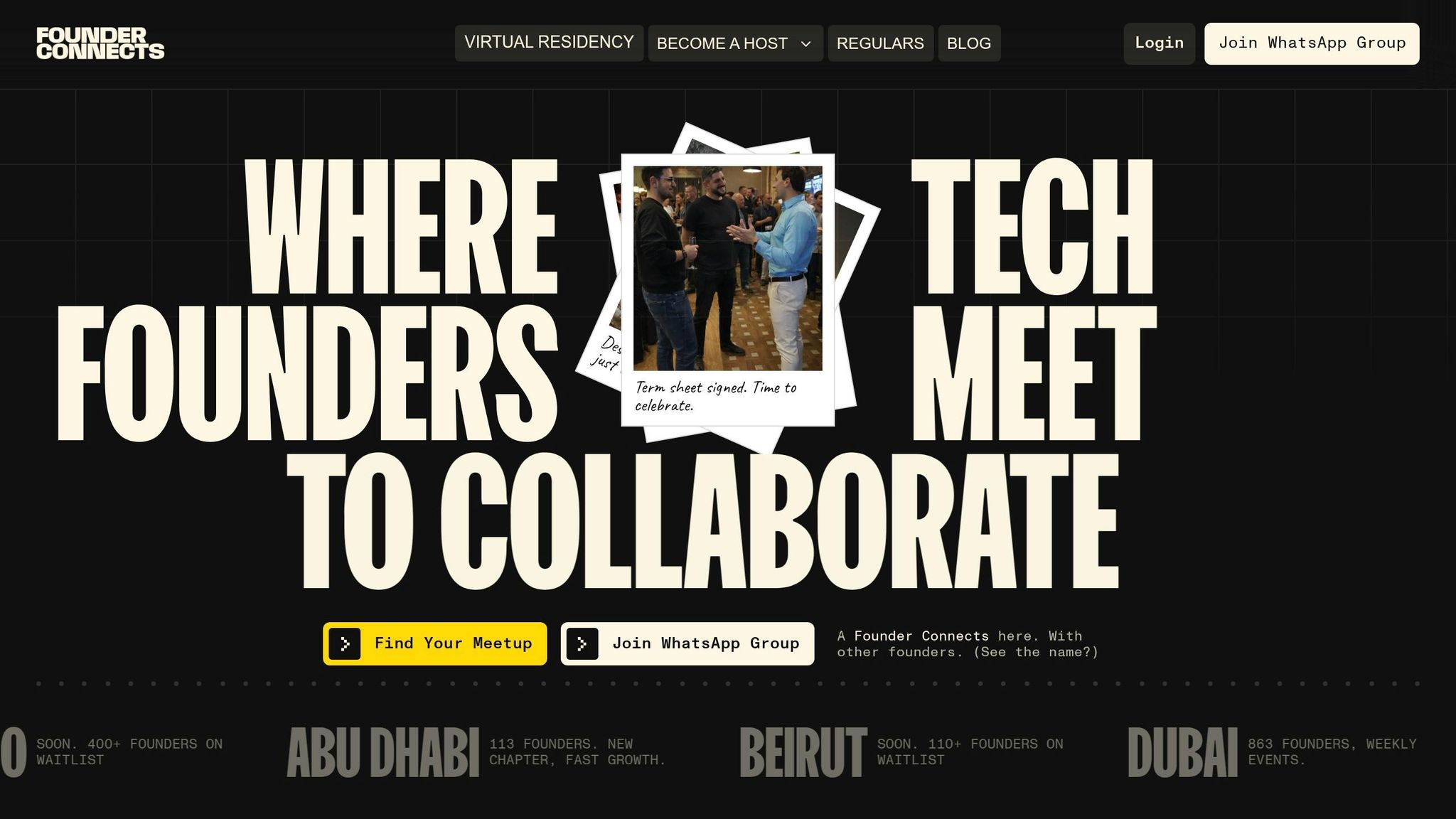
That’s where Founder Connects comes in. Founder Connects works as a community support platform alongside government incentives. It helps UAE founders swap tactics, build peer relationships, and work through day-to-day operating issues together as they move through the UAE startup scene.
This matters when founders are weighing schemes like Hub71+ ClimateTech, with its cash support, in-kind support, and possible top-up funding [6][10]. It also gives founders a place to compare notes on eligibility, timelines, documents, and the right entry points, including whether a free-zone or mainland route makes more sense [2].
Investor access, peer learning, and events
The platform also links founders with investor networks, expert sessions, and matched virtual masterminds focused on fundraising, market entry, and compliance. That includes mandatory emissions reporting under Federal Decree-Law No. 11 of 2024 [2]. In practice, that helps founders move from picking an incentive to actually putting it to work.
Conclusion
These five incentives support different points in a startup’s growth path. The best fit comes down to your stage and what you need most right now: funding, licensing, tax relief, or incubation.
MBRIF gives startups non-dilutive financing leverage. The Green Economy Initiative and ADIO programmes offer grants and subsidies. Masdar City and The Catalyst give early-stage teams a licence base and accelerator support. Corporate tax and R&D incentives help cut tax costs for research-heavy ventures. And Expo City Dubai's Green Licence gives founders a fast-track route to incorporation and IP protection.
The practical move is simple: match the incentive to your stage and your ability to execute fast. Before you apply, check the latest eligibility rules, deadlines, and compliance terms. The UAE is building a strong setup for green tech startups, and timing can make all the difference when an opening is clear.
FAQs
Which UAE incentive suits my startup stage?
It comes down to where you are right now.
If you're still at the idea stage, the Eco-preneurship Bootcamp could be a good fit. If you're an early-stage startup and want non-dilutive capital, take a look at the Mohammed Bin Rashid Innovation Fund.
For companies from pre-seed to Series A, Hub71+ ClimateTech may make sense. And if your startup is more focused on regulatory or day-to-day growth, Expo City Dubai’s Green Licensing Framework may help.
You can also look at the Ministry of Economy’s Green IP initiative if you're building green products or ideas and want support around intellectual property.
Can I combine more than one UAE green startup incentive?
Yes, you can often combine different incentives. The UAE startup scene gives founders plenty of room to stack more than one type of support.
A lot of startups mix options like government grants, non-dilutive loans, and accelerator packages. For example, you might join Hub71 and still apply for other innovation grants or sector-specific support at the same time.
Founder Connects can also help you spot useful resources and get expert advice.
What documents do I need before applying?
Before you apply, put together a solid business plan. It should cover your team, your product or service, financial projections, your value proposition, and the benefits your startup brings to the UAE.
Many programmes also ask for a PDF pitch deck. That deck should outline your business model, market traction, competition, and regional growth plans. You may also need documents that show your impact on the environment, such as lifecycle assessments or projected emissions savings.
Related Blog Posts

Building in MENA? You don't have to do it alone.
Join 300+ founders in the Founder Connects Residency. Monthly squad calls, warm intros, $3M+ in perks, and much more. All for less than your monthly coffee budget.
Popular posts





Founder Connects is a premium MENA tech founder community. Meetups in Dubai and across MENA, Residency Squads of 8–10, and 400+ vetted WhatsApp founders (apply and screened).