

5 Term Sheet Clauses That Change Founder Ownership

Building in MENA? You don't have to do it alone.
Join 300+ founders in the Founder Connects Residency. Monthly squad calls, warm intros, $3M+ in perks, and much more. All for less than your monthly coffee budget.

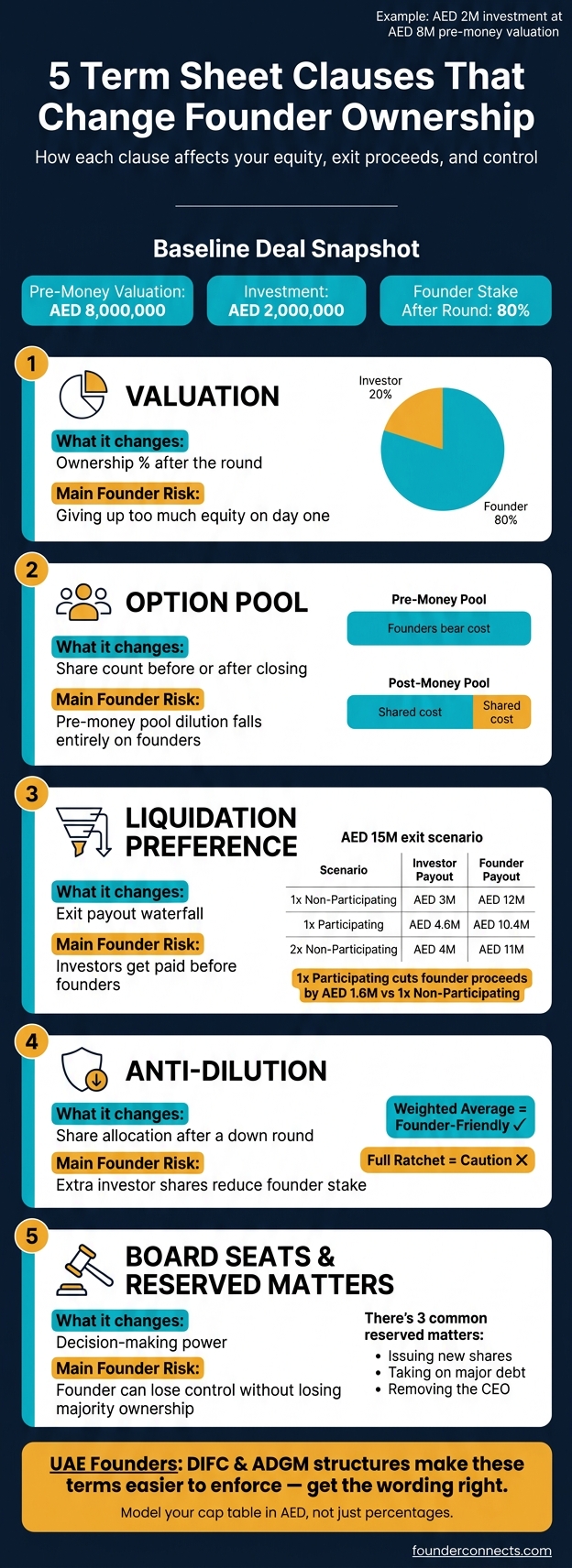
A high valuation does not tell you what you still own. In one simple deal, an AED 2,000,000 investment at an AED 8,000,000 pre-money valuation when you start a startup company gives the investor 20% and cuts founders to 80%. Then terms like a pre-money option pool, liquidation preference, anti-dilution, and board vetoes can cut your stake, your exit cash, or your control even more.
If I were reviewing this term sheet, I’d focus on five clauses first:
- Valuation: decides the starting dilution
- Option pool: can dilute founders before the round closes
- Liquidation preference: decides who gets paid first at exit
- Anti-dilution: can issue more shares to investors after a down round
- Board seats and reserved matters: can limit founder control even with a large stake
And the numbers can move fast. In the article’s example, at a AED 15,000,000 exit, a 1x participating preference cuts founder proceeds by AED 1,600,000 versus 1x non-participating. A 2x non-participating term changes the payout again.
Term Sheet Explained by a Lawyer (Everything You Need to Know)
Quick Comparison
If you’re a UAE founder, I’d also check the legal setup early. This is a critical step when launching a startup in the UAE to ensure long-term protection. In DIFC and ADGM structures, these rights are often easier to document and enforce, so the wording matters just as much as the headline price.
1. Valuation
Valuation only means something if everyone is talking about the same version of it: pre-money or post-money.
Pre-money valuation is the agreed value of your company before the investment lands. Post-money valuation is that number plus the investment amount. Investor ownership = investment ÷ post-money valuation. [1][2][4]
"Ensure that you and the investor are clear as to whether you are talking about pre-money or post-money valuation, as any confusion will impact the size of equity stake your investors receive, due to the fact that this affects price per share." - Suraya Turk, Managing Partner, Legal Circle [1]
A lot of founders trip up here. On paper, the gap can look small. In practice, it changes how much of the company you give away.
Immediate Dilution Impact
Say your startup is valued at AED 8,000,000 pre-money and an investor puts in AED 2,000,000. Your post-money valuation becomes AED 10,000,000. That gives the investor 20% of the business, and the founders’ combined ownership drops from 100% to 80%. [2][1][4]
Price per share = pre-money valuation ÷ fully diluted shares. [6][4]
This is where the maths stops being abstract. A number in a term sheet turns straight into ownership.
Future Dilution Risk
A lower pre-money valuation means you give up more equity now, and you start the next round from a weaker position. A higher pre-money valuation does the reverse.
That matters because dilution rarely happens just once. If you give away too much early, later rounds can squeeze founder ownership much harder than expected.
Founder Payout Effect
When the company exits, every percentage point you gave up in this round cuts into what founders take home.
And valuation is only the start. The option pool can dilute founders before the round even closes.
2. Option Pool
An option pool is reserved equity set aside for future hires and advisors. If investors ask for that pool to be created pre-money, founders take the dilution before the deal closes. So the timing of the pool matters just as much as the size.
Immediate Dilution Impact
When the pool sits in the pre-money, the dilution hits straight away. The round is priced on a fully diluted valuation basis, which includes all issued shares plus the reserved pool, so the share price drops. A lower price per share means investors get more shares for the same cheque, while founders are left with less.
Put plainly: pre-money pools dilute founders; post-money pools dilute everyone.
Future Dilution Risk
Investors may push for a pool that is larger than the hiring plan calls for. That means extra dilution from day one, for no clear reason. For UAE startups, it makes sense to size the pool around hiring needs up to the next round, not far beyond that. This is why founders should model the pool against the hiring plan before agreeing to the number.
Founder Payout Effect
Any increase in the pool comes out of existing shareholders, which usually means founders in a pre-money setup. And yes, that cuts directly into what founders take home at exit.
3. Liquidation Preference
If valuation sets the entry price, liquidation preference sets the exit waterfall.
Put simply, liquidation preference decides who gets paid first when the company exits. Investors with preferred shares get their money back before common shareholders, including founders and employees, receive any proceeds [2][4][3].
The most founder-friendly version is 1x non-participating. In that setup, the investor either takes back 1x of their investment or converts to common and takes their pro-rata share, whichever pays more. Once you move into participating or multiple preferences, more of the exit value shifts to investors.
This can get painful across multiple rounds. Preferences may stack, which means a low or middling exit can leave founders with nothing [2].
Founder Payout Effect
When an investor pushes for a participating preference, founders should try to add a cap. That means the investor stops participating after hitting a set total return, such as 3x [1].
Without that cap, the investor can effectively get paid twice: first through the preference, then again through their share of what remains. That can eat into founder proceeds fast.
Control and Approval Influence
Exit priority often comes with approval rights over the deal itself.
Liquidation preferences are often tied to protective provisions that give investors veto rights over a sale or merger if the deal does not meet an agreed threshold [2][1]. In Dubai and Abu Dhabi structures, these terms are easier to enforce under common law. So founders should define "Liquidation Event" with care, making sure it clearly covers acquisitions, mergers, and asset sales [3][6].
4. Anti-Dilution Protection
Anti-dilution protects investors when a later funding round comes in at a lower price. For founders, that matters only after a down round. If the conversion price drops, the investor gets more common shares, and founder and employee ownership shrinks [2][4].
The main point isn't just that dilution happens. It's how much extra dilution this clause can create if the company has to raise again.
Future Dilution Risk
The anti-dilution formula is where the fine print starts to bite. Weighted average is the usual, more founder-friendly option. Full ratchet is much tougher because it resets the investor's price to the lower price in the new round [2].
In UAE deals, weighted average is the standard ask. If you see full ratchet, slow down and look closely.
That dilution may not feel immediate on paper, but it often shows up later as a smaller founder share of exit proceeds.
Founder Payout Effect
When anti-dilution is triggered, more of the exit value shifts to investors and less goes to founders. Any extra shares issued to investors come straight out of the pool that would otherwise go to founders and employees at exit [2][4].
Before signing, founders should check a few points:
- Whether the weighted average formula is broad-based, which means it includes all outstanding shares, options, and warrants, rather than being narrow-based [7]
- Which share issuances do not trigger the clause, such as employee option pool grants [2]
- Whether these terms are clearly set out in the Shareholders' Agreement for DIFC and ADGM deals, with local counsel reviewing the wording [5]
Ownership is only part of the story. The next clause can shape who actually controls the company.
5. Board Seats and Control Rights
A founder can lose control of hiring, budgets, and approvals even while still holding a meaningful stake. That’s why board makeup and reserved matters matter just as much as valuation in a UAE startup funding round.
Control and Approval Influence
A founder-majority board doesn’t always mean founder control. Investor veto rights can still limit what the board can do. In practice, those rights can override a board majority on key decisions. Common reserved matters include issuing new shares, taking on major debt, and removing the CEO [5][8].
So the main point isn’t only who has a seat at the table. It’s who has the power to stop things from moving.
In DIFC and ADGM deals, these rights are usually written into the Shareholders' Agreement as Reserved Matters [5]. And even without a board seat, an investor may ask for observer rights, which let them attend meetings without a vote [5][8].
Future Dilution Risk
Board rights also affect future funding rounds. An investor with a board seat or reserved matter rights may be able to block or delay new share issuances, which can in turn delay or block new funding [2]. This is particularly critical when evaluating seed funding options for early-stage growth. Drag-along rights add another layer. They can force founders to sell the company if the required preferred shareholders agree, even if the founders are against the exit [2][8].
These governance rights can start shaping ownership and decision-making long before any exit happens.
Ownership Impact at a Glance
One of the easiest ways to compare clauses is to see how they change ownership and exit proceeds in the exact same deal. Valuation shows who owns what after the round. Liquidation preference shows what founders and investors actually get when the company exits.
That covers the ownership side. The other half of the story is liquidation preference, which changes what founders receive at exit.
Liquidation preference affects exit proceeds, not just paper ownership.
Scenario: AED 15,000,000 exit, AED 2,000,000 investment at 20% ownership - 1x participating means taking both the preference and a share of the remainder [2].
In plain terms, that difference is not small. In this scenario, a 1x participating preference cuts founder proceeds by AED 1,600,000 versus 1x non-participating, and a 2x non-participating preference cuts founder proceeds by another AED 1,000,000 [2].
Use these figures as the basis for the negotiation tactics that follow.
What UAE Founders Should Do Before Signing
Use the ownership and exit scenarios above as your starting point before you sign. The main issue is not just what the term sheet says on paper. It’s what’s left on your cap table after the round closes.
Model the full cap table before signing. Valuation sets the price. But option pool size, liquidation preference, anti-dilution, and board rights shape dilution, exit proceeds, and control.
Start with ownership on a fully diluted basis. Then run that same model in AED proceeds, not just percentages. A percentage can look fine at first glance, but the cash outcome may tell a very different story. Option pool creation can dilute founders by 5–20%, and each priced round can add roughly 20% more dilution [9]. After that, test how those same terms change voting power, veto rights, and your ability to fundraise again later.
Once you’ve looked at price and dilution, move to control rights. This is usually the next big point in the negotiation. Treat control provisions with the same weight as price. Investor veto rights are standard, and reserved matters set out what you can and can’t do without approval [9]. In plain terms, these rights can block dilution, hold up funding, or force an exit. So they shape ownership just as much as the share count does.
If you want a gut check, use Founder Connects to compare notes with UAE founders on term-sheet structure and fundraising strategy.
Conclusion
Headline valuation is only the starting point. Ownership and control are shaped by the fine print: the option pool, liquidation preference, anti-dilution, and board rights.
That’s where things often shift. A round can look founder-friendly on price, yet still end up costly when you look at dilution, the exit waterfall, and control. So a strong headline valuation can still lead to a weak founder outcome. Many UAE founders on problem-solving emphasize that navigating these regulatory and funding nuances is key to long-term success.
For an entrepreneur in UAE deals, the legal wrapper matters too. It affects how these terms play out in practice. Check the jurisdiction early. DIFC and ADGM usually handle complex VC terms more cleanly than onshore structures.
Model the deal in AED, check the jurisdiction early, and negotiate the terms that shape ownership, not just valuation.
FAQs
How do I model my true dilution?
Model it on a fully diluted basis. That means you count all outstanding shares, not just the shares already issued. Include the employee stock option pool, warrants, and any other convertible securities.
If a term sheet adds a new option pool, founders are often diluted straight away because that pool usually comes out of the pre-money valuation. In plain terms, the hit lands on the founders before the investor money goes in.
To check your post-money ownership, divide your shares by the total shares outstanding after the new issue.
Which term sheet clause hurts founders most?
Liquidation preference is often the clause that hits founders hardest on the money side, right up there with valuation.
The biggest danger usually comes from fully participating preferred shares. Here’s why: investors get their money back first, and then they dip in again by taking a share of what’s left. If there’s no cap, that second bite can take a big chunk out of the founders’ payout.
Two other areas can cause major trouble too:
- Protective provisions can give investors veto rights over key decisions.
- Anti-dilution clauses can push more of the economic downside onto founders during down rounds.
On paper, these terms can look technical. In practice, they can shift control and money away from the founding team fast.
Why do DIFC and ADGM matter here?
In the UAE startup scene, DIFC and ADGM play a big role because they offer legal and regulatory setups that many venture capital deals need.
That matters in practice. Investors often ask founders to set up a holding company, often a special purpose vehicle, in one of these jurisdictions so the company structure fits VC funding more neatly.
They also support investment documents that match regional requirements and global best practice.
Related Blog Posts

Building in MENA? You don't have to do it alone.
Join 300+ founders in the Founder Connects Residency. Monthly squad calls, warm intros, $3M+ in perks, and much more. All for less than your monthly coffee budget.
Popular posts





Founder Connects is a premium MENA tech founder community. Meetups in Dubai and across MENA, Residency Squads of 8–10, and 400+ vetted WhatsApp founders (apply and screened).