

Cofounder Equity Split: How to Negotiate It

Building in MENA? You don't have to do it alone.
Join 300+ founders in the Founder Connects Residency. Monthly squad calls, warm intros, $3M+ in perks, and much more. All for less than your monthly coffee budget.

You're in the room before incorporation, the coffee is going cold, and everyone suddenly wants the same number on the cap table. One founder says 50/50 feels fair. Another says they built the product, brought the IP, and now want that reflected in writing. Bad founders' agreements start here, because people try to protect the relationship by avoiding the hard conversation. The smarter move is the opposite, get the split discussed early, write down the logic, and tie it to how the business will be financed.
Why the Cofounder Equity Split Conversation Matters Now
Most founders in the UAE wait too long. They talk product, branding, bank accounts, and pitch decks, then try to settle ownership in a rushed call the night before incorporation. That's when informal promises turn into arguments, because one person remembers the work, another remembers the risk, and both think they're being reasonable.
A better way is to treat the cofounder equity split as a business decision, not a loyalty test. If you're already comparing contribution, control, and future dilution, you're doing the right job. If you're still relying on “we trust each other”, you're setting up a future dispute that gets worse after the first financing round.
Two Dubai-based cofounders I'd expect to see in this situation often start with a verbal 50/50. Six months later, one has done most of the operating work while the other brought the original IP and now feels the split should stay even because the idea came first. That's exactly why you need a framework before shares move, not after emotions harden.
A useful outside reference for one part of the operating side is how to split revenue without spreadsheets, because it shows how founders can think clearly about contribution without drowning in admin. The principle is the same here, define the logic first, then put the numbers on paper.
The rest of this article follows a simple order, contribution metrics, sample split models, vesting and legal safeguards, then the actual conversation script. If you do the work in that sequence, the meeting stops being a fight and starts becoming a documented decision.
Four Contribution Lenses That Actually Drive the Split
Time and operating role
Start with the easiest thing to hide and the hardest thing to fake, time. Who is full-time, who is still employed, who is answering customers at 11 p.m., and who is offering “strategic help” once a week? If one founder is carrying the operating burden, a neat 50/50 can become a polite lie.
Ask this bluntly, how many real hours will each person give over the next six months, and what role are they filling. If one founder is acting as CEO, sales lead, and project manager while the other is part-time, the split should reflect that asymmetry. Don't confuse enthusiasm with delivery.
Intellectual property and prior work
Founders often over-argue and under-document. Pre-incorporation code, design files, research, supplier contacts, and product prototypes all matter, but only if the contribution is real and transferable. If one founder already built the thing everyone wants to commercialise, that has value even before the company exists.
The right question is simple, what existed before incorporation, who created it, and who owns it now. If the answer is unclear, get it clarified before you talk percentages. Undefined IP is how founders end up owning an argument instead of a company.
Capital and forgone salary
Cash is obvious. Forgone salary is usually ignored, which is a mistake. A founder who walks away from paid employment to work full-time has made a different commitment from someone who keeps a salary elsewhere and builds on weekends.
Put both on the table. Cash covers legal fees, tooling, and runway. Forgone salary covers the opportunity cost of choosing the startup over secure income. If the numbers are not written down, people will remember them very differently later.
Network and customer access
Some founders open doors, others build the product those doors need. That distinction matters. If one person can realistically bring the first customers, strategic partners, or a credible distribution channel, that is a contribution, not a nice-to-have.
Practical rule: if a founder can point to specific companies, buyers, or partners they can reach now, that belongs in the split discussion.
That's the lens many teams mishandle, because “network” sounds soft until it shortens the sales cycle. If your cofounder can open the first ten conversations that matter, say so and document it.
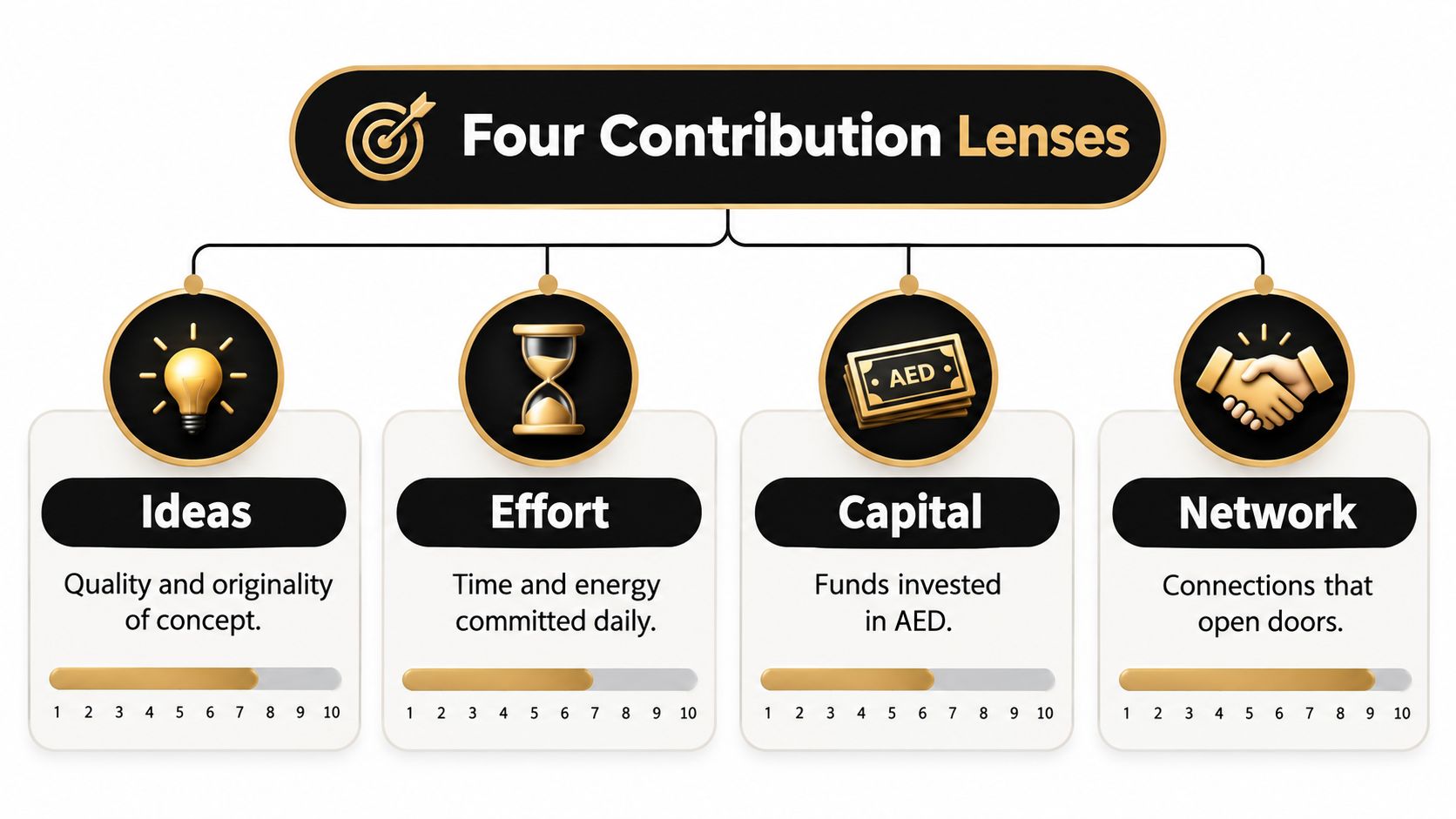
Use this one-page worksheet before you start debating percentages:
- Time and role: who is full-time, who is part-time, who owns delivery
- IP and prior work: what existed before the company and who created it
- Capital and sacrifice: cash invested, salary given up, costs covered
- Network and access: who can bring customers, partners, or credibility
If you want a clean cofounder screening prompt before you even assign work, keep the written answers aligned with the questions in how to vet a cofounder. Once those four lenses are written down, the split stops being emotional guesswork and becomes a defendable proposal.
Three Sample Cofounder Equity Split Models
Founders usually argue about equity as if the split itself proves who was right. It does not. The test is whether the structure survives a seed round, an option pool, and the day one founder stops showing up. Judge the split by what remains after dilution, not by how fair it feels in isolation.
Model A, the clean equal split
Equal ownership is simple, emotionally easy, and often the wrong answer. It only works when both founders are making similar commitments, bringing similar value, and accepting similar risk. Even then, vesting is required, because equality on incorporation day says nothing about contribution over time.
The pressure appears once outside capital enters. A 50/50 headline can become economically thin fast once a seed round and an employee option pool are on the table. That is why founders must judge the split by where it lands after financing, not just at incorporation.
Model B, contribution-weighted ownership
This model ties equity to the four lenses above. It gives more weight to the founder who has brought more time, IP, cash, or access, without pretending every contribution is equal. For a three-founder team, a 55/35/10 split can make sense if the work, risk, and responsibility are visibly uneven.
If one founder is carrying execution and another is providing lighter support, the split should show that plainly.
Do not use weighted ownership as a punishment tool. Use it to prevent resentment later, when the business reality no longer matches the story people told themselves at incorporation. That is the mistake that blows up cofounder relationships after money enters the company.
Model C, equal ownership with unequal profit rights
In a UAE LLC, ownership and profit do not have to match if the memorandum allows a different profit allocation. That gives founders a practical way to separate control, legal ownership, and economic return. It works well where one founder contributes more capital or intellectual property, but the team still wants simple shareholding.
The document matters. If the memorandum is silent, profits are generally distributed in proportion to shareholding, so this cannot be left to informal chats or WhatsApp messages. Put it in writing, then make sure the constitutional documents, the Articles, and the rest of the company paperwork all match the same deal.
| Model | Ownership | Voting | Profit share | Vesting |
|---|---|---|---|---|
| Equal split | 50/50 or equal among founders | Equal, unless documents say otherwise | Usually follows ownership unless memorandum differs | Should still be included |
| Contribution-weighted | Based on time, IP, cash, network | Reflects the agreed ownership mix | Usually follows ownership unless memorandum differs | Should still be included |
| Equal ownership, unequal profit | Equal shareholding | Equal or as documented | Different from ownership if the memorandum allows it | Should still be included |
Use the model that can survive dilution, not the one that sounds polite in the room. In the UAE, that means you also check LLC pre-emption rights, align the memorandum and Articles, and write the split in a way that still makes sense after investors and future hires enter the cap table. If the structure only works before money comes in, it is not a structure, it is a misunderstanding.
Vesting and Legal Safeguards in a UAE Structure
What vesting should look like
Use vesting. Always. In practice, the common structure is four years with a 12-month cliff, which means nothing is earned in the first year, 25% vests at month 12, and the rest vests over the following 36 months. If a founder leaves early, unvested equity should not walk out of the company with them.
If founders already hold shares from incorporation, use reverse vesting so the company keeps a contractual repurchase right over the unvested portion. That matters because UAE company law does not automatically impose founder vesting. Without the repurchase mechanism drafted in, you may find yourself stuck with a departed founder still holding the full allocation.
A workable plain-English schedule looks like this, no vesting before month 12, then 25% vested at month 12, then monthly vesting through months 13 to 48. That is the simplest way to stop an early departure from becoming a permanent ownership mistake.
The documents that must match
The trap in UAE deals is inconsistency. The founders' agreement, the Articles of Association, the shareholder resolution, the IP and confidentiality assignment, the share transfer clause, and the cap table all need to say the same thing. If one document says one thing and another says something else, you've created a dispute before the business has even started.
Use a UAE-qualified lawyer, and make them check the structure you have, mainland, DIFC, or ADGM. Don't copy a US template and assume the repurchase rights, leaver treatment, and transfer mechanics will work the same way. They often don't.
For a practical drafting benchmark, the discussion in UAE startups need shareholder agreements is useful because it keeps the focus on the document stack rather than the theory. I'd also read a negotiation guide like Ciphar's private negotiation playbook if you want to keep the conversation disciplined while people are still calm.
Non-negotiable: if the legal paperwork and the commercial split disagree, you do not have a split, you have a future dispute.
Use this checklist when a lawyer reviews the draft:
- Vesting mechanics: four-year vesting, 12-month cliff, repurchase rights
- Leaver treatment: clear good-leaver and bad-leaver definitions
- IP assignment: all pre-existing and newly created company IP assigned properly
- Transfer process: notice, valuation, and any pre-emption rights
- Jurisdiction fit: mainland, DIFC, or ADGM documents aligned
- Cap table precision: exact percentages, no rounding games
If you want a founder community reference point after the legal draft is in motion, Founder Connects is one option to use for peer discussions around founder disputes and agreement hygiene. It's not a substitute for counsel, but it is a place where founders compare notes before mistakes get expensive.
When an Unequal Split Is the More Honest Answer
Equal sounds fair until one founder is carrying the harder load. Then equal becomes a way of hiding the underlying bargain. In a region where capital access and visibility are not evenly distributed, a "neutral" split can end up rewarding the wrong thing.
Three questions that settle the argument
Ask these before anyone reaches for the 50/50 default:
- Who is taking the larger operating burden?
- Who is bringing the more defensible IP, capital, or access?
- Who will be most exposed to dilution and future fundraising pressure?
If the answers are clearly uneven, the split should be uneven too. That doesn't mean one founder is better. It means the company is telling the truth about who is taking which risk.
The emotional objection is predictable, people worry that unequal ownership will damage the relationship. In my experience, the opposite is more common. Hidden imbalance damages the relationship later, when one founder realises they subsidised the other with their time and future dilution.

A simple 60/40 example
A 60/40 split with vesting is often healthier than a fake 50/50. If one founder leaves at month 14, the vested ownership reflects what was earned while protecting the company from a permanent mismatch. That outcome is far less messy than pretending both founders contributed equally when they didn't.
The key is not the exact ratio, it's the quality of the reasoning. Equal equity is fine if you've tested it. Unequal equity is fine if you can explain it. What fails is pretending the number is “just fair” because nobody wanted a difficult meeting.
When founders ask me whether they should split equally, I give the same answer: only if they can defend it after the next financing round. If they cannot explain the split after dilution, the split was never fair in the first place.
The Cofounder Equity Conversation, Scripted
Send this first: “I want us to finalise the equity logic before we go any further, because I don't want us guessing later when the cap table is already live. Can we sit down and agree the split, vesting, and document steps properly?”
Then run the meeting in this order:
- Share the four-lens worksheet and fill it in line by line.
- Agree the scoring weights for time, IP, capital, and network.
- Run the post-money scenario and talk through what ownership looks like after dilution.
- Agree the vesting terms and leaver treatment.
- Decide the next document to sign and who is drafting it.
If you need a private reference for how cofounders talk through this without posturing, Founder Connects cofounder matching FAQ is a useful place to see how the community frames cofounder readiness and agreement hygiene. Use it as a checklist, not as a substitute for your own judgment.
The hard lines founders need to say out loud
“I'm not comfortable with 50/50 unless we can prove it.”
“If one of us leaves early, the company should not be trapped by a full unvested stake.”
“I can accept a smaller stake only if the reasoning is written down and the documents match it.”
“If we disagree on parental leave, decision rights, or bad-leaver terms now, we will fight later.”
Those lines feel blunt because they are blunt. Good founders say them anyway. Weak founders hide behind politeness and hope the paperwork fixes the disagreement later.
At the end of the meeting, fill in one summary page with ownership, vesting, decision rights, IP status, and the date the founders' agreement will be drafted by counsel. Sign that summary, even if the final legal documents come later. If it isn't written down, it didn't happen.
Your Next Two Weeks and the Founder Connects Path
Founder Connects is a private founder community that runs Meetups and a six-month Residency, where vetted founders test ideas in small squads of 8 to 10. It also has a vetted WhatsApp community and live chapters in Dubai, Abu Dhabi, Nairobi, Beirut, and Cairo.
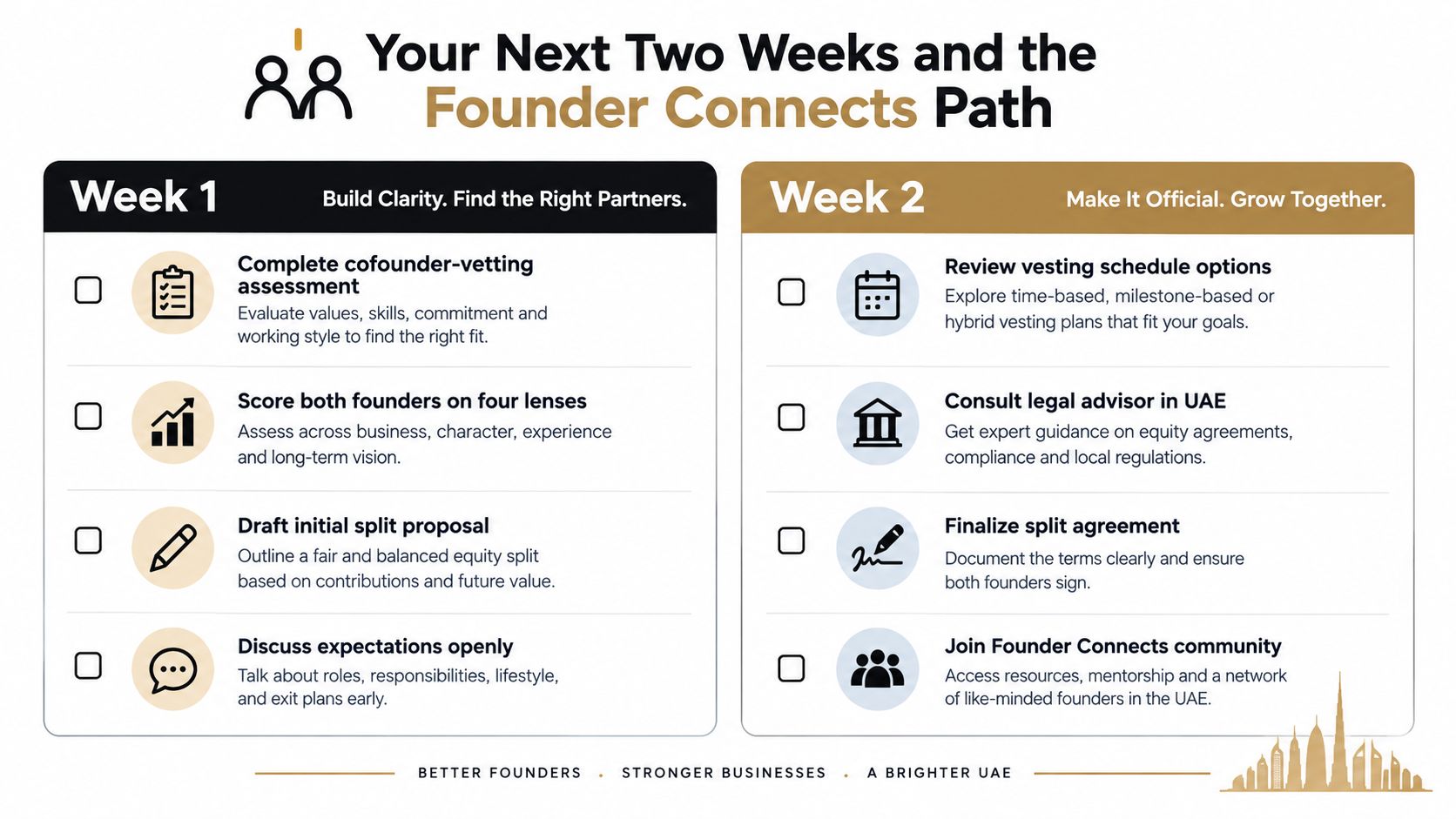
Your next fourteen days
In week one, run the four-lens worksheet with your cofounder, then turn the answers into a split proposal. In week two, take that proposal to a UAE-qualified lawyer, line it up with the vesting checklist, and make sure the Articles of Association, transfer clause, and cap table all agree.
If you want a founder room to pressure-test the decision, bring the signed summary to the next Founder Connects Meetup or apply for the six-month Residency. It gives you a place to compare views with other founders before the relationship hardens into a legal problem.
By the end of this week, decide three things in writing, whether the split is equal or unequal, whether vesting is in place, and who is instructing counsel. By the end of the next two weeks, your founders' agreement should no longer be a conversation, it should be a draft.

Building in MENA? You don't have to do it alone.
Join 300+ founders in the Founder Connects Residency. Monthly squad calls, warm intros, $3M+ in perks, and much more. All for less than your monthly coffee budget.
Popular posts





Founder Connects is a premium MENA tech founder community. Meetups in Dubai and across MENA, Residency Squads of 8–10, and 400+ vetted WhatsApp founders (apply and screened).