

Cofounder Match FAQ for UAE and MENA Founders

Building in MENA? You don't have to do it alone.
Join 300+ founders in the Founder Connects Residency. Monthly squad calls, warm intros, $3M+ in perks, and much more. All for less than your monthly coffee budget.

Do you need a cofounder, or are you trying to solve a validation, capability, or confidence problem with equity? That question matters more in the UAE and MENA than a simple search for someone who shares your enthusiasm. A promising conversation is only the beginning. A durable partnership needs compatibility, structural fit, and evidence that you can work together under pressure.
What This Cofounder Match FAQ Covers
This cofounder match FAQ answers eight questions founders commonly face before committing to a partner:
- Why does cofounder fit matter in the UAE?
- Do you need a cofounder?
- What should you screen before taking a meeting seriously?
- How should you use Founder Connects Meetups?
- How should you handle equity, vesting, and decision rights?
- What must you agree about time, cash, and communication?
- How do Membership and Residency Squads fit into the process?
- What should MENA tech founders check before committing?
Treat the process as three gates, not one introduction.
Gate one is compatibility
Check whether your skills, ambitions, availability, working styles, and risk tolerance fit the company you want to build. Shared interest isn't enough. A technical founder and a commercial founder may complement each other, but only if both understand who owns product, sales, fundraising, operations, and customer relationships.
Gate two is legal fit
Write down equity, responsibilities, intellectual-property ownership, authority, exit rights, and deadlock procedures before meaningful assets are created. A friendly conversation can't protect either founder when expectations diverge.
Gate three is a working trial
Run a defined project with clear deliverables before incorporating or dividing ownership. Customer discovery, a sales sprint, or a small product test will reveal more than several informal coffees.
A Meetup is a place to learn, compare notes, and meet other builders. A match is a tested working relationship with documented expectations. Read the dedicated guide to vetting a cofounder and the UAE and MENA cofounder-match guide when you need the deeper checklist. Use this FAQ for fast decisions and immediate next actions.
Why Cofounder Fit Matters in the UAE Right Now
The UAE isn't a niche environment for entrepreneurship. Official UAE Ministry of Economy figures reported in 2024 state that SMEs represented 95% of companies operating in UAE markets, employed 86% of the private-sector workforce, and contributed 63.5% of national GDP. The same source reported more than 50 government and private incubators and accelerators, while the UAE ranked first globally in the Global Entrepreneurship Monitor 2023/2024 assessment and was classified as the world's best place to set up and operate a new business. The UAE Ministry of Economy outlines these ecosystem figures.
That scale changes the cofounder question. You aren't just choosing someone to brainstorm with. You're choosing someone who may share responsibility for an operating company, employees, licences, customers, capital, and regulatory obligations.
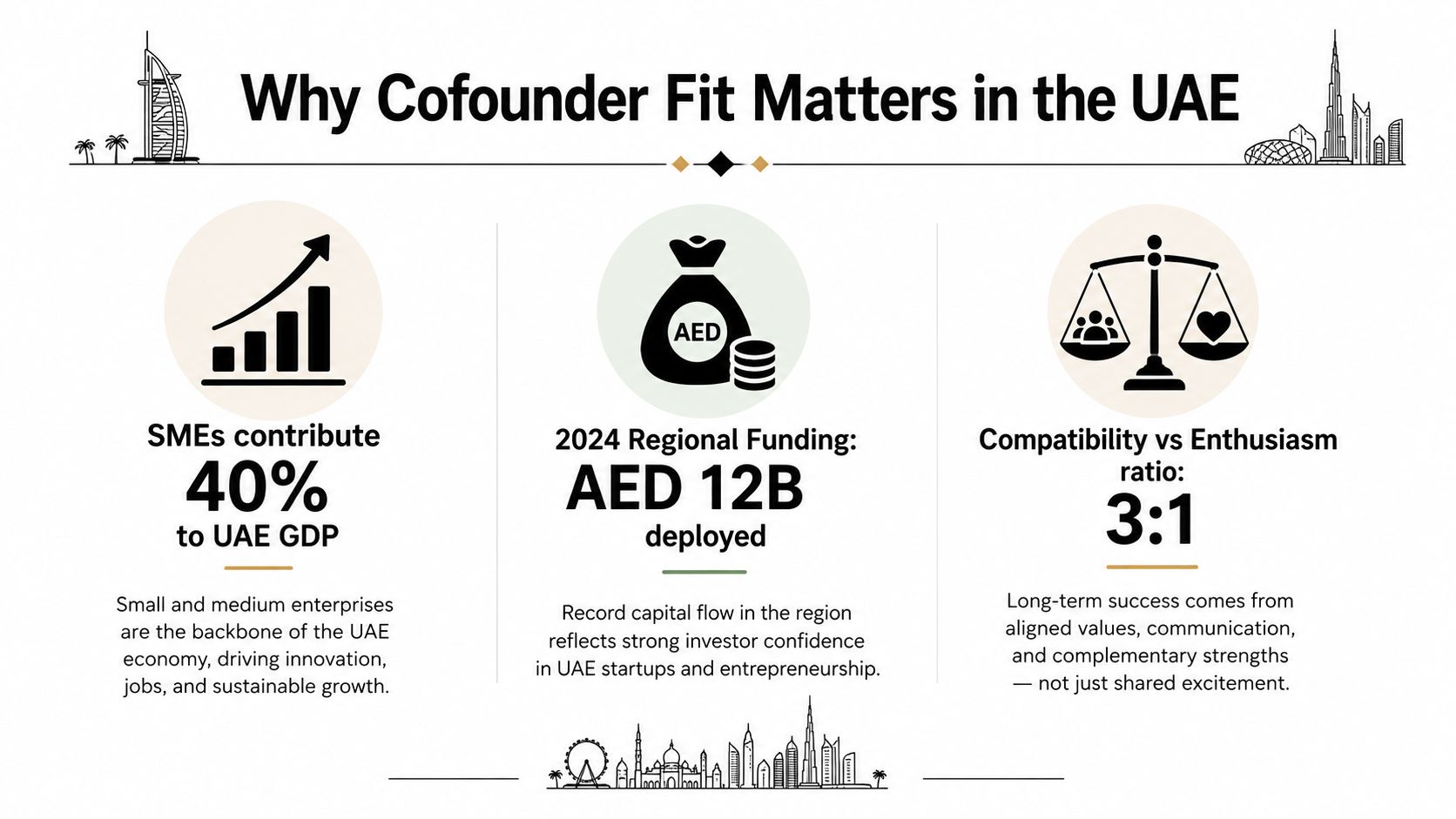
The regional funding picture makes discipline even more important. In 2024, MENA startups recorded 610 investment deals, a 3.5% increase from the prior year, while total investment fell 42% year over year to $2.3 billion when debt financing was included. The UAE led the region with approximately $1.1 billion across 207 deals. Wamda's 2024 MENA investment review provides the regional breakdown.
What the figures mean for your partnership
| Indicator | 2024 figure | What it means for a cofounder match |
|---|---|---|
| UAE companies that are SMEs | 95% | Build for operating reality, not only the pitch |
| UAE private-sector workforce employed by SMEs | 86% | Clarify who manages people and delivery |
| SME contribution to UAE GDP | 63.5% | Treat the partnership as an operating relationship |
| MENA investment deals | 610 | Investor access exists, but founders still need readiness |
| MENA investment including debt | $2.3 billion, down 42% year over year | Agree on fundraising, dilution, and financial risk early |
| UAE startup funding | Approximately $1.1 billion across 207 deals | Complementary UAE-market and execution capabilities matter |
The practical conclusion is direct: don't match on enthusiasm alone. Match on decision rights, local-market access, technical and commercial capability, time commitment, fundraising ownership, and tolerance for risk. A founder who can build the product may need a partner who can sell into regulated or enterprise markets. A founder with customer access may need someone who can turn repeated demand into a reliable product.
Practical rule: If you can't explain why this person is necessary for execution, you aren't ready to discuss equity.
Do You Need a Cofounder
Do you need a cofounder, or are you trying to solve stress, speed, or loneliness with equity?
Treat cofounder matching as a staged protocol, not a single introduction. Start with the structural question. Does the company need sustained complementary execution that must sit inside the business every week, with shared legal responsibility and real decision rights? If not, do not add a cofounder.
A landing page, prototype, financial model, or warm customer access can often be bought, contracted, or covered by a tightly defined advisory role. Those are gaps. They are not always founder-level gaps. In the UAE, founders get into trouble when they confuse immediate help with permanent ownership.
That matters even more in a tougher funding environment. A 2025 MENA early-stage report summary noted that only about one in five startups met VC criteria and highlighted a stalled Series A stage. If your business is still unproven, adding a cofounder too early can create governance and equity problems without improving your fundraising case. The MENA early-stage report summary is available through this source.
Use the lowest-risk option that solves the gap
- Fractional technical leadership: Use this when you need architecture, vendor selection, or product oversight before a full-time technical partner is justified.
- Specialist contractors: Use them for a defined build, design, compliance, or research deliverable with a clear acceptance standard.
- Advisors with scoped mandates: Bring in introductions, regulatory perspective, or fundraising prep, then put written boundaries around the role.
- Peer accountability: Use founder communities and Meetups for challenge, reflection, and practical feedback without giving up ownership.
- Short project collaborators: Test a potential partnership through customer interviews, a prototype sprint, or a sales experiment before discussing equity.
If you are weighing routes to a technical partner, startup cofounder matching with Refact is useful because it pushes you to define the technical need before you start searching.
A cofounder is justified when the missing capability is central to the company, must be owned continuously, and cannot be outsourced without hurting speed, trust, or strategic control. Cultural fit matters, but structural fit matters more. The person must match your working cadence, risk tolerance, and willingness to share authority under pressure. Do not recruit a partner to avoid customer conversations.
Before you approach anyone, answer five basics in writing. The one-page founder brief later in this guide expands them: venture stage, customer evidence, the capability needed every week, available cash runway, and each person's weekly commitment. If those answers are vague, keep validating. If they are concrete and the gap is permanent, start a staged search.
Screening Criteria and Founder Vetting
What are you screening for: chemistry, or a partner who can build with you under pressure? Treat cofounder matching as a staged protocol. Start with compatibility, then test structural fit, then clear the legal and cultural gates that decide whether the partnership can hold.
A useful screening rubric should record what each founder can contribute, what they expect, and what they will not accept. That sounds basic. It prevents the usual mistake, strong rapport hiding weak operating fit.
FoundersBase reports that approximately 40% of listed UAE founders have technical backgrounds in engineering or technology, while 60% bring business-oriented expertise such as product, marketing, or operations. The same platform reports a median founder age of 28.5 and an average age of 33. Treat these figures as indicative platform data, not a census of UAE founders. The UAE founder-platform data is published by FoundersBase.
Before the first serious conversation, capture the same fields every time:
- Capability: Technical, product, sales, marketing, finance, operations, regulatory, or sector expertise.
- Venture stage: Idea, customer discovery, prototype, early revenue, or scaling.
- Availability: Weekly hours now, and the expected commitment after funding or incorporation.
- Location: Emirate, country, travel needs, and preferred working mode.
- Fundraising expectations: Bootstrap, angel, venture capital, strategic finance, or no external capital.
- Startup experience: What the founder built, shipped, sold, managed, or learned from.
- Trial willingness: Whether the person accepts a defined collaboration before equity is finalised.

Bring a one-page founder profile to your first peer session. State the problem, current evidence, missing capability, expected commitment, and the decision you need help making. Specificity gets useful challenge. Vagueness gets polite encouragement.
Then screen for behaviour, not just credentials. Ask how the person handled a missed deadline, a difficult customer, a failed experiment, or conflict with a colleague. Good hiring practices that help you hire without bias or guesswork apply here too, because rapport easily distorts judgement.
After that first conversation, run a proper cofounder vetting checklist. Your job is to decide whether the next test is earned, and whether this person fits the company you are building.
How Founder Connects Meetups Work
How do you use a founder meetup without treating it like speed dating for equity? Use it as a staged filter. Founder Connects runs moderated sessions and Pitch Night Meetups across Dubai, Abu Dhabi, Nairobi, Beirut, and Cairo, and the value comes from how people think, communicate, and respond under pressure, not from a single introduction.
Show up with a testable ask. Say what you are building, where it stands, and what gap you need to examine.
“I'm validating a B2B product for UAE retailers. I need to test whether my current technical and commercial roles are realistic before I discuss equity.”
That framing does two jobs. It gets sharper feedback from the room, and it helps you spot structural fit early. Watch who asks practical questions, who understands execution, and who jumps straight to titles and ownership before the work is clear.
Prepare, participate, follow up
- Prepare one sentence: State the customer, problem, stage, and missing capability.
- Listen for operating detail: Ask how others handled similar decisions. Do not chase introductions first.
- Record observations: Note communication style, follow-through, and whether the person challenges assumptions without creating friction.
- Follow up directly: Send a short message, propose one defined conversation, and set the next action yourselves.
Treat each meetup as the first gate, not the decision point. Cultural fit matters. Legal fit matters. Working rhythm matters more than chemistry in one room.
Founder Connects leaves attendee selection and relationship testing to founders themselves. That is the right model. You should decide who earns a second conversation, then test the relationship in steps. If you want the format difference explained clearly, read The Playbook and Pitch Night. Event discovery is also available on the Founder Connects Luma page. Booking details are consolidated in the membership section below.
Equity, Vesting, and Decision Rights
Equity should reflect expected contribution, risk, responsibility, and duration. It shouldn't be a reward for having the first idea or for being the most persuasive person in the room.
UAE-focused guidance commonly describes reverse vesting as issuing shares upfront while keeping unvested shares subject to contractual repurchase if a founder leaves before completing the agreed contribution period. A commonly cited structure is four years with a 12-month cliff. Under that structure, no equity vests during the first year, 25% vests at month 12, and the remaining 75% vests monthly over the following 36 months. Founder Connects explains common UAE founders' agreement gaps.
The key question is uncomfortable but necessary:
“If either of us leaves after six months, what should happen to the unearned equity?”
Record the answer, including good-leaver and bad-leaver treatment, valuation, and the process for repurchasing unvested shares. Without an enforceable mechanism, a departing founder may retain the full shareholding unless the remaining shareholders agree to buy it back.
Separate ordinary decisions from reserved matters
| Decision type | Who can approve | Examples |
|---|---|---|
| Ordinary decisions | The responsible founder, within an agreed budget | Product priorities, routine supplier choices, customer follow-up, approved hiring |
| Reserved matters | Both founders, or a defined voting threshold | Issuing shares, significant borrowing, changing business activity, selling material IP |
| Strategic changes | Both founders after documented review | Major pivot, acquisition offer, new market entry, material change in the operating model |
| Deadlock decisions | A defined escalation process | Mediation, independent adviser, buyout route, or another agreed resolution mechanism |
Put decision thresholds in writing. A responsible founder needs authority to move quickly inside an agreed area, while both founders need protection against actions that change ownership, debt, intellectual property, or the company's direction. UAE shareholder-agreement guidance identifies voting rights, transfer restrictions, dispute resolution, and exit provisions as core mechanics. DIAC's UAE shareholder-agreement guidance provides useful context.
A founders' agreement operates alongside the Memorandum of Association and Articles of Association, not in place of them. If the private agreement conflicts with registered constitutional documents, the MoA takes priority. Check the structure, activity, ownership plan, and licensing authority with a UAE-qualified lawyer before committing funds or IP.
For founders thinking about future conflict handling, this resource on 2026 partnership dispute resolution offers a useful comparison point, but it isn't a substitute for UAE legal advice.
Time, Cash, and Communication Expectations
Most cofounder disputes start as unspoken assumptions. One founder imagines full-time execution. The other imagines evenings and weekends. One expects equal cash contributions. The other expects equity to compensate for expertise.
Resolve those differences before the company owns anything valuable.
Send a one-page founder brief
Ask each prospective cofounder to answer these questions independently:
- What weekly time commitment can you make now?
- When will that commitment change?
- What cash will you contribute, and when?
- What salary do you expect, and under what conditions?
- Which responsibilities do you own?
- Which decisions can you make without approval?
- What happens if family, visa, employment, or health circumstances change?
- How will you raise disagreement?
- What does leaving look like?
Discuss three UAE and MENA realities directly:
- Visa constraints: Can either founder legally work in the intended structure and location?
- Family obligations: What periods or responsibilities could affect availability?
- Local-market access: Who owns relationships with customers, regulators, suppliers, and strategic partners?
Don't treat these as personal intrusions. They are operating variables. A respectful conversation now is safer than a crisis after incorporation.
Use the trial project as the final filter. Run a time-boxed customer-discovery sprint with explicit interview targets, written findings, and a decision at the end. Agree the separation process before starting, including what happens to work product, customer data, accounts, and confidential information if the partnership stops.
If you can't discuss these subjects calmly, you can't share a company.
Membership, Residency Squads, and Booking
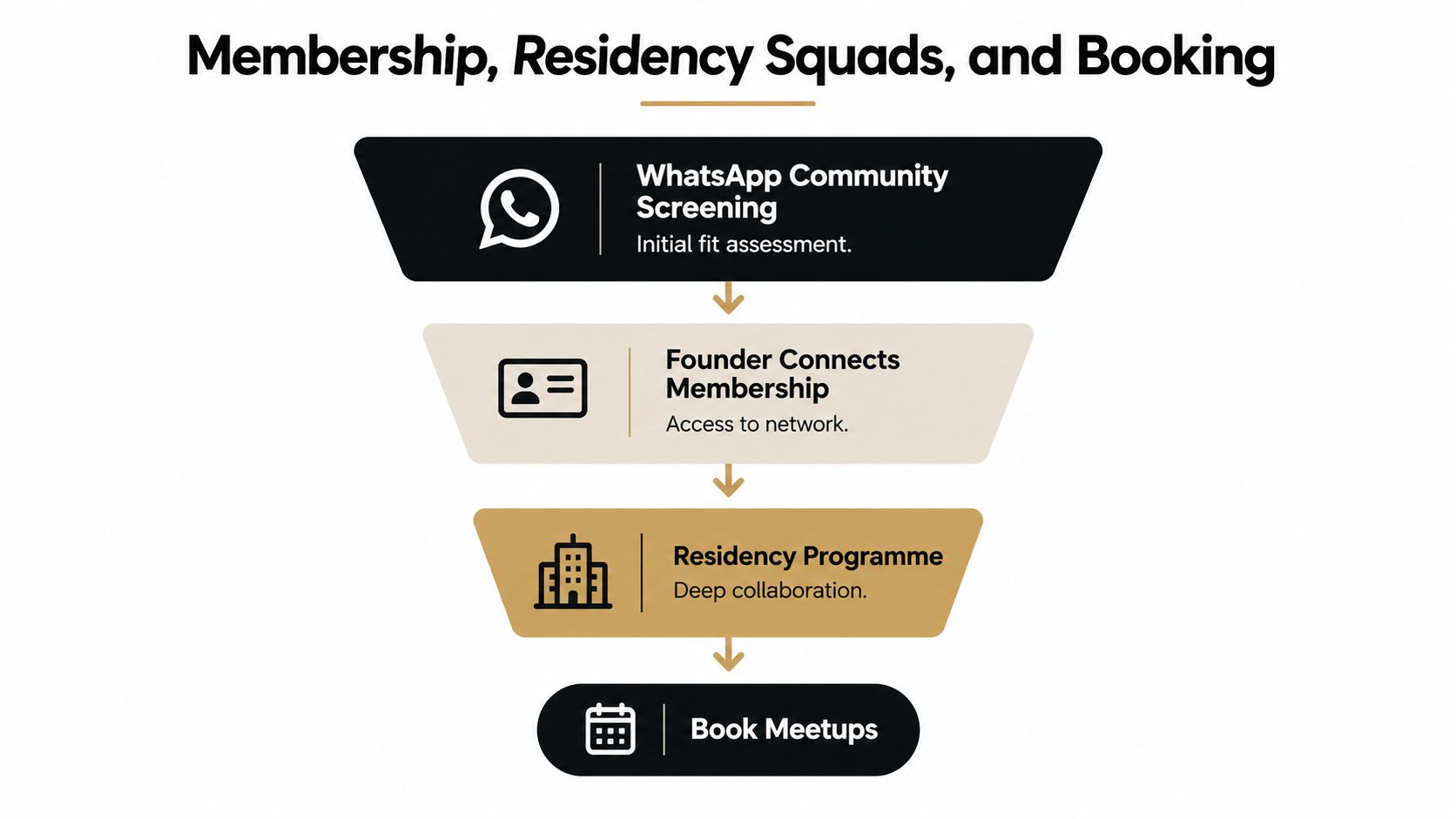
How should you use Founder Connects if you are serious about finding a cofounder? Treat it as a staged protocol, not a matchmaking shortcut. Start with screened participation. Move into smaller working groups only if the fit justifies it. Then book conversations with a clear objective.
Founder Connects offers more than one level of involvement. The wider community gives you access to vetted founder conversations and recurring interaction. The Residency goes further. It places founders into Squads, a smaller group format designed for accountability, repeated exposure, and sharper pattern recognition. That matters because compatibility is not enough on its own. You also need structural fit, including pace, role clarity, and the way each person shows up over time.
Choose the level that matches your need
- WhatsApp community: Apply, complete screening, and join a vetted founder environment.
- Membership: Get broader access to the network, practical support, and founder conversations.
- Residency Squads: Join a smaller group built for accountability and repeated interaction.
- Meetups: Attend moderated sessions, including Pitch Night Meetups, and build real relationships through direct participation.
Use each layer for a different job. Meetups are for first contact. Membership helps you build repetition and context. Squads are where you test cultural fit under structure. If you want a clearer sense of why that smaller-group format works, read Founder Connects on peer groups for bootstrapped founders.
Do not expect Founder Connects to choose a cofounder for you. Your job is still to screen, follow up, and run a defined working trial. Current cohort and pricing details are listed on the booking page. Book a Meetup through the official Founder Connects Meetups page.
Troubleshooting, Next Steps, and a MENA-Specific Question
Run three scenarios with any serious prospective cofounder:
- The pivot: One founder wants to change the product or customer.
- The financing decision: One founder wants to raise money on terms the other dislikes.
- The contribution problem: One founder stops contributing for a sustained period.
Write down who decides, what consultation is required, and what happens if agreement fails. Then exchange your one-page founder briefs and compare time, cash, authority, family obligations, visa constraints, and exit expectations.
What should MENA tech founders check before committing to a cofounder?
Founder Connects recommends checking complementary capability, weekly commitment, decision rights, risk tolerance, local-market responsibilities, and legal fit before discussing final equity. The next action is to bring those answers to a Founder Connects Meetup, then run a defined working trial before incorporation.
Your readiness checklist is short:
- The capability gap is real and continuous.
- Both founders agree on weekly availability.
- Cash, salary, runway, and fundraising expectations are written.
- Equity has vesting and an exit mechanism.
- Ordinary and reserved decisions are separated.
- Deadlock resolution is defined.
- Intellectual property belongs to the correct entity.
- A UAE-qualified lawyer has reviewed the structure.
- The trial project has deliverables and a separation process.
Put one action in your calendar this week: send a prospective cofounder the one-page brief and schedule the conversation where you compare answers.
Founder Connects gives UAE and MENA founders access to moderated Meetups, peer learning, and structured founder communities where working assumptions can be tested before equity is committed. Visit Founder Connects to book a Meetup, apply to the community, or explore a Residency pathway that fits your stage.

Building in MENA? You don't have to do it alone.
Join 300+ founders in the Founder Connects Residency. Monthly squad calls, warm intros, $3M+ in perks, and much more. All for less than your monthly coffee budget.
Popular posts





Founder Connects is a premium MENA tech founder community. Meetups in Dubai and across MENA, Residency Squads of 8–10, and 400+ vetted WhatsApp founders (apply and screened).