

Creating an App in the UAE a Founder's Playbook

Building in MENA? You don't have to do it alone.
Join 300+ founders in the Founder Connects Residency. Monthly squad calls, warm intros, $3M+ in perks, and much more. All for less than your monthly coffee budget.

You've got the idea. It came from a pain point you've seen first-hand. Maybe it's a logistics gap, a messy internal workflow, a niche consumer behaviour in Dubai, Abu Dhabi, Riyadh, or Cairo that nobody has solved properly. The problem isn't inspiration. The problem is that once you decide to start creating an app, the advice gets vague very quickly.
You'll hear “build an MVP”, “hire a good team”, “move fast”, “validate demand”. None of that is wrong. It's just incomplete. In the UAE, the decisions that matter most are usually financial and operational. How much custom build can you afford? How quickly do you need to launch? Which parts should stay lean, and which parts need proper engineering from day one?
Founders lose months by asking the wrong early question. They ask, “How do I build this app?” The better question is, “What is the cheapest reliable path to proving this should exist?”
Your App Idea Is Just the Beginning
A founder sits in a café in Downtown Dubai with a strong idea and a weak plan. That's a common starting point. The pain is real, the market sounds promising, and the excitement pushes people straight into logo design, Figma screens, and developer quotes.
That's where money starts leaking.
Most bad app projects don't fail because the idea was terrible. They fail because the founder moved from concept to build without a disciplined sequence. If you skip discovery, your first version becomes an expensive guessing exercise. If you skip prioritisation, your MVP becomes a bloated wishlist. If you skip process, the team builds fast in the wrong direction.
A better way is to think in stages. If you need a simple reference point, this breakdown of product development lifecycle stages is useful because it frames app creation as a progression from discovery to iteration, not a single build event.
What founders usually get wrong
Three mistakes show up again and again in early UAE startup teams:
- They overbuild the first release. Instead of solving one sharp problem, they try to launch payments, chat, loyalty, analytics, admin controls, and multilingual support all at once.
- They treat developers like strategists. A good engineering team can build well, but they can't decide your market positioning for you.
- They assume launch equals traction. It doesn't. The App Store is full of polished products with no real usage.
Practical rule: If you can't explain the first version of your app in one sentence, it's too broad.
The shift that saves time
Start acting like capital is constrained, even if you've raised money. That mindset forces sharper decisions. It also helps when you speak to agencies, freelancers, or technical co-founders because you'll scope around outcomes, not around random features.
For founders in MENA, that discipline matters even more. Markets move quickly, customer expectations are high, and a slow, expensive build can put you in a difficult position before you've learned anything useful.
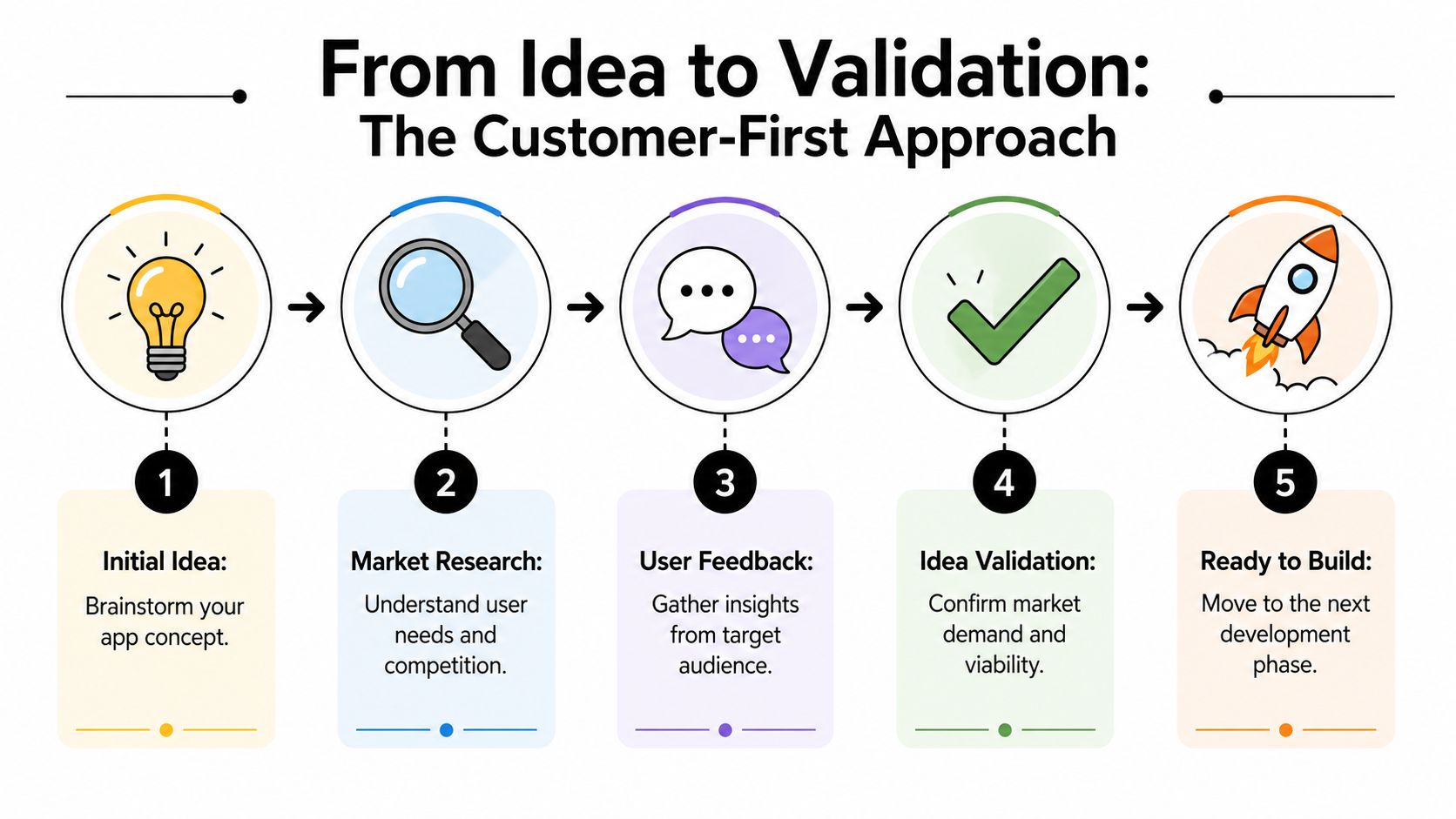
From Idea to Validation The Customer-First Approach
Most founders don't need code first. They need evidence first.
If you're creating an app for the UAE market, assumptions get expensive fast because user habits, pricing tolerance, language preferences, and trust signals vary by segment. What works for a young consumer audience in Dubai may not work for SME operators in Sharjah or cross-border users elsewhere in MENA.
Start with a narrow problem
Validation works best when the problem is specific. “An app for wellness” is too broad. “An app that helps busy parents in Dubai book vetted Arabic-speaking speech therapists” is testable.
Before anything else, write down:
- Who has the problem
- What they do today instead
- Why current options feel broken
- What result they want
- Why mobile is the right format
If your target customer still feels fuzzy, use a sharper customer-definition exercise like this guide on defining target customers in the UAE.
Use a simple three-part validation loop
Here's the fastest practical loop I've seen work.
Talk to real users
Speak to people who match your target profile, not supportive friends. Ask about the last time they faced the problem. Ask what workaround they used. Ask what they paid, delayed, ignored, or stitched together manually.
Don't pitch too early. If you lead with your solution, people will often be polite instead of honest.
A few good interview prompts:
- Last behaviour: “When did this problem last happen?”
- Current workaround: “What do you use now?”
- Pain level: “What part is the most frustrating?”
- Buying signal: “Have you already paid for something to solve it?”
- Urgency: “If nothing changes, what happens?”
If you want a solid discovery lens before those interviews, this breakdown on how to validate your product ideas is a useful complement.
Test interest before building
Set up a basic landing page in Webflow, Framer, or Carrd. Describe the problem, the promise, and the next step. Then send people to a waitlist, demo request, or early-access form.
You can test demand through:
- Founder and operator communities where your audience already spends time
- Targeted social ads with one message per use case
- Outbound messages to a handpicked list of likely users
- Manual concierge offers where you deliver the service without full software
What matters isn't vanity traffic. What matters is whether the right people care enough to act.
Validate usability and inclusion early
A lot of founders treat accessibility as a late-stage clean-up task. That's a mistake. A large-scale analysis highlighted by UW Create found that 23% of analysed apps failed to provide basic accessibility metadata such as content descriptions (UW Create's summary of mobile app accessibility findings).
That matters because accessibility issues usually overlap with general product quality problems. If text contrast is weak, focus order is messy, or tap targets are awkward, your app is harder for everyone to use.
Build the first flow so a tired user on a small screen can still finish it without friction. That standard catches more problems than most design reviews.
What a real validation outcome looks like
A good validation outcome isn't “people liked the idea”. It's more concrete:
- Users described the same pain in similar language
- They already use clumsy alternatives
- Some were willing to join a waitlist, pilot, or pay early
- You learned which feature matters first and which ones can wait
That's enough to move into MVP definition with far more confidence.
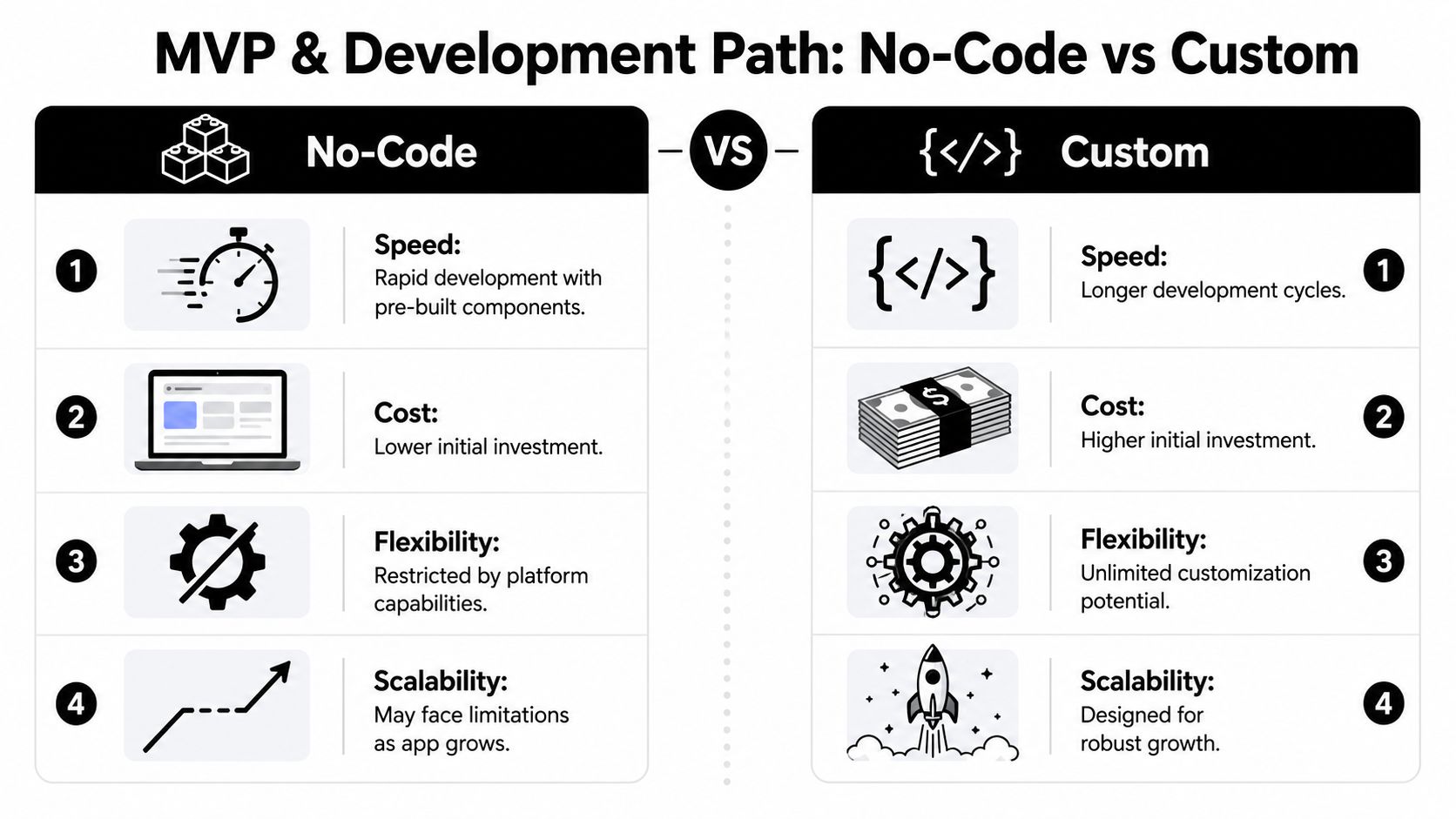
Shape Your MVP and Pick Your Path No-Code vs Custom
A founder in Dubai gets encouraging interview feedback, then makes the same expensive mistake I see every month. The scope triples before the first release. Arabic support gets pushed in late, extra user roles appear, dashboards multiply, and the budget starts behaving like a Series A company showed up, even though the product still has not proved one repeatable use case.
The MVP stage is where UAE founders either protect cash or burn it.
Your first release needs to do one job well enough that a specific user returns without being chased. If you are still tightening how you define scope and release logic, this guide to startup product development is a useful reference before you sign any build contract.
Define the MVP around cost of learning
An MVP is the smallest product that can answer a commercial question. Will users in your target segment adopt this behaviour, complete the core flow, and come back?
For a UAE launch, that usually means being stricter than founders expect. If your first customer is a clinic, logistics operator, property team, or SME, version one often needs only:
- One clear user type
- One outcome the user can complete fast
- A short onboarding flow
- Basic admin controls so your team can operate the service
- Arabic and English support only if the target segment needs both at launch
Everything else has to earn its place. Referral systems, layered permissions, analytics suites, loyalty features, and complex back-office tools can wait unless the business model breaks without them.
That discipline matters more in the UAE because the cost of getting version one wrong is not just developer spend. It is also founder time, visa-linked payroll commitments if you hire too early, and delayed market entry in a market where trust and responsiveness carry real weight.
No-code versus custom in the UAE
The choice is not about what looks more serious. It is about what kind of risk you are buying.
Clutch's UAE market data shows broad pricing bands for app development projects in the region, with simpler builds starting far lower than complex enterprise work and senior development rates reflecting the premium local talent market. Their UAE listings also show the common billing structure agencies use when pricing mobile and web work in this market: UAE app development companies and hourly rate benchmarks on Clutch.
That range is wide for a reason. A booking app for a single service category is one thing. A regulated fintech product with custom workflows, payment logic, KYC handling, admin controls, and audit requirements is another.
A practical comparison
| Path | Best when | Main strength | Main limitation |
|---|---|---|---|
| No-code or low-code | You need to test demand quickly, keep upfront spend contained, and adjust the workflow every week | Faster launch and lower initial commitment | Limits appear once integrations, performance, or custom logic become central |
| Custom build | Your product depends on unique business rules, deeper integrations, stronger control, or technical defensibility | Better long-term ownership and architecture choices | Higher upfront cost, longer delivery time, and more room for expensive mistakes if scope is still fuzzy |
How founders in MENA should make the call
No-code is often the right first move when the core uncertainty is user behaviour. That is common in marketplaces, internal workflow tools, simple booking products, and service businesses trying to digitise operations before investing heavily. If you still change the core flow after every customer call, paying for a full custom build is usually premature.
Custom is the right move when the product's value sits inside the logic itself. That includes products with pricing engines, route optimisation, embedded payments, compliance workflows, custom reporting, or integrations with ERP, CRM, or government-related systems. In those cases, patching together tools can create more cost than it saves.
There is also a middle route, and it is often the smartest one. Launch the customer-facing flow with low-code tools or a lean frontend. Put the backend, data model, and security choices on firmer ground from day one. That gives you a fast pilot without trapping the business inside a fragile stack.
I prefer founders to frame this as a finance decision, not a technology identity. Spend lightly where you are still learning. Spend properly where rework will be painful.
If you are exploring ways to speed delivery without confusing speed with product clarity, this article on optimizing web app development with AI is a useful read.
Decision filter: Pay for custom build now only if it gets you one of three things quickly: faster learning, stronger margins, or defensibility you cannot create later.
Assembling Your A-Team Agency vs In-House Talent
The team question is usually framed badly. Founders ask whether agencies are good or bad, or whether in-house is the “serious” option. Neither framing helps.
The right choice depends on your stage, your cash position, and how much product ambiguity is still on the table.

When an agency makes sense
A good agency gives you immediate coverage. You don't need to separately find a designer, mobile developer, backend engineer, QA lead, and project manager. For a founder who needs execution quickly, that matters.
An agency is often the right move when:
- You need speed now and can't spend months recruiting
- Your app scope is clear enough to hand over in structured phases
- You want one contract instead of several freelancers
- You need delivery discipline more than technical culture-building
The downside is control. Some agencies are strong in delivery and weak in product thinking. Others impress in sales meetings and disappear into junior execution once the contract is signed.
Ask direct questions before signing:
- Who exactly will work on the project?
- How often will we review working product?
- How do you handle change requests?
- Who owns the codebase, design files, and infrastructure access?
- What happens after launch?
When in-house is the stronger bet
In-house is the right call when product iteration is constant and the app sits at the centre of the company. If every week changes priorities, internal communication matters more than vendor management.
In-house tends to work better when:
- The product is your core business, not an add-on
- You need constant prioritisation decisions
- The roadmap depends on deep domain context
- You're building for the long term and can absorb hiring effort
The challenge in the UAE isn't just cost. It's attention. Hiring technical talent well takes founder time, and poor early hires create drag that's hard to undo.
The model that often works best
A lot of strong founders start with an external build partner, keep product ownership tightly in-house, and then bring critical roles inside once the app shows traction. That sequence reduces early hiring pressure without giving away core product judgment.
If the founder can't write the problem statement, success metrics, and first release scope clearly, no team structure will save the build.
Whatever model you choose, keep one principle fixed. Strategy must stay with the company. You can outsource development capacity. You can't outsource founder clarity.
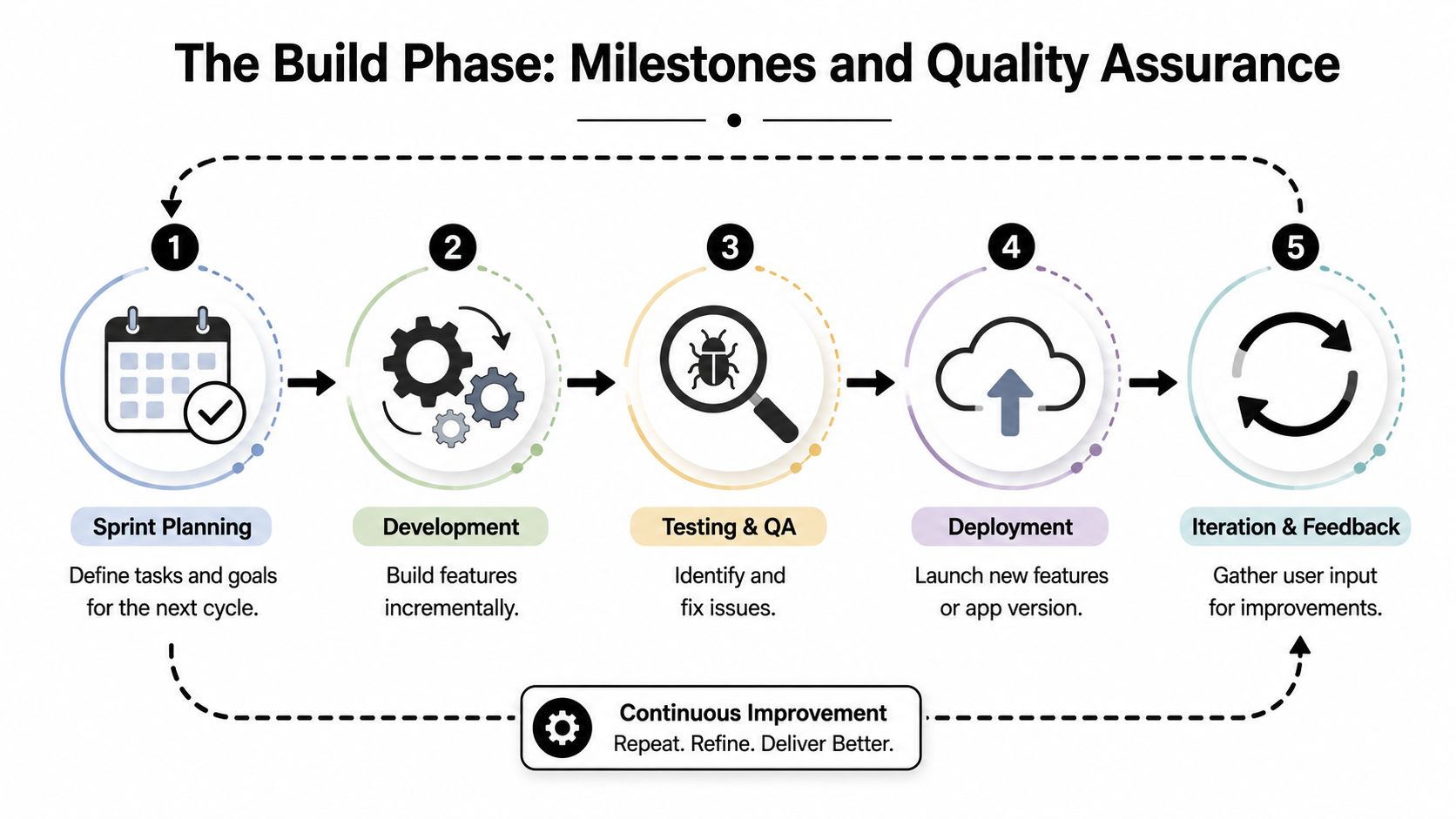
The Build Phase Milestones and Quality Assurance
A lot of UAE founders lose control of budget here. Week after week, the team looks busy, features keep getting marked as done, and then user testing exposes basic flow problems that should have surfaced in week two. By that point, you are paying twice. Once to build the wrong thing, and again to rework it.
That is why the build phase needs hard checkpoints, not just progress updates.
For early-stage apps, short sprint cycles usually outperform long fixed plans because they expose mistakes sooner. The 17th State of Agile Report found that the top reasons companies use Agile are to manage changing priorities, accelerate delivery, and improve alignment between business and engineering (State of Agile Report summary). In the UAE, where founders often balance investor pressure, partnership deadlines, and shifting customer feedback at the same time, that flexibility has direct financial value.
What a sensible build rhythm looks like
Agile works only if the team ships working product regularly and the founder reviews it against business goals. Standups and sprint boards do not matter much on their own.
A practical rhythm looks like this:
- Set a two-week sprint with a small number of outcomes tied to user behaviour or operational needs
- Write acceptance criteria before development starts so design, product, and engineering are judging the same thing
- Review working software at the end of each sprint on actual devices, not only in Figma or staging screenshots
- Test the core flow before adding edge features such as referral logic, advanced filters, or loyalty layers
- Reprioritise based on evidence from bugs, user sessions, and cost of delay
In Gulf startups, this matters more than many generic guides admit. Approval chains can be slower, bilingual content adds review cycles, and payment, mapping, or identity features often depend on local vendors. If the process does not force decisions early, delay gets expensive fast.
Build around milestones that reduce risk
Milestones should answer business questions. They should not exist only to make the timeline look organised.
Milestone one is product flow confidence
Start with wireframes and a tappable prototype to test whether users understand the path from opening the app to completing the main action. For a marketplace, that may be search to checkout. For a healthtech app in the UAE, it may be onboarding to booking to payment, with Arabic and English flows reviewed early.
This stage is cheap compared with engineering. Use it properly.
Milestone two is a narrow alpha
The alpha should prove that the core workflow works end to end with real logic behind it. User signup, permissions, payments, notifications, admin actions, and reporting need to function in one thin slice. A founder does not need every feature here. A founder needs proof that the engine runs.
Milestone three is a controlled beta
Run beta with a small group that matches the actual market you want. If you are building for Dubai residents, test with Dubai residents. If your app depends on delivery zones, WhatsApp support, COD behaviour, or Arabic-speaking parents, test those realities directly. Broad exposure too early often creates noise instead of useful learning.
QA needs its own budget and owner
Testing cannot be left for the final week. In practice, that is how teams end up launching with broken onboarding, duplicate push notifications, failed payment callbacks, or admin panels that work only for the developer who built them.
A disciplined QA stack usually includes:
- Unit tests for business logic that should never break unnoticed
- Integration tests for services such as payment gateways, OTP, CRM sync, and analytics
- System testing across the full user journey on iOS, Android, and web admin if relevant
- User acceptance testing based on real scenarios, not ideal paths
- Security testing before any serious public release, especially if the app handles health, finance, identity, or location data
- Regression testing so fixes in one sprint do not create new bugs in another
This is also where local context matters. UAE users have high expectations for app quality, and enterprise buyers are even less forgiving. If your product touches regulated data, the cost of weak QA is not just poor reviews. It can become a compliance problem.
GitLab's Global DevSecOps Report found widespread AI use in software teams, but it also showed clear concern around accuracy, security, and trust in AI-generated output (GitLab Global DevSecOps Report). AI can help produce test cases, speed up debugging, and reduce repetitive work. It still needs human review, especially for payment logic, permission handling, and anything tied to privacy or regulated workflows.
Ship a smaller release with tighter QA. In the UAE market, founders recover more easily from missing features than from a buggy first impression.
Launch and Grow Your User Base in the UAE
You release on Thursday, switch on paid traffic on Sunday, and by Tuesday the numbers look busy but unhealthy. Installs come in, support tickets start rising, and retention is weak. In the UAE, that pattern gets expensive fast because acquisition costs are not the main problem. Wasted acquisition is.
Mobile usage is high across the region, but founders should use sourced benchmarks carefully. DataReportal's UAE profile shows a mobile-first audience with heavy internet and social usage, which is why launch execution matters so much in this market (DataReportal UAE digital report). Sensor Tower has also reported that consumers spend far more time in apps than on the mobile web globally, and that gap shapes how product teams should think about onboarding, retention, and monetisation (Sensor Tower mobile app usage research). For app revenue models, RevenueCat's subscription benchmark reports give a more grounded view of how subscription apps perform than generic claims about “most revenue” coming from one model (RevenueCat State of Subscription Apps). On product quality, Google's Android vitals guidance and store quality documentation make the practical point clearly. Stability issues, crashes, and poor responsiveness hurt conversion and retention, even before reviews start to drag down install intent (Google Play quality guidance).
That is the financial reality of launch. You are not only testing product-market fit. You are testing whether every dirham spent on traffic has a fair chance to convert into retained usage.
Prepare the launch before release day
A good UAE launch starts with controlled demand, not broad noise. Build a waitlist around a specific promise. Faster onboarding for clinics. Priority inventory access for collectors. Bilingual support for parents. The message needs to match one use case and one buyer group.
Bring back the people who already showed intent during validation. They are cheaper to reactivate than cold traffic, and their feedback is usually more useful than vanity metrics from a large campaign.
A few launch assets carry more weight than founders expect:
- An app store page with screenshots that explain the first value moment
- Arabic and English copy where the target segment expects both
- An onboarding support script for WhatsApp, email, or in-app chat
- A live feedback channel with clear ownership inside the team
- A simple dashboard tracking activation, week-one retention, and payment conversion
Get onboarding right before growth spend
I have seen founders in the UAE burn meaningful budget on Meta, TikTok, and influencer placements before fixing the first three minutes of the user journey. That decision usually shows up later as “poor channel quality” when the underlying problem sits inside the product.
The first session should answer three questions without effort:
| User question | Your app must answer it fast |
|---|---|
| What is this? | The value proposition in plain language |
| What do I do now? | One clear next action |
| Why should I return? | A visible payoff, repeat use case, or saved progress |
If you charge a subscription, earn the paywall. In the UAE market, users will pay for convenience, trust, and status, but they rarely tolerate being asked for money before the value is obvious. If you use freemium or transactional payments instead, make the billing logic easy to understand from the start. Confused pricing slows adoption and creates support load.
Growth in the UAE needs local relevance
Generic launch playbooks miss what drives adoption here. Trust matters. Response speed matters. Language clarity matters. Payment confidence matters.
The channels can be ordinary. The execution cannot.
What tends to work in the UAE and wider MENA market:
- Founder-led outreach to niche communities, industry groups, and early partner networks
- Landing pages built around one narrow problem, not five weak promises
- Clear Arabic and English UX for segments that expect bilingual communication
- Fast human support during the first few weeks after launch
- Small paid campaigns after activation and retention numbers are healthy
- Partnership-led distribution where trust transfers faster than ad performance
What usually wastes money:
- Large awareness campaigns before retention is proven
- Influencer spend without a clear conversion path
- Onboarding flows built for the team's assumptions instead of real user behaviour
- Billing options that ignore local preferences or create checkout friction
- Treating churn as a marketing problem when it is a product problem
For funded startups, launch planning should also match runway. If user acquisition is part of the investment case, model it accurately before you scale spend. CAC in the UAE can climb quickly in competitive categories, and that changes how much room you have for experimentation. Founders preparing for that stage should review these practical fundraising strategies for startups before they commit to an aggressive growth budget.
Early growth is a measurement exercise. Track who activates, who returns in week one, which segment converts, and which support issues repeat. Those signals matter more than a spike in installs. In this market, disciplined growth usually beats loud growth.
Beyond the Build Legal Monetisation and Funding
A founder in Dubai gets the app into users' hands, sees early traction, then encounters the critical questions. Which licence fits the business model. Can this payment setup support local buying behaviour. Will investors accept the cap table and governance as they are. This stage is where expensive mistakes start showing up.
In the UAE, post-launch decisions carry direct cost. A weak legal setup slows enterprise sales. A poor monetisation model hurts conversion and retention. Raising too early on a thin operating story often leads to a down round later, or months spent pitching instead of fixing the business.
Handle legal basics before they block growth
Legal work should match how the company plans to operate in the Gulf, not just what was fastest to set up at incorporation.
Three areas usually matter first:
- Data privacy and user consent. If the app collects personal data, location data, health data, or payment details, founders need clear consent flows, internal access rules, and documented handling practices.
- Terms, privacy notice, and refunds. These should reflect the actual product, billing logic, and support process in both Arabic and English where relevant.
- Company structure and licensing. The setup should support your sales model, banking, contracts, hiring plan, and future fundraising route.
This affects revenue, not just compliance. Larger UAE clients often ask legal and procurement questions earlier than first-time founders expect. Payment providers do too. Investors notice it as well.
Monetisation should match how customers in this market buy
A lot of founders copy SaaS pricing because it looks tidy in a pitch deck. That works for some products. It breaks for others.
Use the model that fits the buying behaviour:
- Subscription fits products with recurring use and clear ongoing value
- Freemium fits products with a believable upgrade trigger, not a vague hope that free users will convert
- In-app purchases fit content, add-ons, or usage-based value
- B2B contracts often fit better when the actual buyer is a school, clinic, retailer, developer, or government-linked entity
In the UAE, pricing friction often comes from billing design, not headline price. Monthly plans can work well for consumers. Annual contracts are often easier for B2B buyers with procurement cycles. Cash collection risk, invoice terms, VAT treatment, and payment gateway constraints should be considered before pricing goes live, not after users start complaining.
One bad pricing choice can force a rebuild of contracts, checkout, reporting, and support scripts.
Funding gets easier when the business looks disciplined
Regional investors hear polished stories every week. What stands out is operational clarity.
Founders should be ready to explain:
- What was validated after launch
- Which user segment is retaining
- How revenue starts, even if it is still early
- Where the next tranche of capital goes
- Why the company can grow without burning cash blindly
If you're preparing for that stage, this guide to fundraising for startups is a useful reference for getting your narrative and readiness in order.
I've found that MENA investors respond better to honest unit economics and focused next steps than inflated regional ambition with no proof underneath it. A founder who can explain customer behaviour, margins, compliance exposure, and hiring priorities usually gets taken more seriously than one who only talks about TAM.
Use AI to reduce operating cost, not to decorate the story
AI tools can improve speed in product, QA, support, and internal operations. That does not mean every app should position itself as an AI startup.
Use AI where it saves time or reduces headcount pressure. Drafting support replies, generating documentation, speeding up test coverage, summarising user feedback, and helping engineers ship faster are all practical uses. Building a custom AI layer too early usually adds cost, product complexity, and investor questions you do not need.
The better story is simple. The team runs lean, ships faster, and keeps quality under control.
A serious app business in the UAE needs more than a working product. It needs a legal setup that supports sales, a pricing model that matches local behaviour, and a funding plan tied to real operating milestones.
If you're building in the UAE or wider MENA ecosystem and want sharper founder conversations while you validate, build, or raise, Founder Connects is built for that. It brings founders into curated peer groups, practical discussions, and relevant introductions so progress doesn't depend on random networking or figuring everything out alone.

Building in MENA? You don't have to do it alone.
Join 300+ founders in the Founder Connects Residency. Monthly squad calls, warm intros, $3M+ in perks, and much more. All for less than your monthly coffee budget.
Popular posts





Founder Connects is a premium MENA tech founder community. Meetups in Dubai and across MENA, Residency Squads of 8–10, and 400+ vetted WhatsApp founders (apply and screened).