

Startup Product Development Guide for UAE & MENA Founders

Building in MENA? You don't have to do it alone.
Join 300+ founders in the Founder Connects Residency. Monthly squad calls, warm intros, $3M+ in perks, and much more. All for less than your monthly coffee budget.

You've probably had this week already. A customer call went well. Your deck looks sharp. The product backlog is full. Your designer wants decisions, your developer wants clarity, and your co-founder wants to know when this thing will launch.
At the same time, you know the uncomfortable truth. In startup product development, motion is easy to mistake for progress. Shipping screens is not the same as validating demand. Talking to friendly contacts is not the same as hearing a buying signal. And in the UAE or wider MENA market, those mistakes get expensive quickly because the market is growing fast, but it is not uniform.
The playbook that works here is lean, disciplined, and brutally honest. You need a way to choose the right first segment, run small experiments, build only what reduces risk, and create enough accountability around the team that nobody gets to hide behind activity.
The Startup Founder's Dilemma in the UAE
A founder in Dubai can feel two opposing realities at once. The opportunity is real, and the room for wasted effort is tiny.
The UAE is full of small businesses building and adopting new products. SMEs make up 94% of all companies and contribute about 63.5% of non-oil GDP, according to this startup product development statistics summary. That matters because most founders are selling into, partnering with, or competing inside a market dominated by businesses that need value fast and don't have patience for bloated products.
The pressure is even sharper when you look at why startups fail. In the same source, 42% fail because they build something the market doesn't need, and 29% fail because they run out of money. Those two failure modes are connected. Build the wrong thing for too long, and cash disappears.
What founders usually get wrong
Most early teams don't fail because they don't work hard enough. They fail because they confuse conviction with evidence.
A few patterns show up again and again:
- Friendly feedback gets overvalued. Friends, former colleagues, and early supporters will often tell you the idea sounds good. That is not validation.
- Scope expands before demand is proven. A product starts as one use case, then turns into a platform, then a dashboard, then a marketplace.
- Speed gets misused. Teams move quickly, but in the wrong direction.
Build less than you want. Learn more than you planned.
The local reality changes the product playbook
In the UAE, startup product development sits inside a market with mixed customer types, multilingual usage, and very different expectations between consumer and B2B buyers. Advice copied from Silicon Valley blogs often assumes one clean segment and one obvious user journey. That's not how this region works.
Founders here need sharper decision-making from day one. That means validating specific demand before building, cutting features that don't answer a core question, and choosing the first customer segment with care.
If you're dealing with unclear traction, long sales conversations, or a team that keeps changing priorities, many of the patterns will feel familiar in these common UAE startup challenges and practical fixes.
Stage 1 Validate Your Idea in a Fragmented Market
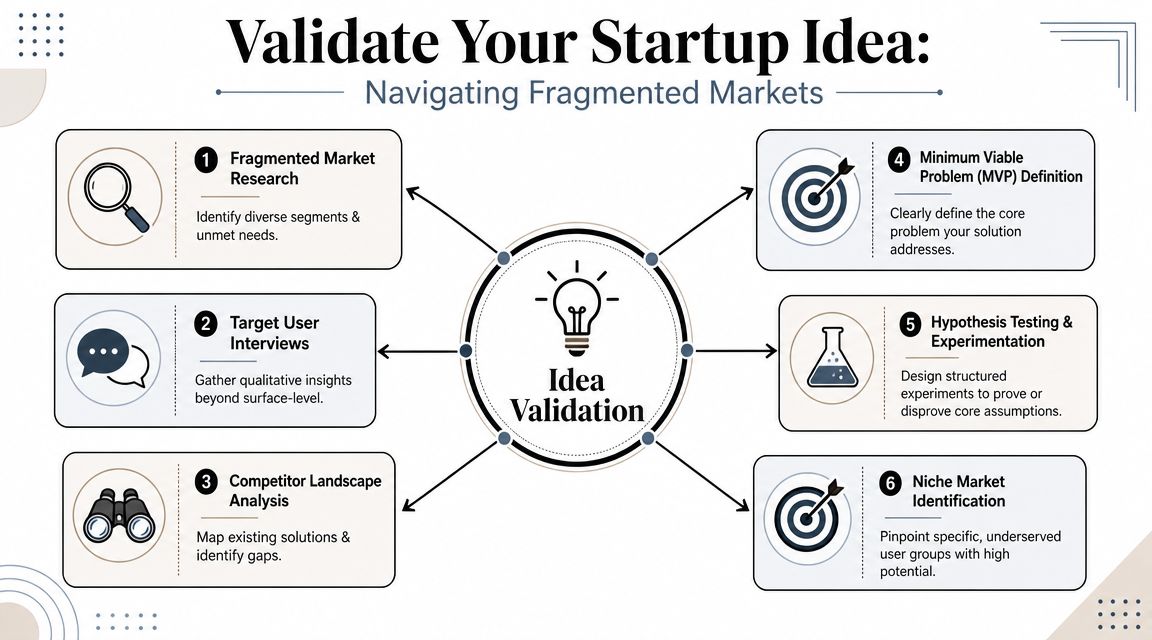
The usual advice says, “Talk to users.” Fine. But in the UAE and MENA, the harder question is which users first.
A product can get a positive response from one segment and fail completely in another. The market isn't one neat customer profile. It is split across expat-heavy audiences, Arabic and English usage, different spending habits, and B2B buyers with different compliance and procurement expectations. That gets more important as the UAE pushes digital growth. The country's digital economy strategy aims to raise digital economy contribution to GDP from about 9.7% to 19.4% by 2031, according to this overview of startup product development strategy.
Pick a beachhead, not a broad market
If you try to validate with “everyone in the GCC who needs better productivity”, you'll learn nothing useful. Start narrower.
Use this segmentation filter:
| Segment lens | What to define |
|---|---|
| User type | Consumer, operator, manager, founder, finance team |
| Language context | Arabic-first, English-first, mixed |
| Buying motion | Self-serve, founder-led sale, procurement-led |
| Workflow pain | Daily repeated task, compliance task, coordination problem |
| Urgency | Nice-to-have, painful workaround, active budget problem |
The goal isn't a perfect persona. The goal is a clear first bet.
A good beachhead segment usually has three traits:
- The pain is frequent. The problem shows up weekly or daily.
- The workaround is ugly. People are already using spreadsheets, WhatsApp, email chains, or manual reconciliation.
- The buyer is reachable. You can speak to them, observe the workflow, and test willingness to change.
If you need a structured way to tighten your segment before interviews, this guide on defining target customers in the UAE is a useful starting point.
Run interviews that expose behaviour, not opinions
Most bad customer discovery calls sound like this: “Would you use this?” or “Do you think this is useful?”
Those questions produce polite fiction.
Ask for specifics instead:
- Walk me through the last time this happened.
- Who was involved, and where did it slow down?
- What did you use to solve it?
- What was annoying about that process?
- What happens if this doesn't get fixed?
- How do you choose a tool or vendor for this today?
Then go one level deeper. If the buyer says the problem matters, ask what they've already tried. If they haven't tried anything, the pain may be weak.
The best validation signal isn't praise. It's evidence that the problem already costs the user time, effort, or internal friction.
Separate signal from courtesy
In this region especially, founders often hear encouraging feedback through warm networks. That's useful for introductions, but dangerous for decision-making. People want to be supportive. They don't want to tell you your idea is weak.
Use a simple filter after every conversation:
- Green signal means the user described a real recent workflow problem in detail.
- Yellow signal means they liked the concept but stayed general.
- Red signal means they were complimentary but couldn't name a concrete pain or existing workaround.
If you want extra frameworks to find product-market fit for your startup, look for methods that force you to test behaviour, not compliments.
Use peer accountability before you write code
Before your team commits to a roadmap, pressure-test the idea with founders who aren't emotionally attached to it. Ask them to challenge your segment choice, your interview notes, and the assumptions you're making from small samples.
One practical option is Founder Connects, which runs curated peer groups and moderated sessions for founders in the UAE and MENA. Used properly, that kind of forum helps you catch blind spots early, especially when your own network is too polite or too similar to your first users.
Stage 2 Build Your First MVP the Right Way
Most founders still define an MVP the wrong way. They hear “minimum viable product” and build a smaller version of the full thing they eventually want.
That usually creates the worst of both worlds. Too much time gets spent building, and the result still doesn't answer the core business question.
In startup product development, your first MVP should behave more like a minimum viable experiment. It exists to reduce one major uncertainty.
Start with the risk, not the feature list
Before anyone opens Figma or starts writing code, ask one question:
What is the single biggest assumption that can kill this business?
It is usually one of these:
- Problem risk. Do people care enough?
- User behaviour risk. Will they adopt a new workflow?
- Commercial risk. Will they pay, or will they only praise it?
- Operational risk. Can your team deliver the service manually before software supports it?
Your MVP should attack one of those, not all of them.
Here's a practical way to scope it:
| If your biggest risk is... | Your MVP should look like... |
|---|---|
| People don't care | Landing page, outreach, interviews, waitlist |
| They won't change behaviour | Concierge workflow, manual onboarding, hands-on service |
| They won't pay | Payment page, paid pilot, proposal with real terms |
| Delivery is unclear | Internal prototype, manual ops layer, no-code workflow |
Regional examples that actually work
A lot of useful MVPs in MENA don't look like software at all in the beginning.
A founder testing a niche community service might run it through a managed WhatsApp group before building a platform. A D2C brand might use a simple landing page with clear pricing and checkout to test whether customers are willing to buy before investing in a full storefront experience. A B2B operations product might start as a manual service delivered through Google Sheets, email, and structured weekly reporting.
That feels scrappy because it is. Good.
The point is to learn whether the market wants the outcome. The software can come later.
What a good MVP includes
A useful first version usually has:
- One job to be done. Not three.
- One user type. Not every stakeholder in the company.
- One success event. A booking, a payment, a completed workflow, a repeated usage moment.
- One time horizon. Short enough that the team learns fast.
What it should not include is “future-proofing”. Early architecture debates often become a hiding place for uncertainty. If you are in a regulated or complex category, that changes how you implement, but it still doesn't justify building broad features before demand is clear. If you're working in financial products, this practical fintech software development guide is useful because it shows how delivery realities affect scope decisions.
Don't outsource the thinking
A common MENA founder mistake is handing a vague spec to an agency or outsourced dev shop and expecting product clarity to emerge from execution. It won't.
External engineering support can help, but only if the founder team already knows what question the MVP is meant to answer. If you're evaluating technical partners, this perspective on engineering consultants for startups is a useful reminder that partner quality matters less than strategic clarity.
Stage 3 Master the Build-Measure-Learn Cycle
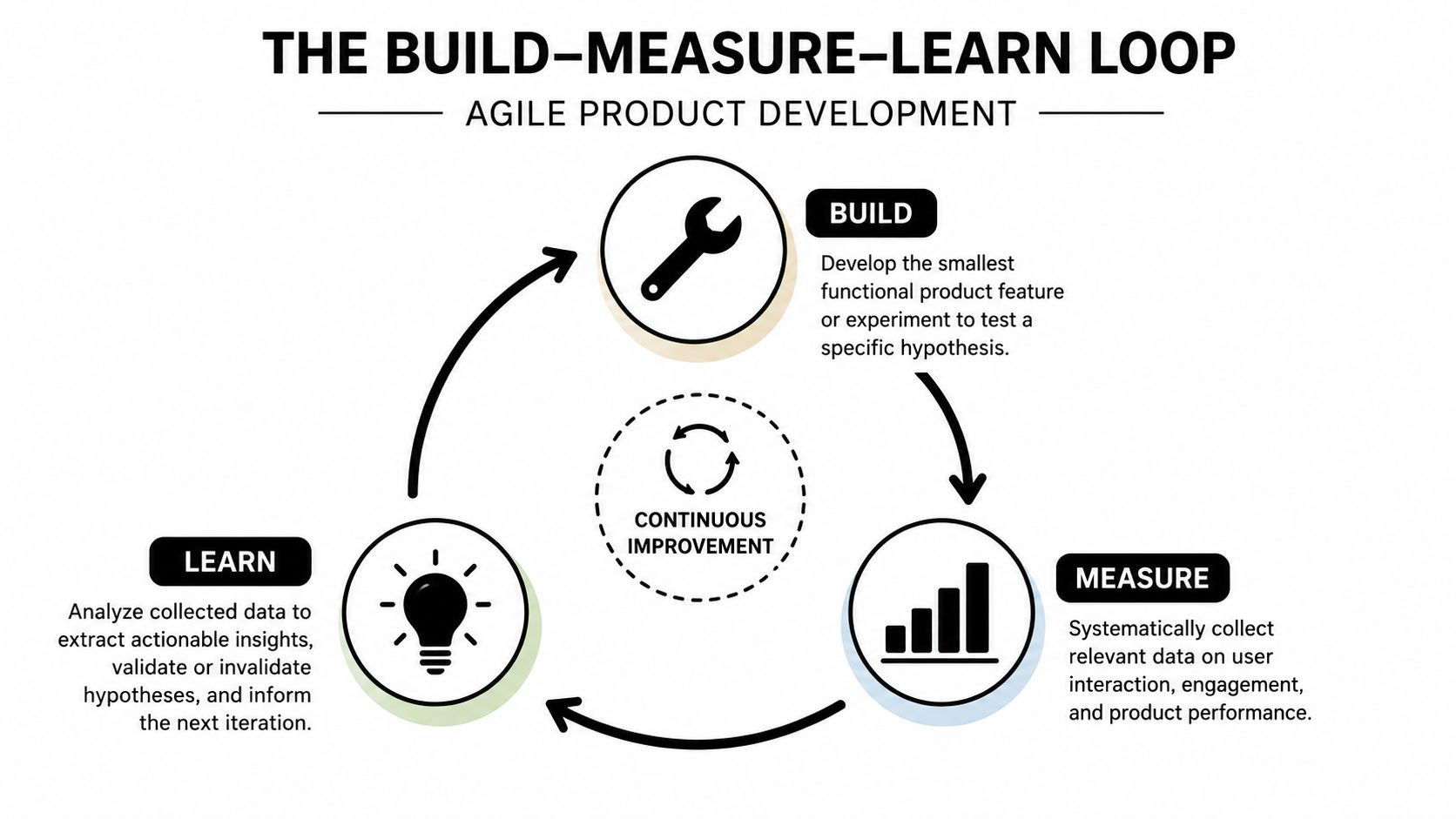
The Build-Measure-Learn loop is where startup product development stops being theory and becomes operating discipline. Without it, teams drift into shipping mode. With it, every sprint answers a question.
Start with the loop itself.
Build the smallest thing that can teach you
The build phase is not “complete the roadmap”. It is “create the smallest testable version of the idea”.
That might be:
- a stripped-down onboarding flow
- a manually delivered service behind a simple interface
- a pricing page sent to qualified leads
- a new feature hidden behind a feature flag for a small customer group
The build is only good if the team can clearly state what assumption it is testing.
Measure behaviour, not sentiment
Many teams lose the plot. They build, launch, collect a few comments, and then call that learning.
Comments matter, but behaviour matters more. You need to know what users did.
Look at signals such as:
- Completed key action rather than page visits
- Repeated use rather than first login
- Drop-off point rather than general “engagement”
- Sales progression rather than verbal interest
If your user says, “Looks good”, but never completes the workflow, the workflow is broken or the problem isn't urgent enough.
If you can't name the behaviour that proves value, you're still guessing.
To see the cycle in plain terms, this short walkthrough helps frame it well:
Learn by making a decision
Learning is not reading a dashboard and saying, “Interesting.”
Learning means the team chooses one of three paths:
- Persevere because the hypothesis looks right.
- Pivot because the value is elsewhere.
- Stop because the signal is weak and the opportunity cost is too high.
That decision needs to be written down. Otherwise teams keep half-pivoting and carrying old assumptions into the next sprint.
Use OKRs to keep the loop honest
A simple way to stop random shipping is to give each cycle one operating objective.
For an early-stage team, an OKR can be very lightweight:
| Element | Example |
|---|---|
| Objective | Improve activation for first-time operations users |
| Key result | More new users complete the first critical workflow without help |
| Initiatives | Simplify onboarding, remove non-essential fields, add guided setup |
The wording matters less than the discipline. Everyone should know what success looks like before the sprint starts.
Keep the loop short enough to matter
A long cycle weakens the whole method. If it takes too long to build, too long to gather feedback, and too long to decide, you end up with expensive ambiguity.
Short cycles force better behaviour:
- Product has to define a sharper hypothesis.
- Design has to optimise for clarity over polish.
- Engineering has to cut non-essential scope.
- Leadership has to make trade-offs instead of postponing them.
That is what makes the loop useful. It doesn't just improve the product. It improves how the company thinks.
Build a Lean and Effective Product Team
Early-stage teams love role titles. They should care more about capabilities.
The strongest product teams in this region aren't built by hiring a generic product manager, a few engineers, and hoping alignment appears. They're built by combining two things that many founders underrate. Technical product leadership and domain understanding.
Why technical product management matters
When the product becomes more complex than a simple front-end app, someone has to translate customer needs into decisions engineering can ship well. That's where a technical product manager changes the game.
A cloud-native scaling study found that organisations with dedicated TPMs achieved 2.3x faster scaling and 67% higher customer satisfaction during rapid-growth phases, according to this TPM-focused scaling study. The useful lesson for founders is straightforward. If nobody in product can reason about architecture, dependencies, delivery constraints, and implementation trade-offs, the team pays for that confusion later.
You see the cost in predictable ways:
- product commits to features engineering can't support cleanly
- teams ship fragile workarounds that create rework
- roadmap promises ignore infrastructure reality
- customer-facing decisions get made without operational consequences in mind
The person you need might not have the title you expect
Some founders think they need a “PM”. What they often need is a person who can do all of this:
| Capability | Why it matters |
|---|---|
| Product judgement | Chooses what matters now |
| Technical fluency | Understands constraints before they become delays |
| Systems thinking | Sees how one change affects the wider product |
| Delivery discipline | Keeps scope controlled and decisions documented |
| Customer context | Can connect real pain to implementable requirements |
If one person can't cover all of that, cover it across two people. But cover it somehow.
Strong product leadership reduces rework long before it shows up in Jira.
Domain depth beats generic product talent
A second mistake is hiring smart generalists with no feel for the workflow you're trying to improve.
An industry analysis on data product roles argues that impactful products require domain knowledge, especially around customer workflows and product mechanics needed to improve them, in this piece on why data product roles require specialization. That applies well beyond data products.
In MENA, domain context shapes product fit more than many founders expect. If you sell into logistics, healthcare, procurement-heavy enterprise, education, or fintech, local workflow details matter. Language handoffs matter. Approval chains matter. Compliance habits matter. A generic product thinker may design something elegant that buyers still reject because it doesn't fit how work gets done.
Hire for evidence, not polish
When evaluating early product hires, ask for specifics:
- Show me a product decision you changed because of technical constraints.
- Tell me about a workflow you mapped in detail.
- How did you decide what not to build?
- What instrumentation did you insist on before launch?
- Which customer type did you prioritise first, and why?
Strong candidates answer with trade-offs. Weak candidates answer with frameworks only.
Measure What Matters Product Metrics for Growth
A lot of founders track what is easiest to see. Sign-ups. page views. followers. demo requests.
Those numbers can be directionally useful, but they don't tell you whether the product is becoming essential. In startup product development, the job of metrics is not to decorate investor updates. It is to tell the team where the product is breaking.
Start with one company-level metric
Your North Star Metric is the clearest measure of delivered value. Not awareness. Not activity. Value.
For example:
- A workflow SaaS product might focus on completed recurring tasks.
- A marketplace might track successful matched transactions.
- A learning platform might track lessons completed by active users.
- A B2B operations tool might track teams running a core workflow without manual support.
The point is alignment. If your North Star Metric improves, the business should be getting healthier.
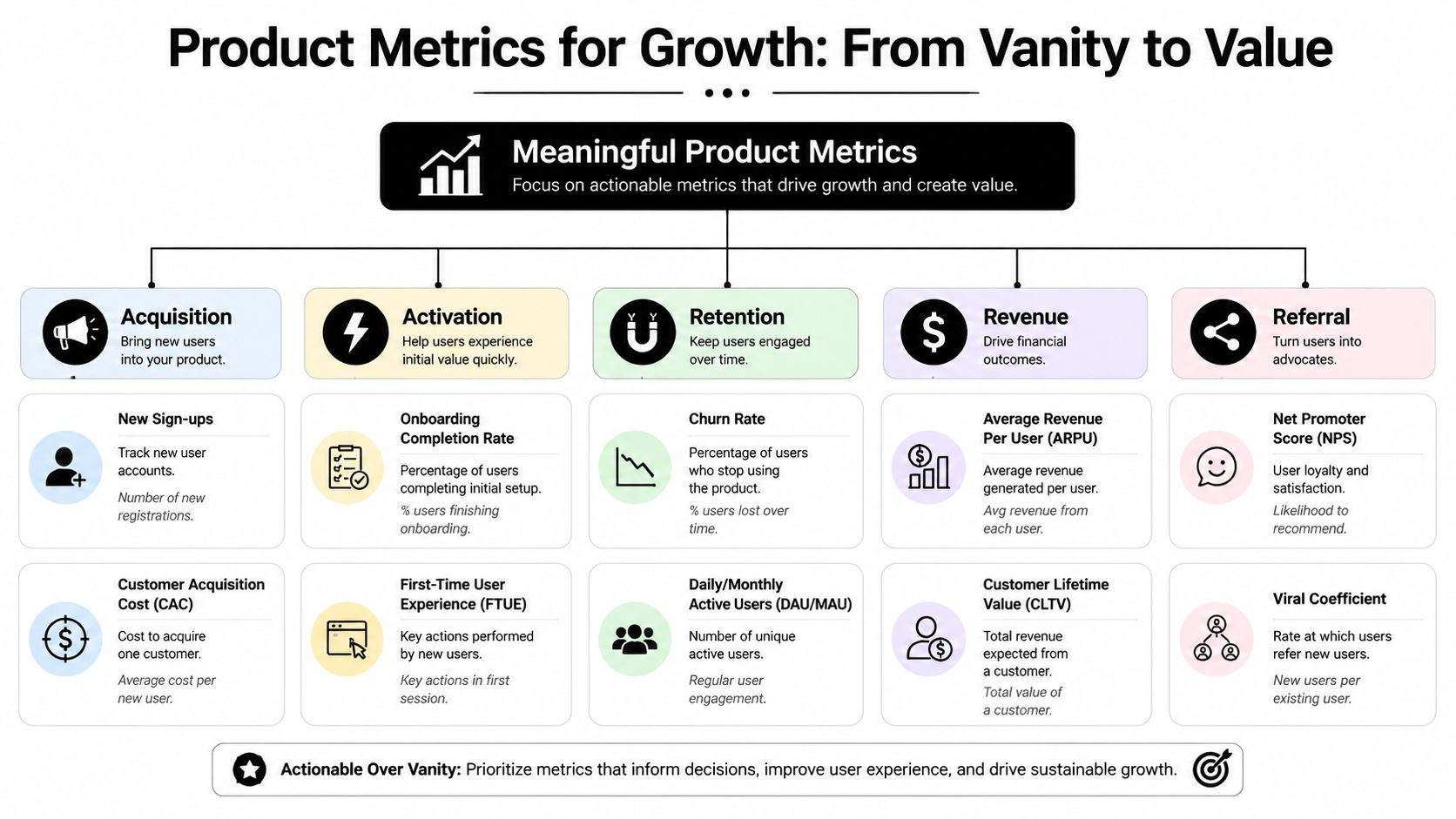
Use AARRR to diagnose the problem
The North Star tells you where you're headed. Diagnostic metrics tell you what is broken.
The AARRR model is still useful because it forces you to inspect the whole journey:
| Stage | What to ask |
|---|---|
| Acquisition | Are the right users arriving? |
| Activation | Do they reach value quickly? |
| Retention | Do they come back without being chased? |
| Revenue | Are they willing to pay or expand? |
| Referral | Are they bringing in others? |
Don't try to improve everything at once. Pick the bottleneck.
Match metrics to stage
An early product often has an activation problem, not a referral problem. A later-stage product may have a retention problem even if acquisition looks healthy.
Here's the practical rule:
- Pre-launch or very early launch. Watch for activation and evidence of core value.
- After initial adoption. Focus hard on retention.
- Once value repeats reliably. Push on revenue mechanics and expansion.
- Only when users love it. Spend serious attention on referral loops.
This keeps the team from celebrating empty top-of-funnel numbers while the product leaks users.
What to stop reporting every week
Founders often clutter internal reviews with vanity data. Cut anything that doesn't drive a decision.
Usually that means treating these carefully:
- Total sign-ups without activation context
- Traffic spikes without qualified intent
- Download counts without repeat use
- Social engagement without customer action
A metric earns its place when the team knows what action to take if it moves up or down.
Good metrics create tension. They force the team to confront what isn't working.
A simple founder review rhythm
Use one weekly review with three questions:
- What changed in the key product metric?
- Where is the biggest drop-off in the user journey?
- What decision are we making because of that?
If your team can't answer question three, you are reporting, not managing.
Your Accountability Framework for Progress
Most product mistakes are not failures of intelligence. They are failures of accountability.
A founder keeps building because no one challenged the segment choice. A team keeps shipping because no one asked what the sprint was supposed to prove. A roadmap keeps growing because no one forced a trade-off. The issue isn't effort. It's that nobody is holding the company to evidence.
That's why peer accountability matters more than founders admit.
Build an external feedback loop
Internal teams develop blind spots fast. Founders become attached to narratives. Employees often avoid hard pushback because they don't want to create friction. Advisors can help, but they usually show up intermittently.
A tighter model is a small group of peers who know what you said you would test, what you learned, and where you're still avoiding the hard decision.
That accountability loop works when people ask blunt questions like:
- Why is this still in the roadmap if the first experiment was inconclusive?
- Which segment are you targeting first?
- What user behaviour would count as proof?
- What did you decide after the last sprint?
- Are you building because the evidence is strong, or because the team is already staffed?
A founder self-audit
Take these questions into your next team meeting or peer session:
- Can we name the exact first segment we're targeting?
- Did we hear workflow pain, or just encouraging feedback?
- What is the single biggest risk our current MVP is meant to reduce?
- What did we include that doesn't serve that goal?
- What hypothesis did the last sprint test?
- Did we make a real decision from the result?
- Who is translating customer needs into technically sound product decisions?
- Who on the team truly understands the customer workflow?
- What is our North Star Metric right now?
- Which one bottleneck matters most this month?
- Who outside the company can challenge our assumptions candidly?
- When is our next decision review?
The founders who move fastest are rarely the ones doing the most. They are the ones removing delusion earliest.
Founder Connects is a practical option for founders in the UAE and MENA who want that kind of accountability built into their operating rhythm. It brings founders into curated peer groups, moderated check-ins, and relevant introductions so product decisions don't happen in isolation. If you want a tighter feedback loop around validation, execution, and traction, explore Founder Connects.

Building in MENA? You don't have to do it alone.
Join 300+ founders in the Founder Connects Residency. Monthly squad calls, warm intros, $3M+ in perks, and much more. All for less than your monthly coffee budget.
Popular posts





Founder Connects is a premium MENA tech founder community. Meetups in Dubai and across MENA, Residency Squads of 8–10, and 400+ vetted WhatsApp founders (apply and screened).