

Crowdfunding Data Privacy | UAE Rules

Building in MENA? You don't have to do it alone.
Join 300+ founders in the Founder Connects Residency. Monthly squad calls, warm intros, $3M+ in perks, and much more. All for less than your monthly coffee budget.

If you use one of the best crowdfunding platforms in the UAE, your data rights depend on where that platform is licensed. In mainland UAE, the PDPL applies. In DIFC, the DIFC Data Protection Law applies. In ADGM, the ADGM Data Protection Regulations 2021 apply, and fines can reach USD 28 million.
I’d boil it down like this: before I upload an Emirates ID, passport copy, bank record, business plan, or investor file, I need to check five things - the platform licence, privacy notice, lawful basis, cross-border transfer rules, and retention period. If any of that is vague, I’d stop and ask questions first.
Here’s the short version:
- Mainland UAE: PDPL + Cabinet Resolution No. 36 of 2022
- DIFC: DIFC Data Protection Law No. 5 of 2020
- ADGM: ADGM Data Protection Regulations 2021
- Financial regulators vary: SCA, CBUAE, DFSA, or FSRA
- Data collected often includes: ID documents, ownership records, investor suitability details, payment data, AML/CTF records, and access logs
- Transfers abroad: need a legal basis or safeguards such as SCCs or BCRs
- Deletion rule: data should not be kept longer than the purpose allows, unless law or record-keeping rules say otherwise
Quick comparison
| Area | Mainland UAE | DIFC | ADGM |
|---|---|---|---|
| Privacy law | PDPL | DIFC Data Protection Law No. 5 of 2020 | ADGM Data Protection Regulations 2021 |
| Privacy regulator | UAE Data Office | Commissioner of Data Protection | Office of Data Protection |
| Financial regulator | SCA / CBUAE | DFSA | FSRA |
| Headline fine point | Set by Cabinet Decision | Scheduled fines | Up to USD 28 million |
If I’m a founder, the rule is simple: check the licence first, then the data flow. That one step can help me avoid legal trouble, investor complaints, and poor handling of sensitive records.
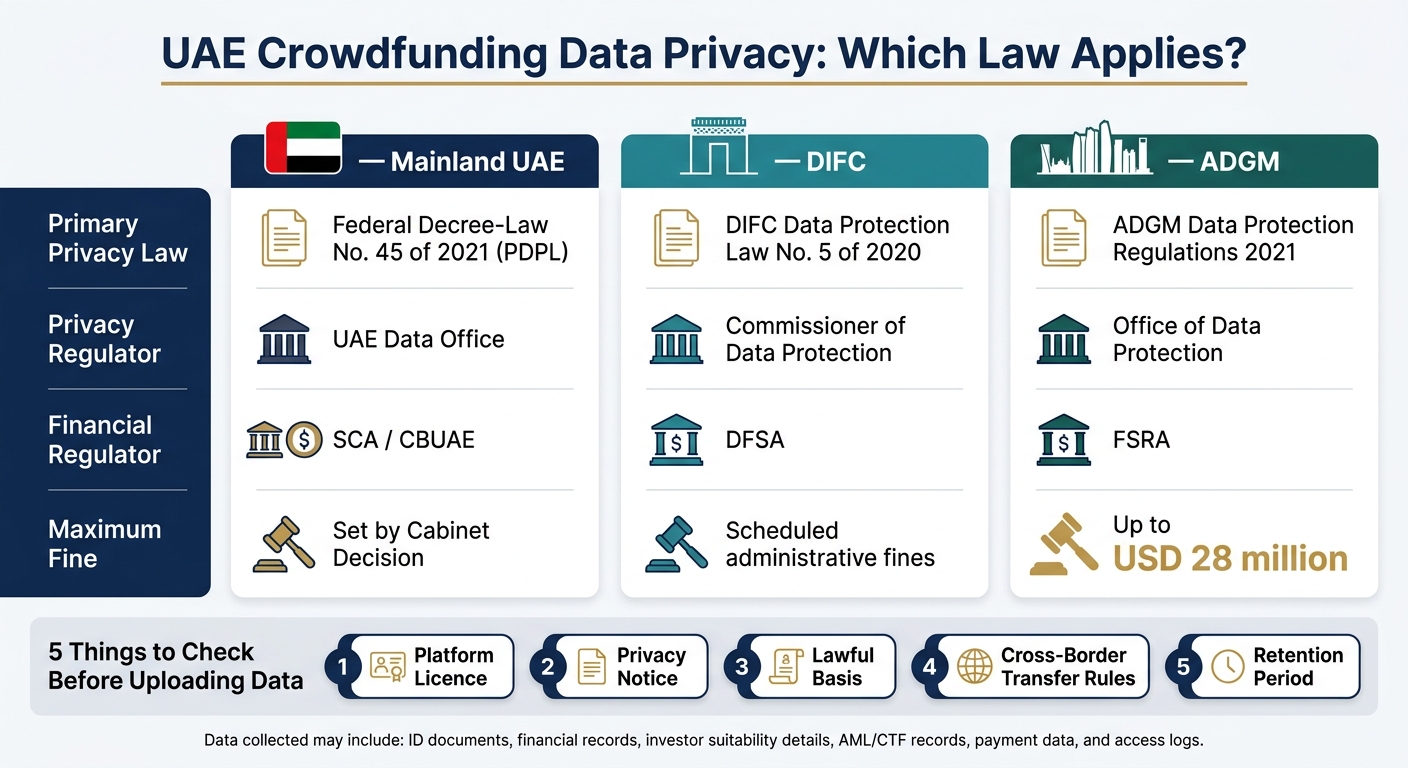
UAE Crowdfunding Data Privacy: PDPL vs DIFC vs ADGM at a Glance
Insights into UAE's Data Protection Law | Tsaaro X Privado Webinar | #Dubai #PDPL
sbb-itb-f597d8f
UAE rules that govern crowdfunding data privacy
Crowdfunding platforms can sit under more than one regulator at the same time. And each regulator has its own rules for handling personal and financial data.
Mainland UAE rules: PDPL, Cabinet Resolution No. 36 of 2022, SCA, and Central Bank
Mainland crowdfunding platforms must comply with the PDPL, along with the crowdfunding rules set by either the SCA or the CBUAE, based on the model they use. That matters because platforms handle founder, investor, and payment data throughout the campaign process.
Mainland UAE privacy law starts with Federal Decree-Law No. 45 of 2021, better known as the PDPL, which is overseen by the UAE Data Office [3][4]. Cabinet Resolution No. 36 of 2022 adds the implementing rules that set out how controllers and processors must act in day-to-day practice. On top of that, equity-based and investment crowdfunding platforms also come under the Securities and Commodities Authority (SCA), while loan-based crowdfunding platforms are regulated by the Central Bank of the UAE (CBUAE) [3][4].
So, privacy compliance and financial compliance run side by side. Once founders know which law applies, they can check how the platform collects, uses, and stores campaign data.
DIFC and ADGM differences founders should not ignore
Where a platform is licensed changes the privacy regime. Mainland platforms follow the PDPL. DIFC and ADGM platforms follow their own data laws.
DIFC platforms are governed by DIFC Data Protection Law No. 5 of 2020, enforced by the DIFC Commissioner of Data Protection, while the DFSA handles financial regulation. ADGM platforms follow the ADGM Data Protection Regulations 2021, overseen by the ADGM Office of Data Protection, with the FSRA in charge of financial regulation. In ADGM, fines can go up to USD 28 million for breaches [5].
For founders, the takeaway is plain: the licence location changes the privacy rulebook. The table below sets out the main differences:
| Feature | Mainland UAE (PDPL) | DIFC | ADGM |
|---|---|---|---|
| Primary Law | Federal Decree-Law No. 45 of 2021 | DIFC Data Protection Law No. 5 of 2020 | ADGM Data Protection Regulations 2021 |
| Privacy Regulator | UAE Data Office | Commissioner of Data Protection | Office of Data Protection |
| Financial Regulator | SCA / CBUAE | DFSA | FSRA |
| Max Fines | Set by Cabinet Decision | Scheduled administrative fines | Up to USD 28 million |
For UAE founders and startup companies, the practical move is simple: check where the platform is licensed before submitting any data.
Key privacy terms used in crowdfunding
After the regulators, the next issue is simple but important: who controls the data, and where can it go?
These terms show up in privacy notices, and they shape how a platform may process data.
Personal data means any information that identifies, or could identify, a person. That could be something like an investor’s name or an ID copy. The controller is the platform, because it decides why and how the data is processed. A processor is a third party that processes data for the platform, such as a payment gateway.
Every platform must have a lawful basis for processing data. In crowdfunding, that is often contract performance or legal obligation, especially for KYC checks. Consent may also be used as a lawful basis, but it must be freely given and can be withdrawn at any time without affecting earlier processing [5]. Cross-border transfer means sending data outside the UAE, which brings in rule-specific safeguards. Retention refers to how long the platform keeps the data before deleting it or turning it into anonymous data.
These definitions shape the data flow covered in the next section.
What crowdfunding platforms collect, store, share, and retain
Founder and investor data collected for KYC, disclosures, and suitability checks
After the rules are mapped out, the next job is simple in theory and messy in practice: track the data that moves through the campaign.
Before a campaign goes live, regulated platforms collect a large set of details from both founders and investors. For founders, that usually means a trade licence, company ownership structure, business plan, financial statements, and information on directors and key personnel. Platforms also check directors and key personnel for any regulatory history [1].
For investors, the process goes well beyond a basic name and email. Platforms carry out suitability and appropriateness checks, so they collect details about an investor’s financial situation, net worth, income, investment experience, risk tolerance, and professional qualifications [1][6]. Investors also sign risk acknowledgements. AML/CTF and sanctions checks become part of the compliance file.
Then the data starts moving - through payment systems, outside vendors, and regulator reporting channels. That’s the point where storage and sharing rules stop being background admin and start mattering a lot.
The table below sums up the main data types and why platforms collect them:
| Data Category | Specific Data Points | Purpose |
|---|---|---|
| Founder / Business | Trade licence, ownership structure, business plan, financial statements, directors and key personnel | Campaign verification and disclosure [1] |
| Investor Profile | Net worth, income, experience, risk tolerance, professional qualifications | Suitability assessment [1][6] |
| Compliance | Sanctions screening results, AML/CTF checks, risk acknowledgements | Compliance record [1][6] |
| Technical / Logs | Consent timestamps, IP addresses, access logs | Accountability and audit trail [5][4] |
Payment and transaction data: storage, location, and access limits
Payment data is where the financial risk gets very direct. Regulated platforms are generally expected to rely on third-party payment and escrow setups to handle funds. That helps keep operating risk lower and protects client money in segregated accounts [1][2].
Common controls for payment data include encryption, secure multi-factor authentication (MFA), and regular vulnerability assessments [1]. Access is usually role-based and kept tight. For transfers outside the UAE, the PDPL permits them only when the destination has enough protection in place, or when safeguards such as SCCs or BCRs are used [3][4].
Sharing data with third parties and record-retention periods
Platforms don’t keep this data to themselves. They share it with banks, payment processors, cloud providers, compliance vendors, issuers, and regulators. Each of those relationships should sit under a contract with data protection duties built in [4].
They also share investor identities, amounts committed, and investment terms with issuers so the sale of securities or loan agreements can go ahead [1]. Regulators may receive periodic financial statements, transaction summaries, and updates on material changes [1]. If a breach affects privacy or security, it must be reported to the right authority - the UAE Data Office, DIFC Commissioner of Data Protection, or ADGM Office of Data Protection [5].
Under the UAE PDPL, personal data must be deleted once the purpose ends, unless it has been anonymised or the law says it must be kept [4][5]. At the same time, regulated platforms must keep records of transactions, investor identities, amounts committed, investment terms, and due diligence results so authorities can inspect them [1].
For founders, this data map is a good stress test. It helps you check the platform’s privacy notice, access controls, and retention terms before launch.
What UAE startups should do before using a crowdfunding platform
Review the platform's licence, privacy notice, and data flow
Once you’ve mapped the data that moves through your campaign, pause before uploading anything. This is the point where you check the platform’s controls, terms, and data rules.
Start with the platform’s licence, privacy notice, and transfer rules. Don’t skim them. Read the privacy notice with four things in mind:
- What data the platform collects
- The legal basis it relies on
- Whether data moves across borders
- How long that data is kept
If any of that feels unclear or vague, ask the platform directly before you proceed. That extra step can save a lot of trouble later. This is especially true when launching your startup in the UAE for the first time. Cross-border transfers need an approved legal basis or safeguards such as SCCs [3][4].
Set up internal data governance before campaign launch
A crowdfunding campaign can pull in sensitive data very fast. IDs, financial records, and payment details can start piling up from day one. So it helps to put a simple internal setup in place before launch.
Keep a basic data-processing register (RoPA) that shows what data you hold, where it’s stored, which vendors can access it, and how long you keep it. That register should tie back to the founder, investor, and payment data already covered [4][5].
Access should also be limited by role. In plain terms, sensitive files like passport copies and financial statements should only be visible to compliance staff. Not everyone on the team needs to see everything.
It also makes sense to write a breach-response plan before the campaign goes live. Set out who handles regulator reporting and what steps the team follows if there’s an incident. Put an internal 72-hour response target in place [5].
These controls make it much easier to review platform terms, vendor access, and retention limits before launch.
Appoint a DPO when the PDPL requires one for your data activity [3][4]. Even if a DPO isn’t required, it still helps to name one clear internal owner for data compliance.
Use the UAE startup community to build compliance awareness
After the legal checks are done, founders can turn to peer discussions to compare how other teams handle day-to-day compliance work. The UAE startup community can be useful for pressure-testing practical questions and spotting gaps in your process.
That said, peer input is just that: peer input. Use it to sense-check your workflow, then rely on legal advice for final decisions.
Conclusion: Core privacy checks founders should remember
After mapping what each platform collects and shares, the last thing to check is the licence behind those rules. In the UAE, crowdfunding privacy depends on the platform's licence. That means it may sit under the Federal PDPL, the DIFC Data Protection Law, or the ADGM Data Protection Regulations.
Platforms may collect identity details, financial information, investor-suitability records, and payment data. But collecting data is only part of the story. They also need secure storage, limited retention, and approved safeguards for cross-border transfers.
Before launch, founders should check a few things:
- Confirm the platform's licence and the privacy regime that applies
- Read the privacy notice for the lawful basis, transfer rules, and retention periods
- Map what data is shared and where it is stored
- Audit third-party access and make sure Data Processing Agreements are in place
- Verify that a documented breach-response process exists
Data privacy isn't something to leave for later. It should be part of the pre-launch checklist from day one. Founders who build these checks into their workflow are in a better position to protect investors, protect the business, and keep the campaign ready for launch.
FAQs
How do I verify a platform’s UAE licence?
Check which regulator oversees the platform based on its setup and where it operates. In the DIFC, platforms are licensed and supervised by the DFSA.
Outside free zones, or under a different legal setup, they may fall under the SCA or CBUAE. The safest move is to check the official register of the relevant authority and confirm that the platform is active and in good standing.
When is consent needed instead of legal obligation?
Under the UAE PDPL, consent is just one lawful basis for processing personal data. You don’t need it in every case. If processing is needed to carry out a contract, protect vital interests, serve legitimate business interests, or meet a legal obligation, consent may not apply.
A legal obligation often covers required crowdfunding platform work, such as KYC, AML checks, and tax or audit compliance. Consent is more common for non-mandatory activity, like some marketing, cookies, or sensitive data processing.
What should I do if the platform stores data overseas?
Check that the transfer follows UAE rules. Under federal law and free-zone regimes such as DIFC or ADGM, cross-border transfers are allowed only when the destination offers adequate protection, or when the right safeguards are in place.
Then look closely at the platform’s privacy policy. It should tell you where your data is sent, what transfer mechanism is being used, and whether the operator has a valid legal basis for moving it outside the UAE.
If that information is vague or hard to find, that’s a red flag. A clear policy should spell out the path your data takes instead of leaving you to guess.
Related Blog Posts

Building in MENA? You don't have to do it alone.
Join 300+ founders in the Founder Connects Residency. Monthly squad calls, warm intros, $3M+ in perks, and much more. All for less than your monthly coffee budget.
Popular posts





Founder Connects is a premium MENA tech founder community. Meetups in Dubai and across MENA, Residency Squads of 8–10, and 400+ vetted WhatsApp founders (apply and screened).