

Customer Discovery: How Founders Validate Ideas in the UAE

Building in MENA? You don't have to do it alone.
Join 300+ founders in the Founder Connects Residency. Monthly squad calls, warm intros, $3M+ in perks, and much more. All for less than your monthly coffee budget.

You have a name, a domain, and a landing page that took a weekend. Three people have told you the idea sounds great, and one said they would definitely use it. That's usually the moment a founder in Dubai starts building, and it's also the moment the most expensive mistake in early-stage business gets locked in.
Customer discovery is the work that happens before that build. It isn't a survey, a focus group, or a chance to pitch. It is a dated, logged set of conversations with the people who would sign, aimed at learning how they handle the problem today, what it costs them, and who controls the money.
Treat it as a two-week test with a written decision at the end.
What Customer Discovery Is and Why It Comes First
A good physician takes a history before prescribing. Where does it hurt, when did it start, what have you already tried, what made it worse. A doctor who writes a prescription in the first thirty seconds is guessing, and a founder who builds before taking the customer's history is guessing with more capital at risk.
That is the whole case for discovery coming first. Nothing in the work mentions your product.
Customer discovery tests the problem before it tests the product.
Why the UAE version is harder. A 2019 Dubai Chamber and Roland Berger white paper found that 46% of surveyed entrepreneurs noted that the availability of industry and market data remains a key obstacle to their success.
The data gap has a local shape. Purchasing behaviour, regulatory conditions, cultural preferences, and the practical differences between doing business in Dubai, Abu Dhabi, and the other emirates all change the answer. When reliable market information is thin, discovery is the substitute for assumption. Treat it as a dated, logged 14-day test of the buyer's adoption path: who signs, what they give up to get the problem solved, and which UAE segments must be heard before the evidence counts. Write down the decision you will make at the end before you begin.
Discovery, validation and selling are three different jobs
Founders blur these constantly, then wonder why a warm conversation didn't turn into revenue.
- Discovery is learning the problem. You are the student, the customer is the expert, and your product stays out of the room.
- Validation is testing whether demand will act. You put a small, real cost in front of the buyer and watch what happens.
- Selling is asking for the order. Different conversation, different energy, and it comes last.
Skip the first two and you are selling on hope. The lean startup method exists precisely to keep those three stages in order.
By the end of a proper discovery round you should be able to answer three questions without hedging. Who exactly has this problem? What do they do about it right now? And what does it cost them in money, time, or risk? If any answer starts with "probably", the round isn't finished.
Choose Whose Feedback Counts Across Dubai and the UAE
A founder building procurement software for logistics firms spends three weeks interviewing operations managers in Dubai. Every one of them loves the idea. The pilot proposal then stalls, because the buying decision sits with a procurement committee in Abu Dhabi that nobody has spoken to. The product was fine. The sample was wrong.
A food delivery founder runs ten interviews with English-speaking professionals and hears a time problem. Ten conversations with Arabic-speaking households in the same city describe a trust problem: who prepared the food, how it was handled, whether the rider will find the building. Same category, different problem, different pitch.
A fintech founder assumes the end user is the buyer. Two conversations with a compliance officer reverse that. Compliance decides, the end user complains, and no amount of user enthusiasm moves a decision.
None of those founders needed more interviews. They needed different ones.
Segments to check before generalising across the UAE
| Segment | Why it can change the answer | Coverage check |
|---|---|---|
| Dubai English-speaking professionals | Often the easiest group to reach, so it can dominate early feedback | At least one other segment is in the sample |
| Arabic-speaking customers | Language and trust shape how the problem is described | Interviews are offered in Arabic where needed |
| Other emirates such as Abu Dhabi | Buying process, networks and rules can differ | Conflicting answers are logged by location |
| Expatriate households and small firms | Budgets and decision rights often differ from large companies | The buyer role is recorded for each interview |
| Emirati nationals in target roles | Preferences and purchasing channels can vary | Included wherever the target buyer includes them |
The aim isn't a universal interview count. A fixed target like 100 interviews tells you nothing if all 100 come from the same row. What matters is whether your sample matches the buying decision: the person who feels the problem, the person who approves the spend, and the person who can block it. Three roles, not three hundred interviews.
The practical test before you move on: if your strongest evidence comes from a single segment, name the segment you still haven't heard from. Write it at the top of your notes. That's the next interview. For a deeper walkthrough of defining who counts as your customer, this guide on defining target customers in the UAE is worth an hour of your week.
Questions That Reveal Real Buying Behaviour
Start with the buyer, not the question. The UAE Ministry of Economy and Tourism advises founders to study the market by defining the buyer persona, including its characteristics, needs and preferences, and by examining competitors' strengths and weaknesses before developing a solution. Name the exact buyer first. A question written for "SMEs" produces answers about SMEs, which is to say, nothing usable.
Then keep every question pointed at the past and the present. The future is fiction, and people are polite about fiction.
Discovery question types and what they reveal
| Question type | Example question | What it reveals | Weak answer to watch for |
|---|---|---|---|
| Past behaviour | When did this problem last happen, and what did you do? | How often the problem really occurs | It happens sometimes, I think |
| Current workaround | What do you use to handle it today, and what does that cost? | The real cost of the status quo | Nothing, we manage fine |
| Buying authority | Who signs off on spending for this kind of tool? | Who must be won over before any sale | I would probably buy it myself |
| Urgency trigger | What would make this urgent for you this quarter? | Why and when a buyer would switch | No idea, maybe later |
| Prior attempts | What have you already tried, and why did it stop working? | Alternatives and reasons earlier options failed | We have not looked at anything yet |
Retire these questions. "Would you use this?" invites a compliment. "Do you think this is a good idea?" invites agreement. "How much would you pay?" invites a number that has never been tested against a budget. "Could I show you a quick demo?" turns discovery into a pitch and ends the learning. Every one of them produces a warm feeling and zero evidence.
Practical rule: if the customer's answer would make you feel good but change nothing you plan to do, the question was badly designed.
Where a prospect is more comfortable in Arabic, ask in Arabic and record the original wording alongside your translation. The phrasing carries the diagnosis. A problem described as a burden, a risk, or an embarrassment leads to three different products.
Finally, tag every answer as you write it up. Opinion means they told you something. Behaviour means they described something they did. Only the second kind counts toward a decision, and mixing the two in one notebook is how founders end up building for a problem that never happened.
Run Five Discovery Interviews in 14 Days
The fastest credible version of this is a 14-day test built around five interviews, each lasting 20 to 30 minutes, followed by a willingness-to-act test and a written decision to continue, change or stop. Short enough to finish before your enthusiasm fades.
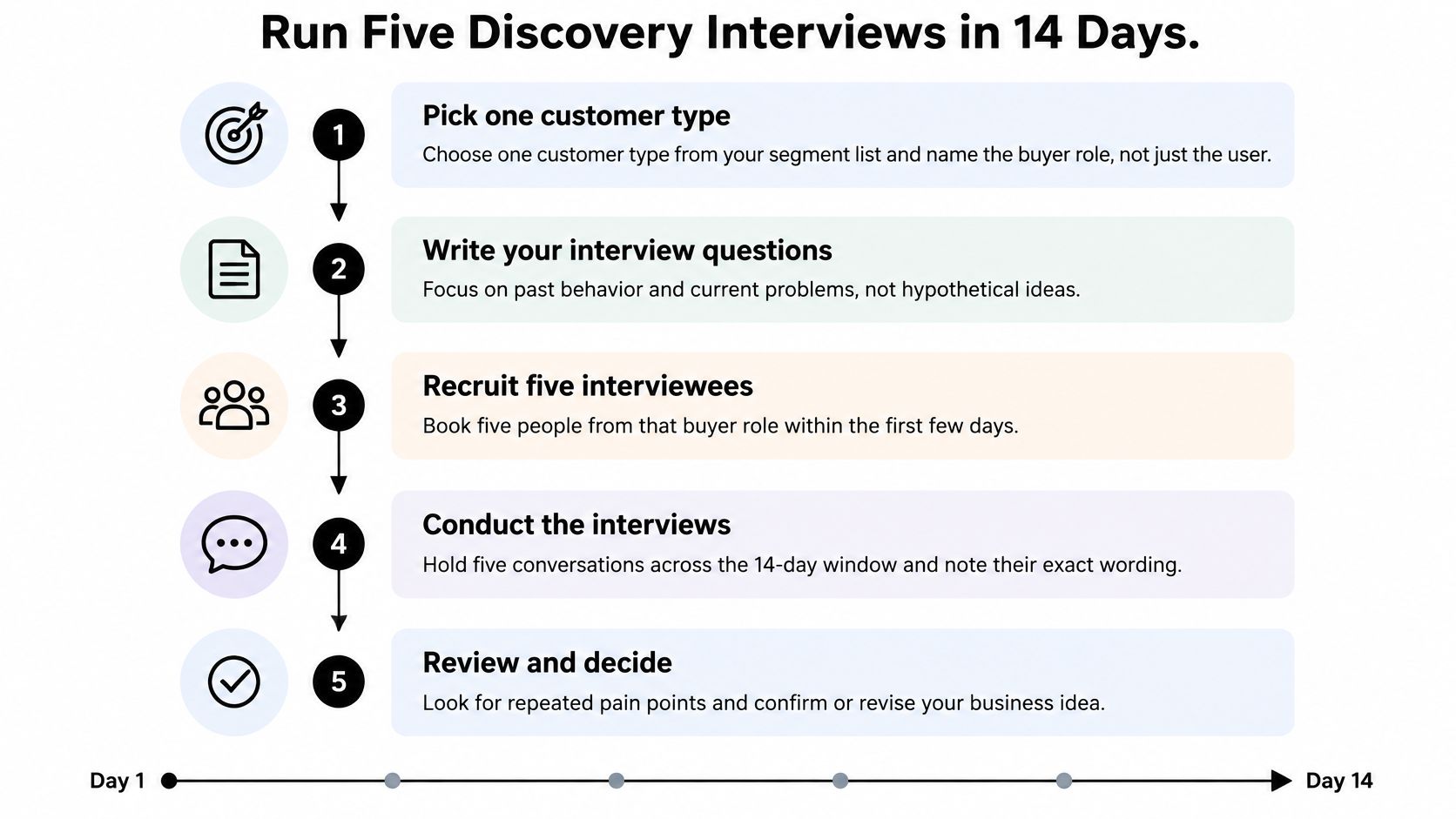
- Pick one customer type and name the buyer role. Not "logistics firms". Say "operations manager at a 50-truck freight forwarder who approves software spend". If you can't name the role, you can't recruit for it.
- Write a one-page interview sheet. Five fields only: buyer role, recurring problem, current workaround, purchasing authority, evidence of demand. One page keeps you honest. A ten-page script turns the conversation into an interrogation.
- Book five conversations of 20 to 30 minutes. Recruit from the named segment, not from your network. Common slip: founders interview friends, get encouragement, and mistake it for data.
- Ask about past behaviour, not purchase intent. When did the problem last occur, what did it cost, what did they do instead. Common slip: the founder talks for twelve of the twenty minutes and drifts into pitching.
- Log every interview the same day. Memory reshapes a conversation within hours, and usually in your favour.
The log is the part founders skip and later regret. A structured evidence matrix should capture the customer segment, respondent role, recruitment source, interview date, the specific problem described, recent behaviour, the current alternative, the decision-maker, supporting evidence and remaining uncertainty. It keeps reported opinion separate from observed behaviour and makes contradictory answers impossible to ignore.
Why the weekly review decides the outcome
Review the matrix once a week, not once at the end. You're looking for three things: the same problem appearing in different words, the same workaround appearing across companies, and the questions you still can't answer.
If the same workaround shows up four times, you've found a market. If five interviewees describe five unrelated problems, you haven't found a segment yet, and the honest move is to change the segment rather than broaden the product.
Close day 14 with a written decision, in one sentence. Continue, change the segment, or rewrite the problem statement. "Keep exploring" is not a decision, it's a delay with better branding.
Telling Real Demand From Polite Interest
Positive feedback is a social courtesy, and an expensive one. An analysis of more than 60 failed MENA startups, including companies from the UAE, found that lack of market need was the most frequently cited failure reason at 27.3%, ahead of being outcompeted and poor team quality at 13.6% each. Those founders ran interviews, gathered encouragement, and built on it. Encouragement is exactly what polite interest produces.
So stop asking whether the problem is real and start watching what the buyer does about it. Behaviour is the only currency here, and your 14-day test should log each buyer action against a dated rung.
Evidence ladder for judging customer demand
| Evidence level | What the prospect does | What it proves |
|---|---|---|
| Interest | Agrees the problem is worth solving | The problem may exist, but demand is unproven |
| Access | Shares data, a process map or an introduction to a decision-maker | The buyer is engaged enough to open their workflow |
| Commitment | Signs a letter of intent or agrees a dated pilot | The buyer will take a costly next step |
| Payment | Pays a deposit or a pilot fee | The budget is real and has been released |
| Repeat use | Uses the pilot again or renews without prompting | The problem recurs and the solution has earned a place |
Practical rule: a level counts only when the prospect took the action without being chased twice.
Set your threshold before the first interview. Decide in advance what share of interviewees must describe the same high-frequency problem, and how many prospects must agree to a concrete next step such as a paid pilot, a data-sharing arrangement, or a procurement review. Write both numbers down on day one. Deciding the bar after you've heard the answers is how founders negotiate with themselves.
Then run the willingness-to-act test inside the 14 days, not after them. Ask for something small and real: a deposit, a signed pilot scope, a calendar hold with the person who approves budget. The size matters less than the fact that it costs the buyer something. Log the ask, the answer, and the date next to it, because an unsigned yes on day 12 counts as interest and nothing more.
Pay attention to who signs. In a UAE enterprise sale, the person describing the problem is often not the person who releases budget, so every interview entry should name the buyer role and what that specific person gave up. Time and information are small costs. Money, signatures and introductions to decision-makers are large ones.
When answers conflict between emirates or between segments, log the conflict and treat it as a segmentation question rather than noise. Two different truths from two different buyers usually means you have two markets, and one of them is not yours yet.
Ask the founding team one question at the end of the round: which rung of the ladder have we reached, and what specific evidence would move us up? If nobody can point to the rung, you're still at interest. That's a fine place to be in week one and a bad place to be in month six. The path from discovery to product market fit starts here, with a dated log of buyer actions rather than a feature list.
One more discipline worth borrowing from growth work: treat a landing page or ad response as a top-of-ladder signal at best. A click shows access; only a payment shows demand.
Your Next Step This Week
Monday looks like this: the company exists, the calendar is empty, and nobody has logged who signs or what they give up. The UAE was rated 7.7 out of 10 as a destination for starting and operating new businesses in 2024, the highest score in the Global Entrepreneurship Monitor's history, according to the UAE Ministry of Economy and Tourism. Setting up is the easy part. Knowing that someone will pay is the hard part.
Run the next 14 days as a dated log of the buyer's adoption path. Census Market Research's 2026 UAE Business Innovation Report, from research involving 152 UAE-based business professionals, found that among those who answered the question, 95.3% agreed or strongly agreed that their organisation's targeted customers had changed during the previous two years. Last quarter's segment can be the wrong room this quarter. Name the UAE buyers you will hear before any line in the log counts as evidence.
Do these four things this week.
- Choose one customer type from the segment table and write the buyer role, the person who signs, in a single sentence.
- Book the five interviews, 20 to 30 minutes each, with a date and time in the calendar before Friday.
- Prepare the one-page sheet with buyer role, recurring problem, current workaround, purchasing authority and evidence of demand.
- Set the review date now, seven days from the first interview, with a named person responsible for the evidence matrix.
Copy this template into a document the same day and fill one row after every conversation. Blank fields are the point. They show what you still have not heard.
- Buyer role: who signs, in one line
- Recurring problem: in the customer's own words
- Current workaround: what they do today and what it costs
- Decision-maker: name and title, not a department
- Strongest evidence: the behaviour you observed, not the opinion you heard
- Remaining uncertainty: the question you still can't answer
- Smallest commitment offered: deposit, dated pilot, letter of intent, data access
- Result: what they did
- Decision: continue, change the segment, or rewrite the problem
Take the completed template to your next team meeting and answer one question: which interview would change our plan if it went the other way? That answer marks your weakest assumption. Repeat that interview first, and do not call the 14-day test finished until that UAE segment has been heard.
Customer discovery FAQs
What is customer discovery? Customer discovery is a dated, logged set of conversations with the people who would sign, held before you build. It aims to learn how they handle the problem today, what it costs them, and who controls the money.
How many customer discovery interviews do I need? Five interviews of 20 to 30 minutes, inside a 14-day test, is the fastest credible start. The sample matters more than the count. It should include the person who feels the problem, the person who approves the spend and the person who can block it.
What should I ask in a customer discovery interview? Keep every question pointed at the past and the present. Ask when the problem last happened and what they did, what they use to handle it today and what that costs, and who signs off on spending. Avoid "Would you use this?" and "How much would you pay?".
How do I tell real demand from polite interest? Watch what the buyer does. Agreeing the problem is worth solving does not prove demand. Sharing data, signing a letter of intent, agreeing a dated pilot, or paying a deposit or a pilot fee are the rungs that count.
Why is customer discovery harder in the UAE? Reliable market information is thin, and purchasing behaviour, regulatory conditions and the practical differences between Dubai, Abu Dhabi and the other emirates all change the answer. Hear segments you have not heard from, such as Arabic-speaking customers, before you generalise.
Founder Connects, a startup community in Dubai and the world, runs Meetups where founders compare notes with other builders. See upcoming Meetups.

Building in MENA? You don't have to do it alone.
Join 300+ founders in the Founder Connects Residency. Monthly squad calls, warm intros, $3M+ in perks, and much more. All for less than your monthly coffee budget.
Popular posts





Founder Connects is a premium tech founder community in Dubai and the world. Meetups, Residency Squads of 8–10, and a WhatsApp group of 600+ vetted founders.