

Lean Startup: A Founder's Guide to Testing Ideas Fast

Building in MENA? You don't have to do it alone.
Join 300+ founders in the Founder Connects Residency. Monthly squad calls, warm intros, $3M+ in perks, and much more. All for less than your monthly coffee budget.

A founder in Dubai has a folder of market research, a registered trade name, a logo and a pitch deck that opens with a large number for the size of the regional market. What the folder doesn't contain is one payment from one customer.
That gap is where most early ventures stall. Not because the idea is weak, but because nothing about it has been tested. Fifteen months can pass before the first honest answer arrives, and by then the savings, the visa and the co-founder's patience have gone.
Lean startup is the discipline that closes the gap, and it's far less mysterious than its vocabulary suggests. This guide builds it in order: the principles, the assumption to test first, the cycle that produces the answer, the cheapest tests available, how to read a result, what regulation and AI claims demand, and the one-page artefact that keeps all of it honest. It ends with an experiment to start this week.
Why Lean Startup Thinking Matters in Dubai
Lean startup is a way to build a business by testing one assumption at a time with the smallest thing a customer can react to, then changing course on what the evidence shows.
It replaces the plan-build-launch order that many first-time founders copy from accelerator templates: write the plan, build the product, launch it, then discover whether anyone wanted it. That order spends the entire budget before the first real answer arrives. The lean loop of build, measure and learn costs a fraction of that and closes in weeks rather than quarters.
The everyday version is satellite navigation. Take a wrong turn and it reroutes within seconds, working from your current location rather than from where the original itinerary predicted you would be. Each lean experiment does the same job for a business: the result of the last test sets the next instruction.
Lean also demands rigour. Shipping something broken and calling it a test fails the method, because every experiment answers one named question, and that question gets written down before the test runs.
The UAE makes the urgency concrete. The Global Entrepreneurship Monitor reports that one in five UAE adults was starting or running a new business in 2025, compared with one in seven in 2024, a rise from approximately 14.3% to 20% of adults aged 18 to 64. Starting a company is no longer the hard part. The Dubai Startup Guide 2024 from Dubai Chamber counts more than 1,000 startups in the UAE, with Dubai accounting for 86% of them, and puts the share of startups that advance to the next stage of scaling at 20%. Starting is common; advancing is rare, and that gap is where early testing earns its keep.
The same thinking applies to the commercial side of a young company. The story behind the pay-per-close model shows a founder tying cost to a closed deal rather than to activity that might lead somewhere, which is the lean principle applied to selling.
For a founder watching burn rate in a selective funding market, the order of operations matters as much as the method: name the riskiest assumption first, pick the cheapest test that could prove it, agree the pass mark before the test runs, and check what licensing requires before money goes out. Each step keeps capital intact while the honest answers arrive.
Five Lean Startup Principles and What Each Asks
The whole method fits in five rows, and every decision in this guide is one of those rows applied to a specific choice.
Core lean startup principles and the question each one asks
| Principle | What it means | Question to ask |
|---|---|---|
| Validated learning | Progress is measured by evidence from real customers | Did customers change their behaviour because of this test? |
| Build measure learn | Short loops turn each idea into a test | What is the smallest build that answers this question? |
| Minimum viable product | The least you can show customers to test one assumption | Which assumption does this version test? |
| Innovation accounting | Track evidence of progress, not vanity metrics | Which metric moves if the idea is right? |
| Pivot or persevere | Change direction or continue based on results against a set threshold | Did the result meet the threshold we agreed before testing? |
Read the right-hand column straight through and it stops sounding like theory. Each question forces a founder to name what would count as an answer before the work begins.
How the five depend on each other
The loop needs a minimum product to run, because otherwise there's nothing to measure. Accounting needs a threshold, because a metric with no target can be narrated either way after the fact. A decision to pivot is only honest when the threshold existed before the result, which is why the last row rests on the fourth.
Take the rows one at a time. Remove validated learning and the loop has nowhere to land. Remove the minimum product and the loop becomes an expensive build. Remove accounting and the decision becomes a mood.
What lean doesn't mean
Lean isn't an excuse to skip research or ship something shoddy. A founder who ignores licensing, unit costs or the buyer's identity hasn't removed waste; they've removed the map. Do the desk work first, then run experiments on the part a document can't answer, which is almost always whether customers will change what they do.
Pick one principle to apply this week. If the choice isn't obvious, take the third row: write down which assumption the next piece of work tests, and cancel the work if it tests none.
Choose the Assumption Worth Testing First
Every early idea rests on three kinds of belief, and trouble starts when a founder treats them as one thing.
- Desirability: a real customer has a problem worth paying to solve.
- Viability: the numbers work once the product sells the way it's meant to sell.
- Feasibility: the team can build it, run it and legally offer it.
Feasibility questions get answered first because they are the comfortable ones. Code compiles or it doesn't. A licence arrives or it doesn't. Licensing deserves an early check anyway, since discovering a regulatory wall after months of build is the most expensive version of a cheap answer. Desirability is where ventures die, and it is the belief founders hold with the least evidence behind it. In a funding market that rewards repeatable revenue and capital efficiency, an unproven customer is also the belief investors probe hardest.
Sort beliefs in four steps
- Write each customer belief in the customer's own words. "Dubai service founders lose track of client follow-ups every week" is testable. "The market needs a better operations stack" isn't.
- Mark the evidence behind each belief. None, an opinion from someone who isn't the buyer, or a behaviour already observed happening.
- Rank by risk. Put the belief that would end the business if it turned out false next to the evidence that's weakest. That pairing is the top of the list.
- Rewrite the winner as a falsifiable statement naming a segment, a behaviour and a number: Dubai service founders will pay monthly for a follow-up service, with ten paid sign-ups in four weeks.
Step four is where founders slow down, so treat the number as a design choice rather than a forecast. Ten paid sign-ups from forty qualified conversations is a threshold, not a prediction about the market.
The two beliefs nobody tests
The leap-of-faith assumptions sit in the same place on every list: that customers want this, and that customers will pay for it. Both feel rude to question, so they get buried under product work. A founder building an invoicing tool can spend three months polishing PDF templates without once asking a firm to pay for a single month of it.
A ranked list for that tool makes the pattern visible. Willingness to pay sits at the top with no evidence behind it. Problem frequency comes next, usually supported only by opinion. Switching behaviour follows, because moving a firm off spreadsheets and WhatsApp is genuine work. Feasibility sits at the bottom, since template compliance and PDF generation are known problems with known answers.
Differentiation belongs on the list too. The GEM UAE profile reports that more than one in two adults intend to start a business within the next three years, and it defines innovation rate by whether early-stage entrepreneurs believe their offering is new to at least some customers. Treat "nobody else does this" as a claim to test with prospects who have already tried alternatives, since their switching decisions carry more weight than a founder's survey of the market.
Narrowing the segment first makes the ranking easier. Five steps to define target customers in the UAE turn a vague audience into a list of names worth calling.
The reassuring assumption is that the product is the risk. Usually the customer is.
Take the top assumption on the list and put a number on it.
How to Run One Build Measure Learn Cycle
A cycle is a loop, not a launch. The unit of progress is a completed loop that changed a decision, and a loop can close in weeks with a handful of real customers.
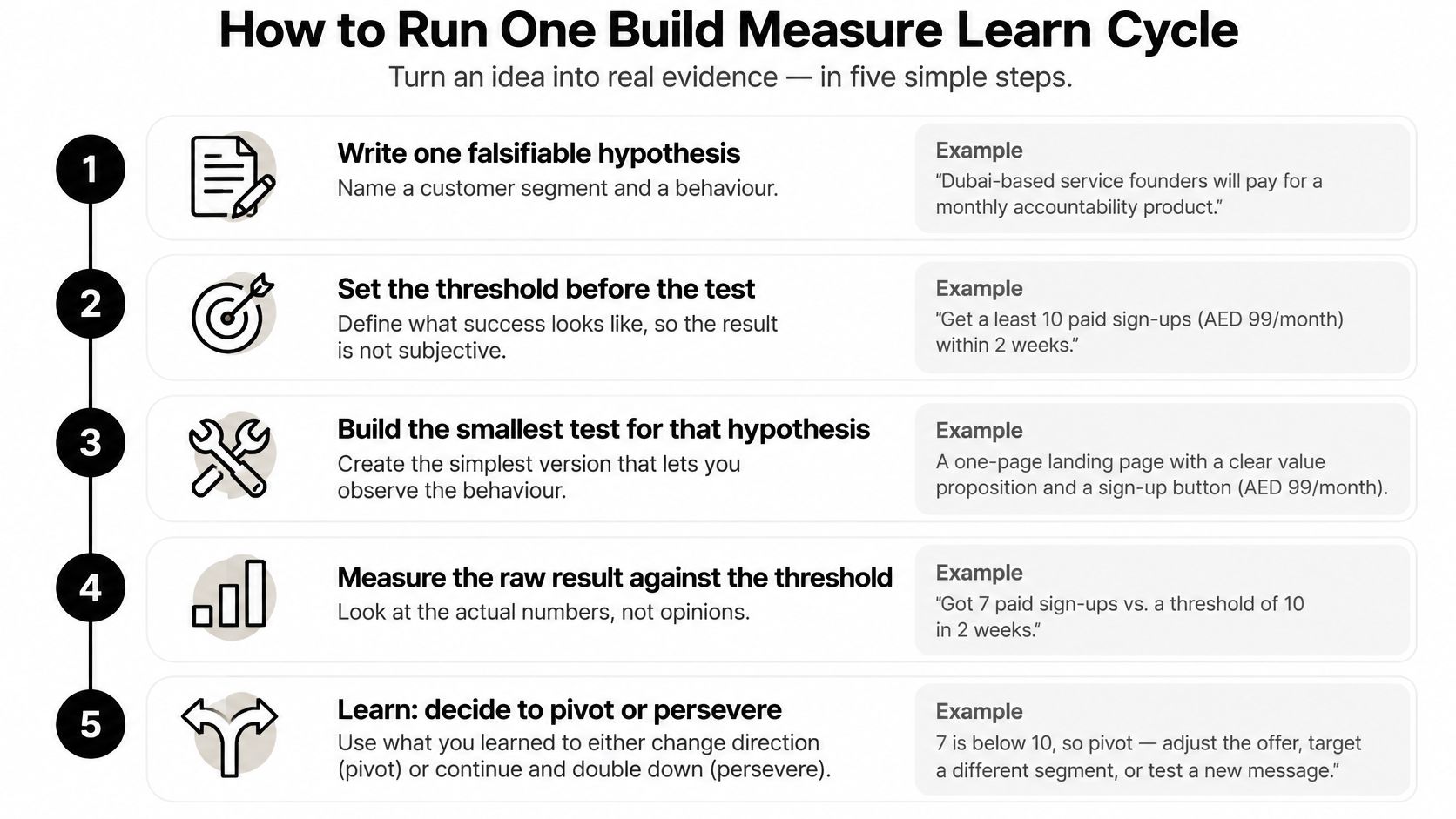
The six steps, and the slip at each one
- Write one falsifiable hypothesis. Name the segment and the behaviour, such as "Dubai-based service founders will pay for a monthly accountability product". A statement that can't fail teaches nothing, and the usual slip is a hypothesis so broad that any outcome confirms it.
- Set the success threshold before testing. Decide how many paid sign-ups from a defined list of qualified prospects counts as a pass. The slip here is setting the number after the results arrive, which lets a founder shift the goalposts without noticing.
- Build the smallest test capable of producing that behaviour. A landing page, a hand-delivered service and a manual back end are all builds. The slip is building the full product because it feels like proper work.
- Run it with a narrow group and record what people did. Not what they said they'd do. The slip is counting polite interest as demand, and it's the most expensive error on the list.
- Measure the raw result against the threshold. Write the number down before discussing what it means, because the discussion always softens it.
- Learn and decide. Persevere, pivot or stop, then record the reason in one line. A decision with no written reason gets relitigated every few weeks.
A test that can't fail isn't a test. It's a delay with paperwork attached.
The cycle repeats. Speed comes from keeping each loop small enough to finish, not from skipping steps, and a first loop usually reveals which question to ask next. That's a good outcome even when the answer is no.
Where local data sharpens the hypothesis
The UAE government data portal, Bayanat, was reported to contain 1,131 datasets in a Dubai Chamber and Roland Berger white paper on UAE entrepreneurship, which identifies market validation as a major obstacle for founders here and recommends matching startup concepts to granular, real-world datasets. Those datasets give a founder something to test assumptions about target segments, demand geography, usage patterns and expansion markets against, rather than guessing at all four.
The same paper recommends co-creating solutions with target customers, corporations and government agencies using live datasets. That points towards structured pilots with named partners, not a wider network and a follow-up email.
When the build itself is the open question, creating an app for a UAE startup sets out the order of decisions, so a two-week test doesn't become an eighteen-month roadmap.
Choosing the Smallest Test for Your Assumption
Most founders get the test wrong in the same direction. They build the product first and go looking for evidence afterwards, which turns validation into a review of work already done.
The rule is shorter than the menu below. Choose the test that produces the behaviour your assumption depends on, not the most impressive product you can build. If the assumption is that people will pay, the test has to end in a payment. A survey can't prove that, however well designed it is.
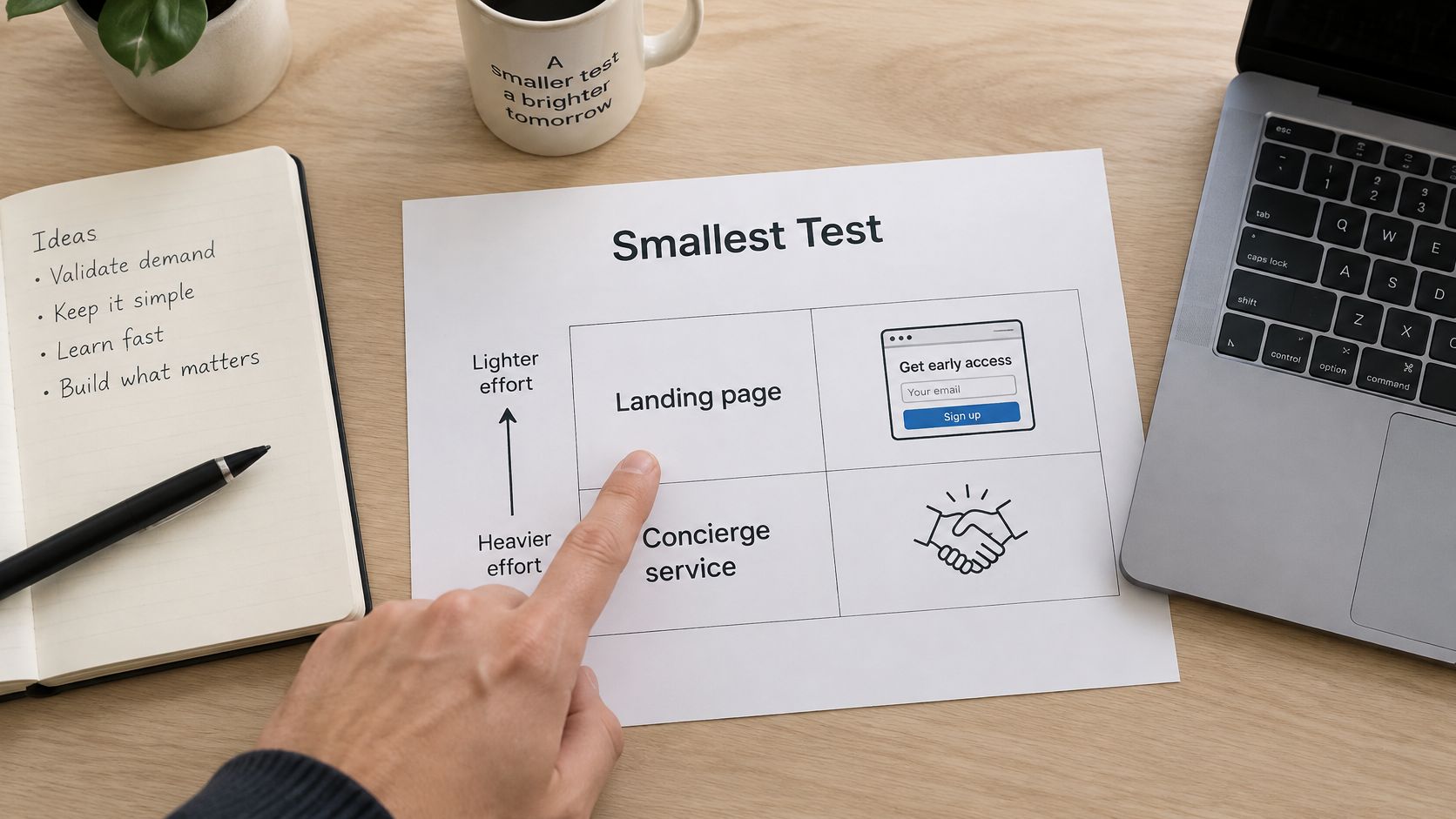
Minimum viable test formats and the evidence each one gives
| Test format | Best for | Typical effort | Evidence it gives |
|---|---|---|---|
| Landing page with sign-up | Testing demand and the message | Low | Sign-up rate from targeted traffic |
| Concierge service | Testing a service before automating it | Medium, delivered by hand | Willingness to pay and workflow gaps |
| Wizard of Oz prototype | Testing whether users value the output | Medium, manual back end | Whether users act on the output |
| Single-feature prototype | Testing one core function | Medium to high | Repeat use of the core feature |
| Paid pre-sale or pilot | Testing commitment rather than interest | Low to medium | Payment or signed pilot terms |
Say a founder believes operations managers at Dubai service firms will pay for a monthly reporting pack that pulls numbers from three systems into one page. A concierge version answers that in about three weeks. The founder collects the figures by hand, assembles the page in a spreadsheet, sends it on the first of the month and invoices from month two. Nothing is automated and nobody needs a software licence. If eight of twelve invited managers pay for the second month, the assumption holds well enough to justify building. If they read it, thank the founder and never pay, the problem was real and the willingness to pay wasn't.
Interviews explain the problem, not the demand
Interviews still earn their place. They're the right tool for learning how a problem shows up in someone's week, which words people use for it, and what they've already tried. They're the wrong tool for proving demand, because people are generous with enthusiasm and careful with budget.
Recruiting a sample that can answer the question
Build the list by hand. Named prospects already showing the behaviour, such as a firm that visibly chases invoices on WhatsApp every Friday, are the only sample that can test this assumption. Invite them one at a time, from a real sender, with a specific ask and a fixed time in the next two weeks. Decide before the first call how many responses count as evidence, and don't count silence as support. A test run on friends, former colleagues or a general audience measures enthusiasm for the founder, not the behaviour the assumption depends on.
Write down the single behaviour the next test must prove. If it can be proven without building anything, do that first.
Reading Evidence to Decide Whether to Pivot or Persevere
Compare the raw number with the threshold you wrote before the test. Two figures on one line settle most cases, and anything written after them is interpretation, the place founders talk themselves into another six months.
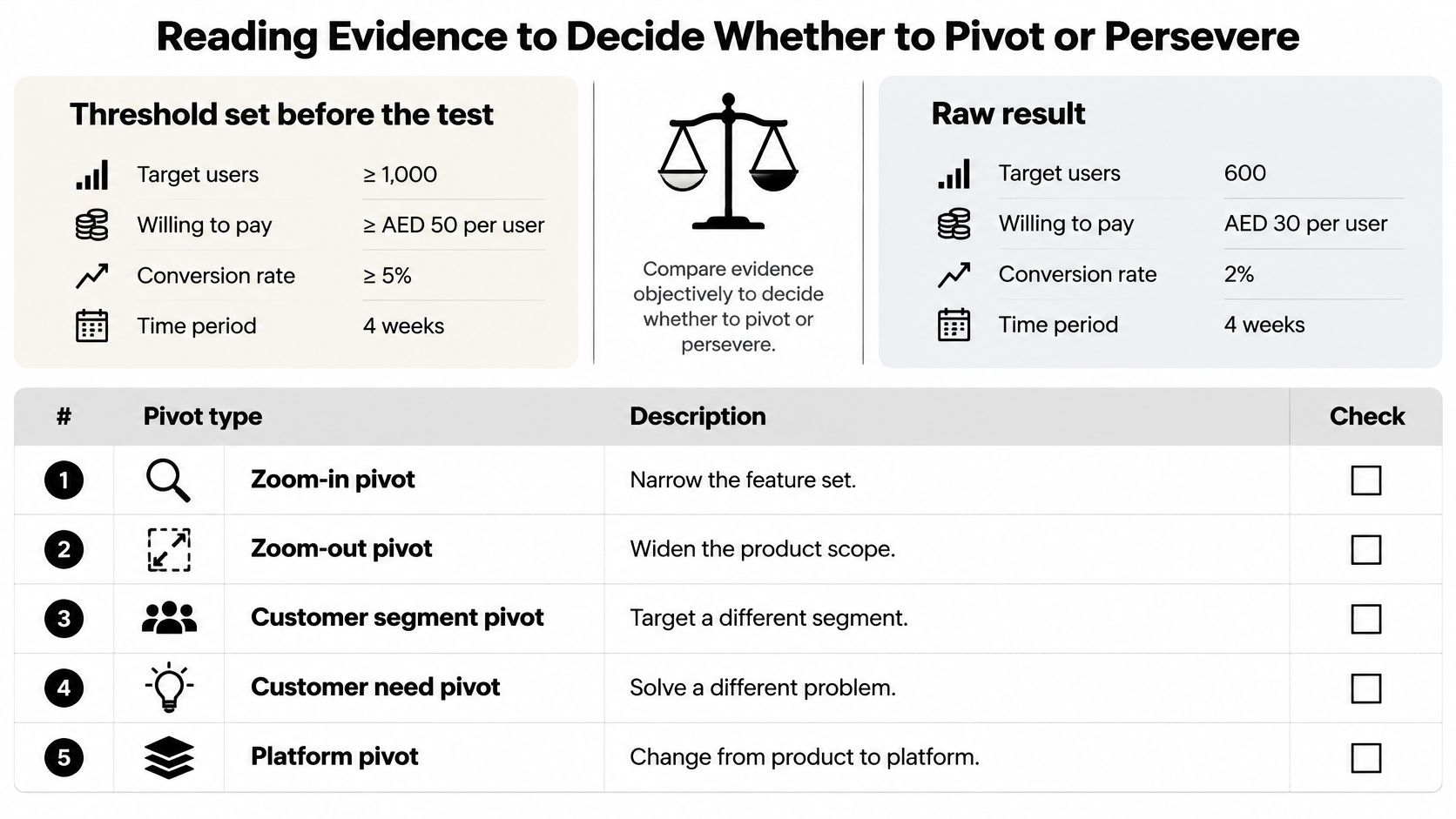
A miss is rarely a dead end. More often it is a clue about which part of the business the evidence has ruled out, and matching the result to the right change is the skill that saves a founder from rebuilding at random.
Pivot types and the evidence that points to each
| Pivot type | What changes | Evidence that points to it |
|---|---|---|
| Customer segment | The same problem sold to a different, easier to reach group | Interest and payment arrive from a group outside the target segment |
| Problem | The same customers, a different problem they keep pushing towards | Customers ask for an outcome other than the one that was built |
| Channel | How the product reaches customers, not what the product is | The test converts well through a route nobody planned |
| Price | The way you charge, from subscription to usage or a pilot fee | Prospects want the product but stall on price or commitment |
| Business model | How value is captured, such as service first and software later | Manual delivery earns money while the automated version doesn't |
Three checks that keep a result honest
- The sample matched the target. If the people who responded weren't the segment named in the hypothesis, the result measures a different question.
- The behaviour was real. Payment, repeat use or signed pilot terms count. A compliment, a "let's stay in touch" or an offer of an introduction doesn't.
- No single buyer or one-off moment explains it. One enthusiastic pilot customer or a busy conference week can manufacture a pattern that vanishes the following month.
Run these checks before choosing any row of the table. A payment from outside the target segment is interesting, but under the first check it answers a different question. A surge of signups during a conference week fails the third. Only a result that survives all three earns a decision, and a result that fails them needs a cleaner test rather than a bigger pivot.
Signals for persevering look different from the noise. The threshold was met, repeat behaviour appeared without prompting, and customers describe the problem before the founder mentions it.
For a spoken walkthrough of the same reasoning, the session below covers how founders read a result before committing to the next build.
Vanity evidence is the trap here: follower counts, applause at a pitch, a waiting list that never converts. In a market where the next round isn't a reliable step, the bar for continuing has to be firmer. Reporting on MENA venture funding records early-stage deals falling 45%, with capital remaining concentrated in Saudi Arabia and the UAE. That is the practical reason to justify building on repeatable revenue, growth achieved on modest spend and a clear next milestone.
Matching a result to the right change is easier when the destination is defined. How to find product-market fit for a UAE startup sets out what evidence looks like at each stage.
Keep a one-page decision log with five fields: hypothesis, threshold, result, decision and reason in one line. Five rows of that log say more about a business than a deck does, because the pattern across tests shows which assumptions keep failing and which keep paying.
Testing Regulation and AI Claims Before You Scale
For a regulated product, the rulebook is itself a business assumption, and it belongs in the same loop as price and demand. A founder who builds first and asks the regulator second hasn't validated anything. They've joined a queue.
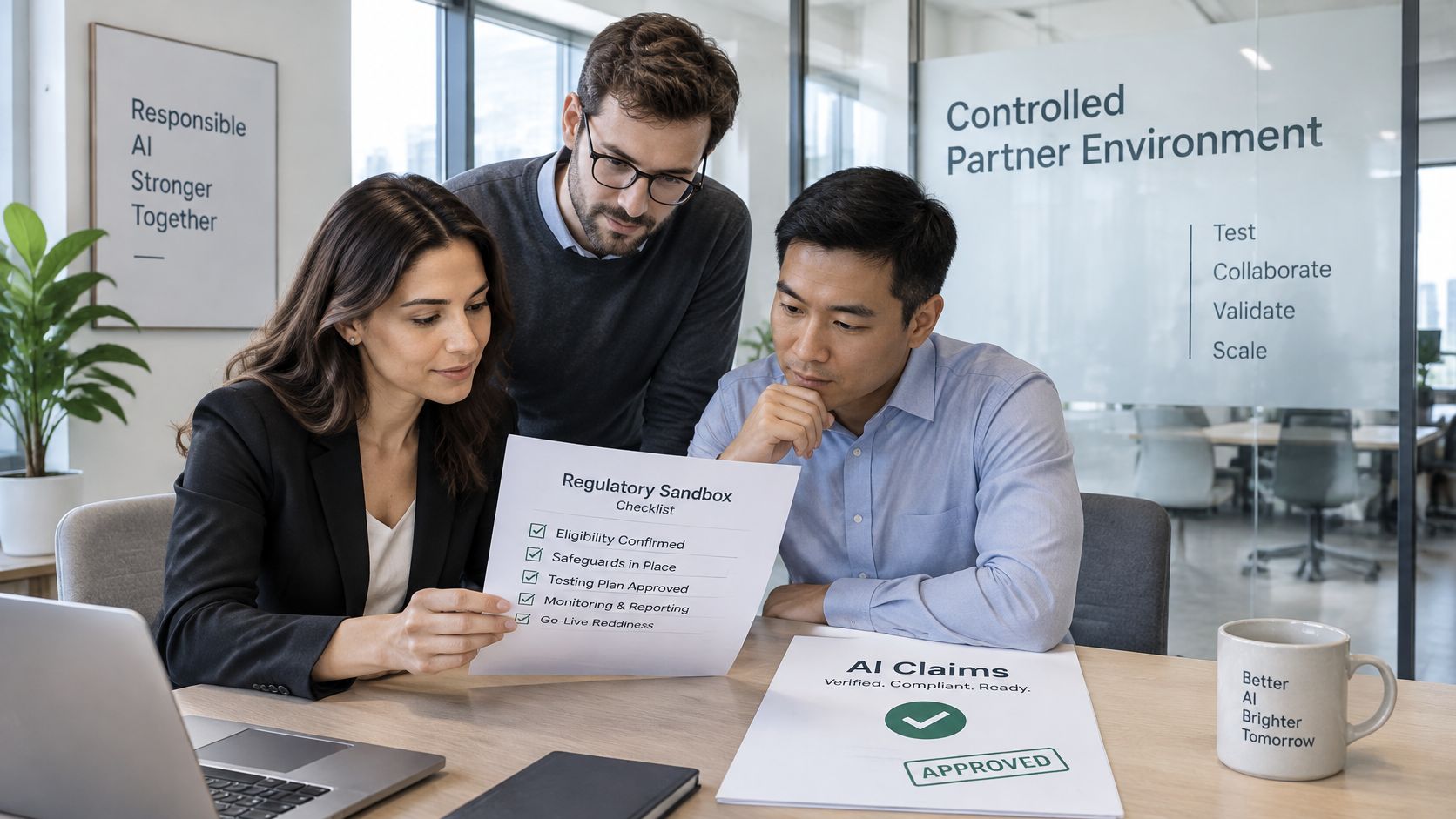
A sandbox turns the MVP into a bounded pilot
An OECD assessment of Abu Dhabi's startup ecosystem reports that a License enables an incubator to help startups validate new technologies and business models while remaining independent and conducting business-traction activities. Participating companies can test innovations in a controlled environment and, if successful, obtain a first customer reference that may open access to additional private clients.
That changes what a minimum viable product is. Instead of a functional prototype, it becomes a bounded pilot, and the pilot needs five things written down before deployment:
- the permitted use case
- the success metrics
- the data-handling conditions
- the points where the regulator gives feedback
- a go or no-go rule
Treat regulator approval, repeat usage and conversion to a paid reference customer as three separate metrics. One passing doesn't imply the other two, and a founder who assumes it does will scale on a false signal.
Test whether the AI earns its place
A founder describing the product as AI-first should test whether the model creates measurable value against a human or non-AI baseline. Same task, same customers, both routes measured, then compared. Track error rates across the languages and segments the product will serve, including Arabic and English, along with inference cost, gross margin, data permissions and the minutes a person spends reviewing output before it reaches a customer.
Regional funding has grown more selective about exactly that claim. AGBI's analysis of MENA venture capital notes that investors increasingly favour startups with clear AI use and a credible path to revenue, which raises the price of a demo that can't survive a baseline comparison.
Adding AI before product-market fit stacks compliance, reliability and cost risk into the same quarter. A simpler workflow product that customers pay for is often the better first test, with the model added once volume justifies it.
When a test changes an interface rather than a price, measure design decisions with real data keeps the judgement tied to observed behaviour instead of taste.
Build Your Assumption Log Before the Next Experiment
A page of writing comes before the next build. An assumption log takes twenty minutes and works like a pre-flight checklist: it separates what can be tested this month from what needs permission first.
Three columns, one line each.
- Customer problem, in the customer's words. "Service firms chase late invoices on WhatsApp every Friday" beats "SMEs need better cash flow tools".
- The smallest experiment capable of proving or breaking that belief, chosen from the test menu.
- The licence or approval the activity needs, if it needs one.
The test of a good log: every row names a behaviour someone could observe, not a feeling someone could report.
The third column is the one founders skip
Licensing changes the order of work, not just the paperwork. The starting-a-business guide on dubai.ae states that every mainland company requires a licence to operate, and its initial-approval process can ask for identification documents, residency or visa information, constitutional documents and, for some company types, a feasibility study. After initial approval and any additional approvals, the applicant can proceed to obtain the business licence.
Read against the log, that splits the experiments in two. Structured interviews and a paper prototype reveal whether the problem is real, and they can happen before any commercial activity. A paid pilot, a deposit or a live referral cannot. A founder planning a regulated fintech or health pilot should know which column each test falls in before booking a single customer meeting.
Four actions for the next two weeks
- Run the structured conversations and record behaviour rather than compliments.
- Choose one test and set its threshold in writing.
- Put the review date in the calendar, two to four weeks out.
- Take the log to peers who will ask what the number was.
Founder Connects runs The Playbook, a free, bi-annual, online Meetup where real founders share playbooks on AI agents, lead gen, fundraising and growth. It gives a founder one room to say the assumption out loud and have it challenged before money goes into code, ads or a regulated pilot. In a selective funding market, that order protects capital: riskiest assumption first, cheapest test next, licence check before spend.
Finish the log before writing another line of code.
Bring a one-line assumption, the cheapest test for it and the threshold set before the meeting. Founder Connects has hosted more than 1,000 founders and VCs at Meetups in Dubai and cities around the world, from Pitch Night & Mixer and Cofounders Wanted to Coffee Series, Tech After Hours and The Playbook, so a sharper question is usually one conversation away. Visit Founder Connects to find the next Meetup and bring the log with you.

Building in MENA? You don't have to do it alone.
Join 300+ founders in the Founder Connects Residency. Monthly squad calls, warm intros, $3M+ in perks, and much more. All for less than your monthly coffee budget.
Popular posts





Founder Connects is a premium tech founder community in Dubai and the world. Meetups, Residency Squads of 8–10, and a WhatsApp group of 600+ vetted founders.