

DMCC Free Zone Business Setup Guide: 2026 Process & Costs
Building in MENA? You don't have to do it alone.
Join 300+ founders in the Founder Connects Residency. Monthly squad calls, warm intros, $3M+ in perks, and much more. All for less than your monthly coffee budget.

You're probably in the same spot most founders hit early. You've decided Dubai makes sense, then immediately run into a mess of conflicting advice, setup agents, free zone comparisons, and vague promises about “fast incorporation” and “low cost”.
DMCC keeps showing up in those conversations for a reason. But a serious founder shouldn't pick it just because it's popular. The right question is simpler. Does DMCC fit your actual business model, cash position, and near-term operating plan?
This DMCC free zone business setup guide is written from that angle. Not brochure language. Just the practical choices that matter if you're building a tech company, a service business, an e-commerce operation, or something more regulated.
Why Every Founder in Dubai Considers DMCC
DMCC is usually on the shortlist because it solves three problems founders care about immediately. Credibility, activity coverage, and a process that doesn't force endless in-person back and forth.
The scale matters. DMCC is home to over 26,000 registered companies and supports more than 900 business activities, which is why it keeps attracting everyone from solo operators to larger cross-border firms, as outlined on the DMCC business setup page. In practical terms, that breadth reduces one common founder problem: choosing a free zone only to discover later that your activity, structure, or future expansion plan doesn't fit cleanly.

What founders actually like about DMCC
A lot of setup advice treats all free zones as interchangeable. They aren't.
With DMCC, founders usually value:
- Brand signal: DMCC is widely recognised in the market. That helps when you're speaking with banks, partners, landlords, and enterprise clients.
- Activity flexibility: A broad activity list gives you more room if your business sits between consulting, software, e-commerce, or trading.
- Digital onboarding: The setup flow is designed for online submission, document upload, and digital signing through the DMCC portal, which removes a lot of old-school admin friction.
Practical rule: A free zone choice is rarely about just getting a licence. It's about reducing future amendments, banking friction, and compliance surprises.
Why DMCC keeps winning attention from busy founders
If you're moving quickly, speed matters. DMCC's portal-driven process is built for founders who want to get from decision to operation without dragging setup across months of unnecessary admin. That doesn't mean every company gets instant approval. It means the system itself isn't the bottleneck if your paperwork and activity choice are clean.
DMCC is especially attractive when you want one jurisdiction that can support a consultancy today, a product company later, and regional expansion after that. That flexibility is why it keeps getting recommended, even by people who don't always agree on the “best” free zone.
Is DMCC the Right Choice for Your Tech Startup
For tech founders, DMCC is a strong option. It isn't automatically the best option.
The mistake I see most often is founders asking, “Is DMCC good?” That's too broad. The useful question is, “Is DMCC right for the way my startup will make money in the next year?”
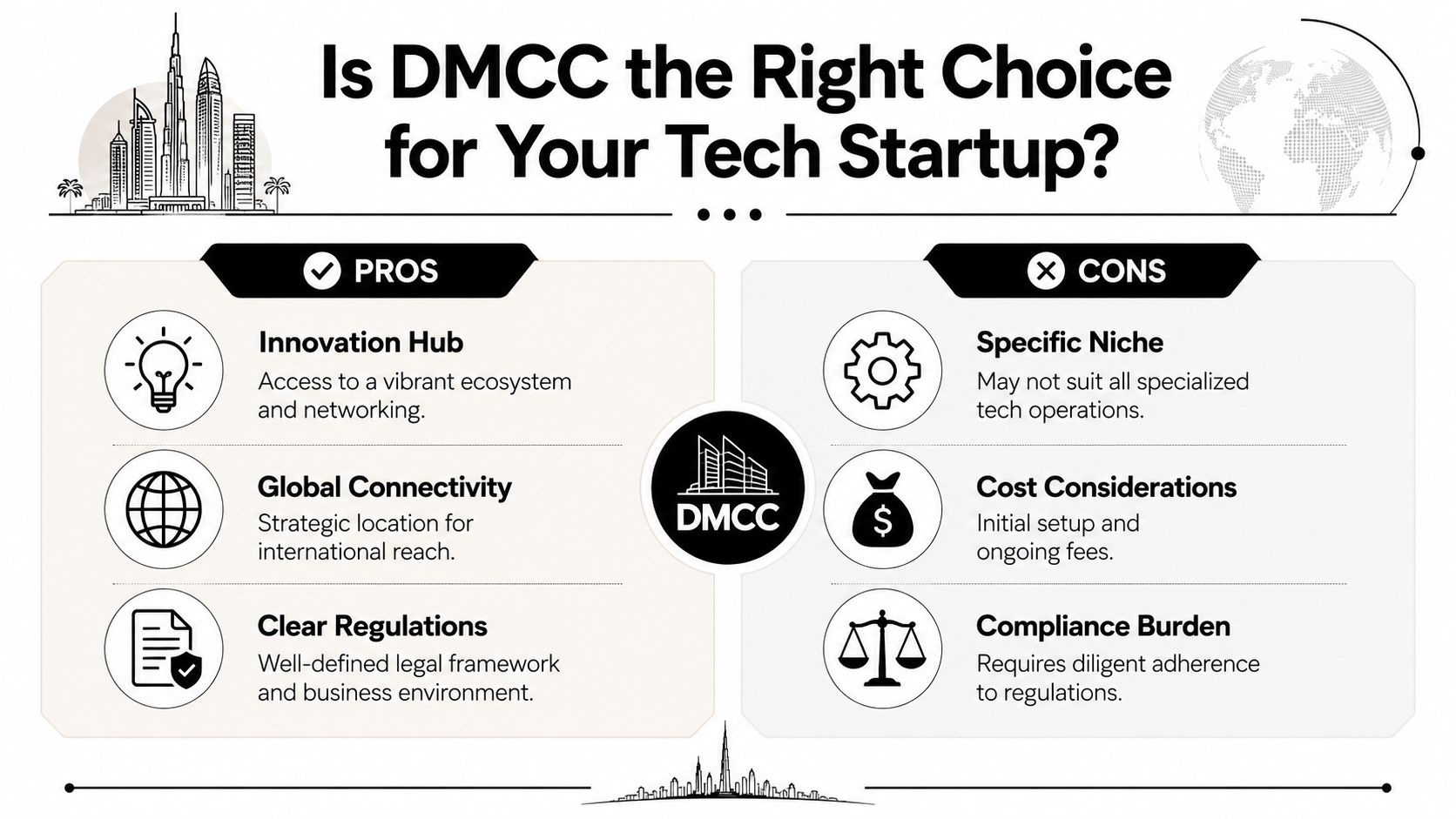
When DMCC fits a tech startup well
DMCC usually works well for tech businesses in these situations:
- B2B SaaS with consulting attached: If your startup sells software but also earns from implementation, onboarding, training, or advisory work, DMCC's broad activity environment tends to be useful.
- E-commerce or hybrid digital commerce: If you're selling physical goods alongside a digital layer, DMCC can make more sense than a zone built mainly around pure tech positioning.
- Cross-border service businesses: Agencies, dev shops, product studios, and remote-first service firms often choose DMCC because it balances reputation with operational flexibility.
A founder building a lean software company doesn't always need a “tech-themed” free zone. They need a place where the licence works, the bank account is realistic to open, and future changes don't become expensive admin.
When another zone may be a better fit
If your main value from a jurisdiction is ecosystem proximity, a more specialised zone may suit you better.
For example:
- DIFC may be more relevant if your identity is tightly tied to regulated financial services or fintech positioning.
- Dubai Internet City may feel more natural if your strategy depends on being physically close to a dense cluster of technology operators and enterprise counterparts.
- DAFZA can be worth comparing if your operating model is more trade-heavy or logistics-linked.
For a broader side-by-side view, this UAE free zones comparison for tech startups is a useful companion read before you commit.
The share capital nuance that matters for early founders
A common failing of generic DMCC content is its discussion of share capital, treating it as if every founder must approach it identically.
What matters for lean startups is this nuance: DMCC now allows flexi-setups with no upfront capital deposit for low-risk service businesses, which is a meaningful consideration for cash-conscious founders validating early offers, as noted in this DMCC area guide.
If you're running a low-risk service startup, don't structure your budget around assumptions meant for a more capitalised trading entity.
That doesn't mean every tech startup qualifies. It means you shouldn't assume the harshest capital interpretation applies to your case without checking your exact activity and setup route.
A simple founder decision test
Choose DMCC if most of these are true:
- You need flexibility: Your business may evolve across service, software, advisory, or trading-adjacent activities.
- You care about commercial credibility: You want a recognised Dubai base when speaking with banks, clients, and partners.
- You're not picking a zone purely for niche branding: You care more about operating cleanly than sounding “tech-native” on paper.
Skip DMCC, or at least compare harder, if your company needs highly specific ecosystem benefits that another zone clearly provides.
Decoding DMCC Licenses for Your Business Model
The licence choice isn't admin trivia. It defines what your company is legally allowed to do, and it shapes banking, compliance, and future amendments.
Most founders deciding on DMCC are really choosing between service, general trading, and commodity trading. If you get this wrong, you usually don't feel the pain on day one. You feel it later when a bank asks sharper questions, a client contract doesn't match your activity, or you need to amend the licence.
Service licence
This is the usual fit for knowledge businesses.
If you run a software development shop, growth agency, product consultancy, management advisory firm, recruitment boutique, or implementation partner, service is normally the cleanest route. It fits businesses where the main output is expertise, execution, or digital delivery rather than physical goods.
A lot of tech startups belong here, even if they think they need something more complicated. If your revenue comes from subscriptions, retainers, project work, or advisory, service is often the right starting point.
General trading licence
Many e-commerce founders land here.
If you import, export, distribute, or resell physical products, a trading route is usually more appropriate than a service licence. That includes consumer brands, B2B product resellers, electronics distributors, and founders building a commerce business with warehousing or supply relationships behind it.
The main practical difference is that your compliance and operations need to reflect goods movement, supplier relationships, and in some cases customs-linked processes. Don't try to force a goods business into a service structure because it seems simpler.
A clean licence match makes banking easier. A clever mismatch usually creates problems later.
Commodity trading licence
This is the specialised category. It isn't for founders who just like the sound of “trading”.
Commodity trading is aimed at businesses dealing in sectors that attract closer scrutiny, including precious materials and other commodity-linked activities. If your company sits here, expect more oversight and more documentation.
That increased scrutiny also affects timing. For regulated industries like healthcare or commodities trading, additional approvals from authorities such as the Ministry of Health or Dubai Customs must be obtained before final licence issuance, adding 30–60 days to the timeline, according to Healy Consultants' DMCC guide.
A founder-friendly way to choose
Ask these questions before you submit anything:
- What do customers pay you for: Advice, code, retainers, and delivery usually point to service. Physical inventory usually points to trading.
- Will you touch regulated products or sectors: If yes, expect approval complexity to increase.
- Could your revenue model change soon: If you plan to add physical goods later, think ahead now rather than amending under pressure.
If your startup touches digital assets, financial rails, or blockchain-adjacent operations, spend time understanding the wider regulatory environment too. This breakdown of UAE Central Bank DeFi regulation is useful context before choosing activities that could trigger extra review.
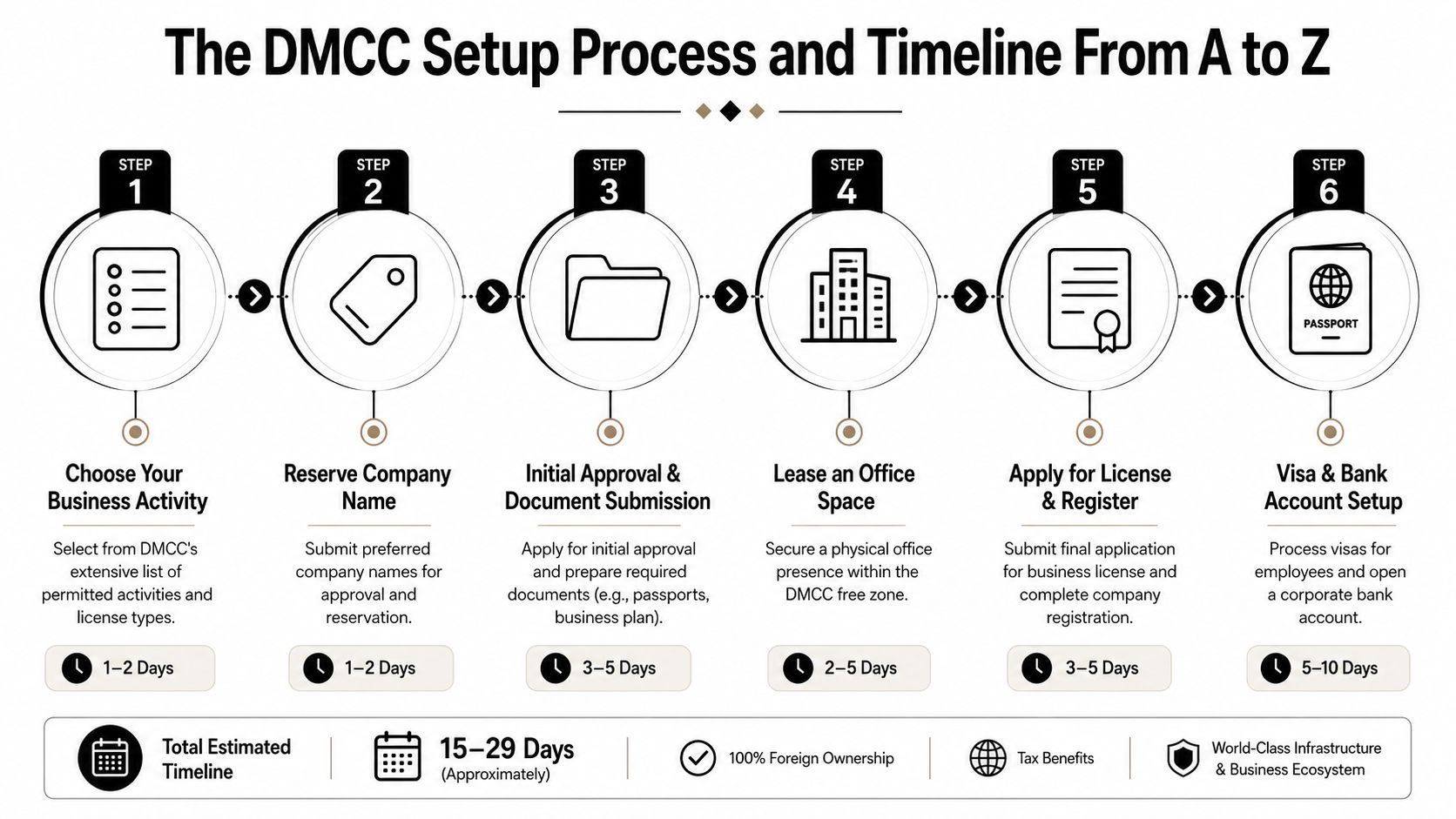
The DMCC Setup Process and Timeline From A to Z
A founder usually hits the same wall around day three. The portal looks straightforward, but then the crucial decisions start. Which activity will a bank accept, how much office do you need, and does the AED 50,000 share capital line change anything for a digital business that barely touches physical infrastructure?
That is why DMCC setup works best as a sequence of decisions, not a checklist. If you run a tech startup, the timeline depends less on form filling and more on whether your company story is internally consistent from day one.
Phase one, define the company you can actually operate
Start with the version of the business you can support with documents, contracts, and a credible banking narrative.
For a tech founder, that usually means resisting the urge to select broad activities just to keep options open. A software studio, SaaS business, IT consultancy, marketplace operator, and trading company do not read the same way to compliance teams. If your invoices will come from subscriptions, development retainers, or implementation work, your activity selection should reflect that clearly.
This is also the right point to pressure-test whether DMCC is the best fit. If your startup is digital-first, has no real need for JLT presence, and wants the lowest possible operating cost, compare your plan against other free zone options before you commit. This Dubai free zone setup cost guide helps frame that decision properly.
Choose the company name in the same pass. Names get delayed for predictable reasons. Restricted words, regulated wording, and brand names that do not match the activity are common examples.
Phase two, get initial approval and prepare for the banking reality
Once you submit the application, DMCC reviews the proposed structure, shareholders, activity, and supporting documents. Initial approval matters because it confirms that your file is broadly acceptable before you spend more time and money on the later stages.
For startup founders, this phase has a second purpose. It forces early discipline around banking.
If your cap table is messy, your business description changes every time someone asks about it, or your source documents are scattered across email threads, the process slows down fast. The portal may still move, but the company is not really setup-ready until your shareholder documents, business summary, and ownership trail are clean.
The share capital point also starts to matter here. DMCC commonly states a minimum share capital requirement of AED 50,000 for many company types. In practice, founders should treat that as a structuring and banking issue, not just a line in the incorporation documents. The question is not only whether capital is required on paper. The practical question is whether your bank, shareholders, and setup plan are aligned on how that capital is shown and when it may need to be evidenced.
Phase three, secure the office that fits your operating model
DMCC requires a registered address inside the free zone before licence collection. For a tech startup, this is one of the easiest places to waste money.
A flexi-desk usually works for solo founders, lean product teams, and service-led startups that sell remotely. A private or serviced office makes more sense if you need regular in-person operations, plan to hire locally soon, or want more room for visa capacity and future expansion.
I have seen founders overbuy here because they assume a bigger office signals credibility. Banks care more about consistency than appearances. If your startup is remote-first, your office should support compliance and visas, not founder ego.
Here's a useful walkthrough to watch before you choose the route:
Phase four, sign the final documents and collect the licence
After the office is locked in and the remaining documents are approved, DMCC moves to final incorporation steps and licence issuance.
The licence stage itself is often faster than founders expect if the file is clean. The slower part is everything around it. Clarifications on shareholder documents, office changes, name revisions, and banking-related requests create more delay than the actual issuance step.
A realistic founder timeline usually looks like this:
- Days 1 to 5: Finalise activity, legal structure, shareholder documents, and company name
- Week 1 to 2: Submit the application and respond to initial review comments
- Week 2 to 4: Secure office space, sign required documents, and complete incorporation formalities
- After licence issuance: Start immigration, establishment card, and visa steps if needed
For straightforward service or tech setups, the company can move fairly quickly. For founders who are still changing the model mid-process, each correction pushes the clock out.
What actually causes delays
The portal is rarely the problem. Founders usually lose time in four places.
- Activity drift: The licence activity says one thing, the website says another, and the pitch deck says something else.
- Weak shareholder file: Passport copies are easy. Source-of-funds support, ownership clarity, and clean company documents are where issues appear.
- Office hesitation: Founders wait too long to decide because they are trying to optimise for year three instead of year one.
- Misreading the capital requirement: The AED 50,000 share capital point is often treated as a box-ticking step, even though it can affect banking conversations and internal planning.
The fastest DMCC setup is usually the one with the fewest late-stage changes. Pick the activity you can defend, choose the cheapest compliant office that fits your model, and sort the capital narrative before anyone asks for it.
A Realistic Breakdown of Your DMCC Setup Costs
Most cost discussions around DMCC are either too vague or too optimistic. Founders need a working budget, not marketing language.
The right way to model DMCC is in three layers: base government fees, setup package and office cost, and capital or banking requirements.
The numbers that are fixed first
Start with the fees that are clearly defined.
Business setup costs for a DMCC Free Zone company typically range between AED 35,000 and AED 70,000, while base government fees include a fixed Registration fee of AED 9,020 and an Articles of Association fee of AED 2,020 per application, according to this DMCC setup cost breakdown.
That gives you a floor for planning, but not your exact number. Your total cost still depends on licence type, office choice, and visa needs.
Estimated DMCC Setup Costs 2026
| Cost Item | Estimated Cost (AED) | Type |
|---|---|---|
| Registration fee | 9,020 | Base government fee |
| Articles of Association fee | 2,020 | Base government fee |
| Total setup cost range | 35,000 to 70,000 | Typical overall setup range |
| Share capital requirement for most setups | 50,000 | Capital requirement |
The broad lesson is simple. The headline setup range is not the same thing as all-in cash pressure on day one. That distinction matters a lot for bootstrapped founders.
The share capital issue founders misunderstand
This is the part people either exaggerate or explain badly.
For most setups, the minimum share capital is AED 50,000. It's a real rule, not a casual suggestion. But the founder decision isn't just “can I afford it?” It's “does my activity and structure require me to treat this as immediate locked operating cash?”
Some low-risk service businesses may qualify for a flexi setup with no upfront capital requirement, while the capital threshold remains a hard rule for standard FZE and FZ-LLC structures, as described in this DMCC share capital explanation.
Founder shortcut: Don't ask “What's the share capital?” Ask “For my exact activity, entity, and office setup, when does it need to be shown or deposited?”
That question gets you a much more useful answer.
What changes your cost profile most
Your budget usually moves based on these variables:
- Office format: Flexi-desk keeps things lean. A physical office increases commitment fast.
- Licence category: A simple service business is usually cleaner than a regulated or trading-heavy setup.
- Visa plan: Founders often underestimate the knock-on cost of needing residency and future hires.
- Banking complexity: Extra document work and delays don't always show up as a fee, but they still cost time and momentum.
If you want a broader planning reference beyond DMCC alone, this business setup in Dubai free zone cost guide is useful for comparing assumptions across structures.
What works for lean founders
If you're validating a startup, the cost-efficient route is usually:
- Start narrow: Choose the minimum clean activity set that matches revenue.
- Use the smallest office solution that still supports compliance: Don't rent for optics.
- Confirm the capital treatment early: Especially if you're a low-risk service business.
- Budget for post-licence operations too: Banking, residency, and execution matter as much as formation.
What doesn't work is setting up an expensive structure before product validation, then discovering your actual commercial model needed a simpler route.
Your Next Steps After Getting Your DMCC License
Getting the licence isn't the finish line. It's the point where setup turns into operating discipline.
The first move is usually banking. With your licence and company documents ready, your bank conversations become much more concrete, requiring consistency across your business description, contracts, founder profile, and expected transaction narrative.
The immediate post-licence checklist
- Open the corporate bank account: Keep your company profile, shareholder documents, and business narrative aligned.
- Apply for your visa and residency steps: Founders often delay this, then create unnecessary pressure on travel and hiring plans.
- Plan employee sponsorship only when needed: Don't build admin overhead before the team requires it.
- Set up tax and compliance routines early: This UAE corporate tax for startups explained guide is worth reviewing before your first filing cycle sneaks up on you.
What smart founders do next
The better founders shift quickly from formation to traction.
That means tightening the sales pipeline, documenting finance properly, and pressure-testing the next funding milestone. If capital is part of your roadmap, this guide for startup funding challenges is a useful read because setup success doesn't remove the usual fundraising frictions.
Your licence gives you the vehicle. It doesn't give you momentum. The next wins come from clean execution.
DMCC can be a strong base if you chose it for the right reasons. If you didn't, the friction shows up later in cost, compliance, and awkward operational workarounds. That's why the smart move is to treat setup as a strategic decision, not a paperwork exercise.
If you want practical founder support after setup, Founder Connects is built for exactly that stage. It brings UAE and MENA founders into curated peer groups, relevant one-to-one introductions, and high-signal conversations that help you make better decisions faster.

Building in MENA? You don't have to do it alone.
Join 300+ founders in the Founder Connects Residency. Monthly squad calls, warm intros, $3M+ in perks, and much more. All for less than your monthly coffee budget.
Popular posts





Founder Connects is a premium MENA tech founder community. Meetups in Dubai and across MENA, Residency Squads of 8–10, and 400+ vetted WhatsApp founders (apply and screened).