

Founder Meetups for Climate and Sustainability Startups in Dubai

Building in MENA? You don't have to do it alone.
Join 300+ founders in the Founder Connects Residency. Monthly squad calls, warm intros, $3M+ in perks, and much more. All for less than your monthly coffee budget.

Why would a climate founder in Dubai spend an evening in a room full of generalist builders when the venture is, by definition, sector-specific?
Because the sector label rarely matches the problem. A founder working on building-energy analytics and a founder working on waste logistics run into the same walls: metering data they don't control, a buyer who needs finance sign-off, and an impact claim that has to survive somebody else's scrutiny. Founder Meetups for Climate and Sustainability Startups in Dubai work best when the founder treats the room as a place to test one problem, not a place to announce a category.
Climate and sustainability founders use the same Founder Connects Meetup calendar as every other builder. The advantage lies in arriving with one measurable problem and finding the peers working on adjacent ones, because that's where feedback usually comes from.
Which Founder Meetup Fits a Climate Startup
Climate and sustainability founders in Dubai use the same Founder Connects Meetup calendar as other builders, so there's no separate climate track to hunt for. The useful variable isn't the label on the room. It's what the venture is missing this month: a hard question answered, a partner found, or an hour of unforced conversation with people who've made the same decision.
Founder Connects Meetup formats for climate founders
| Meetup | Format | Best first use for a climate founder |
|---|---|---|
| Pitch Night & Mixer | In person | Testing a 60-second problem statement |
| Cofounders Wanted | In person | Finding a technical or domain cofounder |
| Coffee Series | In person | Small-table problem checks |
| Tech After Hours | In person | Informal peer contact with no pitches |
| The Playbook | Online | Learning playbooks before attending in person |
The gap between formats is narrower than it looks. A founder who can't explain the problem in 60 seconds can't brief a cofounder or hold a useful one-to-one either, so the 60-second version is worth building whichever Meetup comes first. Most founders get further from two formats in a month than from one repeated five times.
The peer pool makes the practice worthwhile. The Dubai Chamber of Digital Economy's 2024 Startup Guide reports that the UAE had more than 1,000 startups, with Dubai accounting for 86% of them. Density is the point. Feedback sharpens when the person across the table has already run the pilot, hired the engineer or lost the tender.
For a sense of what a first session feels like, from arrival to the last conversation, what to expect at a tech founder Meetup in Dubai walks through the room and the rhythm. Pick one format for the next 30 days and put it in the diary.
What a Startup Pitch Is and Its Key Components
A startup pitch is a short, structured account of the problem a company solves, why the solution works, the evidence behind it and the specific ask. That's the whole definition. Its purpose isn't to win the room. It's to earn the next useful conversation, whether that's a peer's judgement on one assumption, a potential partner, a pilot site or a second meeting.
Six components carry the weight. Skip any of them and the listener fills the gap with a guess, usually an unflattering one.
| Component | Question it answers | Climate example |
|---|---|---|
| Problem | What is wrong, and where does it occur? | Night-time cooling waste in office buildings |
| Buyer | Who pays and who signs off? | Facilities manager with finance approval |
| Solution | What changes in the current workflow? | Sensors flag idle floors for setback |
| Evidence | What has been measured against a baseline? | Pilot readings compared with billing data |
| Route to revenue | How does the business earn, and what does the buyer commit to? | Annual licence per site |
| Ask | What is the one thing needed now? | A pilot site with metered data |
A building-energy team might open with facility managers who can't see which floors waste cooling overnight. The buyer is the facilities manager with finance sign-off. The change is sensors flagging idle zones for setback. The evidence is pilot readings checked against billing data, revenue comes from an annual licence per site, and the ask is a pilot site with metered data.
That version survives follow-up questions. "We use AI to decarbonise real estate" doesn't, and it invites the room to assume the founder hasn't spoken to a buyer.
Delivery matters as much as content. Timing, slide order and how to handle the first hostile question are covered in how to give better startup pitches.
What Climate Peers Will Test in Your Pitch
Peer feedback only gets useful when the claim becomes a number and the number arrives with a method.

Climate and sustainability founders lose more time to vague impact language than to weak technology. A peer will push past "reduces energy use" and ask what is measured: kilowatt hours saved, cubic metres of water avoided, tonnes of waste diverted, tonnes of CO2e reduced. Then who verifies it, and against which baseline. Then the first customer workflow the product changes, the deployment cost and the time to payback.
The follow-up questions split by build type.
- Hardware ventures: availability, useful life and performance under Dubai's heat and dust, where derating and maintenance intervals decide the economics more than the spec sheet does.
- Software ventures: how much forecasting accuracy, dispatch, demand response or asset utilisation improves against the current method, with that method named rather than implied.
Non-climate founders in the same room ask about pricing, sales cycle and team, which is why a mixed room earns its keep. A founder selling into industrial buyers gets more from someone who has run B2B procurement than from someone who shares a sector label and nothing else.
Founders whose impact story reaches past carbon, into land, water and habitat, increasingly get asked to frame it in commercial language. Biodiversity's role in economic output is a useful primer on the vocabulary buyers now use, and it helps a founder answer the "so what does it change for the operator" question without reaching for ethics.
For founders deciding how the product earns, cleantech business model pathways in the UAE market covers the commercial shapes that tend to survive contact with real buyers.
Before you walk in: which operational data does the product produce, against which baseline, and who signs off the result?
A founder who can answer those three in a minute gets more from the room than one who needs five minutes to explain the category.
How to Frame One Clear Problem Before You Attend
A founder who arrives with three problems gets advice on none of them. The framing sequence below takes about 20 minutes and pays for itself in the first conversation.
- Write the problem in one sentence. Name the operational inefficiency or the emissions source, not the company. Peers can react to "facility managers can't see which floors waste cooling overnight" and can't react to "we're a climate-tech platform". The usual slip is describing the business instead of the problem.
- Name the primary sector. Power, water, waste, buildings, transport, industry or agriculture, and pick one. The UAE Net Zero 2050 programme organises its work across six core sectors, as the Ministry of Climate Change and Environment sets out, which is a reminder that claiming all of them reads as claiming none.
- Name the first buyer and their decision role. A facilities manager and a finance lead ask different questions, and the person who signs rarely sits where the problem happens. Naming both stops the room from guessing.
- State the evidence you hold today. A paper model, a pilot, five interview notes or a paid site: say which. Peers calibrate advice to maturity, and overstating it earns advice for a stage you're not at.
- Write the one question you need answered. "How do I verify avoided energy on a site with limited metering?" gets a specific answer. "Any advice?" gets a shrug dressed up as encouragement.
- Name the kind of adjacent founder you want to meet. A team working on a related sector, a shared data source, or the same buyer. That's a searchable description rather than a hope.
- Compress it to 60 seconds and test it on one peer first. The first delivery is always too long. Running it once before the Meetup strips the filler out.
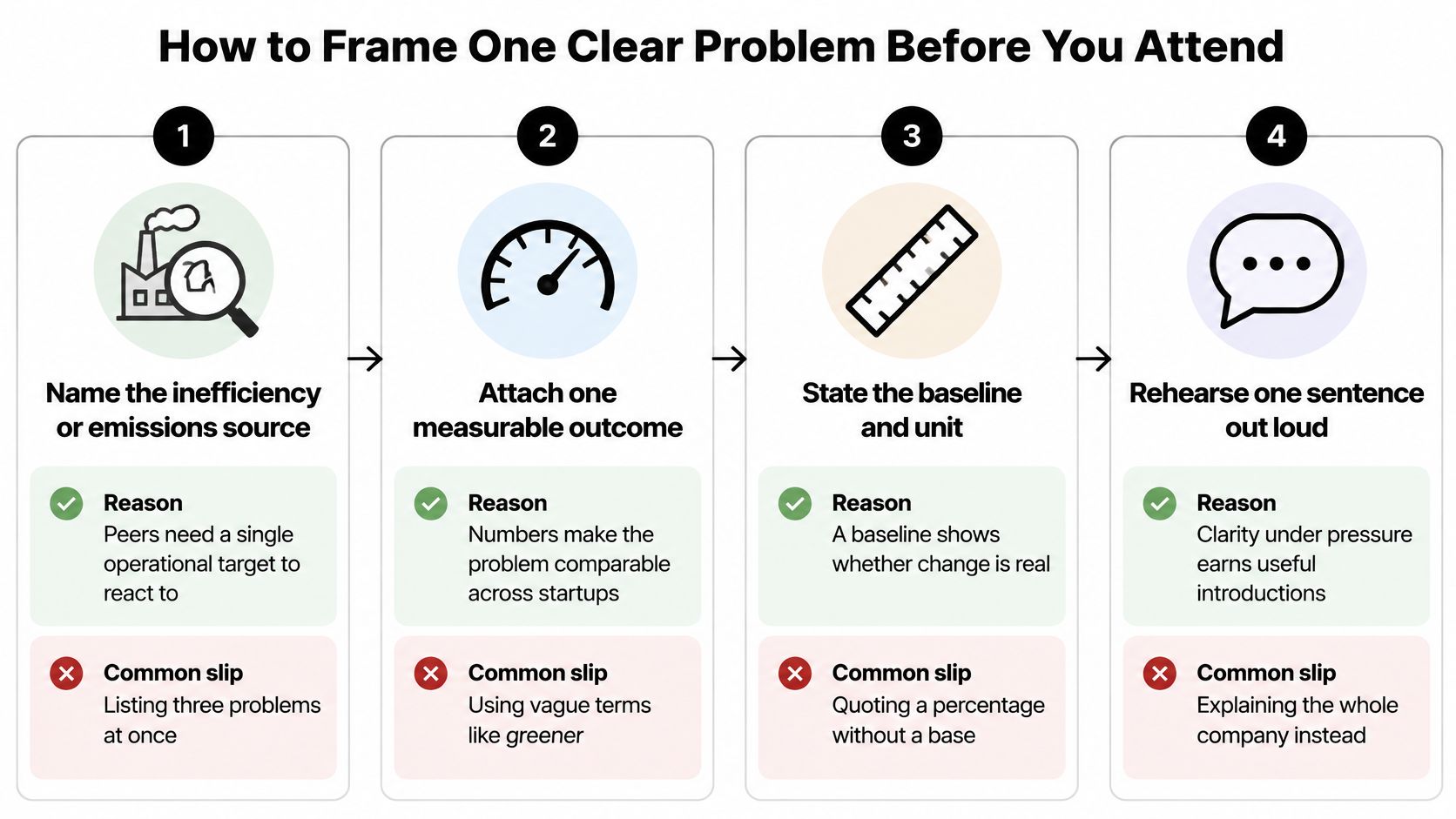
Then check the result against three tests: one line, one buyer, one question. If the problem needs a slide to explain, it's still a business description, and the 60 seconds at Pitch Night & Mixer will go on context rather than on the thing you needed help with.
Peer Pairings That Work for Adjacent Problems
Peer value comes from adjacency, not similarity. Two founders with the same pitch compare notes on the same wall. Founders working on neighbouring problems compare methods, and the method is where the useful detail lives. Treat the four pairings below as archetypes rather than assignments.
Building-energy analytics with industrial efficiency. Both live or die on metering quality, and both get blamed when the client's data turns out to be unusable. The first question is "what's your worst data source?" The follow-up that earns its keep is a comparison of metering setups and what each one cost to install.
Carbon accounting software with low-carbon logistics. Both depend on emissions data that operators must supply, and both lose deals when the operator refuses. Ask "which number does your customer refuse to give you?" Then swap data collection templates, because the fields that survive a real customer are usually fewer than the fields in the spec.
Waste diversion with water-efficiency hardware. Both need site access and a facility operator willing to change a routine that has run unchanged for years. Ask "who let you onto site, and what did it take?" The follow-up is a side-by-side of the site permission path, since the second installation is always cheaper than the first.
Clean-energy software with hardware. Forecasting, dispatch and asset performance questions overlap more than either founder expects. Ask "what does your model get wrong in summer?" Then exchange one test case each, ideally one where the answer was inconvenient.
A founder missing a technical or domain partner should look at Cofounders Wanted, because that search is different from peer feedback and deserves its own preparation: a specific role, a described scope and a clear view of what the first three months look like.
The barriers these pairings expose are shared rather than individual. PwC's research on piloting to scale reports that UAE climate-tech founders cite high pilot costs, limited climate-tech zones for industrial decarbonisation and grid innovation, weak investor appetite for hardware and insufficient predictable demand, alongside multiple siloed entry points across regulators, accelerators and investors. Two founders comparing notes on the same silo learn faster than one founder reading the same list alone.
The target is a peer working on an adjacent problem, not a competitor rehearsing the same pitch.
How to Work the Room and Follow Up Well
Three questions do most of the work in a first conversation. They're specific enough to be answered in a minute and open enough that the answer shows what the founder is stuck on.
Three questions that open a room: What are you testing this month? Which buyer have you spoken to? What evidence would change your mind?
The habits that separate a useful evening from a pleasant one are unglamorous.
- Arrive with the 60-second version. It's the entry ticket to every other conversation, and it signals that you respect someone else's time.
- Ask before you pitch. A question about their month gets a real answer; a rehearsed monologue gets a polite nod and an exit.
- Keep the conversation on the problem. Company history, funding plans and market size are for another setting.
- Don't work the room for money. Meetups are built for peer learning and conversation, so ask for judgement on the problem rather than for a cheque.
- Close with a specific ask. "Can I send you the metering plan for a ten-minute read?" works. "Let's stay in touch" doesn't survive the week.
Follow-up within 48 hours, and carry one useful item rather than gratitude. A template, a dataset structure or a question the peer can put to their buyer keeps the thread alive. A thank-you note rarely earns a reply, and it never earns a second conversation.
The three-line follow-up: the problem you discussed, the one thing you'll test next, and the specific point you want feedback on.
When a conversation needs more than a queue allows, the Coffee Series offers a smaller table for closer problem checks, and how Coffee Series conversations usually run covers preparation. For the wider picture of building a network across Dubai and the UAE, startup Meetup networking in the UAE is the place to start. The room itself rewards people who read it well, and founder Meetup etiquette and the unwritten rules of the room covers the details nobody explains.
Should a climate founder share unpublished site or customer data at a Meetup?
Usually not. Share the problem, the method and anonymised ranges, and keep the specifics for a signed agreement. A peer can judge a method without seeing a customer's name or a site's metered output. Founders who overshare in a first conversation often spend the rest of it worrying about what they said.
Can a pre-revenue climate hardware founder benefit from these Meetups?
Yes, if the founder brings a specific pilot plan, a named site condition and one precise question. Choose the format by priority: Pitch Night & Mixer for feedback on the problem statement, Cofounders Wanted when the gap is expertise rather than input. A vague "we're looking for a pilot" gets vague sympathy.
Should a founder pitch investors at a Meetup?
Meetups are built for peer learning, feedback and conversation, so treat the room as a place to sharpen the problem rather than to raise funds. A founder who asks peers what they would measure walks away with something usable. A founder who works the room with a deck walks away with polite contacts and no new information.
Booking steps come next.
Book Your First Meetup and Test Your Problem
Choose one Meetup from the table at the top of this guide, based on the first use that fits your stage. Book through the Founder Connects Meetup page, or check the Luma calendar for what's next.
Booking isn't a formality. Attendees pick the Meetup, book a seat and show up, and walk-ins are turned away because room size is capped for quality.
Before the session, write your one-sentence problem, list the evidence you hold, and draft the three-line follow-up. Then run a 30-day experiment: attend one in-person Meetup and one online Playbook session, and log which piece of peer feedback changed the problem statement. That log is the only measure worth tracking at this stage.

One small discipline protects the seat you booked. Replying to the confirmation promptly, and releasing it if plans change, keeps the room full for the people who need it.
Founder Connects is a startup community in Dubai and the world. 1,000+ founders attended Meetups in the last few months, with Meetups in Dubai and in cities around the world, and the WhatsApp network has 500+ vetted founders. Founders apply and are screened.
Book one seat this week.
Climate and sustainability founders come to Founder Connects for straight answers from peers instead of another round of business cards. Its Meetups, Pitch Night & Mixer, Cofounders Wanted, Coffee Series, Tech After Hours and The Playbook give a founder room to test one measurable problem and hear how someone working on an adjacent one would solve it. Visit Founder Connects to see what's coming up and book a seat.

Building in MENA? You don't have to do it alone.
Join 300+ founders in the Founder Connects Residency. Monthly squad calls, warm intros, $3M+ in perks, and much more. All for less than your monthly coffee budget.
Popular posts





Founder Connects is a premium tech founder community in Dubai and the world. Meetups, Residency Squads of 8–10, and a WhatsApp group of 600+ vetted founders.