

Founder Meetups in Beirut: What Tech Founders Should Expect

Building in MENA? You don't have to do it alone.
Join 300+ founders in the Founder Connects Residency. Monthly squad calls, warm intros, $3M+ in perks, and much more. All for less than your monthly coffee budget.

Tech founders should expect a mixed Beirut scene: broad community meetups for discovery, hubs and programmes for structure, selective pitch formats for visibility, niche technical groups for depth, and Founder Connects Meetups for a high-signal founder room. The best choice depends on whether your goal is peers, talent, mentorship, investors, or wider ecosystem exposure.
Beirut offers useful founder rooms, but they're not interchangeable. Some are broad and social, some are programme-based, some are technical, and some are built around pitching rather than honest peer conversation. Founder Connects has a live Beirut chapter for founders who want moderated, high-signal Meetups. It doesn't curate or match attendees, so choose the format and room for yourself, then arrive with a clear reason to be there.
Use the distinction between room types to avoid treating every listing as generic networking. LeadBeast's founder outreach playbook is useful for the follow-up mindset: clear relevance and a specific next step matter more than collecting contacts.
1. Beirut Startup: Idea to IPO
Start here if you want discovery, not depth. Beirut Startup: Idea to IPO runs a broad Meetup community page listing founders, technologists, investors, professionals, and people still exploring entrepreneurship, with online activity alongside its Beirut presence.
That breadth suits a first-time founder. The listings cover startup work plus adjacent topics such as technology, finance, and company-building, so you can hear what the ecosystem is discussing before you narrow your focus. Use it to scan the scene.

Check the host, not just the listing
Variability is the main trade-off. Outside organisers host some sessions, so the community name alone tells you little about the format, audience, or quality of a given event. Read the named host, agenda, and registration terms before you commit an evening.
Expect a mixed crowd, and don't assume every attendee is building a startup. The page displays a rating of 3.9 out of 5 from 18 ratings, a thin sample, so judge each session on its own details rather than the group average.
Before you go: Write down one kind of person you want to meet and one question you want answered. If the listing doesn't suggest either will be relevant, choose another room.
For context beyond Beirut, compare this open community format with Founder Connects Meetups across Nairobi, Beirut, and Cairo. If a listed session involves pitching or a finance workshop, the Capital Express guide to pitch-ready finances gives you a checklist for whether your own numbers are ready to discuss.
2. Berytech
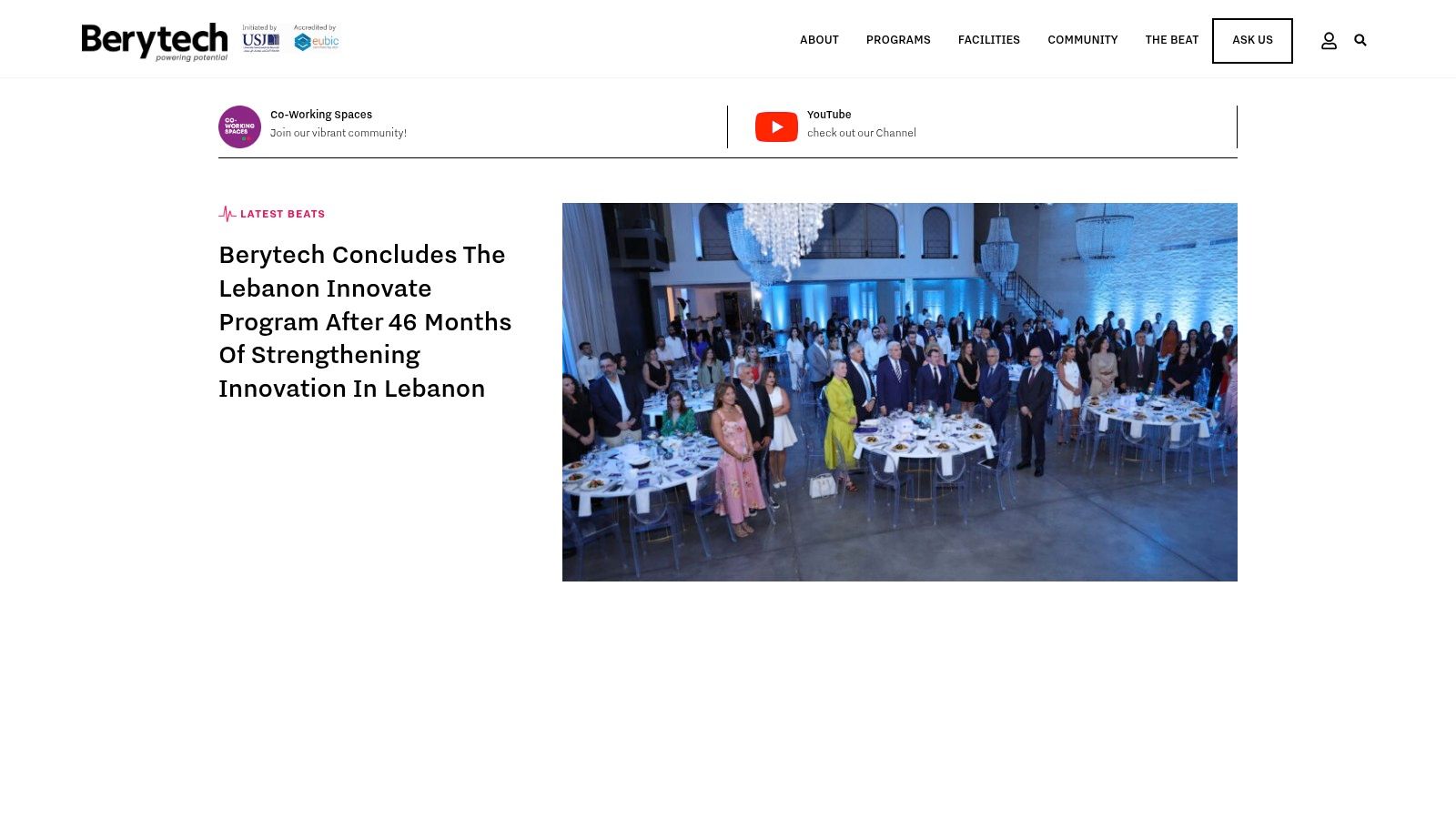
Choose Berytech when you want more than a room to meet people. It combines entrepreneurship events and workshops with startup and SME support, mentorship and growth initiatives, and coworking or office options at Beirut locations. Its official website is the place to check current activity and programme details.
Berytech's sector coverage extends beyond software. Founders working in areas such as food, agriculture, energy, and cleantech can find a more relevant ecosystem than they might in a tech-only gathering. That cross-sector range can be useful when your product depends on industry expertise, physical operations, or partners outside the usual software circle.
Match the activity to the help you need
Berytech offers several ways to engage, from attending an event to exploring workspace or applying for a programme. Those aren't interchangeable. A workshop can offer a focused learning experience; a programme may involve eligibility requirements and a longer commitment; coworking gives you a place to work, not automatic access to mentorship or a founder peer group.
Before registering, check the event date, format, cost, and any application or participation conditions. Programme fit can vary, and some initiatives are sector-specific. Don't assume a general community listing means a particular support programme is open to every founder.
Make your ask concrete: If you're attending a workshop, bring one current decision, such as how to test a customer segment or assess a potential partner. You'll get more from a practical question than from a general request for advice.
Berytech suits founders who want to combine ecosystem contact with a practical support route. If you're only looking for a casual technical discussion, a specialist community may be a better use of your time.
3. Beirut Digital District (BDD)
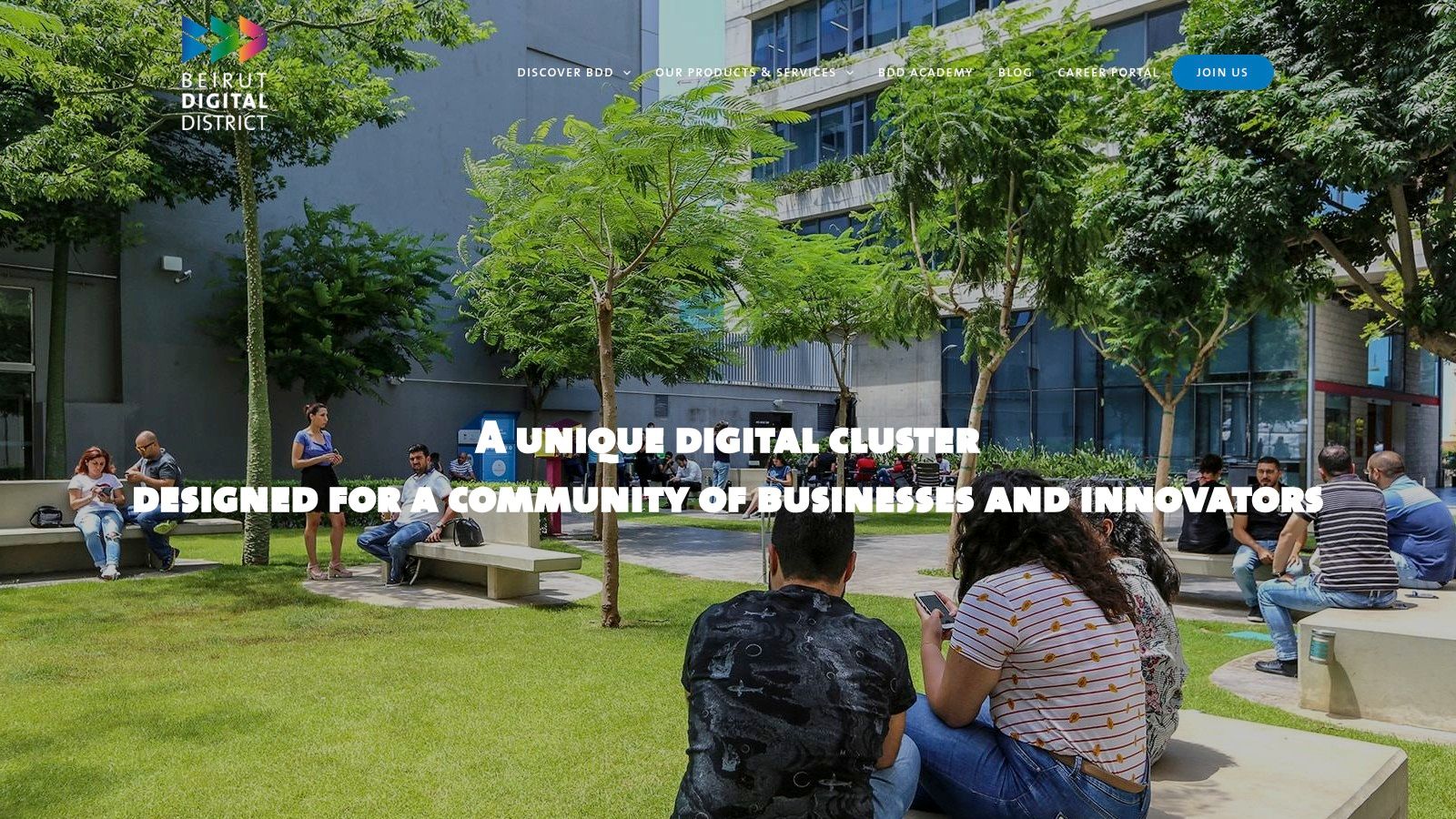
BDD is a workspace and ecosystem hub in Beirut, which makes it a different kind of choice from a single meetup. Its facilities cover hot desks, private offices, meeting rooms, and event spaces, and the community mixes startups, companies, and other organisations. Check the BDD website for current access options and services.
Decide what the hub is for before you pay for it
BDD hosts pitches, demo days, workshops, and other ecosystem activity. If you need a physical base, meeting space, or repeated contact with people working around Beirut startups, a hub earns its cost. The BDD app handles booking for passes, rooms, and services, though what you can access depends on your plan or the specific event.
Here is the honest trade-off. Shared space gives you proximity. It does not hand you a peer group. You can sit among founders for months and still have nobody to call about a hard decision. The room only pays off if you attend sessions, start conversations, and arrange your own follow-ups.
Pricing varies by plan and booking type, so confirm costs with BDD directly before committing. Old listings and third-party summaries go stale fast.
Practical test: Ask whether you need a regular place to work, a room for one specific meeting, or an ecosystem gathering. If you cannot name which, hold off on a workspace plan.
Founders weighing regional formats can compare this setup with what tech founder meetups in Dubai look like. Use the comparison to sharpen what you want from a Beirut room. Access models and event density differ between cities, so do not assume the same format transfers.
4. Asher Center for Innovation & Entrepreneurship (ACIE), USEK
ACIE suits founders who want learning and structured support rather than an unplanned networking session. The entrepreneurship centre associated with Holy Spirit University of Kaslik runs founder conversations, validation and growth workshops, demo days, and incubation-program activity. Its official website is the best place to check current sessions and eligibility.

Check whether the session is open
ACIE's Founder's Room conversations can expose idea-stage founders to how other co-founders approach startup problems. Workshops can provide a more structured route to validation and growth, while demo days and incubation activity may be tied to a particular programme.
Some activities are linked to USEK or have specific participation conditions. The Kaslik campus is outside central Beirut, although ACIE also lists Beirut-based and online activity. Confirm the location and format before planning around a session; not every listing is a casual meetup.
ACIE also uses a WhatsApp community to share event and opportunity updates. Treat that as a channel for information, not a guarantee that every opportunity suits your stage or is open to all founders.
Best preparation: Bring one assumption you need to test. Ask whether the session is designed for idea validation, founder learning, or programme participants, then frame your question to fit that purpose.
ACIE is a good option when the value you need is structured learning and access to a university-linked entrepreneurship network. If your immediate goal is a technical peer review or investor pitch, choose a room built for that outcome instead.
5. LIFE Beirut Pitch Events and LIFE Venture Community
LIFE is the clearest fit on this list when your goal is pitch visibility and connections with Lebanese professionals and diaspora networks. Its Beirut pitch events give selected Lebanese tech and tech-enabled startups a chance to present to investors, mentors, and ecosystem partners. Check LIFE's official site for current calls and participation details.
Pitch exposure has a specific job
A pitch event can help you practise communicating the business, meet people who may have relevant experience, and make your work visible beyond Lebanon. LIFE's international chapters and diaspora connections are particularly relevant if you're thinking about customers, partners, or capital across borders.
But pitch access is selective and application-based. LIFE's Venture Community is separate from the pitch events and is exclusive to LIFE members. A pitch slot also doesn't give you ongoing peer accountability or guarantee a follow-up with every person in the room.
Prepare for the format. Be ready to describe the customer problem, evidence that people want a solution, and the specific conversation you want after your pitch. Don't treat the presentation as a substitute for a clear next step.
Ask yourself first: Do you need visibility, or do you need private feedback on an unresolved business decision? LIFE is more directly suited to the first. For help tightening your delivery, use this guide to giving better startup pitches.
6. Zein AUB Innovation Park (iPark)
Choose Zein AUB Innovation Park when you want a university-linked route into early-stage venture development, research, or technical talent. iPark connects founders with early-stage ventures, university talent, industry experts, and investors through startup programmes and events. Its official iPark page is the place to check what's currently open.
Pitch days and startup sessions give founders a chance to observe how ventures explain their products and progress. Programme activity can also provide a more structured setting for idea validation and development than a general networking gathering.
Learn from the room, even without a pitch slot
Some sessions may focus on iPark participants or the AUB community, so don't assume that every listing is open to the public. Check access conditions before attending. Events can be intermittent, and a pitch day may leave little time for deeper peer conversations.
The strongest reason to attend as an observer is to study how founders make their case. Notice whether they explain the customer, the commercial problem, and the next milestone clearly. Then compare that structure with your own pitch or product explanation.
Take one note you can use: After a pitch, write down one question you'd ask the founder about customer validation. Apply the same question to your own startup before you decide whether you're ready to seek investor attention.
iPark is best for founders who value university connections and structured development. If you need an ongoing circle of founders at a similar stage, look for a recurring peer format as well.
7. Smart ESA
Smart ESA is a programme-based option for founders who want coaching and execution support rather than a casual drop-in conversation. The innovation and entrepreneurship centre associated with ESA Business School supports ventures from idea stage through an MVP seeking traction, with activities such as pitching, workshops, coaching, and one-to-one support. Review Smart ESA's official page for current programmes.
Use stage fit to decide
Smart ESA's structured approach is useful when you need to make progress against customer needs and defined milestones. Its specialist tracks include green and education technology initiatives, and founders may encounter mentors, business partners, and people connected to ESA's broader network.
The trade-off is commitment. The strongest support sits within programmes rather than casual drop-in access, and applications may require a meaningful investment of time. Confirm current fees, selection criteria, and whether public event access is available before applying.
If you have an idea but haven't tested it with customers, a programme focused on validation may be more valuable than pitching to a broad room. If you already have an MVP, identify the traction question you need help with and ask whether the programme is designed to address it.
Make the decision on fit: Apply because the support matches your stage and immediate constraint, not because a programme name sounds impressive.
Smart ESA suits founders ready to work through a structured process. It's not the right substitute for a low-commitment technical community or a single evening of informal peer feedback.
8. ACC Lebanon
ACC Lebanon is for technical conversation, particularly around cloud and AI. The community grew out of an AWS user group and now covers a wider range of technology topics. It isn't founder-specific, but its Meetup page can be useful to founders looking to meet developers, cloud practitioners, and potential collaborators.
Bring a product question, not a fundraising pitch
The value here is technical depth. If you're building a cloud-native product, a discussion with practitioners may help you examine implementation choices or identify an engineering perspective missing from your team. That's different from asking for investor introductions or founder coaching.
The main drawback is the same reason the group can be useful: sessions are oriented towards technology, not startup business support. You may get strong technical discussion without much time for customer validation, sales, or fundraising. Check the current group page for activity and format before planning around it.
A useful opener: Explain the product decision you're working through, then ask what implementation trade-off a practitioner would investigate first. Keep the company pitch short unless someone asks for more.
ACC Lebanon is a sensible room for a technical founder who wants to learn from builders. Pair it with a founder-focused community if you also need accountability, go-to-market feedback, or fundraising preparation.
9. LFDT Beirut
LFDT Beirut is a specialist community for founders building in distributed-trust technologies and related areas. Its Meetup page describes participation as open to employees of member companies, contributors, developers, and others interested in the field.
That focus makes it more useful than a broad networking room when your product depends on distributed systems or blockchain-related technology. You can test whether the local technical community understands the problem you're solving, meet people working in the area, and potentially find domain-specific peers or contributors.
Confirm the community is active
A narrow technical community won't suit every founder. If you're building outside this field, the topic may have little relevance to your immediate product or market questions. Even for a relevant startup, technical discussion may not address customer validation, sales, or fundraising.
Check the current Meetup page before you plan around it. Activity and formats can change, and an old group listing doesn't tell you whether a useful session is coming up.
Keep the objective narrow: Ask whether your architecture or technical premise makes sense to people familiar with the field. Take commercial questions to a room where founders or customers can challenge the business case.
LFDT Beirut is a depth-first choice, not a general founder community. Attend when the technical subject fits your product and the current listing confirms an active opportunity to participate.
10. LEBTECH
LEBTECH is a conference-style technology gathering, not a recurring founder meetup. Its promoted programme includes panels, exhibitions, workshops, and participation from founders, investors, technology leaders, and policymakers. Check the official LEBTECH website for current dates and registration status.
Choose breadth over intimacy
A conference can help you map the technology ecosystem, identify potential partners, and hear how people from different sectors describe current opportunities. It's a useful setting for exposure when you want to understand who is active and which organisations may be relevant to your business.
The trade-off is the size and pace of the format. A conference gives you breadth, but it may not leave enough time for the candid, detailed founder conversation you'd get in a small group. It isn't a recurring accountability room either.
Plan your attendance around a short list of people or topics. Review the programme, choose sessions connected to your business, and prepare a specific question for each conversation. Follow up with the people whose work directly connects to your current goal.
A large gathering is useful when you need a map of the ecosystem. It's a poor substitute for repeated peer contact when you need someone to challenge a decision and check whether you acted on the advice.
Top 10 Beirut Founder Meetup Resources Compared
| Community | Core Offer | Experience & Quality | Best For | Access & Value |
|---|---|---|---|---|
| Beirut Startup: Idea to IPO | Broad startup discussions and event listings | ★ 3.9/5 from 18 ratings; event hosts and formats vary | 👥 First-time founders and startup-curious professionals | 💰 Often a low-barrier way to discover events; check details |
| Berytech | Workshops, startup programs, mentorship, and workspace | 🏆 Combines events with practical support across sectors | 👥 Founders and SMEs seeking structured support or workspace | 💰 Program eligibility and costs vary |
| Beirut Digital District (BDD) | Coworking, offices, event spaces, and ecosystem events | ✨ Flexible workspace and recurring in-person exposure | 👥 Founders needing a physical base and local connections | 💰 Plans and bookings vary; confirm current rates |
| ACIE, USEK | Founder conversations, workshops, demo days, and incubation activity | ✨ Mixes learning events with mentorship and online options | 👥 Idea-stage founders and founders exploring validation | 💰 Some activities are program- or university-linked |
| LIFE Beirut Pitch Events & Venture Community | Selective pitch events and member venture support | 🏆 Investor, mentor, and diaspora connections | 👥 Lebanese startups seeking visibility or fundraising exposure | 💰 Pitching is selective; Venture Community requires LIFE membership |
| Zein AUB Innovation Park (iPark) | Startup development, idea validation, and pitch days | ✨ Access to university, research, and industry networks | 👥 Early-stage founders and AUB-linked ventures | 💰 Event access and program eligibility may vary |
| Smart ESA | Stage-based programs with coaching, workshops, and pitching | 🏆 Structured support focused on execution and milestones | 👥 Idea- and MVP-stage founders seeking hands-on guidance | 💰 Application, time commitment, and fees may apply |
| ACC Lebanon | Meetups focused on cloud, AI, and related technologies | ✨ Technical discussions and potential product collaborators | 👥 Technical founders and cloud practitioners | 💰 Open community; check current event schedule |
| LFDT Beirut | Specialist gatherings on distributed-trust technologies | ✨ Focused technical conversations and domain connections | 👥 Founders building in blockchain or distributed systems | 💰 Check event activity and participation details |
| LEBTECH | Conference, panels, workshops, and exhibitions | 🏆 Broad ecosystem exposure; less suited to intimate peer exchange | 👥 Founders seeking sector trends, partners, and visibility | 💰 Check future dates and registration details |
| Founder Connects | Moderated peer sessions, accountability, practical tools, and meetups | 🏆 Emphasizes trusted relationships, honest discussion, and progress | 👥 Founders across stages seeking ongoing peer support | ✨ UAE-based, serving the wider MENA ecosystem; partner perks and membership terms may vary |
Choose One Room and Measure It
Beirut has enough founder events to fill a month, but they do different jobs. Treat each listing as a specific tool: open community meetups for peer problems, coworking and ecosystem hubs for context, university-linked programmes for structure, pitch events for visibility, technical communities for builders, and conference-scale gatherings for market signals.
Your constraint decides the room. If the bottleneck is isolated decisions, go where founders discuss operating problems openly. If it is hiring, use technical or campus-linked rooms and name the skill you need. If it is pressure-tested feedback, choose a pitch format. If it is partners, customers, or sector context, choose BDD, LEBTECH, or a comparable hub.
Use this selection rule:
- Peers: founder-focused meetups or recurring communities with real operating discussion.
- Talent: technical communities or university-linked networks.
- Mentorship: Berytech, ACIE, Smart ESA, or similar programme-based support after checking eligibility.
- Investors and visibility: selective pitch formats such as LIFE, with a concise evidence-backed pitch.
- Ecosystem exposure: BDD activity or larger gatherings such as LEBTECH.
Before you go, write a two-sentence update: customer, problem, evidence, next test. Ask for one output only, such as a sharper customer definition, an intro path, or a technical referral. That keeps the evening from becoming pleasant chat with no consequence.
Afterwards, score it: names worth following up, one concrete next action, and whether the room matched the goal. Send follow-ups within 48 hours and reference the exact conversation. Generic notes get ignored.
Founder Connects is a Dubai-based startup community connected to the wider MENA ecosystem, with live chapters listed in Dubai, Abu Dhabi, Nairobi, Beirut, and Cairo. It offers founder meetups and structured peer formats; it does not curate or match attendees. Browse Founder Connects Meetups or the Founder Connects calendar to check current Beirut options and choose the format that fits your next decision.
FAQs
Do Beirut founder meetups cost money?
It depends on the organiser, format, and programme. Check the current listing for registration requirements and fees, and confirm workspace or programme costs directly with the organisation.
Are these all investor meetups?
No. LIFE pitch events suit selected startups seeking pitch visibility, technical communities focus on technology, and hubs or university programmes offer other kinds of support. Choose an investor-facing format only if fundraising exposure is the goal.
How does Founder Connects Beirut differ from open listings?
Founder Connects lists Beirut as a live chapter and offers different founder meetup formats. It does not curate or match attendees. Check the listing, choose the format that fits your purpose, and judge it by the next step it produces.
What should I bring?
Bring a two-sentence update, one piece of evidence about what you have learned, and one specific question. If you are pitching, be ready to explain the customer, problem, traction or validation, and what the next conversation should cover.
Founder Connects offers founder meetups and peer experiences for builders who want practical conversations and measurable follow-through. If you are choosing a Beirut room, visit Founder Connects to see the chapter's current options and select a format tied to your next business decision.

Building in MENA? You don't have to do it alone.
Join 300+ founders in the Founder Connects Residency. Monthly squad calls, warm intros, $3M+ in perks, and much more. All for less than your monthly coffee budget.
Popular posts





Founder Connects is a premium MENA tech founder community. Meetups in Dubai and across MENA, Residency Squads of 8–10, and 400+ vetted WhatsApp founders (apply and screened).