

Founder Meetups in Nairobi: What Tech Founders Should Expect

Building in MENA? You don't have to do it alone.
Join 300+ founders in the Founder Connects Residency. Monthly squad calls, warm intros, $3M+ in perks, and much more. All for less than your monthly coffee budget.

You're in Dubai with a Nairobi trip pencilled in, deciding whether a tech-founder Meetup will help you find investors, test a route to market, or add business cards to your bag. The useful question isn't how many people might be in the room. It's whether the conversations will test your product against local realities, clarify which investors or operators are relevant, and leave you with a concrete next step.
For a UAE or wider MENA founder, Nairobi combines a dense technology ecosystem with mobile-money expectations and questions about who gets meaningful access. Use three filters before you book: what the room tests about your product, whether its attendees are relevant to your goal, and whether the format gives different founders a fair chance to contribute. If you're also assembling a technical team, AI engineer placement services for startups can help you think through hiring needs before you turn a product conversation into a recruitment pitch. The same principle applies when building a founder network in the UAE: be clear about what you need from each relationship, as discussed in this guide to building a founder network in Dubai.
What Founders Ask Before Flying to a Nairobi Meetup
Three questions come up in nearly every pre-trip conversation: will I meet investors who write cheques at my stage, will anyone in the room pressure-test my distribution plan, and is the trip worth the airfare if neither happens. Each answer depends on who attends and what the session is built to do, so treat them as research tasks rather than hopes.
Nairobi holds the overwhelming majority of Kenya's startup funding, which concentrates investors, support organisations and operators in one city. That density cuts both ways. A vague pitch competes with founders who arrive knowing which fund they want to reach and why. Your odds improve when your ask is specific enough that a ten-minute conversation can confirm it or kill it.
Expect peers to probe mobile assumptions early: whether your core workflow survives on a mid-range Android, what happens when a payment confirmation arrives late, which parts of the model travel beyond your first market. A founder still assembling a technical team may also weigh hiring questions against product ones, and AI engineer placement services for startups can help frame that side before the trip.
Questions worth answering before you book:
- Which decision should this trip improve: payment design, customer discovery, investor fit?
- Who is likely in the room, and are they relevant to that decision?
- What counts as a good outcome if no funding conversation happens?
Treat the trip as a working session. Write the decision down before you book. A Meetup that sharpens one assumption beats a bag full of business cards.
The discipline travels across hubs. Founders who split time between cities face the same question of what each relationship should produce, something this guide to building a founder network in Dubai covers from the UAE side.
What a Tech-Founder Meetup in Nairobi Actually Is
A tech-founder Meetup is a chance to talk through real building problems with other founders and relevant operators. Depending on the format, that might mean peer discussion, pitch practice, founder stories or informal conversation. It isn't automatically a demo day, an investor dinner or a promise of introductions.
Founder Connects has a live Nairobi chapter, alongside chapters in Dubai, Abu Dhabi, Beirut and Cairo. Nairobi is in Kenya, in East Africa, not MENA. Founder Connects runs Meetups, experiences, events and Retreats, and its Meetups are one option for founders who want structured time with peers rather than a generic networking mixer. It doesn't claim to make introductions, curate attendees or match people. The format and purpose of a particular gathering matter, so check the listing before you book.
Know which room you're entering
A regular Meetup gives you room to share a challenge, hear how other builders approach it and practise explaining your business. A Pitch Night Meetup puts pitching and founder visibility closer to the centre. An accelerator demo day is different: it's generally tied to a programme's companies and showcases their progress to an invited or relevant audience. An investor dinner is built around a smaller, specific guest list, while a community happy hour may be intentionally informal.
Before attending, ask what participants will do during the session, whether direct pitching is part of the format, and what kind of feedback is expected. Don't assume every person in the room is an investor or that the organiser will arrange a follow-up on your behalf.
Good networking is also a skill, not a matter of collecting contacts. For practical advice on starting and sustaining conversations, see The Sleep Consultant's networking guide. At a Meetup, a useful introduction is specific: what you're building, who it serves, and one question you're trying to answer. That gives the other person something meaningful to respond to, and gives you a better basis for deciding whether to follow up.
Why Nairobi's Numbers Change How You Should Prepare
Founders arriving from Dubai or London often assume a large ecosystem spreads opportunity across several cities. Kenya does the opposite. The Kenya Innovation Outlook 2024 reports that Nairobi-based companies attracted more than 95.7% of Kenya's startup and innovation funding between 2015 and the third quarter of 2024, and that the city rose to 113th in the 2024 Global Startup Ecosystem Index, up from 137th the previous year. Concentration on that scale cuts both ways: the room holds real expertise, and it has already heard most versions of your pitch.
The startup map shows the same pattern. A 2022 Kenyan tech ecosystem report found that 97.4% of the 308 Kenyan tech startups it tracked were based in Nairobi, with fintech the largest tracked sector at 30.2%. Expect conversations to lean towards payments, lending, digital commerce and the infrastructure underneath them. If you are arriving from the UAE or elsewhere in MENA, test whether your home-market assumptions survive contact with local distribution, regulation and payment rails before you present them as facts.

Capital conditions sharpen the case further. According to the Nairobi ecosystem profile, Kenyan startups attracted $984 million in 2025, and Nairobi captured $536 million in the third quarter of 2025, or 54.2% of African startup funding in that quarter. The same profile lists an average software-engineer salary of about $17,000 for 2025.
Read those figures as context, not as a hiring quote or a funding forecast. They tell you the room sits near real capital and comparatively affordable engineering talent. They also tell you a narrow pool of founders captures most of that attention, so notice who gets airtime in the session and who does not.
Turn concentration into a question
Bring a concise account of your architecture, deployment cost per active user, engineering priorities, retention evidence and the specific mechanism that makes the product hard to copy. Then ask a local founder or operator: “Which part of this plan depends on a Nairobi-specific assumption, and what evidence would you want before I expand it elsewhere?” That question turns the city's concentration into a test of your own reasoning, which is far more useful than asking whether Nairobi is “good for startups”.
Mobile-First Product and Payment Architecture You Will Be Asked About
In Nairobi, a product pitch that assumes reliable desktop access or card-first checkout may miss the conditions local users encounter. The Communications Authority reported 45.36 million mobile-money subscriptions, 57.18 million mobile-data subscriptions, 44.44 million mobile-broadband subscriptions and 416,994 mobile-money agents in early 2025. These figures come from the Authority's mobile data and digital services report. For a founder, the takeaway isn't that every customer behaves the same way. It's that mobile access and mobile-money flows deserve to be central product questions, not late-stage integration details.

Test the full transaction, not just the happy path
A payment request can appear successful in a demo and still fail in the conditions a customer faces. Prepare to explain how your system handles an intermittent connection, delayed confirmations and a customer who retries after seeing no response. Talk through these details with the people who understand local user behaviour and payment operations:
- Separate authorisation from fulfilment. A timeout shouldn't trigger a duplicate order or cause your service to deliver before payment status is clear.
- Design for asynchronous recovery. Use retries, idempotent requests and webhook reconciliation so the system can recover when a response arrives late or a connection drops.
- Measure the experience. Track payment success, confirmation latency and recovery after failed requests. Be able to describe what a customer sees while waiting.
- Check real device performance. Test the core task on lower-end Android devices, keep payloads lean and record where a user abandons the flow.
- Discuss operations, not just APIs. Ask about fraud controls, transaction limits, disputes, audit logs and the responsibilities that apply to your product.
A technical conversation is only useful if it changes what you build or how you test it. Background on fintech team-building and software development can help you frame the engineering skills these systems require, but your local product decisions still need evidence from users and operators.
Bring a concrete question rather than a generic pitch: “If a customer's connection drops after they approve a payment, what should they see, and how would you prevent a duplicate fulfilment?” The answer can expose gaps in your retry logic, customer support or transaction-state design.
The Inclusion Filter Most Coverage of Nairobi Meetups Skips
A room can be full and still offer uneven access. The Kenya Innovation Outlook 2024 reports that women-only-founded startups received 12% of funding between 2019 and 2023, despite representing 15% of funding deals. That data is about funding, not a direct measurement of who attends a Nairobi Meetup. It is still a useful warning against treating informal networking as automatically fair or inclusive.
The same caution applies across the wider region. MENA funding figures are not Nairobi-specific, but regional reporting on 2025 MENA investment and funding patterns reported in August 2025 offer context for founders comparing the two ecosystems. Don't transfer those figures to Kenya. Instead, use the broader pattern to ask whether your Meetup's format makes it easier for relevant founders to participate, rather than favouring people who already know how to command an informal room.

Check the room before and during the Meetup
Before you book, look beyond the headline speaker. Check whether the programme and venue account for different founders' practical needs, and whether the Meetup makes its participation expectations clear. A short pre-event review can tell you more than a polished event description.
- Representation: Who is speaking, and does the attendee profile seem relevant to your sector and stage?
- Practical access: Are the venue, timing, transport and safety considerations clear? Can attendees participate in the language used?
- Accessibility: Can people with different access needs take part without needing to negotiate every detail privately?
- Pitching and feedback: Are participation criteria transparent? Is feedback structured, and can attendees share it anonymously?
- Room dynamics: During the session, notice who gets airtime. Do quieter founders have a route into the conversation, or do the same confident voices dominate?
A smaller, moderated discussion can create more useful participation than an open room where conversations cluster around existing relationships. That doesn't mean a large Meetup is poor; it means size is a weak substitute for judging how people take part.
Use the guide to founder mastermind groups as a prompt for thinking about what accountable peer discussion can look like. After the Meetup, assess access by the quality of the conversations and follow-ups you could pursue, not by how many people you spoke to.
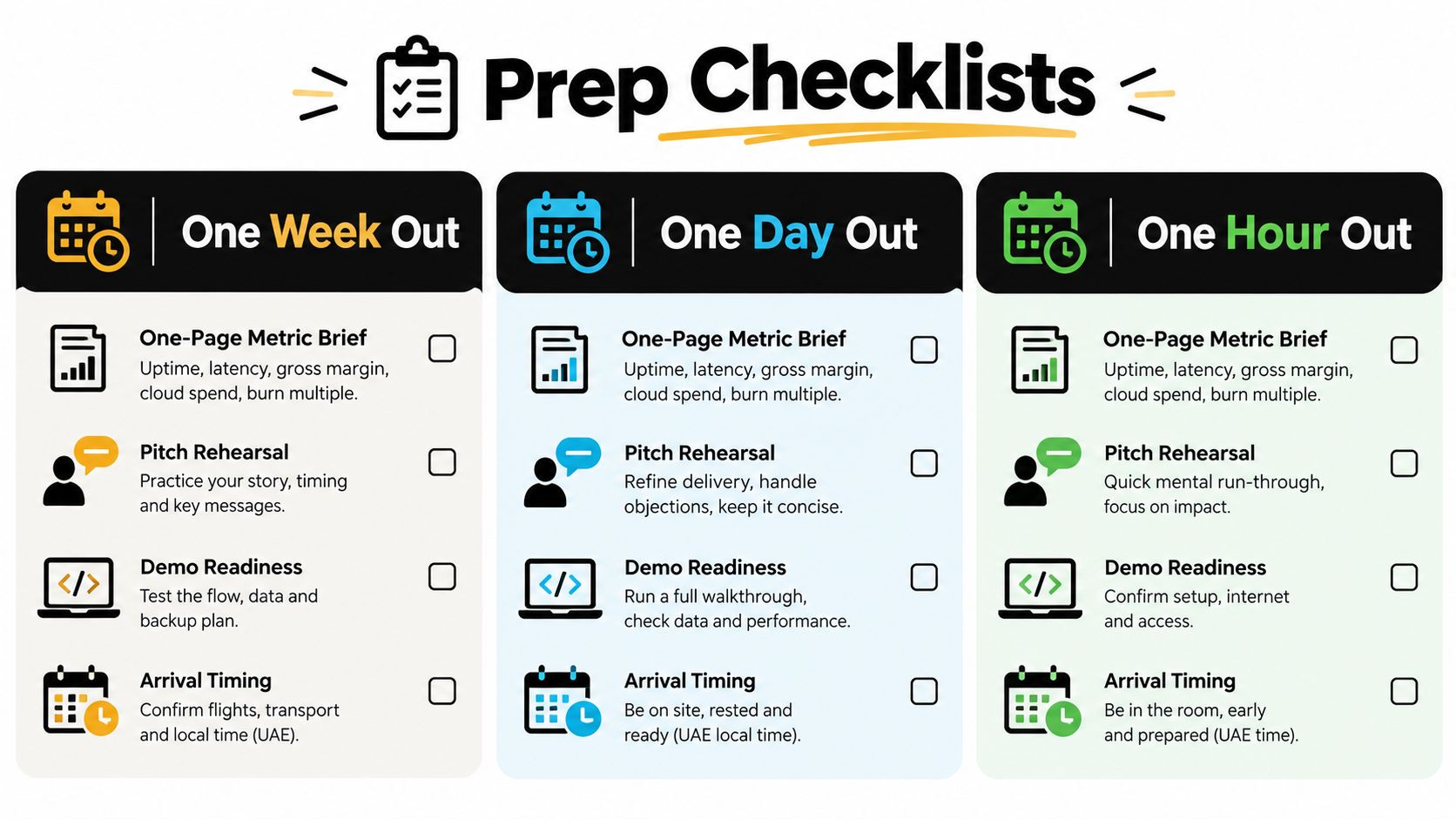
One-Week, One-Day and One-Hour Prep Checklists
Preparation pays off when it sharpens the question you carry into the room. A founder who can show the evidence behind a product decision gets challenged in useful ways. A founder who arrives with a polished fundraising narrative gets polite nods and leaves with a pocket of business cards.
One week out
Write a one-page technical and commercial brief. It should give another founder enough to attack your assumptions without a long deck:
- Product reliability: Uptime and latency.
- Business model: Gross margin and cloud spend.
- Capital use: Burn multiple and the next decision your funding supports.
- Usage quality: Monthly active users and cohort retention.
- One precise ask: Name whether you want a pilot customer, regulatory perspective, hiring referral or investor introduction to pursue independently.
That page is your entry ticket to a real conversation.
Revisit past pitch feedback and decide which single point you are testing this time. For technical defensibility, state what would take a competitor real effort to reproduce. “We have AI” and “proprietary technology” are claims, not answers.
One day out
Confirm the venue, arrival plan and transport. Then rehearse the mobile-money version of your product story: how the product behaves when a payment confirmation arrives late, when connectivity drops mid-transaction, or when the customer's workflow depends on a phone that is not a flagship device. Peers in Nairobi will probe exactly these points.
Choose what not to pitch. If your main goal is customer discovery, turning every conversation into a fundraising request wastes the room.
One hour out
Check your route, test the demo, carry water, and decide how you'll follow up without relying on business cards. Open with questions that invite real information:
- Which local assumption would you test first?
- What breaks in the customer workflow when connectivity or payment confirmation is delayed?
- Which operator, customer or specialist should I speak with next, and why?
Nairobi's support network is concentrated, and being in the city still requires a funding plan of your own. A UNDP mapping and 2022 Kenyan Startup Ecosystem Report found that 46% of the country's 148 innovation hubs were located in Nairobi and that 31% of surveyed startups had received funding. Read that density as a reason to arrive with a specific request and a clear idea of how you'll pursue it once the conversation ends.
After the Meetup, send a short message that refers to the actual discussion and names one action: “Good speaking about [specific topic]. I'm testing [specific assumption] and will [next step]. Would you be open to [one clear follow-up]?” A post-networking follow-up checklist keeps that outreach purposeful and turns a good evening into a measurable next step.
Before you book, it also helps to see how Nairobi compares with peer cities; the guides to founder Meetups in Nairobi, Beirut and Cairo give that context. Booking details are covered in the FAQ below.
FAQ
What should I wear to a Nairobi founder Meetup?
Choose neat, comfortable clothing that suits the venue and lets you focus on the conversation. Check the Meetup listing for any format or venue details, and don't treat formal business attire as a substitute for arriving prepared to explain your business.
How is a Founder Connects Meetup different from an accelerator demo day?
A Meetup is a founder-community format, and the activities depend on the listing. A demo day is generally tied to an accelerator programme and showcases participating companies. Check whether a particular Meetup includes pitching before assuming you'll have a formal slot.
Do I need a visa to attend in Nairobi?
Visa and entry requirements depend on your passport, travel status and current rules. Check official Kenyan immigration guidance before booking travel, and confirm your eligibility independently rather than relying on a Meetup listing.
How do I apply or reserve a place?
Check the Nairobi listing on the Meetups booking page or Luma calendar for the format and booking details. A booking is not the same as an investor introduction. Use the three filters in this guide to decide whether the Meetup suits your product question, your intended conversations and your access needs.
| Item | Detail |
|---|---|
| Chapter | Nairobi, Kenya, a live Founder Connects chapter |
| Booking | Check the Meetups page or Luma listing for the current format and details |
| Preparation | Bring a clear product question and a specific next step |
| Travel | Verify entry requirements for your passport and circumstances |
This week, choose the product assumption you want to test, prepare your one-page brief and check the Nairobi Meetup listing for a format that fits your goal.
Founder Connects is a startup community in Dubai and the world, with Meetups, experiences, events and Retreats for founders seeking practical peer learning. If you're weighing a Nairobi Meetup, visit Founder Connects to check the current chapter information and decide whether a Meetup fits the conversation you need.

Building in MENA? You don't have to do it alone.
Join 300+ founders in the Founder Connects Residency. Monthly squad calls, warm intros, $3M+ in perks, and much more. All for less than your monthly coffee budget.
Popular posts





Founder Connects is a premium MENA tech founder community. Meetups in Dubai and across MENA, Residency Squads of 8–10, and 400+ vetted WhatsApp founders (apply and screened).