

Cofounder Match in Dubai and MENA: A Practical Playbook

Building in MENA? You don't have to do it alone.
Join 300+ founders in the Founder Connects Residency. Monthly squad calls, warm intros, $3M+ in perks, and much more. All for less than your monthly coffee budget.

Dubai and MENA cofounder matching works best as a structured filter process, not open-room networking. In this market, the cost of a poor fit is high because setup friction, visa work, and ownership choices make the wrong partnership expensive fast.
You're probably not short on people. You're short on the right sequence for screening them, and that's the core issue in the UAE.
Why Cofounder Matching in the UAE Is a High-Stakes Filter Problem
A bad cofounder decision in Dubai is never just a bad conversation. It becomes a legal, financial, and emotional drag once you start dealing with entity setup, visa headcount, ownership structure, and the time it takes to get anything moving.
The UAE has enough startup density to create opportunity, but not enough slack to forgive sloppy matching. Dubai Chamber's 2024 Startup Guide says more than 1,000 startups operate in the UAE, with Dubai accounting for 86% of them, and 40% of Dubai-based startups are scaleups that have raised more than US$1 million. It also says Dubai-based scaleups make up 89% of all UAE scaleups, and since 2017 Dubai startups have attracted more than 95% of all startup funding into the UAE. That concentration matters because it raises the odds of meeting complementary operators, but it also raises the cost of wasting time on the wrong person. Dubai Chamber's 2024 Startup Guide
The right way to think about matching
Treat the search like a filter pipeline. First source broadly, then screen for role fit, then test working style, then only commit when the legal and commercial fit is clean.
Practical rule: if a cofounder can't survive your screening process, they won't survive your first hard quarter.
That's why warm, curated matching beats shouting into a room. If you want a useful framework for how senior teams build working rhythm, this piece on meeting rhythms for executives is relevant because cofounders need the same kind of cadence, just earlier and with more pressure.
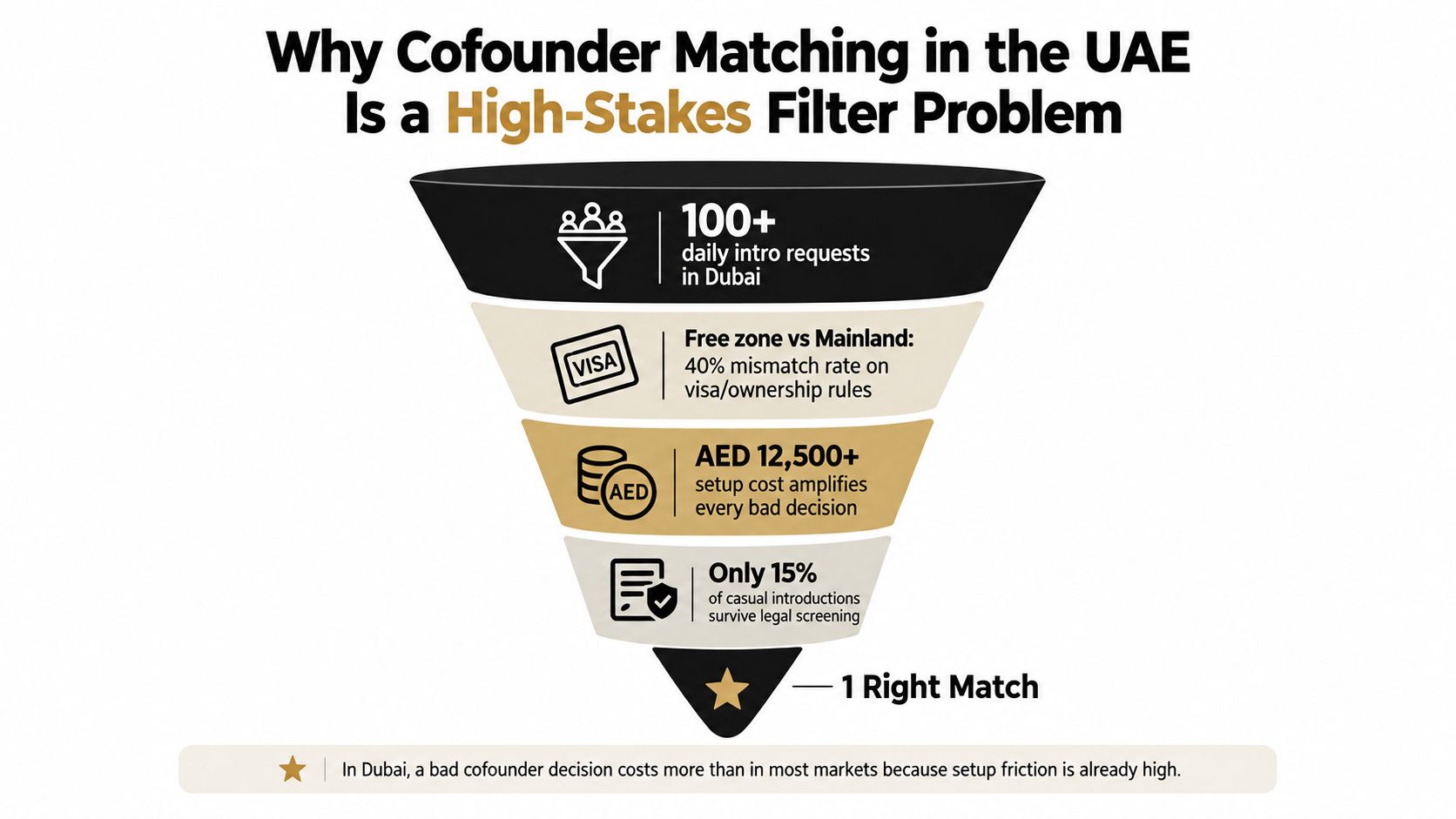
The point of the funnel is simple. Every bad intro gets more expensive in the UAE because the market already asks founders to make decisions about setup, residency, and launch path before they've even proved the partnership works.
The Dubai and MENA Founder Landscape You Are Matching Into
Dubai is not a flat founder market. It's a concentrated, cross-border, relationship-driven market where team shape matters as much as the idea. MAGNiTT's #MENAFounders research says 79% of the region's top 100 startups were built by one or two founders, including 40% single-founder startups and 39% two-founder startups. The same report says 12% of MENA founders were female, 38% came from Lebanon and Jordan, the UAE hosted 50% of MENA's top funded startups, and only 1% of founders were UAE nationals. MAGNiTT #MENAFounders research
That mix changes how you source. You're not just looking for talent in Dubai, you're looking across a regional founder graph where nationality, market familiarity, and mobility all shape who can realistically build with you.
Where the talent tends to cluster
If you want speed, look where founders already sit near capital, compliance, and customers. DIFC and ADGM attract regulated and finance-heavy teams. Dubai Internet City still matters for digital and product talent. Hub71 matters if you want Abu Dhabi-linked access and structured programmes. Saudi and Egyptian operators also show up in Dubai because the UAE is often the easiest regional base for a cross-border launch.
Strong signal: a founder who has already moved between Gulf and non-Gulf markets usually understands how much context-switching the region demands.
Sector mix matters too. Fintech founders talk differently from SaaS founders, and both talk differently from consumer operators. If you need a technical cofounder for a market-entry play, use this market entry for SaaS founders resource as a reminder that the first job is not “find anyone smart”, it's “find someone whose experience matches the route to market”.
What the team-size data tells you
Two-person teams dominate because the region rewards complementary role coverage. One founder often owns product or tech, the other owns commercial, fundraising, or operations. That means your search should start with the gap in your own profile, not with a personality test.
| Sector | Typical Team Size | Primary Hub | Notes |
|---|---|---|---|
| B2B SaaS | 1 to 2 founders | Dubai | Often needs a technical and commercial split |
| Fintech | 2 founders | DIFC, ADGM | Regulation and partnerships shape the pairing |
| Consumer | 1 to 2 founders | Dubai | Speed and distribution matter more early |
| Deep tech | 2 founders | Abu Dhabi | Technical depth usually comes first |
Where to Find Real Cofounder Candidates in Dubai and MENA
Don't start with random social posts. Start with places where founders already expect to be screened, introduced, and followed up with.
Curated communities beat empty networking because the intent is clearer. Ecosystem programmes beat open mixers because people show up with a reason. Warm introductions from investors or operators beat cold LinkedIn messages because the trust transfer is already partly done.
Channel quality matters more than channel count
If you need high-intent candidates, use a mix that matches your urgency:
- Founder-led communities: Use vetted groups when you need people who are already active builders and open to collaboration.
- Ecosystem programmes: Use DIFC- and Hub71-linked cohorts when you want founders with some institutional signal and process discipline.
- Co-working founder hubs: Use in5 or AstroLabs when you want breadth and earlier-stage signal, not perfect filtering.
- Investor warm intros: Use firms like B&Y and Nuwa Capital when you need a credibility bridge into a tighter network.
- University alumni networks: Use AUC, AUB, KFUPM, and NYUAD when you want trust, shared reference points, and a more personal first meeting.
- Cold LinkedIn outreach: Use it only as a last-mile supplement, because it usually gives you reach without commitment.
The core question is not “where are founders?”. It's “where are founders already primed to speak candidly about building together?”
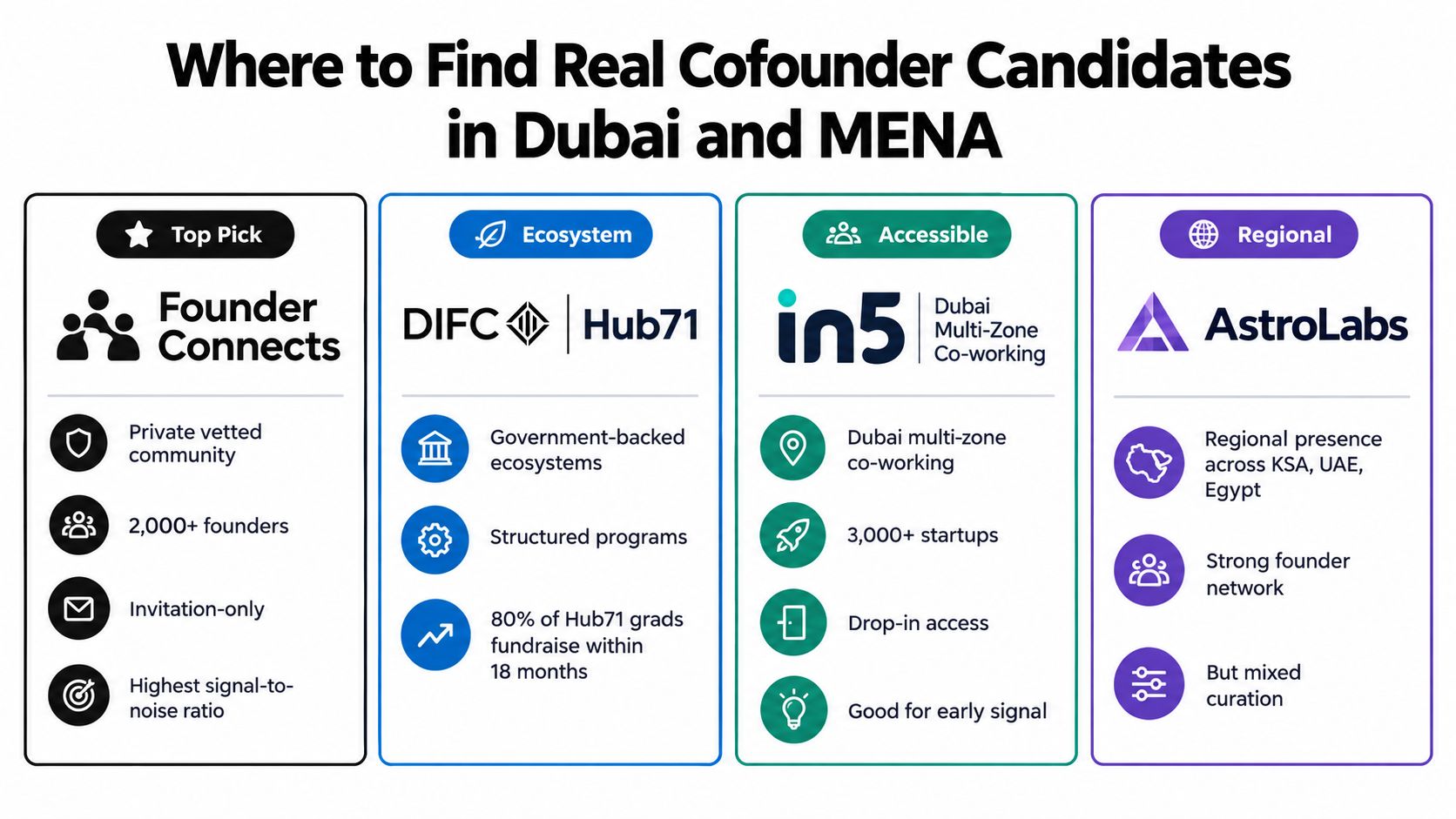
The highest-signal path is still the one that lets you watch someone think, not just market themselves. If you want a practical starting point, the guide on how to build a founder network in Dubai is useful because it focuses on how founders meet in this market, not just where they post.
How to judge the channel
Pick the channel based on three things: conversion rate, vetting depth, and time-to-meet. If you need a technical cofounder quickly, go where the filter is already built. If you need a commercial partner for a slower, more trust-heavy build, choose a community where repeated contact is normal.
The Four-Layer Fit Filter for UAE Cofounder Candidates
Most cofounder mismatches in the UAE come from people skipping straight to chemistry. That's a mistake. Chemistry matters, but it comes after role fit, legal fit, working style, and commitment.
Layer one, role fit
Start with the job, not the person. A technical founder should not be hunting another technical founder unless the company needs two engineers. A commercial founder shouldn't pair with another commercial founder unless the product is already built and the business needs two distribution engines.
My rule: one founder owns building, one owns selling, one owns keeping the company operational. If two people want the same chair, keep looking.
A Saudi product lead who wants UAE market entry can be a strong fit if the other founder is local on banking, incorporation, or customer access. An Egyptian CTO with a UK visa can be a strong technical partner if they're ready for the UAE rhythm and the region's launch requirements.
Layer two, regional and legal fit
Many founders get sloppy. Visa status, nationality, and Gulf family ties can change how quickly someone can commit, where they can travel, and how much friction sits between agreement and execution. A Pakistani growth marketer already on a Golden Visa signals a different level of mobility and stability from someone who still needs a path to residency.
Layer three, values and working style
This is the hidden filter. Ask how they think about debt versus equity, pace, weekends, Ramadan, summer hours, and whether they want a sprint-heavy or process-heavy company. If you disagree on how work should feel, the partnership will leak energy every week.
Layer four, commitment and risk tolerance
You need to know what “all in” means to them. Some founders can defer salary. Some can't. Some want a fast exit. Some want a durable operating company. If you don't align here, the company becomes a negotiation instead of a build.
| Fit layer | What to test | What a pass looks like |
|---|---|---|
| Role fit | Complementary responsibility | They own a clear lane |
| Regional and legal fit | Residency and launch readiness | They can actually commit in the UAE |
| Values and working style | Pace, risk, hours, decision-making | You can work without friction |
| Commitment and risk tolerance | Salary, runway, exit expectations | They're realistic and honest |
The Cofounder Conversation Script and One-Week Trial Project
Stop doing vague coffee chats. Run a real conversation with a purpose. If someone dodges the basics, that's already useful data.
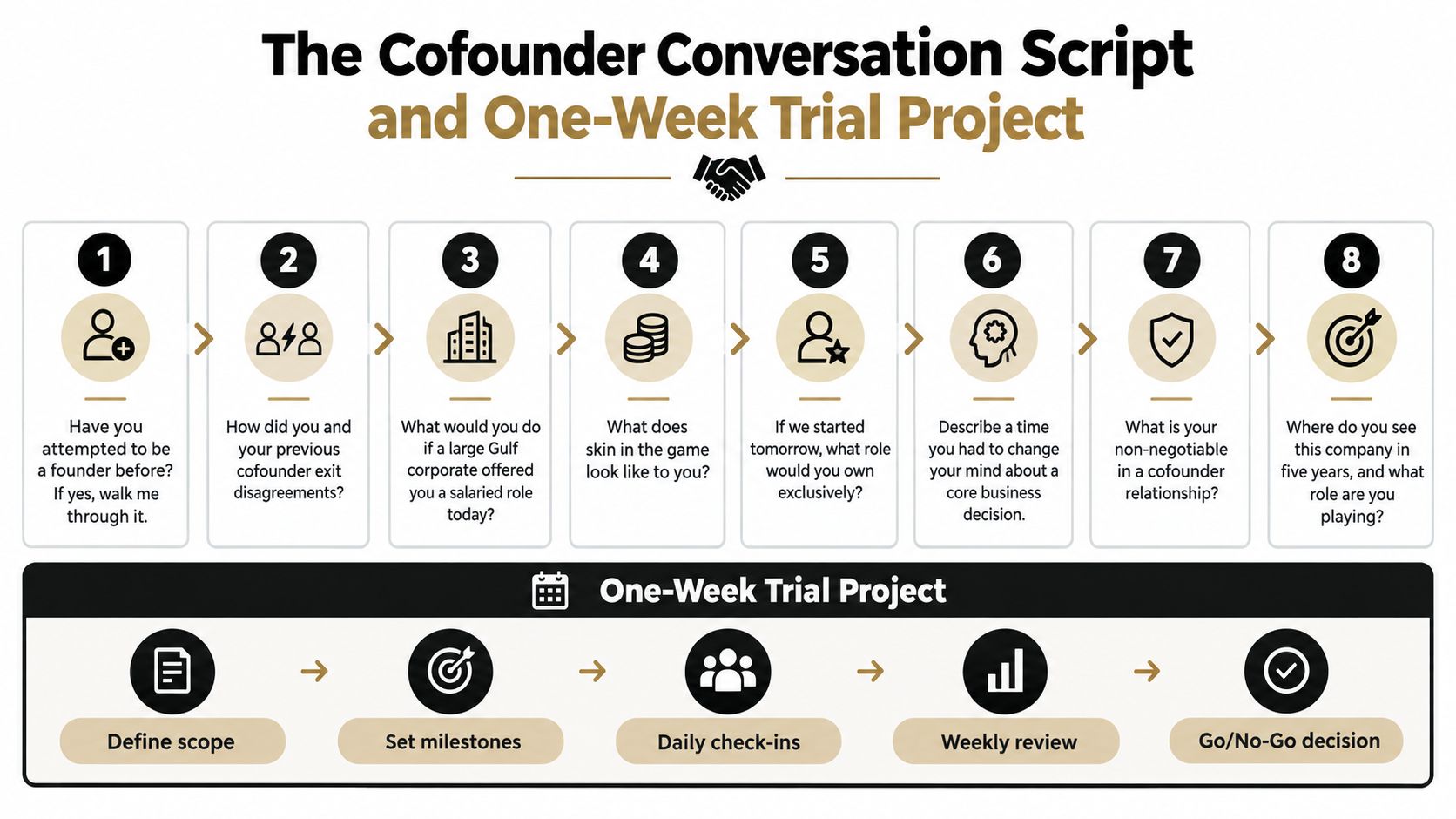
Use these eight questions
- Have you attempted to be a founder before? If yes, walk me through it.
- How did you and your previous cofounder exit disagreements?
- What would you do if a large Gulf corporate offered you a salaried role today?
- What does skin in the game look like to you?
- If we started tomorrow, what role would you own exclusively?
- Describe a time you had to change your mind about a core business decision.
- What is your essential requirement in a cofounder relationship?
- Where do you see this company in five years, and what role are you playing?
Those questions tell you more than a polished pitch deck ever will. They show whether the person can handle pressure, conflict, and ambiguity without turning dramatic.
Run a one-week trial
Make it small, paid if possible, or equity-based if you both agree. A landing page plus five customer interviews is enough to expose discipline. Use daily standups, a shared Notion page, and a Friday retrospective. If someone can't handle a one-week sprint, they're not ready for a cofounder relationship.
Red flags are easy to spot:
- Missed standups: They don't respect the rhythm.
- Vague updates: They talk around work instead of showing it.
- Scope creep: They keep changing the deliverable.
- Rule-blaming: They complain about DIFC versus ADGM without reading the actual setup requirements.
- Tax-haven thinking: They treat the UAE like a loophole instead of an operating market.
If you need a fast way to make the conversation operational, use the same discipline you'd use for a serious project. That means one scope, one deadline, and one decision.
From Match to Launch Entity, Visa, and Equity
A good match is useless if the launch structure is sloppy. Once two founders agree, they need to choose the entity path, settle equity, and stop pretending incorporation is just paperwork.
Free zone or mainland
For a two-person team, free zone can be cleaner if your customer base is international, startup-led, or easier to serve from a dedicated zone. Mainland becomes more attractive if the target customer is government, local B2B, or consumer-facing and you need broader operating flexibility. The official UAE platform says free zone setup starts with choosing the business sector, then the specific free zone, then the legal entity type. UAE free zone setup guidance
The official UAE business platform also says founders can set up several entity types in free zones, including FZ Co., FZE, branch structures, and a Private Limited Liability Company. UAE free zones also allow 100% foreign ownership. UAE Ministry of Economy free zone guidance
| Factor | Free Zone | Mainland |
|---|---|---|
| Ownership | 100% foreign ownership | Most sectors now allow 100% foreign ownership, with some strategic exceptions |
| Setup path | More structured and zone-specific | More flexible for wider local market access |
| Best for | International, digital, and zone-based models | Local B2B, government, and consumer exposure |
| Friction | Lower for simple launches | Higher, but often worth it for the right customer |
For documents and setup paperwork, an AI legal assistant for business owners can help founders keep their questions organised before they speak to a lawyer.
Good founder habit: decide entity structure after deciding customer type, not before.
Equity, vesting, and onboarding
Use a split that reflects actual contribution and risk, not ego. Equal equity can work, but only when both founders are bringing comparable value and commitment. Four-year vesting with a one-year cliff is the baseline I'd expect in most serious cofounder setups.
The first 30 days should be concrete. Open the bank account, sort Emirates ID, set the VAT registration deadline if the business needs it, and book the first shared customer meeting before momentum disappears.
If you want a setup reference point, the internal guide on business start-up in Dubai is a useful companion because it keeps the launch sequence practical.
Why Curated Peer Support Is the Edge After the Match
The hardest part is not the intro. It is the ninety days after two people say yes. That is when enthusiasm fades, unclear ownership shows up, and one founder starts carrying more emotional load than the other.
Most cofounders meet at a hub, swap decks, and never build a real working cadence. A curated peer circle changes that because it creates repetition, accountability, and social pressure to keep moving. That matters in Dubai, where founders often move between DIFC, JLT, Riyadh, and other regional nodes while trying to hold a company together.
Why loose networks underperform
Loose networks give you visibility, but not follow-through. Nobody owns the outcome, nobody checks whether the founders shipped, and nobody notices when one side disengages.
Curated peer support works differently. A moderator keeps the conversation honest. Founders show progress, name constraints, and get called out when they start drifting. That is the missing layer between “we met someone interesting” and “we built together.”
The lasting value is not access to more people. It is a group that keeps both founders accountable after the intro.
Why this fits MENA behaviour
MENA founders tend to trust trusted people more than anonymous metrics. They respond to short feedback loops, direct conversations, and visible consistency. That is why a structured circle often beats a broad room full of business cards.
Founder Connects-style groups fit that pattern because they combine introductions with ongoing peer accountability. If you want to understand how that format works, this analysis of mastermind groups is the right place to look.
If you are serious about a cofounder search in Dubai or the wider MENA market, stop treating matching like a social activity. Treat it like a screening system, then protect the partnership with a peer structure that keeps both sides honest.

Building in MENA? You don't have to do it alone.
Join 300+ founders in the Founder Connects Residency. Monthly squad calls, warm intros, $3M+ in perks, and much more. All for less than your monthly coffee budget.
Popular posts





Founder Connects is a premium MENA tech founder community. Meetups in Dubai and across MENA, Residency Squads of 8–10, and 400+ vetted WhatsApp founders (apply and screened).