

In5 Dubai Incubator vs Sheraa Sharjah: A Founder's Guide
Building in MENA? You don't have to do it alone.
Join 300+ founders in the Founder Connects Residency. Monthly squad calls, warm intros, $3M+ in perks, and much more. All for less than your monthly coffee budget.

If you're staring at two tabs right now, one for in5 Dubai and one for Sheraa Sharjah, you're probably not comparing “best incubator” against “second-best incubator”. You're deciding where your first year of startup life will hurt less, where your pitch will sound stronger, and whether you want a looser ecosystem or a more structured programme with real support attached.
That's the trade-off. Dubai gives you cluster depth, investor traffic, and a mature startup brand. Sharjah gives you a more curated accelerator model, a free licence for eligible startups, and a grant-led structure that keeps cash in the company. If you choose badly, you don't just waste time, you burn runway, add setup friction, and miss the kind of introductions that only happen when you're physically in the right room.
| Criteria | in5 Dubai | Sheraa Sharjah |
|---|---|---|
| Equity terms | No-equity incubator | Equity-free accelerator support |
| Launch year | 2013 by TECOM Group, with a long-running ecosystem record of over 850 startups and more than AED 9 billion raised since launch | Government-backed Sharjah entrepreneurship platform |
| Core model | Multi-campus incubator across dedicated districts | Structured 4-month accelerator |
| Sector focus | Tech, media, design, science | Tech-enabled startups, with traction and scale potential |
| Geographic footprint | Dubai Internet City, Dubai Production City, Dubai Design District, Dubai Science Park | Sharjah-based ecosystem support |
| First-year cost profile | Licence and workspace costs apply | Free UAE business licence, rent-free coworking, grant support |
Choosing Between Dubai and Sharjah Startup Ecosystems
You're not choosing between two logos. You're choosing between two operating environments, and that decision shows up fast in year one. A founder with a decent deck, a prototype, and limited cash usually wants one thing first, less drag.
I've seen this choice play out the same way dozens of times. The founder sits on a small runway, one eye on Dubai's reputation and one eye on Sharjah's lower-cost pitch, then asks the wrong question, “Which brand is stronger?” The better question is, “Which option reduces my first-year friction while increasing my odds of real progress?”
The practical tension founders actually feel
in5 Dubai is the cleaner fit for founders who want ecosystem breadth and a sector-specific home base. Its strength is not just that it's in Dubai, it's that it's embedded across dedicated districts and has a long track record as a founder platform, with over 850 startups supported and more than AED 9 billion in funding raised by companies operating within it since launch, according to reported milestone coverage.
Sheraa Sharjah is the better fit if you want a more guided accelerator journey and a cash-preserving support package. It's built around a structured programme rather than open-ended community participation, and the strongest signal in the available data is its combination of licence support, grant support, and curated selection.
Practical rule: if your business needs room to build, test, and stay lean, choose for runway first, prestige second.
That's why this comparison matters now. Both platforms have matured into real ecosystem institutions, not experimental projects. If you're wrong by even a few months, you can lose momentum, sit in limbo, or find yourself paying for setup items you never budgeted for.
The rest of this guide is about the stuff founders feel, equity terms, true costs, facilities, mentorship depth, network access, and post-program support. By the end, you should know exactly which programme fits your stage, your sector, and your cash reality.
Program Overview and Core Positioning
in5 and Sheraa look similar from the outside because both are founder-facing and both sit inside the UAE startup story. They're not built the same way, though. in5 is an incubator with a district-based footprint, while Sheraa is a more curated accelerator built around a clear selection process and a defined programme period.
What in5 actually is
in5 was launched in 2013 by TECOM Group, and that matters because it tells you this isn't a short-lived government initiative or a vanity project. It's a long-running Dubai institution with enough ecosystem depth to support over 850 startups and sit behind more than AED 9 billion in reported funding raised by startups in the platform since launch, as covered by The Dubai Voice reporting.
Its structure is the key differentiator. in5 runs dedicated centres in Dubai Internet City, Dubai Production City, Dubai Design District (d3), and Dubai Science Park, and positions itself for tech, media, design, and science startups with specialised facilities and subsidised startup infrastructure, according to the official in5 FAQs. That multi-campus model matters because founders can match location to product category instead of forcing a generic office setup to fit every startup type.
For a deeper look at how that sector logic plays out, see this in5 science and AI focus deep dive.
What Sheraa is really offering
Sheraa, or the Sharjah Entrepreneurship Center, is a government-backed startup platform with a more guided feel. The strongest signal in the available material is the structured 4-month accelerator model, which is aimed at tech-enabled startups that are typically up to three years old and already showing traction. The better benchmark here is not “how long it's been around”, because the brief doesn't give a comparable milestone count. It's the fact that Sheraa acts like a formal acceleration path, not just a shared space.
The application process is also more direct. Founders submit an online application, and selected startups move into a structured programme, as described on Sheraa's startup application page.
| Criteria | in5 Dubai | Sheraa Sharjah |
|---|---|---|
| Launch year | 2013 | Government-backed Sharjah startup platform |
| Programme duration | Incubation with graduation into alumni network | 4-month accelerator |
| Target stage | Early-stage to pre-Series A style founders | Tech-enabled startups up to three years old with traction |
| Sector focus | Tech, media, design, science | Tech-enabled, broader commercial fit |
| Geographic footprint | Multi-campus Dubai model | Sharjah-based programme |
If you want open-ended incubation with district-specific infrastructure, in5 is stronger. If you want a time-bound accelerator with clearer eligibility and sharper commercial filtering, Sheraa is stronger.
Equity Terms and True First-Year Costs
Founders must stop romanticising the decision. Equity is only one part of the bill. The key question is what it costs to get legally set up, physically operating, and bankable in year one.
The ownership question
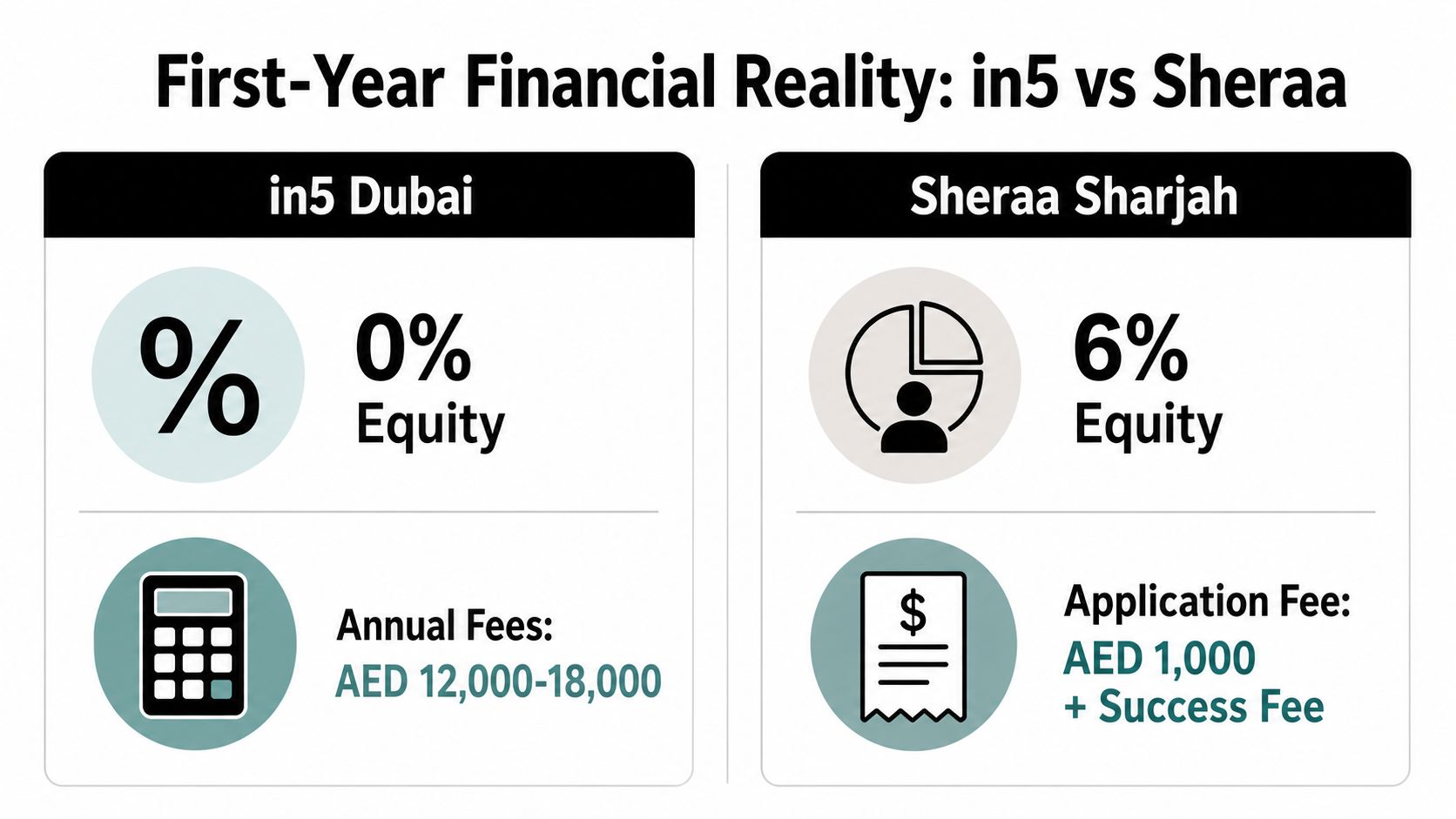
in5 is explicitly no-equity, which is a strong position if you're building for long-term ownership and don't want to hand over shares for early support. That's especially relevant for founders who expect to raise later and don't want an unnecessary cap table complication at the start.
Sheraa is also positioned as equity-free, but its financial value is more immediate and more visible. According to the available comparison data, Sheraa offers a free UAE business licence, rent-free coworking, and an AED 35,000 equity-free grant for eligible startups, while in5's startup licence is around AED 1,000 per year with coworking desks starting from about AED 12,000 per year as summarised in Founder Connects' UAE incubator comparison.
That's the paper answer. The actual answer is cash burn.
What founders forget to budget
The under-discussed costs are the ones that hit after acceptance, not before. Independent UAE startup guidance notes that visa costs add roughly AED 3,000 to AED 7,000 per person, and some banks require minimum deposits of AED 50,000 to AED 250,000 for account opening, according to the UAE startup ecosystem guide. Those aren't optional line items if your team needs residency and a proper operating account.
For a two-person founding team, the first-year difference can be brutal if you ignore setup friction. At a minimum, in5 puts you into a model where you're likely paying for a licence and workspace, while Sheraa removes more of that early burden on paper and adds a grant on top. If you need to stretch every dirham, Sheraa is the more capital-efficient path.
Hard truth: a “cheap” incubator isn't cheap if the banking setup drags, visa needs pile up, and you end up commuting across emirates every week.
The commuting piece matters too, even if it doesn't show up neatly in a spreadsheet. Dubai-based founders who need to meet customers, investors, and ecosystem players daily often absorb travel friction better in Dubai than in Sharjah. Sharjah can still work, but only if your priority is lean setup and structured support over constant proximity to Dubai's deal flow.
For a deeper Sheraa-specific breakdown, I'd point founders to this Sheraa accelerator overview, especially if your main question is how much support sits behind the grant.
Facilities and Sector-Specific Infrastructure
Physical setup isn't sexy, but it affects how fast you build. If your startup needs a lab, a studio, or a district where people already understand your category, location becomes an operating decision, not a branding one.
Why in5's footprint is more useful than it first looks
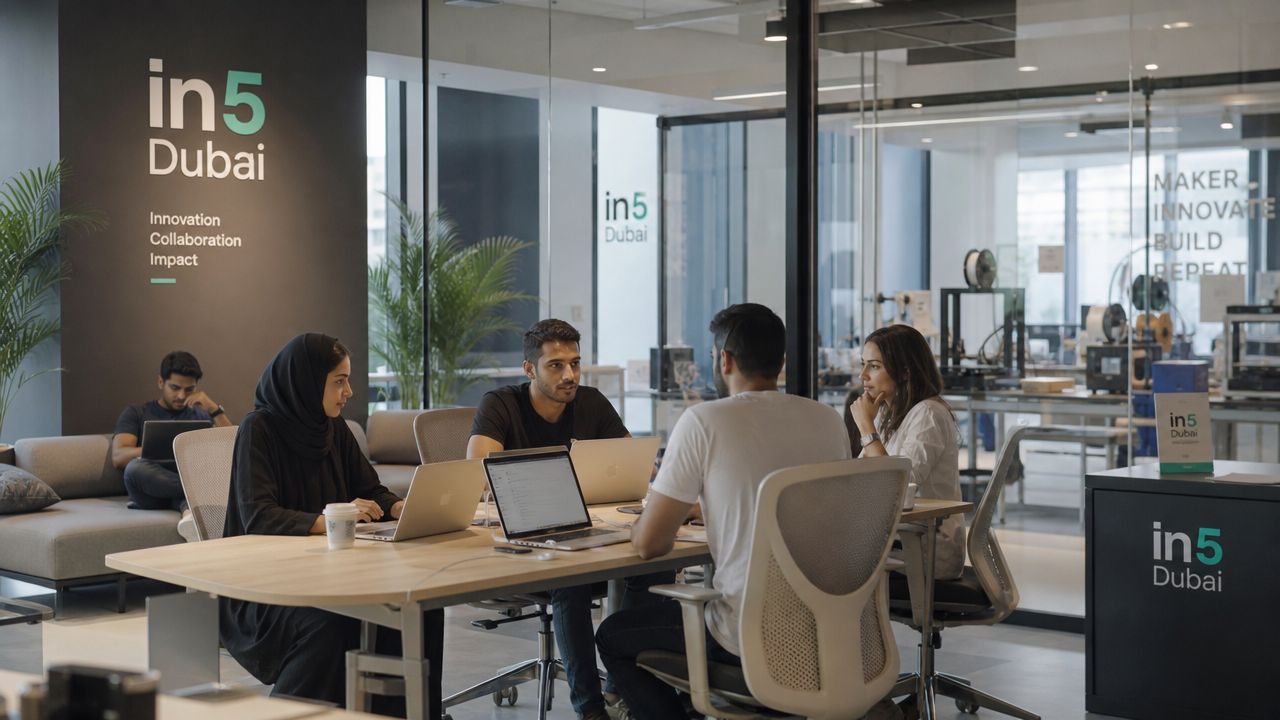
in5's biggest facility advantage is that it doesn't force every founder into the same physical environment. It runs dedicated centres in Dubai Internet City, Dubai Production City, Dubai Design District (d3), and Dubai Science Park, which means a founder can choose a base that matches the business, not just the postcode as stated in the official FAQs.
That matters for real work. A hardware startup benefits from science-adjacent infrastructure. A design studio wants a district where creative talent and software expectations already exist. A media company works better near production-oriented facilities than in a generic office tower. in5's cluster model makes that easier.
What Sheraa offers physically
Sheraa's appeal is different. It gives you a modern, centralised workspace model with support services wrapped around the programme. It's less about specialised labs and more about a polished, structured environment where founders can work, meet mentors, and access the programme without needing to stitch together office and advisory support from scratch.
For a lot of teams, that's enough. If you're building a SaaS product, a services business, or a tech-enabled company that doesn't need a physical prototype lab, Sheraa's setup is perfectly workable. If your business depends on district adjacency, specialised equipment, or industry-specific facilities, in5 is better.
What I'd tell founders to test
Before you apply, ask current members three things.
- Workspace reality: Can they get the space they need when they need it, or is booking tight?
- Daily friction: How long does it take to commute, park, and get into a working rhythm?
- Category fit: Does the location help them meet customers, suppliers, and collaborators in their sector?
If your startup needs a room, a screen, and a solid internet connection, Sheraa may be enough. If it needs an ecosystem-shaped building, in5 wins.
For ecosystem-specific context in Sharjah, this Sharjah innovation park and grants resource is a useful cross-reference, especially if you're comparing what Sharjah's broader startup ecosystem can support beyond one programme.
Mentorship Quality and Network Access
Mentorship is only useful if it leads to decisions, intros, or revenue. “Great mentors” means nothing if you never speak to the right one, or if the advice stays generic.
in5's network strength is scale and repetition
in5 has the stronger ecosystem memory because it has supported over 850 startups and sits on top of a long-running startup base that has collectively raised more than AED 9 billion since launch, according to the reported milestone coverage from The Dubai Voice. That kind of base matters because peer learning compounds. Founders hear what worked, what didn't, and which intros converted.
The alumni side also matters. in5 says successful startups graduate into the in5 alumni network after the programme, as described in its business setup flow. That gives founders something more durable than a temporary cohort, a living network they can tap later for hiring, customer referrals, and peer validation.
Sheraa's advantage is curation and access
Sheraa's support package is more curated. The available data points to access to legal support, investor access, and the possibility of government and private sector contracts for eligible startups. That's not just mentorship, it's commercialisation support, and for some founders that's more valuable than a large informal network.
The likely trade-off is obvious. in5 gives you a broader community, while Sheraa gives you a tighter, more guided path. If you're the sort of founder who can use a big room well, in5's network can be a real asset. If you want a smaller circle and direct support on getting commercially ready, Sheraa is stronger.
Investor access, without the fantasy
Neither programme hands you funding on a plate, so don't overread “investor access”. What matters is the quality of the warm introduction and whether the programme's team is willing to make it. In practice, founders who can explain a sharp use case, a market pain point, and a clear ask get more out of both ecosystems.
Best network behaviour: ask for one specific introduction, not “any investors who might like us”.
For UAE investor context, founders should arrive with a tight pitch deck, one-page summary, cap table, basic financial model, and clear use of funds, which aligns with the practical preparation advice in this UAE angel investor guide. That preparation matters more than a logo on your cohort page.
Application Process and Eligibility Requirements
The application itself reveals a lot. Some programmes want early ideas. Others want proof you're already moving.
How in5 screens founders
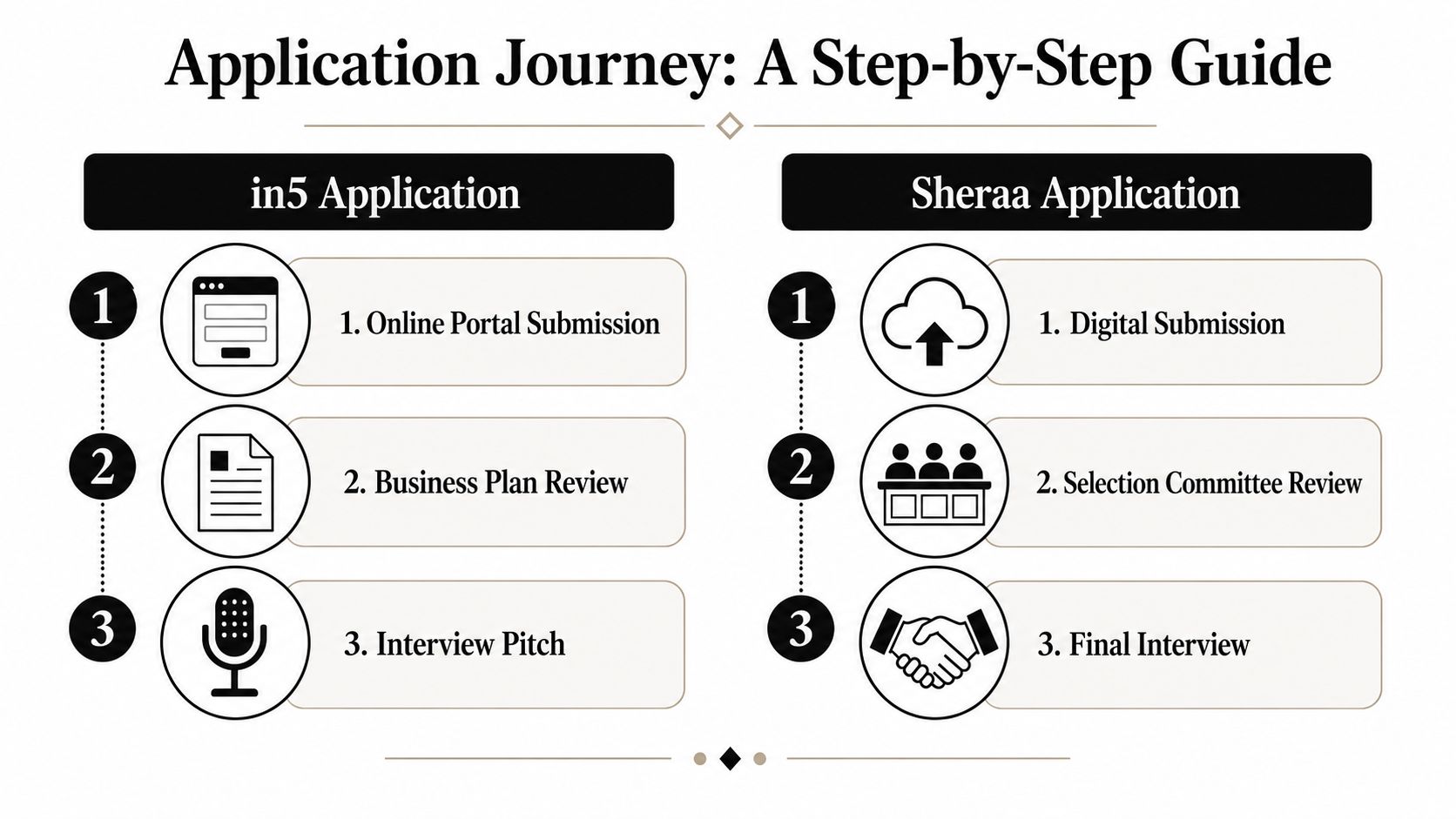
in5's flow is clear, online submission, validation, committee presentation, incubation, and graduation into the alumni network, with successful startups becoming part of the alumni network after the programme, according to its business setup page. That's a structured but accessible process, and the data I've seen doesn't show a hard minimum traction threshold.
That makes in5 friendlier to earlier-stage founders. If you have a credible concept, a solid team, and the ability to show why your business belongs in one of its sectors, you're in the game.
How Sheraa screens founders
Sheraa is more selective on stage. The clearest benchmark in the source set is that it focuses on startups that are typically tech-enabled, up to three years old, and already showing at least three months of traction. That can be revenue, users, pilots, or meaningful commercial progress, but the point is the same, Sheraa wants evidence.
Its public process starts with an online application, then moves into a structured review path, as shown on Sheraa's application page. That's the right model for founders who already have something moving and want acceleration, not ideation support.
What to prepare before applying
- Pitch deck: Keep it tight, with problem, solution, traction, market, and ask.
- Founder bios: Show why this team can execute.
- Business model clarity: Say how you make money, not just what the product does.
- Evidence of traction: Users, pilots, revenue, or meaningful intent.
- Setup readiness: Be clear on whether you can operate in Dubai or Sharjah without delay.
Rejections happen for obvious reasons. In5 is less likely to reject a founder just because the traction is light. Sheraa will care more about whether your startup is already validated enough to benefit from a 4-month accelerator.
If you want a clean comparison of the Sheraa path before applying, the Sheraa accelerator overview is the right place to sanity-check your readiness.
Decision Matrix for Different Founder Profiles
This is the part that matters most. Founders don't need balanced commentary, they need a call.
My direct recommendations
| Founder profile | Best fit | Why |
|---|---|---|
| Bootstrapped solo founder | Sheraa Sharjah | Lower first-year cash pressure, free licence support, rent-free coworking, and grant-led structure |
| Pre-seed team seeking investor intros | in5 Dubai | Broader Dubai network, alumni depth, and better ecosystem visibility |
| Sector-specific startup needing infrastructure | in5 Dubai | Multi-campus setup across tech, media, design, and science districts |
| B2B founder targeting contracts | Sheraa Sharjah | Government-backed platform and stronger commercial support angle |
| Lifestyle entrepreneur | Sheraa Sharjah | More structured, easier to contain costs, less distraction |
| Earlier-stage founder with no traction | in5 Dubai | More accessible entry point, no clear minimum traction hurdle in the available sources |
| Tech-enabled startup with traction | Sheraa Sharjah | Better fit for structured acceleration and commercial readiness |
Edge cases founders ask about
If you're based in Abu Dhabi, I'd still lean toward the programme that matches your stage first. If you need sector depth and investor-facing momentum, in5 can still make sense. If you need a leaner commercial setup, Sheraa wins.
If you're a non-UAE resident, don't optimise for convenience, optimise for fit. The programme that gives you the cleanest path to operating, meeting the team's expectations, and staying present is the right one.
If you're pivoting and need flexibility, choose the option that gives you the least cap table pain and the most room to iterate. That is usually in5 if you need a looser incubation path, or Sheraa if the pivot already has traction and you want disciplined execution.
Final call: choose in5 if your startup needs district-level infrastructure, broader ecosystem depth, and a no-equity incubator environment. Choose Sheraa if runway, commercial discipline, and grant-backed support matter more than ecosystem prestige.
One more reality check. Program choice helps, but it doesn't save weak execution. The startup that wins is still the one that sells, ships, learns fast, and follows up harder than everyone else.
A CTA for Founder Connects.

Building in MENA? You don't have to do it alone.
Join 300+ founders in the Founder Connects Residency. Monthly squad calls, warm intros, $3M+ in perks, and much more. All for less than your monthly coffee budget.
Popular posts





Founder Connects is a premium MENA tech founder community. Meetups in Dubai and across MENA, Residency Squads of 8–10, and 400+ vetted WhatsApp founders (apply and screened).