

MENA Expansion Strategy for Startups: 2026 Guide

Building in MENA? You don't have to do it alone.
Join 300+ founders in the Founder Connects Residency. Monthly squad calls, warm intros, $3M+ in perks, and much more. All for less than your monthly coffee budget.

You've built traction in the UAE. Revenue is moving. Customers are referring other customers. A few investors or advisors have started asking the obvious next question: where do you go next?
Then the map gets messy.
Saudi looks commercially attractive. Egypt looks large and talent-rich. Qatar can look focused. Kuwait can look easier for some models. Jordan can look founder-friendly. Every market has a story, and most of those stories leave out the operational drag, the hiring friction, and the amount of management attention expansion consumes.
That's why a good MENA expansion strategy for startups can't start with a market report. It has to start with founder reality. The practical discussion is usually less glamorous: which country gives you the best mix of revenue potential, regulatory clarity, hiring confidence, and survivable burn if things take longer than planned?
The opportunity is still real. In 2025, AI-linked startups captured 17% of total MENA venture capital, AI-native startups received 58% of all AI funding, and the region secured over $2.1 billion in AI funding in the first half of the year alone, a 134% year-on-year increase according to Hub71's analysis of AI startup growth in MENA. That kind of momentum matters if you're building in AI, fintech, or adjacent infrastructure.

Founders who want broader context on regional dynamics should also review this MENA startup ecosystem guide before choosing a beachhead market.
The Allure and Anxiety of MENA Expansion
The pull of regional expansion is easy to understand. Once your UAE base starts working, standing still can feel like the bigger risk. Your team sees inbound from Saudi. A partner introduces you to someone in Cairo. A customer asks for multi-country rollout. Suddenly, “we're UAE-first” turns into “we should be across MENA by next year”.
That's where founders usually make one of two mistakes.
The first mistake is treating MENA as one market with different flags. It isn't. Buyer behaviour, payment flows, enterprise sales cycles, hiring expectations, and compliance realities vary sharply by country. A playbook that works in Dubai can break in Riyadh. A product that spreads well through WhatsApp-led sales in one market may need far more field presence in another.
The second mistake is assuming expansion is mainly a commercial decision. It isn't. It's an operating model decision. You're deciding how much complexity your company can absorb without losing speed in the home market.
Practical rule: Expand when the second market strengthens your core business, not when it distracts from an unresolved one.
The founders who handle this well usually think in sequence, not territory. They don't ask, “How do we win MENA?” They ask better questions:
- Which market gives us the fastest proof?
- Which market is easiest to support operationally from the UAE?
- Which entry path teaches us something reusable for the next country?
- Which move keeps us investable if the rollout takes longer than planned?
A sound MENA expansion strategy for startups is rarely about ambition alone. It's about choosing the next country your team can serve properly, hire into credibly, and finance without panic.
Is Your Startup Truly Ready for a Second Market
Expansion is often framed as the natural next step after early traction. That framing causes damage. A second market doesn't fix a weak go-to-market motion. It amplifies it.
The timing question matters more than the destination question. In March 2026, startup funding across MENA fell to $48.3 million, an 85% drop month-on-month, a contraction that underlined the need for startups to build resilience and customer-led revenue models rather than relying on capital to cover weak execution, as reported by Wamda's March 2026 funding update.
The questions founders avoid
Often, teams ask whether there is demand elsewhere. Fewer ask whether they can support that demand without damaging what's already working.
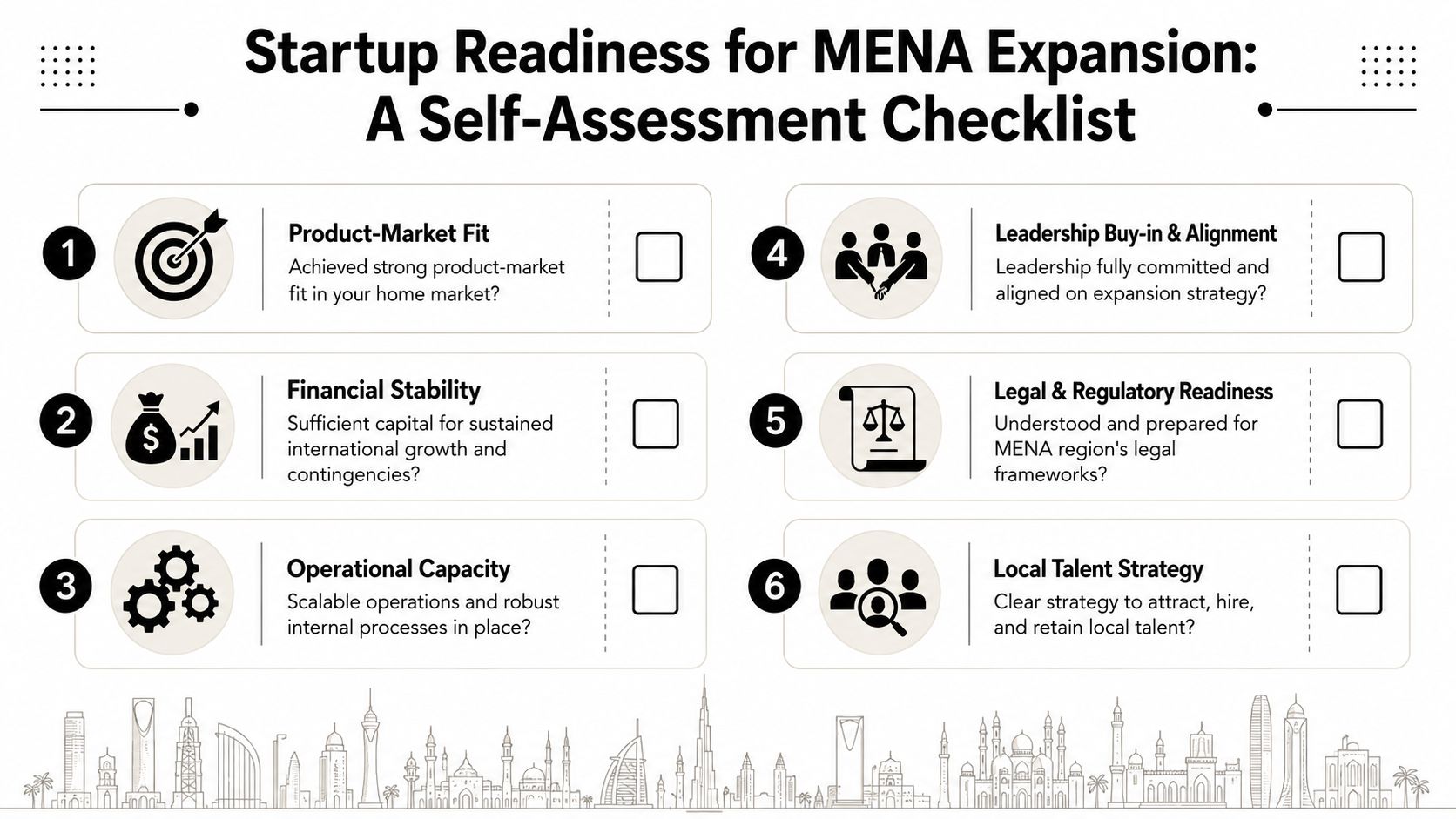
Use this internal audit before you commit:
- Home market repeatability: Are new UAE customers still teaching you the same core lesson, or does each deal require custom handling? If every sale still depends on founder intervention, export will be painful.
- Cash discipline: Can you absorb setup delays, compliance work, travel, senior team attention, and a slower-than-expected sales ramp without turning your current business brittle?
- Leadership bandwidth: Who exactly owns the new market day to day? If the answer is “everyone”, no one owns it.
- Product localisation load: What changes are mandatory for payments, language, procurement, reporting, or support? Founders often call these “small changes” right before they become roadmap debt.
- Customer pull vs founder push: Are customers, channel partners, or credible hires pulling you in, or are you expanding because growth at home has become harder?
A better go or no-go filter
I'd pressure-test readiness with three checks.
First, your core motion should already be teachable. A sales manager, account lead, or customer success hire should be able to reproduce your playbook with limited founder rescue.
Second, your economics should survive a slower launch. New markets almost always take longer than the internal plan says they will.
Third, your operating cadence should be calm enough to absorb complexity. If your team is still changing pricing, packaging, and onboarding every few weeks, cross-border expansion will add noise, not growth.
Expansion works best when the company has already learned how to do boring things consistently.
For engineering-led teams, especially those rolling out multilingual products, localisation workflows can become an unexpected blocker. If you're running a Python stack, this guide for Django teams expanding internationally is a useful technical reference because it shows how internationalisation work affects shipping speed more than most founders expect.
The simplest readiness scorecard
Ask your leadership team to score each item as green, yellow, or red:
| Area | Green looks like | Red looks like |
|---|---|---|
| Product | Stable value proposition | Frequent exceptions and custom promises |
| Revenue | Repeatable sales motion | Founder-led every time |
| Team | Clear expansion owner | Shared, vague accountability |
| Finance | Buffer for delays | Expansion only works if everything goes right |
| Ops | Compliance and support mapped | “We'll figure it out after launch” |
If you see more yellow than green, wait. Delay feels frustrating, but premature expansion is usually more expensive than patient expansion.
Choosing Your Beachhead Market KSA Egypt or Elsewhere
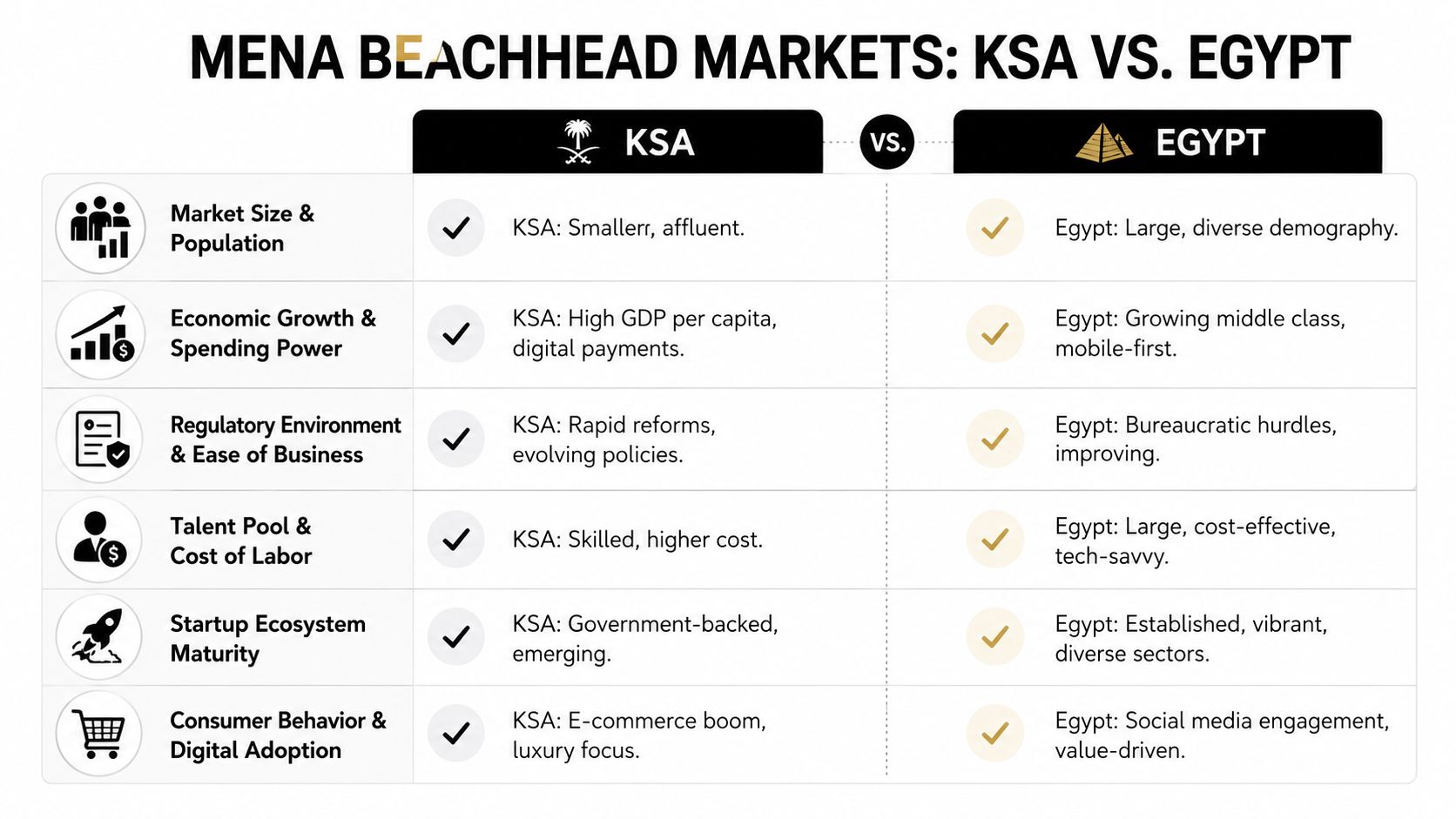
Most UAE founders eventually land on the same debate: KSA or Egypt first? It's a valid question, but the wrong way to answer it is by comparing headlines. Population size alone won't help you. Neither will generic comments about “high growth”.
The better question is this: which market gives your current company the highest probability of controlled success?
Start with the anchor market logic
A lot of founder pain comes from entering fragmented markets too early. New data shows that 78% of startups that delayed GCC entry and expanded into volatile non-GCC markets first faced 40% higher capital burn rates due to fragmented financial systems, which is why using Saudi Arabia or the UAE as a stabilising anchor has become such an important strategic lens in Wamda's playbook on navigating MENA uncertainty.
That doesn't mean Egypt is the wrong move. It means Egypt should be chosen for a reason that matches your model, not because the market is large on paper.
When KSA is the stronger first move
Saudi is often the better first expansion market when your business depends on:
- Enterprise contracts: Larger account sizes and formal buying processes can suit B2B SaaS, fintech infrastructure, HR tech, and regulated products.
- Government adjacency: If partnerships, compliance confidence, or institutional trust matter, Saudi can reward teams that invest properly in local presence.
- Premium positioning: Products that sell on quality, speed, reliability, or brand often translate better than purely price-led offers.
- Regional signalling: For some founders, a credible Saudi footprint strengthens the next investor conversation and the next partnership conversation at the same time.
For more local context, founders looking specifically at Saudi can review this Riyadh startup ecosystem view for 2026.
When Egypt is the stronger first move
Egypt can be the better first move when your company benefits from:
- Volume and iteration: Consumer products, education, media, social commerce, and high-frequency user feedback loops can learn quickly in Egypt.
- Cost-aware experimentation: Teams that need to test channels, support models, or product variations often value the market's pace and talent depth.
- Tech and operations hiring: If your entry strategy combines go-to-market expansion with building a local operating team, Egypt can make more sense than founders initially assume.
- Mobile-first distribution: Products that fit messaging-led acquisition and value-driven customer behaviour often find clearer signals there.
A side-by-side founder lens
| Decision lens | KSA first | Egypt first |
|---|---|---|
| Best for | Enterprise, regulated, premium | Consumer, volume, experimentation |
| Main risk | Higher setup burden if undercommitted | Complexity if you need stable payment and operating rails |
| Hiring reality | Market knowledge is critical | Speed is possible, but localisation still matters |
| Common founder error | Treating it as remote sales from Dubai | Treating size as the same thing as access |
If your product wins through trust, procurement discipline, or institutional buyers, Saudi often deserves priority. If it wins through usage loops, affordability, or rapid iteration, Egypt may teach you faster.
Elsewhere is sometimes the right answer
Not every UAE startup should pick KSA or Egypt first.
Some businesses do better in a smaller, tighter market where one partnership can provide distribution. Others should expand only where an anchor client already exists. If your category depends on compliance comfort, bank integrations, or local operational certainty, a narrower market with cleaner execution may beat a larger market with more noise.
The mistake isn't choosing a smaller market. The mistake is choosing a market your current team can't support.
The On-the-Ground Operational Playbook
The operational phase is where founder optimism meets paperwork, banking, payroll, and approvals. This is also where weak planning becomes expensive. The practical work isn't glamorous, but it decides whether your expansion becomes a controlled rollout or a string of delays.
Sequence matters more than speed
The teams that handle regional rollout well usually follow a disciplined order.
- Confirm the commercial case first. Don't start with entity setup because a lawyer told you to. Start with customer conversations, channel interest, and a realistic view of who will buy, how they buy, and what local presence they expect.
- Choose the legal path that matches the sales path. Founders often obsess over the cheapest setup structure instead of the one that supports invoicing, hiring, contracting, and credibility with actual buyers.
- Open banking and finance workflows early. A market entry plan stalls fast when you can't collect money cleanly or run payroll with confidence.
- Map compliance before the first hire. Employment rules, payroll handling, contract standards, and data responsibilities need owner-level attention.
What usually goes wrong
Investor selectivity has changed the standard founders are held to. Expansion success is now closely tied to capital discipline and regulatory transparency, and failure to align with investor domains reduces partnership viability by over 40% according to Magnitt's 10-year funding funnel analysis for MENA, UAE, and KSA.
In practice, that means a messy setup process doesn't just slow operations. It can weaken your next fundraising conversation. If you can't explain entity structure, reporting flow, compliance ownership, and market rationale clearly, experienced investors read that as execution risk.
A second-market launch should look boring on paper. Clear entity. Clear contracts. Clear reporting. Clear ownership.
The four-part operating checklist
Use this as your minimum viable setup plan:
- Commercial design: Who signs the contract, who invoices, who supports the account, and whether enterprise buyers expect local procurement capability.
- Finance design: Revenue recognition, expense handling, cash movement, and internal reporting between headquarters and the new market. Teams managing multiple entities often benefit from a solid primer on branch accounting before they scale administrative confusion.
- People design: Which roles must be employed locally, which can sit in the UAE, and who owns manager support across locations.
- Partner design: Local counsel, payroll support, and a reliable operator who can help you overcome routine blockers without drama.
How to vet local operators and service partners
Not every “local expert” is useful. Some are only connected. You need people who reduce ambiguity.
Ask direct questions:
- What have you set up before?
- Where do founders usually get delayed?
- Which tasks still need founder involvement?
- What can you own end to end, and what can't you?
- Which assumptions in our plan look unrealistic to you?
Good partners make your plan more grounded. Weak ones tell you everything is easy.
Building Your Team The Local Hire vs Relocation Dilemma
Founders often treat hiring as an HR decision. In expansion, it's a strategy decision. Your people model will shape sales quality, culture transfer, product feedback, and how quickly the new market starts telling you the truth.
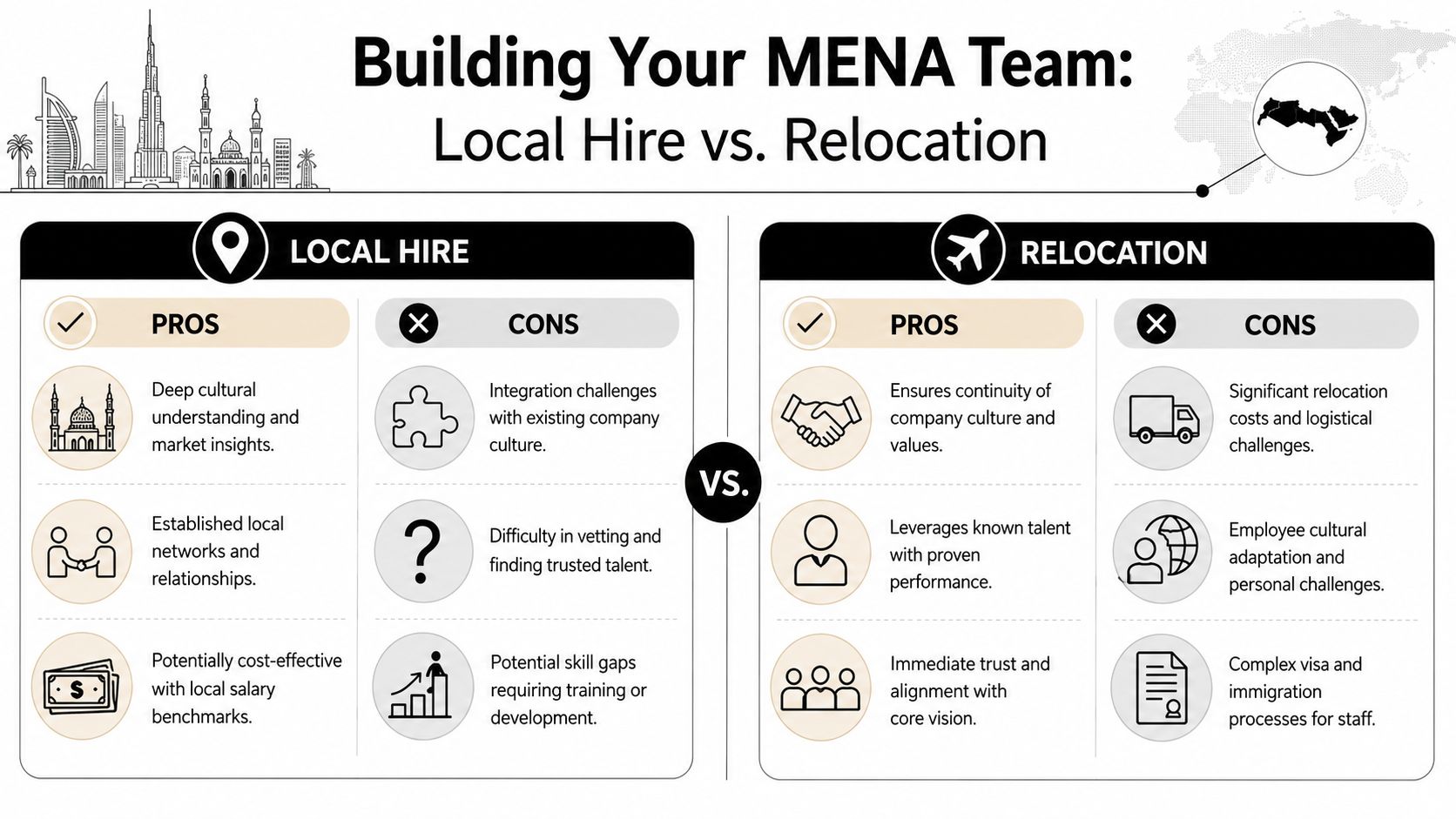
There are only two pure models, and both have problems. A fully relocated team can preserve culture but miss local nuance. A fully local team can bring market instinct but struggle with product context and internal trust.
What relocating gets right and wrong
Relocating trusted people helps when you need speed, cultural continuity, and product accuracy from day one.
That matters most in roles like product implementation, early customer success, training, and internal operations handoff. These people already know how your company works. They know what “good” looks like. They can spot when a new market issue is a product issue, not just a local issue.
But relocation creates blind spots. Transplanted teams can overestimate how transferable the UAE playbook is. They can build an expat bubble, stay too dependent on headquarters, and miss the informal dynamics that local hires catch early.
What local hiring gets right and wrong
A strong local hire brings context you can't import. They understand how decisions get made, which objections are real, which meetings matter, and how trust is earned locally.
This is why I'd almost always localise the commercial edge early. If you're choosing only one local senior hire at the start, it's often sales, partnerships, or market development.
The challenge is integration. A local commercial lead without enough product and internal context can end up making promises your delivery team can't support. That's not a talent problem. It's a setup problem.
The hybrid model most founders should use
The strongest approach is usually a deliberate blend.
- Relocate one culture carrier: Pick someone who understands your standards, rhythm, and customer promise.
- Hire one local market carrier: Choose someone with customer access, local judgement, and enough credibility to open the right doors.
- Avoid overbuilding too early: Don't hire a full country team before the first repeatable wins.
- Document the playbook: Every objection, pricing issue, onboarding friction point, and legal question should get written down fast.
“Send your culture, hire your context.”
That's a better default than choosing one side of the debate.
Practical role sequencing
A simple way to decide:
| Role type | Better relocated first | Better hired locally first |
|---|---|---|
| Product and implementation | Yes | Sometimes later |
| Sales and partnerships | Rarely | Usually |
| Operations and admin | Depends on structure | Often local or outsourced |
| Customer success | Hybrid | Hybrid |
If you're formalising hiring systems before entering a new market, reviewing how different applicant tracking tools fit startup workflows can save time. This roundup to compare 2026 ATS solutions for startups is useful because regional expansion usually exposes process gaps that didn't matter when the team was small.
Founders also underestimate the immigration and relocation burden on the employee, not just the company. If you're weighing advisory help around cross-border people moves, this Y-Axis consultancy overview is a practical starting point.
Lessons from the Trenches and Your Next Move
The failure modes repeat more often than founders admit.
One team expands because a handful of inbound leads from a new country made the market feel “hot”. They hire too early, discover those leads weren't a repeatable channel, and spend months carrying fixed costs while the UAE team loses focus.
Another founder chooses a large market first, assumes localisation will be light, and learns too late that payment habits, buyer expectations, and support needs require operational changes they never budgeted for.
A third team sends only relocated staff, wins a few early meetings, then plateaus because they still don't have someone local who knows which relationships matter and how deals really progress.
Most expansion failures don't come from lack of ambition. They come from sequencing mistakes.
The best founder story I can share here is a composite of several conversations that all followed the same pattern. The company had clear UAE traction and real interest from both Saudi and Egypt. Instead of launching in both, the founders ran a simple discipline.
They picked one market based on current fit, not aspiration. They sent one trusted internal operator. They hired one local commercial lead. They refused to set up a large local team until sales motion and delivery friction were visible in practice. They wrote down every operational snag, from contracting language to onboarding expectations. They treated the first market as a learning lab for the second.
That approach sounds modest. It wins because modesty preserves optionality.
The unwritten rules founders keep relearning
Here are the lessons that come up repeatedly in real conversations:
- Country readiness beats excitement: UAE-specific data shows that 56% of pre-seed startups fail to reach the next stage because of inadequate regulatory and market validation, which is why traction and country readiness matter so much in Strategy& Middle East's work on scaling MENA SMEs.
- Localisation isn't cosmetic: Language, support style, contracting expectations, and payment behaviour can alter conversion more than founders expect.
- Entity setup is not market entry: You can be legally present and still commercially absent.
- One strong local operator beats a loose network of introductions: Warm intros help. Consistent execution helps more.
- Expansion should create learning, not just footprint: If the first new market doesn't sharpen your model, it's probably draining it.
Your next action this week
Book a one-hour session with your co-founder or leadership team and do only this:
- Score your readiness as green, yellow, or red across product, revenue, team, finance, and operations.
- Write down the top two candidate markets after the UAE.
- What proof do we already have?
- What local changes are mandatory?
- Who would own this market internally?
- What would make us regret this choice in six months?
- If the answers are fuzzy, don't expand yet.
- If one market is clearly stronger, run a narrow entry plan before a full launch.
Good expansion doesn't look dramatic at the start. It looks disciplined, slightly conservative, and very clear about trade-offs.
If you want a sharper sounding board before making the call, Founder Connects gives UAE and MENA founders access to high-signal peer conversations, curated introductions, and practical accountability so expansion decisions get pressure-tested before they become expensive.

Building in MENA? You don't have to do it alone.
Join 300+ founders in the Founder Connects Residency. Monthly squad calls, warm intros, $3M+ in perks, and much more. All for less than your monthly coffee budget.
Popular posts





Founder Connects is a premium MENA tech founder community. Meetups in Dubai and across MENA, Residency Squads of 8–10, and 400+ vetted WhatsApp founders (apply and screened).