
Riyadh Startup Ecosystem 2026: A Founder's Guide
Building in MENA? You don't have to do it alone.
Join 300+ founders in the Founder Connects Residency. Monthly squad calls, warm intros, $3M+ in perks, and much more. All for less than your monthly coffee budget.

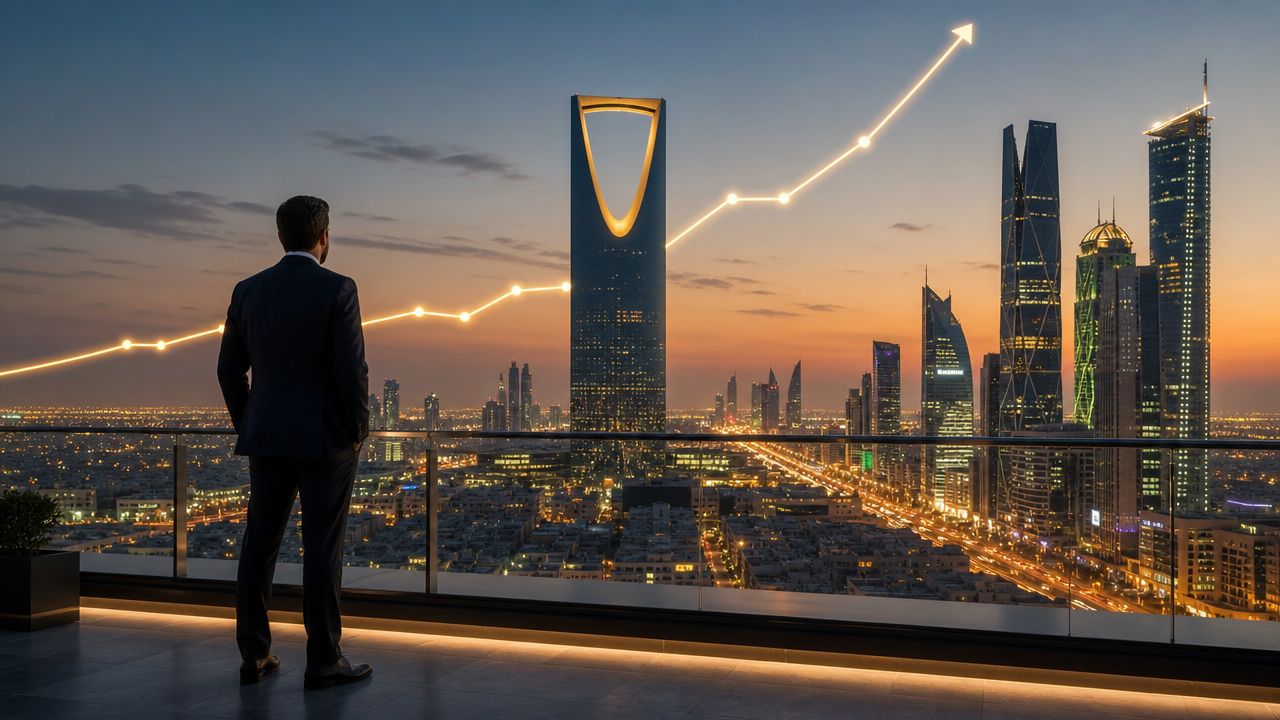
Riyadh moved up 60 places to become the 23rd strongest startup ecosystem globally in the 2025 Global Startup Ecosystem Report, and the ecosystem grew by 118% in a single year according to Founder Institute's analysis of Riyadh and Saudi Arabia's startup rise. For founders in the UAE, that's the number that changes the conversation.
A few years ago, many UAE startups treated Saudi as a later-stage market. Now Riyadh is often the market you have to plan for earlier, especially if you're in fintech, AI, B2B software, logistics, or anything that sells into regulated sectors.
What's changed isn't just capital. It's buyer behaviour, government attention, founder ambition, and the seriousness of local support. In founder conversations across the region, Riyadh no longer comes up as “promising”. It comes up as “we need a plan”.
This guide is written for busy UAE and MENA founders who want practical answers fast. It draws on what Saudi founders have shared in the Founder Connects community, plus what matters on the ground when you're deciding whether to enter, fundraise, hire, or build partnerships in the Riyadh startup ecosystem 2026 conversation.
Riyadh Rising Why Every Founder Is Watching KSA
The fastest way to understand Riyadh is this. The Saudi startup ecosystem grew by +236.8% in 2025, with approximately 2,068 startups recorded nationwide, while Riyadh now ranks as the 3rd most vibrant hub in the Middle East and among the top 38 emerging ecosystems globally, based on Peak Ventures' summary of the Saudi startup ecosystem under Vision 2030.
That doesn't mean every startup should rush in. It does mean ignoring Riyadh is now a strategic error for a large share of UAE-based founders.
What's actually pulling founders in
Riyadh matters because it combines three things founders care about:
- Serious market attention: Saudi buyers are actively evaluating new solutions across digital sectors, especially where policy priorities and enterprise demand line up.
- Regional gravity: More investors, operators, and ecosystem builders now treat Riyadh as a core node, not a side market.
- Execution pressure: Companies that enter early can build relationships before categories become crowded.
For UAE founders, the appeal is obvious. Dubai is still the easiest regional base for many teams. Riyadh is increasingly where you test whether your company can become meaningfully Gulf-scale.
What works and what doesn't
A lot of founders still make the same mistake. They assume success in the UAE transfers cleanly into Saudi. It rarely does.
What works:
- Local presence with clear intent
- A product tied to a visible business pain
- Patience in relationship-building
- A founder willing to spend time in-market
What doesn't:
- Remote-only market entry from Dubai
- Generic GCC messaging
- Treating Riyadh like a simple extension of UAE sales
- Expecting quick trust without repeated follow-up
Practical rule: If Saudi is important to your next stage of growth, stop treating it as “international expansion” and start treating it as a core operating market.
That shift in mindset changes how you hire, pitch, travel, price, and build partnerships.
The Vision 2030 Engine Driving Startup Growth
The cleanest way to read Riyadh's momentum is through Vision 2030. Founders hear the phrase constantly, but the useful question is simpler. How does it change what a startup can do?
It changes demand. It changes regulation. It changes who writes cheques. And it changes which sectors get institutional support.
Where Vision 2030 shows up for founders
Saudi founders don't talk about Vision 2030 as a slogan. They talk about it as a market-shaping force. In practical terms, it has pushed more attention into sectors that help diversify the economy, digitise services, and build local capability.
That matters because startups don't grow on policy language. They grow when policy creates:
- New buyers
- Faster adoption in priority sectors
- Support for local incorporation and talent
- More willingness from institutions to work with startups
A founder building in fintech, AI, enterprise software, tourism-related technology, logistics, or cybersecurity is operating inside that policy tailwind. Not every company benefits equally, but the sectors that align with national priorities get a different level of seriousness.
Why Riyadh benefits more than other cities
Riyadh sits close to the institutions that shape the market. That includes decision-makers, large buyers, sovereign capital, and many of the people who influence whether a startup gets a pilot, a meeting, or a second conversation.
That proximity creates a real operating advantage. Founders can get more done in person than they can through decks and cold outreach from abroad.
Here's the trade-off. Centralisation helps if you're present. It hurts if you're not.
Riyadh rewards founders who show up repeatedly. The market often opens through conversation, not just through a polished product demo.
The sectors where the signal is strongest
Based on repeated founder conversations, a few themes keep coming up:
| Area | Why founders pay attention |
|---|---|
| Fintech | Regulation and capital are both active, and buyers understand the category |
| AI | There's visible interest in practical AI use cases, especially where they solve local business problems |
| B2B software | Enterprises and growth-stage companies need tools that support efficiency and digitisation |
| Cybersecurity | Trust, compliance, and infrastructure remain central concerns |
| Logistics and operations | The market rewards products that solve execution bottlenecks |
For UAE founders, the useful question isn't “Is Saudi hot?” It's “Does my product sit inside a category Saudi institutions and buyers already care about?”
If the answer is yes, Riyadh deserves immediate attention. If the answer is unclear, spend time validating use cases before spending heavily on setup.
Navigating the Riyadh Funding Landscape
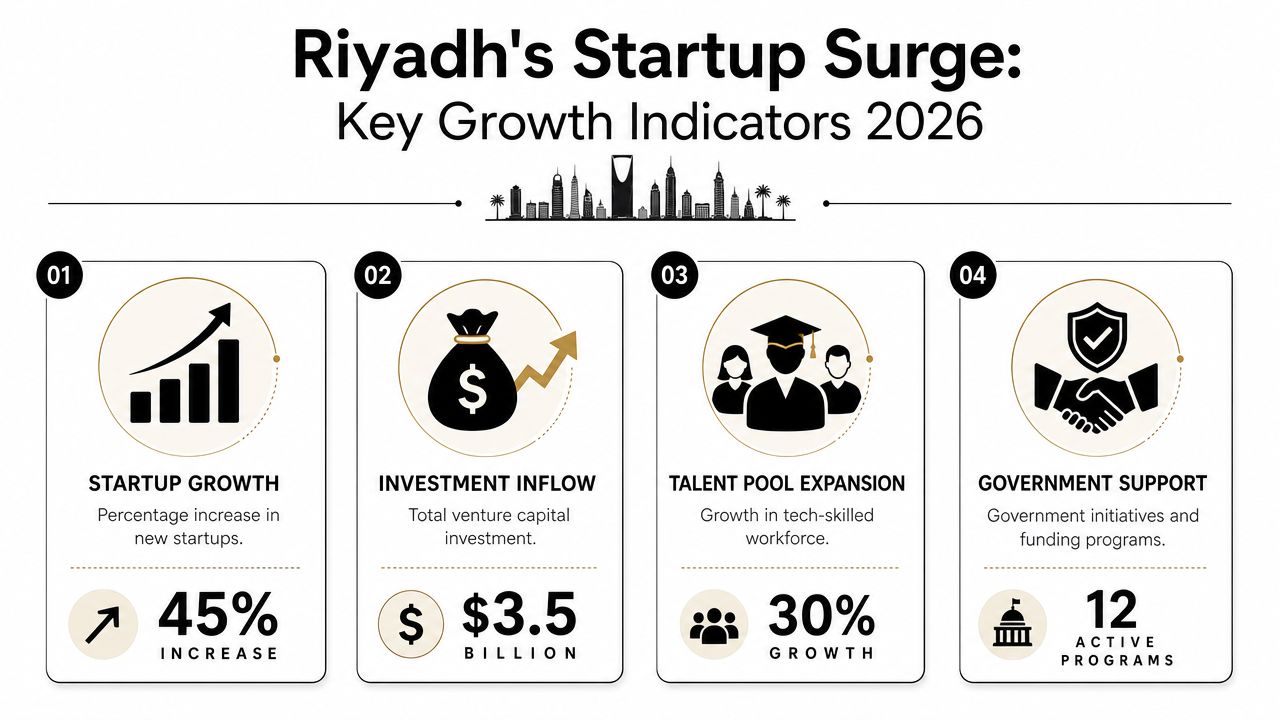
Saudi startup funding is no longer a side story in the Gulf. Over $2.6 billion in venture capital has flowed into Saudi startups since 2018, and startups raised a record $1.34 billion in the first half of 2025 alone, a 342% year-on-year increase, according to MAGNiTT's reporting on Saudi venture activity.
That volume matters because it changes founder behaviour and investor expectations at the same time. Riyadh is now one of the few markets in the region where founders can raise, sell, and build relationships with policy-linked stakeholders in the same city. In Founder Connects conversations, UAE founders usually ask the same practical question first. Who writes cheques here, and what do they need to see before they move?
The three funding layers founders need to understand
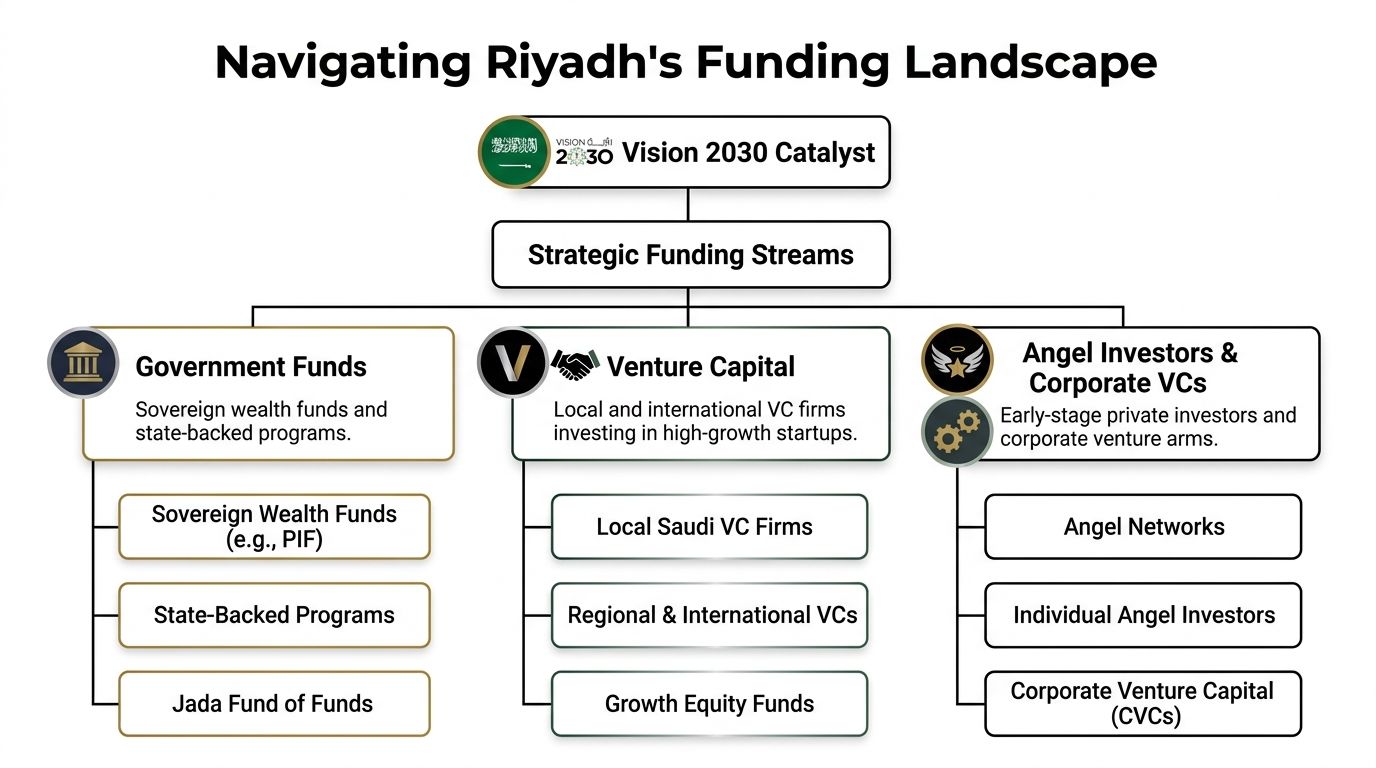
Riyadh funding usually falls into three groups, and each one evaluates risk differently.
State-backed capital and policy-linked funds
These investors shape the market through capital allocation, sector priorities, and long-term economic goals. Founders in AI, fintech, infrastructure software, logistics, and other nationally relevant categories often get a better hearing here than startups with a generic regional story.Local and regional VC firms
These firms want the usual venture signals, but they also test for Saudi execution. A good UAE business with no clear Saudi wedge often struggles. A smaller company with real local demand, a credible hiring plan, and active customer conversations can get much more traction.Angels, family offices, and strategic investors
This part of the market runs heavily on trust and referrals. Meetings often come through operators, portfolio founders, or commercial contacts rather than broad outbound. Founders preparing for this channel should review this guide to pitching family office investors in the Middle East.
The trade-off is straightforward. Riyadh has more capital in motion than many founders assume, but access improves sharply once investors believe you are serious about Saudi, not merely adding KSA to a regional slide.
What UAE founders should prove before fundraising
For UAE founders, the adjustment is usually not the pitch quality. It is the market specificity.
Investors in Riyadh generally want answers to four questions:
- Why does your product fit Saudi demand now?
- Which buyer or user behaviour is different in KSA versus the UAE?
- What local proof do you have already, or how will you get it fast?
- Who on the ground helps you close customers, hire, and stay close to the market?
In our Founder Connects community, the founders who get meetings faster usually arrive with one concrete Saudi signal. A pilot. A serious enterprise conversation. A local advisor with sector credibility. Even a narrow proof point can change the tone of the discussion.
This video gives useful context on the broader ecosystem founders are entering:
Where founders lose momentum
The common mistake is over-relying on a Gulf-wide story. Riyadh investors hear that constantly, and it rarely answers their real concern. They want to know why this team will win in Saudi specifically, what local advantage it can build, and how quickly it can turn introductions into commercial proof.
A better approach is more disciplined:
- Build Saudi proof before broad outreach: A live conversation with the right buyer beats a long investor target list.
- Adjust the deck for local context: Saudi expansion should show buyer logic, sector relevance, and execution steps, not just TAM slides.
- Use introductions selectively: The quality of the introducer affects how seriously the meeting starts.
- Show where the team is still learning: Humility reads better than overconfidence, especially in a market where relationships shape access.
One founder in our community put it plainly during a simulated Riyadh fundraising discussion. “My UAE traction got attention. My Saudi customer pipeline got follow-up meetings.”
That is usually the difference. A good regional startup can get a first call. A founder with a clear Saudi case gets a second meeting.
Key Players and Support Systems on the Ground
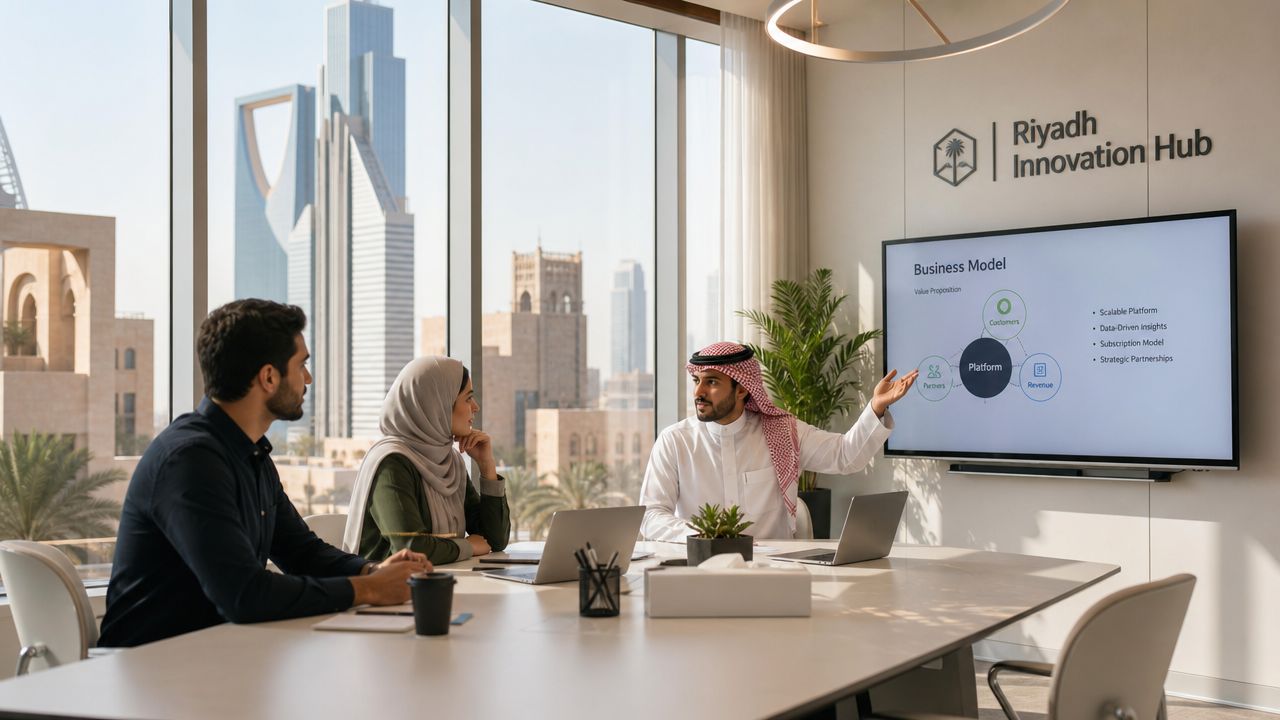
Money matters, but support often determines whether an expansion survives first contact with the market. Riyadh's ecosystem now has enough depth that founders can find help with funding, licensing, mentorship, and practical market entry.
Support systems are strong, with accelerators like Flat6Labs providing seed funding up to SAR 750K (approx. USD 200K), and the National Technology Development Program offering a non-dilutive grant of $40,000 (SAR 150,000) to AI-first startups, according to StartupBlink's Riyadh ecosystem profile.
The support map founders should know
UAE founders entering Riyadh usually need four kinds of support.
| Support type | What it helps with |
|---|---|
| Accelerators | Founder coaching, market access, credibility, and in some cases capital |
| Government-linked programmes | Licensing support, introductions, sector alignment, and founder navigation |
| Founder communities | Honest local insight, hiring referrals, and deal reality checks |
| Professional service partners | Setup, compliance, payroll, and administrative execution |
The founders who move fastest are rarely the ones with the biggest brand. They're the ones who know who to call when something practical gets stuck.
Flat6Labs and NTDP are worth real attention
Flat6Labs matters because it can help early founders close the gap between concept and market-ready execution. Teams that need structure, local context, and a stronger investor narrative often benefit from that environment.
NTDP matters for a different reason. If you're building an AI-first company, non-dilutive support changes the risk profile of experimentation. It gives technical teams more room to validate before raising on weak terms.
That's especially relevant if your AI product needs local adaptation, Arabic workflows, enterprise integrations, or sector-specific proof.
What support is useful and what is just noise
Not every programme is worth your time. Founders in Saudi often separate support into two categories.
Useful support:
- Programmes that provide actual introductions
- Teams that help with licensing and practical navigation
- Operators who understand your sector
- Communities that share candid feedback, not just stage time
Mostly noise:
- Events where nobody follows up
- Generic “innovation” programming with no market access
- Mentorship without decision-maker proximity
- Brand-heavy partnerships that don't shorten your path to customers
Field note: Ask every accelerator, programme manager, or ecosystem contact the same question. “Which three founders or customers should I meet in the next two weeks?” Their answer tells you whether they're connected or just visible.
That single question saves a lot of wasted time.
From a Founder A Conversation About Riyadh
One of the more useful conversations I had recently was with a Riyadh-based founder in the community building a B2B product for local enterprises. I'm keeping it unattributed because the value is in the pattern, not the name.
What stood out wasn't hype. It was precision. He had a clear view of what Riyadh rewards, and he was blunt about what outside founders misunderstand.
The conversation
What's the first thing UAE founders get wrong about Riyadh?
He didn't hesitate. They think interest equals commitment.
He said many founders visit Riyadh, get several encouraging meetings, then go back to Dubai assuming deals are moving. In reality, those first meetings often mean only one thing: the market is open to more conversation. Not that the deal is close.
What moves deals forward?
“Repeat presence,” he said. “People want to know you're serious, and they want to know you'll still be here when implementation gets hard.”
That matches what I keep hearing. In Riyadh, persistence reads as commitment. Sporadic visibility reads as opportunism.
What surprised him most about building there
I asked what had gone better than expected.
He said customer urgency. When the pain is real and the product fits a priority workflow, buyers can move faster than outsiders expect. But speed only appears after trust exists. Before trust, everything feels slower.
That's the Riyadh paradox. Relationship-building can take time. Once confidence forms, commercial movement can be sharp.
“Don't confuse a warm room with a closed deal. Keep showing up until the conversation becomes operational.”
His advice for a UAE founder entering now
I asked him what he'd tell a Dubai-based founder thinking about Saudi expansion this year. His answer was practical.
- Come with one sharp use case: Broad positioning underperforms. A clear problem statement lands better.
- Put someone senior in market: Junior business development alone usually won't carry the expansion.
- Hire context, not just CVs: A local operator who understands how decisions get made can outperform a more polished but disconnected hire.
- Adapt the sales process: You may need more in-person time, more stakeholder mapping, and more patience around internal approvals.
He also made one point that founders often avoid. If your product only works when the customer already behaves like a UAE customer, your Saudi expansion isn't ready.
The real takeaway
The most useful part of the conversation was his framing of credibility.
In his view, Riyadh buyers don't just assess product quality. They assess seriousness. Are you committed to the market? Are you building for this context? Will your team stay close after the contract is signed?
That's why some outside founders with stronger decks lose to local teams with simpler products. The local team often looks easier to trust.
Cultural Nuances for UAE Founders Expanding to KSA
Geographic proximity hides real operating differences. In Founder Connects conversations, UAE founders usually underestimate one thing first. How Saudi buyers read intent.
The practical gap is trust formation. In Dubai, a strong deck, a fast follow-up, and a clear commercial case can move a conversation quickly. In Riyadh, buyers often want to understand who is behind the company, how serious the commitment is, and whether the team will stay close after signing.
That changes how a UAE founder comes across in the room. Efficient can read as rushed. A polished pitch can feel generic if it jumps straight to product without enough local context. Teams that win tend to show they have done the work on the customer, the institution, and the approval process around the deal.
Sector context sharpens this. In fintech and other regulated categories, local buyers expect more than category fluency. They expect founders to understand how risk is assessed inside Saudi institutions, who influences the buying decision, and what kind of local presence reduces concern. Growth List's overview of the Saudi startup market points to strong activity in categories attracting both capital and policy attention. That creates demand, but it also makes lazy market entry easier to spot.
I hear the same pattern from founders in the community. UAE teams often prepare for Saudi as a sales expansion. Saudi customers often evaluate it as a commitment test.
A few adjustments make a clear difference:
- Lead with relevance: Start with the local use case, not your regional credentials.
- Budget for in-person time: Riyadh usually requires more founder presence than a UAE team expects in the first quarter.
- Get introduced well: One credible intro can outperform a long outbound list.
- Map the actual decision chain: The first meeting rarely reveals every stakeholder.
- Translate proof carefully: UAE case studies help only when the buyer can see the Saudi equivalent.
If you are entering a policy-linked or institution-heavy category, review the Saudi Chamber of Commerce structure and how it affects business access before outreach starts. It helps explain why formal relationships, industry bodies, and local credibility often sit closer to commercial progress than they do in the UAE.
Relationships in Riyadh are part of execution, not a soft layer around it.
That is the part many UAE founders only learn after a few slow meetings. The teams that adjust early usually shorten that learning curve.
Your First Steps A Practical Plan for Entry
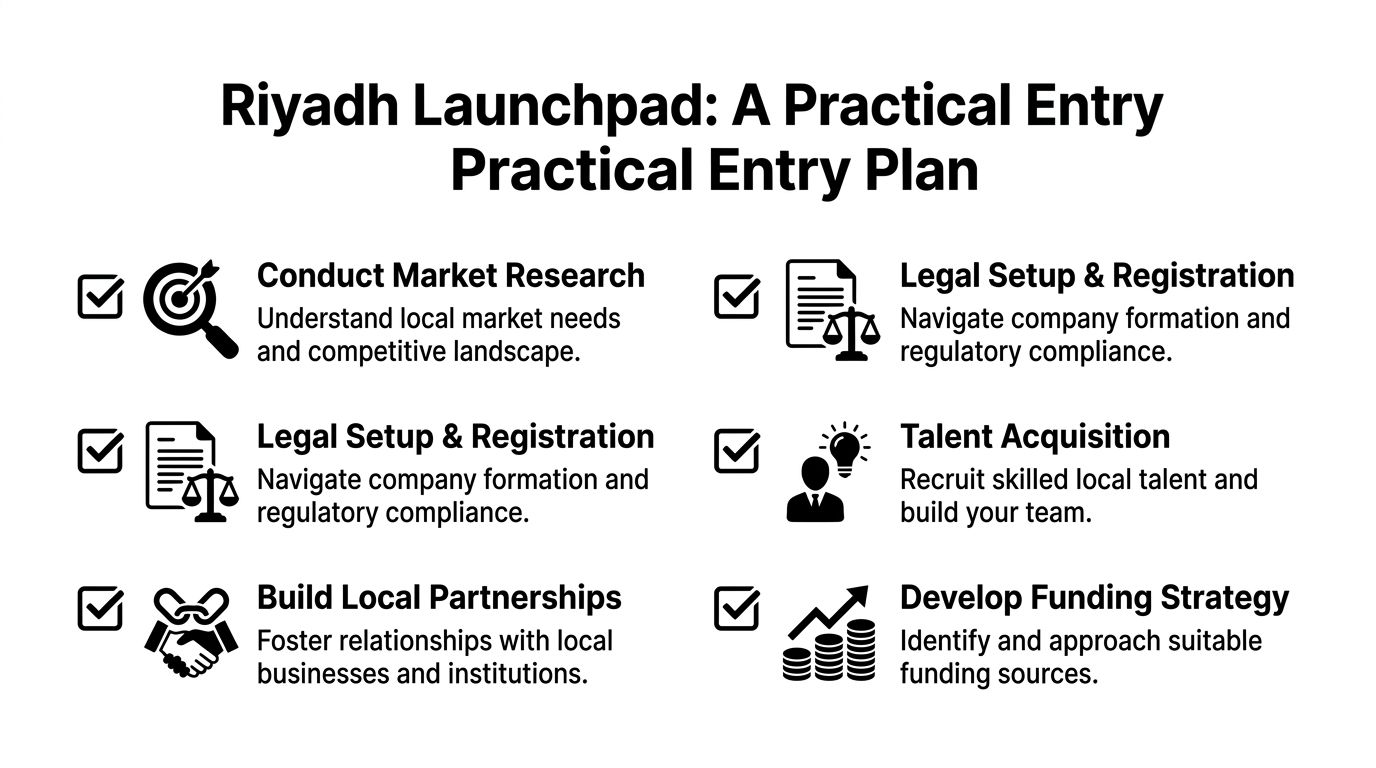
Most UAE founders don't need a huge Saudi strategy deck first. They need a simple entry plan they can execute in the next month.
A useful starting point is understanding that a new Startup Visa category introduced in 2025 reduces founder friction, while Saudi Fintech initiatives are designing regulatory sandboxes and Monsha'at's Business Accelerators provide mentorship and licensing support for international founders, based on Startup Genome's Riyadh ecosystem overview.
A simple 30-day entry plan
Week one
Map the opportunity clearly. Define one customer segment in Riyadh, one urgent problem, and one reason your product should win there.
If your team's Saudi thesis still sounds like “large market, strong demand”, it's too vague.
Week two
Book meetings in market. Don't wait until setup is perfect. Speak to potential customers, operators, and founders already working in Riyadh.
Use this step to test assumptions around pricing, sales cycles, and who owns the budget.
Week three
Pressure-test acquisition. A lot of market-entry plans fail because founders focus on licensing before they understand demand generation.
If your team needs a sharper framework for this, this guide on customer acquisition for startups is worth reviewing before you build your Saudi go-to-market plan.
Week four
Decide whether to commit resources. By this point you should know whether you need:
- A local commercial lead
- A regulatory path through a sandbox
- A founder presence plan
- A partnership-first model
- A delayed launch while you refine the offer
Three questions to ask your team now
- What proof do we have that a Riyadh customer needs this now?
- Who on the founding team owns Saudi, personally?
- Which local relationship could remove the most friction in the next 30 days?
For additional market context, this Saudi world map guide for founders is a useful way to frame where Riyadh sits in the broader opportunity.
The main point is simple. The Riyadh startup ecosystem 2026 opportunity is real, but it rewards disciplined entry. Start narrow. Build trust early. Spend time on the ground. Let real conversations shape the plan.
If you want more founder-to-founder insight like this, Founder Connects brings UAE and MENA builders into curated peer groups, practical conversations, and high-signal introductions that help turn market interest into real progress.

Building in MENA? You don't have to do it alone.
Join 300+ founders in the Founder Connects Residency. Monthly squad calls, warm intros, $3M+ in perks, and much more. All for less than your monthly coffee budget.
Popular posts





Founder Connects is a premium MENA tech founder community. Meetups in Dubai and across MENA, Residency Squads of 8–10, and 400+ vetted WhatsApp founders (apply and screened).