

The National Grocers Association: A Founder's Playbook
Building in MENA? You don't have to do it alone.
Join 300+ founders in the Founder Connects Residency. Monthly squad calls, warm intros, $3M+ in perks, and much more. All for less than your monthly coffee budget.

Most founders look at the US grocery market and ask the wrong question. They ask, “Who are the biggest chains?” The better question is, how do smaller operators stay relevant when scale is stacked against them?
That's why the National Grocers Association matters. For a founder in Dubai, Riyadh, or Cairo, it isn't just a US trade body to recognise from a market map. It's a working example of how a fragmented industry organises itself, protects margins, upgrades operations, and stays competitive without becoming one giant company.
If you're building FoodTech, retail infrastructure, workforce tooling, logistics software, or B2B services for merchants, the lesson isn't “join an association”. The lesson is to study what functions the association performs, then decide which of those functions your product, network, or partnerships can replicate in your own market.
What Is the National Grocers Association
The National Grocers Association is a US trade association for independent grocers, wholesalers, and suppliers. On paper, that sounds straightforward. In practice, it represents a strategic response to one hard commercial reality: independent supermarkets need shared strength if they're going to compete in a market dominated by larger retail systems.
For a MENA founder, that matters because many regional retail markets look different on the surface but behave similarly underneath. Large groups control traffic, supplier terms, talent, and technology budgets. Smaller operators often win on local knowledge, service, and agility, but they still need better access to information, support, and collective bargaining power.
Why this matters outside the US
The useful way to read the National Grocers Association is as a coordination layer.
It helps smaller businesses do three things they struggle to do alone:
- Speak collectively: Individual operators rarely shape policy or industry standards by themselves.
- Learn faster: Good operators often solve the same problems in parallel, wasting time and money.
- Modernise with less friction: Technology adoption, training, and process change are easier when there's a support structure around them.
That's the takeaway. The NGA is not just an institution. It's an operating model.
A founder in the UAE can apply the same lens when assessing any foreign market. Don't just map buyers. Map the bodies that aggregate buyers, train them, represent them, and influence what they adopt. That's often where distribution, trust, and market intelligence sit.
If you already think this way, you'll see why groups outside your home market can matter even before you sell there. The same logic shows up in chambers, trade councils, and bilateral business groups such as the American business council ecosystem in Dubai, where networks create practical access long before a contract is signed.
Practical rule: When evaluating a market, identify the organisations that reduce fragmentation. They often tell you more than a list of top retailers.
Who the NGA really serves
The formal audience is broad, but the commercial centre is clear. The NGA exists to help independent operators compete and endure.
That makes it especially relevant for founders selling to the “messy middle” of retail. Not enterprise chains with huge internal teams. Not tiny informal shops. The mid-sized and independent operators who need solutions badly, but need them packaged with education, trust, and operational realism.
If your product assumes buyers have deep implementation teams, clean data, and spare management capacity, you'll miss this segment. The NGA's model suggests the opposite approach works better. Pair product with guidance. Pair innovation with adoption support. Pair ambition with execution help.
Decoding the NGA Value Proposition
The NGA's value proposition is easiest to understand through three pillars. Not because the organisation uses that exact language everywhere, but because founders need a clear operating frame.
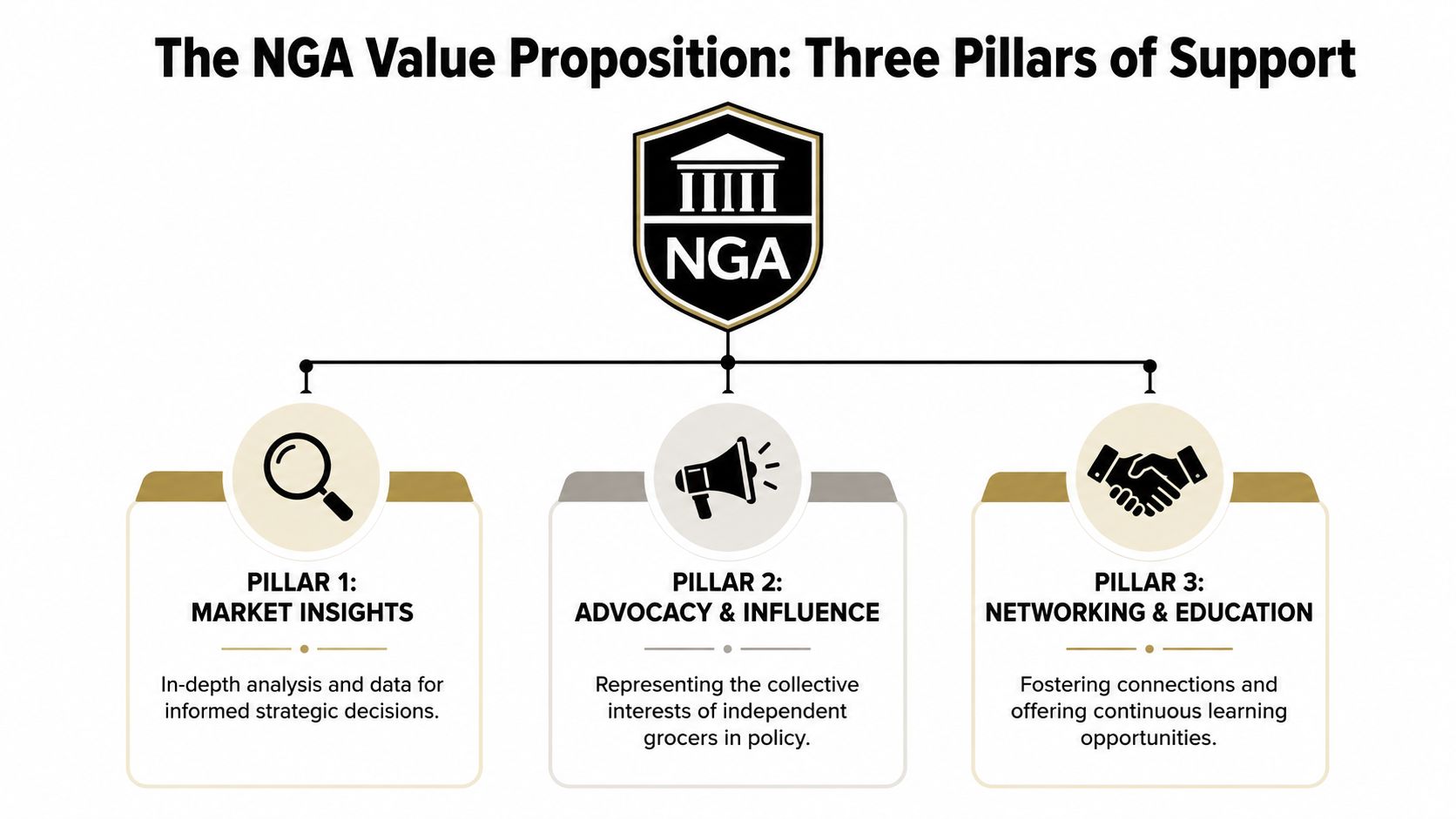
Advocacy and influence
At the top level, the NGA gives independents a unified voice. That matters because many grocery issues aren't purely commercial. They sit at the intersection of food access, regulation, labour, and public policy.
For founders, the lesson is simple. Markets don't only move through product superiority. They also move through representation. If your customers face recurring compliance friction, procurement barriers, or local operating constraints, someone has to aggregate those concerns and make them legible.
A startup can't always do formal advocacy. But it can still play a similar role by collecting customer pain points, translating them into a common narrative, and bringing that narrative to regulators, landlords, logistics partners, or payment providers.
Community and connection
Many founders underestimate the model. Associations look boring until you realise they create trust density.
Events, memberships, and peer access aren't soft benefits. They reduce search costs. They shorten the time it takes for a buyer to hear about a tool, ask another operator whether it works, and decide whether to trial it.
That's why in retail, commercial education and buyer networking often sit next to each other. A grocer rarely adopts a new workflow because a vendor's landing page looked polished. Adoption happens when the solution fits a live problem and the operator hears a credible implementation story from someone comparable.
If you're thinking about fulfilment or omnichannel operations, a practical external read is this curbside guide for retail. Not because it explains the US grocery market in full, but because it shows how one specific service model needs operational clarity before it becomes commercially useful.
Community isn't a branding asset. It's a distribution mechanism for know-how.
Operational support
This is the least glamorous pillar and usually the most valuable. The NGA's Grocer Solutions Center and Resource Library provide educational tools, modernisation resources, and personalised support aimed at helping grocers improve customer acquisition and expand food access.
That line matters because it reveals a lot about the underlying demand. Grocers don't only need inspiration. They need help implementing change in stores, with real teams, on real timetables.
Here's the founder takeaway in plain terms:
| Pillar | What members get | What founders should learn |
|---|---|---|
| Advocacy | Collective representation | Aggregate customer pain, don't sell in isolation |
| Community | Peer access and industry connection | Build trust channels, not just lead funnels |
| Operations | Practical tools and support | Adoption support is part of the product |
What tends to work and what doesn't
What works:
- Tight problem framing: Support tied to live operating pain gets used.
- Peer validation: Buyers trust comparable operators more than polished messaging.
- Practical enablement: Templates, education, and guided implementation reduce drop-off.
What doesn't:
- Abstract innovation language: Retail operators don't buy slogans.
- Overbuilt software without onboarding logic: Good features fail when stores lack execution bandwidth.
- Purely transactional community efforts: If nobody learns anything useful, attendance doesn't convert into action.
Measuring the NGA's Industry Impact
Scale matters because it tells you whether a market is worth the effort to understand thoroughly. The independent grocery segment in the US clears that threshold easily.
According to the NGA, independent supermarkets generate more than $557.5 billion in annual economic activity and support nearly 1.5 million American jobs, which it describes as about 2.0% of the U.S. economy in its Grocers Impact America analysis.
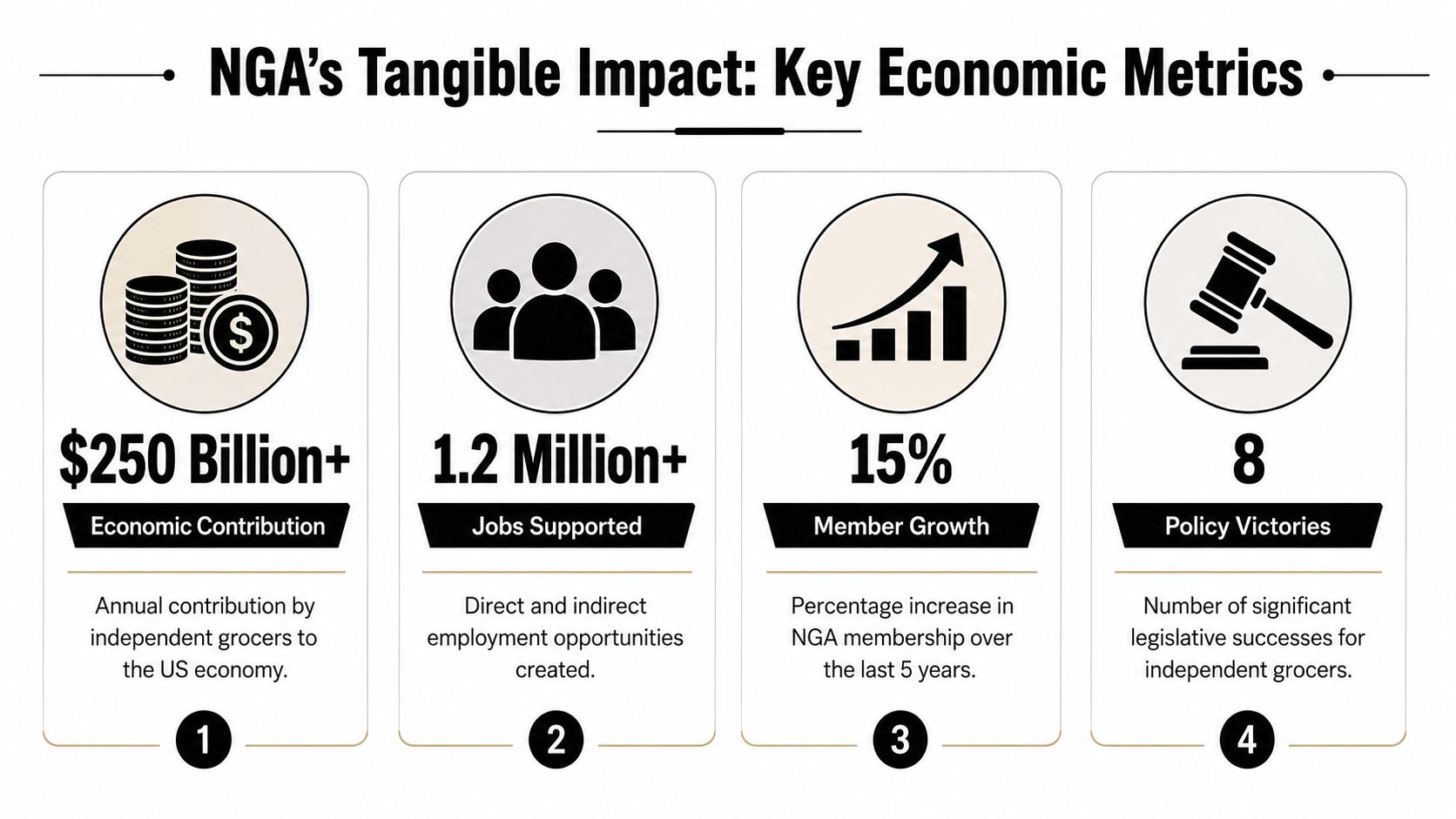
For a MENA founder, the point isn't to memorise the headline. The point is to recognise that “independent grocers” in the US are not a niche tail-end category. They represent a large, structured, economically significant market with enough weight to justify specialised support, events, education, and vendor ecosystems.
The growth signal founders should notice
A prior NGA impact study released in 2016 reported that independent grocers employed 945,000 people, paid over $30 billion in wages and $27 billion in taxes, and produced $129.5 billion in sales across almost 21,000 supermarkets. NGA later reported that the sector had grown to more than $253.6 billion in sales and 1.1 million jobs from the 2012 data year to the newer study period, as noted in the earlier impact release shared by California Grocers Association.
That progression matters more than any single line item. It shows sustained relevance in a segment many outsiders wrongly assume is being wiped out by consolidation.
What this means strategically
If a fragmented sector can sustain this kind of scale, three conclusions follow.
- There is room for specialised tooling: You don't need to sell only to giant chains for the market to be meaningful.
- Intermediaries matter: Associations, wholesalers, and service networks become important channels in markets like this.
- Adoption won't be uniform: A large independent base means broad variation in maturity, which affects pricing, onboarding, and sales cycles.
Treat the US independent grocery sector as a layered market, not one customer type. A family-owned regional operator and a sophisticated multi-store independent may sit in the same category but buy very differently.
That's why founders should be careful with average-case assumptions. In markets served by an organisation like the NGA, the winning go-to-market usually combines segmentation, education, and channel strategy. A blunt “sell software to grocers” thesis won't travel far.
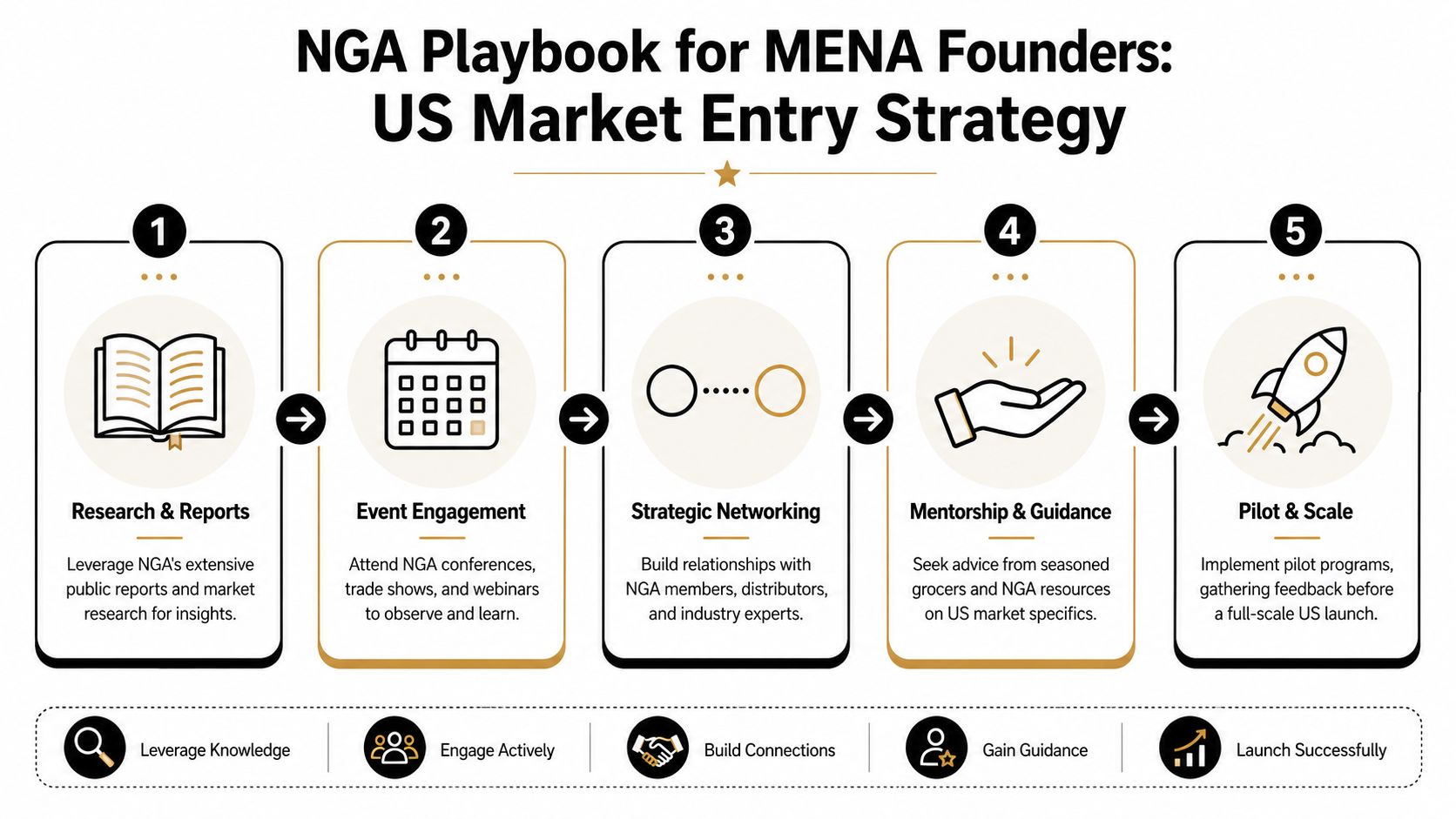
The NGA Playbook for MENA Founders
The best way to use the NGA model in MENA is not to copy the institution. It's to extract the functions and rebuild them at startup scale.
Build a micro-coalition
If you're selling into retail, don't try to carry every conversation alone. Create a small group of aligned operators or ecosystem partners who benefit from solving adjacent problems together.
That coalition could include a POS provider, a logistics operator, a merchandising consultant, or a category specialist. The goal isn't a formal alliance with branding and press releases. The goal is simple. Share insight, compare objections, and present a more credible improvement path to customers.
This approach works especially well in MENA where trust often moves through relationship clusters rather than cold institutional channels.
Create a lightweight knowledge hub
Most sectors don't need another generic community. They need a place where operators can swap implementation detail.
Run a breakfast roundtable. Start a private WhatsApp or Slack group. Host a short operator debrief after a retail event. Keep the agenda narrow. Labour scheduling, shrink control, shelf availability, delivery handoff, store staff onboarding, or multilingual training content are all better themes than broad “innovation” talk.
A useful benchmark for founders doing cross-border work is to get outside startup language and study advisory routes too. If you're designing regional or international growth plans, this overview of international business consulting support helps frame where external expertise is useful and where it adds noise.
Become the voice on one shared problem
You don't need to represent the entire sector. Pick one issue that repeatedly blocks execution and organise around it.
Examples include:
- Workforce onboarding: Stores hire, but struggle to train consistently.
- Store systems transition: Operators want upgrades but fear disruption.
- Last-mile operations: Customer promise breaks when handoffs are messy.
- Working capital access: Growth stalls because operators can't finance practical improvements.
If you're assessing the last point in a US context, a resource like GoSBA Loans' lender ranking is useful as market texture. Not because every founder needs debt finance expertise, but because capital access shapes what retailers can adopt and when.
Field test: Ask five operators the same question. “What change do you know you should make, but keep postponing?” If the same answer appears repeatedly, that's your coalition issue.
A simple startup version of the playbook
| Function from the NGA model | Startup-scale equivalent in MENA |
|---|---|
| Representation | Shared problem memo sent to partners or regulators |
| Education | Small peer learning group with operator-led sessions |
| Modernisation support | Guided pilot with training and implementation checklists |
This is how smaller founders punch above their weight. Not by pretending to be an association, but by becoming useful enough to coordinate action.
The NGA as Your Compass for US Market Entry
If you're considering the US, the NGA is valuable even if you never become extensively involved with it. Think of it as a market intelligence filter.
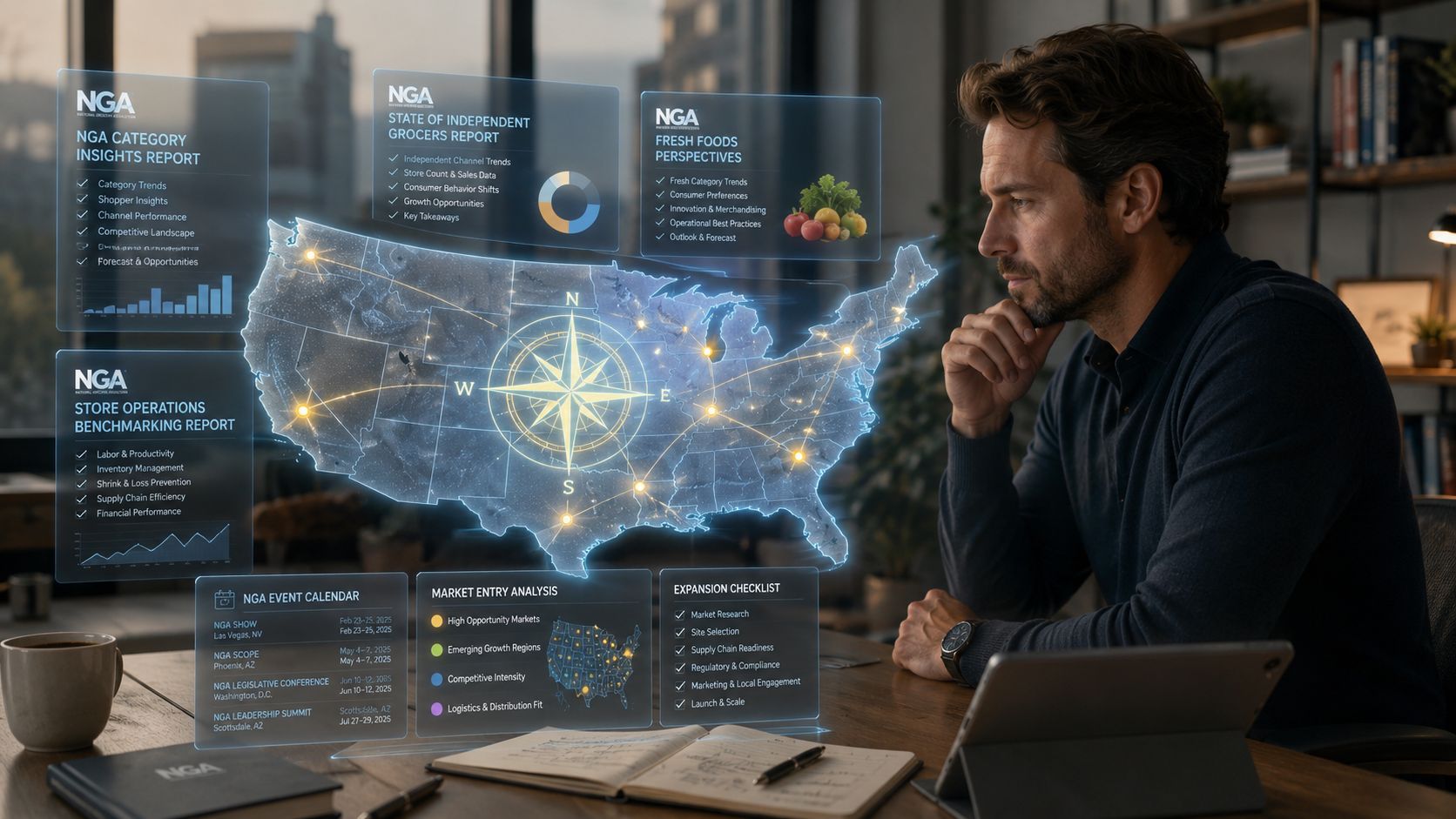
The reason is practical. Associations reveal where operators need help badly enough to organise around it. Their public materials, events, focus areas, and support resources tell you what keeps surfacing as a real operational constraint.
Look for execution pain, not just policy pain
One of the most useful signals here comes from the workforce side. The NGA's own foundation says it focuses on recruiting, retaining, and training staff for independent grocers, yet much of the public conversation around the organisation still emphasises lobbying. That creates a useful gap for founders, because the less visible challenge is often day-to-day execution rather than headline advocacy, as described by the National Grocers Association Foundation partner overview.
That distinction matters.
If you're a MENA founder looking at the US market, you might initially assume the opportunity sits in policy-heavy categories or broad “digital transformation” messaging. In reality, the sharper angle may be much more operational:
- Training systems that work in stores
- Tools that reduce managerial complexity
- Workforce coordination across mixed-skill teams
- Process discipline that protects service quality
Those are not glamorous categories. They are commercially serious categories.
How to use the NGA as an intelligence source
Use a simple four-part reading method:
Track what gets repeated
Repeated themes usually indicate persistent pain, not passing interest.Separate stated needs from operational needs
Buyers may talk publicly about advocacy and growth, while privately struggling with staffing, implementation, or execution consistency.Map where your product removes friction
Don't ask whether your product is groundbreaking. Ask whether it reduces one painful operational step.Test your assumptions against adjacent market signals
Retail property, local demand patterns, and merchant sentiment all add context. If you want a broader commercial lens, this market outlook for retailers offers a useful directional reference alongside sector-specific reading.
A founder planning cross-border expansion should also pressure-test whether the US is the right next market at all. This guide to global expansion planning for UAE startups is a good prompt for that decision.
The hidden opportunity in many retail markets isn't replacing the incumbent. It's helping operators execute the basics more reliably.
That's the key strategic use of the National Grocers Association. It helps you see where the independent grocery market has already told you, in plain sight, where support is needed.
Your Next Actionable Steps
Don't leave this as market trivia. Turn it into a working plan this quarter.
Run an internal gap audit
Ask your team one question: which part of this model is our biggest weakness right now, advocacy, community, or operations?
If you can build a strong product but can't educate buyers, that's an adoption problem. If you have users but no trusted ecosystem relationships, that's a community problem. If your customers keep asking for help beyond the software, that's an operations support problem.
Write one sentence under each category. Keep it brutally honest.
Map your ecosystem
List the key players around your target market.
Include:
- Industry bodies: Formal associations, trade groups, buying groups
- Commercial connectors: Distributors, consultants, service providers, implementation partners
- Operator networks: Peer communities, WhatsApp groups, event organisers, category specialists
You're looking for one thing. Who already has trust with your buyer?
Launch one small experiment
Pick one action that mirrors the NGA model at founder scale.
Good examples:
- Host a five-person operator dinner on one painful workflow
- Publish a short problem memo based on repeated customer objections
- Run a guided pilot with implementation support instead of a bare software trial
- Set up a recurring peer call for operators facing the same issue
Keep the scope narrow. You're not trying to build an association. You're testing whether coordination creates commercial advantage in your market.
If it does, you've found more than a tactic. You've found part of your go-to-market engine.
Founder Connects helps UAE and MENA founders build that kind of advantage through curated peer groups, practical introductions, and honest operator-level conversations. If you want a stronger circle around your next market move, explore Founder Connects.

Building in MENA? You don't have to do it alone.
Join 300+ founders in the Founder Connects Residency. Monthly squad calls, warm intros, $3M+ in perks, and much more. All for less than your monthly coffee budget.
Popular posts





The premier community for tech founders, investors, and builders. Connect, collaborate, and grow together.