

Networking for Introvert Founders: How to Get Value from a Dubai Meetup

Building in MENA? You don't have to do it alone.
Join 300+ founders in the Founder Connects Residency. Monthly squad calls, warm intros, $3M+ in perks, and much more. All for less than your monthly coffee budget.

The loudest networking advice is usually the worst advice for a quiet founder. Work the room, meet everyone, leave with a pile of contacts. That approach fills your evening with activity and gives you little you can use the next morning.
A better measure is simpler: what did you learn, and who will you follow up with?
Networking for introvert founders: how to get value from a Dubai Meetup starts there. Treat the Meetup as a short, goal-led research visit. Founder Connects, a startup community serving Dubai and the wider MENA region, runs small Meetups such as Coffee Series, where depth comes easier than performance. Pick a small format, arrive early, and aim for two real conversations over a room of names you will never contact again.
Pick a Small Meetup Format Before You Book
Book the smallest Meetup that matches your first goal, not the busiest room on the calendar. A busy room gives you more faces, but it also gives you more closed circles, more competing talk, and fewer chances to ask a careful question. For a quiet founder, format is the first decision, because the format decides how much performing the room expects from you.
Founder Connects runs Meetups in several formats, and they don't ask the same thing of you. Coffee Series is built around small-group conversation, so speaking one to one is the normal pattern. Tech After Hours is relaxed and informal, so you can build familiarity through repeated attendance without preparing a pitch. Pitch Night asks more of the room's attention. It suits a founder who wants feedback and visibility, but it's usually the wrong first step if speaking to a group drains you.
Meetup Formats Compared for Quiet Founders
| Format | Structure | Fit for a quiet founder | Best first goal |
|---|---|---|---|
| Coffee Series | Small group, in person | High: one-to-one conversation is the default | Learn how one founder solved a specific problem |
| Tech After Hours | Informal founder gathering, in person | High: no performance expected | Build a light, repeatable presence |
| Pitch Night | In person, one founder story and short pitches | Lower: rewards speaking to the full room | Visibility and feedback on your pitch |
Use one simple test before you book. If a format asks you to speak to a whole room before you've spoken properly to one person, it isn't the right first visit. Choose the low-pressure first visit instead, learn how the room moves, and move to a more public format later if you need that kind of feedback.
Choose for depth first. Visibility is useful only after you know what you want the room to notice.
Read the Coffee Series guide to understand the feel of a small-group session, and compare it against the other option in the Coffee Series and Tech After Hours comparison. Then check upcoming Meetups and choose one date. Don't keep browsing until motivation fades.
Set One Goal and Prepare Two Questions
Define one outcome before you leave home. Without a goal, you'll drift between conversations, collect names, and struggle later to explain what the visit gave you. A clear goal also helps you choose who to talk to, because you can listen for relevant experience instead of approaching people at random.
Three goals work well for a quiet founder:
- Learn from an operator: Find out how one founder handled a problem you're facing now.
- Test an assumption: Check whether a potential customer recognises the problem you think exists.
- Agree a follow-up: Leave with one defined reason to continue a useful conversation.
Pick only one. Trying to achieve all three in a single visit turns a calm plan into another performance target.
Write a Short Introduction
Prepare a 20-second introduction with four parts: the customer, the problem, the evidence you have so far, and the precise question you need help with. That structure stops you from giving a vague company description and hoping the other person works out how to respond.
Say something like: "We help UAE retailers reduce invoice delays. We've completed several customer interviews and need to know whether finance teams would pay for a workflow." The listener now knows who you serve, what you've tested, and where their experience might help. For more phrasing options, use the 60-second introduction guide for founder Meetups and shorten the version until it sounds natural aloud.
Prepare Two Diagnostic Questions
Write two questions that invite specific answers. "What decision helped you move from early traction to a more repeatable business?" works because it asks for a decision, not general advice. "Which approval created the most friction when you set up?" works because it points to a concrete operating detail.
Book properly as well. You pick the Meetup, book your seat, and show up. Walk-ins are turned away because room size is capped for quality. Check the details for guest rules before the day.
Your packing list is short: your goal, your introduction, your two questions, and a notebook or phone note for names and next steps. That's enough preparation. Anything more becomes rehearsal, and rehearsal makes you sound less natural.
Arrive Early and Find Your Spot in the Room
Arriving early is the most effective move you can make. Early in the session, people haven't formed closed groups, conversations are still forming, and you can choose where to stand without pushing into an established circle. Arriving late forces you to interrupt. Arriving early lets you become part of the room as it forms.
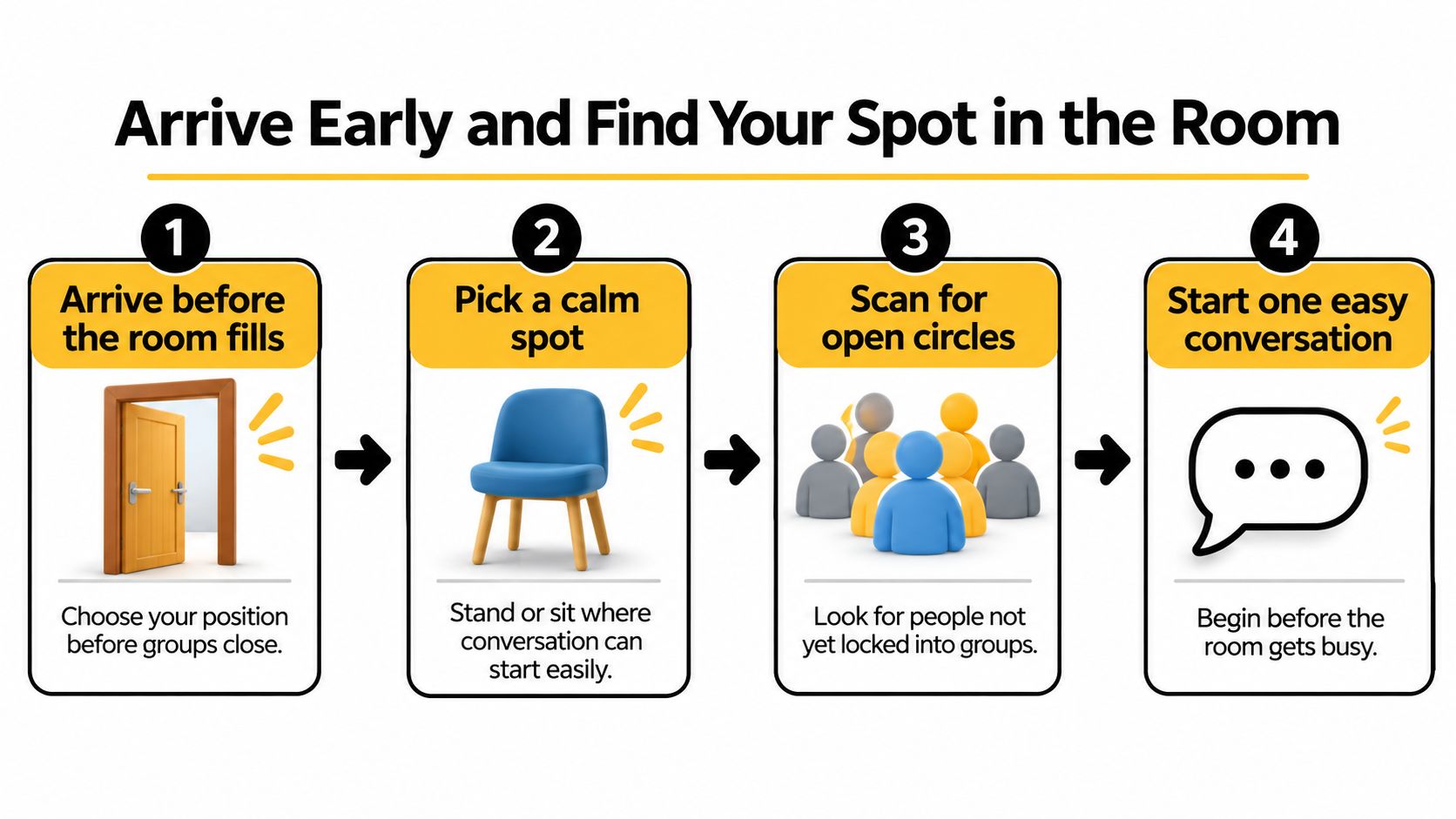
Follow this sequence:
- Arrive before the room fills: Choose your position calmly instead of taking whatever space is left.
- Stand where conversation forms: Sit or stand near the host or drinks station, not against the back wall. Passing traffic creates natural openings.
- Greet the host: Ask one practical question about how the format will run. You get useful information and a natural first exchange.
- Join a group with a clear topic: Take a listening role. Ask a question, repeat a point back in your own words, and let others continue.
- Keep an exit line ready: Say, "I want to hear more about that. Can we pick it up later?" Then move politely.
- Reset without leaving: If you need quiet, step away briefly, get water, and return to the conversation that interested you most.
The back wall feels safe, but it reduces accidental contact and makes you look unavailable. A position near a natural pause point works better because people expect brief conversation there. You don't need to dominate that space. You only need to be reachable.
Read the guide on what to expect at tech founder Meetups in Dubai if the room layout is the part that worries you. Your test for a settled arrival is simple: one real conversation started within the first fifteen minutes.
Turn Listening Into Two Real Conversations
Stop measuring the visit by the number of people you meet. Your target is two real conversations, each with a named person, a problem discussed, and a next step you could reasonably take. One strong conversation is still a worthwhile result. Ten shallow exchanges usually produce nothing after you leave.
Open with a question tied to the founder's work instead of "What do you do?" Ask, "What are you trying to solve this month?" or "What decision helped you move from early traction to a more repeatable business?" These questions give the other person something concrete to answer and give you useful material to follow.
Listen for the Repeated Problem
Listen for a problem the person mentions more than once. Repetition usually signals importance. Ask one follow-up about how they handled it, what they tried first, or what they'd avoid next time. Don't rush to offer your own experience before you understand theirs.
Then make the exchange two-way. Share a brief, specific answer using the introduction you prepared. Explain what you're building, who it's for, and the one question you're testing. Specificity helps the other founder respond with relevant experience rather than polite encouragement.
A useful listening move: Summarise what someone said, then ask one sharper question. People remember being understood more than they remember being pitched.
Handle Introductions and Small Talk
When someone asks you to introduce yourself to a small circle, keep it short. Name the customer, the problem, and what you're currently testing. Then stop. A concise answer leaves space for questions and stops you filling silence with unnecessary detail.
Small talk doesn't need to become a performance either. Ask about the person's current priority, how they found the Meetup, or what they're hoping to learn. If English isn't your first language, or you want steadier openers in mixed professional settings, these English conversation tips for international professionals can help you prepare topics without memorising a script.
End each good conversation with a concrete next step. Say, "Can I send you the customer interview template I mentioned?" or "Would a short call next week on that pricing question be useful?" Don't ask for a vague coffee. A named topic makes replying easy.
Quiet listening is a contribution when it leads to a clear observation or useful question. The success test is simple: by the end, you should have two named people, each with a problem discussed and an agreed next step.
Follow Up Within 24 Hours Without Small Talk
Send follow-ups within 24 hours, while the conversation is still specific. Delay turns a precise exchange into a generic "great to meet you" message, and generic messages are easy to ignore.
Write a short private note for each person: their role, the problem you discussed, and the agreed next step. Nothing more. You'll write a better message from three accurate lines than from a long summary created days later.
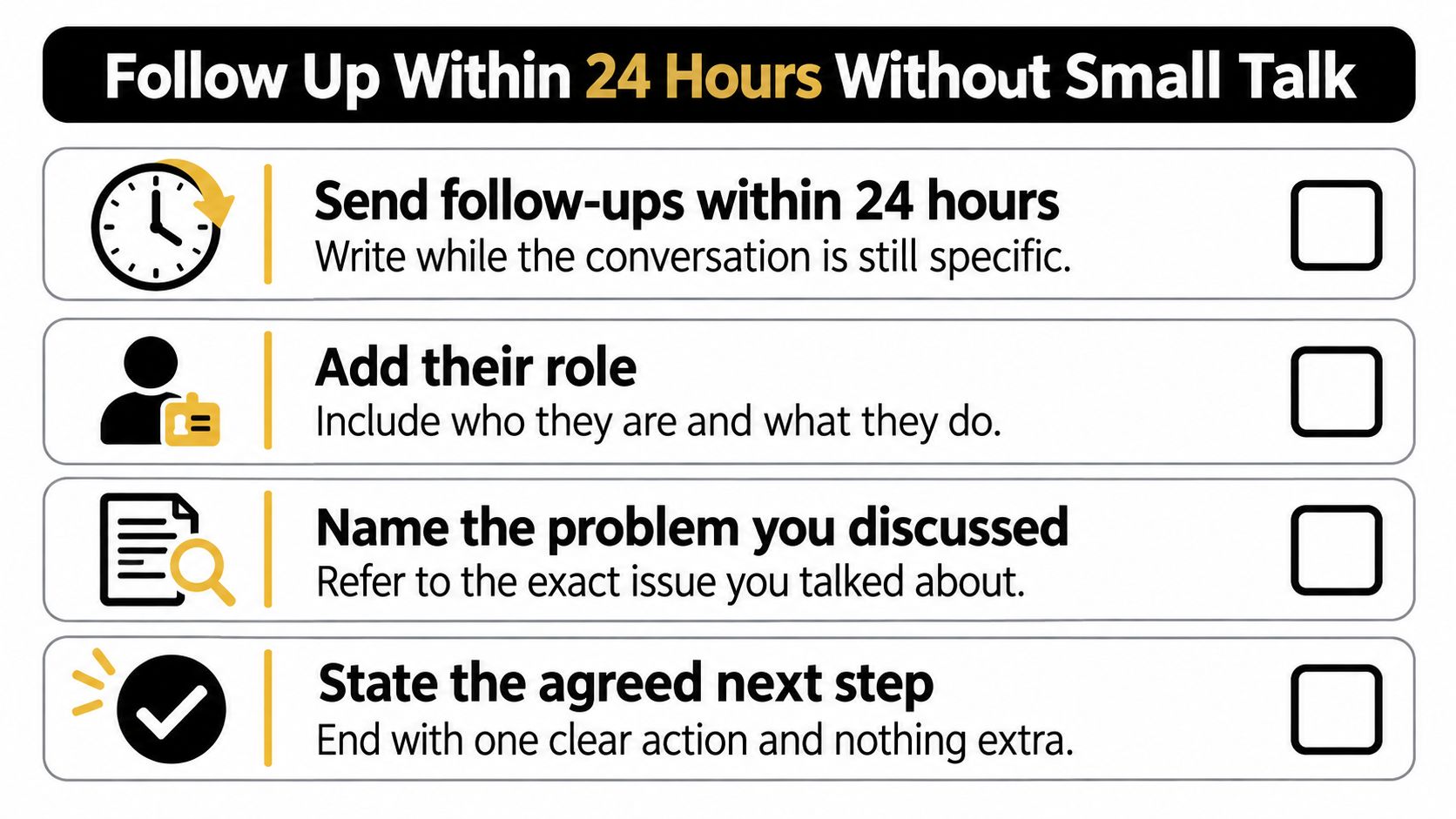
Message with a direct reference to the discussion: "You mentioned finance teams chase invoices by email. Here's the workflow idea I described." Send a resource rather than a request where possible. A useful link, template, or observation proves you listened and asks for nothing in return.
Treat what someone told you as their information. All information shared within the Founder Connects community is confidential and shouldn't be disclosed to third parties without express consent from Founder Connects. That restraint builds trust, especially when founders discuss pricing, hiring, customers, or fundraising difficulties.
Use the post-networking follow-up checklist to structure each message, then run this three-visit plan.
| Visit | Action | Success signal |
|---|---|---|
| 1 | Ask two founders about their current priorities and note the answers | Two priorities recorded |
| 2 | Return to one of them with a useful observation or resource | A reply to your message |
| 3 | Propose a short follow-up call on one defined topic | A call agreed on that topic |
Repeated attendance reduces pressure because familiarity does some of the work. You don't need a new opening line when you can ask how a previously discussed priority changed. Measure success by whether one person replies to your second message.
Avoid the Traps That Drain Introverts at Meetups
Most draining visits follow predictable patterns. The fix is rarely more confidence. It's usually a better format, a clearer stopping rule, or a more honest measure of success.

- Collecting names instead of learning: Measure the visit by insight gained or one follow-up agreed, not by contact volume.
- Staying with one friendly person all evening: Give yourself a time check. Thank them, name a next step if one exists, and move before comfort becomes hiding.
- Expecting immediate investor access: Funding conversations usually develop through trust and warm routes over time. Use the first visit for learning, customer discovery, or a relevant referral.
- Pitching when asked what you do: Give the short customer and problem version, then ask about the other founder. A sales monologue closes the exchange.
- Choosing a format that fights your goal: Don't book Pitch Night when you want quiet listening. Change format before you conclude that Meetups don't work for you.
- Judging one visit as failure: Familiarity needs repetition. A room can't recognise your value if you disappear after one awkward evening.
Run a Two-Question Self-Check
After each Meetup, ask: Did I learn something I can use this week? Did I leave one next step open? If both answers are yes, the visit worked even if you spoke to only one person. If both are no, examine the format and your goal before blaming your personality.
Also watch your energy. Leaving after two useful conversations is better than staying until you're depleted and associating every future Meetup with dread. Consistency matters more than endurance.
A quiet founder doesn't need a louder personality. They need a room, pace, and follow-up system that fit how they already think.
Set realistic expectations before the next visit, and don't compare your result with the founder who speaks easily to everyone. Their contact count may look stronger while producing fewer useful follow-ups than yours.
Your Questions on Introvert Founder Meetups Answered
Can I Bring My Co-Founder
Yes, co-founders are welcome at relevant Meetups. Check the Meetup details before bringing any guest, so you know what applies to that format. Friends are only allowed if they're founders or becoming one.
Bringing a co-founder can help if you split conversations and compare notes afterwards. Don't spend the whole session talking only to each other, because that removes the reason for attending.
Do I Have to Talk a Lot if I Am an Introvert
No. A prepared question, a listening role, and one specific follow-up count as a strong contribution. You don't need to lead the room or speak in every group.
Focus on understanding one founder's problem properly. That depth is often more memorable than confident small talk spread across many people.
How Do I Know a Meetup Is Worth Attending
Check whether the room offers the one outcome you need: customer feedback, a domain expert, a peer who can hold you accountable, or a relevant investor conversation. The format also matters. A smaller, structured room may serve you better than a larger room built around public pitching.
If the session can't plausibly produce your chosen outcome, choose a different Meetup next time. Don't keep attending out of obligation.
Take one action this week: choose one Meetup, write your goal and two questions, and reserve your seat before you do anything else.
Pick a small Meetup that fits one clear goal, prepare two questions, and give yourself permission to leave after two real conversations. Founder Connects runs founder Meetups in Dubai where you can use that calm, research-led approach without trying to work an entire room. Visit Founder Connects to choose your next Meetup and book your seat.

Building in MENA? You don't have to do it alone.
Join 300+ founders in the Founder Connects Residency. Monthly squad calls, warm intros, $3M+ in perks, and much more. All for less than your monthly coffee budget.
Popular posts





Founder Connects is a premium tech founder community in Dubai and the world. Meetups, Residency Squads of 8–10, and a WhatsApp group of 600+ vetted founders.