

Peer groups for bootstrapped founders in Dubai and MENA

Building in MENA? You don't have to do it alone.
Join 300+ founders in the Founder Connects Residency. Monthly squad calls, warm intros, $3M+ in perks, and much more. All for less than your monthly coffee budget.

The peer groups that suit bootstrapped or pre-revenue founders in Dubai and MENA match your stage, ask for real numbers at every session, and keep the same people around you over months. Founder Connects Residency Squads bring together 8–10 vetted, stage-matched founders on one structured 90-minute call a month.
Getting the fit right matters in Dubai and MENA because the venture narrative is loud. The region's funded startup activity is concentrated, visible, and easy to copy. For a bootstrapped or pre-revenue founder, copying that rhythm usually wastes time. What you need is a decision-support system that helps you validate demand, compare operating choices, and stay accountable when no investor is forcing the pace.
Redefining Peer Support Beyond Networking
A useful peer group is not a mixer with coffee and name tags. It is a disciplined circle that helps founders test assumptions before they burn cash on the wrong move. That distinction matters in the UAE, where the startup ecosystem is active enough to make fundraising feel like the default path even when revenue, ownership, or capital efficiency matter more.
The regional backdrop explains the temptation. In 2024, UAE startups raised approximately $1.1 billion across 207 deals, nearly half of MENA's total startup funding for the year, while the region as a whole attracted $2.3 billion even though total investment value declined year on year Wamda's 2024 MENA investment review. That creates noise for founders who are trying to build from customers, not capital.
A serious founder circle should do the opposite of hype. It should help you decide whether the next step is another interview, a pricing test, a hire, a channel experiment, or a hard stop. If you want a broader framing of peer support as an operating tool, the peer groups at Madeira Remote piece is useful because it treats peer learning as structured support rather than social networking.
Practical rule: if a meeting does not end with a decision, a test, or a clear escalation, it was probably just social time.
The best peer groups for bootstrapped founders also reduce emotional drift. They give you a place to hear whether your idea is becoming clearer or merely more polished. That matters because a polished story can still hide weak demand, weak margins, or a customer problem nobody is desperate to solve.
For founders trying to avoid VC distraction, the right question is simple, what would make this idea false in the next two weeks? A group that can answer that directly is far more valuable than a room full of people trading elevator pitches.
Why Bootstrapped Founders Need Stage-Matched Cohorts
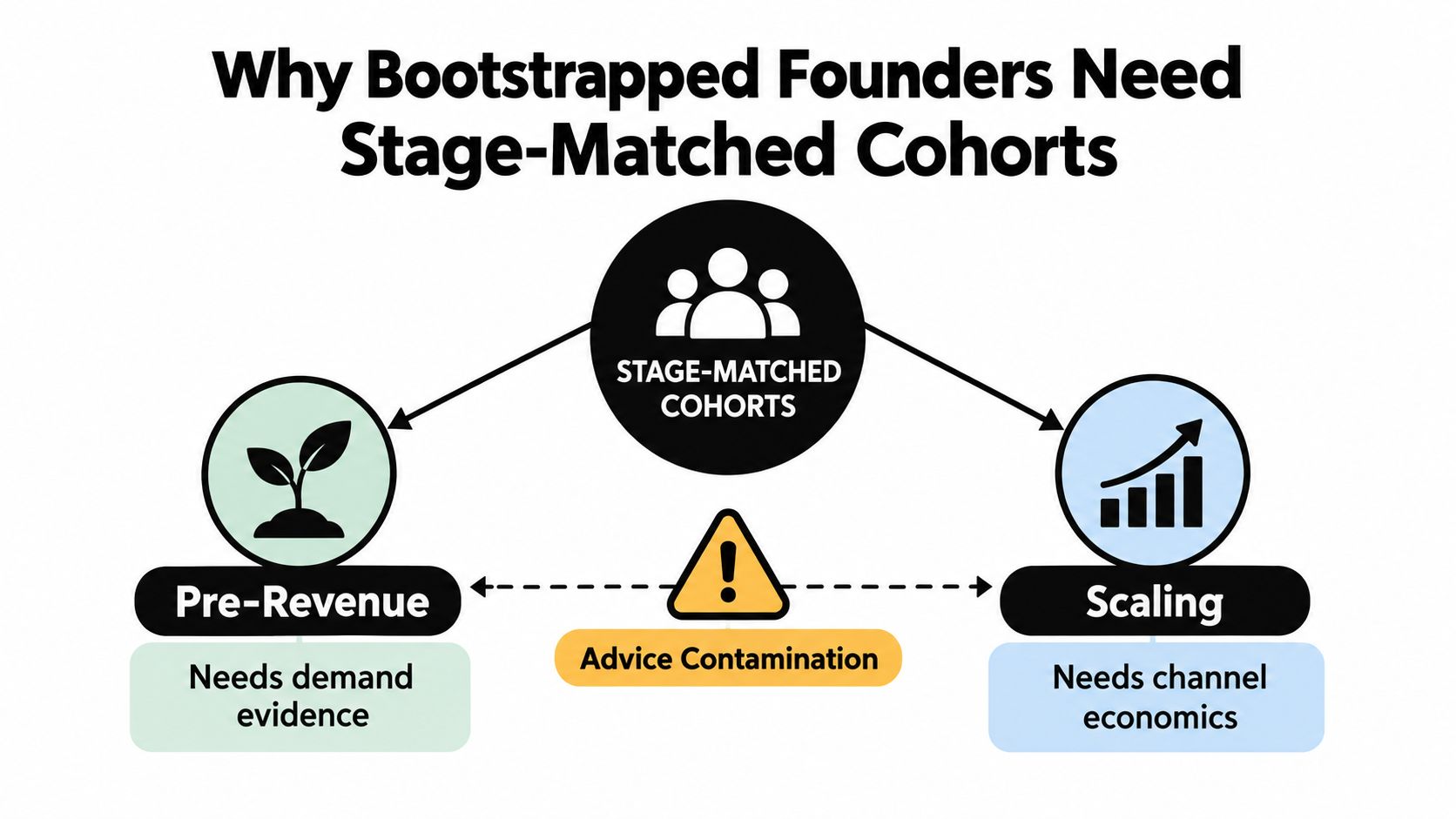
Stage mismatch is where peer advice goes stale. A founder with no revenue needs evidence of demand. A founder with repeatable revenue needs channel economics, hiring discipline, and proof that the model can be repeated. Put those people in the same room without structure, and one leaves with advice that sounds smart but does not fit the stage.
That problem shows up clearly in the UAE. The ecosystem is spread across cities, and founders often get pulled into the region's funding narrative instead of the work of building from customers. Dubai Chambers' startup analysis points to geographic dispersion as a practical barrier, and it also notes that founders see scalable growth strategy as a major challenge Dubai Chambers startup analysis. Small, fixed cohorts help because the same people show up repeatedly and can track whether your thinking is getting better.
What stage matching actually changes
A pre-revenue founder should be comparing customer interviews, objections, and signs of urgency. A scaling founder should be comparing conversion, contribution margin, and the repeatability of one channel. Mix those together and people start benchmarking the wrong things, then copy someone else's business model without noticing the fit gap.
The cleanest outside reference for that logic is Fundl's traction-based funding. Traction looks different depending on stage and financing strategy, and peer groups should reflect that.
For bootstrapped founders, the sharper metric is learning velocity per unit of cash burn. Track the signals that show whether uncertainty is falling:
- Customer interviews per week, because customer truth beats internal opinion.
- Experiment cycle time, because speed matters when cash is finite.
- Contribution margin, because growth that destroys margin is fake progress.
- Runway visibility, because founders make better choices when cash is explicit.
- Revenue generated by a change, because not every improvement matters.
A small cohort works because the same people can remember what you said last month, then press you on whether the evidence changed.
Stage-matched cohorts outperform broad communities for founders who need honest, specific feedback. The room should feel a little uncomfortable if the diagnosis is weak. That discomfort saves time.
Evaluating Common Peer Group Formats
Not every founder gathering deserves your calendar. Some formats are fine for visibility, but weak for accountability. Others are heavy on commitment and light on signal. The job is to choose the room that matches your current stage and how much structure you need.
A useful way to compare them is by how much follow-through the format forces. For a bootstrapped founder, a high-signal room isn't necessarily the most exclusive one. It is the one that makes people report evidence, revisit commitments, and challenge assumptions without turning every conversation into a pitch.
| Peer Group Format for Bootstrapped Founders | Accountability Level | Best For |
|---|---|---|
| Open virtual meetups | Low | First contact, broad market scanning, lightweight visibility |
| Local in-person chapters | Medium | Relationship building and occasional peer exchange |
| Moderated masterminds | Medium to high | Founders who want a recurring accountability rhythm |
| Paid residency cohorts | High | Stage-matched founders who need structure, trust, and continuity |
For founders who want to understand the mechanics of a more formal room, understanding executive masterminds and forums is a useful comparison. The core lesson is simple, recurring peer pressure works better than casual chat when the goal is execution.
What each format does well
Open meetups are useful when you need a quick temperature check on the market. They are poor for deep accountability, because nobody has enough context to challenge your assumptions well. Local chapters help with belonging and visibility, but they often drift into general conversation unless there is a hard agenda.
Moderated masterminds can work if the participants are aligned on stage and incentives. They break down when people want reassurance more than challenge. Paid residency cohorts usually provide the cleanest operating rhythm because the commitment is explicit and the room is smaller, which makes it harder to hide.
Founder Connects' own mastermind groups fit that logic, but the decision should always come back to the same filter, does the format make better decisions more likely?
Useful filter: if the room doesn't require evidence, it will usually reward confidence instead.
For a bootstrapped founder, the right format is the one that creates a habit. One-off inspiration rarely changes a business. Repetition, scrutiny, and follow-through do.
Designing a High-Signal Meeting Agenda
A peer group meeting works only when the room has structure. Without it, the hour slides into therapy, networking, or polite status updates. Bootstrapped founders do not need another place to sound busy. They need a room that forces decisions against evidence.
Start with one concrete item from each founder. That can be a customer interview summary, a pricing test result, a cash-flow forecast, a sales pipeline review, or a retention snapshot. The point is simple. Anchor the discussion in something observable, because observation is harder to fake than opinion.
A simple agenda that keeps the room honest
Check-in, five minutes each.
Each founder says what changed since the last meeting.Context share, one artefact only.
The founder explains the issue and shows the evidence.Analysis, with pressure-testing.
The group asks what would disprove the current plan.Actionable next steps.
Each founder leaves with one experiment and one deadline.
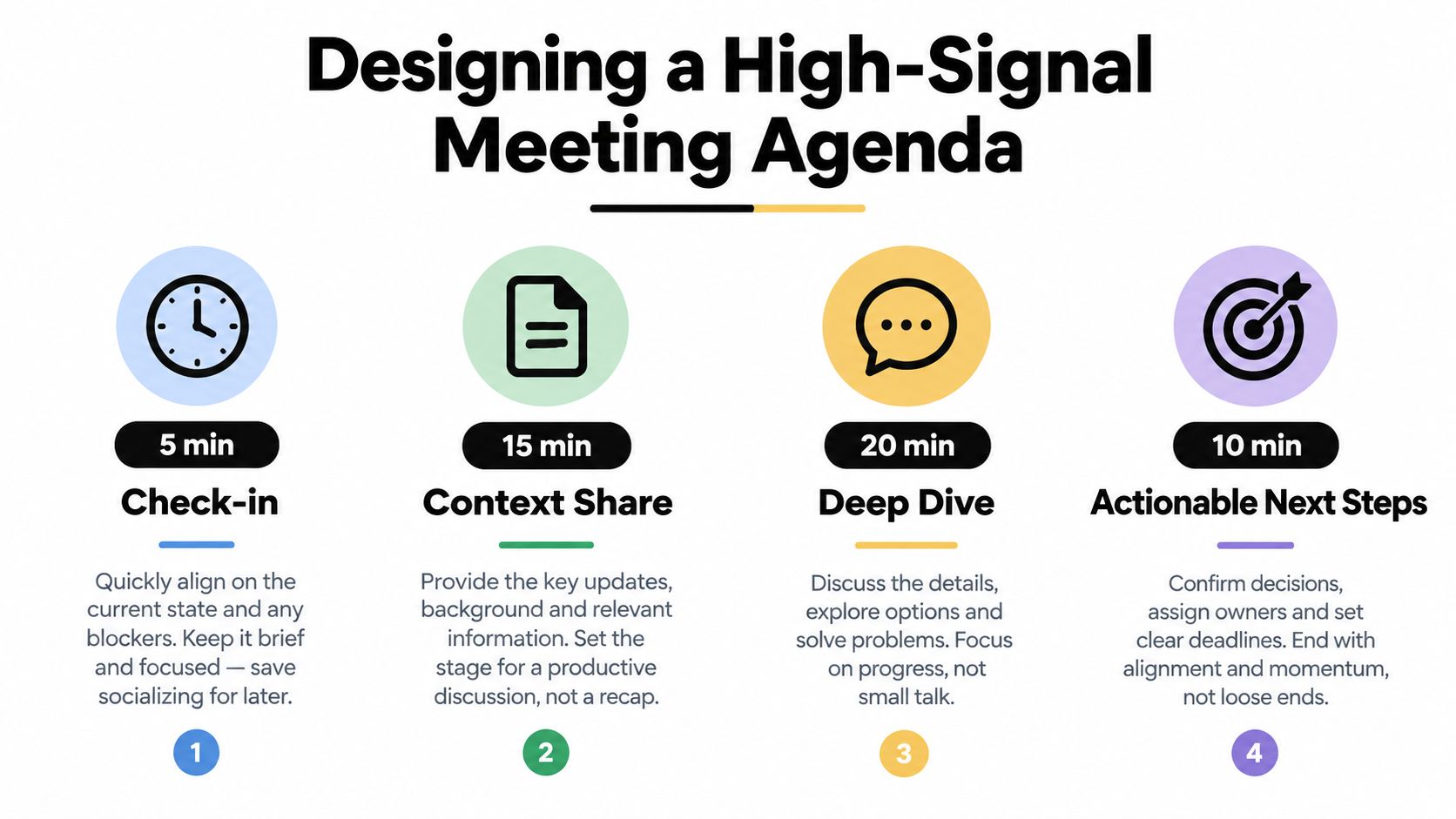
The prompt matters as much as the sequence. Ask, “What would disprove this in the next 14 days?” That question cuts through optimism and forces a founder to define evidence before spending more money. It also keeps the group from giving abstract advice to a problem that needs a test.
Escalation rules matter too. If a question is legal, financial, tax-related, or highly specialist, the group should route it to an external expert instead of bluffing through it. A peer group is strongest when it knows its limits.
Traction belongs in the same evidence-first conversation. The point is not to talk about fundraising theatre. It is to look at the exact proof behind the claim and decide whether the next move is real or just noise.
The Founder Connects Residency Model
Some founders don't want to build a peer room from scratch. They want a structured environment where the group has already been screened, the stage fit is deliberate, and the cadence is already set. That is where the Founder Connects Residency Squads fit in, because the model is built around 8–10 vetted, stage-matched founders rather than loose, one-off networking.
The wider community also matters here. Founder Connects has had 1,000+ founders attend Meetups in the last few months, supports 300+ Residents, and runs a WhatsApp community of 500+ vetted founders who apply and are screened, with a 23.3% acceptance rate. The Residency is priced at $582 for 6 months or $984 for a year, and the live chapters are in Dubai, Abu Dhabi, Nairobi, Beirut, and Cairo. For founders building across MENA, that regional spread is useful because ecosystem questions are often local, but the operating problems rhyme.
Why the model fits bootstrapped founders
The value isn't in audience size, it's in repeatability. A small squad can track the same decisions over time, which is exactly what a bootstrapped founder needs when cash is tight and the margin for bad advice is thin. The format also reduces the temptation to perform for a crowd.
Founder Connects' Residency is most relevant when you want recurring peer accountability without assembling the room yourself. That's different from a broad community, and different again from a pitch-first network. It is a practical option for founders who need a stage-matched cohort and don't want to spend weeks creating one.
For the wider case, see how founders benefit from peer groups and how Residency compares with YPO and EO.
What to expect from a good residency room
- Clear stage fit, so advice matches the problem.
- Recurring check-ins, so commitments don't evaporate.
- Shared operating language, so discussion stays practical.
- A bounded group size, so everyone gets airtime.
The model works because it respects the reality of founder time. No one has space for endless community browsing. The room has to earn its place by helping you think more clearly and act faster.
If you are comparing options inside the UAE, the question is not whether a community looks active. It is whether it helps you make a better next decision. That's the standard that matters.
Rules of Engagement and Daily Integration
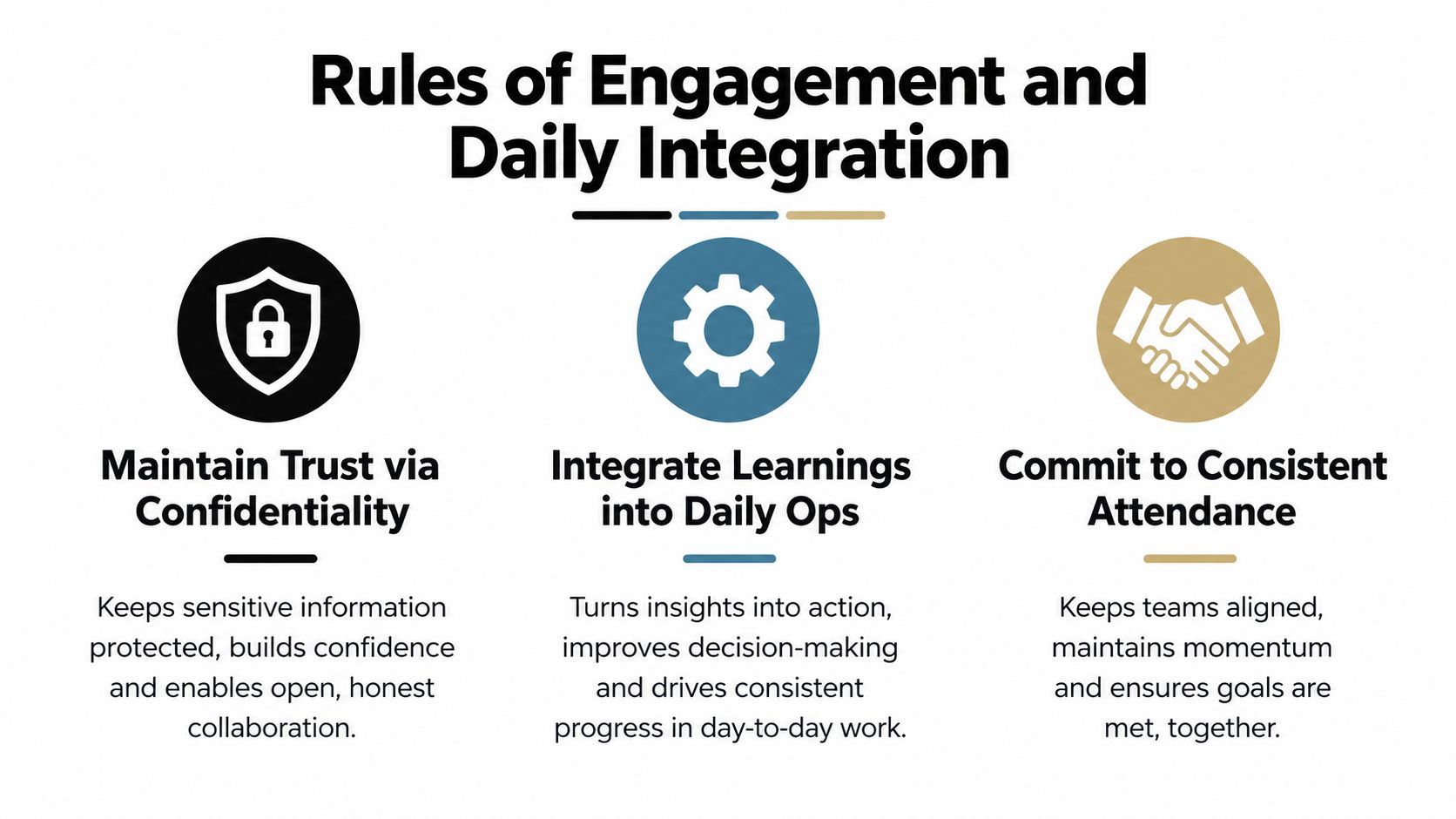
A peer group only changes a business when the learning is carried into the week that follows. That means the rules of engagement have to be explicit. Without them, founders protect image, avoid hard topics, and leave with good intentions instead of operational change.
Confidentiality comes first. If founders don't trust the room, they'll share only the polished version of the problem. Reciprocal expertise comes next, because every member should contribute something useful, whether that is a tested playbook, an introduction, or a sharp diagnostic review. Attendance matters too, since irregular participation destroys memory and weakens accountability.
Make the learning visible in weekly work
Turn every session into a short sprint plan. One founder lesson should become one task, one owner, and one deadline. If the discussion doesn't alter the next seven days of work, it was probably too abstract.
A simple operating rhythm helps:
- Record one decision, so you remember what the group pushed you to do.
- Track one benchmark, even if it's anonymous, so you can compare progress without oversharing.
- Review one milestone, so the room knows whether the last recommendation landed.
That discipline also fits the broader guidance in join a peer group in Dubai, where value comes from regularity and trust, not attendance for its own sake.
If a group is doing its job, you should feel the effect in how fast you decide, how clearly you see the numbers, and how quickly you recover from uncertainty. That is the whole point.
Frequently Asked Questions
How do I protect sensitive information in a peer group?
Use confidentiality rules from day one, and keep financial data anonymised where possible. Share enough context for useful feedback, but not more than the group needs.
What if my business grows out of the cohort?
Move up when your questions change. A good peer group should help you graduate cleanly, not trap you in a stage that no longer fits.
How much time should I commit?
Enough to show up consistently and act on what you learn. If the group competes with execution rather than improving it, the format is wrong.
Should pre-revenue founders join early?
Yes, if the room is stage-matched and focused on validation. The best early peer groups help you test demand before you overbuild.
Founder Connects builds structured peer environments for founders who want real accountability, not empty networking. If you're bootstrapping in Dubai and MENA and want a room that helps you test decisions, compare evidence, and stay focused, look at the Residency and Meetups and see which fits where you are now.

Building in MENA? You don't have to do it alone.
Join 300+ founders in the Founder Connects Residency. Monthly squad calls, warm intros, $3M+ in perks, and much more. All for less than your monthly coffee budget.
Popular posts





Founder Connects is a premium MENA tech founder community. Meetups in Dubai and across MENA, Residency Squads of 8–10, and 400+ vetted WhatsApp founders (apply and screened).