

Join a Peer Group Dubai

Building in MENA? You don't have to do it alone.
Join 300+ founders in the Founder Connects Residency. Monthly squad calls, warm intros, $3M+ in perks, and much more. All for less than your monthly coffee budget.

You've just closed a funding round, hired your first senior operator, or hit a decision that nobody on your team can answer. You know plenty of people in Dubai, but very few understand the pressure of your particular day. A global mentor may understand growth, yet still miss the practical reality of UAE licensing, VAT, free-zone decisions, bilingual hiring, or selling across MENA.
That's why joining a peer group in Dubai is a fit problem first and an application problem second. The right room gives you relevant judgement, confidentiality, and follow-through. The wrong one gives you another WhatsApp chat, a pitch-heavy Meetup, and a calendar full of conversations that never change what you do.
Dubai SME facilitated the establishment of 2,937 new businesses in 2023 and 3,461 new Emirati businesses in 2024, while supporting 19,904 SMEs by the end of 2024. Its advisory services reached 3,075 entrepreneurs in 2024, compared with 1,186 in 2023, according to the Dubai Media Office's report on Dubai SME. There's no shortage of founders. The challenge is finding peers operating at your stage, in your sector, and under comparable UAE conditions.
Why Dubai Founders Look for Peer Groups
Dubai's founder market is dense, international, and unusually varied. A software founder validating demand may sit a few kilometres from a DIFC fintech preparing for regulatory approval, a DMCC trading business expanding across borders, and an established operator managing a regional team. They all call themselves founders, but the decisions in front of them are completely different.
A peer group becomes useful when it narrows that distance. You need people who can understand your customer, cash position, hiring constraints, legal structure, and market-entry choices without requiring a long explanation. Advice from an experienced founder in another market can still help, but it may not account for UAE-specific licensing, local procurement, free-zone restrictions, or the practical realities of hiring across cultures and languages.
The wider economy makes this relevant beyond venture-backed startups. SMEs account for approximately 94% of companies in the UAE and contribute around 60% of non-oil GDP, while SMEs represent about 99% of establishments in Dubai, according to the Dubai Media Office's overview of Dubai SME. A founder peer group isn't a niche accessory for technology companies. It can support operators across services, commerce, software, manufacturing, consulting, and other sectors.
Before you apply anywhere, decide what you want the group to change:
- A decision: pricing, hiring, positioning, licensing, or market entry.
- A recurring behaviour: weekly accountability, customer discovery, or disciplined cash management.
- A relationship: peers you can trust with uncertainty, not just contacts for referrals.
- A local perspective: practical experience from founders operating in the UAE or wider MENA.
Use the guide to mastermind groups if you want to understand the broader model, but don't confuse a large networking room with a working peer circle. A group earns its place in your calendar by helping you make better decisions and follow through after the conversation.
A Four-Criteria Vetting Checklist for Any Dubai Peer Group
Don't join because the group has a polished website, a recognisable sponsor, or a crowded Meetup photo. Ask how the room works when a founder brings a difficult, commercially sensitive problem.
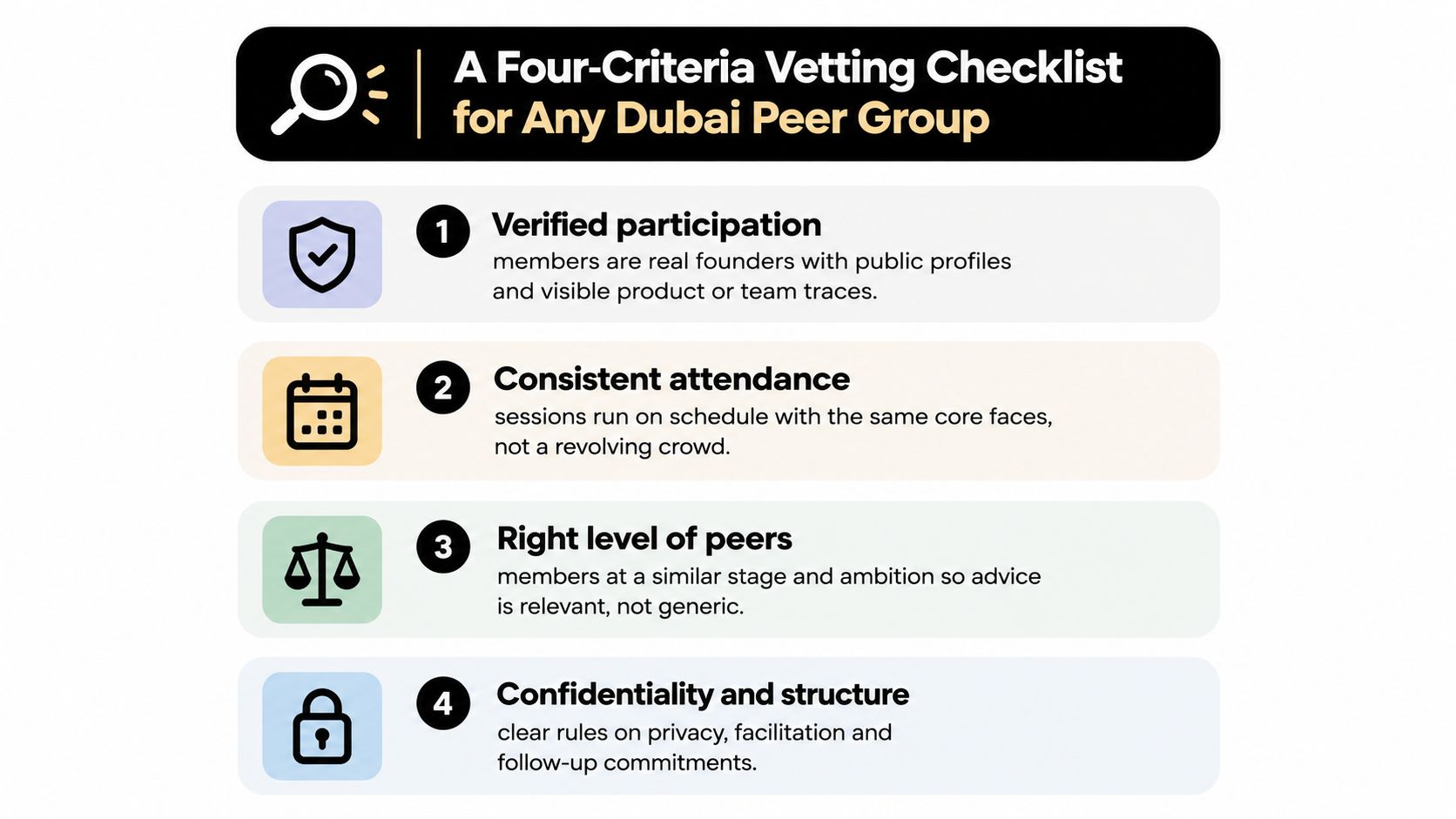
Verified participation
You should know who is in the room. Look for founders with visible companies, products, teams, customers, or operating histories. A LinkedIn profile alone doesn't tell you whether someone is building a business, selling services to founders, raising capital, or just collecting community memberships.
Ask:
- How are members vetted?
- Can I understand the typical founder profile before joining?
- How many members are active operators rather than advisers or providers?
- Can I speak with existing members privately?
A high-signal group doesn't need to publish every member publicly. It should, however, explain its participation standards clearly. If the organiser can't tell you who the room is for, expect generic discussion and uneven commitment.
Structured mentoring
A WhatsApp group isn't a peer format. It may be useful for quick questions, but it won't reliably create thoughtful discussion or accountability. Look for a facilitator, a defined agenda, a case format, or a clear process for bringing one problem to the room.
Ask who facilitates, how often the group meets, and what happens during a typical session. Find out whether members receive preparation prompts, whether airtime is managed, and whether the discussion ends with a practical next step.
Dubai has plenty of sponsor-led and pitch-heavy gatherings. Those can be useful for visibility, but they serve a different purpose from confidential peer learning.
Measurable follow-through
A good conversation feels productive. A useful peer group changes what you do afterwards. Ask whether members record commitments, revisit decisions, or check progress at the next meeting.
Useful evidence includes:
- A stated commitment between meetings.
- A follow-up question at the next session.
- A record of completed, delayed, abandoned, or redirected actions.
- A clear response when someone repeatedly misses sessions.
Dubai SME's advisory and training activity shows strong local demand for guidance, but participation volume alone doesn't prove that a community creates follow-through. Independent UAE reporting found that more than 80% of surveyed entrepreneurs valued trusted advisers and global networks, while 31% lacked an immediate peer group for guidance, as reported by WAM. The quality of the operating format still matters more than the size of the audience.
Stage and sector relevance
A solo founder validating a problem doesn't need the same room as a funded scale-up managing a regional leadership team. A fintech founder preparing for licensing needs different experience from a software founder testing customer demand.
Ask whether the group considers:
- Founder stage and company maturity.
- Business model and sector.
- UAE operating experience.
- Nationality, language, and regional context.
- Competitive conflicts.
- The decision you need to make now.
Practical rule: If you can't describe the type of founder who will challenge your thinking, you haven't assessed the group properly.
Three Routes Founders Use to Get In
Dubai founders generally enter peer communities through one of three routes. Each has a different job, so don't judge them by the same standard.
Invite-only boards and established chapters, including EO or YPO-style organisations, suit founders who want a formal membership structure, deeper confidentiality, and a long-term leadership network. The barrier is higher, and the application may involve eligibility checks, referrals, interviews, or chapter approval. These rooms can be valuable for experienced operators, but they aren't automatically right for an early-stage founder.
Stage-matched Squads are smaller working circles. Founder Connects Residency Squads consist of 8 to 10 stage-matched founders, with a focus on recurring moderated conversations rather than occasional attendance. The Residency programme is the relevant route when your priority is accountability with peers facing comparable operating decisions. The Residency is listed at $582 for 6 months, so review the commitment and format before applying.
Open Meetups are the easiest entry point. You can attend a public Meetup, listen to the quality of conversation, and decide whether the community feels useful before making a deeper commitment. Founder Connects has live chapters in Dubai, Abu Dhabi, Nairobi, Beirut, and Cairo, and its Meetups have had 1,000+ founders attend in the last few months. Use the Meetups booking page or the Founder Connects Luma page, not an individual Luma page.
| Route | Entry Barrier | Best For | Typical Cost | Time Commitment |
|---|---|---|---|---|
| Invite-only boards | Formal eligibility, referrals, or application | Established founders seeking a durable leadership forum | Higher and organisation-specific | Regular formal sessions plus wider participation |
| Stage-matched Squads | Application and suitability review | Founders needing confidential accountability | Paid programme | Recurring calls and preparation |
| Open Meetups | Public registration | Exploring the ecosystem and testing community fit | Often free or low-cost | Flexible, based on attendance |
A seed-stage SaaS founder should usually start with an open Meetup and then test a stage-matched Squad. A Series B fintech chief executive may need a more confidential board with peers who understand regulated growth and executive complexity. Some founders use one structured circle for decision support and occasional Meetups for broader ecosystem exposure. Just don't collect memberships instead of attending.
For a wider comparison of established peer networks and Residency options, read the Dubai peer network comparison.
Step-by-Step Path from First Search to First Meeting
Start with the problem, not the community name. Write one sentence that includes your stage, sector, and biggest blocker. For example: “I run an early-stage B2B software company in Dubai, and I need practical feedback on converting local pilot customers into repeat contracts.” That sentence will help you reject groups that can't address your situation.
Then build a shortlist from founder networks and ecosystem listings connected with DIFC, in5, Hub71, AstroLabs, and relevant LinkedIn communities. Look for groups with a clear format rather than just collecting every Meetup listing. Three serious options are more useful than a long directory you never review.
Contact an existing member where possible. Ask for an honest description of attendance, facilitation, confidentiality, and the type of problems members typically bring. If you don't know a member, contact the organiser and request a guest seat or an introductory conversation.
Prepare a short founder story before you attend. Include what you build, who buys it, what stage you're at, and the decision you want help with. Don't turn the introduction into a pitch deck. A peer group needs enough context to offer useful judgement, not a polished performance.
Attend one public Meetup before committing to a private format. Notice who speaks, whether founders listen, how much time goes to promotion, and whether conversations continue after the room clears. A large audience can be useful for discovery, but it won't tell you whether a smaller Squad can handle sensitive issues.
Ask for a trial month or guest seat on a Squad call. During the call, test whether members ask precise questions, share relevant experience, and respect confidentiality. You should leave with a clearer next action, not merely a positive impression of the organiser.
Finally, score the group against verified participation, structure, follow-through, and stage or sector relevance. If it fails two of those tests, move on. The guide to building a founder network in Dubai is useful if you need to strengthen your wider relationship-building approach alongside the peer-group search.
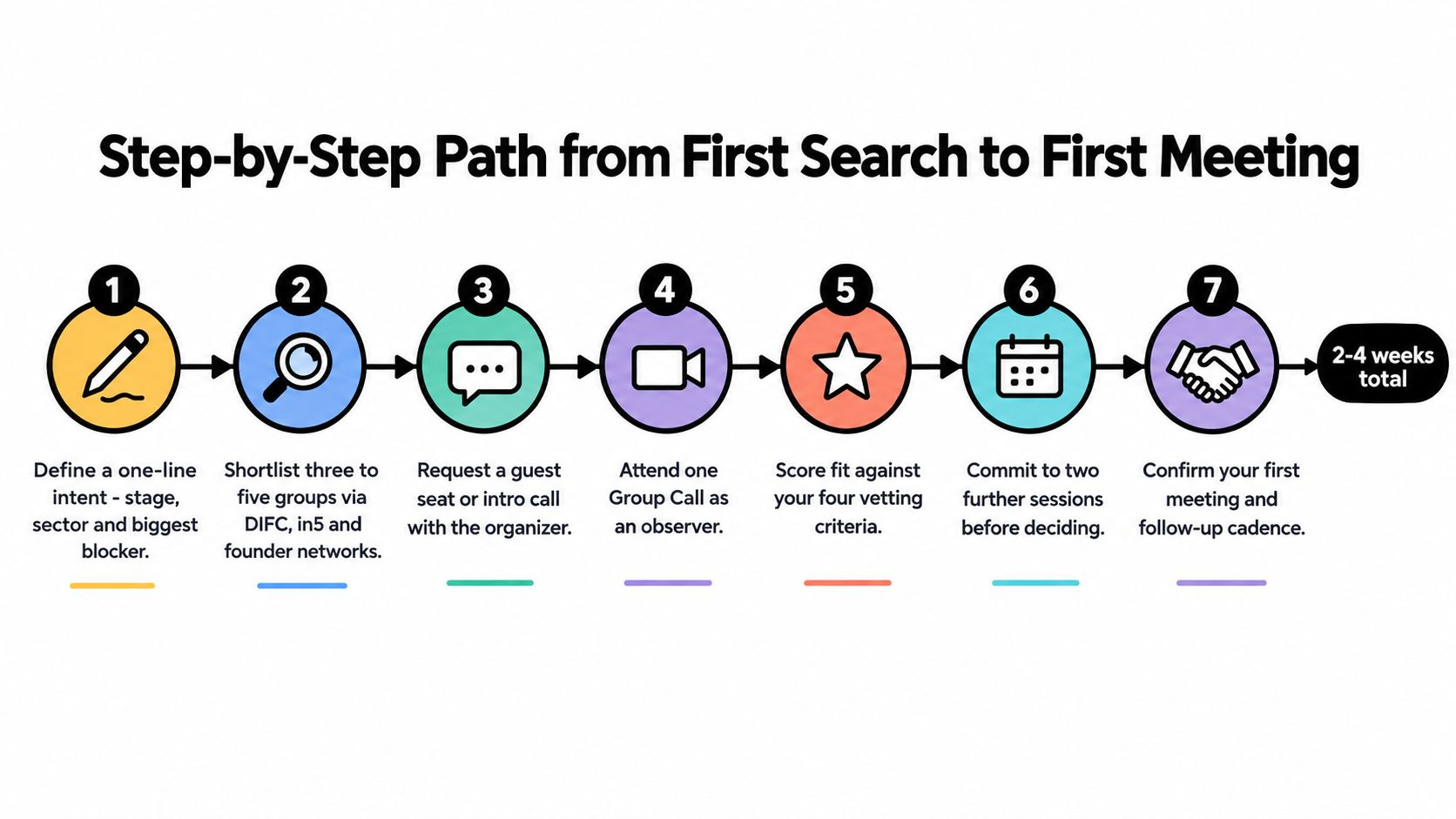
Use the sequence above as a filter. Don't spend months submitting cold applications to rooms that were never designed for your stage.
Outreach Message and Questions to Ask
Your first message should be brief, specific, and easy to answer. Don't write a generic note about wanting to “connect with like-minded entrepreneurs”. That phrase tells the reader nothing about your company or the problem you want to solve.
Hi [Name],
[Mutual connection] suggested I speak with you about [group name]. I'm building a [sector] company in Dubai at the [stage] stage, and I'm currently working through [specific problem]. I'm looking for a peer group with founders who understand this operating context.
Would you be open to a short call, or could I attend the next group call as a guest? I'd like to understand the member profile, meeting format, and whether my current challenge fits the room.
Thanks,
[Name]
Treat the conversation as an interview in both directions. The organiser is assessing your contribution, while you're assessing whether the group deserves your time.
Ask:
- Who currently participates, and how are members vetted?
- Which sectors and company stages are represented?
- What does a normal session look like?
- Who facilitates the conversation?
- What confidentiality rules apply?
- What preparation is expected before each meeting?
- How much time should members reserve outside the call?
- How are fees structured and what do they include?
- What happens when members disagree or a conflict appears?
- Can I speak with two existing members before deciding?
Listen for concrete answers. “We're a community of ambitious people” is positioning, not evidence. You want to hear how the group handles missed commitments, commercial conflicts, sensitive information, and members who dominate the conversation.
Meeting Etiquette, Time Commitment and Costs
Productive peer behaviour is less glamorous than most founder marketing suggests. You arrive prepared, bring one specific question, and explain what you've already tried. You don't use the session to recruit clients, sell a service, or turn every answer into a pitch.
Confidentiality needs extra care in Dubai because founders often operate across overlapping free zones, sectors, investor networks, and national communities. Agree on the rules before discussing customers, employees, financial information, or regulatory matters. Chatham House-style expectations can work well, but the group must explain what members may repeat and what must stay private.
A strong session has a practical rhythm:
- Before the meeting: Share your issue and relevant context early enough for members to prepare.
- During the meeting: State the decision, answer clarifying questions, and distinguish facts from assumptions.
- After the meeting: Record the action you'll take and report what happened at the next session.
- Between sessions: Use the group for focused follow-up, not a constant stream of unstructured messages.
Don't judge value by how busy the group chat looks. Judge it by whether members show up, listen carefully, and return with evidence of progress.
The cost also varies by format. Open Meetups may be free or low-cost, while private boards and structured Squads require a more serious financial commitment. Ask what the fee covers, whether facilitation is included, how often the group meets, and what happens if you pause or leave.
| Format | Hours per Month | Typical Annual Cost (AED) |
|---|---|---|
| Open Meetups | Flexible and attendance-led | Free or low-cost |
| Stage-matched Squad | Recurring preparation and calls | Paid programme, format-specific |
| Invite-only board | Formal sessions plus member participation | Higher annual dues, organisation-specific |
A founder who can't protect time for preparation shouldn't join a demanding peer format. The Dubai tech founder Meetup guide can help you assess what to look for in public sessions before you commit to deeper participation.
Your Next 30 Days and a Single Action to Take This Week
Your plan should create evidence, not just activity. Start by listing three Dubai peer-group options and requesting a guest seat. Record the member profile, meeting format, facilitator, confidentiality expectations, and the specific problem each group appears able to help with.
After you attend or observe the calls, score each option against the four criteria. Don't give extra credit for prestige, a large social following, or impressive logos if the actual conversation is generic. The strongest choice is the group where you can contribute immediately and receive relevant challenge in return.
Use this simple decision sheet:
- Shortlist: Group name, founder stage, sector relevance, and access route.
- Outreach: The message sent, recipient, date, and response.
- Trial agreement: Sessions attended, preparation required, and expected commitment.
- Exit criteria: The conditions that mean you'll continue, pause, or leave.
- Outcome record: The decision you brought and what changed afterwards.
Avoid the usual traps. Collecting memberships creates the appearance of progress without the discipline of participation. Staying in a mismatched cohort for prestige can be worse, because it teaches you to accept advice that doesn't fit your customers, jurisdiction, or stage.
If you want a practical reference for documenting processes, decisions, and follow-up, these how to guides can help you turn peer conversations into repeatable operating habits.
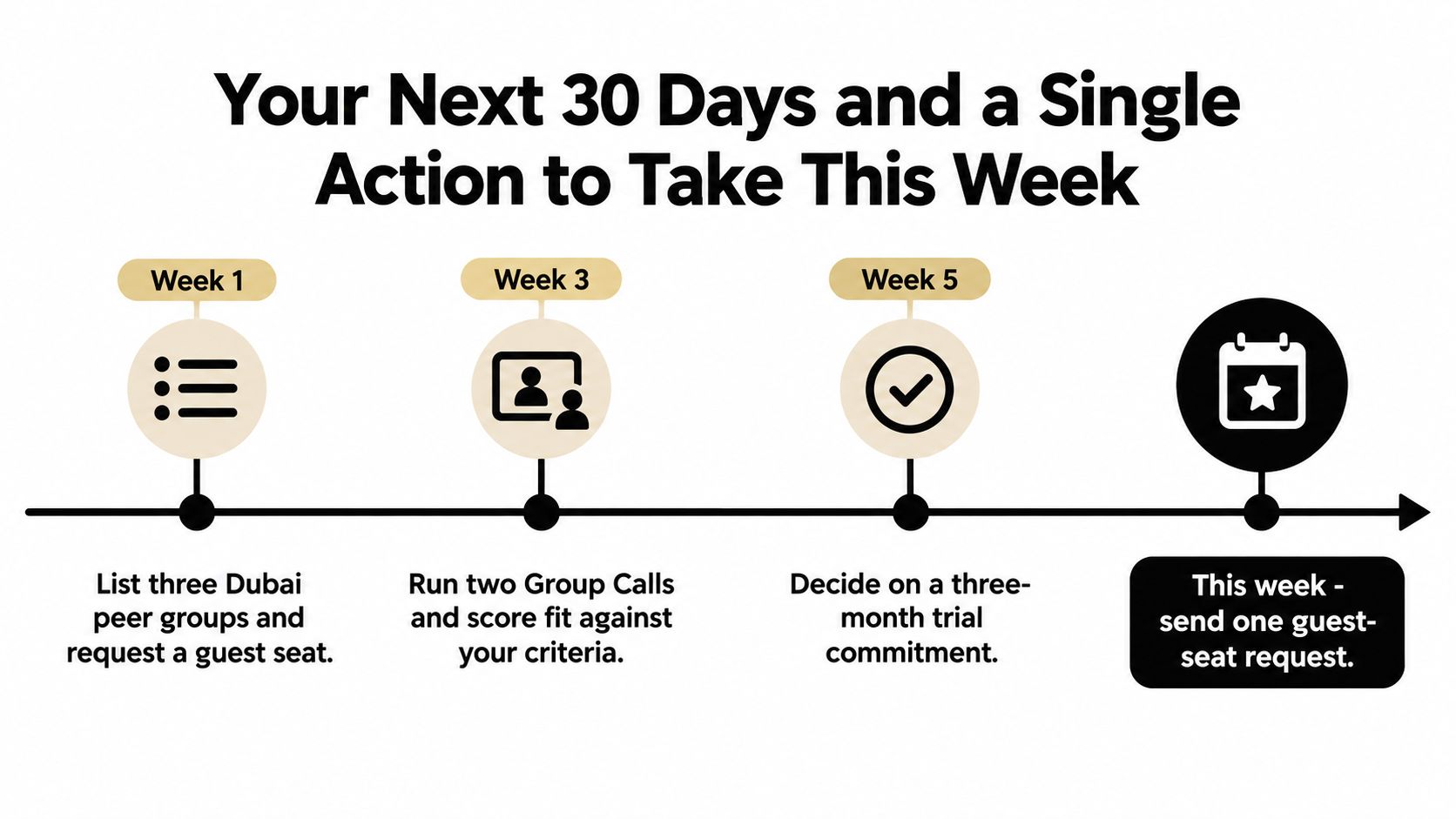
Your single action this week is simple: choose one group from your shortlist and send the outreach message above. If the organiser offers a guest seat, attend with one specific decision and judge the room by the quality of the questions, the relevance of the experience, and the follow-through expected afterwards.
For the Residency format specifically, review the Squad FAQ when it is live, then decide whether the structure fits your stage, sector, and available time.
Founder Connects offers public Meetups and a Residency built around moderated Squads of 8 to 10 founders, giving UAE and MENA operators a practical way to test peer learning and accountability. Visit Founder Connects to book a Meetup or review the Residency before sending your guest-seat request.

Building in MENA? You don't have to do it alone.
Join 300+ founders in the Founder Connects Residency. Monthly squad calls, warm intros, $3M+ in perks, and much more. All for less than your monthly coffee budget.
Popular posts





Founder Connects is a premium MENA tech founder community. Meetups in Dubai and across MENA, Residency Squads of 8–10, and 400+ vetted WhatsApp founders (apply and screened).