

Pitch Night Follow Up: A Complete Playbook for UAE Founders
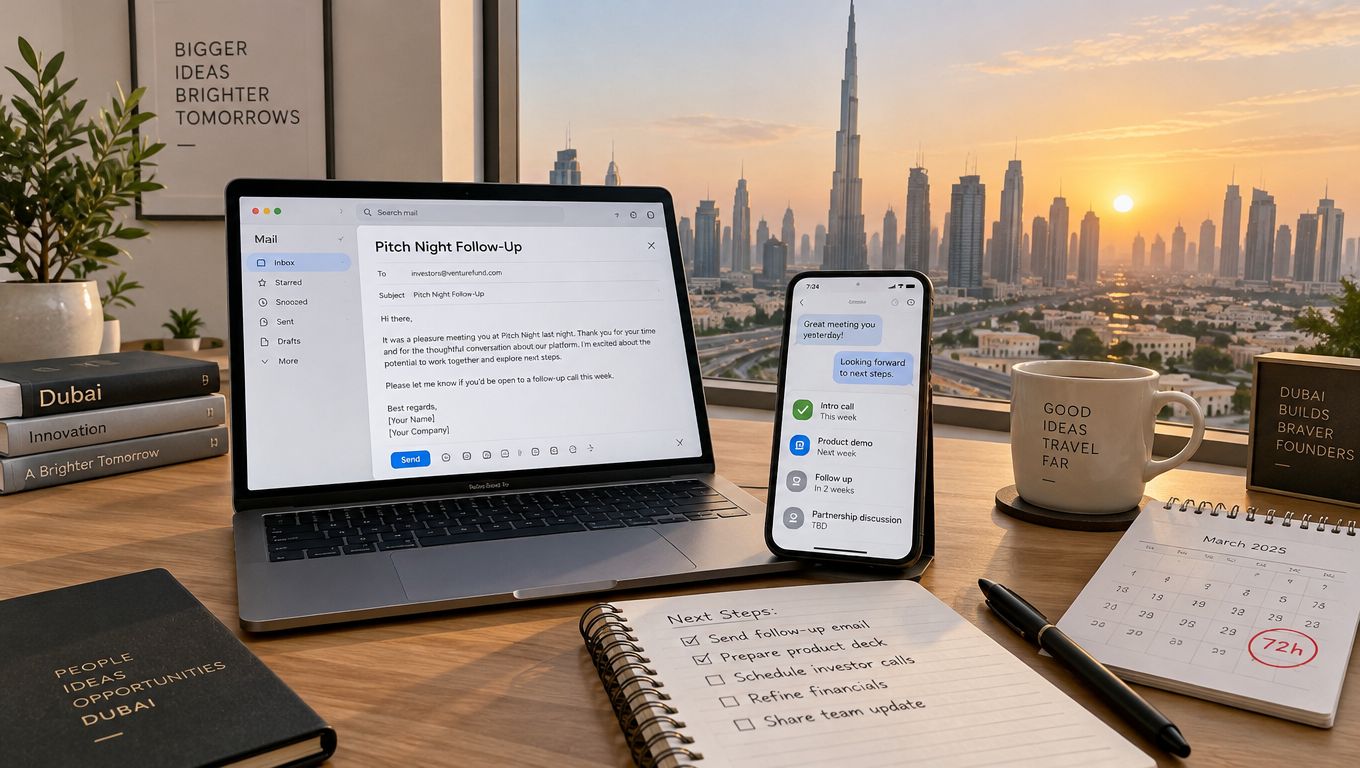
Building in MENA? You don't have to do it alone.
Join 300+ founders in the Founder Connects Residency. Monthly squad calls, warm intros, $3M+ in perks, and much more. All for less than your monthly coffee budget.

You leave a Pitch Night in Dubai with three names in your phone, one voice note full of half-finished promises, and a deck that's already too generic for any of them. The temptation is to send the same polite message to everyone and call it follow-up. That's usually where momentum dies, because the people you met did not all leave with the same intent, the same urgency, or the same next step.
Why Generic Follow-Up Fails in the UAE Market
The biggest mistake after a pitch night follow up is treating every contact like they belong in the same bucket. An investor, a potential customer, a strategic partner, and a founder peer all need different next steps, because each conversation started from a different motive. If you blast the same message to all four, you look disorganised, and you waste the one advantage the night gave you, a live, high-trust first impression.
In the UAE, that matters more than in a slower market. The country's startup-investment market reached approximately $1.1 billion across 207 transactions in 2024, with 89 foreign investors and 92 regional investors active in the market, which means attention is broad but fragmented, not concentrated in a few obvious pockets of capital (Wamda coverage on UAE startup investment in 2024). If investor attention is spread across that many transactions, a lazy follow-up disappears quickly.
Classify people before you draft anything
I use a simple sorting rule as soon as I get home.
- Investor: send evidence, clarify the thesis fit, and make the next meeting specific.
- Customer: send a sharp problem recap and a product conversation.
- Partner: focus on what collaboration would look like, not on funding.
- Peer or mentor: keep it relational, useful, and low-pressure.
That first classification step keeps you from over-explaining. It also stops you from sending a deck to someone who only asked for a customer case, or from pushing for a call with someone who just wanted to stay in touch. A thoughtful reply feels deliberate, and deliberate follow-up is what makes you memorable after a crowded night.
Practical rule: write the contact type in your CRM before you write the message. If you can't classify the person, you don't know what you're asking them to do.
For founders who want a local reference point for the original positioning of the night, the page on Pitch Night Dubai is useful context, but the actual work starts when you separate intent from excitement.
Templates That Convert Conversations Into Meetings
A strong message after a pitch night follow up doesn't feel like a pitch deck dump. It feels like you heard the other person, wrote down the important detail, and made the reply easy. The difference shows up in the subject line, the opening line, and the ask.
Match the message to the recipient
For an investor, the subject line should remind them of the specific discussion. Something like “Follow-up on your question about UAE SME retention” works because it signals relevance immediately. For a peer, a simpler line like “Good to meet at Pitch Night” is enough, because you're not asking them to evaluate your business.
The body should stay short. Lead with the point they raised, add one relevant proof point, then ask for one concrete next step. If they asked about compliance, don't bury that under a full company story. If they asked about traction, don't answer with a product roadmap.
For outreach style, it's worth looking at hireSDR.com on better outreach as a reminder that better replies usually come from clearer structure, not from more words.
Keep the ask small enough that the recipient can answer it between meetings.
Use one of these message shapes
Investor email
“Great speaking with you at Pitch Night. You asked about our retention among UAE SMEs, and I've attached a one-page summary with the current cohort view. If it's relevant, I'd value a 20-minute follow-up next week to go through the assumptions.”
Partner DM
“Enjoyed the conversation about possible collaboration. The use case we discussed is below, and I'd be glad to send a short outline of where a joint pilot could fit. If helpful, I can set up a quick call to compare notes.”
Peer or mentor message
“Good meeting you at Pitch Night. I appreciated your point about customer proof, and I'll share the summary we discussed. If you're open to it, I'd like to stay in touch and compare notes after the next milestone.”
The point is not to sound polished for its own sake. The point is to lower friction. A custom subject line and a role-specific ask give the recipient a clear reason to respond without opening a giant deck they didn't request.
The 72-Hour Follow-Up Sequence
Timing matters because interest decays fast once the room empties. A strong pitch night follow up sequence is not a burst of enthusiasm, it's a disciplined handoff from conversation to next step. The goal is to stay specific, not to stay visible for the sake of it.
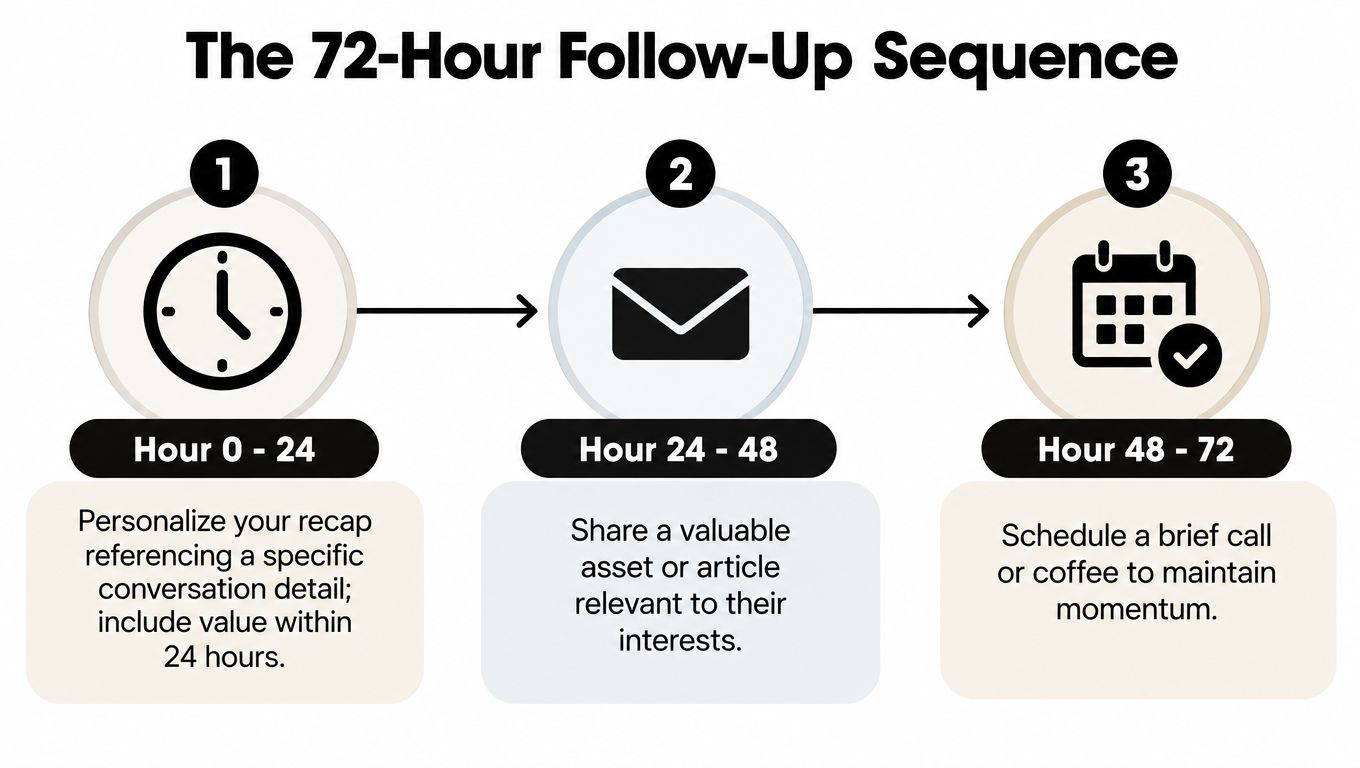
Hour 0 to 24
Send a personalised recap while the conversation is still fresh. Reference one exact detail, one question, or one objection they raised, then attach only what they asked for, such as a one-page summary or a brief data note. If you're unsure whether an address is still usable, a tool like Email Validation API can help keep your outreach list cleaner before you send.
Hour 24 to 48
Share only the promised evidence. That might be a metric, a product screenshot, a short explanation of your model, or a document they requested in the room. Don't widen the scope here, because extra information usually reads like avoidance.
Hour 48 to 72
Move to a defined next step. Ask for a 20-minute call, a product review, a customer introduction, or whatever action fits their role. Make the agenda visible, so they know why the meeting matters before they agree.
The hardest part is resisting the urge to “just check in” again and again. If the last message didn't add something new, a second one won't rescue it. For a simple operating framework to keep yourself honest, the follow-up checklist for post-networking success gives you a practical structure to work from.
Building Relationships Through Community Engagement
A pitch night should rarely be your only touchpoint. The founders who stay memorable are usually the ones who show up in the ecosystem with useful context, not just a funding ask. That means keeping the relationship warm in places where the pressure is lower and the conversation is easier.
Founder Connects runs Meetups as ongoing spaces for founder-to-founder conversation, and over 1,000+ founders have attended Meetups in recent months, which creates a steady channel for trust-building outside formal pitching environments (Founder Connects Meetups). The value here is not spectacle, it's repetition with substance. When someone sees you contributing, asking good questions, and following through, your later message doesn't feel like a cold reach-out.
Use community without turning it into a sales funnel
The right move after Pitch Night is often to stay visible without making every interaction transactional. Comment on a useful discussion, join a later Meetup, or share a practical update that helps others think more clearly. If you're in a city where the founder network spans Dubai, Abu Dhabi, Nairobi, Beirut, and Cairo, that consistency matters even more, because people remember behaviour across rooms, not just one stage.
I'd treat this as relationship maintenance, not audience-building. The conversation gets easier when people already know how you think, what you're working on, and whether you follow through. That reputation makes future replies more likely to be taken seriously.
One useful option in that ecosystem is the Founder Connects community itself, because it combines moderated peer interaction with recurring Meetups and founder accountability. Used well, that kind of setting turns a one-off handshake into a longer, more credible thread.
The strongest follow-up sometimes starts before you send an email. It starts when someone already recognises your name from a useful conversation in the room.
If your aim is durable trust, keep showing up where founders and operators speak plainly. The follow-up message then becomes one point in a longer relationship, not the only point of contact.
Tracking Metrics and Avoiding Common Pitfalls
Without measurement, follow-up turns into guesswork. The fastest way to improve a pitch night follow up process is to track a few signals separately and stop relying on your memory. You don't need a huge dashboard, just enough discipline to see what's working.

The four metrics that matter
Use four buckets in your CRM or spreadsheet:
- Response rate: who replied at all.
- Meeting-booked rate: who agreed to a call.
- Qualified-follow-up rate: who was worth continuing with after the first reply.
- Referral rate: who introduced you to someone else.
These four signals tell different stories. If people reply but no one books, your opener is probably fine but your ask is too vague. If replies are scarce, your classification or message relevance is probably off. If referrals come in, you've likely built enough trust for the person to think beyond their own inbox.
A practical way to keep the system honest is to compare the messages you send to different categories of contact. That's where a tool comparison like LinkShip's tracking tool comparison can be useful, not because tracking fixes weak messaging, but because it helps you see what gets opened, replied to, and ignored without relying on memory alone.
The mistakes that quietly kill momentum
The most common errors are easy to spot once you know what to look for.
- Using the same ask for everyone: it ignores role and intent.
- Sending inflated traction language: it falls apart when someone asks for diligence.
- Repeating the same message: it signals that you're not listening.
- Treating silence as rejection too quickly: sometimes the issue is timing, not fit.
For a cleaner internal benchmark, the KPI guide at Founder Connects' startup KPI development resource is a solid reference point for founders who want to tighten their measurement discipline. The main lesson is simple, though, track what happened, compare it with what you sent, and change the message before you change the hope.
Real-World Example of a Successful Sequence
A founder leaves Pitch Night in Dubai with three useful contacts. One investor asked about regulatory exposure, one operator wanted to understand the customer problem better, and one peer offered to share a supplier introduction. The founder writes each name into a CRM, tags them by type, and notes the exact promise made in the room.
Within 24 hours, the investor gets a short recap that says, “You asked about compliance, and I've attached a one-page summary of the current approach.” The operator gets a separate note that asks for a 20-minute product conversation, because that person never asked to review a deck. The peer gets a lighter message that thanks them for the introduction offer and suggests staying in touch.
The key move comes when the investor replies with a concern about jurisdiction. Instead of sending a generic reassurance, the founder answers with a single document and a dated suggestion for the next call. That keeps the conversation tight and makes it easy for the investor to decide whether to continue.
By the end of the week, the founder has one meeting on the calendar, one warm thread with a potential partner, and one peer relationship that can still produce value later. None of that happened because of a perfect script. It happened because the founder classified people properly, answered one real question at a time, and made each follow-up easier than the last.
If you're planning your next Pitch Night or want a sharper way to turn introductions into progress, Founder Connects hosts Meetups and founder conversations built around practical follow-through. Join the community, use the room well, and treat every contact as the start of a structured relationship, not just a name in your inbox.

Building in MENA? You don't have to do it alone.
Join 300+ founders in the Founder Connects Residency. Monthly squad calls, warm intros, $3M+ in perks, and much more. All for less than your monthly coffee budget.
Popular posts





Founder Connects is a premium MENA tech founder community. Meetups in Dubai and across MENA, Residency Squads of 8–10, and 400+ vetted WhatsApp founders (apply and screened).