

Pitch Night Dubai: A Founder's Practical Guide

Building in MENA? You don't have to do it alone.
Join 300+ founders in the Founder Connects Residency. Monthly squad calls, warm intros, $3M+ in perks, and much more. All for less than your monthly coffee budget.

You've probably seen the same Dubai pitch-night listings pop up again and again, and wondered which ones are worth an evening out. The right answer is simple, a good pitch night in Dubai is a curated room where founders get a short stage slot, fast feedback, and a real chance to earn follow-up, not just collect business cards.
What Pitch Night in Dubai Actually Means for Founders
A pitch night in Dubai is a structured founder-facing session, not a loose social mixer. Founders step up for a short, timed pitch, then move into networking with investors, operators, and peers who came to hear live ideas rather than sit through another generic panel.
Treat it as a signal, not a night out
In practice, pitch nights sit in the middle between a private intro and a full fundraising meeting. They are designed for signal sending, so you can test how clearly you explain the problem, whether people lean in, and which parts of your story trigger questions.
That matters in Dubai because the room is often a mix of angels, VCs, family offices, and operator peers across places like DIFC, Dubai Internet City, and the wider free zone ecosystem. If you show up without a sharp ask, you waste the slot. If you show up with a clear company story, you can turn one night into a proper follow-up pipeline.
Practical rule: go only if you have a real company, a clear next step, and enough conviction to answer questions without drifting into vague vision talk.
What to decide before you go
Ask four things before you commit. Is this the right stage for you? Is the audience relevant to the round you want? Is the format tight enough to force quality? And will the room give you a way to follow up, or just another badge and handshake?
If the answer is fuzzy, skip it and keep your energy for a better room.
How Dubai Pitch Nights Differ from Meetups and Summits
A pitch night is not the same thing as a meetup or a summit. It sits in the middle, with a clearer founder slot than a meetup and less noise than a big conference.
Use the format, not the label
Meetups in Dubai are often panel-led or mostly social, and founders can spend two hours without ever getting airtime. Summits are bigger, more polished, and usually built around sponsors, stages, and broad audience reach. Pitch nights give founders an actual turn, with time pressure and direct feedback.
That difference matters because your evening is finite. If you need investor attention, you want a room where the audience came expecting founders to speak, not a crowd that drifted in for snacks and general networking. The stronger the structure, the easier it is to turn a pitch into a conversation.
| Dimension | Pitch Night | Founder Meetup | Summit |
|---|---|---|---|
| Founder airtime | Direct, timed slot | Often limited or none | Limited and competitive |
| Audience focus | Investors, operators, peers | Broad founder community | Mixed audience, sponsor-heavy |
| Feedback style | Live Q&A and reactions | Informal chat, often unfocused | Panels, side conversations |
| Conversion potential | High if the room is curated | Mixed | Usually lower per founder minute |
| Best use | Fundraising practice and follow-up | Community and general networking | Visibility and ecosystem awareness |
If you want a practical comparison with broader Dubai founder gatherings, read this guide to tech founder meetups in Dubai and what to expect.
Look for the operational signals
A real pitch night usually has filtering, a defined agenda, and some expectation of post-event follow-up. If the organiser can't tell you who will be in the room, or if the pitching window is buried inside a random mixer, it's not a serious founder venue.
The Typical Pitch Night Format in Dubai
A proper Dubai pitch night follows a simple sequence, and founders should plan for the whole block, not just the stage moment. If the organiser can't explain the flow clearly, assume the room will be messy.
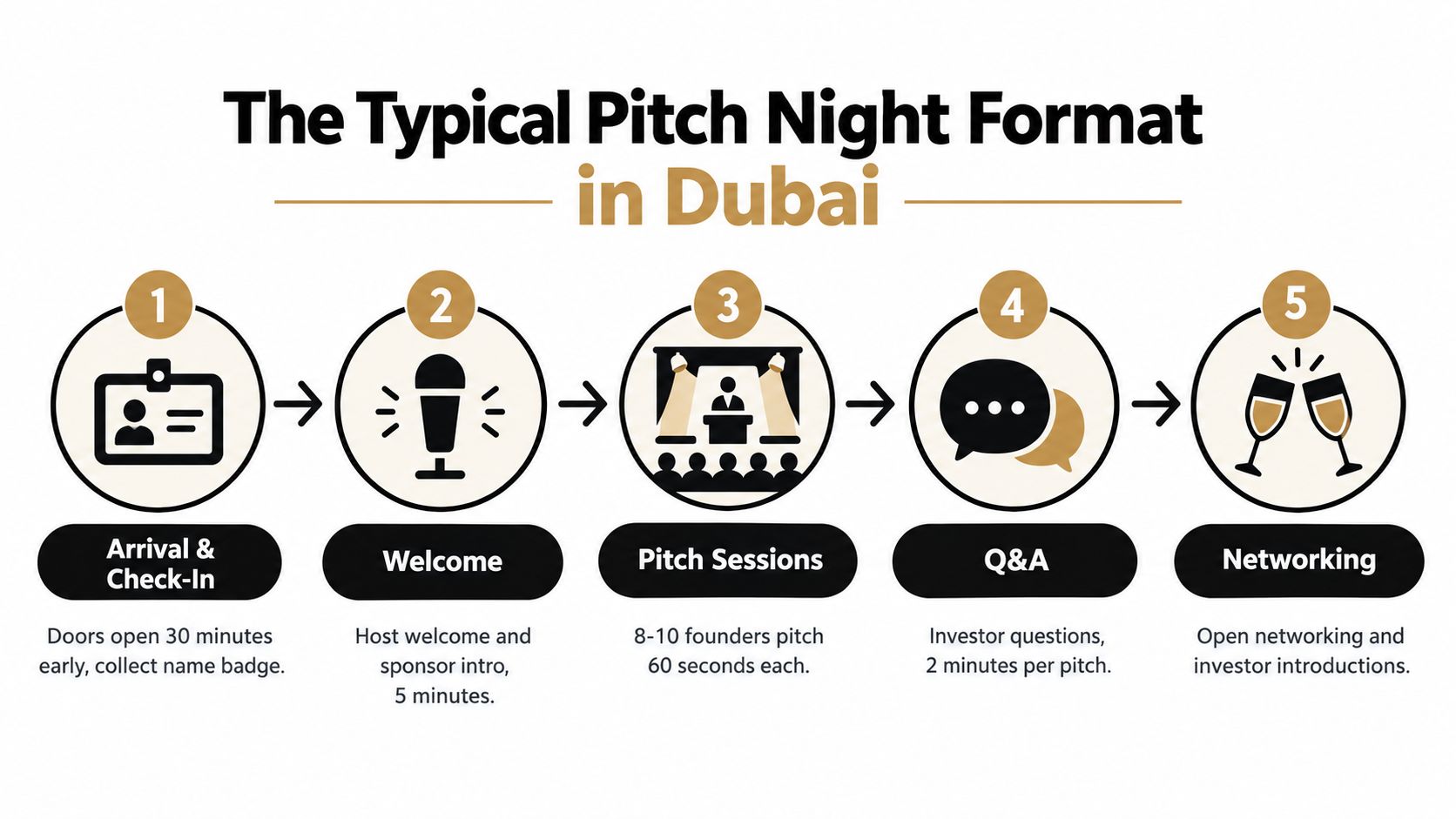
Expect a fixed arrival and pitch sequence
Most good formats start with registration, a welcome, then a round of short pitches with tight cut-offs. The best ones keep things moving, because pacing is what stops the room from turning into background noise.
You should arrive early enough to settle in, speak to a couple of people, and understand who is in the room. If there is a keynote or panel, treat it as a warm-up, not the main event. The founder pitches are the point.
Practical rule: bring a one-page teaser, a sharp verbal intro, and a short list of people you want to meet. Don't rely on a deck to do your talking.
Know what happens after the stage slot
Higher-quality nights add a structured networking window, sometimes with informal rotations or intentional introductions. That's where the value usually sits, because the pitch gets attention, but the conversation gets the next meeting.
If the organiser offers a shared attendee list, a Slack group, or a follow-up path, pay attention. If they don't, your follow-up discipline has to do all the work. For a useful baseline on pitch expectations, see what founders should expect from UAE startup pitch competitions.
Who Pitch Night Dubai Is Really For
Pitch night works best for founders who already have something real to say. It's useful for early-stage teams with a company, a customer problem, and a story that's almost ready but not yet tight enough for a proper investor meeting.
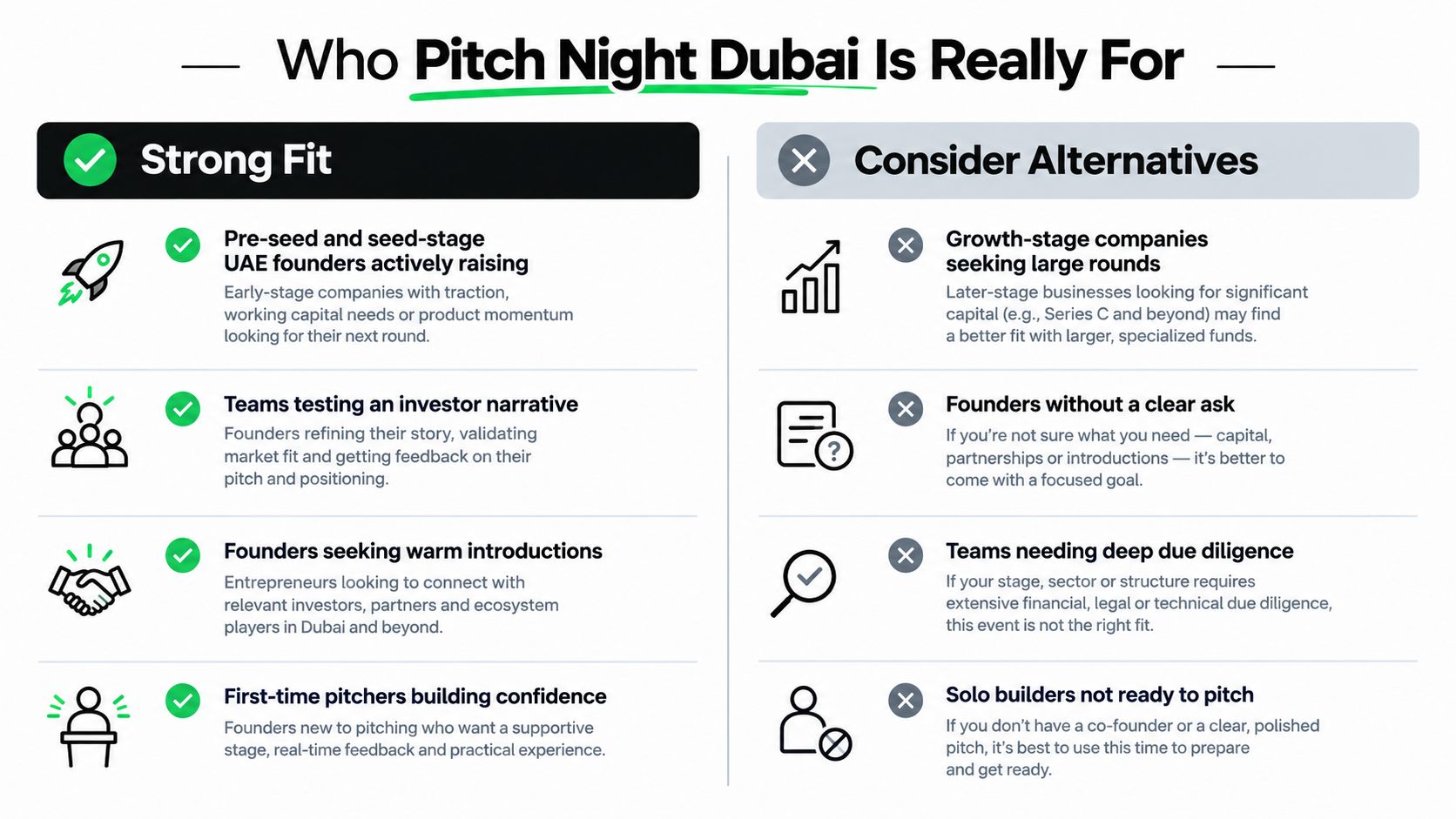
Strong fit
- Pre-seed and seed founders raising now. You need repetition, audience reactions, and a chance to sharpen the story fast.
- Technical founders with a fuzzy one-liner. The room forces clarity.
- Solo founders building in public. A pitch night gives you a deadline, which many founders badly need.
- Teams testing investor messaging. If you want to see which parts of the pitch land, this is a useful environment.
- Founders seeking warm introductions. The networking phase can open the door to second conversations if you're specific.
Consider alternatives
- Founders without a company. If there's no real venture yet, you need customer discovery, not stage time.
- Growth-stage teams chasing larger cheques. A pitch night is rarely the right room for that conversation.
- People looking for pure social networking. You'll leave disappointed.
- Builders who need deeper diligence. A short pitch won't help if the next step is a heavy data room discussion.
The main filter is simple. If you can't say what you're building, who it's for, and what you want next, don't take the slot.
How to Find the Right Pitch Night in Dubai
The right pitch night is curated, relevant, and easy to understand before you sign up. The wrong one is just another crowded listing with a stage bolted onto networking.
Start with trusted calendars, then filter hard
Use curated sources first, then check whether the room is worth your time. Founder Connects' monthly schedule, DIFC and Hub71 community calendars, Dubai Internet City listings, in5, and the Astrolabs ecosystem digest are better starting points than random social posts.
Then run a quick filter on each listing. Is it founder-only or open to spectators? Is there a real balance between stage time and attendance? Are investors present, or is the room mostly operators and service providers? Does the organiser have a track record of hosting serious founder gatherings?
Reject low-signal formats early
Skip any listing where pitching feels like an afterthought. If pitches run too long, the room is oversized, or the event looks like networking first and founder feedback second, keep moving.
Confirm the basics before you register. Check the venue, the language used on stage, the dress code, and whether photos or recording are allowed. If those details are vague, the event is probably vague too.
Practical rule: pick two strong pitch nights per quarter, prepare properly, and ignore the rest. Attention is your scarce asset.
Preparing Your 60-Second Pitch for Dubai Pitch Night
Your pitch needs to do one job, get someone to ask for a follow-up. That means the message has to be tight, specific, and built around the problem, the solution, the market, one proof point, and the ask.

Build it in layers
Start with the problem in plain language. Then state what you do as an action, not a feature list. A line like “We help retailers predict stock gaps before they lose sales” is stronger than a product paragraph full of labels.
Next, name the market in a way a Dubai investor will recognise, then show one hard proof point. One traction number is enough. If you've got revenue, paying users, pilots, or a waitlist, pick the most credible one and say it cleanly.
If you want a more detailed build-out, use the framework in this startup pitch guide.
Keep the ask explicit
End with what you want next, not a vague hope for support. Say whether you want an intro, a meeting, feedback on a deck, or a conversation about capital. If you can't name the next step, the pitch is not finished.
Use three slides at most if slides are allowed. Keep each one focused on a single message. No logo wall, no overdesigned narrative, no clutter.
After that, rehearse twice. Do one timed run on camera, then do one live run with a peer who interrupts at 45 seconds. That's where weak wording gets exposed.
How to Pitch Effectively on the Night
Run the pitch from memory and treat the timer as a hard stop. If you need to read your own notes, the room will feel the hesitation immediately.
Deliver the message cleanly
Open with the problem, then move straight to the solution, the customer, one traction point, and the ask. Keep your pace measured, because founders rush when they're nervous and lose half the room by the third sentence.
Use your diaphragm, pause before the ask, and let the last line land. Investors need a second to process what you want from them. If you bury the ask inside the rest of the pitch, they won't remember it.
During Q&A, answer in under 30 seconds when you can. If you don't know something, say so directly and move back to what you do know. That honesty reads better than improvising a fake answer.
Read the room like a founder
Watch who leans in, who asks follow-up questions, and who starts taking notes. Those are your strongest signals. People checking their phones are usually not worth chasing unless they come back to you later with a direct ask.
Have business cards or a one-page teaser ready, not a full deck. Pitch night is a conversation opener, not a closing argument. Your job is to earn the second conversation.
Following Up After Pitch Night Dubai
Follow-up matters more than the stage performance. A solid pitch without fast follow-up usually dies in the inbox.
Move quickly and keep it short
Send a same-day email within a few hours while the room is still fresh in people's minds. Keep it tight, reference one specific moment from the conversation, attach your one-page teaser, and include one clear ask, like a 15-minute call.
Track every reply in a simple sheet with names, dates, response status, and next step. If someone doesn't respond, send one polite nudge after 48 hours, then stop chasing. You're looking for momentum, not endless ping-pong.
Keep the thread warm
Send a short progress update about a week later if something meaningful has changed. Keep it to one new milestone, one number, and one open question. That gives the recipient a reason to re-engage without feeling spammed.
Archive cold contacts after two cycles and put your attention back on warm prospects. That discipline matters more than trying to revive every thread.
How Founder Connects Pitch Night Works
Founder Connects runs a curated morning virtual pitch night for founders who want real conversations, not filler networking. One founder gets more room to tell the story. Then ten founders each deliver a 60-second pitch in a controlled virtual session, which keeps the room focused and the pace moving.
Why the format changes the conversation
Applications are screened, so the founders on the call have something real to show. Investors and operators are screened too for relevance, which cuts down on random attendance and idle chatter.
Every founder follows the same structure: problem, solution, traction, ask. That keeps the pitch clear and makes it easier for the room to respond with useful feedback. The moderated Q&A and breakout conversations push the discussion beyond surface-level introductions.
For founders in Dubai, Abu Dhabi, and the wider GCC, the virtual setup removes travel friction and fits a packed week. It also makes the room easier to join without sacrificing quality.
The outcome is straightforward, fewer wasted evenings and more useful follow-up. If you want a curated founder environment instead of a random crowd, Founder Connects is the one to check.
Quick-Reference Checklist Before Your Next Pitch Night
Use this as your working brief, not a checklist you glance at once and forget.
Before You Sign Up
- Check the fit. Make sure the event is relevant to your stage, your raise, and the kind of people you want to meet.
- Read the agenda carefully. If the founder slot is buried, treat that as a warning sign.
- Research the room. Look at who the organiser says is attending, then judge whether the audience matches your next step.
One Week Out
- Write the 60-second version. Keep it short, sharp, and repeatable without slides.
- Prepare your teaser. One page is enough if it is specific and clean.
- Draft your outreach. Decide who you want to meet and what you'll say if you get the chance.
Day Of
- Arrive early. Use the first part of the room to get your bearings and spot the people worth speaking to.
- Pitch from memory. Don't let notes take over.
- Carry only what you need. Business cards, teaser, and a calm ask.
Within 10 Days After
- Send the follow-up quickly. Same day is best.
- Nudge once if needed. A single follow-up is enough.
- Update the warm contacts. Keep the thread alive only where there's actual interest.
Pitch Night Dubai FAQs for Founders
Is pitch night in Dubai right for my stage?
Yes, if you're pre-seed or seed, have a real company, and need sharper investor messaging. It's usually a poor use of time if you're still at idea stage with no customer signal, or if you're later stage and chasing a larger round than the room can support.
How much preparation does a 60-second pitch really need?
Enough to force a few rounds of rewriting, rehearsal, and live delivery. If you can't say it cleanly without slides, you're not ready yet.
What's the biggest mistake founders make?
They waste the slot with a generic story, too much product detail, or an unclear ask. The pitch should lead to a next conversation, not try to close the deal on stage.
Does it still make sense if I'm not actively fundraising?
Sometimes, but only if you have a strong reason to be there. If you want customer feedback, peer accountability, or warm introductions, the room can still help. If you only want to “network,” skip it.
If you want a more curated founder environment, use Founder Connects as your benchmark for what a serious pitch room looks like. It's built around structured founder exchange, relevant introductions, and practical follow-up, which is exactly what attendees hope a pitch night will deliver. Visit Founder Connects and use it to compare any Dubai pitch night before you commit your time.

Building in MENA? You don't have to do it alone.
Join 300+ founders in the Founder Connects Residency. Monthly squad calls, warm intros, $3M+ in perks, and much more. All for less than your monthly coffee budget.
Popular posts





Founder Connects is a premium MENA tech founder community. Meetups in Dubai and across MENA, Residency Squads of 8–10, and 400+ vetted WhatsApp founders (apply and screened).