

7 Proptech Startups Dubai Real Estate Tech Founders Should

Building in MENA? You don't have to do it alone.
Join 300+ founders in the Founder Connects Residency. Monthly squad calls, warm intros, $3M+ in perks, and much more. All for less than your monthly coffee budget.

Dubai's proptech opportunity isn't mainly about building another property portal. It's about removing specific friction across fractional investing, mortgage finance, rent collection, market data, short-term rentals and off-plan discovery. That distinction matters in a market where the UAE proptech sector was valued at about USD 677 million in 2025, with Dubai representing roughly 62% of the market, according to independent UAE proptech market research.
In practical terms, proptech means technology that improves how people finance, buy, sell, lease, manage, value or operate property. For founders, the opportunity sits at the intersection of a painful workflow, a reachable buyer and a regulatory path that can support trust.
Use this roundup as a decision tool. For each company, compare the problem, customer, distribution route, traction signal and capital requirement. A regulated investment platform has a different burden from an analytics subscription or a landlord payment product. Local partnerships, data access and licensing may matter as much as product features.
Founder filter: A strong Dubai proptech idea solves a local property problem, fits the relevant regulatory perimeter and earns distribution through trusted market participants.
If you're building a related product, study Dubai real estate CRM solutions to see how operational software fits into the wider property stack.
1. SmartCrowd
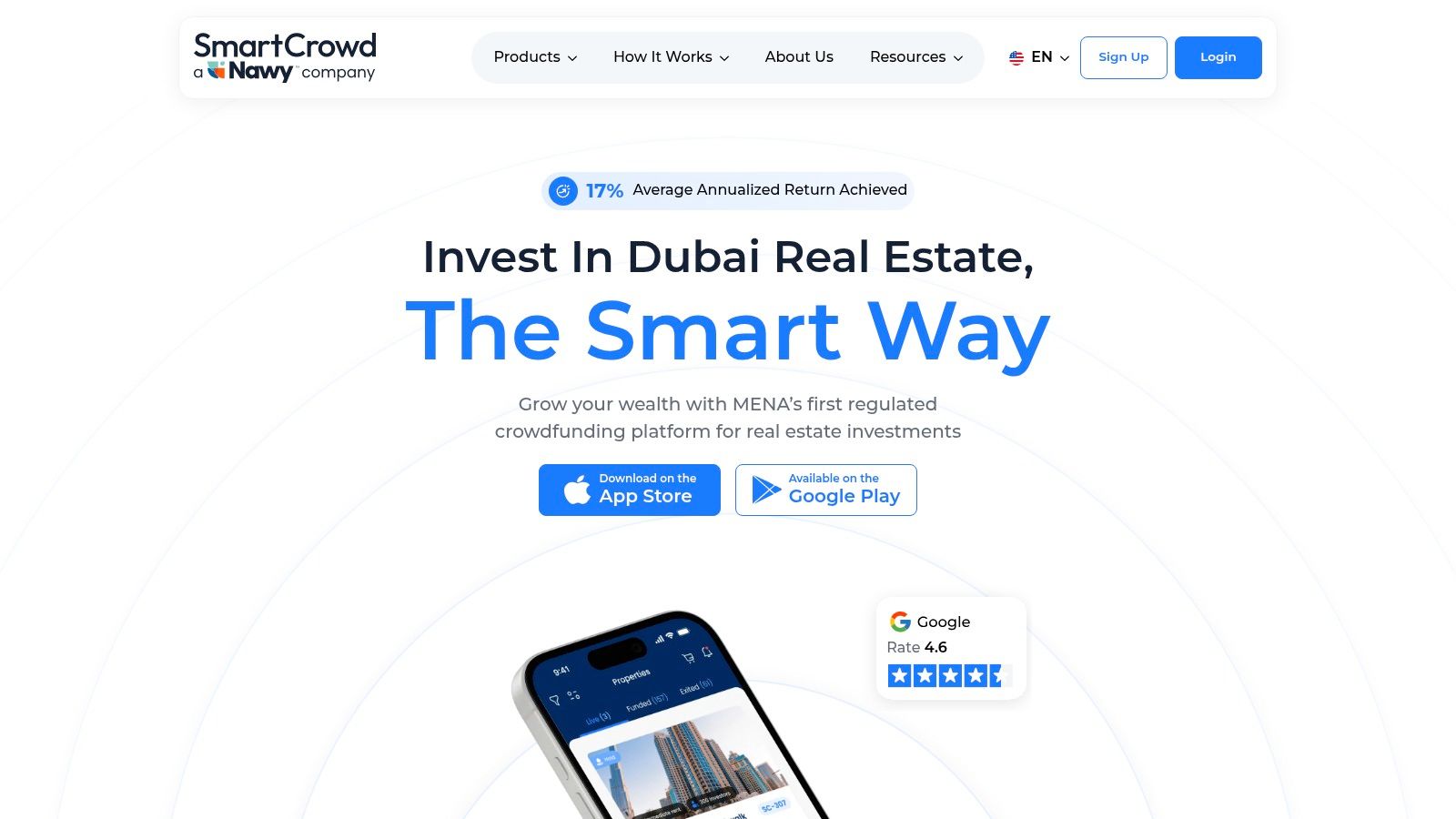
SmartCrowd addresses a straightforward barrier to Dubai property investing: many individuals want exposure to income-generating real estate but don't want to purchase an entire unit. Its platform lets investors participate in fractional property ownership through a separate special purpose vehicle for each asset, with investment documentation and reporting organised around that structure.
The platform's stated entry point is AED 500, and investors can fund a wallet before selecting opportunities through the platform's investment process. It also provides market reporting and portfolio analytics, giving users a way to monitor holdings instead of treating the investment as a one-off transaction. SmartCrowd operates within a DFSA-regulated framework, which makes licensing, eligibility and documentation central to the customer proposition.
The founder lesson
SmartCrowd shows how regulation can become part of the product rather than an obstacle hidden behind it. The SPV-per-asset model gives investors a clearer view of what they're participating in, while regulated processes help establish credibility in a category involving personal capital.
The trade-off is liquidity. A fractional property investment isn't the same as cash held in an instant-access account. Exits depend on the asset, the platform's processes and market conditions. Returns can also vary across properties and cycles, so transparent reporting cannot remove investment risk.
Founders studying this model should focus less on the low entry ticket and more on the operating system behind it:
- Regulatory design: Map the licensing and investor eligibility requirements before building acquisition features.
- Asset trust: Make ownership structure, fees, risks and exit mechanics easy to understand.
- Distribution: Build relationships with developers, brokers and investor communities, not only paid consumer acquisition.
- Capital readiness: Expect investors to examine compliance, asset sourcing and governance alongside user growth.
The platform's relevance to the wider sector is also reflected in this overview of proptech companies and real estate technology innovation. The next action for a founder is practical: interview prospective investors about the exact point where they lose confidence, asset selection, legal structure, reporting or liquidity. Build the first experiment around that answer.
2. Stake
Stake tackles a similar access problem but places more emphasis on helping investors understand potential routes to partial liquidity. It offers fractional exposure to curated Dubai properties, with investment opportunities presented through a digital platform and supported by performance reporting.
The platform advertises fractional investments from AED 500. It also describes exit windows and secondary-market functionality, which can give investors a clearer mechanism for seeking an exit than waiting for a whole-property sale. Those features don't make liquidity guaranteed, but they directly address one of the biggest objections to fractional ownership.
Stake operates under a DFSA-regulated framework in Dubai and is also described as CMA-regulated in Saudi Arabia. That cross-market positioning matters for founders because financial products need more than a smooth interface. They require clear eligibility guidance, compliant customer journeys and careful communication about availability, fees and risk.
Where the model gets difficult
Stake's main advantage is clarity around the investor journey. Curated assets, regular reports and defined exit mechanisms can make a complex property investment easier to evaluate. The weakness is that every liquidity feature remains connected to market demand, property performance and the terms of the specific offering.
That creates an important distinction for founders. You're not only designing an investment product. You're designing expectations around timing, pricing and fairness when users want to leave.
A useful diligence framework includes:
- Exit conditions: Ask what determines an exit window, who can participate and how pricing is established.
- Investor communication: Test whether a first-time investor understands the difference between access and guaranteed liquidity.
- Market expansion: Treat Saudi and UAE regulatory requirements as separate operating questions, even when the technology is shared.
- Asset selection: Validate whether users trust the curation process or need independent valuation evidence.
Stake's investment relevance comes from its attempt to solve the confidence and liquidity objections that can restrict fractional platforms. For a founder, the next move is to model the user journey from deposit to exit, including every point where compliance, customer support or asset-level information can slow the process.
3. Huspy
Huspy focuses on the buyer journey, where property discovery and mortgage finance often operate as separate processes. Its technology-enabled brokerage model combines home search with mortgage aggregation, digital pre-approvals and coordination between the buyer, broker and financing provider.
That combination is commercially important. A buyer doesn't experience “property discovery” and “mortgage acquisition” as unrelated software categories. They experience one purchase journey, with delays, documentation and uncertainty across both sides.
Huspy is a clear Dubai example in mortgage technology and home-buying enablement. Industry coverage identifies it as a lead company in the category and reports a US$37 million Series A, as detailed in coverage of Dubai's proptech ecosystem. That is a meaningful investment signal, but the more useful founder lesson is the operating model: Huspy sits between consumers, property inventory and banks, so its value depends on coordinating several parties.
Distribution is the product
The upside is a more coherent customer journey and a strong Dubai brand presence. Licensing and compliance transparency also matter because mortgage brokerage involves sensitive financial information and regulated relationships.
The limitations are equally clear. Huspy is an intermediary, so mortgage availability and rates depend on external banks. Property inventory can change with market conditions, and a digital pre-approval doesn't eliminate the need for underwriting, documentation or final lender decisions.
Founders evaluating a similar model should ask:
- Who owns the lead: Is the customer relationship controlled by the platform, broker or bank?
- Where does conversion fail: Discovery, document collection, lender matching or final approval?
- What must be licensed: Separate property brokerage, mortgage activity and data obligations before launch.
- Which partner drives distribution: A bank, developer, brokerage network or employer channel may be more valuable than broad advertising.
The practical next step is to map one buyer journey from first enquiry to completion and measure every manual handoff. This guide to proptech product-market fit is useful context, but the decisive validation will come from sitting with brokers and lenders and identifying the handoff they'd pay to remove.
4. Keyper
Keyper solves a distinctly local payment problem. In Dubai's rental market, landlords may want predictable cash flow while tenants may prefer monthly payments rather than a large upfront commitment. Keyper combines digital property management with a Rent-Now-Pay-Later model, paying landlords upfront while allowing tenants to pay monthly by card.
The product includes owner and tenant mobile apps for payments, contracts and oversight. Digital onboarding, automated reminders and payment visibility make the proposition more operational than a simple payment button. The value comes from changing the relationship between landlord cash flow and tenant payment timing.
The local friction is the moat
Keyper's investment relevance is supported by its reported US$6.5 million seed round, led by Access Bridge Ventures and Vivium Holdings, with participation from MEVP, Jabbar Internet Group, real estate ecosystem players and angel investors, according to Wamda's coverage of Keyper.
The model works because it addresses a specific financial workflow rather than asking users to adopt generic property software. It also shows why distribution can be harder than product development. A tenant can want monthly payments, but the landlord, building owner or property manager may still control whether the arrangement is accepted.
The trade-offs need close attention:
- Tenant cost: Service and processing charges should be compared with the tenant's alternatives.
- Landlord agreement: Adoption depends on owner approval and building policies.
- Risk controls: Underwriting, collections and payment failure processes are core infrastructure.
- Property management fit: The product must connect to contracts, renewals and support, not only rent transfer.
For founders, Keyper's lesson is direct. Find a recurring UAE property friction where every party has a different incentive, then design the commercial model around alignment. Before building a broad landlord dashboard, secure conversations with property managers and test whether they'll introduce the product to tenants.
5. Property Monitor by Cavendish Maxwell
Property Monitor addresses a different layer of the market. Instead of helping consumers invest or pay rent, it supplies data and analytics for teams that need to price, underwrite, value or report on UAE property.
The platform provides Automated Valuation Models, valuation workflows, dashboards, market reports, APIs and integrations. Its coverage draws on public and private sources, while its methodology is aligned with RICS standards. That positioning makes it relevant to developers, lenders, valuers, brokers and other professional users whose decisions depend on defensible market intelligence.
Data products must earn decision authority
Property Monitor's traction signal is its role as a leading UAE real estate intelligence source used by major market participants. That kind of enterprise adoption is more relevant than consumer visibility because customers use the data inside high-value workflows. The investment case rests on recurring professional demand, defensible coverage and the cost of making a wrong decision without reliable information.
The downside is the buying cycle. Enterprise subscriptions are priced by quote, which means founders should expect procurement, security, data-quality reviews and stakeholder approval. UAE-centric coverage also limits its usefulness for teams operating outside the market.
A founder building a data product should validate four points before investing in a polished interface:
- Coverage: Can the product answer the exact question a valuer, lender or broker asks?
- Methodology: Can a customer explain where the data comes from and how models are governed?
- Workflow fit: Does the output enter a credit memo, valuation report, pricing meeting or CRM?
- Commercial value: Does the product improve a decision, reduce manual work or support revenue?
The next experiment should be narrow. Pick one professional user, one decision and one recurring report. Secure a design partner who will compare the product against its current spreadsheet, vendor or analyst process. If the product doesn't change a decision, better visualisation won't rescue it.
6. Silkhaus
Silkhaus is built around the operating complexity of furnished short-term rentals. Its model combines software with managed operations, giving asset owners access to centralised pricing, channel distribution, guest communication and property operations for short-term and corporate stays.
That hybrid approach matters. A landlord doesn't only need a pricing algorithm. They need listings distributed across relevant channels, guest issues handled, units prepared and local operating requirements followed. Silkhaus packages those activities as an operating system and service layer for furnished rentals.
Software alone won't run a stay
Silkhaus has a specialised GCC short-term rental position, with fundraising and regional expansion used to scale the operating model. Its investment relevance comes from combining recurring property operations with technology, rather than selling an isolated tool to owners who still need to execute everything themselves.
The trade-off is margin and control. Owner pricing and commissions are bespoke, so an owner needs to understand the full economics before signing. Short-term rental returns are also sensitive to tourism seasonality, unit quality and building policies. A strong software layer can improve execution, but it can't remove those market constraints.
Founders assessing this category should separate the technology from the service burden:
- Revenue model: Establish whether income comes from management fees, commissions, software or a blended structure.
- Owner promise: Define whether the product targets higher yield, less work, better occupancy or professional compliance.
- Operations: Treat cleaning, maintenance, guest support and incident handling as core product requirements.
- Distribution: Test which owner segment can be reached efficiently, individual landlords, developers or asset managers.
A useful next action is to compare one owner's current short-term rental workflow with the proposed service. This background on Bayut properties in Dubai can help frame the broader discovery environment, but your validation should focus on the owner's actual operating costs, not only listing visibility.
7. Asette
Asette focuses on off-plan discovery, a segment where buyers and smaller investors often need to compare launches, prices, payment plans and project information before speaking with a broker. Its AI-powered product aims to organise that fragmented information into a faster decision-support experience.
The model is intentionally narrower than a full property marketplace. Asette gives users comparisons of off-plan projects and payment structures, adds regulatory context and disclaimers to the user experience, and publishes focused information for Dubai's off-plan market. It helps users orient themselves before formal valuation, legal review or broker engagement.
Narrow information gaps can become products
Asette's opportunity comes from the difficulty of comparing fast-moving launches. Buyers may see different payment structures, developer materials and promotional claims, but still lack a simple way to orient themselves. The product's investment relevance is therefore tied to data freshness, user trust and the quality of the next action it enables.
The risks are typical of an early-stage intelligence product. Coverage and features will evolve, and AI-generated comparisons are not a substitute for formal valuation or legal due diligence. If a user treats a lightweight insight tool as a final investment authority, the product creates trust and compliance problems.
Founders can assess the model through a simple sequence:
- Information gap: Identify which off-plan facts users struggle to compare.
- Source quality: Record how often project, pricing and payment-plan information changes.
- Decision handoff: Show whether the product leads to a broker call, developer enquiry or professional diligence.
- Regulatory language: Make disclaimers useful and clear, not hidden behind generic legal copy.
The next validation experiment should involve a small group of buyers comparing several current launches. Observe where they still leave the product to search elsewhere. Those gaps will tell you whether the opportunity is better served by structured data, broker distribution, developer partnerships or a deeper diligence workflow.
Top 7 Dubai PropTech Startups Comparison
| Platform | Implementation Complexity 🔄 | Resource Requirements ⚡ | Expected Outcomes 📊 | Ideal Use Cases 💡 | Key Advantages ⭐ |
|---|---|---|---|---|---|
| SmartCrowd | 🔄 Low, web onboarding; SPV per asset managed by platform | ⚡ Low capital (from AED 500); holding period until exits | 📊 Fractional rental/income exposure; returns vary by asset/market | 💡 Investors seeking Dubai real-estate exposure without whole-unit purchase | ⭐ DFSA-regulated; transparent SPV structure and reporting |
| Stake | 🔄 Low–Medium, onboarding plus periodic exit window processes | ⚡ Low capital (from AED 500); liquidity tied to exit windows/secondary market | 📊 Fractional income with improved partial-exit potential | 💡 Investors who want clearer liquidity paths for fractional holdings | ⭐ DFSA (and CMA) regulation; secondary market / exit windows |
| Huspy | 🔄 Medium, integrated search + mortgage brokerage workflow | ⚡ Requires buyer funds; relies on partner banks for mortgages | 📊 Faster mortgage pre-approvals and coordinated buy+finance process | 💡 Homebuyers seeking quicker approvals and competitive rates | ⭐ Streamlined digital buyer journey; licensed brokerage |
| Keyper | 🔄 Low, app-based landlord/tenant onboarding and RNPL flow | ⚡ Integration with landlord consent; tenant card payments and service fees | 📊 Improved landlord cashflow (upfront RNPL); monthly tenant payments | 💡 Landlords in cheque-heavy markets wanting monthly collections | ⭐ Solves local rent-payment friction with simple mobile apps |
| Property Monitor | 🔄 Medium–High, enterprise dashboards, AVM integration and APIs | ⚡ Enterprise subscription cost; data/IT integration required | 📊 Authoritative UAE pricing, AVMs and underwriting-grade market insights | 💡 Developers, lenders, valuers and brokerages needing UAE data | ⭐ Broad UAE coverage; RICS-aligned methodology and APIs |
| Silkhaus | 🔄 Medium, onboarding of furnished units, ops and channel management | ⚡ Operational resources (furnishing, guest ops); commission-based model | 📊 Potentially higher STR yields; results sensitive to seasonality/policies | 💡 Owners wanting professional STR operation and distribution | ⭐ Dedicated STR tech/ops across GCC; yield-focused management |
| Asette | 🔄 Low, consumer-facing AI comparisons and off‑plan dashboards | ⚡ Minimal user input; depends on data coverage and model quality | 📊 Quick directional comparisons of off‑plan projects and payment plans | 💡 Buyers/investors researching fragmented off‑plan launches | ⭐ Niche off‑plan focus with AI-driven comparison tools |
Turn the Dubai Proptech Map Into Your Next Move
These seven companies show that Dubai real estate technology isn't one market with one winning playbook. SmartCrowd and Stake turn property access into regulated investment products. Huspy connects discovery with mortgage finance. Keyper modernises rent collection and landlord cash flow. Property Monitor sells decision-grade data to professional users. Silkhaus combines software with short-term rental operations. Asette focuses on the information gap before an off-plan purchase.
The founder decision is to choose the layer where you can create durable value. Regulated financial products require compliance, investor trust and careful control of eligibility, disclosures and money movement. Workflow platforms need access to landlords, brokers, developers or building operators. Data products must prove coverage, methodology and decision value before customers will rely on them.
The UAE market has enough depth to support specialised models. Independent market research forecasts the UAE proptech market to grow from roughly USD 712.34 million in 2025 to USD 1.87367 billion by 2031, with a projected 17.49% CAGR, while Dubai's own PropTech market was valued at about AED 2.2 billion in 2023 and is targeted to exceed AED 4.5 billion over the following five years, according to TechSci Research's UAE proptech market analysis. Those projections don't validate an idea by themselves. They show why founders should investigate specific workflows instead of treating market growth as a substitute for customer evidence.
Use this action sequence:
- Choose one property workflow: Pick rent collection, mortgage matching, valuation, off-plan discovery, short-term rental operations or another defined process.
- Interview the buyer or operator: Speak with the person who owns the problem and the person who approves spending.
- Map dependencies: Identify licensing, data permissions, payment providers, government e-services and building-level integrations.
- Find a distribution partner: Seek a brokerage, developer, lender, property manager or investor community that already has customer trust.
- Run a narrow experiment: Test one workflow with a small set of users and measure whether it changes a decision, reduces manual work or creates a qualified transaction.
Founder communities can make this process faster by helping you pressure-test assumptions, find relevant introductions and meet potential design partners. Founder Connects offers curated peer groups, one-to-one introductions, practical tools and founder events for the UAE and wider MENA ecosystem. Its moderated groups and regular founder conversations can be useful when you need honest feedback on a regulated product, a partnership strategy or an early customer discovery plan.
The strongest Dubai proptech opportunity is a validated local problem with a credible path through regulation, partnerships and execution.
Start with the workflow, not the feature list. A founder who can explain who pays, why they trust the product and which local dependency drives adoption is already ahead of a team building a generic real estate app.
Founder Connects gives UAE and MENA founders access to curated peer groups, relevant one-to-one introductions, practical tools and focused events. If you're validating a Dubai proptech idea or looking for design partners and ecosystem connections, visit Founder Connects and take the next conversation seriously.

Building in MENA? You don't have to do it alone.
Join 300+ founders in the Founder Connects Residency. Monthly squad calls, warm intros, $3M+ in perks, and much more. All for less than your monthly coffee budget.
Popular posts





Founder Connects is a premium MENA tech founder community. Meetups in Dubai and across MENA, Residency Squads of 8–10, and 400+ vetted WhatsApp founders (apply and screened).