

Startup Accounting UAE VAT Guide 2026: Essential Compliance

Building in MENA? You don't have to do it alone.
Join 300+ founders in the Founder Connects Residency. Monthly squad calls, warm intros, $3M+ in perks, and much more. All for less than your monthly coffee budget.

A lot of UAE founders hit the same moment at the wrong time. Revenue starts moving, a large invoice lands, the team is hiring, and someone suddenly asks whether the company should already be VAT registered. By then, finance is usually running in the background on a mix of spreadsheets, bank screenshots, and good intentions.
That's where VAT becomes a cash flow issue, not just a compliance task. If you register late, penalties can follow. If you register too casually, your application can stall. If your invoicing and records aren't clean, filing becomes harder than it should be. For founders with irregular startup revenue, especially SaaS, consulting, marketplaces, and cross-border services, the risk isn't only the headline threshold. It's the timing.
This guide is built for that exact reality. It gives a practical startup accounting UAE VAT guide 2026 founders can use to decide when to register, how to handle invoicing, what records to keep, how returns are filed, where zero-rating gets risky, how free zone treatment can trip you up, which software setup works in practice, and how to choose an accountant who won't create more problems than they solve.
Introduction
The founder I worry about most isn't the careless one. It's the organised one who assumes VAT can wait until year end.
In the UAE, that assumption gets expensive fast. A startup can cross the registration line because of one annual SaaS contract, one consulting project, or one burst of imported taxable supplies. Once that happens, finance work stops being a back-office task and becomes an operating priority. The wrong timing affects pricing, collections, supplier claims, and investor reporting.
Good VAT management in 2026 is less about memorising rules and more about building a simple system that works under pressure. Founders need clean invoicing, reliable bookkeeping, certified software, a filing rhythm, and someone on the team who watches the threshold before the FTA does.
The practical goal is straightforward. Know when you must register. Know when voluntary registration is worth it. Issue invoices properly. Keep records that support claims. File on time. Reclaim input VAT where it's allowed. Avoid the common mistakes that usually start small and become painful later.
Understanding VAT and Startup Accounting Key Concepts
A founder closes a large annual contract in April, collects cash upfront, and still tells the team VAT can be sorted later. By the time bookkeeping catches up, the deeper issue is no longer just tax. Pricing, margin reporting, supplier claims, and registration timing are already affected.
That is why startup accounting and VAT need to be treated as one operating system, not two separate admin tasks.
VAT is a consumption tax. In practice, a startup usually charges VAT on taxable sales and pays VAT on eligible business costs. The accounting job is to record each side correctly, classify supplies properly, and keep enough evidence to defend the treatment later. In the UAE, the standard rate remains 5% on taxable supplies and imports, and VAT returns are submitted through the VAT 201 process set out by the Federal Tax Authority VAT guidance.
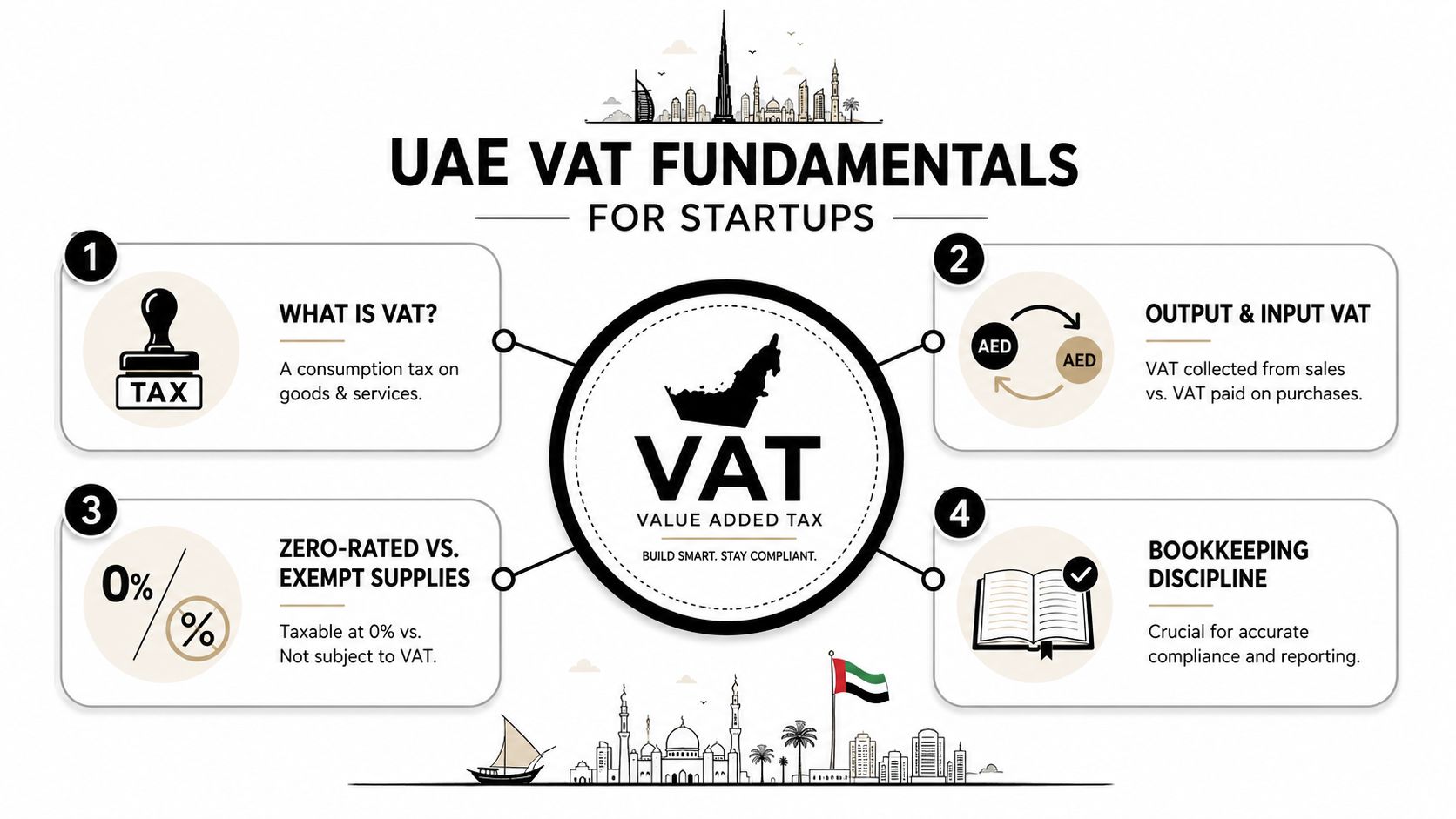
Output VAT and input VAT
Output VAT is the VAT charged on taxable sales.
Input VAT is the VAT paid on business purchases that may be recoverable if the expense is allowable and the documents are in order.
The distinction sounds simple. Startups still get it wrong because revenue is irregular and costs are often paid by founders, foreign cards, or different entities during setup. That is exactly where weak accounting creates VAT risk. A finance team can only report the right net VAT position if every transaction is posted to the right ledger, with the right tax code, at the right date.
The practical model is straightforward:
- Sales create output VAT liabilities
- Purchases may create input VAT recovery
- Timing and documentation determine what goes on the return
For SaaS startups, output VAT often sits in subscription invoices, onboarding fees, and UAE-billed support work. For agencies and consultancies, the pressure point is usually milestone billing and mixed client locations. For product businesses, inventory purchases, imports, and supplier credit notes often drive the biggest posting errors.
Practical rule: If the team cannot pull the invoice, supplier or customer name, date, amount, VAT treatment, and payment trail quickly, the accounting process is not ready for a clean VAT return.
This matters even more for founders with uneven revenue patterns. The same bookkeeping file used for VAT should also support rolling 12-month threshold tracking and forward projections. If revenue comes in spikes, poor coding does not just create filing errors. It can also hide an approaching registration trigger until the business is already late.
A lot of founders also need to align VAT treatment with entity structure, ownership, and broader tax setup. If that part is still being worked out, this guide to UAE corporate tax for startups gives the wider context.
A short walkthrough helps here:
Zero-rated and exempt are not the same
Founders regularly group these together because both can result in no VAT being charged on the invoice. The accounting effect is different, and that difference matters.
Zero-rated supplies are taxable supplies charged at 0%. They stay inside the VAT system.
Exempt supplies are treated differently, which can affect whether related input VAT can be recovered.
The trade-off is practical, not academic. If a startup labels a supply as zero-rated without the right basis and supporting evidence, it may understate output VAT. If it treats exempt activity like zero-rated activity, it may overclaim input VAT. Both errors tend to surface only after several filing periods, when the clean-up is slower and more expensive.
Why bookkeeping discipline matters early
Early-stage founders often focus on incorporation, sales, and payroll first, then try to rebuild VAT from bank statements later. That approach usually fails once the business has annual billing, imports, cross-border services, or founder-paid setup costs.
What works in 2026 is a simple structure the team can maintain under pressure:
- Use separate VAT ledgers: keep output VAT, input VAT, reverse charge entries, and credit notes distinct
- Post invoices from one controlled system: avoid mixing spreadsheets, emailed PDFs, and manual journals
- Code supplies based on actual VAT treatment: not based on where the customer is located alone
- Review unusual transactions monthly: especially large prepayments, cross-border sales, and one-off imports
- Keep projection notes with the books: this helps explain why the business did or did not expect to cross the threshold during irregular revenue periods
The best finance setups do one thing well. They let founders see the VAT position early enough to act, especially where rolling 12-month turnover and forward-looking registration tests depend on accurate month-by-month coding.
For startups, that is the core accounting concept to get right first. Clean books are not just helpful for filing. They are how founders control registration risk before it becomes a penalty issue.
VAT Registration Process and Thresholds
A founder signs a large annual contract on the 24th, collects the cash a week later, and assumes VAT registration can wait until quarter end. In the UAE, that is often the mistake. Registration risk is tested on a rolling 12-month basis and on what the business reasonably expects to earn in the next 30 days, not on a year-end review.
Mandatory VAT registration applies once taxable supplies and imports exceed AED 375,000 over the previous 12 months, or where the business expects to exceed that level within the next 30 days. Voluntary registration is available from AED 187,500. Applications are filed through EmaraTax, and late registration can trigger penalties, as outlined in this 2026 UAE VAT compliance guide.
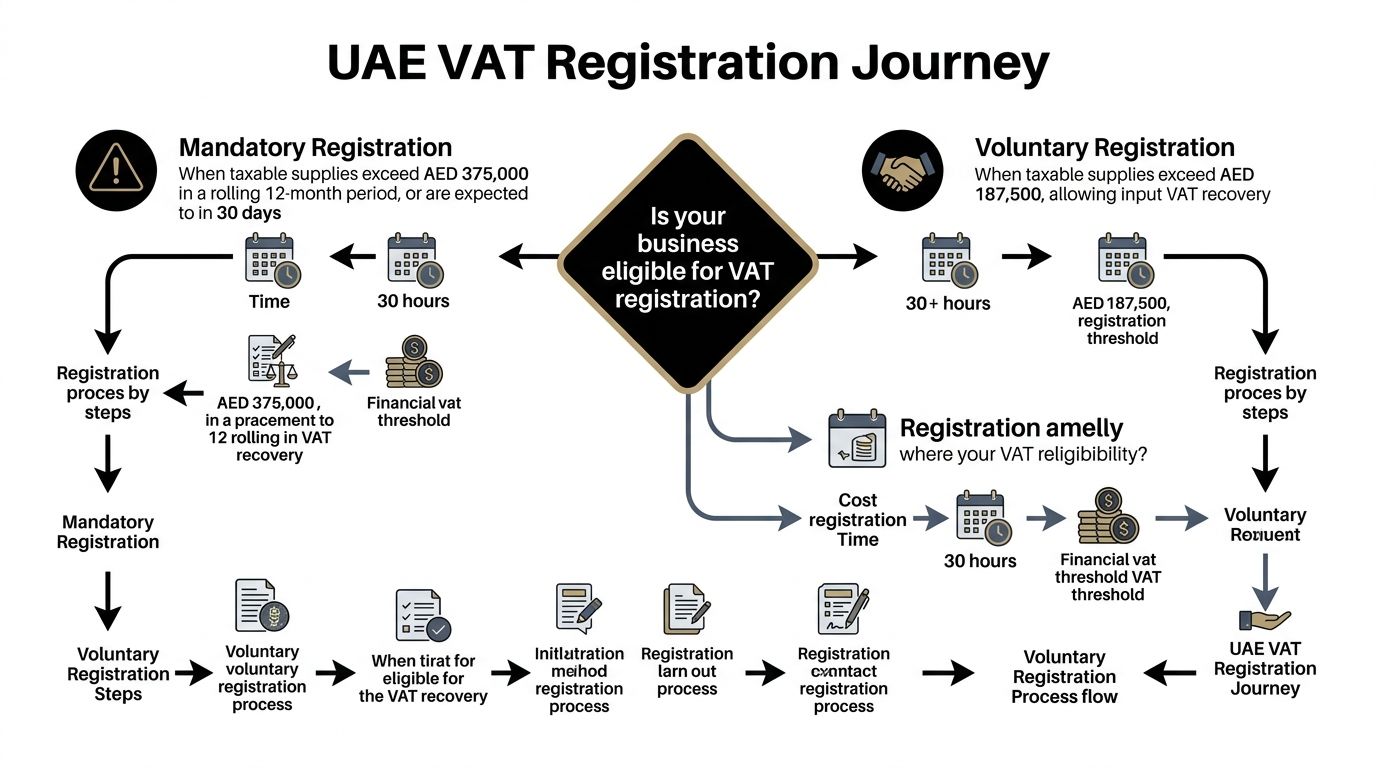
The threshold founders misread
The problem is rarely the headline number. The problem is timing.
Many startup teams still monitor turnover by financial year or by invoice month alone. That misses how the threshold works in practice. The FTA test looks back over the immediately preceding 12 months, then looks forward 30 days. For irregular revenue businesses, one prepaid annual deal, one enterprise implementation fee, or one marketplace spike can change the registration position quickly.
This matters most where revenue is uneven:
- SaaS companies billing annually upfront
- Consultancies with milestone invoices
- Agencies with large campaign retainers
- Platforms with seasonal volume spikes
The safer method is simple. Keep a monthly taxable turnover model that rolls forward every month, then add a short forecast for signed work, committed billings, and near-certain supplies over the next 30 days. Founders who rely only on cash received or invoices already issued usually identify the threshold too late.
I tell founders to treat this as a risk model, not an admin check. If revenue is lumpy, review it weekly.
Mandatory versus voluntary registration
Voluntary registration can make sense during the build phase if the startup is incurring meaningful VAT on software, advisors, fit-out, or launch costs and wants to recover that input tax. But early registration also creates filing obligations, invoice discipline, and a need for cleaner coding from day one. For some pre-revenue startups, the cash recovery is worth it. For others, the compliance load arrives before the finance process is stable.
The harder judgement call in 2026 is projection-based registration.
New businesses often do not have 12 months of invoices to prove the position, so they apply using contracts, pipeline evidence, budgets, and launch assumptions. The risk is not that projection-based registration is impossible. The risk is that weak projections are hard to defend later if the expected revenue slips or the support file is thin. Zoho Books' guide to UAE VAT registration is useful here because it explains the practical documents businesses prepare for registration, including cases where the business must support its eligibility with underlying records.
A better approach is to separate evidence into three buckets:
- Historical taxable turnover, if any
- Contracted revenue, such as signed agreements, purchase orders, or accepted proposals
- Management projections, clearly marked as forecast assumptions rather than confirmed turnover
That distinction matters. Signed revenue supports the application more strongly than an optimistic sales plan.
What the registration process should look like
Use EmaraTax only after the support file is ready. The portal is the easy part. The judgment sits behind the numbers.
Prepare these items before submitting:
- Trade licence and entity details
- Bank details that match the legal entity
- Turnover support, using invoices, imports data, signed contracts, or other defensible records
- A short business model note, especially for startups with cross-border services, prepayments, or irregular billing
- A threshold memo, showing the rolling 12-month calculation and the forward 30-day basis for registration if projections are being used
For startups with uneven sales, that threshold memo is one of the best controls you can put in place. It should show month-by-month taxable turnover, identify what counts and what does not, and explain why the company concluded registration was required or commercially sensible at that point. If the FTA later reviews the file, the business is not trying to reconstruct its reasoning from inbox searches and founder memory.
E-Invoicing Compliance and Invoicing Rules
Many VAT problems start with a bad invoice.
Founders often assume invoicing is an admin task the ops team can “sort out later”. In practice, invoicing is where compliance becomes visible. If the invoice is wrong, the customer may question it, the bookkeeping entry may be wrong, and the VAT return can inherit the mistake.

What has to be on the invoice
In 2026, founders should treat invoice compliance as a system issue, not a formatting issue. Your invoices need the required information consistently, not only when the finance manager remembers.
Based on the verified 2026 VAT guidance already noted earlier, accurate e-invoicing requires fields such as:
- TRN
- Invoice date
- Unique sequential number
Those fields matter because they support audit readiness and reduce the risk of duplicate or untraceable invoices.
What works in practice
The easiest setup is one invoicing source connected to your accounting ledger. That can be through your certified accounting platform if it handles invoicing properly, or a clean workflow that syncs sales invoices into the accounting system without rekeying.
Strong habits include:
- Lock the sequence: don't let different team members create invoices from separate templates
- Control edits: if an invoice needs correction, use the proper correction flow rather than overwriting history
- Match customer data carefully: the wrong legal entity name or missing TRN can create downstream recovery issues
What doesn't work is mixing PDF templates, manual invoice numbers, and ad hoc exceptions for “just this one enterprise client”. Those exceptions multiply.
Common invoice traps
The mistakes I see most often are operational, not technical.
| Issue | What usually caused it | Better fix |
|---|---|---|
| Missing TRN | Registration happened but templates weren't updated | Update the master template and system defaults immediately |
| Duplicate invoice number | Separate invoice creation by sales and finance | Centralise issuance in one system |
| Wrong VAT treatment | Team guessed based on client location | Require finance review for unusual supplies |
| Incomplete invoice archive | Invoices stored in inboxes instead of system folders | Push all final invoices into a single controlled repository |
A clean invoice process saves more time than a clean-up project. Founders usually notice that only after the first filing scramble.
Recordkeeping and Bookkeeping Best Practices
Good VAT compliance is built in the ledger, not in the return form.
As of July 2026, only FTA-certified accounting software is permitted for VAT compliance in the UAE, and startups must maintain records for a minimum of five years to avoid irreversible VAT credit loss, according to this 2026 UAE regulation update.
The bookkeeping setup that actually works
Keep the structure simple enough that a founder can inspect it without needing a tax manual.
A practical setup includes:
- Output VAT ledger for VAT charged on sales
- Input VAT ledger for recoverable VAT on purchases
- Credit note ledger so adjustments don't disappear into revenue or expenses
- Customer and supplier folders with final invoices, credit notes, and supporting documents
- Monthly reconciliation routine so VAT balances are checked before filing pressure starts
In response, optimizing finance with cloud accounting becomes useful reading. Founders don't need theory. They need a system where bank feeds, invoice capture, and document storage reduce manual errors.
Software recommendations and trade-offs
The core recommendation is not a brand. It's certification and process fit. Since only FTA-certified software is permitted, the first filter should be certification status, then workflow suitability.
Use these decision criteria when reviewing tools:
If your startup is still lean
Pick software that is easy for a founder or small ops team to use daily. The priority is invoice control, bank reconciliation, document attachment, and clean VAT coding.
If your startup has complex contracts
Choose a system that handles approval workflows and audit trails well. Complex revenue recognition may sit outside the VAT setup, but the invoice and ledger controls still need to be reliable.
If your startup operates cross-border
Make sure the system supports consistent treatment for different supply types and makes document retrieval easy when proof is needed.
I won't name three specific tools here unless you confirm they are currently FTA-certified at the point of purchase. Certification status matters more than popularity.
A five-step routine founders can delegate
- Capture invoices daily
- Reconcile bank and card feeds weekly
- Review VAT coding monthly
- Back up records into structured folders
- Close each tax period before the filing week starts
What fails most often is the “we'll tidy it later” model. Later usually means after a deadline, after a cash call, or after an FTA question.
VAT Return Filing and Payment Timelines
A common startup mistake looks like this. Revenue lands late in the quarter, founders focus on payroll and product, and the VAT return only gets attention in the final two days. That is usually when unreconciled invoices, missing credit notes, and avoidable payment delays show up together.
Good filing discipline starts earlier than the portal login.
UAE startups file VAT returns through the VAT 201 process in EmaraTax. The practical rule is simple. Work backwards from the filing due date for your assigned tax period, and treat the return as the last step in a closed accounting cycle, not a month-end clean-up exercise. The Federal Tax Authority sets the filing and payment deadlines through its VAT procedures and taxpayer guidance on EmaraTax and VAT return filing.
Filing frequency and deadline control
The filing frequency depends on the tax period assigned by the FTA. Many startups are placed on quarterly filing, while higher-turnover businesses may be required to file monthly. In both cases, the return and payment are generally due by the 28th day following the end of the tax period.
If the due date falls on a weekend or public holiday, confirm the effective deadline inside EmaraTax and your FTA notices rather than relying on memory. Founders get into trouble here because they remember the filing date but forget that payment timing has to match it.
That matters more for startups with irregular revenue. A business that spikes past the registration threshold based on rolling 12-month actuals, or based on expected taxable supplies in the next 30 days, often also has uneven cash collection patterns. I advise founders to model VAT cash outflows alongside threshold monitoring, especially after one large contract or a delayed invoice catch-up. Registration risk and return-payment risk often appear in the same quarter.
How to approach the VAT 201 form
No founder needs to memorise every field. The better approach is to understand which records drive the return and where errors usually start.
The areas startups check most often are:
- taxable sales reported for the period
- output VAT due on those sales
- taxable expenses and imports, where relevant
- input VAT being recovered
- adjustments from credit notes, bad debt relief, or prior-period corrections
By the time someone opens EmaraTax, the sales ledger, purchase ledger, bank movements, and VAT codes should already tie out. If the team is still debating invoice treatment inside the portal, the close process started too late.
A filing routine that works in practice
I use a short review window for founder-led teams because long checklists get ignored. The goal is not perfection. It is a return that is supportable if the FTA asks questions later.
Seven days before the deadline
Pull the draft sales and purchase reports for the tax period. Review whether all issued invoices, supplier bills, credit notes, and major expense claims are posted in the right period. Freeze casual edits.
Five days before the deadline
Review exceptions only. Look at one-off contracts, cross-border supplies, mixed-use costs, manual journals, and any transaction that required judgment. Such a review allows startups with irregular billing cycles to catch period errors before they become repeated errors.
Three days before the deadline
Reconcile VAT control accounts to the draft return. Confirm who will submit the return, who will approve payment, and which bank account will be used. If collections have been lumpy, check cash availability now rather than on the due date.
One day before the deadline
Do a second-person review, even if the company is small. One reviewer checks the numbers against reports. One approver checks that the filing period, payment amount, and submission details are right.
Banking friction still causes missed payments in otherwise organised startups. If your team is still patching together payment approvals or dealing with account access limits, fix that early with a proper UAE startup business bank account setup guide. Filing on time but paying late is still a compliance failure.
Reclaiming Input VAT and Cross-Border Supply Treatments
Input VAT recovery is where startups can improve cash efficiency, but only if the paperwork and treatment are defensible.
For many early-stage teams, reclaiming VAT on setup costs matters because early spend often lands before revenue becomes predictable. Software subscriptions, professional fees, operational tooling, and certain launch costs can all affect the company's VAT cash position if they are properly recorded and supported.
Reclaiming input VAT without creating a future problem
The first rule is simple. Don't claim because a payment feels business-related. Claim because the invoice, supplier details, VAT treatment, and accounting record all align.
The second rule is timing. As noted in the earlier section on recordkeeping, the current framework includes a hard five-year window for VAT refund claims and input credit submissions. If your records are weak, the business can lose recoverable value permanently.
A useful internal review before claiming includes:
- Is the invoice addressed correctly to the company?
- Does the invoice show VAT clearly?
- Can the expense be tied to the business activity?
- Has the transaction been coded correctly in the ledger?
Cross-border services and the proof problem
Cross-border work is where founders get overconfident.
The nuanced rolling 12-month threshold can trigger immediate liability if crossed in any 30-day window, and non-resident suppliers must register from the first taxable supply with no threshold. Misclassifying zero-rated exports without proper proof can lead to penalties up to AED 10,000, according to this founder-focused UAE VAT guide.
That means a founder can't say, “The client is overseas, so it's zero-rated.” The burden sits on the business to prove the treatment.
Keep a proof file for each export-service client. Contract, invoice, delivery evidence, correspondence confirming where the service is consumed, and any internal memo explaining the treatment should sit together.
A practical proof-of-consumption template
Use a short internal statement for each zero-rated export position. It should cover:
- Customer legal name and jurisdiction
- Nature of service supplied
- Why the service is treated as consumed outside the UAE
- Documents held in support
- Reviewer name and approval date
This won't replace legal analysis where the facts are messy, but it creates a discipline most startups badly need.
Reverse charge changes founders should note
The same verified 2026 update referenced in the recordkeeping section noted that the reverse charge mechanism's self-invoicing requirement was removed from 1 January 2026. Operationally, that simplifies part of the workflow for startups dealing with imports or cross-border services, but it doesn't remove the need for careful classification and documentation.
Free Zone Supplies VAT Treatment
Free zone founders often assume their licence location answers the VAT question. It doesn't.
The practical issue is how the supply is treated, where the customer sits, whether goods or services are involved, and whether mainland interaction changes the result. If the business operates across free zone and mainland touchpoints, the bookkeeping and invoicing logic has to reflect that reality.
What founders usually get wrong
The most common mistake is treating “free zone” as a blanket tax category. It isn't. VAT treatment depends on the facts of the supply, not the marketing label on the company setup.
That matters in a few recurring situations:
- A free zone company invoicing a mainland customer
- A startup moving goods through customs before mainland sale
- Intra-group charges between related entities in different jurisdictions
- A free zone services business assuming every cross-border invoice is automatically zero-rated
When the business model spans jurisdictions, finance should map transaction types individually. One company can easily have multiple VAT treatments across different revenue streams.
A better way to handle free zone VAT decisions
Use a transaction map rather than a company-level assumption.
Start with these questions:
- Is this a supply of goods or services?
- Where is the customer or recipient?
- Does mainland delivery or use affect the treatment?
- What evidence supports the position?
For tech founders deciding where to incorporate or expand, this comparison of UAE free zones for tech startups is a useful strategic read. Setup choices influence operations, but they don't eliminate VAT analysis.
Where free zone teams should get external help
Get an accountant or VAT specialist involved early if:
- Your startup imports goods
- You recharge shared costs across related entities
- You have mixed mainland and export revenue
- Your contracts bundle product and service elements together
What works is documenting VAT treatment by transaction type. What doesn't work is telling the finance team, “We're in a free zone, so VAT shouldn't apply.”
Common Pitfalls and Practical Examples
A founder closes a strong quarter, sees cash coming in, and assumes VAT timing is under control. Then finance checks the rolling turnover properly, spots that a large invoice shifted the registration position weeks earlier, and the team is suddenly reconstructing dates, invoices, and supporting documents.
That pattern is common in startups with irregular revenue. One big annual contract, milestone billing, imported setup costs, or a delayed customer signature can change the VAT position faster than the dashboard suggests. The risk in 2026 is not just missing a deadline. It is relying on the wrong measurement method.
Five mistakes that keep repeating
- Tracking calendar-year revenue instead of the rolling 12-month position: founders watch bookings or annual sales summaries, while VAT registration depends on taxable turnover across a moving window
- Using projection-based registration without evidence: the application relies on confidence, not signed contracts, board-approved forecasts, or a clear revenue model
- Letting invoice templates drift: TRN fields, supply wording, or tax calculations change across teams and create avoidable errors
- Starting the close process too late: the filing deadline is visible, but the records are still scattered across inboxes, bank feeds, and ops spreadsheets
- Applying one VAT assumption to every transaction: a startup treats all free zone, export, or cross-border activity the same instead of reviewing each supply type
The first two points are where I see early-stage teams get caught most often. Founders usually understand the headline threshold. The miss happens in the mechanics. VAT registration risk sits in the rolling 12-month test and, for expected turnover cases, in how well projections can be defended if the FTA asks questions. The UAE government's VAT registration guidance on the FTA portal is the right reference point for the formal process, but the operational issue is internal: startups need a live threshold model, not a once-a-quarter estimate.
Practical example one. Irregular revenue breaks the founder dashboard
A SaaS startup signs two annual contracts in the same month after a slow first half. The founder looks at MRR, sees a moderate monthly number, and decides registration can wait. That is the wrong lens. VAT risk follows taxable supplies in the rolling period and the near-term expected position, not the comfort of a subscription chart.
The fix is simple and disciplined. Build a rolling 12-month tracker that uses invoice dates, taxable amounts, credit notes, and expected signed business in the next 30 days. Review it weekly during periods of uneven sales. I have seen this single worksheet prevent both late registration and premature filings based on inflated pipeline assumptions.
Practical example two. Projection-based registration without a support file
A services startup wants voluntary registration because input VAT on setup costs is building up. The team files with optimistic revenue projections, a draft proposal, and a vague description of future work. Approval does not move as quickly as expected, and finance then has to rebuild the story with cleaner evidence while the cash-flow benefit is delayed.
A better approach is to prepare a support file before applying. Use signed contracts where possible. If contracts are still pending, include customer correspondence that shows real commercial commitment, a forecast tied to named deals rather than broad assumptions, an explanation of how the business bills, and organised expense records that match the registration rationale. Conservative projections are often stronger than ambitious slides because they are easier to defend.
If your registration case depends on expected revenue, shorten the narrative and strengthen the evidence.
Practical example three. Registration was correct, but invoicing failed
A startup registers on time, but sales, operations, and finance each use a different invoice template. One version has the wrong TRN. Another omits the tax breakdown. A third applies VAT to a transaction that had not been reviewed properly. Filing then turns into a cleanup exercise.
The practical fix is version control. Keep one approved invoice template, one owner for changes, and one review point before a new product, market, or pricing structure goes live. This is not admin for its own sake. It prevents small document errors from spreading across a quarter of billing.
How to spot trouble early
These signs usually appear before the core VAT problem does:
| Symptom | What is probably wrong |
|---|---|
| Revenue reports and accounting turnover do not match | The threshold model is using the wrong inputs |
| Forecasted turnover is cited in the registration plan, but no support file exists | Projection-based registration is exposed |
| Invoices live across email threads and shared drives | Record retrieval will be slow during filing or review |
| Finance asks basic classification questions during filing week | Transaction mapping happened too late |
| Teams refer to MRR, bookings, and VAT turnover as if they are interchangeable | Management reporting and tax reporting are being mixed |
The practical standard is clear. Track the rolling 12-month threshold every month as a minimum, every week when revenue is lumpy, and separately maintain a short evidence pack for any projection-based registration position. Startups do not usually get into VAT trouble because one rule was impossible to understand. They get into trouble because no one converted the rule into a repeatable finance process.
Founder-Friendly Compliance Checklist and Roadmap
Founders don't need a bigger tax manual. They need a working operating checklist.
The right roadmap turns VAT from a periodic panic into a repeatable process. That's especially important in startups because finance responsibility often shifts between founder, ops lead, external accountant, and internal hire as the company grows. Without a checklist, each handover creates blind spots.
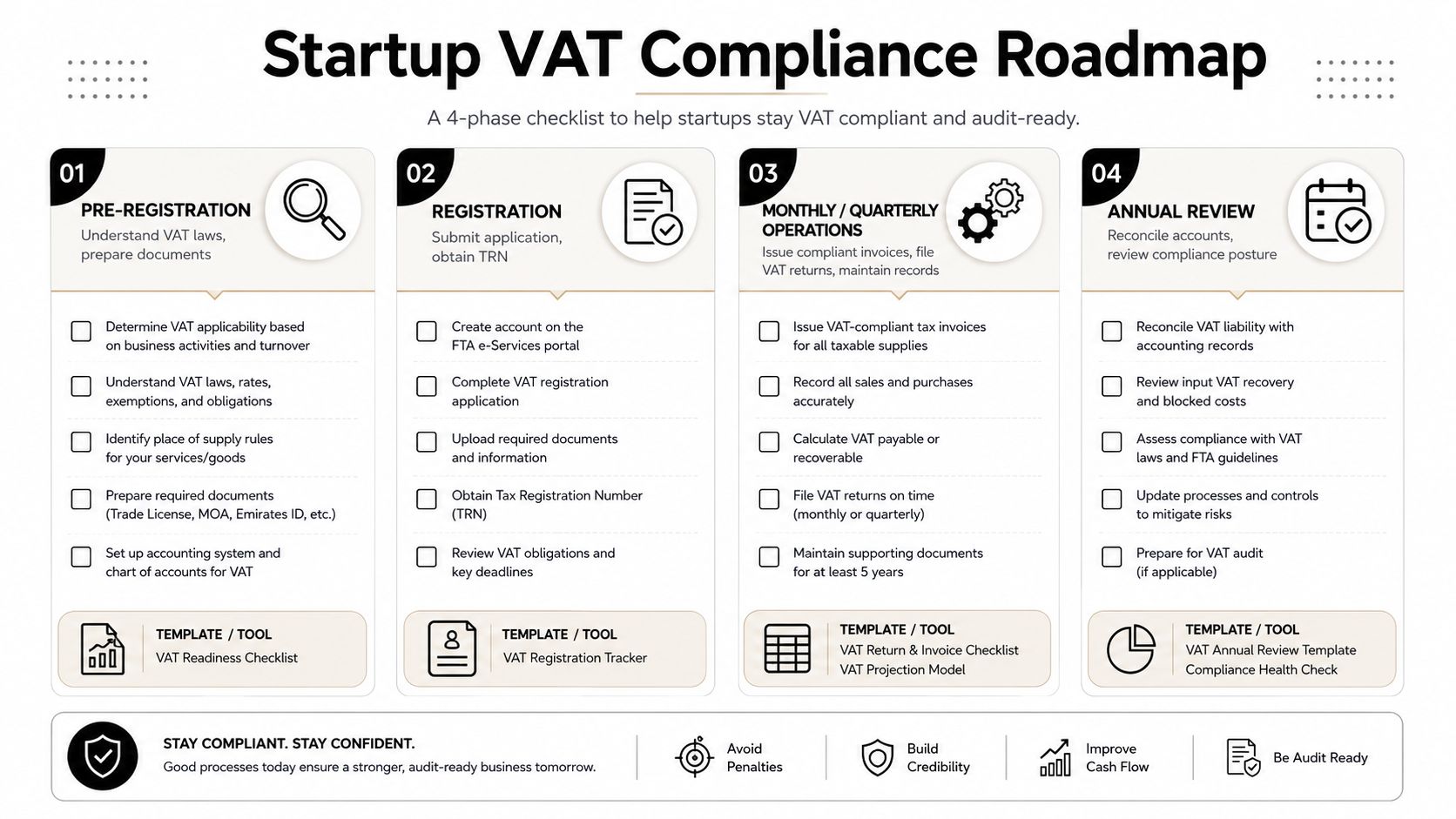
Pre-registration
Before anything is filed, make sure the business can answer basic VAT questions consistently.
- Build a turnover tracker: review rolling taxable supplies and imports, plus near-term expected contracts
- Prepare a document pack: trade licence, bank details, invoices or support for any projection-based case
- Map supply types: local sales, exports, free zone activity, and unusual contract structures should be identified early
Best next action: create one internal worksheet your founder, finance lead, and accountant all use. If three people are working from three revenue views, registration timing will drift.
Registration
Once the company decides to register, speed matters less than coherence.
- Use EmaraTax carefully: don't rush incomplete entries
- Align legal data: company name, licence details, and bank information should match cleanly
- Decide who owns follow-up: one person should monitor status, document requests, and final TRN issuance
Monthly or quarterly operations
At this juncture, most companies either become efficient or create recurring mess.
- Issue compliant invoices from one system
- Capture supplier invoices into a controlled repository
- Reconcile VAT ledgers before the filing week
- Keep an internal filing calendar with alerts before the deadline
Best next action: put a recurring finance task in your project management tool called “VAT close”, scheduled before filing week rather than on filing week.
Annual review
A startup can stay compliant and still run an inefficient VAT process. Annual review fixes that.
- Check old ledger coding for repeated mistakes
- Review zero-rated positions and supporting evidence
- Audit your invoice template and numbering logic
- Confirm your accountant and software setup still fit the current business model
If your revenue model changed during the year, don't assume last year's VAT workflow still fits this year's operations.
Quick Reference
Keep these numbers and reminders close to the finance calendar:
- Mandatory registration threshold: AED 375,000 in taxable supplies and imports over the previous 12 months, or if the business expects to cross it in the next 30 days, based on the earlier registration guidance
- Voluntary registration threshold: AED 187,500
- VAT rate: 5%
- TRN timeline: often 5 to 20 business days after a complete EmaraTax application
- Late registration penalty: starts at AED 10,000
- Return form: VAT 201
- Filing and payment deadline: 28th day of the month after the tax period
- Filing frequency: monthly above AED 10 million, quarterly otherwise
- Late filing penalties: AED 1,000 first time, AED 2,000 for repeat failures within 24 months
- Record retention: minimum five years
- Portal: EmaraTax portal
A TRN is issued as a unique 15-digit number, as noted in the earlier registration section.
If you want sharper founder-to-founder conversations around finance, compliance, hiring, and scaling in the UAE, Founder Connects is built for that. It's a practical community for founders who want relevant introductions, honest peer input, and consistent progress instead of generic networking.

Building in MENA? You don't have to do it alone.
Join 300+ founders in the Founder Connects Residency. Monthly squad calls, warm intros, $3M+ in perks, and much more. All for less than your monthly coffee budget.
Popular posts





Founder Connects is a premium MENA tech founder community. Meetups in Dubai and across MENA, Residency Squads of 8–10, and 400+ vetted WhatsApp founders (apply and screened).