

The Playbook vs Pitch Night: Founder Connects UAE Guide

Building in MENA? You don't have to do it alone.
Join 300+ founders in the Founder Connects Residency. Monthly squad calls, warm intros, $3M+ in perks, and much more. All for less than your monthly coffee budget.

You've got two Founder Connects Meetups on your calendar in Dubai. One offers a chance to tell your story and deliver a short pitch in front of the room. The other promises practical lessons from founders who've dealt with the same operating problems you're facing. Both sound useful. They don't create the same kind of progress.
The central question in The Playbook vs Pitch Night isn't which format attracts more attention. It's whether you need a validated experiment, sharper positioning, useful peer feedback, or investor follow-up. Exposure and applause can feel productive while leaving your business exactly where it was.
Why This Comparison Matters for UAE Founders
A founder in Dubai or Abu Dhabi can attend both formats within the same month and leave with completely different results. The Playbook might help you identify why your sales process has stalled, choose an experiment, and return to work with a clear operating decision. Pitch Night might reveal that people misunderstand your customer, problem, or request within the first few seconds of your pitch.
Neither outcome is automatically better. The value depends on the job you need the Meetup to do.
The UAE is an active venture market, but the capital environment has become more selective. UAE startups completed 134 funding rounds in the first nine months of 2024, representing 38% of all MENA rounds, while total UAE startup funding reached approximately USD 380 million, down 18% year over year. The same MAGNiTT MENA venture investment report recorded 352 MENA venture deals worth USD 1.316 billion during that period. More companies were raising, but each company had to communicate evidence and commercial logic more clearly.

The expensive mistake
Treating every Meetup as interchangeable wastes attention. A founder validating demand may need a protected discussion about customer interviews, pricing, or distribution. A founder preparing for fundraising may need to discover whether an unfamiliar listener understands the business before the pitch ends.
Practical rule: Choose the format according to the next decision your business must make, not according to the format that sounds more exciting.
This also affects how you present yourself. A founder attending a pitch-focused room needs clear visual communication, including a credible profile and professional presence. If your online presence is part of your follow-up, these professional headshot tips can help you improve the image investors and peers see after the Meetup.
Founder Connects runs Meetups across Dubai, Abu Dhabi, Nairobi, Beirut, and Cairo, with a community model built around peer learning, accountability, and practical support. The useful distinction is simple: The Playbook helps you work on the business; Pitch Night helps you test how quickly other people understand the business.
Understanding The Playbook And Pitch Night Formats
Pitch Night has a deliberately compressed structure. One founder shares a full story, then ten 60-second pitches are chosen at random, and the room votes. There are no prizes. That removes the incentive to optimise for a competition result and puts the emphasis on clarity, confidence, and the audience's immediate response.
Random selection changes the preparation burden. You can't rely on a carefully timed slot or assume you'll receive a long conversation on stage. Your opening must establish the company category, customer, problem, and proof point quickly. The room's vote can show which ideas attract attention, but it can't replace customer validation or investor diligence.
The Playbook has a different operating logic. Based on the Founder Connects Playbook Meetup, it is a free, bi-annual virtual format where founders share practical playbooks covering areas such as AI agents, lead generation, fundraising, and growth. The value comes from understanding how another founder approached a real business problem and deciding which part of that approach can be tested in your own company.
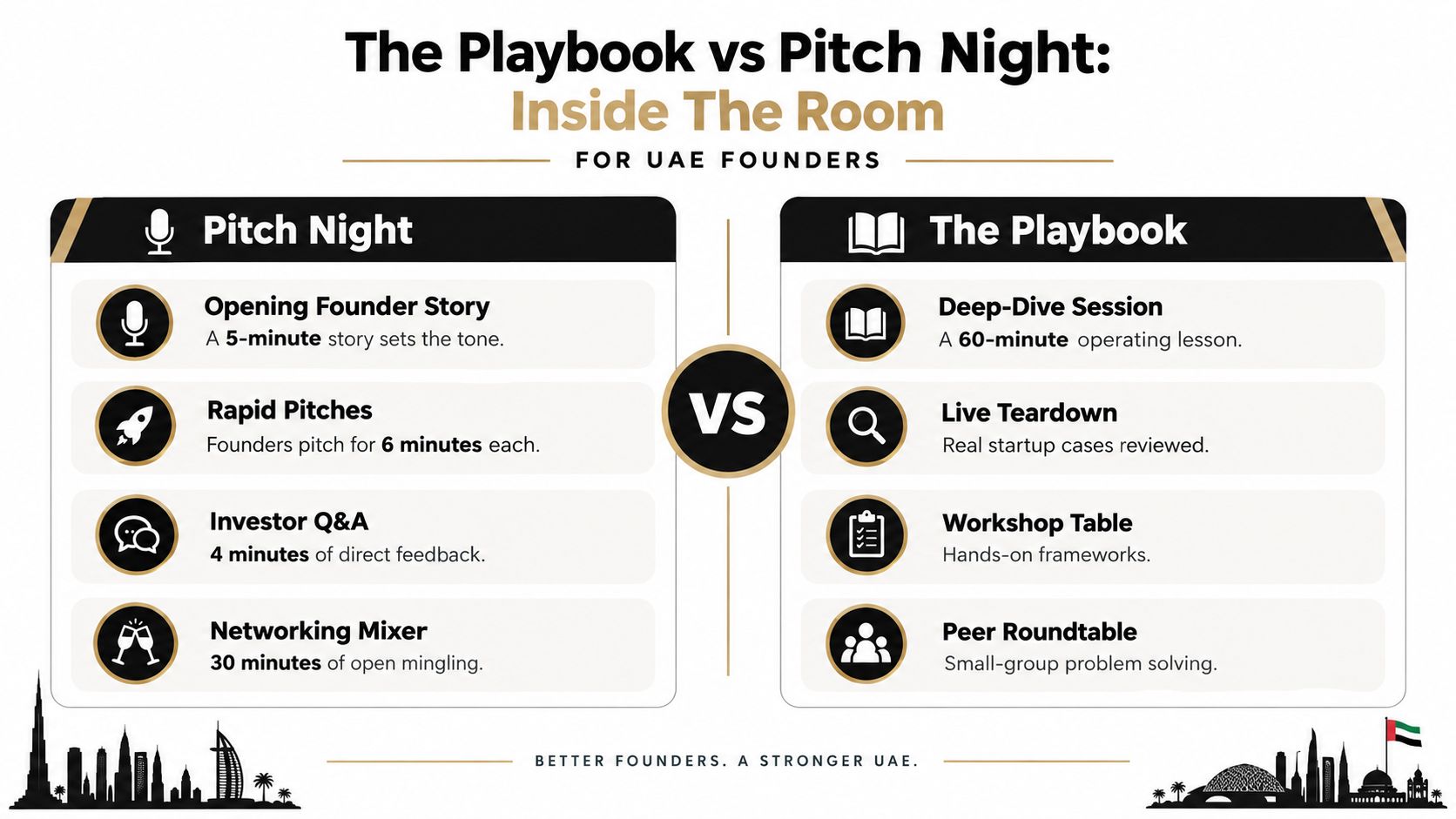
The two formats reward different behaviours
Pitch Night rewards compression. You need to choose the few facts that make the business intelligible and memorable. The Playbook rewards application. You need to listen for a useful operating principle, adapt it to your context, and leave with a defined action.
A simple way to frame the distinction is:
- Pitch Night: “Can people understand and respond to this business quickly?”
- The Playbook: “Can I turn someone else's operating lesson into a useful experiment?”
If you're refining a commercial motion, you may also find it useful to browse prospect playbooks for examples of how teams turn broad sales ideas into repeatable actions. That research is most useful when you bring a specific question to The Playbook rather than collecting frameworks without testing them.
Neither format guarantees investor introductions, funding, or customer contracts. The Playbook gives you a lower-pressure learning environment. Pitch Night gives you a public test of your narrative and an opportunity to observe how peers respond under time pressure.
Side-By-Side Comparison Across Five Decision Criteria
The choice becomes clearer when you judge both formats against the same five criteria. This prevents a founder from choosing Pitch Night only because fundraising is an eventual goal, or choosing The Playbook only because the founder feels nervous about presenting.
| Criteria | The Playbook | Pitch Night |
|---|---|---|
| Primary goal | Turn practical founder lessons into operating experiments | Test whether a business and its request are understood quickly |
| Ideal audience fit | Idea-stage founders, solo founders, and operators solving a specific problem | Founders refining positioning, seeking visibility, or preparing for investor conversations |
| Preparation depth required | Bring a defined challenge, relevant context, and a willingness to adapt ideas | Prepare a concise narrative, proof points, and a precise request |
| Expected outcome type | A clearer decision, experiment, or peer-supported action | Audience feedback, positioning insight, and possible follow-up conversations |
| Risk tolerance | Lower public exposure, useful for incomplete or sensitive ideas | Higher public exposure, useful when you can explain the business without disclosing confidential details |
Goal
Choose The Playbook when your immediate problem is operational. For example, you may have interviewed customers but still lack a repeatable acquisition process, or you may be deciding whether to prioritise partnerships, direct sales, or product-led discovery.
Choose Pitch Night when the question is communicative. Can a listener identify the customer and pain? Do they understand why your approach is different? Can they tell what you want from them?
Audience fit
The UAE ecosystem includes founders at very different stages. The UAE Ministry of Economy's GEM 2025/2026 results reported that more than 20% of adults were engaged in entrepreneurship, with a 19.2% Total Early-stage Entrepreneurial Activity rate. That broad pipeline means you can't assume every listener shares your vocabulary, sector knowledge, or fundraising context.
A Playbook discussion can absorb more background. Pitch Night exposes gaps in your explanation, which is valuable when you're ready to hear them.
Preparation and risk
The Playbook requires intellectual preparation. Pitch Night requires verbal preparation. A founder with confidential customer information can discuss the pattern, not the customer name, contract value, or sensitive implementation detail. Public pitching is still possible, but only if the disclosed version preserves enough substance to invite useful feedback.
Preparation And Follow-Up Checklists For Each Format
Preparation should produce an artefact you can use after the Meetup. For The Playbook, that artefact is an operating experiment. For Pitch Night, it's a concise narrative, a readiness scorecard, and a follow-up list.
The Playbook checklist
- Name the operating problem: Write three challenges, then select one. “Growth is hard” isn't specific enough. “Qualified leads stop responding after the first call” gives peers something concrete to examine.
- Bring evidence: Prepare your funnel, customer interview notes, sales messages, or onboarding flow. Don't bring every document. Bring the smallest set that helps others understand the decision.
- Define the desired output: Ask whether you need a hypothesis, a script, a prioritisation method, or a challenge to your current assumption.
- Set the experiment: Before you leave, write the action, owner, target audience, and observation that would change your mind.
- Follow up: Send a concise thank-you message within 24 hours, then record what you tested and what happened.
For Pitch Night, use the four-part 60-second structure:
- First 15 seconds: State the customer and painful problem.
- Next 20 seconds: Explain the product and what differentiates it.
- Next 15 seconds: Present one proof point, such as paid pilots, repeat usage, or a defensible technical capability.
- Final 10 seconds: Make a precise request, such as customer feedback, a pilot conversation, a hiring lead, or an investor conversation.
The five-field scorecard should cover customer traction, unit economics, regulatory status, milestone budget, and regional competition. A Dubai funding guide recommends a 10 to 14-slide deck, bottom-up MENA market sizing, sector-specific regulatory considerations, three-year projections with monthly detail for year one, milestone-linked use of funds, and a regional competitive overview. Use those materials for diligence preparation, not for cramming every detail into a 60-second pitch. See the Pitch Night Dubai guide for the format context, then keep your live version focused.
Sample follow-up agenda
- Before the Meetup: Record monthly recurring revenue, customer acquisition cost, retention, runway, and use-of-funds milestones where relevant.
- During the session: Capture the exact question or objection, not just the person's name.
- Afterward: Classify feedback as product, market, traction, team, or financing. Rewrite the relevant evidence and assign the next action.
For regional businesses, rewrite your final pitch sentence as an expansion hypothesis. Name the initial market, adjacent market, and reason the model can travel, then test that assumption with potential customers or operators.
Real-World Use Cases And Founder Scenarios
The most useful comparison is not theoretical. It starts with the founder's current constraint.
An idea-stage founder with a rough concept and a set of customer interviews should usually choose The Playbook. The immediate output should be a customer-discovery experiment, not a polished performance. Bring the strongest evidence that the problem exists, state what remains uncertain, and ask peers to challenge the proposed next step. Success means leaving with a narrower customer segment or a better test.
A fundraising-ready founder should consider Pitch Night when the pitch narrative needs external pressure. The Wamda 2025 MENA investment review reported $2 billion raised by UAE startups across 218 startups, including 162 early-stage companies securing $768.4 million. That mix of early and later-stage companies means a founder needs to make stage and evidence obvious. A short pitch shouldn't sound like a miniature investment memorandum. It should make the next conversation easy to start.
Four practical scenarios
- Solo founder with no accountability: Choose The Playbook if isolation is slowing decisions. Bring one unresolved operating question and ask a peer to hold you to a specific experiment.
- Founder seeking customer validation: Choose The Playbook when the idea is still changing. Protect sensitive details by describing the customer pattern and the decision you need to make.
- Founder testing fundraising positioning: Choose Pitch Night when you have enough evidence to explain the business publicly. Measure whether listeners repeat the problem, customer, and ask accurately.
- Scaling founder seeking investor warmups: Choose Pitch Night as a funnel experiment, not as proof of fundraising success. Track qualified investor conversations, follow-up requests, data-room requests, and meetings held within 30 days.
A UAE funding snapshot reported 240 venture deals and $1.5 billion deployed in the first half of 2025, with angel investment rising from $60 million to $85 million. The FounderFirst UAE startup funding trends analysis supports a practical split: early-stage founders should optimise for validation and angel or pre-seed conversations, while later-stage founders should show scalable metrics and institutional fit.
Don't judge either Meetup by applause. Record the baseline question, the action you took, and the follow-up that resulted.
How To Choose The Right Format For Your Stage
Use this decision path:
- Are you trying to solve an operating problem? Choose The Playbook. Bring one challenge and leave with one experiment.
- Are you trying to test whether people understand your business quickly? Choose Pitch Night. Prepare the 60-second structure and one precise request.
- Are you fundraising but still unclear on customer traction, unit economics, regulation, budget, or competition? Start with The Playbook or private preparation. Public pitching won't repair missing diligence evidence.
- Are the evidence and ask ready, but the narrative feels confusing? Choose Pitch Night and ask listeners to repeat what they heard.
- Are you protecting confidential information? Choose the lower-pressure learning format, or prepare a public version that removes customer-specific and commercially sensitive details.
The UAE and wider MENA market rewards regional clarity. Wamda reported that MENA startups raised $7.5 billion across 647 startups in 2025, while Saudi Arabia raised $5 billion and the UAE raised $2 billion. The Wamda regional funding analysis makes the strategic implication clear: don't assume the audience will infer how your UAE model expands. State the initial market, adjacent market, and distribution logic.
For a founder preparing investor follow-up, a stronger LinkedIn presence can support credibility after the room has forgotten the pitch. This guide to how to master LinkedIn for your startup is useful when you're turning a Meetup conversation into a considered second interaction.
Book The Playbook when you need clarity before exposure. Book Pitch Night when you need feedback through exposure. You can use both at different stages, but don't attend either without a measurable next action.
Frequently Asked Questions For Hesitant Founders
Do I need paying customers before attending?
No. An idea-stage founder can attend The Playbook with a clearly stated assumption and a customer-discovery question. Pitch Night is also possible before revenue, but you'll need to label what is validated, what is inferred, and what remains untested.
How can I ask for feedback without revealing confidential information?
Describe the customer problem, workflow, and decision without naming the customer or disclosing sensitive pricing, contracts, source code, or proprietary implementation details. Ask for feedback on the assumption, not access to the confidential material.
What happens if my Pitch Night pitch isn't selected?
You still get a useful preparation test. If you can explain the business clearly in 60 seconds, you're better prepared for corridor conversations and follow-up calls. Use the time to listen for repeated language and identify which questions the selected founders struggle to answer.
Does pitching automatically prepare me for investors?
No. Pitching tests communication and public response. Investor readiness also requires evidence across traction, unit economics, regulatory status, milestone budget, and competition. Use the Founder Connects guide to better startup pitches to improve delivery, then prepare the underlying diligence materials separately.
How do I know whether the Meetup produced real progress?
Write down the intended outcome before attending. Afterward, count validated experiments, qualified follow-ups, requested materials, and meetings held. If the only result is that people liked the idea, you learned something about attention, not necessarily about demand.
Founder Connects offers practical Playbook sessions, Pitch Night Meetups, and a peer community for founders working through validation, fundraising, and growth across the UAE and wider MENA ecosystem. Choose the format that matches your next business decision, then visit Founder Connects to book a Meetup and turn the conversation into a measurable next step.

Building in MENA? You don't have to do it alone.
Join 300+ founders in the Founder Connects Residency. Monthly squad calls, warm intros, $3M+ in perks, and much more. All for less than your monthly coffee budget.
Popular posts





Founder Connects is a premium MENA tech founder community. Meetups in Dubai and across MENA, Residency Squads of 8–10, and 400+ vetted WhatsApp founders (apply and screened).