

UAE Mainland vs Free Zone Company Formation: Founder's Guide

Building in MENA? You don't have to do it alone.
Join 300+ founders in the Founder Connects Residency. Monthly squad calls, warm intros, $3M+ in perks, and much more. All for less than your monthly coffee budget.

You've validated the idea. You've spoken to a few customers. You're ready to issue invoices, open a bank account, and hire your first person.
Then the setup question stops everything.
Every founder in the UAE hits the same fork in the road: Mainland or Free Zone. One advisor says Free Zone is faster and cheaper. Another says Mainland is the only serious option if you want to scale. Both are partly right. Both usually leave out the operational mess you'll deal with later.
The First Big Decision for Your UAE Startup
Most founders start with the same instinct: choose Free Zone, keep costs low, move fast, and figure out the rest later. That instinct isn't random. According to 2025 data, free zones now constitute approximately 41% of all new business registrations in the UAE, which tells you this is no longer a niche route. It's become a default starting point for a large share of founders entering the market.
That popularity makes sense. Free zones are designed to feel frictionless at the setup stage. The problem is that setup convenience and operating fit are not the same thing.
I've seen founders pick the “easy” structure, only to realise six months later that their actual customers are in Dubai, Abu Dhabi, or Sharjah mainland, not overseas. At that point, the decision stops being administrative and becomes commercial. Your licence structure starts shaping who you can sell to, how you invoice, what margin you keep, and how much operational complexity you absorb.
The best UAE setup choice isn't the one that gets you licensed fastest. It's the one that matches how revenue will actually flow.
That's why this decision belongs inside your wider budgeting and runway model, not on an admin checklist. If you're still building that thinking out, a solid founder's guide to financial planning is a useful companion because entity choice affects far more than registration cost.
This guide cuts past brochure language. It deals with the practicalities of UAE Mainland vs Free Zone company formation: trade access, office rules, visa implications, tax treatment, hidden compliance costs, and the expensive mistake founders make when they choose a Free Zone by default and only later discover they needed Mainland all along.
Mainland and Free Zone Explained At a Glance
If you only remember one thing, remember this: Mainland gives you direct access to the UAE market. Free Zone gives you a leaner operating base, but with limits on how you sell locally.
| Factor | Mainland | Free Zone |
|---|---|---|
| Licensing authority | Emirate DED or equivalent economic department | Specific Free Zone authority |
| Trade scope | Broad access across the UAE domestic market | Operates within the zone and internationally |
| Office model | Physical office required | Often flexible, including virtual options in many zones |
| Tax position | Standard corporate tax framework applies | May qualify for 0% on qualifying income if conditions are met |
| Best fit | Local trading, retail, government work, broad UAE sales | Digital businesses, global services, lean international setups |

What a Mainland company actually means
Mainland company
Licensed by the local Department of Economic Development. It can operate across the UAE market and is the right structure when your business needs direct local commercial access.
A Mainland setup is usually the practical choice when the business lives on the ground in the UAE. Think retail, food and beverage, logistics, local services, clinics, salons, agencies selling to UAE clients, or any company planning to bid for government work.
What a Free Zone company actually means
Free Zone company
Licensed by a Free Zone authority. It gives founders a more contained setup environment, often with simpler setup mechanics and a stronger fit for international trade, digital services, and remote-first teams.
This is why Free Zones became the entry point for so many founders. They work well when your customers are outside the UAE, your team is lean, and you don't need unrestricted local market access on day one.
The trade-off that matters
The mistake is treating this as a prestige choice. It's an operating model choice.
- Choose Mainland when your sales motion depends on the UAE domestic market.
- Choose Free Zone when your business can operate cleanly without direct Mainland trading.
- Pause the decision if you're telling yourself, “We'll start global, but UAE local sales will probably become important soon.” That's where founders walk into avoidable complexity.
A lot of generic content frames this as freedom versus cost. In practice, it's revenue design versus operating overhead. Founders who get that early usually make cleaner decisions.
Comparing Key Operational and Structural Factors
The setup brochures usually focus on speed and headline pricing. Founders need to look at what the structure allows once the business is live.
Trade licence scope
This is the first question to settle. Not tax. Not branding. Where can the company legally earn revenue?
- Mainland suits founders who need to sell directly across the UAE. You can serve customers in any emirate without building workarounds into the sales process.
- Free Zone works when your activity stays within the zone or is aimed at international customers. If your sales model later shifts toward UAE domestic buyers, the structure becomes more restrictive.
That's the issue many first-time founders miss. A licence isn't just paperwork. It defines commercial reach.
Practical rule: If your core plan depends on direct invoicing to UAE local customers, treat Mainland as the default unless you have a very clear reason not to.
Office requirements
The difference quickly becomes tangible.
All mainland companies in the UAE must secure a minimum of 200 square feet of physical office space to obtain a trade licence, while many free zones like UAQFTZ allow virtual or remote workplaces with no physical office requirement, which is why digital businesses often start in a zone-based structure according to UAQFTZ's comparison of free zone and mainland licences.
For founders, that changes the first-year setup experience:
- Mainland means you're planning around a lease from the beginning.
- Free Zone can let you stay lean with a flexi-desk, shared desk, or remote structure depending on the zone.
- Remote-first teams usually feel this difference immediately because office overhead hits before revenue is predictable.
If you're comparing specific zones for a software or digital services business, this UAE free zones comparison for tech startups is a useful shortcut.
Visa allocation
Visa discussions often get reduced to “how many visas do I get?” The better question is: what staffing model are you building?
In practice:
- Mainland visas are tied more directly to your office footprint and operating substance.
- Free Zone visas depend on the package and rules of that specific zone.
- Small founding teams may not feel the difference early.
- Hiring-heavy businesses usually do.
If your plan includes sales staff, operations hires, warehouse support, or on-the-ground account managers, don't leave visa capacity as an afterthought. Ask for written clarity before signing anything.
Ownership and legal reality
The old ownership conversation has changed. Post-reform, founders can obtain 100% foreign ownership in most commercial sectors in both structures. That means the actual comparison today is less about shareholding optics and more about operational rights.
What still matters:
- Mainland gives broader local trading access.
- Free Zone often gives a cleaner launch path.
- Specific activities can still have their own licensing nuances, so founders should confirm the exact activity code rather than relying on general advice.
What works and what doesn't
What works:
- Match the setup to the first two years of revenue, not to a vague five-year plan.
- Choose based on sales geography, not setup convenience.
- Stress-test your licence against your hiring and office model before committing.
What doesn't:
- Starting in a Free Zone because everyone else did.
- Assuming a digital business won't need local UAE revenue.
- Treating visa allocation and office requirements as admin details.
That's where founders create friction they didn't budget for.
The Critical Breakdown of Tax and Costs
Tax and setup cost are usually the reasons founders lean Free Zone. That's fair. But this is also where generic comparisons become dangerously incomplete.
Tax treatment
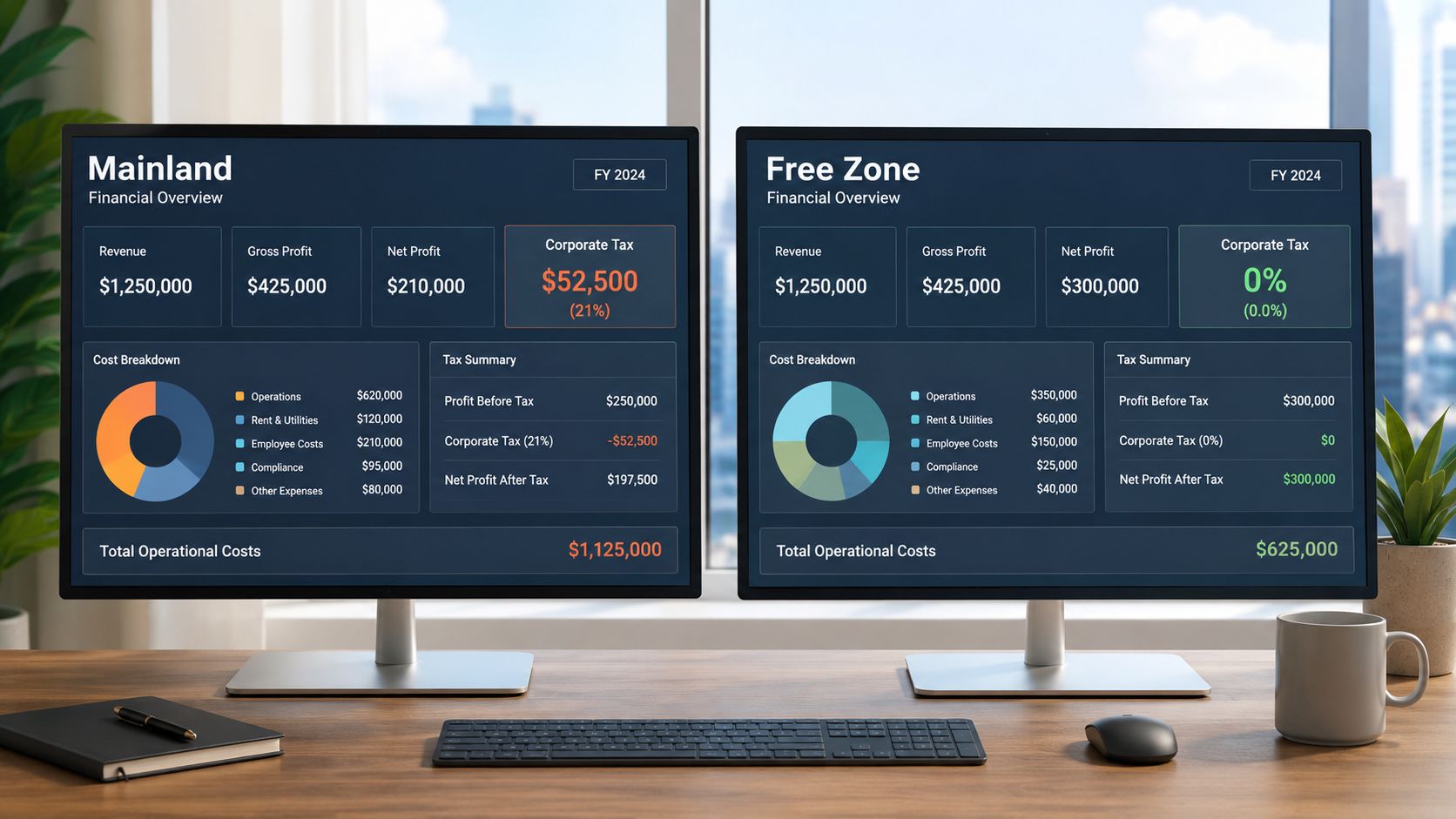
Mainland companies in the UAE are subject to a 9% corporate tax rate on profits exceeding AED 375,000 annually, while Free Zone companies can qualify for a 0% tax rate on qualifying income if they meet the Qualifying Free Zone Person criteria, including eligible activities, adequate substance, and avoiding the wrong kind of Mainland income, as outlined in this breakdown of Mainland vs Free Zone tax treatment in the UAE.
That sounds straightforward until founders hear “0%” and assume the structure is automatically tax-free. It isn't. The benefit depends on how the company earns money.
For startup teams trying to map that properly, this guide to UAE corporate tax for startups explained is worth reviewing before you lock your entity structure.
A Free Zone setup only works as a tax strategy if your operations stay aligned with the rules that protect that status.
If you've compared tax structures in other jurisdictions before, the logic is familiar. The mechanics differ, but the principle is the same. Structure follows revenue model. Founders who've looked at resources like compare business tax options Australia will recognise the same pattern: legal form changes tax outcome, but only when the commercial reality fits the structure.
Setup cost and renewal cost
The sticker-price gap is real. Free Zone companies can be established in days, or as quickly as 60 minutes with providers like Meydan Free Zone, while Mainland setups often take weeks. On cost, Free Zone basic packages range from AED 12,000 to 25,000 annually, while Mainland incorporation requires a mandatory physical office lease of AED 20,000 to 80,000 per year minimum and total initial setup costs of AED 15,000 to 30,000+, making Free Zones 30% to 50% more cost-effective for early-stage founders according to Meydan Free Zone's setup comparison.
That's why early-stage founders choose Free Zone so often. The upfront maths usually does favour it.
The hidden cost founders discover later
The problem starts when a founder picks Free Zone for tax and low setup cost, then later needs direct Mainland sales.
According to this analysis of the Free Zone versus Mainland trade-off, Free Zone companies that need access to the UAE Mainland typically require a local distributor or agent, which can create 15% to 20% revenue leakage via distributor margins. The same source notes there is no direct conversion mechanism from Free Zone to Mainland, and many founders end up paying for a second setup, often around AED 25,000 to 30,000, to build a parallel Mainland LLC.
That's the dual-entity trap.
A founder starts lean in a Free Zone. Sales traction appears in the local market. Suddenly, one entity no longer fits the business. Instead of graduating smoothly, the company adds legal complexity, duplicate administration, and more cash burn.
This short video is useful if you want to visualise how these structural choices affect actual business economics over time.
A Founder's Flowchart for Making the Right Choice
The fastest way to make this decision is to start from your revenue path, not from setup offers.

Use this decision sequence
Ask these questions in order:
Will most of your paying customers be inside the UAE?
If yes, lean Mainland. Direct local sales are usually the deciding factor.Do you need to bid on government contracts or operate in regulated local sectors?
If yes, Mainland is usually the cleaner route.Is your business digital, export-led, or aimed at clients outside the UAE?
If yes, a Free Zone often gives you a simpler launch structure.Can you operate without direct Mainland invoicing for the foreseeable future?
If no, be careful. That answer often means the cheap setup will become expensive later.
The founder version of the logic
A good flowchart should remove false options.
- Mainland wins when local access is not optional.
- Free Zone wins when local access is unnecessary and lean operations matter more.
- Hybrid thinking matters when you know local UAE revenue is likely, but not immediate.
If local demand is part of the plan, even loosely, model the cost of future restructuring before you choose the cheaper setup.
Business type guide
Here's a simple way to translate that into decision-making:
| Business type | Likely fit | Why |
|---|---|---|
| Global SaaS or software services | Free Zone | International clients and lean overhead usually matter most |
| Local e-commerce selling into the UAE | Mainland | Domestic customer access drives the business |
| Consultancy with mixed UAE and overseas clients | Depends | Choose based on where invoices will actually come from |
| Retail, restaurant, salon, clinic | Mainland | Physical presence and local footfall make direct market access essential |
If you're unsure, don't ask “Which setup is better?” Ask: Where will the next 20 invoices come from? That answer usually points to the right structure faster than any sales deck.
Which Setup Wins for Your Business Model
Abstract comparisons are useful. Real business models make the decision clearer.

SaaS startup serving global clients
Winner: Free Zone
If you're building software, selling subscriptions, and signing clients outside the UAE, a Free Zone is often the cleanest fit. You usually care more about a lean operating base, quick setup, and keeping overhead low while product and revenue are still stabilising.
This is especially true when the team is small and remote-first.
E-commerce business selling physical goods locally
Winner: Mainland
If your business depends on direct local sales inside the UAE, Mainland usually saves pain later. The setup may feel heavier, but it aligns with the actual commercial model from the start.
Many founders often make the wrong call by choosing a Free Zone because it's cheaper at incorporation. If local fulfilment and local customer acquisition are central, the “cheap” structure often stops being cheap.
Consultant or service provider
This one depends on client mix.
- Mostly overseas clients: Free Zone often works well.
- Mostly UAE corporates: Mainland is usually cleaner.
- Mixed book of business: model your likely invoice mix before deciding.
A solo consultant can often start lean. But if you expect enterprise contracts, in-person delivery, or a sales push into the UAE market, don't assume your first structure will carry you comfortably.
Physical retail, restaurant, or customer-facing venue
Winner: Mainland
These businesses need direct local operating rights, physical presence, staff movement, and broad market access. There's usually no practical advantage in forcing a Free Zone structure onto a business that lives in the domestic market.
For founders trying to estimate early setup expectations, this overview of business setup in Dubai Free Zone cost 2026 can still be helpful as a reference point for what the lower-cost path looks like before comparing it against your actual business model.
One operational test that helps
Write down the next three things your business must do after incorporation.
Maybe that's:
- Invoice UAE clients directly
- Hire two staff and sponsor visas
- Open a customer-facing site
Or maybe it's:
- Bill overseas clients
- Operate remotely
- Keep admin light while testing demand
That list will usually tell you more than any generic comparison page. If you want founder-to-founder perspective while pressure-testing that choice, Founder Connects is one option founders use for peer discussion and practical decision support in the UAE ecosystem.
Founder FAQs on Mainland vs Free Zone
Can you convert a Free Zone company into a Mainland company later?
Usually, not in a simple direct way. In practice, founders often end up setting up a separate Mainland entity when the business outgrows the original Free Zone structure. That's why “we'll just switch later” is weak planning.
Is Free Zone compliance really simpler?
Not always. A 2026 mandate requires all Free Zone entities to undergo mandatory annual audits to qualify for the 0% Corporate Tax rate, creating a hidden administrative cost of AED 10,000 to 15,000 annually even for small startups, according to this review of Mainland vs Free Zone audit requirements. Tax-efficient doesn't mean admin-light.
Does entity choice affect fundraising?
It can. Investors usually care less about the logo on the licence and more about whether the structure fits the business model, cap table, and future scale path. What raises concern is a mismatch. For example, a company targeting heavy local UAE expansion but trapped in a restrictive operating structure.
What should you do next?
Answer three questions with your co-founder or finance lead today:
- Where will revenue come from first?
- Will we need direct UAE market access soon?
- Are we choosing low setup cost, or long-term fit?
If you answer those truthfully, the right structure usually becomes obvious.
If you're working through this decision and want grounded founder input, Founder Connects gives UAE and MENA founders a place to test assumptions, compare real setup experiences, and get practical feedback from peers who are building through the same choices.

Building in MENA? You don't have to do it alone.
Join 300+ founders in the Founder Connects Residency. Monthly squad calls, warm intros, $3M+ in perks, and much more. All for less than your monthly coffee budget.
Popular posts





Founder Connects is a premium MENA tech founder community. Meetups in Dubai and across MENA, Residency Squads of 8–10, and 400+ vetted WhatsApp founders (apply and screened).