

How UAE SpaceTech Startups Secure Funding

Building in MENA? You don't have to do it alone.
Join 300+ founders in the Founder Connects Residency. Monthly squad calls, warm intros, $3M+ in perks, and much more. All for less than your monthly coffee budget.

The UAE's space sector has seen AED 44 billion in investments, according to the latest UAE startup news, creating opportunities for startups. However, securing funding in this field comes with challenges like high costs, long timelines, and strict regulations. Here’s what you need to know:
- Funding Sources: Around 70% of funding comes from sovereign-linked programs (e.g., ADIO, Mubadala, Hub71), which often require local job creation, R&D hubs, or founder relocation to the UAE.
- Private Capital: Investors like BECO Capital and Wamda Capital collaborate with international VCs and sovereign funds to support SpaceTech startups.
- Government Programs: Initiatives like the UAE National Space Fund (AED 3 billion), MBRIF accelerator, and Space Economic Zones offer grants, facilities, and tax benefits.
- Key Metrics: Investors prioritize local R&D, job creation, and alignment with UAE’s National Space Strategy 2030.
- Startup Success: Examples include Farmin, which secured AED 1.1 million, and Orbitworks, which reduced satellite production costs by 40%.
To succeed, startups must combine government and private funding, align with UAE space goals, and leverage resources like accelerators and economic zones.
The UAE SpaceTech Funding Landscape
Funding for SpaceTech in the UAE comes from a mix of sources - government programmes, private investments, and international institutional backing. Understanding how each contributes can help startups create a smarter funding strategy.
Government Support and Funding Programmes
The UAE government plays a key role in shaping the SpaceTech sector through targeted initiatives and financial backing. Under the National Space Strategy 2030, the UAE has committed over AED 22 billion to support the industry [7]. Several specific programmes fall under this strategy:
- The UAE NewSpace Innovation Program offers a three-month accelerator programme along with AED 2 million in funding [1].
- The Mohammed Bin Rashid Innovation Fund (MBRIF) provides up to AED 5 million in financing for innovative projects [9].
For example, in May 2024, UAE-based remote-sensing startup Farmin secured AED 1.1 million after participating in the MBRIF Innovation Accelerator [8].
"At MBRIF, we believe partnerships are crucial to the development of the innovation ecosystem. Our collaboration with AzurX is a strategic move to enhance the impact and reach of innovative endeavours within the space sector." - Fatima Yousif Alnaqbi, Acting Assistant Undersecretary for Support Services Sector and Chief Innovation Officer, UAE Ministry of Finance [8]
Additional opportunities include the MBRSC Space Ventures launchpad and the MBRSC Research Grant Programme, which funds scientific testing for up to two years [1]. For hardware-focused startups, the Space Economic Zones, facilitated by the Abu Dhabi Investment Office, offer tax breaks and fast-tracked licensing to help reduce initial costs [7].
Private Capital Options for SpaceTech Startups
In addition to government funding, private capital offers another route for SpaceTech startups to thrive. UAE investors, including BECO Capital and Wamda Capital, often take a strategic approach, focusing on promising opportunities [5]. A hybrid funding model is commonly used: a lead investor from the US or Europe sets the valuation and terms, a GCC-based fund joins the syndicate, and a sovereign-linked programme like Hub71 or ADIO contributes non-dilutive funding to extend the startup’s financial runway [5]. This approach works particularly well for deep-tech and SpaceTech ventures, where long development timelines can complicate traditional equity funding.
Choosing the right jurisdiction is also critical for attracting private investment. Registering in the DIFC or ADGM is highly recommended for startups targeting institutional investors. Both operate under English common law and support standard financing instruments like SAFEs and convertible notes [10]. While the DIFC is often viewed as having stronger credibility with international investors, the ADGM offers a more flexible SPV framework, ideal for managing complex cap tables [10].
By combining public and private funding options, SpaceTech startups in the UAE can navigate the journey from concept to launch more effectively.
Using Community Platforms to Gain Investor Visibility
Beyond structured funding sources, community engagement plays a vital role in gaining investor attention. In the Gulf region, personal introductions often carry more weight than cold outreach. Platforms like Founder Connects bridge this gap by offering UAE founders access to curated investor lists, live talks, exclusive events, and virtual masterminds. These resources can open doors that cold emails rarely do.
sbb-itb-f597d8f
How to Build an Investor-Ready SpaceTech Case
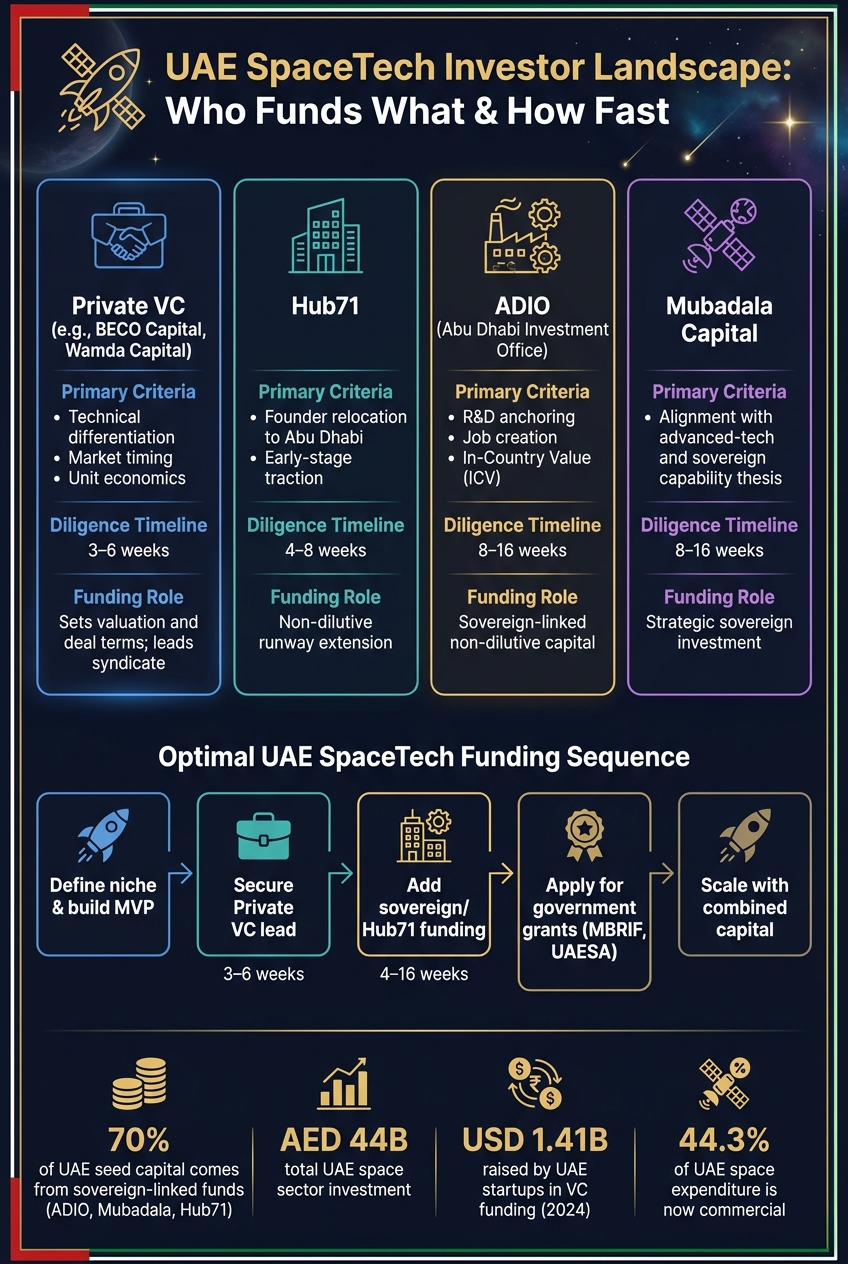
UAE SpaceTech Investor Types: Criteria, Timeline & Funding Sources
Finding Your Position in the SpaceTech Value Chain
Start by pinpointing your niche within the SpaceTech value chain. Today’s investment trends lean heavily towards downstream applications like software, AI-powered analytics, and Earth Observation (EO) services, rather than focusing solely on hardware or launch technologies [1][4]. In the UAE, areas such as geospatial data processing, satellite communications for remote infrastructure, and solutions tailored to harsh environments are particularly in demand [1].
"The nature of what the UAE sends to space has changed from sharing food to manufacturing electronic boxes." - Hazza Al Mansoori, UAE Astronaut [12]
Your niche and technical advantage must be clearly defined. For instance, if your startup specialises in processing SAR satellite data for agricultural or urban planning, highlight how your approach stands out from existing solutions. A functional MVP or an early-stage proof-of-concept will resonate far more with investors than a theoretical concept deck [11].
Once your niche is established, align your financial projections to reflect this strategic focus.
Setting Realistic Financial Projections and Funding Needs
In the UAE, financial projections are evaluated differently, particularly by sovereign-linked investors. Approximately 70% of seed capital in the UAE comes from sovereign funds like ADIO, Mubadala, and Hub71, meaning your financial plans must emphasise strategic value alongside commercial potential [5].
Investors in the region are particularly focused on metrics like high-skilled job creation, local R&D efforts, and In-Country Value (ICV). These metrics are key indicators for government-linked investors [13].
A typical funding sequence in UAE SpaceTech involves private VCs - such as BECO Capital or Wamda Capital - leading the valuation and terms, followed by sovereign-backed funds like Hub71 or ADIO extending additional runway [5]. Sovereign entities like ADIO often require longer diligence periods (8–16 weeks) compared to private VCs (3–6 weeks), so securing a private VC lead first is a smart strategy [5].
"In 2026, the UAE seed rounds that close in under 90 days all share one trait: a private VC lead already signed before the sovereign money entered the conversation." - Causo Hub [5]
Plan your funding in phases, with milestones tied to technical validation, securing government contracts or Letters of Intent (LOIs), and eventual commercialisation. Investors expect you to achieve meaningful progress with less capital, making efficiency a critical factor in this resource-intensive sector [11].
With financial goals in place, ensure your startup aligns with the UAE’s national space objectives.
Aligning Your Startup with UAE Space Goals
The UAE’s National Space Strategy 2030 serves as both a guide for procurement and a roadmap for investments. The UAE Space Agency has committed to allocating at least 50% of mission work to private companies [4], offering direct revenue opportunities for startups that position themselves as execution partners for these national initiatives.
Prominent focus areas include Earth observation, satellite communications, and support for deep-space exploration [4][3]. Your pitch should clearly illustrate how your startup contributes to these strategic priorities, as sovereign investors like ADIO and Mubadala assess portfolios based on their alignment with national goals [5].
Localisation is another critical factor. The UAE is actively transitioning from importing space technologies to fostering domestic expertise. Take the MBZ-SAT satellite as an example - 90% of its mechanical components were sourced from UAE-based companies [12]. Startups that showcase plans for local manufacturing, Emirati workforce development, or knowledge transfer will stand out during investor discussions.
By integrating the UAE’s national space priorities into your business strategy, you’ll not only validate your commercial potential but also demonstrate strategic alignment - key factors for attracting both sovereign and private investment.
| Investor Type | Primary Evaluation Criteria | Typical Diligence Timeline |
|---|---|---|
| Private VC (e.g., BECO, Wamda) | Technical differentiation, market timing, unit economics | 3–6 weeks |
| Hub71 | Founder relocation to Abu Dhabi, early-stage traction | 4–8 weeks |
| ADIO | R&D anchoring, job creation, ICV contribution | 8–16 weeks |
| Mubadala Capital | Alignment with advanced-tech and sovereign capability thesis | 8–16 weeks |
How to Apply for UAE Government Grants and Programs
Key Government Bodies and Programs to Know
When it comes to SpaceTech funding in the UAE, two organisations take the lead. The UAE Space Agency (UAESA) oversees the sector, coordinates initiatives, and manages the AED 3 billion National Space Fund, which aims to build infrastructure and attract startups [2][14]. Meanwhile, the Mohammed Bin Rashid Space Centre (MBRSC) is responsible for implementing missions and runs the Space Ventures accelerator. This programme offers startups access to laboratory facilities valued at AED 8 million annually [2].
In addition to these, the Mohammed Bin Rashid Innovation Fund (MBRIF), operated by the Ministry of Finance, offers a six-month accelerator programme providing resources, mentorship, and connections to investors [8]. For Emirati founders, the UAE NewSpace Innovation Program delivers a three-month initiative that includes AED 2 million in direct funding [1]. Startups in the early technical validation stage should also consider the MBRSC Research Grant Programme, which funds scientific testing for up to two years [1].
| Programme | Operator | Key Benefit |
|---|---|---|
| National Space Fund | UAESA | AED 3 billion for priority space projects [2][14] |
| Space Ventures Accelerator | MBRSC | Labs, regulatory coaching, investor exposure [2] |
| NewSpace Innovation Program | UAESA | AED 2 million for Emirati startups [1] |
| MBRSC Research Grant | MBRSC | Up to two years of scientific testing funding [1] |
| MBRIF Innovation Accelerator | Ministry of Finance | Six-month programme with resources and mentorship [8] |
These programmes and institutions provide a strong foundation for funding. The next step is creating a grant application that aligns with UAE priorities.
What Makes a Strong Grant Application
Tailoring your application to align with the UAE's national goals is critical. Proposals that address priorities like space-enabled food security, climate resilience, or the digital economy tend to receive faster reviews [2]. If your project ties into the Emirates Mission to the Asteroid Belt (EMA), it’s worth noting that UAESA has committed to allocating at least 50% of the total contractual value of the EMA to private sector businesses, with over 30 specific opportunities available [14].
Before submitting any application, securing a No Objection Certificate (NOC) from UAESA is an essential first step. This process typically takes one to two months and demonstrates your credibility, which can help speed up approvals later on [2]. Your application should include:
- Clear technical objectives
- Defined milestones
- Orbital debris mitigation plans
- Evidence of radio-frequency coordination
All of this should be presented in one cohesive document. Building a technical alliance with organisations like MBRSC, Bayanat, or UAE University can also strengthen your submission [2].
The MBRIF accelerator has already proven its value. For instance, Farmin, a startup specialising in remote sensing with satellite imagery and AI, participated in the programme and went on to secure over AED 1.1 million in contracts with MBRSC and Abu Dhabi Ports [8].
Making Use of Space Economic Zones and Incubators
Beyond grants, specialised zones and incubators can help streamline your startup’s growth. Registering in the Masdar City Space Economic Zone offers several benefits, such as 100% foreign ownership, corporate tax exemptions until 2073, and expedited visa processing [2]. These advantages not only reduce costs but also demonstrate your operational commitment to government evaluators.
The MBRSC Space Ventures programme provides startups with access to ISO-8 clean rooms, EMI chambers, and regulatory officers who assist with ITU filings and export-control requirements [2]. This level of lab and regulatory support is a key strength of the UAE's SpaceTech ecosystem. Startups participating in MBRSC programmes have collectively raised over USD 110 million in matched equity [2]. For hardware-focused businesses, the Trial Licence option offers lower fees and can cut up to two years off the product-to-market timeline for proof-of-concept demonstrations [2].
"The UAE now offers one of the clearest routes from start-up to orbit anywhere in the world." - Virtuzone [2]
Examples like SAR-Sat-Arabia highlight how this system works in practice. The startup secured funding and support after being selected for the UAE Space Agency's NewSpace Innovation Program [1]. Another success story is Orbitworks, a joint venture between Marlan Aerospace and Loft Orbital. By establishing an automated satellite assembly line in Abu Dhabi, Orbitworks now produces up to 50 satellites annually and has reduced engineering costs by 40%, thanks to the UAE’s advanced infrastructure [2].
Conclusion: Funding Strategies for UAE SpaceTech Startups
In the UAE's SpaceTech sector, successful funding strategies require a layered approach. No single source of funding - whether it’s government grants, venture capital, or family office investments - can fully support a startup's journey. The most agile startups are those that combine these resources strategically: leveraging government programmes to mitigate early risks and using that foundation to attract private investors.
The numbers speak for themselves. Commercial spending now makes up 44.3% of the UAE's total space sector expenditure [3][4], and UAE startups secured USD 1.41 billion in venture capital in 2024 alone [6]. This marks a pivotal shift, with private-sector initiatives gaining traction alongside government-led projects. For founders ready to seize the moment, this momentum offers a wealth of opportunities, underscoring the importance of a multi-layered funding strategy.
"One thing that the satellite and space industry just needs is money, and the UAE has shown that they can unite funding in a very meaningful way." - Dallas Kasaboski, Principal Analyst, Analysys Mason [4]
Location matters. Registering in hubs like ADGM or DIFC enhances credibility with institutional investors, while operating within a Space Economic Zone reduces costs and streamlines regulatory processes. These early structural decisions can significantly simplify future funding discussions.
Building strong relationships also plays a key role in securing funding in the UAE. Warm introductions through accelerators, events like GITEX, or platforms such as Founder Connects often yield better results than cold outreach. Founder Connects, for instance, provides UAE entrepreneurs with access to a curated investor database, peer networks, and tailored introductions - helping founders gain the visibility they need to attract the right investors at the right time.
FAQs
What do UAE sovereign-linked funders prioritise first?
Startups in the UAE looking for support from sovereign-linked funds and government-backed initiatives need to focus on showcasing a clear problem-solution fit and a scalable minimum viable product. These programmes prioritise businesses that present a compelling investment case, emphasising growth potential, market opportunities, and compliance with the UAE’s regulatory environment.
Founders can strengthen their position by validating their business models through venture-building programmes. It's also essential to demonstrate how their ventures contribute to the UAE’s economic diversification goals. For example, industries like satellite manufacturing or downstream data processing are highly aligned with these objectives.
Should I register in ADGM or DIFC to raise funding?
Choosing between ADGM and DIFC comes down to your industry and long-term goals.
ADGM works best for regulated businesses, investment funds, and deep-tech startups, especially those that align with Abu Dhabi's focus on national assets and innovation. On the other hand, DIFC is a great fit for fintech and financial services, giving you access to Dubai's dynamic financial ecosystem.
The key is to pick the jurisdiction that matches your product's sector and funding objectives to ensure smoother alignment with potential investors.
How do I combine grants and VC without slowing my round?
To make the most of grants and venture capital together, start applying for government programmes such as the Mohammed Bin Rashid Innovation Fund or Hub71 well in advance, as these processes often take around 3–6 months. Timing is key - align your applications with your venture capital round to demonstrate credibility and appeal to potential investors.
Opt for flexible funding tools like convertible notes or SAFEs (Simple Agreements for Future Equity). These options help you postpone assigning a valuation to your business too early. Additionally, explore government-backed loan guarantees, which can provide funding while minimising the need to give up significant equity.
Related Blog Posts

Building in MENA? You don't have to do it alone.
Join 300+ founders in the Founder Connects Residency. Monthly squad calls, warm intros, $3M+ in perks, and much more. All for less than your monthly coffee budget.
Popular posts





Founder Connects is a premium MENA tech founder community. Meetups in Dubai and across MENA, Residency Squads of 8–10, and 400+ vetted WhatsApp founders (apply and screened).