

Web3 Crypto Regulations UAE 2026 Founder Guide to Licensing

Building in MENA? You don't have to do it alone.
Join 300+ founders in the Founder Connects Residency. Monthly squad calls, warm intros, $3M+ in perks, and much more. All for less than your monthly coffee budget.

You've got a deck ready, a UAE entity in mind, and a simple question that keeps coming back up in founder chats, Dubai or Abu Dhabi, and which crypto licence covers what you're building? That question is getting sharper in 2026 because the UAE doesn't run on one clean crypto rulebook anymore. It runs on a set of overlapping regimes, and if you pick the wrong lane, you can end up licensed in one place and non-compliant in the place you serve.
The hype version says the UAE is crypto-friendly, so everything should be straightforward. The founder-operator version is different. Approval is activity-specific, jurisdiction-specific, and in some cases payment-token-specific, which means your product design, custody model, and onboarding flow all matter before you ever speak to a regulator. Even a simple consumer-facing flow, like taking crypto for travel spend, needs careful mapping. If you want a practical example of how users experience that world, see how to pay Emirates with crypto, then come back and ask whether your own product is as clean as it looks on the pitch deck.
Introduction Why UAE Web3 Rules Feel Confusing In 2026
A founder lands in Dubai with a product deck and asks the same thing I hear all the time, “Can we just get the crypto licence?” That is the wrong question. Ask instead, what exact activity are you doing, where are you doing it, and who is the customer?
That confusion is real because the UAE no longer behaves like one clean crypto market. By 2026, you are dealing with overlapping federal, Dubai, Abu Dhabi, and free zone regimes, and the same product can fall into different buckets depending on how it is built and where it serves users. The federal layer is clearer now too, with Capital Markets Authority Decision No. 4/R.M/2026 and its three-module rulebook, which splits activity into eight licensed categories for functions like exchange, custody, brokerage, advice, portfolio management, and trading-platform services. A token startup, a wallet startup, and a DeFi protocol are not automatically treated the same way.
Founders waste weeks here. They start with a brand and an incorporation plan, then pick a free zone or regulator because it sounds credible, only to learn that one approval does not cover the whole federation.
Practical rule: build the licensing plan from the product outward, not from the emirate inward.
A lot of the noise around web3 crypto regulations uae 2026 comes from teams treating compliance as a box-ticking exercise. If your product touches custody, brokerage, payment rails, or stablecoin logic, you are already in regulated territory, even if the interface looks simple. That is why teams need to map regulated functions early, before incorporation paperwork and banking outreach force them into the wrong structure.
One more trap founders miss is product-level cost. Custody segregation, transaction controls, onboarding checks, and AED payment token limits all change your operating model before you launch. A clean pitch deck does not matter if your flow fails the regulator, or the bank, the moment real users arrive. If you want a consumer example of what this world looks like in practice, see how to pay Emirates with crypto, then decide whether your own product is ready for that standard.
How UAE Web3 Regulation Works As A Multi Regulator Stack
Think of the UAE's crypto system as a stack, not a single gate. At the top are federal rules, then jurisdictional layers for Dubai, Abu Dhabi, and the financial free zones. In practice, that means one product can touch more than one regulator if it crosses activity lines or serves users in different places.
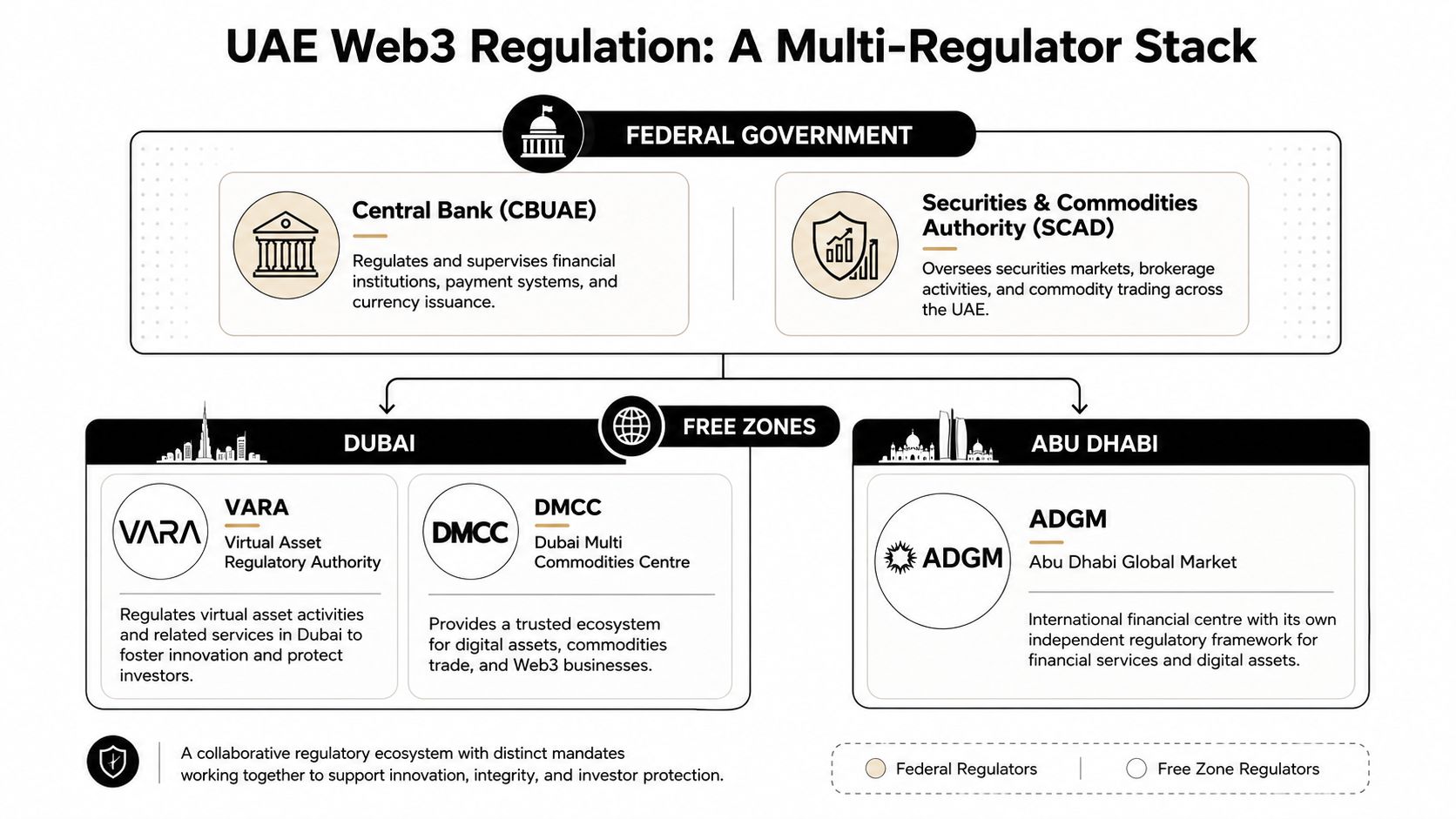
The five regimes founders actually have to think about
The clearest way to read the market is to separate the regimes by scope:
- CMA, for federal mainland activity.
- VARA, for Dubai outside DIFC.
- DFSA, for DIFC.
- FSRA, for ADGM.
- CBUAE, for payment tokens and DeFi-related activity, especially where payments or financial infrastructure are involved. The federal milestone here is tied to Federal Decree-Law No. 6 of 2025, which brought DeFi, Web3 protocols, stablecoins, decentralized exchanges, cross-chain bridges, wallets, and payment services using virtual assets under stronger Central Bank oversight, with a transitional period running until September 2026. The law also carries reported penalties of up to AED 1 billion, about $272 million, for non-compliance. Source: UAE crypto regulation H1 2026 analysis and federal DeFi and stablecoin regulation summary.
That stack matters because product architecture now has to be jurisdiction-aware. A wallet can't be treated as just a wallet if it also routes payments, controls custody, or interacts with token permissions. A stablecoin can't be treated as generic “crypto” if its backing and payment use trigger a different authority. The same goes for onboarding, transaction monitoring, and customer classification.
Why architecture now sits inside compliance
Founders often think compliance starts after launch. In the UAE, that approach is weak. The rules now force product teams to decide whether the asset is a payment token, a non-payment virtual asset, or part of a broader DeFi service before they write the final workflow. If you get that wrong, you don't just risk a filing problem, you risk redesigning the product later.
The strongest mental model is simple. Regulation follows function, not branding. If your platform lets users swap, custody, route, lend, stake, or pay with virtual assets, the regulatory question is already live. That's why the UAE's 2026 framework rewards teams that can describe their token logic, custody model, and jurisdiction mapping in plain English, because that's how regulators and banks will read you too.
VARA In Dubai And ADGM Framework Side By Side
Dubai and Abu Dhabi both work for crypto founders, but they are not interchangeable. Teams waste time when they treat “UAE setup” as one decision, then find out late that VARA and ADGM solve different problems for different business models. If your product team cannot explain why one fits better than the other, the activity map is not clear enough yet.
VARA suits Dubai onshore virtual asset activity
Dubai's VARA is the right lane for businesses running virtual asset activities in Dubai outside DIFC. It is a focused onshore regime, not a blanket UAE approval, and that distinction matters more than people admit in pitch meetings. Independent licensing guides are blunt about this point, the UAE has no single crypto licence, and firms may need more than one approval depending on what they do and where they do it. Source: crypto licensing in the UAE
VARA fits exchange and broker models, consumer-facing platforms, and businesses that want a Dubai operating footprint. If your business model is activity-heavy and customer-facing, Dubai is often the first place founders explore because it is the easiest jurisdiction to explain to investors and counterparties. Market visibility does not mean regulatory simplicity. A Dubai approval does not cover Abu Dhabi, and it does not solve federal questions around payment tokens or DeFi functions.
ADGM fits a different style of build
ADGM is a separate Abu Dhabi licensing path, built around FSRA virtual asset rules rather than a generic business registration. That makes it cleaner for teams that want a more institutional operating style, especially where governance, control frameworks, and compliance depth matter from day one. The practical point is simple, a Dubai approval does not cover an Abu Dhabi operation, and an Abu Dhabi setup does not backfill Dubai activity. Source: Founders' guide to UAE crypto laws
For teams hiring around Abu Dhabi, compliance roles matter early. If you are looking at a UAE ADGM compliance officer, that tells you something important, the market expects serious governance, not just a glossy token launch.
A useful way to choose is this:
- Choose VARA if your operating centre is Dubai onshore and your product is built around virtual asset services for a broad market.
- Choose ADGM if your model is more institutional, governance-heavy, or built for a tighter regulated environment.
- Do not choose either blindly if your product touches payment tokens, DeFi, or cross-jurisdiction customer flows, because the federal layer may still matter.
For broader location planning, I would also compare the business environment with this UAE free zone comparison for tech startups. The wrong zone choice creates delays that have nothing to do with the quality of the product.
Licensing Paths Capital And Compliance Requirements For Founders
The founders who move fastest in the UAE do not start by asking whether a license is possible. They start by pinning down the regulated activity, then they match that activity to the right regulator, the right entity setup, and the right capital burden. If you are running an exchange, custodian, broker, adviser, portfolio manager, or trading platform, that activity map comes first. Everything else follows from it.
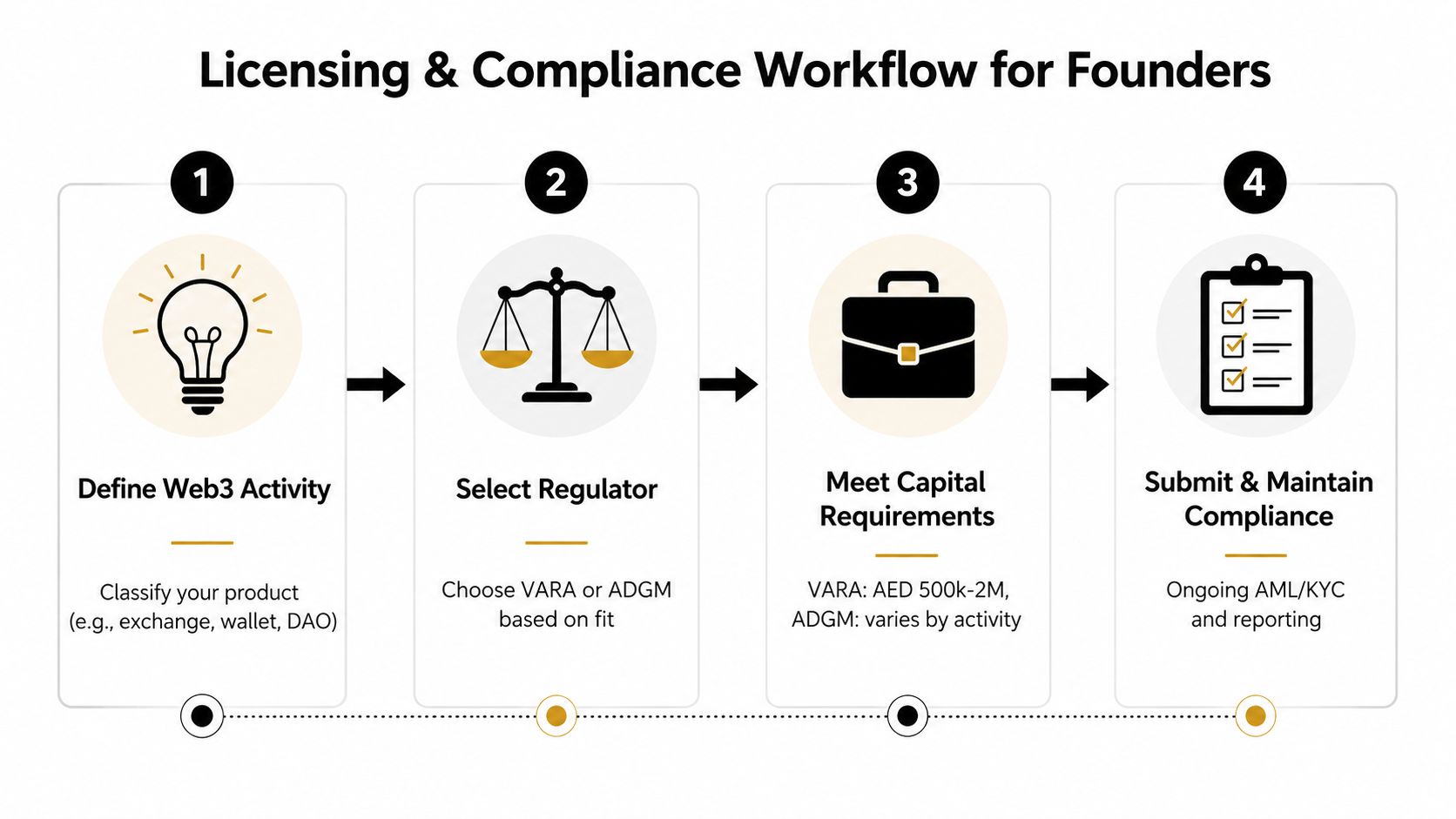
Start with the activity list, not the entity structure
CMA Decision No. 4/R.M/2026 matters because it pushed the federal framework into a three-module rulebook covering licensing, business regulation, and ATS governance. That is the signal founders should pay attention to. The authorities want activities separated and described clearly, not bundled into a vague “crypto platform” label. Source: UAE federal crypto regulation H1 2026
The categories drive every later decision. Exchange is not custody. Brokerage is not portfolio management. Trading-platform functions are not just a user interface if you control order routing or execution logic. If your team cannot write a one-page activity map, you are not ready to brief a regulator or a bank.
Capital and governance are part of the product design
Reported capital floors in the federal framework range from AED 500,000 for a trading platform to AED 4 million for dealing as principal. That tells founders exactly where the market has tightened. Entry is still open, but casual setups are out. Analysts also report a risk-based capital test at 25% to 35% of projected annual expenses for some activities. Those figures are not legal decoration. They tell you whether the business model can survive the licensing path you want.
Before you submit anything, your package needs the basics that banks and regulators inspect:
- UBO details, so ownership is clear.
- Entity structure, so the regulator and the bank can see who sits where.
- AML governance, including written controls and escalation paths.
- MLRO and compliance roles, because oversight has to sit with named people.
- Jurisdiction mapping, so each activity is tied to the right authority and customer base.
- Custody segregation, because commingling client assets with operating funds creates avoidable risk and slows every review.
- AED payment token limits, if your product touches local settlement flows, because payment design can trigger a different compliance path from the rest of the stack.
Licensing is the first gate. Banking is the second. Treat them as separate workstreams, because the wrong sequence burns time and weakens your case with both sides.
If you want a practical check on your launch model, review a simple agreement for future tokens in the UAE and compare it with the license path you are pursuing. If the legal wrapper and the operating model do not match, investors will spot it fast.
What Is Allowed Grey And Prohibited For Web3 Products In 2026
A founder can still get burned in the UAE by assuming every Web3 feature can fit under one compliance wrapper. That is the wrong model in 2026. Some products are workable with the right licence and structure, some sit in a grey zone until a regulator reviews the facts, and some are blocked unless you have the right approval path from the start.
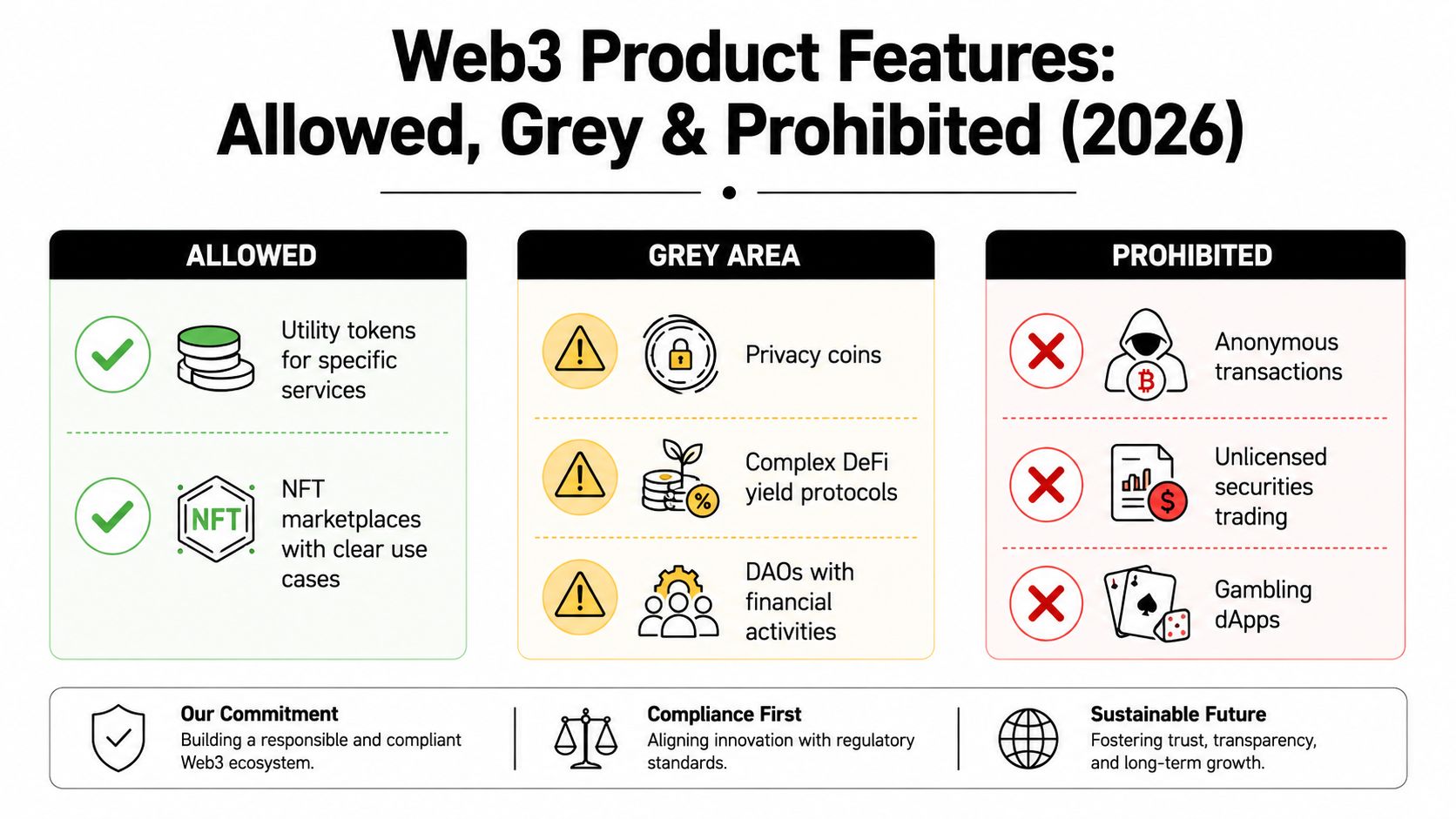
What looks workable
Utility tokens with a real service function are easier to defend than speculative token designs. NFT marketplaces also tend to be workable when the platform has a clear use case and is not trying to dress up financial activity as entertainment. A clean wallet product can work too, but only if the custody model, onboarding flow, and transaction monitoring are built for the correct jurisdiction from day one.
Federal rules changed the baseline. Federal Decree-Law No. 6 of 2025 brought stablecoins, DEXs, bridges, wallets, lending, staking, and virtual-asset payment services under stronger Central Bank oversight. It took effect in September 2025 and gave existing operators a one-year transitional period until September 2026. Source: UAE enacts law regulating DeFi, Web3, and stablecoins
That kills the old launch first, sort it out later habit for any in-scope infrastructure.
What is grey and needs legal review
The grey zone is where founders waste the most time. Privacy-oriented tokens, complex yield mechanics, and DAO structures with financial activity can all trigger more scrutiny than a straightforward marketplace or wallet. A product can be technically possible and still be a poor fit for the regulator's risk view.
Token design decides the lane. If the model includes reserve management, issuance controls, or any token that behaves like a payment instrument, the path can move toward CBUAE oversight. A token used for payments inside the UAE should not be treated the same way as a utility asset or community token. The architecture has to match the regulatory lane, or the review will stall.
What should be treated as off limits unless clearly licensed
Anonymous or privacy-heavy transaction flows are a bad bet. Unlicensed securities-style trading is a bad bet. Gambling dApps are a bad bet. The issue is not moral panic. Federal and jurisdictional supervision is moving toward control of financial infrastructure based on what the product does.
The transitional window to September 2026 is the pressure point. If your product still depends on unsupported token logic or unclear payment functionality, fix it now. Teams that make it through this cycle will re-architect before launch instead of asking a regulator to bless a broken design later.
Banking For Crypto Startups And Practical Compliance Actions
Licensing gets the headlines. Banking gets the reality check. In the UAE, those are two separate gates, and a company can clear one without being anywhere near the other. I've seen founders celebrate a licence path and then stall because the bank wanted a much clearer compliance story than the deck ever showed.
What banks want to see
The cleanest view is simple. Licensing must match the activity and the jurisdiction. Banking must prove compliance, AML controls, and a regulator-recognised structure. That means the bank is looking at how your business works, not how polished the pitch is. Source: UAE crypto regulation and setup strategy
Before you approach a bank, get your internal pack in shape:
- UBO documentation, so ownership is traceable.
- Entity structure chart, so the bank can see the operating chain.
- AML governance, including policies, escalation, and monitoring.
- MLRO and compliance roles, with named responsibility.
- Jurisdiction mapping, so Dubai, Abu Dhabi, and federal exposure are clear.
- Transaction monitoring logic, especially if you touch custody or payments.
- Custody segregation rules, if client assets ever sit in your stack.
If you're still vague on the operational side, a guide to opening a business bank account in the UAE as a startup is useful because it forces the basic conversation founders try to skip.
The operating question banks quietly ask
A bank is really asking one thing, can this company be monitored without guesswork? If your onboarding flow doesn't separate customer types, if your token permissions are messy, or if your custody model mixes company assets and client assets, you're making the bank's job harder. They'll notice.
The most bankable crypto founders in the UAE are boring in the right way. They know their regulator, they know their entity structure, and they can explain how funds move. They don't oversell “Web3 innovation” when the issue is whether the company can keep clean books and satisfy AML reviews.
Useful test: if your compliance lead can't explain your customer flow in one page, the bank will probably ask the same questions and more.
Is The UAE Advantage Narrower Than It Sounds And Your Timeline To Be Ready For 2026
The UAE advantage is narrower than the marketing pitch suggests, and that matters for founders who are still planning around headlines instead of licensing reality. The country does give you multiple active frameworks, a credible regional base, and a serious market for Web3 businesses. It does not give you a light-touch shortcut. The advantage goes to teams that choose the right lane and operate cleanly, not to founders who assume “UAE friendly” means low-friction.
The timeline is the pressure point. The CMA milestone landed on 13 February 2026 with Decision No. 4/R.M/2026. September 2025 started the clock on Federal Decree-Law No. 6 of 2025, and the transitional period is expected through September 2026 for existing operators. That leaves a window, but it is closing for teams that still have not separated token design, custody logic, and payment-token exposure.
What to do before the compliance deadline approaching in September 2026
- Map every regulated function in your product, including exchange, custody, brokerage, advice, lending, staking, or payment use.
- Pick one primary jurisdiction lane first, then test whether the federal layer changes the answer.
- Review stablecoin and payment-token exposure early if your product touches AED-linked flows.
- Document AML and custody controls before you open banking conversations.
- Decide what gets removed or redesigned if it falls into a grey or prohibited category.
Founders waste time by treating this as a branding exercise. It is an operating exercise. If your product touches custody, the cost is not just legal work, it is segregation of client assets, controls around who can move what, and clean evidence that your stack does not blur company money with customer money.
That is where product-level choices bite. A simple token launch can still trigger different treatment depending on whether you are running a venue, holding assets, routing payments, or issuing something that behaves like a payment token. AED-linked flows deserve extra care because the regulator and the bank will both look at how value moves, not how clever the whitepaper sounds.
If you want a quick check on market mood while you sort out the licence path, crypto prediction tools can be useful as a reminder that trading excitement does not tell you whether the company is ready for compliance review. Use them for sentiment. Do not confuse sentiment with permission.
My blunt advice is simple. Build for the regulator and the bank first, then optimise for growth. In the UAE, that sequence is efficient, and it saves you from expensive rewrites when the compliance deadline approaching in September 2026 gets closer.

Building in MENA? You don't have to do it alone.
Join 300+ founders in the Founder Connects Residency. Monthly squad calls, warm intros, $3M+ in perks, and much more. All for less than your monthly coffee budget.
Popular posts





Founder Connects is a premium MENA tech founder community. Meetups in Dubai and across MENA, Residency Squads of 8–10, and 400+ vetted WhatsApp founders (apply and screened).