

What Is a Founder Peer Group? a Plain Definition.

Building in MENA? You don't have to do it alone.
Join 300+ founders in the Founder Connects Residency. Monthly squad calls, warm intros, $3M+ in perks, and much more. All for less than your monthly coffee budget.

A founder peer group is a small, structured circle of founders who regularly exchange practical advice, challenge assumptions and hold one another accountable from comparable experience.
If you already know other founders, what makes this different from another group chat? The difference is a working relationship, not a contact list. Members bring decisions they haven't resolved, contribute relevant experience and return to discuss what happened.
For a busy UAE founder, that distinction matters. A room full of entrepreneurs can be useful without being a peer group. The name should describe what people do together, not just who attends.
A Plain Definition of a Founder Peer Group
Think of a founder peer group as a trusted room for practical business judgement. Members discuss problems they're responsible for solving, such as validating demand, choosing a hire or deciding which customer segment to pursue.
Small means there's room for everyone to contribute. Structured means the conversation has a purpose and boundaries. Comparable experience means members understand enough of each other's situation to ask useful questions, even when their businesses aren't identical.
The UAE Ministry of Economy's entrepreneurship report describes an active entrepreneurial environment with a substantial small-business base. That's useful local context: meeting entrepreneurs and building a repeatable learning relationship with them are different activities.
Reciprocity is the defining feature
Reciprocity means everyone contributes. A founder might bring an unresolved question, explain an unsuccessful experiment or challenge an assumption with relevant evidence.
Nobody needs to have an answer to every problem. But a participant who only listens, sells or seeks approval isn't taking part in the full exchange.
- A question contributes focus. It gives the group a specific decision to examine.
- Experience contributes context. Members explain what they tried and the conditions surrounding it.
- A commitment contributes accountability. The founder names what they'll test or investigate.
The concept is easier to recognise when its parts sit together.
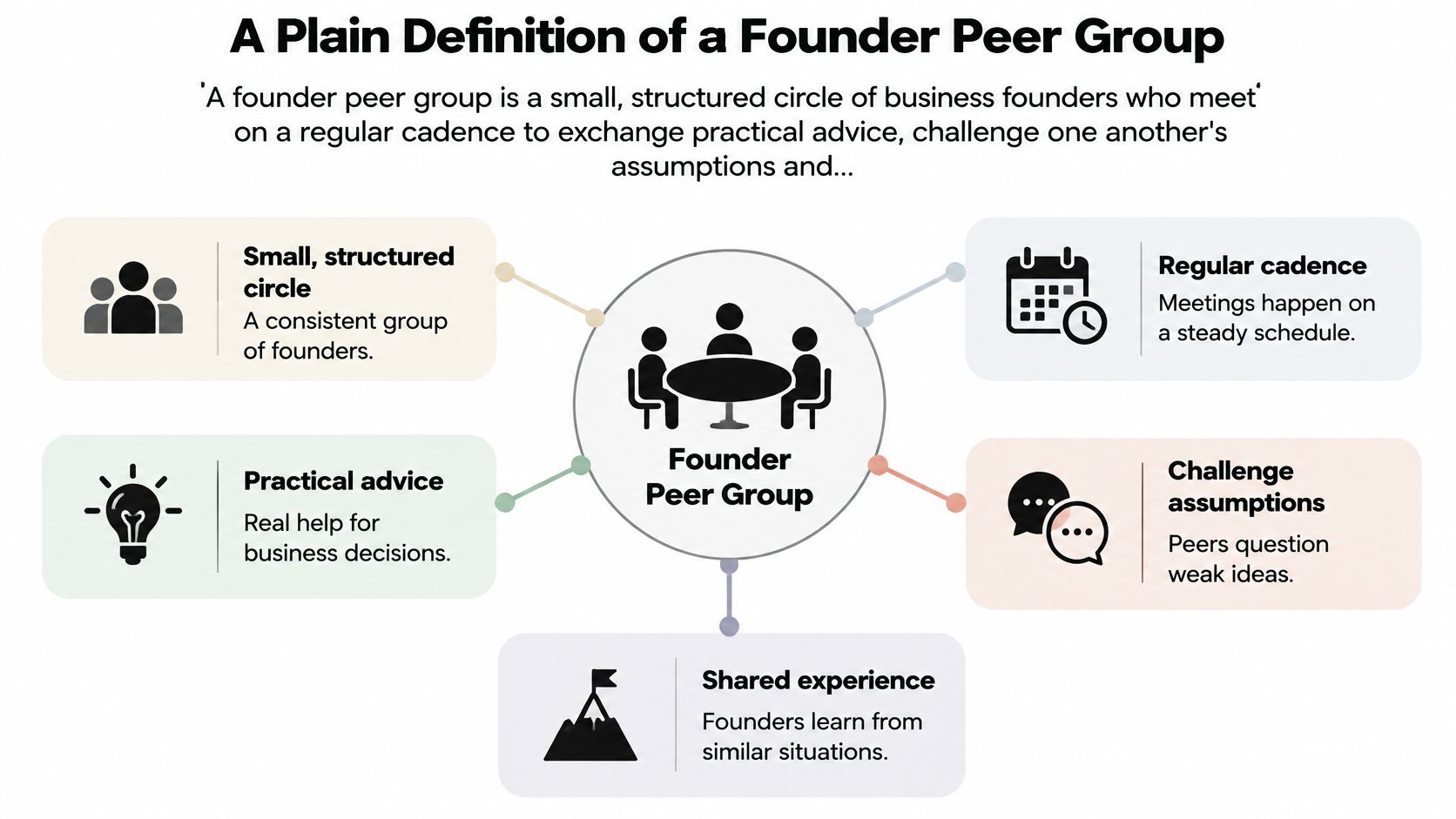
Founder Connects, a startup community in Dubai and the world, uses this plain meaning: founder-to-founder discussion centred on practical problems and shared responsibility for the conversation.
A moderator can protect that structure without becoming the person who supplies every answer. Their job is to preserve airtime, keep questions relevant and stop a case discussion turning into a sales pitch.
The simplest test is behavioural: members return with a live problem, receive experience-based feedback and report what they tried. Without that pattern, the room may be a useful community, but it isn't necessarily a founder peer group.
How a Peer Group Differs from Nearby Formats
| Format | Who is in the room | How help flows | Cadence | What counts as a result |
|---|---|---|---|---|
| Founder peer group | Founders at a similar stage | Both ways, from lived experience | Recurring, on an agreed schedule | A decision tested and a commitment reviewed |
| Networking Meetup | Mixed attendees | Through individual conversations | Occasional | Names met |
| Mentoring | Founder plus a more experienced adviser | Mostly through the adviser's guidance | Agreed with the mentor | Advice applied |
| Accelerator | Cohort plus a programme team | Through a curriculum and programme support | Fixed programme length | Programme milestones or a demo day |
A networking Meetup creates space to meet people. You might have a valuable conversation without discussing confidential operating details or expecting the same people to review your progress later. That doesn't make the format inferior. It serves a different purpose.
Mentoring centres on an adviser's experience. The founder usually brings questions, and the mentor supplies perspective or guidance. A peer group distributes that responsibility across members rather than organising the relationship around an expert.
An accelerator has a programme structure. Its team sets activities, learning requirements or milestones within a defined period. Founders may form peer relationships during it, but those relationships aren't the same thing as the programme itself.
The closest cousin is a mastermind
A mastermind can also be a small, recurring circle with confidential discussion and accountability. The labels overlap, so the actual format matters more than the name. The guide to mastermind groups explores that distinction without assuming every group works identically.
Likewise, a business referral network and a founder community can organise participation around different expectations. The comparison of BNI and a founder community helps clarify that boundary.
A practical quality test
The UAE startup activity described by Economy Middle East provides context for a busy ecosystem. It doesn't establish the quality of any particular founder circle.
A larger room isn't automatically a stronger peer group. Use these questions to distinguish substance from a community label:
- Confidentiality: Can founders discuss an uncertain decision without expecting it to leave the room?
- Relevance: Do members understand the stage or operating challenge under discussion?
- Continuity: Will participants meet again with enough shared context to go deeper?
- Evidence of work: Does the group examine decisions, experiments and kept commitments rather than just attendance?
For a broader view of community formats, the founder groups recommended by Find Startup Idea provide a useful starting point for comparison. Apply the same quality test to any listing: a description can explain the offer, but participation reveals the working format.
The Loop That Makes the Circle Work
Peer learning is the mechanism behind the format. Founders compare operating detail, recognise similarities and examine whether someone else's experience applies to their own decision.
The important word is applies. A tactic that worked for an established business may be unsuitable for a founder still testing demand. Useful discussion makes those differences explicit rather than copying another company's answer.
The Unlocking the Pipeline report identifies limitations in entrepreneur networks and access to experienced mentors across the region. A peer circle offers a distributed advisory layer, not a claim that every participant is an expert.
A case needs more than a business update
A useful case gives members enough information to question the decision:
- The issue: State the choice that needs resolving.
- The evidence: Bring customer comments, operating observations or relevant documents.
- The options: Explain which approaches remain open and why.
- The request: Say whether you need challenge, comparable experience or help identifying missing information.
For example, a founder deciding whether to change pricing shouldn't start with a general complaint about slow sales. They can bring objections from customer conversations, explain the current offer and identify which pricing assumption they want challenged.
Peers then ask questions before prescribing answers. Someone who has faced a similar objection can describe what happened, including what didn't work.
The process depends on repetition rather than a particularly impressive discussion.

Follow-through keeps the discussion honest
A steady schedule, protected speaking time, rotating case discussions and written commitments make this exchange repeatable. The founder remains responsible for the decision, including choosing not to follow a peer's suggestion.
Without a report on what was tried, a meeting can become content consumption rather than a working peer relationship.
Useful records include attendance, commitments completed, customer conversations conducted and decisions reached. These describe participation and execution, not popularity.
The skills founders build in mastermind groups offer a related view of the behaviours involved. For outcomes rather than the definition itself, see how founders benefit from peer groups.
UAE Situations a Peer Group Is Built For
The definition becomes clearer when you apply it to an unresolved decision. These hypothetical UAE situations show what belongs in a case discussion.
The setting can be informal, but the work needs focus.

An idea-stage founder in Dubai
A solo founder isn't sure whether customers will pay for a proposed service. Instead of voting on whether the idea sounds promising, peers examine what prospective customers have said and done.
They might ask which problem customers already spend money solving. The founder leaves with a narrower assumption to test, such as whether a particular customer segment will pay for a clearly defined outcome.
For founders working without external capital, the guide to peer groups for bootstrapped founders addresses that specific context.
A company set-up question
A founder weighing free-zone and mainland options brings their intended activities and operating requirements. Peers describe the decisions they made and the questions they wish they'd asked a qualified adviser.
The useful output isn't a room-wide verdict on the correct licence. It's a clearer description of the founder's requirements and the unresolved questions that need professional confirmation.
A first senior hire
A founder brings alternative role descriptions and a budget. Members compare their delegation mistakes and ask whether the business needs leadership, specialist execution or clearer ownership of existing work.
Rather than collecting opinions about job titles, the founder tests whether the proposed role solves the actual bottleneck.
The accompanying video offers another way to engage with the topic.
The UAE Ministry of Economy's entrepreneurship findings address familiarity with entrepreneurship and perceived start-up capability. Familiarity alone doesn't describe the structured case work illustrated here.
The subject changes with the founder's stage: customer problems and first-user learning at idea stage, communication of the business model during fundraising preparation, and hiring or market judgement during scaling. The format stays centred on a decision, not a promised outcome.
Limits of the Plain Definition
A founder peer group isn't therapy, a substitute for legal, tax, immigration or financial advice, or a guarantee of funding or growth.
Calling the circle an advisory layer doesn't give its members professional authority. A founder may have relevant experience and still misunderstand why a particular arrangement worked for their business.
Formal support exists alongside peer discussion. The Dubai Government Media Office's account of Dubai SME describes advisory services that include expert guidance and mentorship.
Separate the kinds of contribution
For UAE questions involving company formation, ownership, licensing or cross-border operations, distinguish between:
- Personal experience: A member explains what they did and the circumstances surrounding it.
- General guidance: The group identifies considerations or information the founder should gather.
- Professional questions: Members flag matters that require a qualified legal, tax, immigration or financial adviser.
That distinction should happen before anyone recommends a step. Another founder's setup isn't proof that the same arrangement is appropriate for your activities, contracts or obligations.
A good discussion can help someone prepare a clearer adviser briefing. It can also help them identify what they haven't understood in advice they've already received.
The founder still owns the decision. Members shouldn't pressure someone to disclose sensitive material, accept a recommendation or treat consensus as professional confirmation.
Confidentiality also requires deliberate conduct. Participants need to understand what they can share, with whom and under what permission, rather than assuming that a friendly room automatically protects private information.
The practical boundary is straightforward: peers examine judgement and follow-through. Qualified professionals confirm matters within their remit.
Use the Definition Before You Read On
This week, assess a founder circle you already participate in. Write down what happened during its most recent discussion, rather than relying on how the group describes itself.
Look for observable behaviour
- Continuity: Did participants remember the context behind an unresolved issue?
- Specificity: Could the founder explain the evidence and alternatives behind the decision?
- Responsibility: Was it clear who would act and what they would bring back?
If those details are absent, you may have a network rather than a peer group. That's a useful classification, not a criticism. A network doesn't need to perform every function.
For a practical conversation, ask founders you already trust whether they'd meet regularly, protect confidentiality and review a commitment each time. Their response will tell you more about the proposed relationship than a group name will.
Keep the next reading specific to your question. The benefits guide explains outcomes, the bootstrapped-founder guide addresses resource constraints, and the mastermind guide compares closely related formats.
If your question is about participation rather than meaning, use the guide to joining a peer group in Dubai. Keep that separate from deciding whether the format itself fits the work you need to do.
Three Follow Up Questions on the Definition
How small is small?
Small enough for every founder to present a case and contribute within a short cycle, yet large enough to bring different experience into the discussion.
There is no universal headcount that proves quality. Look at how the conversation works: can quieter members explain their reasoning, can peers ask follow-up questions, and does the group remember each person's context? A crowded Meetup can still be worthwhile, but it may serve a different purpose.
Can a pre-revenue founder belong?
Yes. Comparable decisions matter more than matching revenue. An idea-stage founder can contribute customer observations, evidence from an unsuccessful test, or thoughtful questions about another member's assumptions.
The shared subject might be customer understanding, pricing, or priorities. A pre-revenue founder needs room to examine uncertainty openly, without pressure to sound further along. Peer discussion is not counselling, professional advice, or a funding commitment.
Why name a separate format if founders already know other founders?
An acquaintance describes a relationship. A peer group describes an agreed way of working. Friends can exchange useful advice spontaneously, while a peer group makes space for difficult cases and returns to unfinished decisions.
Naming the format makes expectations clear. Participants can distinguish social conversation from focused case work and understand when they are expected to contribute.
Use that distinction when choosing what to read next: outcomes, bootstrapping, mastermind formats, and Dubai participation are separate questions addressed by the guides linked above. If you want a conversation with fellow builders, browse the Founder Connects Meetups and keep the quality test in mind.
Founder Connects offers Meetups and founder experiences as a startup community in Dubai and the world. Visit Founder Connects to explore its founder community, and bring a concrete business question to your next conversation with fellow founders.

Building in MENA? You don't have to do it alone.
Join 300+ founders in the Founder Connects Residency. Monthly squad calls, warm intros, $3M+ in perks, and much more. All for less than your monthly coffee budget.
Popular posts





Founder Connects is a premium MENA tech founder community. Meetups in Dubai and across MENA, Residency Squads of 8–10, and 400+ vetted WhatsApp founders (apply and screened).