

Y Combinator for MENA Founders: Essential Guide 2026

Building in MENA? You don't have to do it alone.
Join 300+ founders in the Founder Connects Residency. Monthly squad calls, warm intros, $3M+ in perks, and much more. All for less than your monthly coffee budget.

You're in Dubai at 1am, tab open on the Y Combinator application, and the same question keeps coming back: is this a real move for a MENA founder, or just Silicon Valley theatre? If you've heard ten different opinions from ten different people, that's normal. Most of them are treating YC like a trophy instead of what it really is, a milestone signal that can open doors, compress trust, and expose weak execution fast.
For founders in the UAE and wider MENA region, y combinator for mena founders is worth talking about for one reason above all others, it sits at the intersection of capital, credibility, and network access. YC says it invests $500,000 in startups four times a year, and independent summaries report that it has funded more than 5,000 companies since launching in March 2005 Y Combinator. That scale matters because YC isn't a local incubator. It's a global filter.
If you're building in the UAE, that filter can be useful, but only if you already have the raw material. A founder with no prototype, no user signal, and no clear wedge doesn't need YC. They need peers, customers, and sharper execution. If you want a good companion read on how founders use AI to move faster in search and content workflows, how AI transforms SEO growth is a useful example of the kind of practical, systems-first thinking YC likes.
Why UAE and MENA Founders Keep Talking About YC
A founder in Abu Dhabi can spend months building a decent product, get one warm intro, and still feel invisible. Then somebody says, “Have you applied to YC?” and the room changes. That's the reason YC keeps coming up in MENA founder circles, it's not just funding, it's a shorthand for seriousness.
YC's draw is simple. It is a globally recognised gatekeeper to capital and networks, and its model has become a standard launchpad for international startups. The accelerator says it invests $500,000 in startups four times a year, and independent summaries report that it has funded more than 5,000 companies since March 2005 Y Combinator. That combination gives founders something local ecosystems often can't provide on their own, a fast credibility signal that travels across borders.
What YC actually signals
YC acceptance does three things at once. It tells investors you've passed a selective filter, it tells potential hires you're not a hobby project, and it tells peers you can survive under pressure. For many UAE founders, that matters as much as the money.
Practical rule: if YC would only make you feel validated, you're probably not ready. If it would make customer calls, investor conversations, and hiring easier, you're closer.
The better way to think about YC is this, it is not the destination. It's a milestone that can amplify an already moving startup. That's why founders who already have a small but serious peer circle, clear user pain, and enough traction to explain their momentum usually benefit most.
There's also a second reason MENA founders obsess over it. Local startup scenes have matured enough that international signals matter more, not less. When you can get local community, local intros, and local support in the region, YC becomes the next layer, not the first layer. That's a very different decision from “should I try my luck at the famous accelerator?”
How YC's Model Actually Works for International Founders
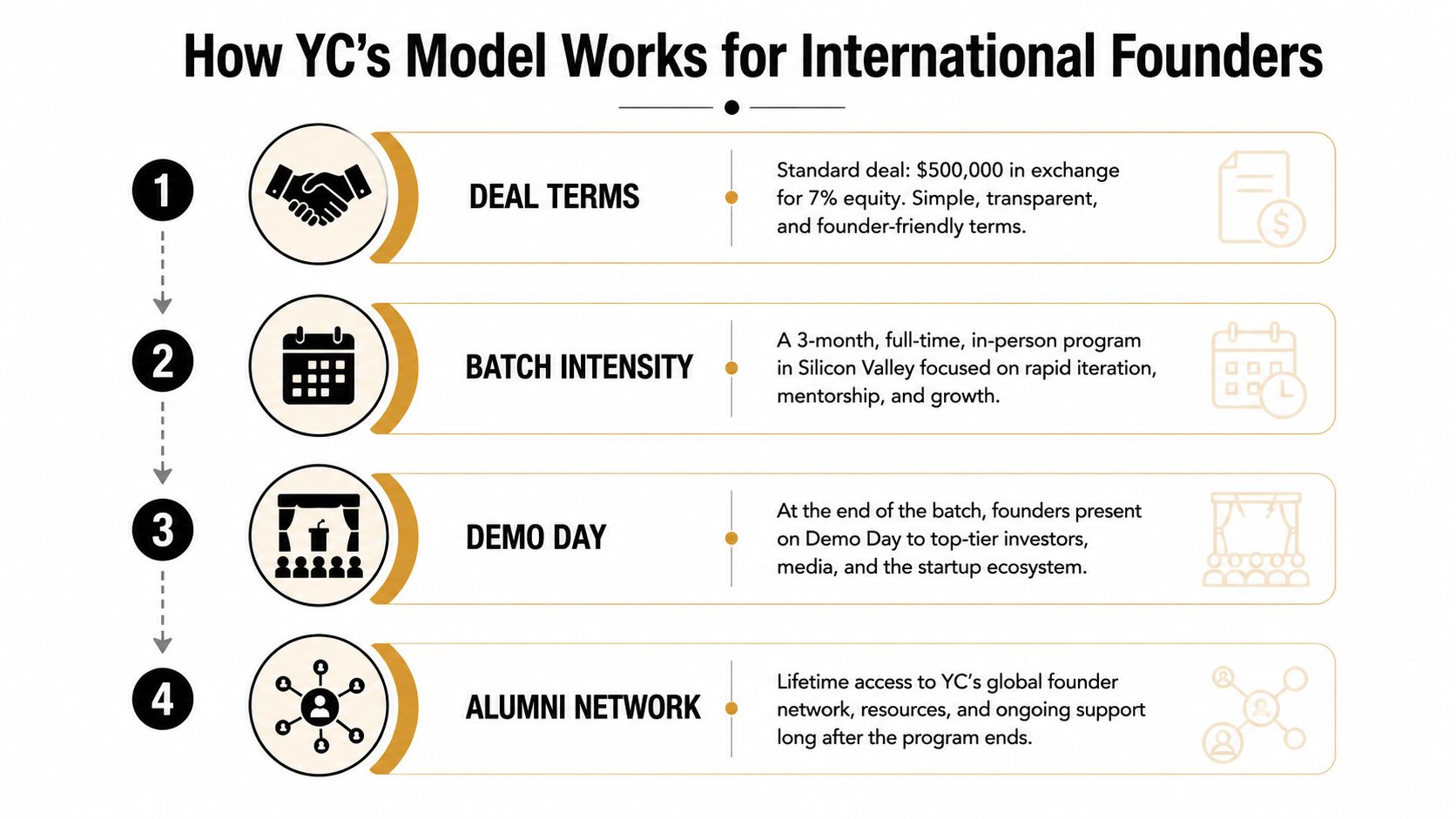
YC works like an operating system, not a grant. You give up equity, move through a tight batch, and get access to structured feedback, peers, and investor introductions. For international founders, the point isn't the logo. It's the cadence.
Here's the blunt version. YC's standard deal anchors around $500,000, and the company moves through a fast cycle designed to force shipping, learning, and iteration. That rhythm is why it works for founders who can already execute quickly and don't need hand-holding to decide what to build next. The batch creates pressure, but it also creates focus.
What the batch gives you
YC's structure is useful because it reduces randomness. You're not wandering through generic networking. You're working inside a repeatable process where the expectation is to build, learn from users, and tighten your story fast. That's a better fit for MENA founders who value high-signal advice and warm introductions more than broad exposure.
The internal logic is easy to understand:
- Deal terms. YC writes a real check, not symbolic support. That matters because it changes how much runway you have and how seriously outside investors take the company.
- Batch intensity. The programme is short and concentrated, so procrastination gets punished quickly.
- Demo Day. You get a high-pressure investor showcase, which is less about performance and more about forcing clarity.
- Alumni network. The network keeps compounding after the batch ends, which is where a lot of the hidden value sits.
YC is strongest when you already know what problem you solve and you need sharper execution, not when you're still searching for the problem.
If you want a deeper explainer on the operating model and how founders think about it, the overview at Founder Connects' YC guide is a useful companion. Don't overcomplicate this. YC is a pressure cooker with access attached.
Eligibility, Geography, and the Small Market Reality
A lot of UAE founders assume YC is the default next step because it sounds global. That assumption is weak. YC is open to companies worldwide, but it still rewards growth momentum, unique insight, and market size. If you're building from a smaller market, the third one becomes the hardest.
That's the part people gloss over. A founder in Dubai may have a strong product instinct and still struggle to tell a big enough story if the company sounds trapped inside one city or one narrow local category. YC applications are often judged on how convincing the growth path is, not just on whether the product is neat.
How to frame a UAE beachhead properly
The right answer is not to pretend the UAE is a massive market. It isn't. The right answer is to show why the UAE or GCC is the starting point for a broader regional or international wedge. That means your application should make it obvious that the local problem is a proof of demand, not the whole opportunity.
Use this structure in your head:
- Beachhead first, explain the exact customer segment you're winning now.
- Expansion path second, show how the same pain exists in adjacent GCC or MENA markets.
- Insight third, make it clear why you understand the problem better than a founder from outside the region.
- Proof last, attach whatever traction you have, even if it's small and messy.
Many MENA founders lose the plot here. They write as if YC wants a generic global SaaS story, when the advantage may be regional distribution, cross-border trust, or a problem only obvious to someone who has sold in this market. If you don't show that logic clearly, you look narrow. If you do, you look focused.
A historical detail matters here too. A JETRO report places startup venture activity in MENA in formal tracking as early as March 2005, the same month YC launched JETRO report on MENA startup investment and support. That parallel matters because YC and the region's ecosystem matured alongside each other. The gap is no longer “does MENA have startups?” The question is whether your startup is ready to travel.
Writing a YC Application That Gets Read
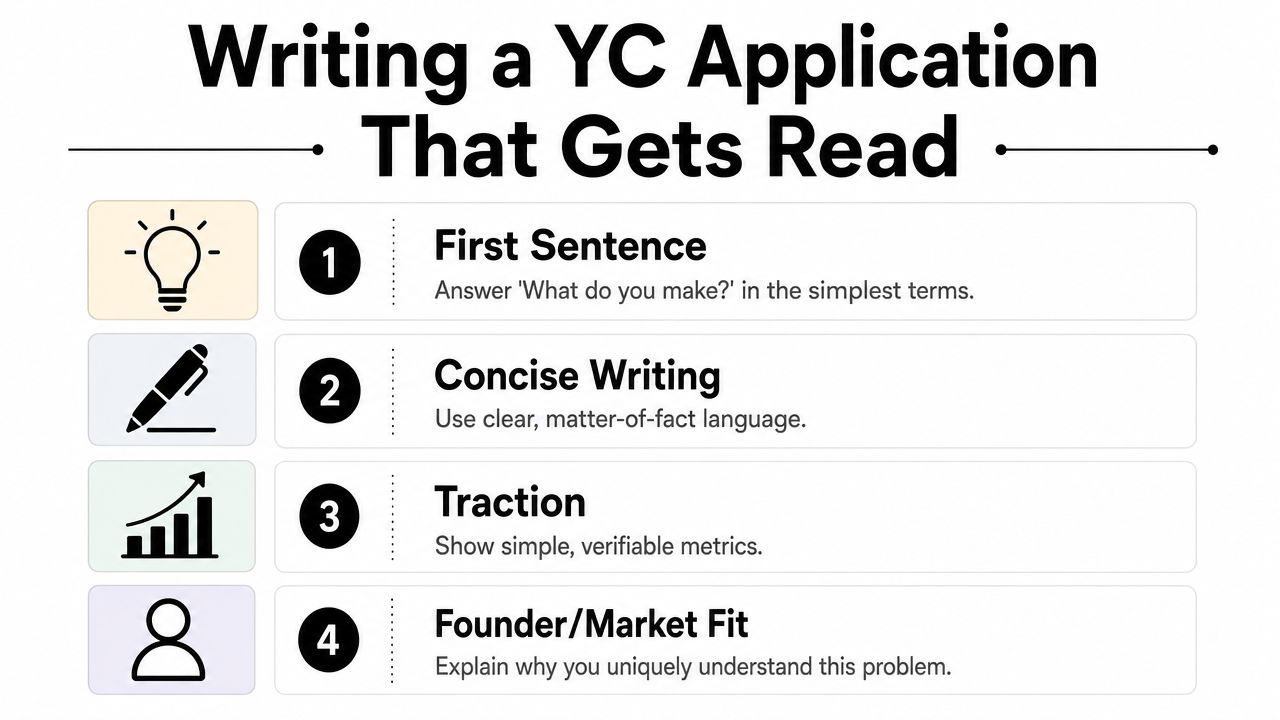
YC tells founders to answer the first sentence in the simplest possible terms, use concise and matter-of-fact language, and cut every unnecessary word before submitting YC application guidance. That advice sounds obvious until you read most applications from the region, which are often overbuilt, overexplained, and full of decorative language.
The first sentence should tell a stranger what you make without making them work for it. If you need three clauses, you've probably lost them. If you need buzzwords, you've definitely lost them.
What actually improves the odds
The prompt that matters most for first-time founders is the one asking each founder to state something impressive they've built or achieved. That is your opening. Don't bury it. Don't apologise for it. If you built a working product, sold to users, shipped quickly, or solved something hard with few resources, say it plainly.
Use this checklist before you submit:
- First sentence. Answer “What do you make?” in the simplest terms possible.
- Concise writing. Strip out filler and write like you're sending notes to an investor who is reading fast.
- Traction. Show simple, verifiable proof that people are using or wanting the product.
- Founder-market fit. Explain why you're the right team for this problem, especially if your edge comes from living the pain locally.
For MENA founders, the subtle move is to connect small-market origin to global relevance without sounding defensive. Say what's unique about the local wedge, then show why the same problem exists elsewhere. That's stronger than pretending you're a generic US startup with a Dubai address.
YC also recommends keeping analytics lightweight, with tools such as Google Analytics, Amplitude, or Mixpanel so founders can track one main KPI without slowing execution YC technical advice video. That's the right mentality. Don't build a reporting department before you've built a product.
Founder rule: if you can't explain your company to a smart friend in one breath, the application is too long.
Visa Logistics and the Remote Batch Reality
The most common question I hear from UAE founders is simple. “Do I need to move?” The answer is, not always, but you should treat location as an operating decision, not a lifestyle preference.
YC can be done with a remote or hybrid rhythm, but in-person participation still gives you the strongest access to partners, peers, and investor conversations. If your company needs intense live feedback, temporary relocation gives you more surface area for useful collisions. If you have family, school commitments, or a working customer base in the UAE, staying put can still make sense.
What founders should weigh
YC-backed founders who serve Middle East talent markets often run lightweight, metrics-driven models. Manara, a YC W21 company, says it teaches engineers technical and soft skills, then connects them to remote or onsite roles in Europe or Canada, and only charges after a successful match Manara discussion on Hacker News. That's a good example of a YC-backed team designing around outcomes instead of vanity activity.
The visa question usually splits into two tracks. If you relocate for the batch, the J-1 path often comes up. If you stay remote, you're trading legal convenience for lower density of access. In either case, talk to immigration counsel early and don't leave it to the last minute.
If you want the UAE-specific side of the paperwork, this startup visa guide for 2026 is worth reading alongside your YC planning. The bigger point is that founders should compare YC with regional programmes, not just emotionally, but operationally. If a local accelerator gives you the accountability you need without the relocation burden, that may be the smarter first move.
Fundraising After YC and Whether the Relocation Is Worth It
YC is not the finish line. It's a signal that can change how investors read your story. After the batch, the badge helps because you're no longer pitching as an unknown founder with a good pitch deck. You're pitching as a founder who survived YC's filter.
That matters most at the moment you start fundraising again. Investors respond faster when there's already a trusted name in the chain. But the badge alone won't save you if the company still lacks traction, clarity, or a credible market path. The smartest MENA founders use YC to sharpen momentum, not to manufacture it.

When relocation is worth the disruption
Relocation makes sense when the company needs deep US market entry, enterprise sales in North America, or a level of in-person density that remote work can't match. It can also make sense for biotech or hardware, where physical proximity changes the speed of iteration.
For everything else, be ruthless. If your customer base is in the GCC, your team is distributed, and your sales motion is regional, the value of staying in the UAE may be higher than the value of being physically nearby for every YC event. In those cases, the better move is often to build a stronger local peer layer first, then apply from a position of proof.
That's the reversal most founders need to hear. Don't treat YC as the first support structure. Build accountability, warm intros, and founder feedback first, then use YC as the second move. If you do it in the opposite order, you'll often get rejected, or worse, accepted before you're operationally ready.
If you want a community layer that helps with this kind of preparation, Founder Connects is one option for curated peer groups, introductions, and founder accountability in the UAE and wider MENA ecosystem. That kind of environment won't replace YC, but it can make the application, relocation decision, and post-batch fundraising much cleaner.
YC-Style Alternatives and Regional Accelerators Worth Considering
YC is powerful, but it's not automatically the right first accelerator for a MENA founder. If your startup needs local market access, sector-specific support, or a less disruptive path, regional programmes can be a better fit.
Program comparison
| Program | Standard Funding | Equity | Batch Length | Best Fit For |
|---|---|---|---|---|
| YC | $500,000 Y Combinator | Equity terms are part of the standard deal | Short, intensive batch | Founders who need global signal and fast execution |
| Hub71 | Varies by programme | Varies | Cohort-based | Abu Dhabi founders who want ecosystem access |
| DIFC Fintech Hive | Varies by programme | Varies | Programme-based | Fintech teams with UAE market focus |
| Sanabil | Varies by programme | Varies | Cohort-based | Saudi-linked founders and regional scale-ups |
| Flat6Labs | Varies by programme | Varies | Cohort-based | Early-stage founders who want regional support |
| 500 Global MENA | Varies by programme | Varies | Programme-based | Founders building for emerging markets and cross-border growth |
The core choice is not prestige versus practicality. It's sequencing. If you need a local testbed, use one of the regional programmes first. If you already have traction and a sharp market wedge, YC becomes more attractive. And if you're still trying to figure out the problem, acceleration is too early.
A simple decision filter
Use this before you apply anywhere:
- Apply to YC now if your product is live, your story is tight, and your market can clearly expand beyond one city.
- Choose a regional accelerator first if you need customer access, partner intros, or regulatory proximity in the UAE or GCC.
- Wait and build more if you're still debating what the company is for.
- Use both over time if local support can prepare you for global scale without wasting cycles.
For a broader comparison of programme trade-offs, this accelerator guide and chart is a useful reference. My view is straightforward, YC is one strong path, not the only path. Founders who understand that usually make better decisions.
Your YC-Ready Prep Plan for the Next 90 Days
Spend the first 30 days on evidence. Talk to customers, ship a working prototype, and track one core KPI with a lightweight setup. Don't get fancy, get honest about whether anyone actually cares.
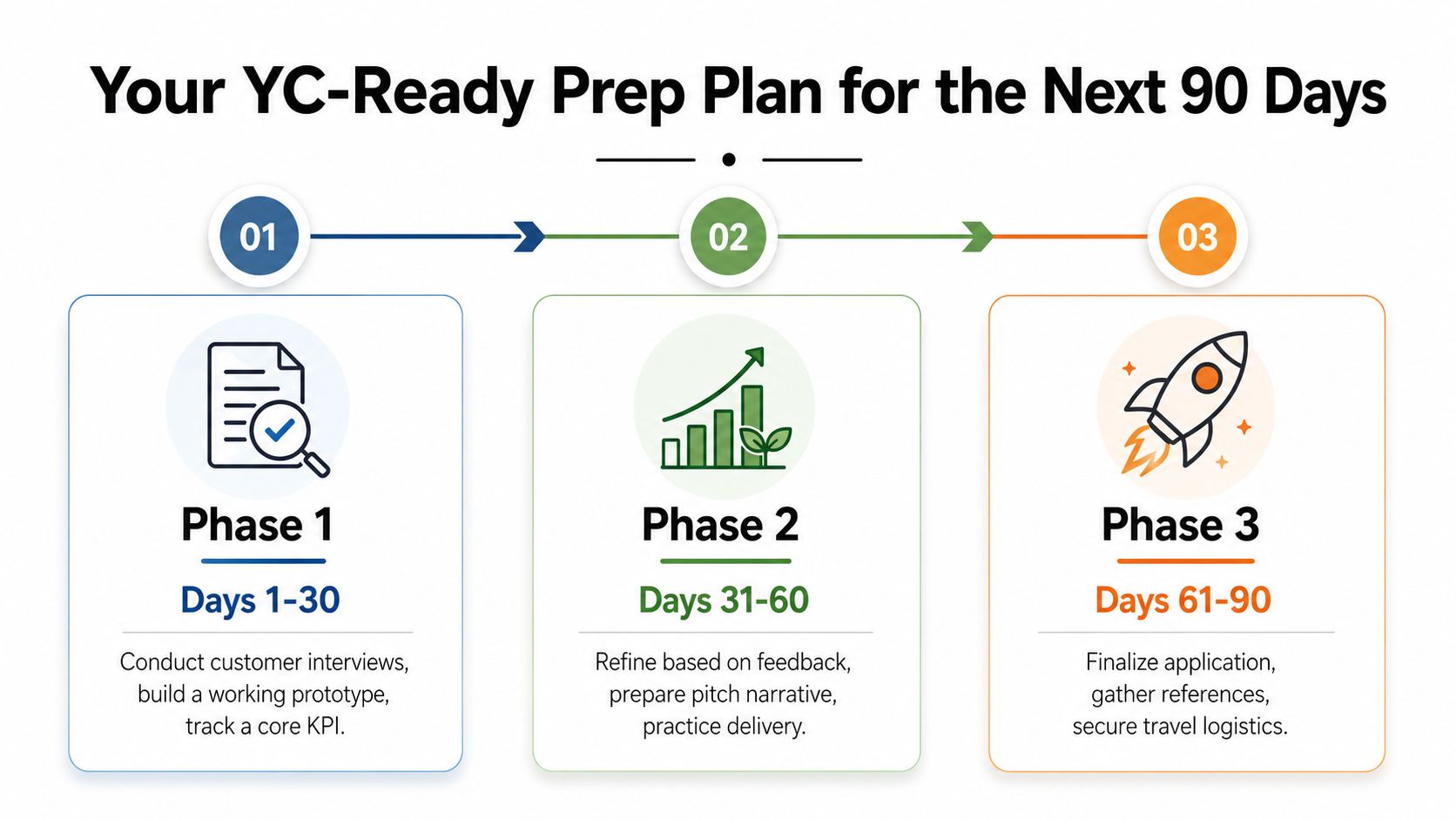
Days 1 to 30
- Customer interviews. Speak to users who feel the pain, not just friends who are being polite.
- Prototype. Build the smallest version that lets someone test the product.
- Main KPI. Pick one number that tells you whether the product is moving.
Days 31 to 60
- Tight company story. Rewrite your one-paragraph description using YC's simple, matter-of-fact style.
- Founder answers. Prepare a clean answer for the “impressive thing you built” prompt for each founder.
- Traction update. Turn your early data into a short narrative that an investor can skim in seconds.
Days 61 to 90
- Warm intros. Ask for specific introductions, not broad “help” messages.
- Peer review. Pressure-test the application with founders who've seen a YC-style process before.
- Travel readiness. If you might relocate, sort out the practical details before you submit.
The question you should be able to answer before clicking submit is simple. If YC says no, what evidence do I have that my company is still strong enough to keep building?
Founder Connects helps UAE and MENA founders build the peer support, accountability, and warm-intro layer that often comes before a strong YC application. If you want sharper decisions, better founder feedback, and a higher-signal community around your next move, visit Founder Connects and see whether it fits the stage you're in right now.

Building in MENA? You don't have to do it alone.
Join 300+ founders in the Founder Connects Residency. Monthly squad calls, warm intros, $3M+ in perks, and much more. All for less than your monthly coffee budget.
Popular posts





Founder Connects is a premium MENA tech founder community. Meetups in Dubai and across MENA, Residency Squads of 8–10, and 400+ vetted WhatsApp founders (apply and screened).