

Angel investors in Dubai - guide for founders

Building in MENA? You don't have to do it alone.
Join 300+ founders in the Founder Connects Residency. Monthly squad calls, warm intros, $3M+ in perks, and much more. All for less than your monthly coffee budget.

If I were starting an angel round in Dubai today, I’d focus on three things first: setup, fit, and timing. In the UAE, startups pulled in US$1.1 billion across 207 deals in 2024, and angels are often the first outside investors founders meet. Most early cheques are not huge - often AED 35,000 to AED 185,000 per angel - so I’d plan for a round built from multiple investors, a network, or a syndicate.
Here’s the short version:
- Pre-seed rounds often land around AED 500,000 to AED 2,000,000
- Seed rounds often move up to AED 2,000,000 to AED 8,000,000
- Angels usually want clean paperwork from day one: trade licence, MOA, bank account, cap table, and deck
- Warm intros matter more than cold emails
- DIFC and ADGM setups are common when founders want a clean holding company for investor entry
- Most rounds take months, not days, once outreach, diligence, KYC, legal work, and document signing are included
- Terms matter as much as valuation, especially board rights, information rights, conversion terms, and follow-on plans
- Exit alignment matters early, because many angels in Dubai look at a 5–10 year time frame
If I had to boil the article down even more, it would be this: don’t start by chasing names. Start by making the company easy to invest in, then build a short investor list based on stage, sector, cheque size, and local fit.
A few points stand out from the article:
- Dubai angel activity often runs through networks, syndicates, startup hubs, and founder circles
- DIFC Innovation Hub, in5, Sheraa, Hub71, Dubai Angel Investors, and Emirates Angels Investors Association are the main places to watch
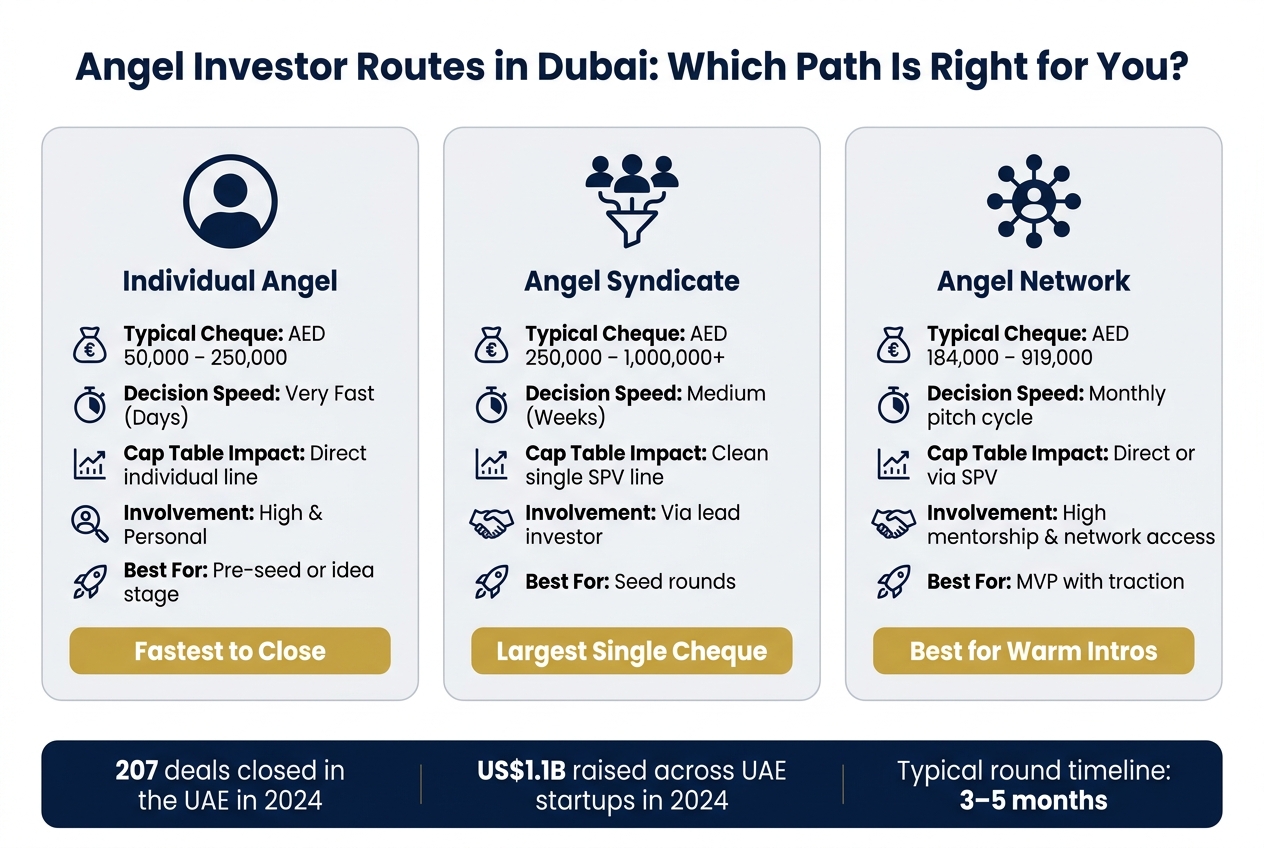
- For many founders, the choice is not just who to approach, but how to approach them: individual angel, syndicate, or network
- If I were in a regulated sector like fintech, I’d put licensing progress straight into the pitch, not in the appendix
- If I already had revenue, I’d expect angels to focus harder on MRR, retention, CAC, payback, gross margin, and repeat demand
How To Secure Startup Funding in the UAE
sbb-itb-f597d8f
Quick comparison
| Route | Best when | Usual cheque pattern | Main trade-off |
|---|---|---|---|
| Individual angel | Very early stage, small round, direct access | Around AED 50,000–250,000 | More names on cap table |
| Syndicate | I need one lead and pooled capital | Around AED 250,000–1,000,000+ | More process before close |
| Angel network | I want warm access and structured pitch flow | Often pooled or member-by-member | Fixed pitch cycles |
My takeaway: Dubai can be a strong place to find angel capital, but founders usually do better when they treat the round like a process, not a hunt. Get the structure clean, know the angel financing instrument, line up warm intros, and check investor fit before talking price.
That’s the frame for the rest of the guide.
Angel investing in Dubai and the UAE: the basics
In Dubai, angel investors are often ex-founders, senior operators, or family-office principals who back startups at pre-seed and seed stage startups.[9][11] For founders, they fill the space between friends-and-family money and the point where a startup is ready for VC traction.
How angels differ from VCs in Dubai
For most founders, the big differences come down to cheque size, speed, and involvement.
| Feature | Angel investors | Venture capital funds |
|---|---|---|
| Stage focus | Pre-seed and early seed | Seed to Series A and beyond |
| Cheque size | AED 35,000–185,000 per angel; AED 750,000–3,700,000 via syndicate[7][11] | USD 500,000 to several million |
| Decision speed | Usually weeks, not months[11] | Months, with investment committee approval |
| Involvement | Hands-on mentoring and introductions | Structured board processes and portfolio support |
In Dubai, angels often feel close to the day-to-day life of a startup. They're the kind of people you can message on WhatsApp, ask for an intro to a regulator, or bring into a customer conversation. They also tend to help in a more informal way, through mentoring and quick calls when things get messy.
VCs usually work differently. They bring more formal support, clearer reporting lines, and stronger governance expectations. One isn't better than the other. They just fit different stages of the company journey.[3][12]
Why Dubai attracts angel capital
Dubai stands out because so much of the startup scene is packed into one place. You have operators, free zones, investor events, and capital all moving in the same circles. That makes early-stage funding easier to reach than in many other hubs across the region.
The DIFC Innovation Hub is a big part of that picture. It hosts more than 1,000 tech firms and offers investor matchmaking plus regulatory support, which helps make it a meeting point for angels and corporate investors.[10][11]
Dubai also has a strong base of operator-investors - people who helped build or scale companies like Careem, Tabby, and Property Finder, and now write cheques while opening doors to enterprise buyers and regulators.[9][11] That matters. Money helps, of course. But in the early days, access can matter just as much.
You can see that shift in the data too. Early-stage rounds of USD 1M–5M grew from 15% of all MENA deals in 2020 to 45% in the first half of 2024.[5] That points to how seriously high-net-worth residents and family offices are taking pre-seed and seed deals across the region. Still, access to capital only goes so far if the company isn't set up to take investment cleanly.
Tax, regulation, and compliance basics founders should know
Before speaking to angels, founders need to make sure the company can actually receive the investment without friction. Put simply: the structure has to be right before the raise starts.
The UAE has zero personal income tax, so angels can realise equity returns without personal income tax at the UAE level. At the same time, a 9% federal corporate tax applies to business profits above AED 375,000. Free-zone entities in DIFC and ADGM may still qualify for 0% corporate tax on qualifying income, but that depends on economic substance and other regulatory conditions.[16][17][18][19]
On top of that, angels and syndicates usually expect UBO registration in place - often for anyone who owns 25% or more of the shares or voting rights - along with basic AML/KYC checks before any capital is wired.[13][11]
The Dubai angel investor landscape: where to look
Angel Investor Routes in Dubai: Individual vs Syndicate vs Network
Once your company looks investable on paper, the next move is simple: find the right local capital channels and investor directories. In Dubai, angel money doesn’t usually come from random cold outreach. It tends to flow through known networks, startup hubs, and investor events.
Angel networks, syndicates, and startup programmes to track
A good place to begin is Dubai Angel Investors (DAI). It’s a member-led group founded in 2016, with more than 100 investors and over 50 startup investments so far, mainly in tech-enabled businesses across MENA at seed and early stage.[20][14][21]
Another active group is Emirates Angels Investors Association. It has over 50 members, and cheque sizes range from AED 91,750 to AED 3.67 million. Its portfolio includes startups such as Takalam and Mindtales.[6]
You should also keep an eye on Hub71 for cross-emirate introductions and syndicate activity.
For startup hubs, it helps to match your sector and fundraise timing to the right channel:
- DIFC Innovation Hub: Best for access to regulated-sector investors and curated introductions. It’s the natural fit for fintech and financial services founders.[8]
- in5: Useful for pitch days where angels, VCs, and corporate partners review early UAE-based deals in tech, media, and design.[8]
- Sheraa (Sharjah): A solid route for equity-free grants and demo days that can lead to early-stage investor introductions.[8]
Apply early enough so the programme ends around the time you plan to raise. That timing matters. And demo days? Think of them as the start of a relationship, not a one-shot pitch.
How Founder Connects supports local capital discovery
Once you know where angels spend time, the next step is turning access into actual meetings. That’s where Founder Connects comes in.
It helps UAE founders build investor relationships through group sessions, curated introductions, Pitch Night, and Cofounder Match. The main value is repeated feedback and warm intros. Founders get the chance to pressure-test their pitch, tighten the story, and reach local angels through members who already know them.
Network, syndicate, or individual angel: how to choose
The best route depends on your stage, your minimum cheque size, and how fast you need to close. Here’s a practical comparison for UAE founders:
| Factor | Individual Angel | Angel Syndicate | Angel Network (e.g., DAI) |
|---|---|---|---|
| Typical Cheque (AED) | 50,000 – 250,000 | 250,000 – 1,000,000+ | ~184,000 – 919,000 |
| Decision Speed | Very fast (days) | Medium (weeks) | Monthly pitch cycle |
| Cap Table Impact | Direct individual line | Clean single SPV line | Direct or via SPV |
| Involvement Level | High and personal | Via lead investor | High mentorship and network access |
| Use When | Pre-seed or idea stage | Seed rounds | MVP with traction |
Pick the route that fits your minimum cheque size and speed to close. That decision affects how you set up the round, shape terms, and approach investors.
How to structure and pitch an angel round in Dubai
Company structure, legal instruments, and regulated-sector considerations
For angel rounds in Dubai, the first thing to sort out is simple: can your company take investment without friction? In most cases, the standard setup is a holdco-opco structure. That means a holding company in DIFC or ADGM sits above an onshore or free-zone operating company. The holding company is where you issue shares or convertible instruments to investors. The operating company handles the trade licence, signs contracts, and employs staff.[23][26]
This setup works well for a reason. A DIFC or ADGM holdco keeps investor ownership separate from day-to-day operations. It also makes share transfers easier and gives clearer handling for instruments like SAFEs and convertible notes, with simpler share and conversion mechanics.[22][24] In practice, the right setup can make diligence, fund transfers, and closing move with a lot less friction.
Once that structure is in place, the next call is the instrument.
Ticket sizes, round composition, and dilution expectations
After structure comes the money side. If valuation is still hard to pin down, SAFEs or convertible notes usually make more sense. If you already have a lead investor and clear traction, priced equity can make the terms easier to handle.[24]
In the UAE, individual angels often write cheques in the AED 35,000–185,000 range per deal. Syndicates and angel networks can pool that into rounds of AED 500,000–2,000,000.[4][27] At pre-seed, most Dubai angel rounds sit between AED 200,000 and AED 1,000,000, based on how much runway the company needs.[1][15]
Ownership expectations matter just as much as cheque size. UAE angels often aim for 7–15% aggregate ownership at pre-seed or seed.[4] One issue founders should model early is what happens when several convertibles convert in the same priced round. If those instruments carry similar valuation caps, the dilution can hit harder than expected.[24][25]
A smart way to handle that is to run a few cap table cases:
- a low-cap case
- a higher-cap case
- a future priced round where all convertibles convert at once
You want to keep founder ownership above 50–60% after the early rounds, so later VC investors still see solid founder skin in the game.[4][15][24]
With the economics clear, the next step is finding the right people to back it.
Building a targeted investor list and preparing outreach
Once the shape of the round is set, outreach should stay focused and warm. Start by splitting investors into clear groups. Tier 1 should be angels with a history in your sector and stage. Tier 2 can include angel investors for early-stage companies and networks active at pre-seed and seed in Dubai. Tier 3 is made up of later-stage investors you may want to know before your next round.
For each name on your list, track the basics: stage preference, usual cheque size, sector focus, and current portfolio. That sounds simple, but it saves a lot of wasted meetings. An investor who likes fintech seed deals and writes AED 150,000 cheques is very different from one who only joins post-Series A rounds.
Warm intros matter a lot here. They tend to lift meeting conversion rates, so they should come first.[15][2] The best paths are usually through founders already backed by those angels, accelerator mentors, or programme organisers. If you're going to events like Pitch Night or Cofounder Match, use them well. They can help you test your deck, tighten your numbers, and hear the rough feedback before a formal investor meeting.
If you're building in a regulated sector, don't treat licensing as a side note. Put it directly into the raise story. Show where you are in the licensing process, include proof of progress, and build compliance costs clearly into your use-of-funds plan.[4][25]
Your materials should line up with the structure and terms you've chosen. In most cases, that means sending a concise deck, your current cap table, a use-of-funds plan tied to milestones, and, for regulated sectors, a one-page regulatory roadmap.
Closing the round: terms, timelines, and alignment
From first meeting to funds received: what to expect
Once outreach starts to land, the next test is simple: can you get the round closed without drama?
In Dubai, a typical angel round takes 3–5 months from first approach to close, with 4–8 weeks for prep and another 4–6 weeks for legal close.[15][28][29] That can sound long at first. But in most cases, the delay comes from process, not lack of interest.
The usual hold-ups are familiar: incomplete diligence, slow legal review, KYC/AML checks, and the back-and-forth that comes with lining up multiple cheques.[29] If your company sits in a regulated sector, you should also expect extra approvals and fintech compliance checks before funds can move. Put plainly, a clean legal setup saves time.
Speed helps. But the final close usually comes down to the rights in the deal, not who pushes hardest. Before signing, settle valuation, equity, rights, and governance - especially board observation rights, veto rights on major actions, information rights, and drag-along/tag-along clauses.[28][15]
A faster close usually comes from clean documents and clear agreement on terms. Not pressure.
A 1x non-participating liquidation preference is standard at early stage.[28][15] If the round uses a convertible structure, make sure you know how valuation caps, discounts, and conversion triggers can affect dilution later. In most cases, it makes sense to keep the rights package as light as possible while still matching the cheque size.
It also helps to agree on reporting before the money lands. Most UAE angels expect monthly or quarterly updates that cover revenue, runway, key hires, and risks.[28] Setting that rhythm before close can save a lot of friction later. You should also ask whether the investor has follow-on capital for future rounds.[6]
What revenue-generating companies should know before raising
The same discipline matters even more when the company already has revenue.
At that stage, the raise should lean on proof, not just upside. Your story needs to rest on repeatable demand, unit economics, customer retention, and a clear path to scale. Revenue can support stronger pricing, sure. But terms, governance, and exit alignment still need the same level of care.
For a deeper look at which angel options suit companies at this stage, read Best angel investor options for revenue-generating companies in the UAE.
Conclusion: key steps to finding and closing the right angel in Dubai
The right angel should fit your stage, your terms, and your exit horizon.
Before you take the money, ask direct questions. What does success look like for them? How do they react if the company misses plan? How much follow-on capital do they think the business will need? What exit horizon are they working towards?
Those questions can bring misalignment to the surface early, which is a lot better than finding it out after the funds hit the bank. That matters even more when you are taking money from a local investor who may have strong views on strategy.
In Dubai, angel investing usually works on a 5–10 year exit horizon, and a mismatch there is one of the most common causes of post-investment tension. To understand what angels in the UAE expect from an exit - and how to judge whether their timeline matches yours - read Angel investor exit expectations: preparing for 5–10 year timelines.
In Dubai, the best angel round is the one that closes cleanly and leaves both sides aligned on growth and exit.
FAQs
Should I use a SAFE or priced equity?
It depends on your stage and on how comfortable your investors are with the instrument.
SAFEs can help early-stage startups raise money faster because you don’t need to set a valuation straight away. That said, many UAE investors still know traditional equity or debt better, so a SAFE may need more explanation.
If you decide to propose a SAFE, spell out the upside and the risks in plain language. Walk investors through how it works, when it converts, and what that means for them.
Priced equity may be a better fit if your startup’s value or traction is easier to show, or if investors want ownership and voting rights from day one.
How many angel investors do I need?
There’s no fixed number. It depends on your funding goal and the cheque sizes of the angels or groups you’re targeting.
A practical way to handle this is to build a list of 10 to 20 aligned investors, then narrow that down to at least five target angels or groups. From there, map out three possible introduction paths for each one.
In the UAE, warm referrals usually work better than cold outreach. That’s just how the market tends to move: trust opens doors.
What documents should I prepare before outreach?
Before you reach out to angel investors in Dubai, get the basics sorted first. That means your legal and day-to-day setup should be in good shape: your company structure, licensing, shareholder agreements, and a clean cap table.
Then put together a concise investor pack. Keep it focused and easy to review:
- a 10–12 slide pitch deck
- a 3–5 year financial model with assumptions and key metrics
- a one-page summary
- a data room with governance, regulatory and IP documents, plus proof of traction
Related Blog Posts

Building in MENA? You don't have to do it alone.
Join 300+ founders in the Founder Connects Residency. Monthly squad calls, warm intros, $3M+ in perks, and much more. All for less than your monthly coffee budget.
Popular posts





Founder Connects is a premium MENA tech founder community. Meetups in Dubai and across MENA, Residency Squads of 8–10, and 400+ vetted WhatsApp founders (apply and screened).