
Cairo Egypt Tech Startups 2026: Founder Insights

Building in MENA? You don't have to do it alone.
Join 300+ founders in the Founder Connects Residency. Monthly squad calls, warm intros, $3M+ in perks, and much more. All for less than your monthly coffee budget.

A Cairo fintech founder told me he stopped treating Egypt like a back office the moment the numbers started behaving differently there. Pricing got tighter. Customer feedback got harsher. Hiring got faster. By the time he entered Saudi, he had already fixed mistakes that would have cost far more in the Gulf.
That is the primary reason Cairo keeps coming up in 2026 founder conversations across MENA.
For UAE operators, Cairo offers a specific kind of arbitrage. You can build with strong technical and operational talent at a lower cost base, pressure-test your product in a demanding market, and learn very quickly where your model breaks. That matters more than ecosystem hype, especially if you are trying to extend runway without slowing execution.
The catch is operational, not theoretical. The same setup that makes Cairo attractive can create reporting, treasury, and salary-planning problems if you do not handle currency exposure properly from day one. Founders who win there usually treat Cairo as part of a regional operating model, not a cheap hiring shortcut.
If you need broader context on how Cairo fits into the region, this MENA startup ecosystem guide for founders is a useful starting point.
Cairo rewards disciplined builders. It punishes loose operators. That is exactly why serious founders are paying attention.
Why Cairo is on Every Founder's Radar for 2026
For UAE and wider MENA founders, Cairo matters for one reason above all else. It gives you a serious market, a serious talent base, and a lower-cost operating environment in one place.
That combination is getting harder to ignore. Cairo ranks #5 in MENA among startup ecosystems, sits in the 71 to 80 global range for emerging ecosystems, hosts over 1,500 active startups as of 2026, and startups in the ecosystem raised more than $2.1 billion between 2020 and 2025, while the city's startup ecosystem is valued at about USD 8.3 billion, according to this Cairo ecosystem summary.
Busy founders shouldn't read that as vanity ranking material. The practical read is simpler:
- You can recruit at scale without fighting the same hiring war you face in Dubai.
- You can test faster in a price-sensitive market that forces product discipline.
- You can build regional readiness before burning GCC-level budgets.
What the numbers mean in practice
A lot of founders still treat Cairo as a support market. That's outdated.
If you're building fintech, SaaS, marketplaces, AI products, or any operating-heavy platform, Cairo can be the place where your team sharpens product, support, growth, and unit economics before you push harder into the Gulf. That's especially relevant if your UAE setup is already stretching salary bands and paid acquisition budgets.
Cairo is no longer just “where we hire engineers”. For many founders, it's where the business model gets pressure-tested.
If you want the wider regional picture before making that call, this MENA startup ecosystem guide is a useful companion. It helps frame where Cairo fits relative to UAE, Saudi, and the rest of the region.
What works and what doesn't
Here's the blunt version.
| Approach | Likely outcome |
|---|---|
| Use Cairo as a full operating base with clear financial controls | Stronger hiring leverage and better runway discipline |
| Use Cairo only as a cheap outsourcing pool | Weaker ownership, slower execution, more management drag |
| Launch in Cairo to learn pricing and retention | Better regional expansion decisions |
| Assume Cairo behaves like Dubai with lower costs | Bad forecasts and messy execution |
Founders who win in Cairo usually treat it as a strategic market. Founders who struggle usually treat it as a shortcut.
The Unmatched Talent Advantage in Cairo
The strongest reason to take Cairo seriously in 2026 is talent. Not cheap talent. Useful talent.
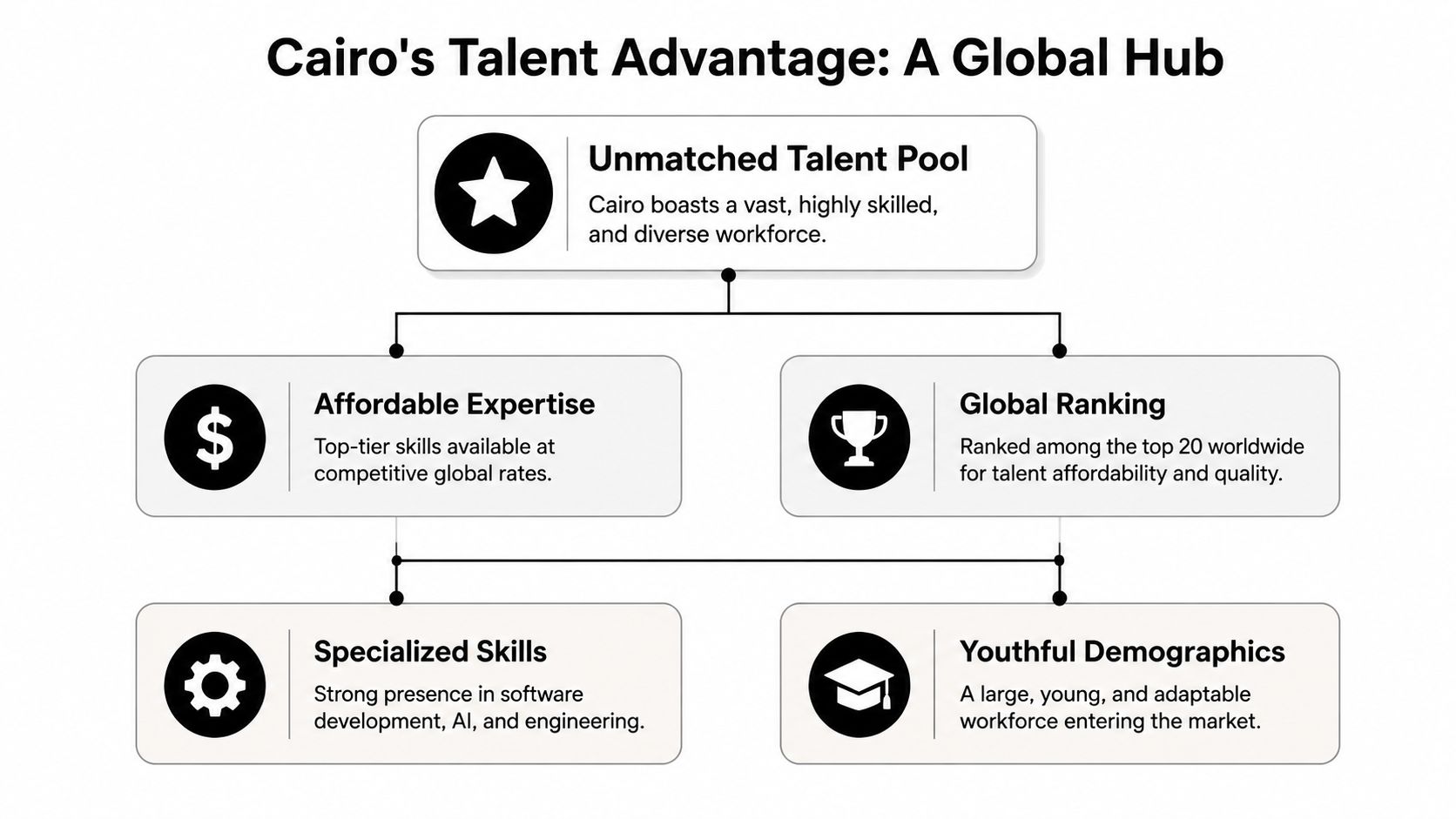
Cairo's startup ecosystem is valued at USD 8.3 billion, ranked as the 3rd largest in MENA for talent and experience, and sits among the top 20 globally for affordable, high-quality tech talent, according to ITIDA's innovation ecosystem overview. For a UAE founder, that matters more than any headline funding news.
Why Cairo talent is different
Dubai gives you proximity to customers, investors, and partners. Cairo gives you depth.
You can find strong engineers in Dubai, but hiring there often becomes a compensation contest. In Cairo, the stronger advantage is volume plus quality. That changes how you build teams. You're not only hiring one senior engineer and hoping they carry the roadmap. You can build a real product function, a support layer, QA discipline, and internal redundancy.
A few Egyptian founders in my network describe the same pattern. The best local hires aren't impressed by startup branding alone. They respond to scope, speed, and whether the company is serious about product ownership. If your Cairo team only receives tickets from HQ, your best people will disengage.
How to hire without getting burned
The mistake UAE founders make is assuming cost solves hiring. It doesn't. Process does.
Use a tighter hiring system:
- Test for shipping, not only syntax. Give candidates a practical assignment tied to your stack, product constraints, and expected turnaround.
- Hire a local operator early. This can be an engineering manager, product lead, or country builder who can spot weak candidates fast.
- Check communication in live settings. Async writing matters. So does how candidates handle ambiguity in a real meeting.
- Build retention into the offer. Top talent in Cairo still has options. Growth path, ownership, and serious management matter.
- Avoid the “cheap team” mindset. The moment people feel they're a back-office cost centre, quality drops.
Practical rule: If a role directly affects product velocity, customer trust, or data quality, interview for ownership before you interview for affordability.
Where the edge is strongest
The practical sweet spots tend to be:
| Function | Cairo advantage |
|---|---|
| Engineering | Deep bench for product and platform work |
| QA and implementation | Strong process discipline when managed well |
| Customer operations | Better economics for support-heavy models |
| Data and AI support functions | Growing fit for teams that need applied technical capacity |
If you're benchmarking broader software engineering markets, TekRecruiter's 2026 report is worth reviewing alongside what you hear on the ground. It's useful as a comparison lens, especially if you're weighing Egypt against Eastern Europe or South Asia.
What doesn't work
Don't try to run Cairo hiring entirely from Dubai with one recruiter and a few Zoom calls. That setup usually over-selects for polished interviewees and under-selects for operators.
Don't assume brand-name employers are the only talent source either. Some of the most effective hires come from smaller product teams where people had to ship under constraints.
And don't under-manage onboarding. A lot of cross-border hires fail in the first months because no one clarified decision rights, reporting lines, or how product trade-offs get made.
Mastering Cost Arbitrage as a UAE Founder
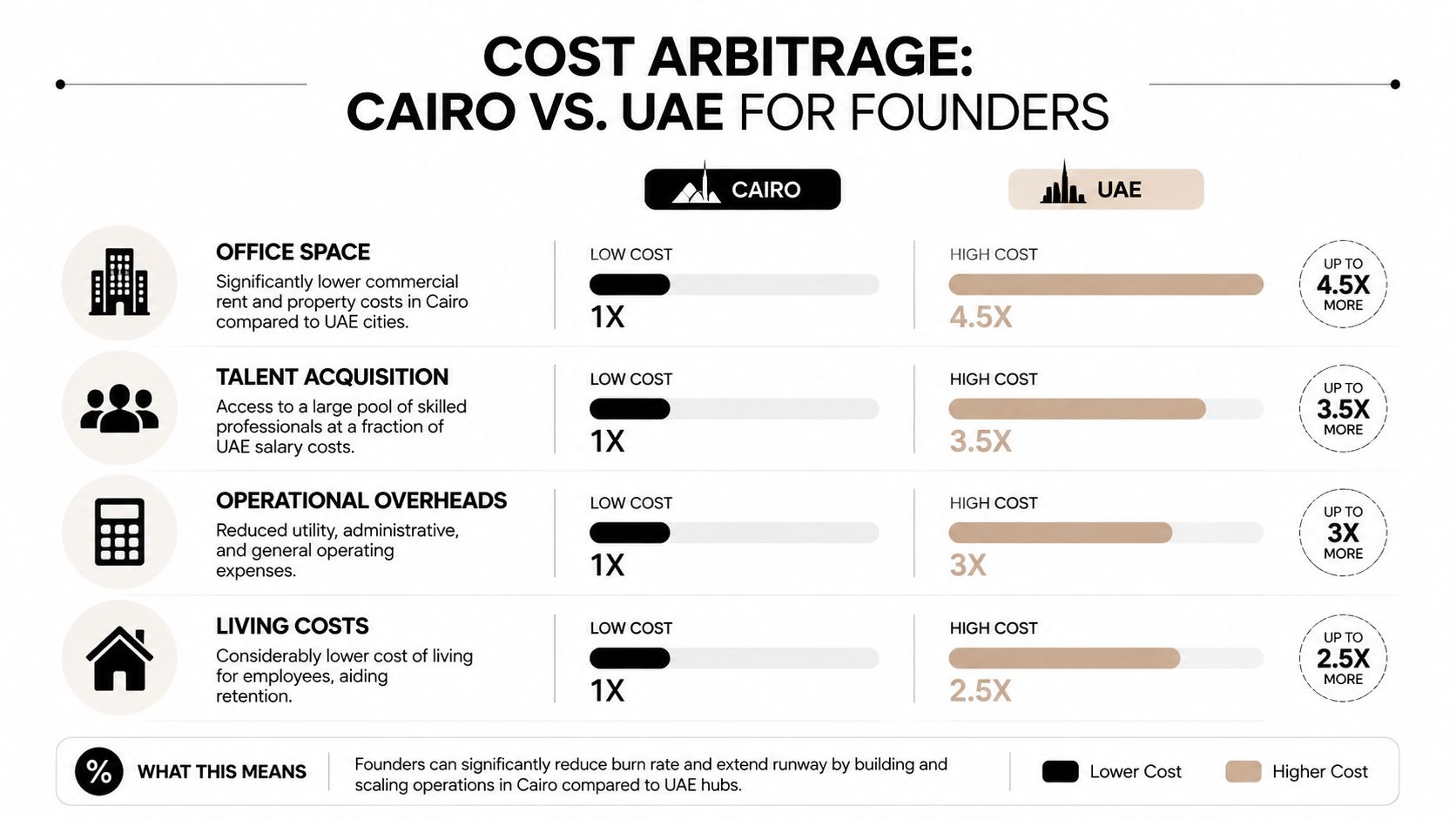
Cost arbitrage only helps if it improves decision quality. If it just makes the spreadsheet look prettier, it won't save you.
Egyptian startups raised $228 million in venture capital and debt financing in the first five months of 2025. In 2024, they raised $334 million across 84 deals, accounting for 11% of all MENA VC flows, according to this Egypt startup funding snapshot. Investors don't put that much capital into a market because it's theoretically cheap. They do it because founders can convert capital into progress.
The Cairo-first model
For many UAE founders, the smarter play isn't “move the company to Egypt”. It's this:
- Build or expand product, operations, and support capacity in Cairo.
- Test pricing, onboarding, and retention in a market that punishes waste.
- Use UAE presence for partnerships, investor access, and enterprise credibility.
- Expand across GCC only after the model is tighter.
That works especially well if your business has long onboarding cycles, high service layers, repeated support interactions, or product complexity that requires more hands on deck than a UAE-only budget comfortably allows.
A simple founder model
Run this back-of-the-napkin check with your team.
| Question | If answer is yes |
|---|---|
| Do we need a larger execution team before revenue catches up? | Cairo becomes more attractive |
| Are UAE salary expectations slowing hiring? | Cairo likely fixes a real bottleneck |
| Is our product still searching for repeatable PMF? | Cairo can lower the cost of learning |
| Do we need constant customer-facing market access in the UAE? | Keep GCC commercial leadership close to customers |
This is the core trade-off. Cairo is excellent for extending runway and building capacity. It's weaker if your success depends on being in front of Gulf enterprise buyers every week.
A Cairo-first strategy works best when the company needs more iterations, more operators, and more discipline. It works less well when sales access is the whole game.
Where founders usually save and where they don't
Founders often get the biggest practical advantage in:
- Team build-out. Product, engineering, QA, support, and operations usually become easier to staff.
- Testing cycles. You can run more experiments before each one feels expensive.
- Operating overhead. The full business can stay leaner for longer.
Where they make mistakes:
- Over-expanding headcount too early. Lower cost can hide mediocre hiring.
- Splitting leadership across too many geographies. Cross-border confusion eats savings fast.
- Ignoring legal and ownership structure. Before you move money, issue contracts, or build a multi-entity setup, get clear on practical compliance. This cross-border investment rules guide for UAE startups is a good place to start.
If you're building a remote or hybrid team and need an operating checklist, this founder's guide to offshore teams is useful because it focuses on team structure, not just hiring slogans.
Navigating Currency Volatility and Financial Hurdles
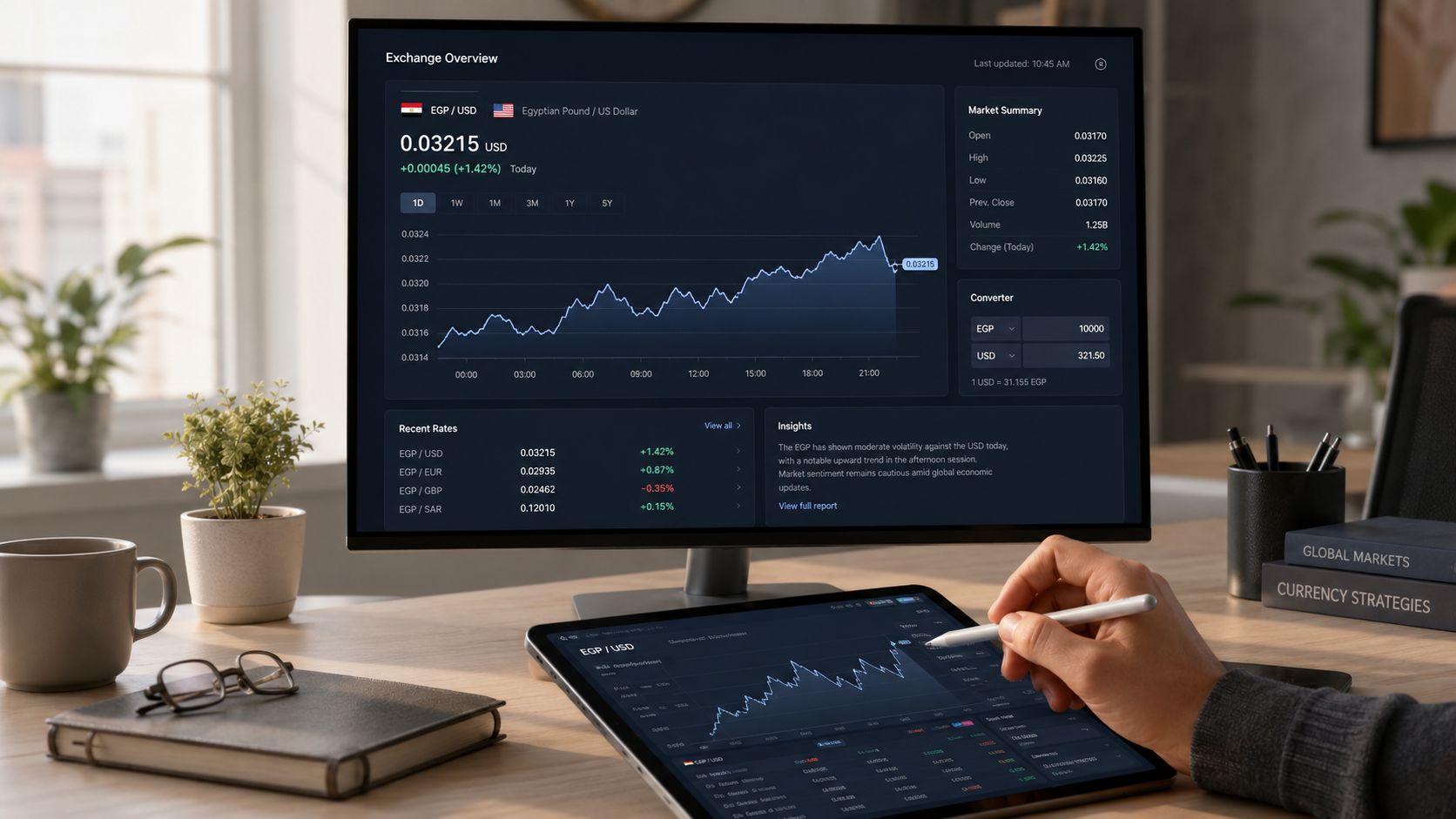
This is the part founders romanticising Cairo tend to skip. Cost arbitrage can disappear on paper if you don't control currency exposure.
Egypt can give you a lower operating base, but it can also complicate pricing, cash management, budgeting, and investor reporting. If your cap table, fundraising, or board reporting is USD-linked while a meaningful share of your costs sits in EGP, finance discipline stops being a back-office issue. It becomes an operating issue.
What founders usually get wrong
The common bad assumption is that lower local costs automatically mean lower real costs. That's not always true.
If your pricing, vendor obligations, software subscriptions, or investor obligations sit in hard currency, local volatility can create weird distortions:
- your monthly burn looks better in one period and worse in the next
- local team expectations shift faster than your compensation framework
- financial reporting becomes harder to explain to investors
- repatriation planning turns into a distraction at the worst possible time
None of this means “don't build in Egypt”. It means you need a treasury mindset earlier than you think.
Practical ways to reduce the pain
A few operating habits help a lot:
- Separate cost centres clearly. Keep Egypt P&L visibility distinct from UAE or holding-company reporting.
- Match currency to obligation where possible. If a cost will be paid locally, plan for it locally. If a commitment is hard-currency linked, don't pretend EGP savings fully solve it.
- Price with buffers. If you serve local customers, revisit packaging and contract terms regularly rather than treating pricing as fixed for long stretches.
- Shorten planning cycles. Annual budgets become less useful when financial conditions move quickly. Quarterly or rolling reviews are more practical.
- Use disciplined cash forecasting. Founders who survive volatility usually know exactly which obligations are flexible and which aren't.
The cheapest team on paper can become the most expensive one to manage if finance, payroll, and reporting are improvised.
Operating model choices
A simple framework helps.
| Model | Trade-off |
|---|---|
| Egypt as full operating base | Best cost leverage, highest financial complexity |
| Egypt as product and ops hub, UAE as commercial HQ | More balanced, easier investor narrative |
| Egypt only for contractors | Lowest setup friction, often weaker long-term cohesion |
For most UAE founders, the middle model is the cleanest. Keep revenue relationships, fundraising conversations, and strategic partnerships close to the Gulf. Put execution-heavy functions in Cairo where the economics are stronger.
Questions to ask before you commit
Bring these into your next leadership meeting:
- Which expenses must stay tied to hard currency?
- How often will we reprice local contracts or packages?
- Who owns treasury decisions inside the company?
- How will we explain FX effects to current or future investors?
- What happens if local operating friction lasts longer than expected?
If your team can't answer those clearly, you're not ready for a Cairo expansion. You're ready for a Cairo experiment.
Top Tech Sectors Dominating Cairo in 2026
Not every category benefits equally from Cairo. Some sectors fit the city's strengths far better than others.
One reason is policy alignment. Egypt's national AI strategy aims to train 30,000 AI professionals and establish 250+ AI tech-startups by 2030, with focus on Arabic-language AI models and governance sandboxes, according to Fast Company Middle East's reporting on Egypt's AI strategy. For founders building regional products, that matters because localisation in MENA is still harder than many investors admit.
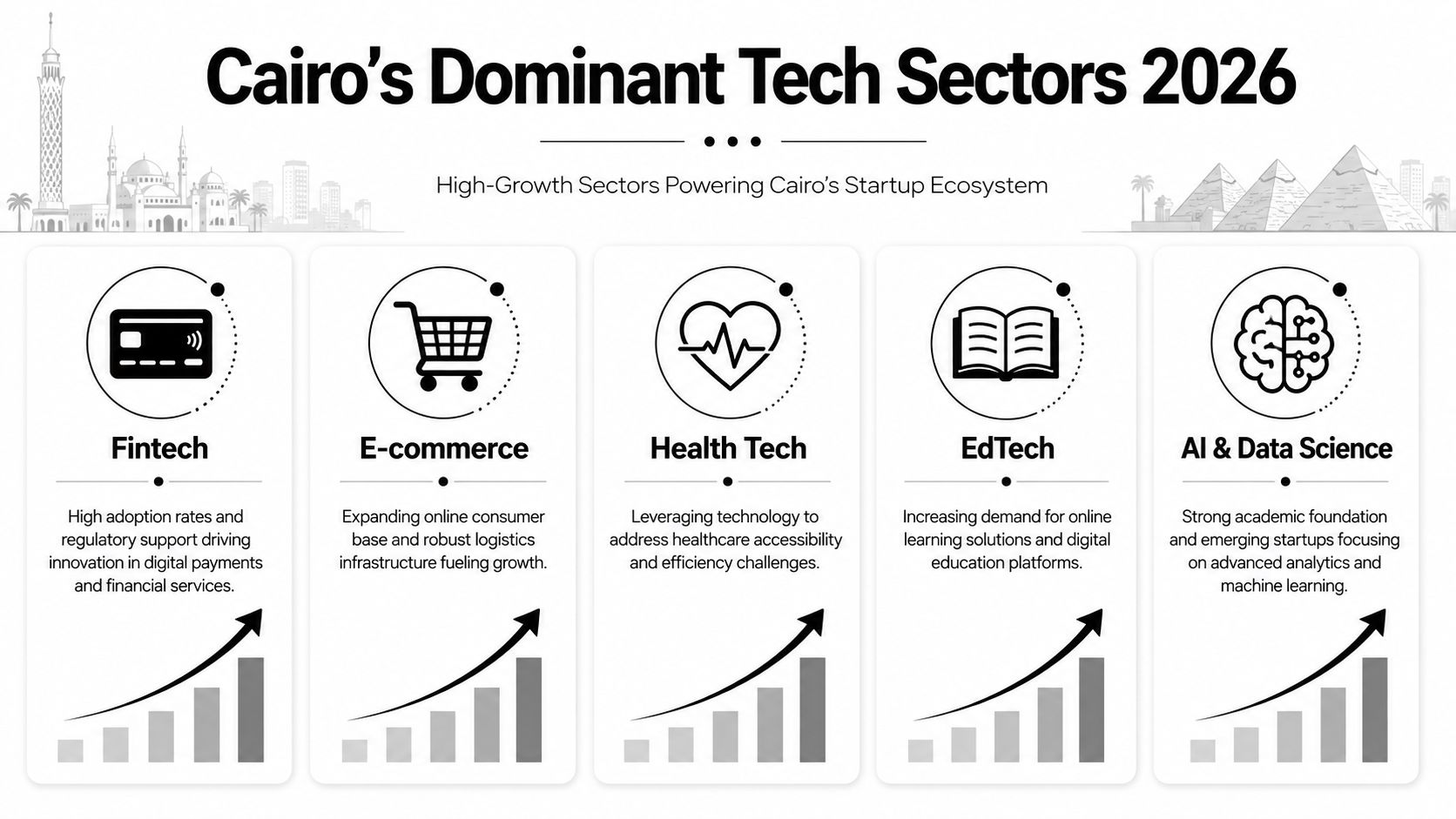
Fintech still leads, but the real edge is execution
Egyptian founders in fintech often build with constraint from day one. That produces sharper habits around onboarding, pricing, support burden, and trust.
For UAE founders, the obvious play isn't copying a Gulf fintech model into Egypt. It's finding the workflow, compliance, or financial behaviour problem that appears first in Egypt and later matters regionally.
Good questions to ask:
- Where does manual financial behaviour still dominate?
- Which segments need Arabic-first UX, education, or support?
- What financial products require stronger trust-building than glossy design?
AI, healthtech, and edtech have practical local logic
AI gets the headlines, but the stronger reason to watch Cairo is that AI capacity can sit close to real operational problems. Arabic-language models, workflow automation, support tooling, document handling, and vertical copilots all make more sense when teams understand local language and institutional messiness.
Healthtech and edtech also remain practical sectors because they fit a market where access, efficiency, and affordability matter every day. Founders don't need a futuristic pitch. They need products that remove friction for patients, students, parents, providers, and admins.
Founder's take: The strongest Cairo startups often solve ordinary regional pain with disciplined product execution, not flashy positioning.
Sectors worth serious attention
Here's how I'd frame the current opportunity set.
| Sector | What makes Cairo useful |
|---|---|
| Fintech | Strong fit for trust-heavy products and operational discipline |
| AI and data tools | Local language relevance and growing talent pipeline |
| Healthtech | Clear need for efficiency and access improvements |
| Edtech | Large demand for practical learning and delivery tools |
| Proptech and mobility | Strong adjacency where execution and local operations matter |
The ecosystem context also supports this direction. Cairo is the #1 MENA ecosystem in Bang for Buck, ranked #3 in talent and experience, and in the top 20 globally for affordable talent, while CREATIVA Innovation Hubs and ITIDA's TIEC infrastructure support pre-incubation, seed funding, and venture linkages, as outlined in this analysis of Egypt's startup infrastructure. That matters most in sectors where technical capability and commercial execution need to meet earlier.
If you're choosing where to spend founder attention, this guide to sector-focused VCs and industry specialists can help you map the investors and operators who understand these verticals.
The wrong way to pick a sector
Don't choose Cairo just because a category is popular. Choose it if Cairo gives your company one of these:
- better local hiring for the core product
- a market that sharpens your pricing and onboarding
- a distribution path you can reach
- operating conditions that make the business harder to fake
That last point matters. Cairo is a good place to find out whether your company has substance.
Your Next Step Building a Cairo Strategy
A founder I know opened in Cairo for the wrong reason. The pitch inside the company was simple: cheaper hiring, fast setup, broad regional upside. Six months later, the team was decent, but ownership was muddy, reporting was late, and finance kept getting hit by FX surprises no one had priced in. Cairo can improve your business. It can also expose weak operating discipline very quickly.
That is why the next step is not enthusiasm. It is design.
If you are a UAE or GCC founder looking at Cairo in 2026, treat it as a specific operating move inside a regional build plan. Use Cairo because it gives you an advantage you can measure, protect, and manage. Usually that means one of three things: faster hiring into technical roles, lower cost for a function that already has clear process, or a sharper proving ground for a product that needs disciplined execution in a harder market.
Write a one-page Cairo thesis before you spend
Before you open an entity, hire a country lead, or commit to a headcount plan, write one page that answers five questions.
What exact problem does Cairo solve for us?
Be precise. Engineering hiring backlog, support margins, Arabic operations, QA capacity, local commercial access. If the answer is vague, the expansion will be vague too.Which function will Cairo own?
Pick clear ownership. A pod, a department, or one tightly scoped process. Split ownership across two countries too early and quality usually drops.Which risks are we accepting on purpose?
Currency exposure, controls, legal setup, management time, cross-border payroll, and communication gaps should be written down in plain language.What does a good first operating cycle look like?
Define it in business terms. Time to hire, release velocity, support response quality, retention, margin improvement, or better customer feedback loops.What makes us stop, pause, or restructure?
Good founders set a stop rule early. Without it, expansion turns into an expensive story the team keeps defending.
Start with a contained operating test
A full launch is usually unnecessary. A controlled test gives better signal.
Three formats work well:
- Capability test. Build a small engineering, product, or QA pod and compare output against your current benchmark.
- Process test. Move support, onboarding, or back-office operations only if the workflow is already documented and measured.
- Market test. Use Cairo to test one segment, one acquisition motion, or one pricing model before committing to a broader Egypt go-to-market plan.
The trade-off is straightforward. Small tests reduce downside, but they also create weaker internal attention. If you want a fair read, assign one accountable owner, one reporting cadence, and one fixed review date.
If the commercial side of the test still needs work, practical resources like these lead capture tactics for marketing teams can help you tighten inbound and qualification before you scale demand.
Questions worth putting in the next leadership meeting
Ask these directly:
- Where are we paying UAE rates for work that does not require UAE proximity?
- Which team suffers most from hiring delays today?
- Do we have managers strong enough to run a second operating base well?
- Which process is mature enough to move without creating chaos?
- What reporting do we need weekly to know if Cairo is working?
Cairo rewards founders who are clear-eyed. The winners are usually not the people chasing ecosystem momentum. They are the ones who know why Cairo exists inside their company, what it owns, and which problems it is supposed to solve.
If you are evaluating Cairo Egypt tech startups 2026 as a real business decision, use that standard. Ask one question: does Cairo give this company an operational advantage we can turn into better execution?
Founder journeys get easier when you can sanity-check decisions with people who've faced similar trade-offs. If you want a sharper way to think through expansion, hiring, fundraising, or regional strategy, Founder Connects is built for exactly that kind of practical, founder-to-founder progress.

Building in MENA? You don't have to do it alone.
Join 300+ founders in the Founder Connects Residency. Monthly squad calls, warm intros, $3M+ in perks, and much more. All for less than your monthly coffee budget.
Popular posts





Founder Connects is a premium MENA tech founder community. Meetups in Dubai and across MENA, Residency Squads of 8–10, and 400+ vetted WhatsApp founders (apply and screened).